Adhyaya 203
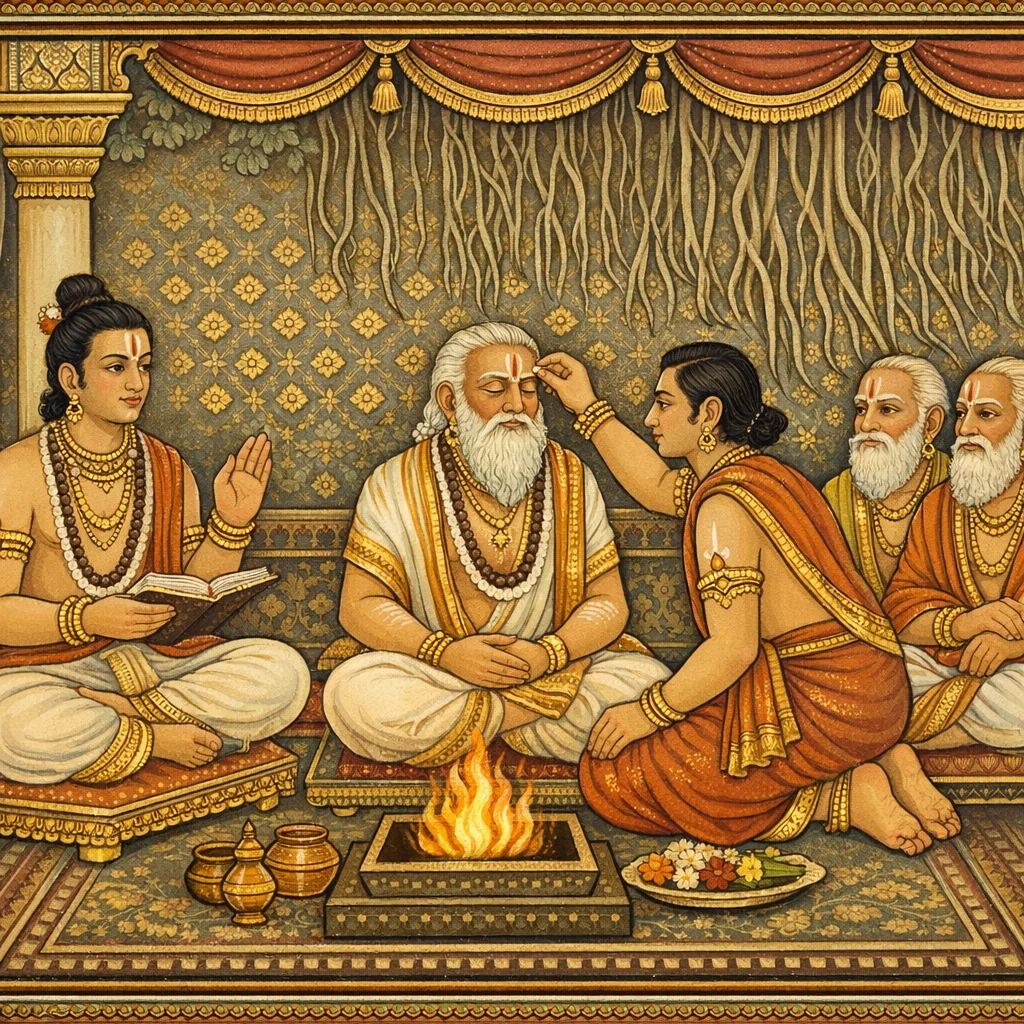
Chapter 203 sets out a community procedure for establishing ritual purity (śuddhi) for a Nāgara dvija. Ānarta asks how a Nāgara who comes seeking purification, standing before the Nāgaras, gains purity that is publicly recognized. The text prescribes a verification protocol: an impartial mediator questions lineage particulars—mother, father, gotra, and pravara—and traces ancestry on both paternal and maternal sides across several generations (father–grandfather–great-grandfather, and the corresponding maternal lines), insisting that the Brahmins conducting the purification investigate with care. Once the “branch-line” (śākhā-āgama) and the root lineage (mūla-vaṃśa) are established—likened to the far-spreading foundation of a banyan—the chapter directs a public bestowal of purity by applying a sindūra-tilaka and reciting mantras (including a reference to a “four-footed” mantra). The mediator then makes a formal proclamation, followed by triple clapping as a communal signal, and the purified person becomes eligible for shared social and ritual standing. He next performs fire-rite actions: taking refuge in fire, satisfying Agni, offering a full oblation with a “five-faced” mantra, and giving dakṣiṇā with food according to his means. The chapter ends with a warning: if lineage-based purity is not established, restriction is required; rites such as śrāddha performed by an impure officiant are declared fruitless. The stated aim is to purify one’s place and one’s family line through rigorous procedure.
Shlokas
Verse 1
आनर्त उवाच । एवं शुद्ध्यर्थमायातो नागराणां पुरः स्थितः । नागरः शुद्धिमाप्रोति यथा तन्मे वद द्विजः
Ānarta said: “Thus, having come for the sake of purification and standing before the Nāgaras—by what means does a Nāgara attain purity? Tell me that, O Brāhmaṇa.”
Verse 2
एवं मध्यस्थवचनात्समुदाये स्थिरे सति । स प्रष्टव्यः पितुर्माता कतमा ते वदस्व नः
“Thus, following the words of an impartial mediator, when the assembly is settled and steady, he should be questioned: ‘Which are your father and mother? Tell us.’”
Verse 3
किं गोत्रः कतमस्तस्याः पिता किंप्रवरः स्मृतः । एवं तस्यान्वयं ज्ञात्वा गोत्रप्रवरसंयुतम्
“What is her gotra? Who is regarded as her father? What pravara is remembered for her?”—thus, having ascertained her lineage in this manner, together with gotra and pravara, (the rite of purification) should proceed on a properly verified ancestral foundation.
Verse 4
प्रष्टव्या च ततो माता तस्याश्चापि च या भवेत् । जननी चापि प्रष्टव्या तस्याश्चापि च या भवेत्
Then her mother should be questioned, and also the one who is her mother’s mother. Likewise, her maternal ancestress should be asked about, and also the one who is her mother’s mother—(thus) the maternal line is to be examined carefully for the rite.
Verse 5
ज्ञातव्या सापि यत्नेन ब्राह्मणैः शुद्धि कर्मणि
She too must be ascertained with diligence by the brāhmaṇas in the performance of the purificatory rite.
Verse 6
पिता पितामहश्चैव तथैव प्रपितामहः । शोधनीयाः प्रयत्नेन त्रयश्चैतेऽपि तस्य च
The father, the grandfather, and likewise the great-grandfather—these three also must be carefully examined and purified with earnest effort in relation to him.
Verse 7
तथा पितामहीपक्षे त्रय एते द्विजोत्तमाः । मातामहस्ततस्तस्य पिता तस्यापि यः पिता
So too, on the grandmother’s side, O best of the twice-born: these three are to be considered—the maternal grandfather, then his father, and also the father of that father.
Verse 8
माता मातामही चैव तथैवान्या प्रपूर्विका । पितामह्याश्च या माता सापि शोध्या सभर्तृका
The mother, the maternal grandmother, and likewise an earlier ancestress; and the mother of the paternal grandmother—she too should be purified, together with her husband.
Verse 9
एवं शाखाऽगमं ज्ञात्वा तस्य सर्वं यथाक्रमम् । मूलवंशादधिष्ठानं न्यग्रोधस्येव सर्वतः
Thus, having learned in due order the entire branching descent of that family, one should establish it upon the root-lineage—like the banyan tree whose support spreads everywhere from its root.
Verse 10
ततः शुद्धिः प्रदातव्या सिन्दूरति लकेन तु । चातुश्चरणमंत्रैश्च दत्त्वाशीर्वचनं क्रमात्
Thereafter, purification should be bestowed by the rite of the sindūra-tilaka mark; and with four-pāda mantras, blessings are to be given in proper sequence.
Verse 11
ततो वाच्यं नृपश्रेष्ठ मध्यस्थेन तदग्रतः । दत्त्वा तालत्रयं राजञ्छुद्धोऽयं नागरो द्विजः । सामान्यपदयोग्यश्च संजातः सांप्रतं द्विजः
Then, O best of kings, the mediator should proclaim before you: “O King, having given the three tālas, this Nāgara brāhmaṇa is purified; and he has now become fit for the common rank and standing of a twice-born.”
Verse 12
ततोऽग्निशरणं गत्वा संतर्प्य च हुताशनम् । पञ्चवक्त्रेण मंत्रेण दत्त्वा पूर्णाहुतिं ततः । विप्रेभ्यो दक्षिणां दद्यात्स्वशक्त्या भोजनान्विताम्
Then, going to the refuge of fire and satisfying the sacred Fire, one should offer the complete oblation with the Pañcavaktra mantra. Thereafter, one should give dakṣiṇā to the brāhmaṇas according to one’s capacity, together with a meal.
Verse 13
सिन्दूरतिलके जाते ब्रह्माग्रे द्विजवाक्यतः । पितॄणां जायते तुष्टिर्वंशो नोऽद्य प्रतिष्ठि तः
When the sindūra-tilaka is applied before Brahmā, in accordance with the word of the twice-born (brāhmaṇas), the Pitṛs become satisfied, and our lineage becomes firmly established today.
Verse 14
यस्य नो जायते शुद्धिः शाखाभिर्मूलवंशगा । निग्रहस्तस्य कर्तव्यो द्विजार्हो द्विजसत्तमैः
If a person’s purity is not established through the branch-lines that trace back to the root lineage, then the foremost among the twice-born should impose due disciplinary restriction upon him, as is proper in matters of brāhmaṇic eligibility.
Verse 15
यथा नान्यो हि जायेत शुद्धि स्तस्य प्रकल्पिता । एवं संशोधितो विप्रः श्राद्धार्हो जायते ततः
So that no other doubt may arise, the purification for him is duly prescribed. Thus, once the brāhmaṇa has been properly purified, he then becomes fit to receive and officiate in śrāddha rites.
Verse 16
अपि चाष्टकुलोत्पन्नः सामान्यः किं पुनर्हि यः । अशुद्धेन तु विप्रेण यः श्राद्धा द्यं करोति हि । तस्य भस्महुतं यद्वत्सर्वं तज्जायते वृथा
Even if one is born in an eightfold noble lineage—how much more in other cases—if śrāddha and related rites are performed by an impure brāhmaṇa, then all of it becomes futile, like an offering poured into ashes.
Verse 17
तस्मात्सर्वप्रयत्नेन शोध्योऽयं नागरो द्विजः । स्वस्थानस्य विशुद्ध्यर्थं तथैव स्वकु लस्य च
Therefore, with every effort this Nāgara brāhmaṇa should be purified—both for the complete sanctity of his own place and likewise for the purity of his family line.
Verse 203
इति श्रीस्कांदे महापुराण एकाशीतिसाहस्र्यां संहितायां षष्ठे नागरखण्डे हाटकेश्वरक्षेत्रमाहात्म्ये नागरविशुद्धिप्रकारवर्णनंनाम त्र्युत्तरद्विशततमोऽध्यायः
Thus ends, in the revered Skanda Mahāpurāṇa, within the Ekāśītisāhasrī Saṃhitā, in the sixth Nāgara-khaṇḍa, in the Māhātmya of the Hāṭakeśvara sacred region, the two-hundred-and-third chapter entitled “Description of the Methods of Nāgara Purification.”