Adhyaya 202
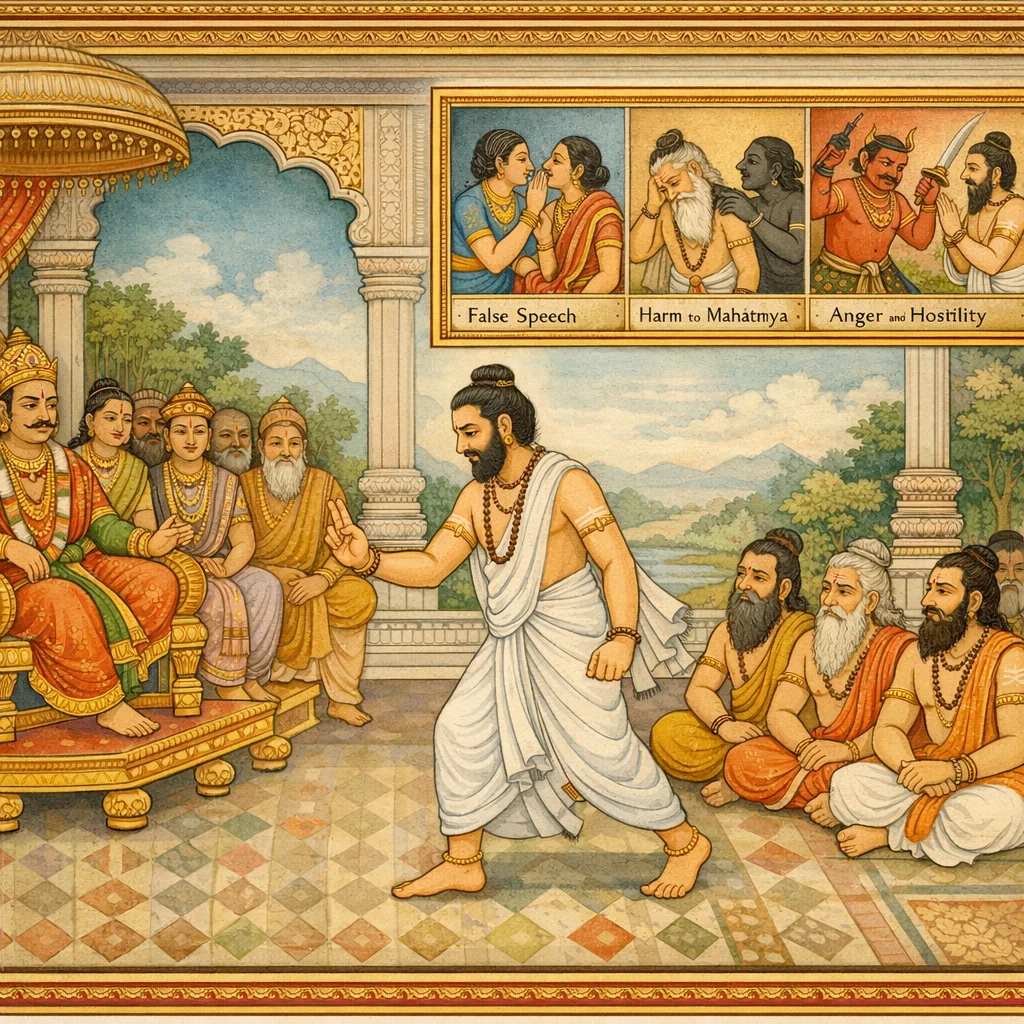
Chapter 202 unfolds a procedural and ethical dialogue: in a setting prompted by Viśvāmitra, a brahmin assembly questions an adjudicator (madhyastha) about the standards by which judgments are made. They ask why verdicts must follow Vedic speech rather than human-origin statements, and why the adjudicator grants a “threefold tāla.” Bhartṛyajña answers by setting out a governance logic for a sacred precinct (kṣetra), especially one seated in the brahmaśālā: false speech should not arise among the nāgaras, and repeated questioning is employed until a firm determination is reached. He traces a causal chain—invalidated speech harms the māhātmya, which breeds anger, leading to hostility and moral fault—therefore the adjudicator is questioned again and again to prevent the breakdown of communal order. The “threefold tāla” is explained as a disciplinary device that, by successive measures, restrains (i) harm tied to improper questioning and answering, (ii) anger, and (iii) greed, thereby stabilizing harmony in the assembly. The chapter also clarifies why the Atharvaveda, though counted as the “fourth,” is treated functionally as “first”: it contains comprehensive knowledge of protective and operative rites (including abhicārika material) for the welfare of all worlds, and so is consulted first for task-accomplishment (kārya-siddhi). The discourse concludes as a unified inquiry into the ethics of questioning and authoritative speech within a kṣetra.
Shlokas
Verse 1
विश्वामित्र उवाच । तच्छ्रुत्वा ब्राह्मणाः सर्वे विनयावनताः स्थिताः । तं पप्रच्छुर्नरश्रेष्ठ कौतुकाविष्टचेतसः
Viśvāmitra said: Hearing this, all the Brāhmaṇas stood with humility and reverence; and—O best of men—questioned him, their minds filled with eager curiosity.
Verse 2
कस्यचिन्निर्णयो देयो मध्यस्थस्य द्विजोत्तमैः । वेदवाक्येन संत्यज्य वाक्यं मनुजसंभवम् ओ
In some matter, a decision should be given by the best of Brāhmaṇas through a neutral mediator—setting aside merely human opinion and resting the judgment upon the words of the Veda.
Verse 3
कस्मात्तालत्रयं देयं मध्यगेन महात्मना । एतन्नः सर्वमाचक्ष्व परं कौतूहलं हि नः
“Why should the great-souled mediator give the ‘three tālas’ (a threefold token or fee)? Explain this whole matter to us, for we are filled with keen curiosity.”
Verse 4
तच्छ्रुत्वा भर्तृयज्ञस्तु तानुवाच द्विजोत्तमान् । श्रूयतामभिधास्यामि यदेतत्कारणं स्थितम्
Hearing this, Bhartṛyajña spoke to those foremost among the twice-born: “Listen—I shall explain the settled reason that stands behind this practice.”
Verse 5
नासत्यं जायते वाक्यं नागराणां कथंचन । ब्रह्मशालास्थितानां च शुभं वा यदि वाऽशुभम्
Among the Nāgaras, no utterance ever proves untrue—especially for those seated in the Brahmaśālā, whether the matter be auspicious or inauspicious.
Verse 6
वेदोक्तेः सवनैस्तस्माद्दर्शयंति द्विजोत्तमाः । इष्टं वा यदि वानिष्टं पृच्छमानस्य चा र्थिनः
Therefore, by the savanas prescribed in the Veda, the foremost brāhmaṇas disclose to the petitioner who asks what is to be desired—or what is to be avoided.
Verse 7
भूयोभूयस्ततः कुर्यान्मध्यस्थः स द्विजन्मनाम् । प्रश्नं तस्य निमित्तं च यावत्तस्य विनिर्णयः
Then, again and again, the mediator should put the question to the twice-born, together with its circumstances and cause, until a final decision is reached.
Verse 8
ब्रह्मशालोपविष्टानां यदि वाक्यं वृथा भवेत् । माहात्म्यं नश्यते तेषां ततः क्रोधः प्रजायते
If the words of those seated in the Brahmaśālā were to become futile or false, their māhātmya—their spiritual potency—would be destroyed; from that, anger is born.
Verse 9
क्रोधात्सञ्जायते द्रोहो द्रोहात्पापस्य संगमः । एतस्मात्कारणाद्विप्रा मध्यस्थः पृच्छ्यते मुहुः
From anger arises hostility; from hostility comes association with sin. For this reason, O brāhmaṇas, the mediator is questioned again and again.
Verse 10
समुदायः समस्तानां यथा चैव प्रजायते । तदा तालत्रयं यच्च मध्यस्थः संप्रयच्छति
And when a unified accord of all is brought about, then the mediator bestows that ‘threefold tāla’ as well.
Verse 11
तासां तु पूर्वया कामं हंति पृच्छाप्रदायिनाम् । द्वितीयया तथा क्रोधं हंति लोभं तृतीयया
Of these three, by the first desire is quelled in those who must answer the inquiry; by the second, anger is quelled; by the third, greed is quelled.
Verse 12
एतस्मात्कारणाद्देयं तेन तालत्रयं द्विजाः
For this very reason, O twice-born, the ‘tālatraya’ must be given.
Verse 13
ब्राह्मणा ऊचुः । आथर्वणश्चतुर्थस्तु ब्राह्मणः परिकीर्तितः । स कस्मात्प्रथमः प्रश्नो नागराणां प्रकीर्तितः
The Brāhmaṇas said: “The Atharvan is proclaimed as the fourth among the Brāhmaṇas’ Vedas. Why then is the Atharvan spoken of as the first question among the Nāgaras?”
Verse 14
भर्तृयज्ञ उवाच । आथर्वः प्रथमः प्रश्नो यस्मात्प्रोक्तो मया द्विजाः । तदहं संप्रवक्ष्यामि शृणुध्वं सुसमाहिताः
Bhartṛyajña said: “O twice-born ones, since I declared the Atharvan to be the first question, I shall now explain the reason. Listen with steady attention.”
Verse 15
नेर्ष्या चैवात्र कर्तव्या स्वस्थानस्य विनाशनी । निरूपितं मया सम्यक्स्थानस्थस्य विशुद्धये
“Here, no jealousy should be entertained—for it destroys one’s own standing. I have set this forth rightly, for the purification of one who abides in his proper place (duty and station).”
Verse 16
ऋग्यजुःसामसंज्ञाख्या अग्निष्टोमादिका मखाः । पारत्रिकाः प्रवर्तंते नैहिकाश्चाभिचारिकाः
The sacrifices known by the names Ṛg, Yajus, and Sāman—such as the Agniṣṭoma—are set in motion for otherworldly ends; and (some) are for worldly ends, including rites of counteraction and coercive application.
Verse 17
अथर्ववेदे तच्चोक्तं सर्वं चैवाभिचारिकम् । हिताय सर्वलोकानां ब्रह्मणा लोककारिणा
But in the Atharvaveda all that is taught—especially the rites of protective and forceful application—was set forth by Brahmā, the maker of the worlds, for the welfare of all beings.
Verse 18
अथर्ववेदः प्रथमं द्रष्टव्यः कार्यसिद्धये । एतस्मात्कारणादाद्यः स चतुर्थोऽपि संस्थितः
For the accomplishment of a desired undertaking, the Atharvaveda should be consulted first. For this reason it is ‘first’ in practical priority, even though it is established as the fourth (in enumeration).
Verse 19
एतद्वः सर्वमाख्यातं यत्पृष्टोऽस्मि द्विजोत्तमाः । पृच्छा संबंधजं सर्वमेकं कार्यं सदैव हि
O best of the twice-born, I have told you everything as I was asked. Indeed, all that arises from inquiry is always directed toward one purpose—right accomplishment.
Verse 202
इति श्रीस्कांदे महापुराण एकाशीतिसाहस्र्यां संहितायां षष्ठे नागरखण्डे हाटकेश्वरक्षेत्रमाहात्म्ये भर्तृयज्ञवाक्यनिर्णयवर्णनंनाम द्व्युत्तरद्विशततमोऽध्यायः
Thus ends the two-hundred-and-second chapter, called “The Description of the Determination of Bhartṛyajña’s Statement,” in the Hāṭakeśvara-kṣetra-māhātmya of the sixth book, the Nāgara-khaṇḍa, within the Skanda Mahāpurāṇa, in the Saṃhitā of eighty-one thousand verses.