Adhyaya 2
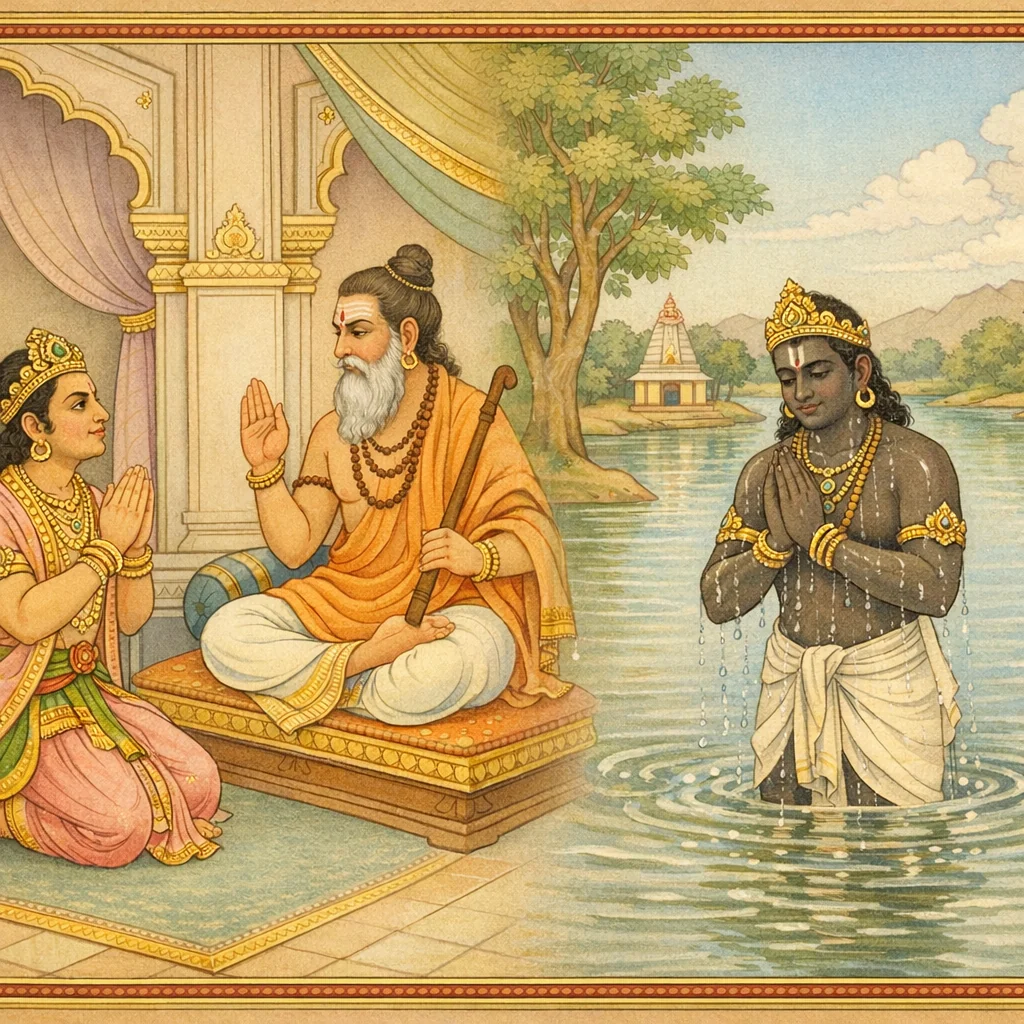
This adhyāya begins with Sūta describing a decisive event in sacred geography: when a liṅga is uprooted, the waters of Jahnavī (Gaṅgā) surge up from pātāla through that opening, praised in the idiom of tīrtha-mahātmya as universally purifying and wish-fulfilling. He then heralds a “world-amazing” tale and introduces King Triśaṅku, who—though fallen into caṇḍāla status—regains a body fit for a king after bathing at that holy spot. The assembled ṛṣis ask for the specific cause of Triśaṅku’s degradation. Sūta agrees to narrate an ancient, purifying account and summarizes the king’s lineage and virtues: born in the Solar dynasty, a disciple of Vasiṣṭha, steadfast in great sacrifices (agnīṣṭoma and the like), complete in sacrificial fees, lavish in gifts—especially to eminent and needy brāhmaṇas—faithful to vows, a protector of those seeking refuge, and an orderly ruler. The narrative shifts to a court dialogue: Triśaṅku requests a sacrifice that would carry him to svarga with his present body. Vasiṣṭha denies the possibility, insisting that heaven is attained through such rites only after another embodiment, and challenges him to cite any precedent for bodily ascent. Triśaṅku presses the sage’s power and threatens to seek another officiant; Vasiṣṭha laughs and lets him proceed as he wishes. The chapter highlights the tension between ritual ambition and doctrinal constraint, while setting the transformative efficacy of tīrtha bathing as a purāṇic counterpoint to contested sacrificial claims.
Shlokas
Verse 1
। सूत उवाच । तस्मिन्नुत्पाटिते लिंगे भूतलाद्द्विजसत्तमाः । पातालाज्जाह्नवीतोयं तेन मार्गेण निःसृतम् । सर्वपापहरं नॄणां सर्वकामप्रदायकम्
Sūta said: When that liṅga was uprooted from the surface of the earth, O best of the twice-born, the waters of Jāhnavī (Gaṅgā) issued forth from Pātāla through that very passage—removing all sins of people and granting all desired aims.
Verse 2
तत्र स्वयमभूत्पूर्वं यत्तद्द्विजवरोत्तमाः । शृणुध्वं वदतो मेऽद्य लोकविस्मयकारकम्
O best among the excellent twice-born, listen today as I speak of what formerly happened there of its own accord—an event that caused wonder in the world.
Verse 3
त्रिशंकुर्नाम राजेंद्रश्चंडालत्वं समागतः । तत्र स्नातः पुनर्लेभे शरीरं पार्थिवोचितम्
A king named Triśaṅku fell into the state of a Caṇḍāla (outcaste). Yet, after bathing there, he regained a body befitting a king.
Verse 4
ऋषयः ऊचुः । चंडालत्वं कथं प्राप्तस्त्रिशंकुर्नृपसत्तमः । एतत्त्वं सर्वमाचक्ष्व विस्तरात्सूतनन्दन
The sages said: “How did Triśaṅku—the best of kings—come to the condition of a Caṇḍāla (outcaste)? Tell us all of this in detail, O son of Sūta.”
Verse 5
सूत उवाच । अहं वः कीर्तयिष्यामि कथामेतां पुरातनीम् । सर्वपापहरां मेध्यां त्रिशंकुनृपसंभवाम्
Sūta said: “I shall recount to you this ancient narrative—purifying and fit to be heard—which destroys all sins, and which arose in connection with King Triśaṅku.”
Verse 6
सूर्यवंशोद्भवः पूर्वं त्रिशंकुरिति विश्रुतः । आसीत्पार्थिवशार्दूलः शार्दूलसमविक्रमः
Formerly there was one born in the Solar dynasty, famed by the name Triśaṅku—a tiger among kings, possessing valor equal to a tiger’s might.
Verse 7
वसिष्ठस्य मुनेः शिष्यो यज्वा दानपतिः प्रभुः । तेनेष्टं च मखैः सर्वैरग्निष्टोमादिभिः सदा
He was a disciple of the sage Vasiṣṭha, a performer of sacrifices, a lord of generosity and a capable ruler; and he continually performed all manner of sacrifices, beginning with the Agniṣṭoma.
Verse 8
संपूर्णदक्षिणैरेव वत्सरं वत्सरं प्रति । तथा दानानि सर्वाणि प्रदत्तानि महात्मना
Year after year, he performed the rites, giving the priests their full dakṣiṇā; likewise, that great-souled king bestowed every kind of charitable gift.
Verse 9
ब्राह्मणेभ्यो विशिष्टेभ्यो दीनेभ्यश्च विशेषतः । व्रतानि च प्रचीर्णानि रक्षिताः शरणागताः
He gave to distinguished brāhmaṇas, and especially to the poor; he also observed sacred vows and protected those who came seeking refuge.
Verse 10
पुत्रवल्लालिता लोकाः शत्रवश्च निषूदिताः । भ्रांतानि भूतले यानि तीर्थान्यायतनानि च । तपस्विभ्यो यथाकामं यच्छता वांछितं धनम्
He cared for his subjects like his own children, and his enemies were subdued. He also journeyed to the tīrthas and holy shrines spread across the earth, and granted ascetics whatever wealth they desired, according to their wish.
Verse 11
कस्यचित्त्वथ कालस्य वसिष्ठो भगवान्मुनिः । तेन प्रोक्तः सभामध्ये संस्थितो नतिपूर्वकम्
Then, at a certain time, he addressed the venerable sage Vasiṣṭha; and, standing in the midst of the royal assembly, he spoke with due reverence.
Verse 12
त्रिशंकुरुवाच । भगवन्यष्टुमिच्छामि तेन यज्ञेन सांप्रतम् । गम्यते त्रिदिवं येन सशरीरेण सत्वरम्
Triśaṅku said: “O Blessed One, I now wish to perform that sacrifice by which one may swiftly reach heaven with this very body.”
Verse 13
तस्मात्कुरु प्रसादं मे संभारानाहर द्रुतम् । तस्य यज्ञस्य सिद्ध्यर्थं यथार्हान्ब्राह्मणांस्तथा
Therefore, show me your grace: quickly procure the needed materials, and for the successful completion of that yajña, likewise summon brāhmaṇas who are worthy and fit.
Verse 14
वसिष्ठ उवाच । न स कश्चित्क्रतुर्येन गम्यते त्रिदिवं नृप । अनेनैव शरीरेण सत्यमेतद्ब्रवीम्यहम्
Vasiṣṭha said: “O King, there is no sacrifice by which one reaches Tridiva (heaven) with this very body. I speak this as the truth.”
Verse 15
अग्निष्टोमादयो यज्ञा ये प्रोक्ताः प्राक्स्वयंभुवा । अन्यदेहांतरे स्वर्गः प्राप्यते तैः कृतैर्नृप
O king, the sacrifices beginning with the Agniṣṭoma, taught long ago by the Self-born (Brahmā), do lead to heaven; yet that heaven is attained only after one has entered another body—after death—through the performance of those rites.
Verse 16
यदि वा पृथिवीपाल त्वया यज्ञप्रभावतः । पार्थिवो वा द्विजो वाथ वैश्यो वान्यतरोऽपि वा
O protector of the earth, even if—by the power of sacrifice—you, whether a king, a brāhmaṇa, a vaiśya, or anyone else at all, should seek such an outcome…
Verse 17
स्वयं दृष्टः श्रुतो वापि संजातोऽत्र धरातले । स्वर्गं गतः शरीरेण सहितस्तत्प्रकीर्तय
If you have yourself seen it, or even heard of it—someone born here upon this earth who went to heaven together with his very body—then declare that example plainly.
Verse 18
त्रिशंकुरुवाच । नासाध्यं विद्यते ब्रह्मंस्तवाहं वेद्मि तत्त्वतः । तस्मात्कुरु प्रसादं मे यथा स्यान्मनसेप्सितम्
Triśaṅku said: O Brahman (Vasiṣṭha), I truly know that for you nothing is impossible. Therefore, show me your favor, so that what my heart desires may come to pass.
Verse 19
वसिष्ठ उवाच । अनृतं नोक्तपूर्वं मे स्वैरेष्वपि हि जिह्वया । तस्मान्नास्ति मखः कश्चित्सत्यं त्वं यष्टुमिच्छसि
Vasiṣṭha said: Never before has my tongue uttered falsehood, even in moments of unrestrained freedom. Therefore, no such sacrifice as you seek exists; in truth, you wish to perform a rite aimed at what cannot be upheld as proper.
Verse 20
त्रिशंकुरुवाच । यदि मां विप्रशार्दूल न त्वं याजयितुं क्षमः । स्वर्गप्रदेन यज्ञेन वपुषानेन वै विभो
Triśaṅku said: O tiger among brāhmaṇas, if you are not able to officiate for me with a sacrifice that grants heaven—so that with this very body I may attain it, O mighty one—
Verse 21
तत्किं ते तपसः शक्त्या ब्राह्मणस्य विचक्षण । अपरं शृणु मे वाक्यं यद्ब्रवीमि परिस्फुटम् । शृण्वतां मुनिवृन्दानां तथान्येषां द्विजोत्तम
Of what use, O discerning brāhmaṇa, is the power of your austerity? Now hear another statement of mine, which I shall speak with complete clarity—while the hosts of sages and others listen, O best of the twice-born.
Verse 22
यदि मे न करोषि त्वं वचनं वदतोऽसकृत् । तेन यज्ञेन यक्ष्येऽहं तत्कृत्वान्यं द्विजं गुरुम्
If you do not carry out my request, though I speak it again and again, then I shall perform that very sacrifice through another brāhmaṇa, making him my guru.
Verse 23
सूत उवाच । तस्य तद्वचनं श्रुत्वा वसिष्ठो भगवांस्ततः । तमुवाच विहस्योच्चैः कुरुष्वैवं महीपते
Sūta said: Hearing his words, the venerable Vasiṣṭha laughed aloud and said to him, “Then do so, O king.”