Adhyaya 194
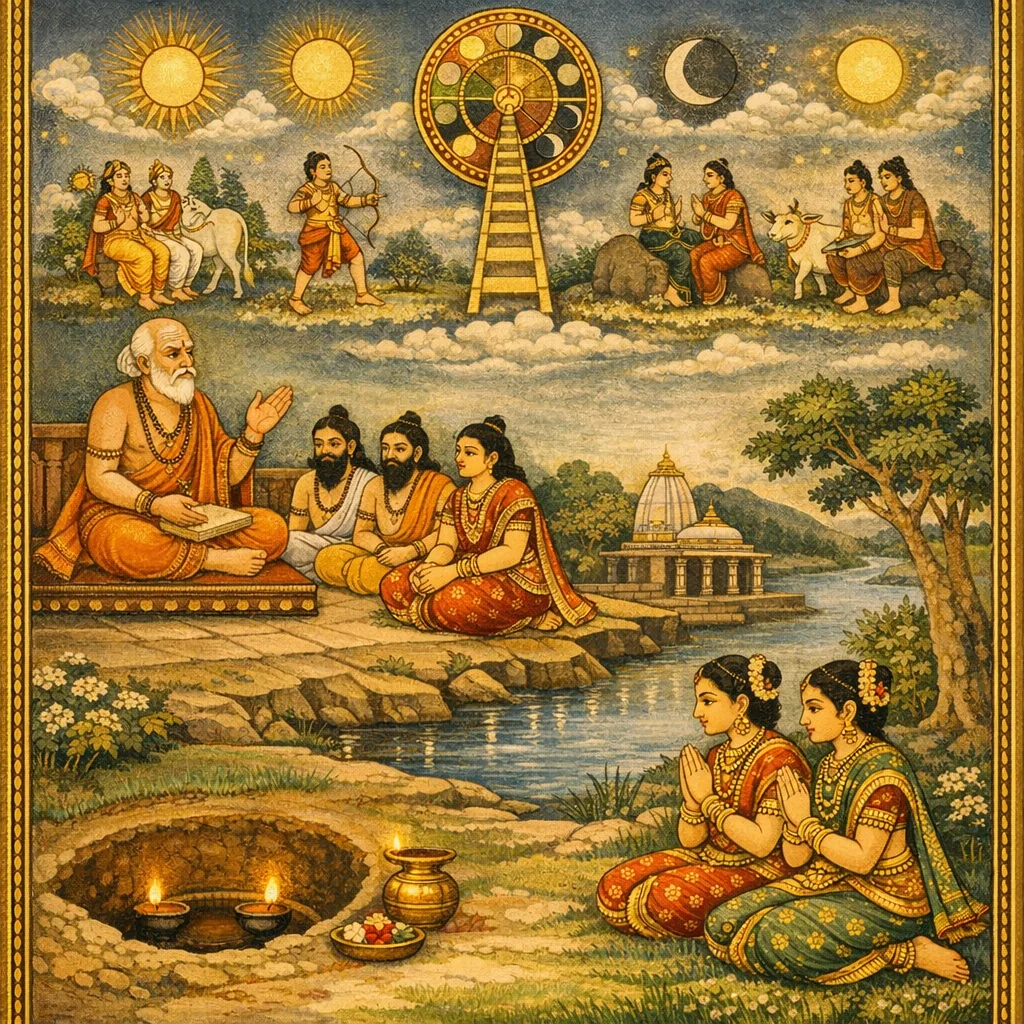
Sūta presents this chapter as a theological dialogue. It opens with divine and sage affirmation that a mortal who worships Brahmā first and then the Goddess attains the highest state; it also notes auspicious worldly results, especially for women who perform reverent acts, including salutations to Gāyatrī, bringing harmony to marriage and household life. The ṛṣis then ask about the order of time and the lifespans of Brahmā, Viṣṇu, and Śaṅkara. Sūta replies with a graded account of time-units from truṭi and lava upward, explains day–month–season–year structures, and sets out yuga durations in human years. He further clarifies divine “days” and “years,” introduces breath-count (niśvāsa/ucchvāsa) as a measure, and culminates in the teaching of Sadāśiva as the imperishable (akṣaya). A soteriological doubt arises: if even great deities end after their measured span, how can short-lived humans speak of mokṣa? Sūta teaches beginningless, number-transcending Time (kāla) and declares that countless beings, including the gods, have attained liberation through brahmajñāna grounded in faith and practice. He distinguishes repeatable heaven-producing sacrifices from brahmajñāna that ends rebirth, emphasizing the gradual accumulation of knowledge across births. Finally, Sūta conveys an upadeśa received from his father: in Hāṭakeśvara-kṣetra are two auspicious tīrthas established by two kumārīs (one brāhmaṇī and one śūdrī). Bathing there on Aṣṭamī and Caturdaśī and worshipping the renowned, concealed Siddhi-Pādukā within a pit leads, after a year of observance, to the arising of brahmajñāna. The sages accept the instruction and resolve to undertake the prescribed vow.
Shlokas
Verse 1
सूत उवाच । एवं सा तान्वरान्दत्त्वा सर्वेषां शापभागिनाम् । मौनव्रतपरा भूत्वा निविष्टाऽथ धरातले
Sūta said: Thus, having granted those boons to all who bore the burden of a curse, she devoted herself to the vow of silence and then sat down upon the earth.
Verse 2
ततो देवगणाः सर्वे तापसाश्च महर्षयः । साधुसाध्विति तां प्रोच्य ततः प्रोचुरिदं वचः
Then all the hosts of gods, along with ascetics and great seers, praised her, saying, “Well done, well done,” and thereafter spoke these words.
Verse 3
एतां देवीप्रसादेन ब्राह्मणानां विशेषतः । पूजयिष्यंति मर्त्येऽत्र सर्वे लोकाः समाहिताः
By the Goddess’s grace, all people in the mortal world—especially the brāhmaṇas—will worship her here with focused devotion.
Verse 4
ब्रह्माणं पूजयित्वा तु पश्चादेनां सुरेश्वरीम् । पूजयिष्यंति ये मर्त्यास्ते तु यांति परां गतिम्
Those mortals who first worship Brahmā, and thereafter worship this Queen of the gods, attain the supreme state.
Verse 5
या कन्या पतिसंयोगं संप्राप्यात्र समाहिता । ततः पादप्रणामं च गायत्र्याश्च करिष्यति । पतिं प्रजापतिं प्राप्य सा भविष्यत्यसंशयम्
Any maiden who, having attained union with a husband, comes here with steady devotion and then bows at the feet of Gāyatrī—she will obtain a husband like Prajāpati, without doubt.
Verse 6
सर्वकामसुखोपेता धनधान्यसमन्विता । या नारी दुर्भगा वंध्या भविष्यति च शोभना
A woman who is unfortunate and barren shall become beautiful and auspicious—endowed with happiness that fulfills every desire, and enriched with wealth and abundance of grain.
Verse 7
ऋषय ऊचुः । यदेतद्भवता प्रोक्तं गते पंचोत्तरे शते । पद्मजानां हरः प्रादादेतत्कथमनुत्त मम्
The sages said: What you have declared about the passing of one hundred and five (measures of time)—that Hara (Śiva) granted this to the lotus-born (Brahmā and his lineage)—how is this most excellent matter to be understood?
Verse 8
ब्राह्मणेभ्यः स संतुष्टः किंवाऽन्योऽस्ति महेश्वरः । एतं नः संशयं भूयो यथावद्वक्तुमर्हसि
If he is truly pleased with the brāhmaṇas, then is there any other Maheśvara (Lord) besides him? Please dispel this doubt of ours once again and explain it properly, as it truly is.
Verse 9
आयुष्यं शंकरस्यापि यत्प्रमाणं तथा हरेः । ब्रह्मणोऽपि समाचक्ष्व परं कौतूहलं हि नः
Tell us the measure of the lifespan of Śaṅkara (Śiva), and likewise of Hari (Viṣṇu), and also of Brahmā—for we are filled with the deepest curiosity about this.
Verse 10
सूत उवाच । अहं वः कीर्तयिष्यामि विस्तरेण द्विजोत्तमाः । त्रयाणामपि चायुष्यं यत्प्रमाणं व्यवस्थितम्
Sūta said: O best of the twice-born, I shall describe to you in detail the established measure of the lifespan of all the three (deities).
Verse 11
निमेषस्य चतुर्भागस्त्रुटिः स्यात्तद्द्वयं लवः । लवद्वयं कला प्रोक्ता काष्ठा तु दशपंचभिः
A truṭi is said to be a fourth part of a nimeṣa; two truṭis make a lava. Two lavas are called a kalā; and a kāṣṭhā consists of fifteen kalās.
Verse 12
त्रिंशत्काष्ठां कलामाहुः क्षणस्त्रिंशत्कलो मतः । मुहूर्तमानं मौहूर्ता वदंति द्वादशक्षणम्
They say that thirty kāṣṭhās make a kalā; a kṣaṇa is considered to be thirty kalās. Those versed in muhūrta-reckoning state that a muhūrta consists of twelve kṣaṇas.
Verse 13
त्रिंशन्मुहूर्तमुद्दिष्टमहोरात्रं मनीषिभिः । मासस्त्रिंशदहोरात्रैर्द्वौ मासावृतुसंज्ञितः
The wise have stated that a day-and-night (ahorātra) consists of thirty muhūrtas. A month consists of thirty day-nights; and two months are known as a season (ṛtu).
Verse 14
ऋतुत्रयं चायनं च अयने द्वे तु वत्सरम् । दैविकं च भवेत्तच्च ह्यहोरात्रं द्विजोत्तमाः
Three seasons constitute an ayana; two ayanas make a year. And that year becomes the divine day-and-night, O best of the twice-born.
Verse 15
उत्तरं चायनं तत्र दिनं रात्रिस्तथाऽपरम् । लक्षैः सप्तदशाख्यैस्तु मनुष्याणां च वत्सरैः
There, the northern course (uttarāyaṇa) is the day, and the other (dakṣiṇāyaṇa) is the night. This divine day-night is measured by seventeen lakṣas of human years.
Verse 16
अष्टाविंशतिभिश्चैव सहस्रैस्तु तथा परैः । आद्यं कृतयुगं चैव तद्भ विष्यति सद्द्विजाः
By twenty-eight thousand years, and also by additional years besides, the first age—the Kṛtayuga—is thus determined, O noble twice-born.
Verse 17
ततो द्वादशभिर्लक्षैः षोडशानां सहस्रकैः । त्रेतायुगं समादिष्टं द्वितीयं द्विजसत्तमाः
Then, by twelve lakṣas and sixteen thousand years, the second age—Tretāyuga—is declared, O best of the twice-born.
Verse 18
द्वापरं चाष्टभिर्लक्षैस्तृ तीयं परिकीर्तितम् । चतुःषष्टिसहस्रैस्तु यथावत्परिसंख्यया
Dvāpara is declared to be the third age, measured as eight lakhs of years; and it is to be reckoned, in proper order, together with sixty-four thousand as its due additional measure.
Verse 19
चतुर्लक्षं समादिष्टं युगं कलिसमुद्भवम् । द्वात्रिंशता सहस्रैस्तु चतुर्थं तद्विदुर्बुधाः
The Kali age—arising as the yuga of Kali—is prescribed as four lakhs of years; and, together with thirty-two thousand, the wise know it as the fourth in the sequence.
Verse 21
ब्रह्मा तेषां शतं यावत्स जीवति पितामहः । सांप्रतं चाष्टवर्षीयः षण्मासश्चैव संस्थितः
Among those measures, Brahmā—the Grandfather (Pitāmaha)—lives for a hundred such spans. And at present, by that divine reckoning, he is established as having completed eight years and six months.
Verse 22
प्रतिपद्दिवसस्यास्य प्रथमस्य तथा गतम् । यामद्वयं शुक्रवारे वर्तमाने महात्मनः
On this first day of Pratipad, two yāmas have already passed; it is now Friday, O great one.
Verse 23
ब्रह्मणो वर्षमात्रेण दिनं वैष्णवमुच्यते
By the measure of one year of Brahmā, it is called a “Vaiṣṇava day”.
Verse 24
सोपि वर्षशतंयावदात्ममानेन जीवति । पंचपचाशदादिष्टास्तस्य जातस्य वत्सराः
He too lives for a hundred years by his own measure; and for one who is born, fifty-five years are declared as already allotted.
Verse 25
तिथयः पंच यामार्द्धं सोमवारेण संगतम् । वैष्णवेन तु वर्षेण दिनं माहेश्वरं भवेत्
Five tithis together with half a yāma, when conjoined with Monday—by the measure of a Vaiṣṇava year—become a Māheśvara day.
Verse 26
शिवो वर्षशतं यावत्तेन रूपेण च स्थितः । यावदुच्छ्वसितं वक्त्रं सदाशिवसमुद्भवम्
Śiva remains in that form for a hundred years—so long as the exhalation of the face born of Sadāśiva endures.
Verse 27
पश्चाच्छक्तिं समभ्येति यावन्निश्वसितं भवेत् । निश्वासोच्छ्वसितानां च सर्वेषामेव देहिनाम्
Thereafter he approaches Śakti, for as long as the inhalation endures; for inhalation and exhalation belong to all embodied beings.
Verse 28
ब्रह्मविष्णुशिवानां च गन्धर्वोरगरक्षसाम् । एकविंशत्सहस्राणि शतैः षड्भिः शतानि च
Of Brahmā, Viṣṇu, and Śiva—and of the Gandharvas, Nāgas, and Rākṣasas—the count is twenty-one thousand, together with six hundreds, and further hundreds as stated in the enumeration.
Verse 29
अहोरात्रेण चोक्तानि प्रमाणे द्विज सत्तमाः । षड्भिरुच्छ्वासनिश्वासैः पलमेकं प्रवर्तते
O best of the twice-born, the measures of time are also stated in terms of a day and night: by six exhalations and inhalations, one pala is reckoned.
Verse 30
नाडी षष्टिपला प्रोक्ता तासां षष्ट्या दिनं निशा । निश्वासोच्छ्वसितानां च परिसंख्या न विद्यते । सदाशिवसमुत्थानामेतस्मात्सोऽक्षयः स्मृतः
A nāḍī is declared to be sixty palas; and by sixty such nāḍīs, a day and night are formed. But inhalations and exhalations have no fixed total count. Therefore, that which arises from Sadāśiva is remembered as “akṣaya”—imperishable.
Verse 31
अन्येऽपि ये प्रगच्छंति ब्रह्मज्ञानसमन्विताः । अक्षयास्तेऽपि जायंते सत्यमेतन्मयोदितम्
Others too who proceed endowed with the knowledge of Brahman—those also become “akṣaya,” imperishable. This is truth, as declared by me.
Verse 32
ऋषय ऊचुः । यद्येवं सूतपुत्रात्र ब्रह्मविष्णुमहेश्वराः । आत्मवर्षशते पूर्णे यांति नाशमसंशयम्
The sages said: “If this is so, O son of Sūta, then Brahmā, Viṣṇu, and Maheśvara—when their own hundred years are complete—surely reach dissolution, without doubt.”
Verse 33
तत्कथं मानुषाणां च मर्त्यलोकेल्पजीविनाम् । कथयंति च ये मुक्तिं विद्वांसश्चैव सूतज
How then, O Sūta’s son, do the learned speak of liberation for human beings—short-lived as they are in the mortal world?
Verse 34
नूनं तेषां मृषा वादो मोक्षमार्गसमु द्भवः
Surely, their talk that arises about the path of liberation must be false.
Verse 35
सूत उवाच । अनादिनिधनः कालः संख्यया परिवर्जितः । असंख्याता गता मोक्षं ब्रह्मविष्णुमहेश्वराः
Sūta said: “Time is without beginning and without end, and it is beyond enumeration. Innumerable Brahmās, Viṣṇus, and Maheśvaras have gone to liberation.”
Verse 36
निजे वर्षशते पूर्णे वालुकारेणवो यथा । निजमानेन या श्रद्धा ब्रह्मज्ञानसमुद्भवा । तेषां चेन्मानुषाणां च तन्मुक्तिः स्यादसंशयम्
Just as grains of sand are (counted) when one’s own hundred years are complete, so too—by one’s own measure—faith that arises from Brahman-knowledge: if that exists in human beings as well, then their liberation will occur, without doubt.
Verse 37
यथैते दंशमशका मानुषाणां च कीटकाः । जायंते च म्रियंते च गण्यंते नैव कुत्रचित् । इन्द्रादीनां तथा मर्त्याः संभाव्या जगतीतले
As gnats, mosquitoes, and other insects among men are born and die, yet are nowhere truly counted—so too upon the face of the earth, mortals, in relation to Indra and the like, are to be regarded as innumerable and insignificant.
Verse 38
देवानां च यथा मर्त्याः कीटस्थाने च संस्थिताः । तथा देवा अपि ज्ञेया ब्रह्मणोऽव्यक्तजन्मनः
Just as mortals, in relation to the gods, stand in the station of insects, so too should even the gods be known to stand thus in relation to Brahman, whose origin is unmanifest.
Verse 39
ब्रह्मणस्तु यथा देवाः कीटस्थाने व्यवस्थिताः । तथा ब्रह्मापि विष्णोश्च कीटस्थाने व्यवस्थितः
Just as the gods, in relation to Brahmā, are stationed in the condition of a mere insect, so too Brahmā himself, in relation to Viṣṇu, is stationed in that same insect-like status.
Verse 40
पितामहो यथा विष्णोः कीटस्थाने व्यवस्थितः । तथा स शिवशक्तिभ्यां पीरज्ञेयो द्विजो त्तमाः
Just as the Grandsire (Brahmā), in relation to Viṣṇu, is placed in an insect-like station, so too, O best of the twice-born, he is to be understood as standing in that same inferior state in relation to Śiva and Śakti.
Verse 41
यथा विष्णुः कृमिर्ज्ञेयस्ताभ्यामेव द्विजोत्तमाः । सदाशिवस्य विज्ञेयौ तथा तौ कृमिरूपकौ
Likewise, O best of the twice-born, even Viṣṇu is to be known as but worm-like in relation to those two (Śiva and Śakti); and those two, in relation to Sadāśiva, are likewise to be understood as worm-formed—immeasurably lesser.
Verse 42
एवं च विविधैर्यज्ञैः श्रद्धा पूतेन चेतसा । ब्रह्मज्ञानात्परं यांति सदाशिवसमुद्भवम्
Thus, by diverse sacrifices performed with a mind purified by faith, they pass beyond mere ritual reward; through Brahma-jñāna they attain the supreme state that arises from Sadāśiva.
Verse 43
अग्निष्टोमादिभिर्यज्ञैः कृतैः संपूर्णदक्षिणैः । तदर्थं ते दिवं यांति भुक्त्वा भोगान्पृथग्विधान्
By sacrifices such as the Agniṣṭoma, performed with the prescribed fees fully given, they go to heaven for that ritual purpose, enjoying there various distinct pleasures.
Verse 44
क्षये च पुनरायांति सुकृतस्य महीतले । ब्रह्मज्ञानात्परं प्राप्य पुनर्जन्म न विद्यते
When that merit is exhausted, they return again to the earth. But having attained the supreme through Brahma-jñāna, there is no rebirth.
Verse 45
तस्मात्सर्वप्रयत्नेन तत्राभ्यासं समा चरेत् । जन्मभिर्बहुभिः पश्चाच्छनैर्मुक्तिमवाप्नुयात्
Therefore, with every effort one should steadily practice that discipline; after many births, gradually, one attains liberation.
Verse 46
एकजन्मनि संप्राप्तो लेशो ज्ञानस्य तस्य च । द्वितीये द्विगुणस्तस्य तृतीये त्रिगु णो भवेत्
If in one birth a small portion of that knowledge is gained, then in the second it becomes double; in the third it becomes triple.
Verse 47
एकोत्तरो भवेदेवं सदा जन्मनिजन्मनि
Thus it increases by one each time—always, from birth to birth.
Verse 48
ऋषय ऊचुः । ब्रह्मज्ञानस्य संप्राप्तिर्मर्त्यानां जायते कथम् । एतन्नः सर्वमाचक्ष्व यदि त्वं वेत्सि सूतज
The sages said: “How does the attainment of Brahma-jñāna arise for mortals? Tell us all of this, if you know it, O son of Sūta.”
Verse 49
सूत उवाच । का शक्तिर्मम वक्तव्ये ज्ञाने मर्त्यसमुद्भवे । स्वयमेव न यो वेत्ति स परस्य वदेत्कथम्
Sūta said: “What power have I to speak of that knowledge which arises among mortals? If one does not know it for oneself, how could one explain it to another?”
Verse 50
उपदेशः परं यो मे पित्रा दत्तो द्विजोत्तमाः । तमहं वः प्रवक्ष्यामि ब्रह्मज्ञानसमुद्भवम्
O best of the twice-born, I shall declare to you that supreme instruction which my father gave to me—an instruction that gives rise to Brahma-jñāna.
Verse 51
हाटकेश्वरजे क्षेत्रे ह्यस्ति तीर्थद्वयं शुभम् । कुमारिकाभ्यां विहितं ब्रह्मज्ञानप्रदं नृणाम्
Indeed, in the sacred field of Hāṭakeśvara there are two auspicious tīrthas, established by two maidens, bestowing Brahma-jñāna upon people.
Verse 52
ब्राह्मण्या चैव शूद्र्या च कुमारीभ्यां विनिर्मितम् । अष्टम्यां च चतुर्दश्यां यस्ताभ्यां स्नानमाचरेत्
Fashioned by two maidens—one a Brāhmaṇī and the other a Śūdrā—whoever bathes there on the eighth and on the fourteenth lunar day fulfills the prescribed observance.
Verse 53
पश्चात्पूजयते भक्त्त्या प्रसिद्धे सिद्धिपादुके । सुगुप्ते गर्तमध्यस्थे कुमार्या परिपूजिते
Afterwards, with devotion, one should worship the renowned ‘Siddhi-Pādukā’—well concealed, set within a hollow, and fully venerated by the maiden.
Verse 54
तस्य संवत्सरस्यान्ते ब्रह्मज्ञानं प्रजायते । शक्त्या विनिहिते ते च स्वदर्शनविवृद्धये
At the completion of that year, Brahma-knowledge (brahma-jñāna) arises in him. And those holy supports were placed there by Śakti to increase her own sacred vision (darśana) and manifestation.
Verse 55
लोकानां मुक्तिकामानां ब्रह्मज्ञानसुखावहे । मम तातो गतस्तत्र ततश्च ज्ञानवान्स्थितः
For those who long for liberation (mokṣa), it brings the bliss of Brahma-knowledge. My father went there, and thereafter he remained firmly established as a knower.
Verse 56
तस्यादेशादहं तत्र गतः संवत्सरं स्थितः । पादुके पूजयामास ततो ज्ञानं च संस्थितम्
By his command, I went there and stayed for a year. I worshipped the Pādukās, and then knowledge became firmly established in me.
Verse 57
यत्किञ्चिद्वा श्रुतं लोके पुराणाग्र्यं व्यवस्थितम् । वर्तमानं भविष्यच्च तदहं वेद्मि भो द्विजाः
Whatever is heard in the world, and whatever is established in the foremost Purāṇa—whether of the present or of what is yet to come—all that I know, O twice-born ones.
Verse 58
तत्प्रसादादसंदिग्धं प्रमाणं चात्र संस्थितम् । मुक्त्वैकं वेदपठनं सूतत्वं च यतो मयि
By his grace, an undoubted authority and proof has been established here. Only one thing is lacking in me—Vedic recitation—since I bear the station of a Sūta.
Verse 59
तस्यापि वेद्मि सर्वार्थं भर्तृयज्ञो यथा मुनिः । अस्मादत्रैव गच्छध्वं यदि मुक्तेः प्रयोजनम्
“I too know the whole purport of that, just as the sage Bhartṛyajña does. Therefore, depart from here at once—if your true aim is liberation.”
Verse 60
किमेतैः स्वर्गदैः सत्रैः पुनरावृत्तिकारकैः । आराधयध्वं ते गत्वा पादुके सिद्धिदे नृणाम् । येन संवत्सरस्यान्ते ब्रह्मज्ञानं प्रजायते
“What is the use of these sacrificial sessions that grant heaven yet cause return again (to rebirth)? Go and worship those Pādukās, the givers of attainment for human beings—by which, at the end of a year, knowledge of Brahman arises.”
Verse 61
ऋषय ऊचुः । साधुसाधु महाभाग ह्युपदेशः कृतो महान् । तेन संतारिताः सर्वे वयं संसारसागरात्
The sages said: “Well spoken, well spoken, O noble one! A great instruction has indeed been given. By that, all of us have been carried across the ocean of worldly existence.”
Verse 62
यास्यामोऽपि वयं तत्र सत्रे द्वादशवार्षिके । समाप्तेऽस्मिन्न संदेहः सर्वे च कृतनिश्चयाः
We too shall go there, to that twelve-year sacrificial session (satra). When this discourse is concluded, there is no doubt—each of us has firmly resolved.
Verse 194
इति श्रीस्कान्दे महापुराण एकाशीतिसाहस्र्यां संहितायां षष्ठे नागरखण्डे हाटकेश्वरक्षेत्रमाहात्म्ये ब्रह्मज्ञानप्राप्त्यर्थं कुमारिकातीर्थद्वयगर्तक्षेत्रस्थपादुकामाहात्म्यवर्णनंनाम चतुर्णवत्युत्तरशततमोऽध्यायः
Thus, in the Śrī Skanda Mahāpurāṇa, in the Ekāśīti-sāhasrī Saṃhitā, in the sixth book, the Nāgara-khaṇḍa, within the Māhātmya of the Hāṭakeśvara sacred region—this is the 194th chapter, entitled “The Description of the Greatness of the Pādukās located in the Dvaya-garta area and the pair of Kumārikā-tīrthas, for the attainment of Brahma-knowledge.”