Adhyaya 186
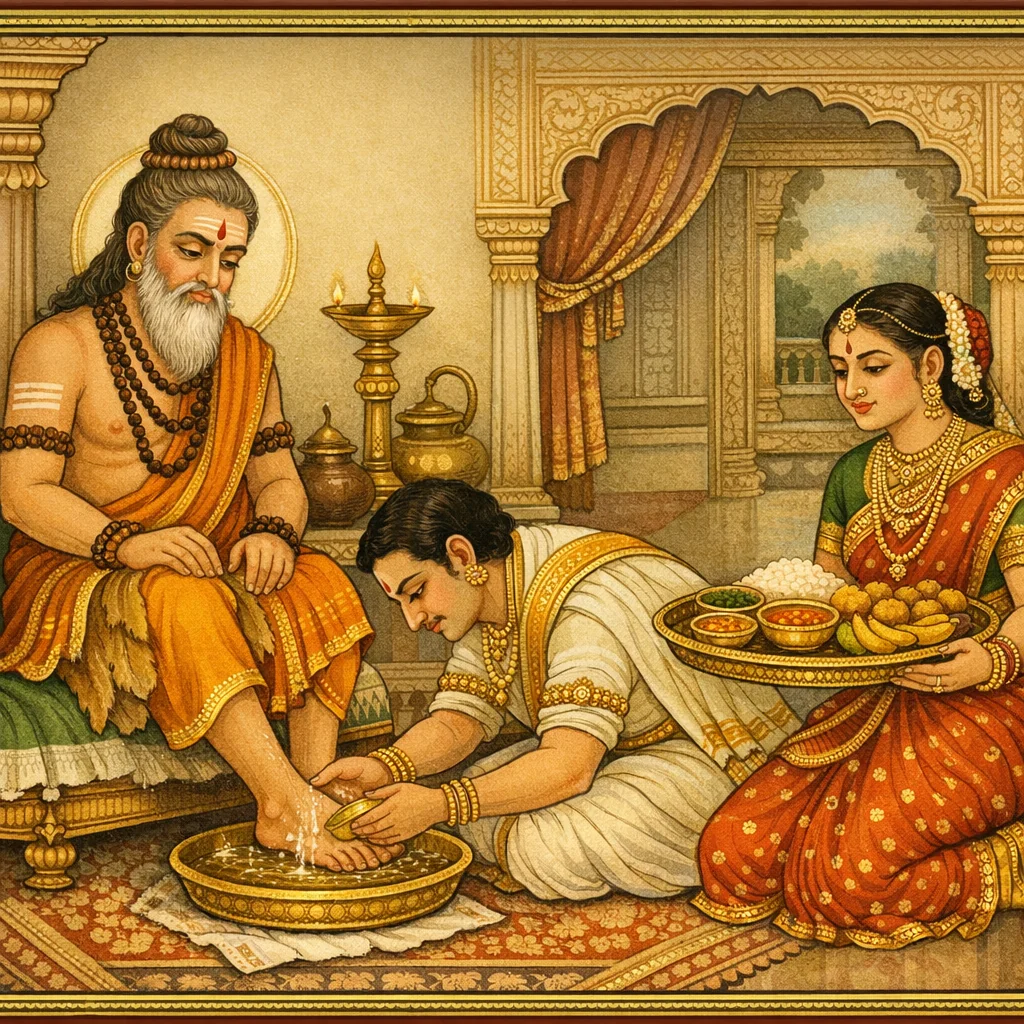
This chapter is a didactic dialogue in which the sages ask Sūta to elaborate on the highest māhātmya concerning a householder’s duty toward guests (atithi-kṛtya). Sūta declares hospitality to be a foremost gṛhastha-dharma: neglecting a guest is ethically ruinous, while honoring and feeding a guest preserves merit and steadies one’s spiritual life. Guests are classified into three kinds—śrāddhīya (arriving during ancestral śrāddha rites), vaiśvadevīya (arriving at the time of the vaiśvadeva offering), and sūryoḍha (arriving after meals or at night)—with fitting responses prescribed. One should not interrogate lineage in detail, but recognize the yajñopavīta and offer food with devotion. The text further teaches that the guest’s satisfaction is divine satisfaction: welcoming, seating, offering arghya/pādya, and giving food are understood as acts that please cosmic principles and deities. It concludes by reaffirming that the guest embodies an all-encompassing divine presence within the household’s moral order.
Shlokas
Verse 1
ऋषय ऊचुः । भूय एव महाभाग वद माहात्म्यमुत्तमम् । अतिथेः कृत्यमस्माकं विस्तरेण च सूतज
The sages said: “O greatly fortunate one, speak once more of this supreme māhātmya. And, O Sūta’s son, explain to us in detail the proper duty regarding an atithi, a guest.”
Verse 2
सूत उवाच । शृण्वन्तु मुनयः सर्वे माहात्म्यमिदमुत्तमम् । येन संश्रुतमात्रेण नश्येत्पापं दिनोद्भवम्
Sūta said: “Let all the sages listen to this most excellent māhātmya; by merely hearing it, the sin that arises day by day is destroyed.”
Verse 3
यन्मया च श्रुतं पूर्वं सकाशात्स्वपितुः शुभम्
And what I previously heard—auspicious and beneficial—from the very presence of my own father,
Verse 4
गृहस्थानां परो धर्मो नान्योऽस्त्यतिथिपूजनात् । अतिथेर्न च दोषोस्ति तस्यातिक्रमणेन च
For householders, there is no higher dharma than honoring a guest. In the guest there is no fault at all; the fault lies only in transgressing one’s duty toward him.
Verse 5
अतिथिर्यस्य भग्नाशो गृहात्प्रतिनिवर्तते । स दत्त्वा दुष्कृतं तस्मै पुण्यमादाय गच्छति
If a guest, his hopes broken, turns back from someone’s house, he departs after giving that person his own demerit—and taking away that householder’s merit.
Verse 6
सत्यं शौचं तपोऽधीतं दत्तमिष्टं शतं समाः । तस्य सर्वमिदं नष्टमतिथिं यो न पूजयेत्
Truthfulness, purity, austerity, sacred study, charity, and sacrifices—even a hundred years of such conduct: all of it is ruined for the one who does not honor a guest.
Verse 7
दूरादतिथयो यस्य गृहमायांति निर्वृताः । स गृहस्थ इति प्रोक्तः शेषाश्च गृहरक्षिणः
He whose home guests gladly seek even from afar is truly called a “householder”; the rest are merely keepers of a house.
Verse 8
न पुराकृतपुण्यानां नराणामिह भूतले । त्रीनेतान्प्रतिहन्यंते श्राद्धं दानं शुभा गिरः
On this earth, for men who have not gained merit in the past, three things are thwarted: śrāddha (rites for the ancestors), dāna (charitable giving), and auspicious words (good counsel and blessings).
Verse 9
तुष्टेऽतिथौ गृहस्थस्य तुष्टाः स्युः सर्वदेवताः । विमुखे विमुखाः सर्वा भवंति च न संशयः
When the householder’s guest is satisfied, all the gods become satisfied. When the guest turns away displeased, all the deities too turn away—of this there is no doubt.
Verse 10
तस्मात्तोषयितव्यश्च गृहस्थेन सदाऽतिथिः । अप्यात्मनः प्रदानेन यदीच्छेत्पुण्यमात्मनः
Therefore a householder must always strive to satisfy the guest—even by giving of his own share, if he desires spiritual merit for himself.
Verse 11
त्रिविधस्त्वतिथिः प्रोक्तो गृहस्थानां द्विजोत्तमाः । तस्याहं वच्मि वः कालं शृणुध्वं सुसमाहिताः
O best of the twice-born, the guest for householders is declared to be of three kinds. I shall tell you the proper times for them—listen with attentive minds.
Verse 12
श्राद्धीयो वैश्वदेवीयः सूर्योढश्च तृतीयकः । ये चान्ये भोजनार्थीयास्ते सामान्याः प्रकीर्तिता
The three principal guests are: the śrāddha-guest, the vaiśvadeva-guest, and third, the sūryoḍha guest. Others who come merely seeking food are declared to be ordinary.
Verse 13
सांकल्पे विहिते श्राद्धे पितॄणां भोजनोद्भवे । समागच्छति यः काले तस्मिञ्छ्राद्धीय एव सः
When a śrāddha is undertaken with a formal saṅkalpa, for the offering of food to the Pitṛs, whoever arrives at that very time is to be regarded as the śrāddha-guest.
Verse 14
दूराध्वानं पथि श्रांतं वैश्वदेवांत आगतम् । अतिथिं तं विजानीयान्नातिथिः पूर्वमागतः
One should recognize as a true guest the person who, having travelled a long distance and grown weary on the road, arrives at the time after the vaiśvadeva rite. One who came earlier is not counted as atithi in this sense.
Verse 15
प्रियो वा यदि वा द्वेष्यो मूर्खः पंडित एव वा । वैश्वदेवे तु संप्राप्तः सोऽतिथिः स्वर्गसंक्रमः
Whether dear or disliked, whether foolish or learned—if he arrives at the time of vaiśvadeva, he is to be treated as the guest; by serving him, he becomes a passageway to heaven through the merit gained.
Verse 16
न पृच्छेद्गोत्रचरणं न स्थानं वेदमेव च । दृष्ट्वा यज्ञोपवीतं च भोजयेत्तं प्रभक्तितः
He should not ask about gotra and caraṇa, nor about residence, nor even which Veda he follows. Seeing the sacred thread (yajñopavīta), he should feed him with sincere devotion.
Verse 17
श्राद्धे वा वैश्वदेवे वा यद्यागच्छति नातिथिः । घृताहुतिं ततो दद्यात्तन्नाम्ना च हविर्भुजि
If, during the śrāddha or the vaiśvadeva rite, no guest arrives, then one should offer an oblation of ghee into the Fire, uttering that guest’s name, so that Agni—the eater of havis—receives it.
Verse 18
अशक्त्या भोज्यदानस्य देयं भक्त्या ततः परम् । तस्यान्नमपि तु स्तोकं येन तुष्टिं प्रगच्छति
If one lacks the means to give a full meal, one should still give with devotion—at least a small portion of food—by which the guest attains satisfaction.
Verse 19
तथान्यश्च तृतीयस्तु सूर्योढोऽतिथिरुच्यते । कृते तु भोजने यस्तु रात्रौ वा चाधिगच्छति । तस्य शक्त्या प्रदातव्यं सस्यं च गृहमेधिना
Another, the third kind of guest is called the “sunset guest”—one who arrives at sunset or even at night, after the household meal has already been prepared. To such a guest, the householder should give, according to his capacity, food-grain and provisions.
Verse 21
तृणानि भूमिरुदकं वाक्चतुर्थी च सूनृता । एतान्यपि सतां गेहे नोच्छिद्यंते कदाचन
Grass for seating, the ground as a place to sit, water, and fourth, gentle truthful speech—these are never absent in the house of the virtuous.
Verse 22
स्वागतेनाग्नयस्तृप्तिं गृहस्थस्य प्रयांति च । आसनेन व्रजेत्तुष्टिं स्वयंभूः प्रपितामहः
By a respectful welcome, the householder’s sacred fires are satisfied; and by offering a seat, the Self-born Grandsire, Brahmā, departs pleased.
Verse 23
अर्घेण शंभुः पाद्येन सर्वे देवाः सवासवाः । भोज्यदानेन विष्णुः स्यात्सर्वदेवमयोऽतिथिः
By offering arghya, Śambhu is honored; by offering water for the feet, all the gods together with Indra are honored; and by giving food, Viṣṇu is honored—for the guest embodies all the deities.
Verse 24
तस्मात्पूज्यः सदा विप्रा भोजनीयो विशेषतः । नामाप्युच्चार्य भोज्योऽन्यो ब्राह्मणो गृहमेधिना
Therefore brāhmaṇas should always be honored, and especially should be fed. Even by calling one by name, the householder should feed another brāhmaṇa as well.
Verse 186
इति श्रीस्कांदे महापुराण एकाशीतिसाहस्र्यां संहितायां षष्ठे नागरखण्डे श्रीहाट केश्वरक्षेत्रमाहात्म्येऽतिथिमाहात्म्यवर्णनंनाम षडशीत्युत्तरशततमोऽध्यायः
Thus, in the Śrī Skanda Mahāpurāṇa, in the Saṃhitā of eighty-one thousand verses, in the sixth division—the Nāgara Khaṇḍa—within the Māhātmya of the sacred Keśvara-kṣetra of Śrīhāṭa, concludes the chapter called “The Description of the Glory of the Guest,” being Chapter 186.