Adhyaya 173
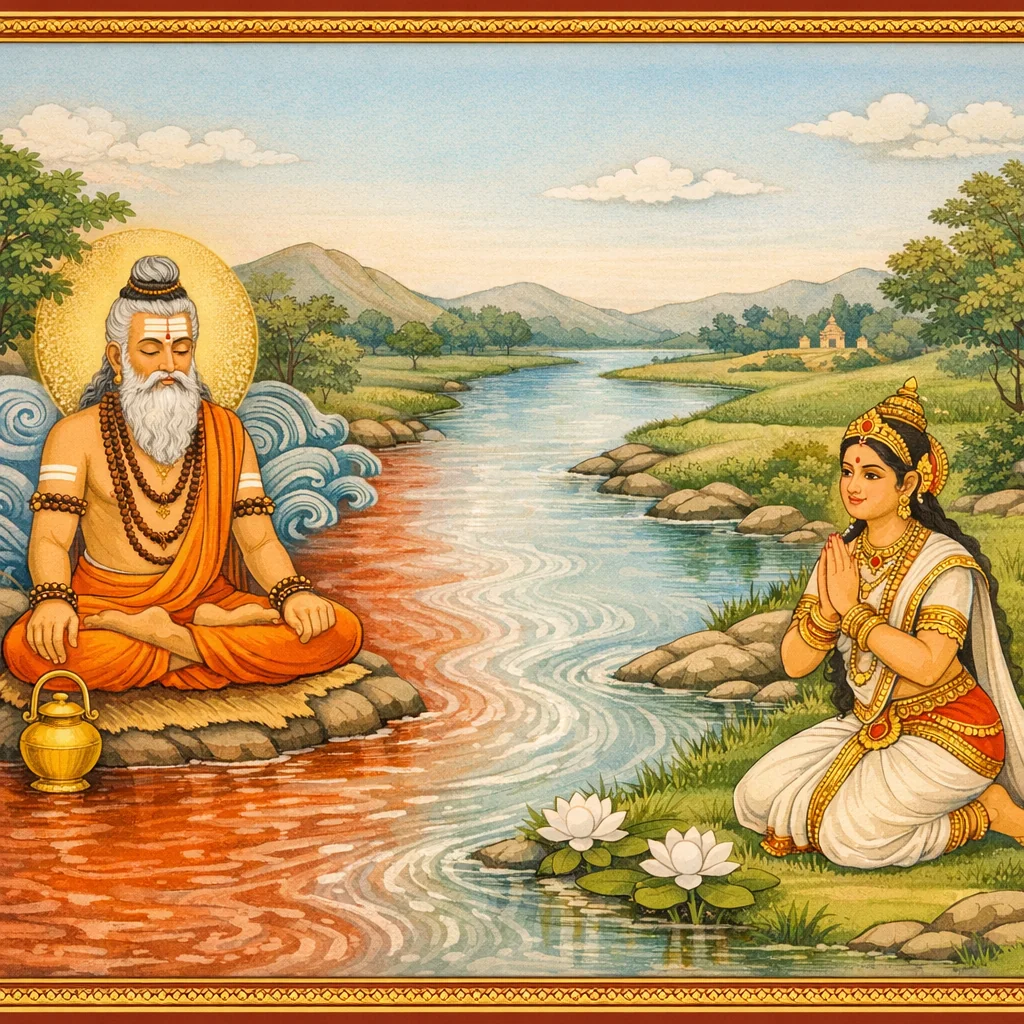
Adhyāya 173 is framed as a rishi’s question answered by Sūta, who explains that the waters of the Sarasvatī became blood-like through the power of a curse (śāpa) connected with the mantra-efficacy of Viśvāmitra. The narrative then turns to Vasiṣṭha, whom the distressed Sarasvatī approaches, describing her flow as a raktaugha (stream of blood), shunned by ascetics and visited by disruptive beings. She implores him to restore her to salila, pure water. Vasiṣṭha affirms he can remedy this and goes to the spot marked by a plakṣa tree where Sarasvatī had descended. Entering samādhi, he employs a Varuṇa-related mantra and pierces the earth, releasing abundant water. Two outlets arise: one becomes the renewed Sarasvatī, whose strong current carries away the blood-like corruption; the other forms a separate river named Sābhramatī. The chapter ends with a phalaśruti, declaring that reciting or hearing this account grants increased clarity of intellect (mati-vivardhana) by Sarasvatī’s grace.
Shlokas
Verse 1
ऋषय ऊचुः । अहो बत महाश्चर्यं विश्वामित्रस्य सन्मुनेः । मंत्रप्रभावतो येन तत्तोयं रुधिरीकृतम्
The sages said: “Ah! What a mighty wonder—of the noble sage Viśvāmitra—by the power of mantra, that water was turned into blood!”
Verse 2
ततःप्रभृति संप्राप्तं कथं तोयं प्रकीर्तय । सरस्वत्या महाभाग सर्वं विस्तरतो वद
From that time onward, how did the water come to be as it is? Please declare it. O fortunate one, tell us everything in detail concerning Sarasvatī.
Verse 3
सूत उवाच । बहुकालं प्रवाहः स सरस्वत्या द्विजोत्तमाः । महान्रक्तमयो जातो भूतराक्षससेवितः
Sūta said: “O best of the twice-born, for a long time that current of the Sarasvatī became a vast stream of blood, frequented by bhūtas and rākṣasas.”
Verse 4
कस्यचित्त्वथ कालस्य वसिष्ठो मुनिसत्तमः । अर्बुदस्थस्तया प्रोक्तो दीनया दुःखयुक्तया
“Then, after some time, the excellent sage Vasiṣṭha—dwelling at Arbuda—was addressed by her, the sorrow-stricken one, in distress.”
Verse 5
तवार्थाय मुने शप्ता विश्वामित्रेण कोपतः । रुधिरौघवहाजाता तपस्विजनवर्जिता
“For your sake, O sage, I was cursed by Viśvāmitra in anger; I became a bearer of a torrent of blood, deserted by ascetics.”
Verse 6
तस्मात्कुरु प्रसादं मे यथा स्यात्सलिलं पुनः । प्रवाहे मम विप्रेन्द्र प्रयाति रुधिरं क्षयम्
Therefore, O best of brāhmaṇas, show me your grace, so that water may return again; may the blood in my stream pass away and be exhausted.
Verse 7
त्रैलोक्यकरणे विप्र संक्षये वा स्थितौ हि वा । नाशक्तिर्विद्यते काचित्तव सर्वमुनीश्वर
O brāhmaṇa, whether in the making of the three worlds, or in their dissolution, or in their preservation—there is no incapacity in you at all, O lord among all sages.
Verse 8
वसिष्ठ उवाच । तथा भद्रे करिष्यामि यथा स्यात्सलिलं पुनः । प्रवाहे तव निर्याति सर्वं रक्तं परिक्षयम्
Vasiṣṭha said: “So be it, auspicious one; I shall act so that water returns again, and in your stream all the blood departs, coming to complete cessation.”
Verse 9
एवमुक्त्वा स विप्रर्षिरवतीर्य धरातले । गतः प्लक्षतरुं यस्मा दवतीर्णा सरस्वती
Having spoken thus, that brāhmaṇa-sage descended to the earth and went to the plakṣa tree from where Sarasvatī had descended (manifested).
Verse 10
समाधिं तत्र संधाय निविष्टो धरणीतले । संभ्रमं परमं गत्वा विश्वामित्रस्य चोपरि
There he entered into samādhi, seated upon the ground; and he rose to a supreme spiritual intensity, even beyond (the reach of) Viśvāmitra.
Verse 11
वारुणेन तु मन्त्रेण वीक्ष यन्वसुधातलम् । ततो निर्भिद्य वसुधां भूरितोयं विनिर्गतम्
Gazing upon the earth’s surface with the Vāruṇa mantra, he then split the ground, and abundant water surged forth.
Verse 12
रन्ध्रद्वयेन विप्रेन्द्रा लोचनाभ्यां निरीक्षणात् । एकस्य सलिलं क्षिप्रं यत्र जाता सरस्वती
O best of brāhmaṇas, by his gaze through the two apertures of his eyes, water quickly issued forth from one opening at the place where Sarasvatī manifested.
Verse 13
प्लक्षमूले ततस्तस्य वेगेनापहृतं बलात् । तद्रक्तं तेन संपूर्णं ततस्तेन महानदी
Then, at the root of the plakṣa tree, her blood was forcefully swept away by the rushing current. Filled with that blood, a great river came into being from it.
Verse 14
द्वितीयस्तु प्रवाहो यः संभ्रमा त्तस्य निर्गतः । सा च साभ्रमती नाम नदी जाता धरातले
But the second stream that issued forth from her in sudden agitation became, upon the earth, the river named Sābhramatī.
Verse 15
एवं प्रकृतिमापन्ना भूय एव सरस्वती । यत्पृष्टोऽस्मि महाभागाः सरस्वत्याः कृते द्विजाः
Thus Sarasvatī regained her natural state once again. And now, O fortunate brāhmaṇas, I have answered what you asked me concerning Sarasvatī.
Verse 16
एतत्सारस्वतं नाम व्याख्यानमतिबुद्धिदम् । यः पठेच्छ्रणुयाद्वापि मतिस्तस्य विवर्द्धते । सरस्वत्याः प्रसादेन सत्यमेतन्म योदितम्
This exposition is called “Sārasvata,” and it bestows keen intelligence. Whoever recites it, or even merely hears it, his understanding increases. By the grace of Goddess Sarasvatī, this is truly what I have declared.
Verse 173
इति श्रीस्कांदे महापुराण एकाशीतिसाहस्या संहितायां षष्ठे नागरखण्डे श्रीहाटकेश्वरक्षेत्रमाहात्म्ये सरस्वत्युपाख्याने सरस्वती शापमोचनसाभ्रमत्युत्पत्तिवृत्तान्तवर्णनंनाम त्रिसप्तत्युत्तरशततमोऽध्यायः
Thus ends the one-hundred-and-seventy-third chapter, “The account describing Sarasvatī’s release from the curse and the arising of Sābhramatī,” in the Sarasvatī episode within the Śrīhāṭakeśvara-kṣetra Māhātmya of the sixth, Nāgara Khaṇḍa, in the Skanda Mahāpurāṇa, in the Ekāśītisāhasrī Saṃhitā.