Adhyaya 170
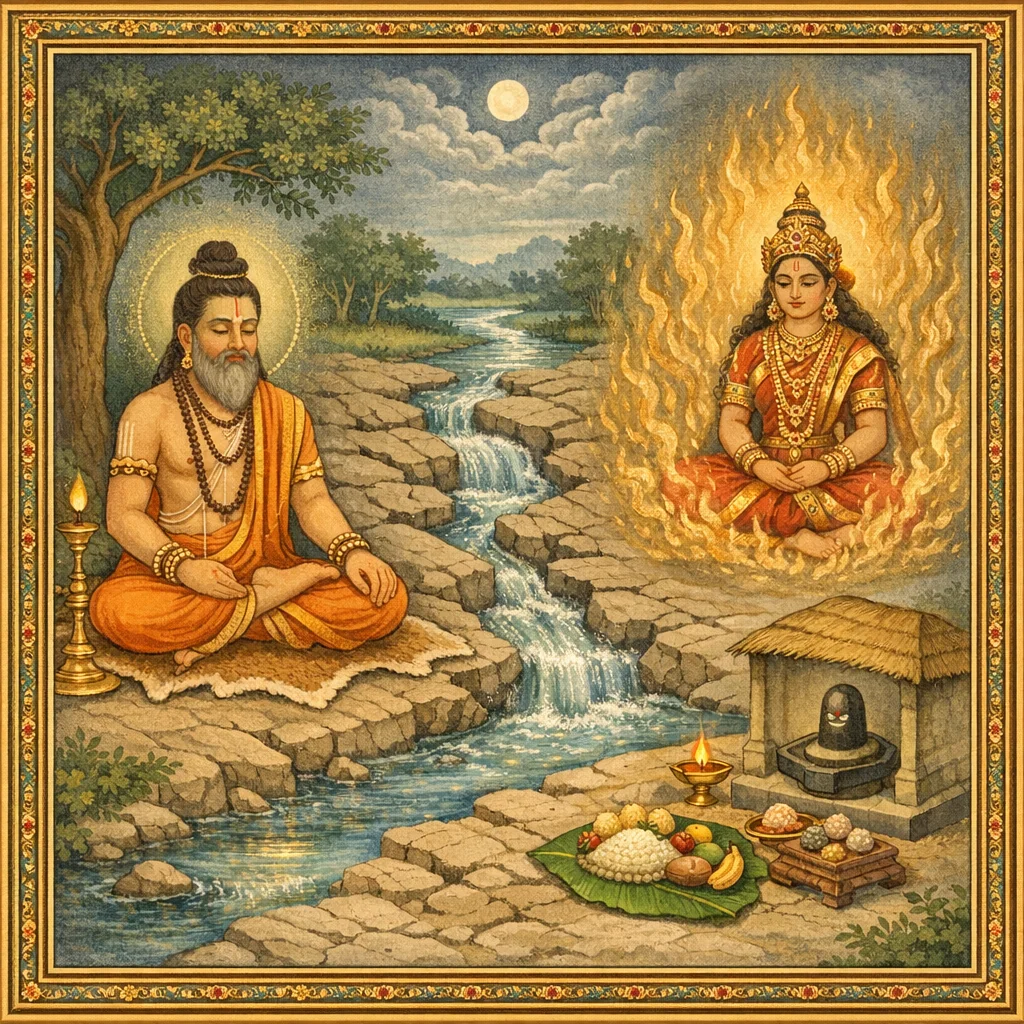
Sūta recounts another marvel involving the sages Viśvāmitra and Vasiṣṭha. Viśvāmitra releases a hostile śakti toward Vasiṣṭha, but Vasiṣṭha restrains it through the power of Atharvanic mantras; then perspiration arises, and from that sweat a cool, clear, purifying water appears, seen flowing from his feet and breaking through the earth as a spotless stream likened to Gaṅgā-water. From this account of the tīrtha’s origin (tīrthotpatti), the chapter turns to observance and promised merit. Bathing there is said to grant immediate fertility to women deemed childless, and any bather gains the fruit of all tīrthas; after bathing, proper darśana of the Goddess bestows wealth, grain, offspring, and happiness associated with royal prosperity. A specific rite is prescribed for midnight on Caitra śukla aṣṭamī, with naivedya and bali-piṇḍikā offerings; eating or receiving the consecrated piṇḍikā is praised as efficacious even in advanced age, heightening the phalaśruti. The chapter concludes by naming the Goddess as kuladevatā for multiple Nāgara lineages and affirming that Nāgara participation is essential for the yātrā to be complete.
Shlokas
Verse 1
सूत उवाच । तथान्यदपि संजातमाश्चर्यं यदभूद्द्विजाः । विश्वामित्रेण सा शक्तिर्वसिष्ठाय विसर्जिता
Sūta said: O twice-born sages, another marvel also came to pass: Viśvāmitra hurled that divine power, a sacred weapon, against Vasiṣṭha.
Verse 2
वधार्थं तस्य विप्रर्षेर्वसिष्ठेन च धीमता । स्तंभिताऽथर्वणैर्मन्त्रैः प्रस्वेदः समजायत
Aiming to slay that brahmin-sage, the weapon was checked by the wise Vasiṣṭha through Atharvan mantras; then perspiration arose.
Verse 3
स्वेदात्समभवत्तोयं शीतलं तदजायत । पादाभ्यां निर्गतं तोयमत्र दृश्यमजायत
From that perspiration water came forth, and it became cool. The water that flowed out from his feet became visible here.
Verse 4
विदार्य भूमिं संजाता जलधारा सुशीतला । निर्मलं पावनं स्वच्छं गंगांभ इव निःसृतम्
Splitting the earth, a very cool stream of water arose—spotless, purifying, and clear—flowing forth like the waters of the Gaṅgā.
Verse 6
तस्यां या कुरुते स्नानं नारी वंध्या द्विजोत्तमाः । सद्यः पुत्रवती सा स्याद्रौद्रे कलियुगे द्विजाः
O best of the twice-born, even a barren woman who bathes in that tīrtha becomes a mother at once—yes, even in this harsh Kali Yuga, O twice-born sages.
Verse 7
अन्योऽपि कुरुते स्नानं सर्वतीर्थफलं लभेत्
Anyone else as well who bathes there obtains the fruit of all tīrthas.
Verse 8
स्नात्वा तत्र तु यो देवीं पश्येच्च विधिना नरः । धनं धान्यं तथा पुत्रान्राज्योत्थं च सुखं लभेत्
But the man who bathes there and then beholds the Goddess according to proper rite gains wealth, grain and prosperity, children, and happiness arising from royal fortune as well.
Verse 9
या नारी दुर्भगा वन्ध्या साऽपि पुत्रवती भवेत् । चैत्रे मासि सिताष्टम्यां भक्तियोगसमन्विता । महानिशायां तत्रैव नैवेद्यबलिपिंडिकाम्
Even a woman who is unfortunate and barren may become blessed with a son, if—endowed with devotional discipline—on the bright eighth day (Śuklāṣṭamī) of the month of Caitra, in the deep of night at that very sacred place, she prepares an offering-ball (piṇḍikā) together with naivedya and bali.
Verse 10
प्रसन्नया कुमार्या तु स्वयं चाऽथ करोति या । गृह्णाति या च वै नारी पिंडिकां बलिसंयुताम्
And the woman who herself prepares it with a serene maiden (kanyā), and who then receives the piṇḍikā accompanied by the bali-offering—she indeed gains the intended sacred benefit.
Verse 11
शतवर्षा तु या नारी पिंडिकां भक्षयेद्द्विजाः । साऽपि पुत्रवती च स्याद्यदि वृद्धतमा भवेत्
O twice-born ones, even if a woman is a hundred years old, if she eats the piṇḍikā, she too may become blessed with offspring—even should she be of the greatest old age.
Verse 12
किं पुनर्यौवनोपेता सौभाग्येन समन्विता । पुत्रसौख्यवती नारी देव्या वै दर्शनेन च
How much more, then, will a woman in the full bloom of youth, endowed with auspicious fortune, attain the joy of children and also the blessing that arises from the very darśana—the sacred sight—of the Goddess.
Verse 13
सर्वेषां नागराणां तु भावजा देवता स्मृता । सा सार्धाष्टद्विपंचाशद्गोत्राणां कुलदेवता
For all the Nāgaras, Bhāvajā is remembered as the presiding deity; she is the kuladevatā, the family-goddess, of the fifty-eight (and a half) gotras.
Verse 14
एतस्मात्कारणाद्यात्रा नागरैः सुकृता भवेत् । न विना नागरैर्यात्रां तुष्टिं याति सुरेश्वरी
For this reason, the yātrā—the pilgrimage—performed by the Nāgaras becomes well accomplished; without the Nāgaras, the Lady of the Gods is not satisfied by the pilgrimage.
Verse 170
इति श्रीस्कांदे महापुराण एकाशीतिसाहस्र्यां संहितायां षष्ठे नागरखण्डे हाटके श्वरक्षेत्रमाहात्म्ये धारातीर्थोत्पत्तिमाहात्म्यवर्णनंनाम सप्तत्युत्तरशततमोऽध्यायः
Thus, in the holy Skanda Mahāpurāṇa—within the eighty-one-thousand-verse Saṃhitā—ends the one-hundred-and-seventieth chapter of the sixth book, the Nāgara Khaṇḍa, in the Māhātmya of Hāṭakeśvara-kṣetra, entitled “The Glorification describing the Origin of Dhārā-tīrtha.”