Adhyaya 17
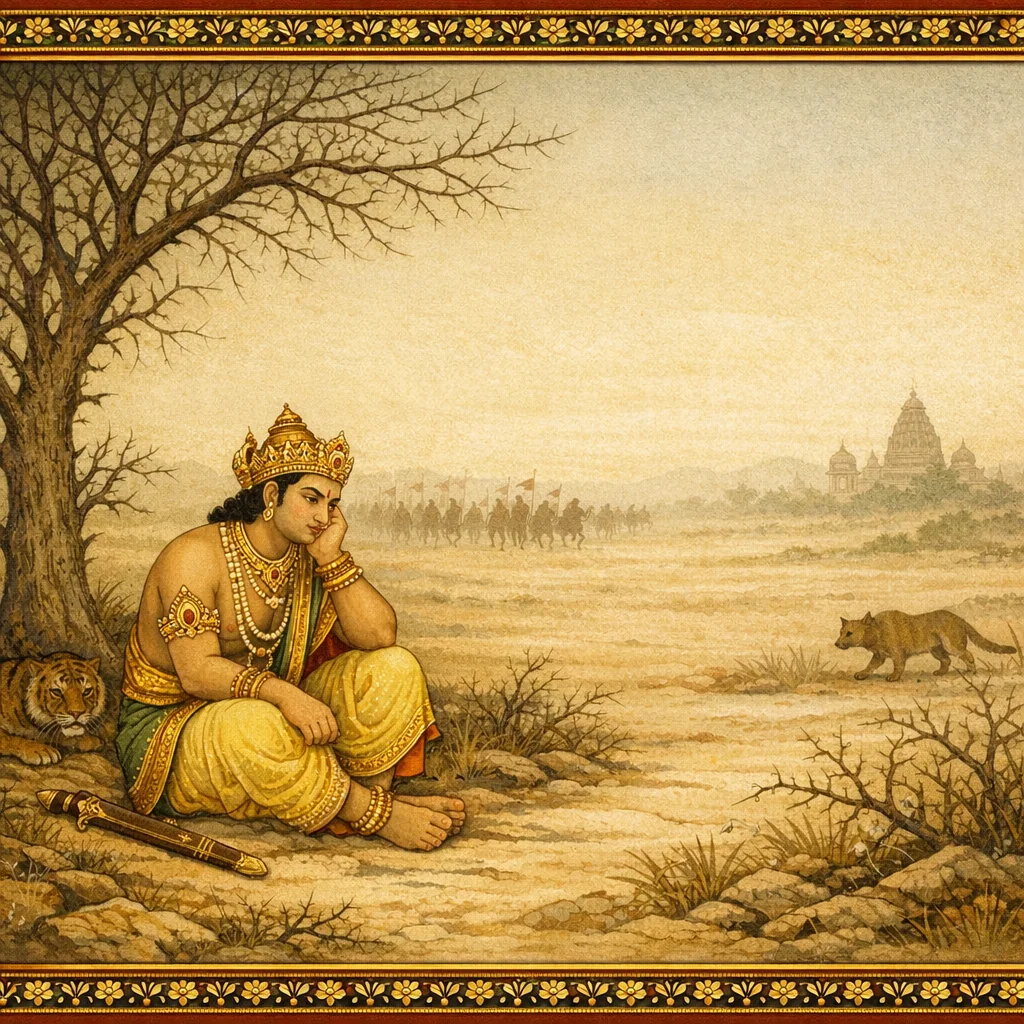
Chapter 17 begins with the ṛṣis asking Sūta for a precise account of Chamatkārapura—its measure (pramāṇa) and the list of its merit-bestowing tīrthas and sanctuaries. Sūta replies that the kṣetra extends for five krośas, and he marks its sacred reference-points by direction: Gayāśiras to the east, Hari’s footprint to the west, and Gokarṇeśvara sites to the south and the north. He also recalls the earlier name Hāṭakeśvara and the place’s renown as a destroyer of sin. The narration then turns from boundaries to origin-legend: at the Brahmins’ request, Sūta begins the tale of King Vidūratha. A royal hunt intensifies into a perilous chase across ever harsher ground—thorny forest without water or shade, scorching heat, and the threat of predators. Separated from his army, the king’s exhaustion and danger mount until his horse collapses, setting the stage for later revelations about the kṣetra’s sanctity and moral import.
Shlokas
Verse 2
। ऋषय ऊचुः । चमत्कारपुरोत्पत्तिः श्रुता त्वत्तो महामते । तत्क्षेत्रस्य प्रमाणं यत्तदस्माकं प्रकीर्तय । यानि तत्र च पुण्यानि तीर्थान्यायतनानि च । सहितानि प्रभावेण तानि सर्वाणि कीर्तय
The sages said: “O great-minded one, we have heard from you of the origin of Camatkārapura. Now declare to us the extent of that sacred region, and also recount all the holy tīrthas and sanctuaries found there—together with their spiritual powers.”
Verse 3
सूत उवाच । पञ्चक्रोशप्रमाणेन क्षेत्रं ब्राह्मणसत्तमाः । आयामव्यासतश्चैव चमत्कारपुरोत्तमम्
Sūta said: “O best of brāhmaṇas, the sacred region of the excellent Camatkārapura measures five krośas, in both length and breadth.”
Verse 4
प्राच्यां तस्य गयाशीर्षं पश्चिमेन हरेः पदम् । दक्षिणोत्तरयोश्चैव गोकर्णेश्वरसंज्ञितौ
To its east lies Gayāśīrṣa; to its west, Hari’s Footprint. And on its southern and northern sides are places known as Gokarṇeśvara.
Verse 5
हाटकेश्वर संज्ञं तु पूर्वमासीद्द्विजोत्तमाः । तत्क्षेत्रं प्रथितं लोके सर्वपातकनाशनम्
O best of the twice-born, formerly it bore the name Hāṭakeśvara; that sacred region is renowned in the world as a destroyer of all sins.
Verse 6
यतः प्रभृति विप्रेभ्यो दत्तं तेन महात्मना । चमत्कारेण तत्स्थानं नाम्ना ख्यातिं ततो गतम्
From that time onward, because that great-souled one granted it to the brāhmaṇas, the place—through a wondrous event—became renowned by that very name.
Verse 7
ब्राह्मणा ऊचुः । यदेतद्भवता प्रोक्तं तस्य पूर्वे गयाशिरः । माहात्म्यं तस्य नो ब्रूहि सूतपुत्र सविस्तरम्
The brāhmaṇas said: “You have mentioned Gayāśīrṣa to the east of that region. O son of Sūta, tell us in detail the greatness of that holy place.”
Verse 8
सूत उवाच । आसीद्विदूरथोनाम हैहयाधिपतिः पुरा । यो वै दानपतिर्दक्षः शत्रुपक्षक्षयावहः
Sūta said: “In former times there was a Haihaya ruler named Vidūratha—skilled as a lord of charity, and a bringer of ruin upon the enemy’s ranks.”
Verse 9
स कदाचिन्मृगान्हंतुं नृपः सेनावृतो ययौ । नानावृक्षलताकीर्णं वनं श्वापदसंकुलम्
Once, that king set out—surrounded by his army—to hunt deer, entering a forest thick with many kinds of trees and creepers, and crowded with wild beasts.
Verse 10
स जघान मृगांस्तत्र शरैराशीविषोपमैः । महिषांश्चवराहांश्च तरक्षूञ्च्छम्बरान्रुरून्
There he struck down the wild beasts with arrows like venomous serpents—deer, buffaloes, boars, hyenas, sambara deer, and antelopes—displaying the fierce vigor of royal pursuit.
Verse 11
सिंहान्व्याघ्रान्गजान्मत्ताञ्च्छतशोऽथ सहस्रशः । अथ तेन मृगो विद्धः शरेणाऽनतपर्वणा
Lions, tigers, and rutting elephants—by the hundreds and even by the thousands—were confronted; then that deer was pierced by his arrow with unbending joints.
Verse 12
न पपात धरापृष्ठे सशरो दुद्रुवे द्रुतम् । ततः स कौतुकाविष्टस्तस्य पृष्ठे हयोत्तमम् । प्रेरयामास वेगेन मनोमारुतवेगधृक्
Though pierced by the arrow, it did not fall upon the earth; swiftly it ran. Then the king, seized by curiosity, urged on his finest horse in pursuit, driving it with a speed like the wind and the mind.
Verse 13
ततः सैन्यं समुत्सज्य मृगं लिप्सुर्महीपतिः । अन्यद्वनांतरं प्राप्तो रौद्रं चित्तभयावहम्
Then the king, intent on capturing the deer, left his army behind and entered another tract of forest—fierce, dreadful, and terrifying to the heart.
Verse 14
कण्टकीबदरीप्रायं शाल्मलीवनसंकुलम् । तथान्यैः कण्टकाकीर्णै रूक्षै र्वृक्षैः समन्वितम्
It was a region filled with thorny jujube shrubs and dense groves of śālmalī trees, and crowded as well with other harsh, thorn-laden trees.
Verse 15
तत्र रूक्षाऽखिला भूमिर्निर्जला तमसा वृता । चीरिकोलूकगृधाढ्या शीर्षच्छायाविवर्जिता
There the entire ground was parched and waterless, wrapped in gloom; it was filled with chirping birds, owls, and vultures, and was devoid of sheltering shade overhead.
Verse 16
ग्रीष्मे मध्यगते सूर्ये मृगाकृष्टः स पार्थिवः । दूराध्वानं जगामाऽथ प्रासपाणिर्वराश्वगः
In the summer season, with the sun at mid-heaven, that king—drawn onward by the deer—traveled a long distance, spear in hand, mounted upon an excellent horse.
Verse 17
तेन तस्यानुगा भृत्याः सर्वे सुश्रांतवाहनाः । क्षुत्पिपासाकुलाः श्रांताः स्थाने स्थाने समाश्रिताः
Because of that pursuit, his attendant servants—all with their mounts utterly exhausted—were afflicted by hunger and thirst, and, worn out, took shelter here and there along the way.
Verse 18
सिंहव्याघ्रैस्तथा चान्यैः पतिता नष्टचेतनाः । भक्ष्यंते चेतयन्तोऽपि तथाऽन्ये चलनाक्षमाः
Some, having fallen senseless and bereft of awareness, were devoured by lions, tigers, and other beasts; others too—though still conscious—were eaten, for they could not even move.
Verse 19
ततः सोऽपि महीपालः क्षुत्पिपासासमाकुलः । दृष्ट्वा तद्व्यसनं प्राप्तमात्मनः सेवकैः समम्
Then the king himself, tormented by hunger and thirst, beheld that calamity which had befallen his own attendants, even as it had befallen him.
Verse 20
कांतारस्यांतमन्विच्छन्प्रेरयामास तं हयम् । जात्यं सर्वगुणोपेतं कशाघातैः प्रताडयन्
Seeking the far end of the wilderness, he drove that horse onward—an excellent steed of noble breed, endowed with every fine quality—urging it on with strokes of the whip.
Verse 21
ततः स नृपतिस्तेन वायुवेगेन वाजिना । नीतो दूरं दुर्गमार्गं सर्वजंतुविवर्जितम्
Then that king, borne by the steed whose speed was like the wind, was carried far away along a difficult path, forsaken by all creatures.
Verse 22
एवं तस्य नरेन्द्रस्य कांदिशीकेऽनवस्थिते । सोऽश्वोऽपतद्धरापृष्ठे सोऽप्यधस्तात्तुरंगमात्
Thus, when that lord of men was bewildered and unsteady, the horse fell upon the earth’s surface, and he too fell down from the steed.