Adhyaya 168
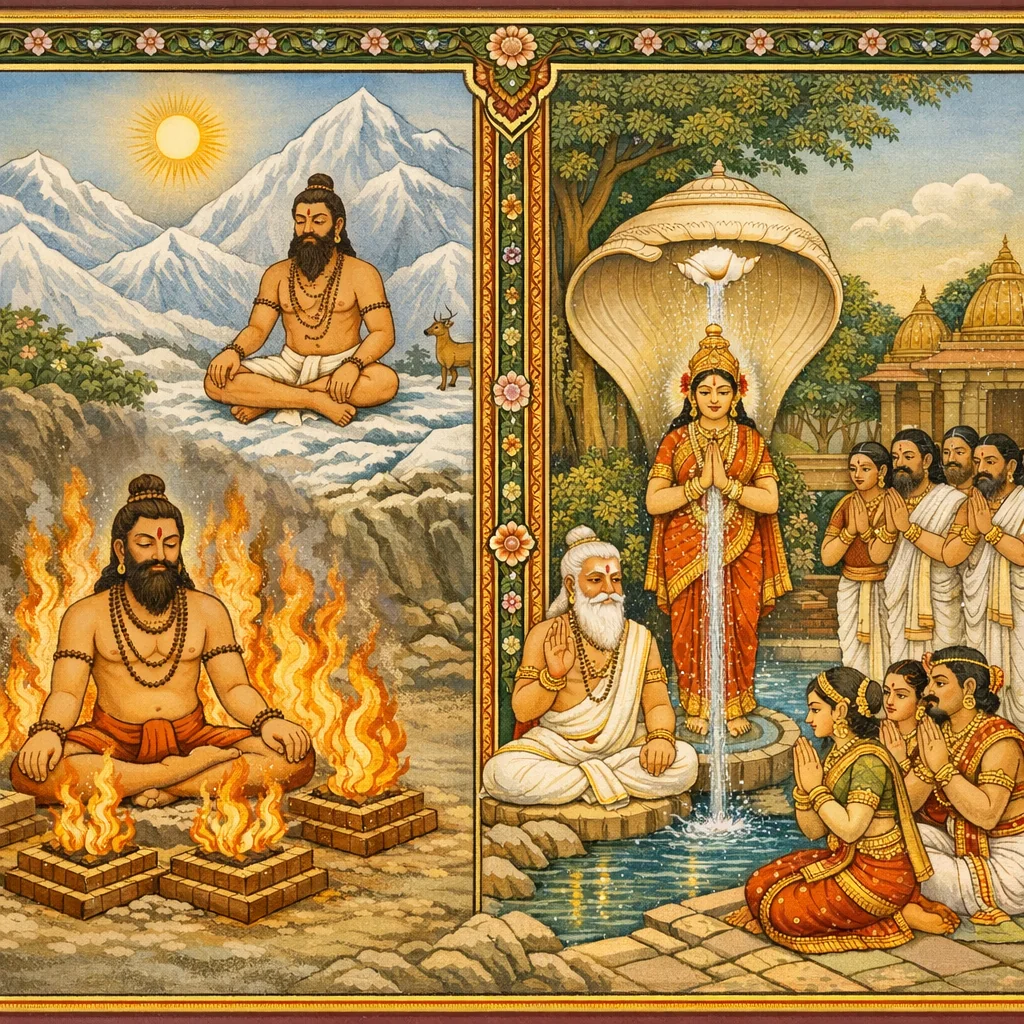
Set within the sanctified landscape of Hāṭakeśvara-kṣetra, this chapter presents a multi-part theological narrative. Sūta recounts Viśvāmitra’s fierce tapas in the Himālaya—sleeping beneath the open sky, dwelling in water, enduring pañcāgni (the five fires), and intensifying fasts until vāyu-bhakṣa, as though sustained by air. Indra, fearing his own displacement, offers boons, but Viśvāmitra refuses all except brāhmaṇya (brahminhood), declaring spiritual attainment higher than sovereignty. Brahmā likewise appears to grant a boon, and Viśvāmitra repeats the single request. Ṛcīka explains that brahmanical mantras and a consecrated caru oblation were arranged for the very purpose of Viśvāmitra’s birth, empowering Brahmā to proclaim him a brahmarṣi. Vasiṣṭha disputes the legitimacy of a kṣatriya-born man becoming a brāhmaṇa and withdraws to Anarta near Śaṅkha-tīrtha, Brahmaśilā, and the Sarasvatī. In hostility, Viśvāmitra performs an abhichāra rite by Sāmavedic procedure to generate a dreadful kṛtyā. Vasiṣṭha, perceiving it with divine insight, immobilizes it with Atharvan mantras and redirects its effect: it merely touches his body and collapses. He then grants the force a settled cultic place—worship on the bright eighth of Caitra—promising devotees a year free from illness. Thus the power becomes known as Dhārā and receives distinctive nāgara (community/urban) worship, weaving ascetic conflict, mantra doctrine, and local tīrtha practice into a place-based māhātmya.
Shlokas
Verse 1
सूत उवाच । एवं राज्यं परित्यज्य विश्वामित्रो द्विजोत्तमाः । हिमवन्तं नगं प्राप्य तपश्चक्रे सुदारुणम्
Sūta said: Having thus abandoned his kingdom, Viśvāmitra—the foremost among the twice-born—reached Mount Himavat and undertook exceedingly severe austerities.
Verse 2
वर्षास्वाकाशशायी च हेमंते सलिलाशयः । पञ्चाग्निसाधको ग्रीष्मे स्थितो वर्षशतत्रयम्
In the rainy season he lay beneath the open sky; in winter he remained immersed in water; in summer he practiced the discipline of the five fires (pañcāgni)—thus he stood steadfast for three hundred years.
Verse 3
फलमूलकृताहारस्ततो वर्षशतत्रयम् । ध्यायमानः परं ब्रह्म स्थितो ब्राह्मणसत्तमाः । शीर्णपर्णाशनः पश्चात्तावत्कालं व्यवस्थितः
Then, living on fruits and roots for three hundred years, that best of Brahmins remained absorbed in meditation upon the Supreme Brahman. Afterwards, feeding on fallen, withered leaves, he continued for an equal span of time.
Verse 5
ततश्चैव जलाहारस्तावन्मात्रं व्यवस्थितः । कालं स वायुभक्षश्च ततश्चैवायुतं समाः सूत उवाच । अथ दृष्ट्वा तपःशक्तिं तस्य तां त्रिदशाधिपः । पातायष्यति मां नूनमेष स्थानान्नृपोत्तमः
Then he lived only on water for the same measure of time; thereafter he subsisted on air, and thus for ten thousand years. Sūta said: Seeing the tremendous power of his austerities, the lord of the gods thought, “Surely this supreme king will cast me down from my station.”
Verse 6
ततः प्रोवाच संगत्य साम्ना परमवल्गुना । विश्वामित्रं नृपश्रेष्ठं भयेन महताऽन्वितः
Then, approaching and meeting him, he addressed Viśvāmitra—the noblest of kings—with exceedingly gentle, conciliatory words, though filled with great fear.
Verse 7
इंद्र उवाच । विश्वामित्र प्रतुष्टोऽस्मि तपसानेन पार्थिव । वरं वरय भद्रं ते यदभीष्टं हृदिस्थितम्
Indra said: “Viśvāmitra, O king, I am well pleased by this austerity of yours. Choose a boon—may auspiciousness be yours—whatever desire rests within your heart.”
Verse 9
विश्वामित्र उवाच । ब्राह्मण्यं देहि मे शक्र यदि तुष्टोऽसि सांप्रतम् । तदर्थं तपसश्चर्यां जानीहि त्वं पुरंदर
Viśvāmitra said: “Grant me Brahminhood, O Śakra, if you are pleased at this time. Know, O Purandara, that it is for this very purpose that I have practiced austerity.”
Verse 10
विश्वामित्र उवाच । न ब्राह्मण्यात्परं किंचित्प्रार्थयामि सुरेश्वर
Viśvāmitra said: “O Lord of the gods, I ask for nothing beyond Brahminhood.”
Verse 11
अपि त्रैलोक्यराज्यं ते वस्तुष्वन्येषु का कथा । तस्माद्गच्छ सुरश्रेष्ठ स्वराज्यं परिपालय
Even the sovereignty of the three worlds holds no appeal for me—what then to speak of other things? Therefore, O best of the gods, go and govern your own realm.
Verse 12
परित्यक्ष्याम्यहं देहं यास्ये वाऽहं द्विजन्मताम् । तच्छ्रुत्वा वचनं तस्य देवराजो दिवं गतः
“I shall abandon this body, or else I shall attain the state of a twice-born (brāhmaṇa).” Hearing his resolve, the king of the gods departed to heaven.
Verse 13
तस्य तं निश्चयं ज्ञात्वा सर्वदेवसमावृतः । विश्वामित्रोऽपि तद्रूपं चकार दुश्चरं तपः
Knowing that firm resolve, and being surrounded by all the gods, Viśvāmitra too undertook a severe, difficult austerity in that very manner, in keeping with his vow.
Verse 14
अथ वर्षसहस्रे तु व्यतिक्रान्ते द्विजोत्तमाः । अन्यस्मिन्वायुभक्षस्य विश्वामित्रस्य भूपतेः
Then, O best of the twice-born, when a thousand years had passed—at another time—of King Viśvāmitra, who lived on air alone as his sustenance…
Verse 15
आजगाम स्वयं ब्रह्मा पुण्यैर्देवर्षिभिः सह । अब्रवीत्तं महीपालं तपसा दग्धकिल्बिषम्
Brahmā himself arrived, accompanied by holy divine seers, and spoke to that king, whose sins had been burned away by austerity.
Verse 16
श्रीब्रह्मोवाच । विश्वामित्र प्रतुष्टोऽस्मि तपसानेन सत्तम । वरं वरय भद्रं ते प्रदास्याम्यपि दुर्लभम्
Śrī Brahmā said: “Viśvāmitra, O best of the virtuous, I am well pleased with this austerity of yours. Choose a boon—may welfare be yours; I shall grant even what is difficult to obtain.”
Verse 17
विश्वामित्र उवाच । यदि तुष्टोऽसि मे देव यदि देयो वरो मम । ब्राह्मण्यं देहि मे देव नान्यदिष्टतमं महत्
Viśvāmitra said: “If you are pleased with me, O Lord, and if a boon is to be granted to me—then grant me brāhmaṇya, O God; nothing else is dearer to me, nothing greater.”
Verse 19
यन्न जातं धरापृष्ठे न भविष्यति कर्हिचित्
“That which has not been born upon the surface of the earth, and will never come to be at any time…”
Verse 20
विश्वामित्र उवाच । गच्छ त्वं देवदेवेश ब्रह्मलोकमनुत्तमम् । अहं त्यक्ष्यामि वा प्राणान्संप्राप्स्ये वा द्विजन्मताम्
Viśvāmitra said: “Go, O Lord of the gods, to the unsurpassed world of Brahmā. As for me—I shall either relinquish my life-breaths, or I shall attain the state of a twice-born.”
Verse 21
अथ देवर्षिमध्यस्थ ऋचीको वाक्यमब्रवीत् । अस्य जन्मकृते देव ब्राह्म्यैर्मंत्रैर्मया चरुः
Then Ṛcīka, standing amid the divine seers, spoke these words: “O Lord, for the sake of his birth, I prepared the caru, the sacrificial oblation, with brāhmaṇical mantras.”
Verse 22
अभितो ब्रह्मसर्वस्वं तत्र सयोजितं मया । तेनैव क्षत्रजन्माऽयं ब्राह्मणश्चतुरानन
“There I infused, on every side, the very fullness of Brahman’s essence. By that very act, though born a kṣatriya, he is worthy as a brāhmaṇa—O Four-faced One (Brahmā).”
Verse 23
ब्रह्मर्षिकीर्तयस्वैनं तस्मात्त्वं प्रपितामह । राज्यस्थोऽपि द्विजार्हाणि सत्कृत्यान्य करोदसौ
“Therefore, O Prāpitāmaha (Great-Grandfather Brahmā), proclaim him a Brahmarṣi. Even while established in kingship, he truly performed honors and reverent acts worthy of the twice-born (dvija).”
Verse 24
ब्राह्ममन्त्रप्रभावेन तस्माद्ब्रह्मर्षिमाह्वय । येन कीर्तामहे सर्वे विश्वामित्रं द्विजोत्तमम्
“By the power of the Brahmā-mantras, therefore, call him a Brahmarṣi—he by whom we all celebrate Viśvāmitra, the foremost among the twice-born.”
Verse 25
अथ ब्रह्मा चिरं ध्यात्वा ब्राह्म्यै र्मंत्रैश्च तेजसा । समुत्पन्नं ततः प्राह ब्राह्मणस्त्वं मया कृतः
Then Brahmā, having meditated for a long time, and by the splendor of the Brahmā-mantras, brought it into manifestation; thereafter he said: “You have been made a brāhmaṇa by me.”
Verse 26
त्यजेदं दुष्करं घोरं तपो मद्वचनाद्द्रुतम् । स यदा ब्रह्मणा प्रोक्तो ब्रह्मर्षि स्त्वमसंशयम्
“Abandon at once this difficult and dreadful austerity, at my word.” When Brahmā thus spoke to him—“You are a Brahmarṣi, without doubt”—his status was affirmed.
Verse 27
ऋचीकाद्यैस्ततः सर्वैः प्रोक्तो देवर्षिभिस्तथा
Then he was likewise addressed and affirmed by all—beginning with Ṛcīka—and by the divine seers (devarṣis) as well.
Verse 28
अथ तेषां मध्यगतो वसिष्ठो मुनिसत्तमः । सोऽब्रवीत्कोपसंयुक्तो नाहं वक्ष्यामि कर्हिचित्
Then Vasiṣṭha, the best of sages, came into their midst. Filled with anger, he said: “I will not speak—ever.”
Verse 29
ब्राह्मणं क्षत्रियाज्जातं जानन्नपि पितामह । ऋचीकस्य च दाक्षिण्यात्तथा त्वं वदसि प्रभो
O Pitāmaha (Brahmā), though you know that a brāhmaṇa has been born from a kṣatriya line, still, out of regard for Ṛcīka’s kindness and graciousness, you speak thus, O Lord.
Verse 30
प्रोच्यमानो ऽपि बहुधा वसिष्ठो मुनिसत्तमः । पितामहेन मुनिभिर्नारदाद्यैरनेकधा । जगामाथ परित्यज्य तान्सर्वान्द्विजसत्तमान्
Though repeatedly entreated in many ways by Pitāmaha (Brahmā) and by the sages—Nārada and others—Vasiṣṭha, the best of sages, departed, abandoning all those foremost among the twice-born.
Verse 31
स चागत्य मुनि श्रेष्ठो देशं चानर्तसंज्ञितम् । हाटकेश्वरजे क्षेत्रे शंखतीर्थसमीपतः
That foremost sage came to the land known as Anarta, to the sacred kṣetra of Hāṭakeśvara, near Śaṅkhatīrtha.
Verse 32
यत्र ब्रह्मशिला पुण्या श्वेतद्वीपसमन्विता । सरस्वती स्थिता यत्र नदी पापहरा शुभा
There stands the sacred Brahmaśilā—holy and associated with Śvetadvīpa—and there the auspicious river Sarasvatī abides, the remover of sins.
Verse 33
तत्राश्रमपदं कृत्वा चकार विपुलं तपः । विश्वामित्रोऽपि सामर्षस्तद्वधार्थं समागतः
There he established an āśrama and undertook abundant austerities. Viśvāmitra too, filled with anger, arrived there with the intent to bring about his death.
Verse 34
तस्याश्रमस्य दूरे स याम्यां दिशि समाश्रितः । कृत्वाश्रमपदं तत्र तस्य च्छिद्राणि चिन्तयन्
At a distance from that āśrama, he took refuge in the southern direction. Establishing an āśrama-site there, he kept pondering the weak points by which he might strike him.
Verse 35
संस्थितः सुचिरं कालं न च पश्यति किंचन । अथाभिचारिकं तेन प्रारब्धं तस्य चोपरि
He remained there for a very long time, yet saw no opening at all. Then he began an act of abhicāra—hostile sorcery—against him.
Verse 36
यदुक्तं सामविधिना सामवेदे वधात्मकम् । तस्य तैर्दारुणैर्मंत्रैर्जुह्वतो जातवेदसम्
Using the dreadful mantras prescribed in the Sāmaveda's ritual procedure for destruction, he offered oblations into the sacrificial fire (Jātavedas).
Verse 37
निष्क्रांता दारुणा शक्तिर्मुक्तकेशी भयानका । वानरस्कंधमारूढा कुर्वाणा किल्किलाध्वनिम्
A dreadful power emerged—terrifying, with loosened hair—mounted upon a monkey’s shoulder, making a shrill, chattering sound.
Verse 38
नानायुधसमोपेता यमजिह्वा यथा परा । साब्रवीद्वद विप्रेंद्र किं ते कृत्यं करोम्यहम्
Armed with many kinds of weapons, resembling Yama’s tongue itself, she said: 'Speak, O best of brāhmaṇas—what task shall I accomplish for you?'
Verse 39
त्रैलोक्यमपि कृत्स्नं च संहरामि तवाज्ञया
'By your command, I can destroy even the entire three worlds completely.'
Verse 40
विश्वामित्र उवाच । मम शत्रुर्मान्यो त्र वसिष्ठः कुमुनिः स्थितः । तं त्वं जहि द्रुतं गत्वा तदर्थं च मया कृता
Viśvāmitra said: 'My honored enemy—Vasiṣṭha, that sage—dwells here. Go quickly and slay him; indeed, you were created by me for that very purpose.'
Verse 41
एवमुक्ता तु सा तेन विश्वामित्रेण धीमता । वसिष्ठाश्रममुद्दिश्य प्रस्थिता चोत्तरामुखी
Thus addressed by the wise Viśvāmitra, she set out facing north and departed toward Vasiṣṭha’s āśrama.
Verse 42
एतस्मिन्नेव काले तु वसिष्ठस्याश्रमे द्विजाः । दुर्निमित्तानि जातानि प्रभूतानि महांति च
At that very time, O twice-born ones, in Vasiṣṭha’s āśrama many ominous portents arose—numerous and great.
Verse 43
पपात महती चोल्का निहत्य रविमण्डलम् । तथा रुधिरवृष्टिश्च अस्थिमिश्रा व्यजायत
A huge meteor fell, as though striking the orb of the sun; and then there arose a rain of blood, mixed with bones—an omen of dreadful import.
Verse 44
दीप्तां दिशं समासाद्य रुरोद च तथा शिवा । तां दृष्ट्वा सुमहोत्पातान्वसिष्ठो मुनिपुंगवः
Approaching a blazing quarter of the sky, Śivā, the auspicious goddess, cried aloud. Seeing those exceedingly great portents, Vasiṣṭha—the bull among sages—became alert.
Verse 45
यावदालोकते रूपं ज्वालामालासमाकुलम् । ततः सम्यक्परिज्ञाय सर्वं दिव्येन चक्षुषा
As he beheld the form, encircled and crowded with garlands of flame, he then understood everything correctly by means of his divine sight.
Verse 46
विश्वामित्रप्रयुक्तेयं शक्तिर्मम वधाय च । कृत्या रूपा सुमंत्रैश्च सामवेदसमुद्भवैः
“This power has been set in motion by Viśvāmitra for my destruction. It is a kṛtyā in form, fashioned through potent mantras born of the Sāmaveda.”
Verse 47
तिष्ठतिष्ठेति तेनोक्ता ततः सा निश्चलाभवत् । निजमंत्रैश्च सा तेन स्तंभिताथर्वणोद्भवैः
Commanded by him, “Stand! Stand!”, she became motionless. Then, by his own mantras—born of the Atharvaveda—she was restrained and immobilized.
Verse 48
ततः स्त्रीरूपमादाय प्रोवाच मुनिपुंगवम् । सामवेदस्तु वेदानां प्राधान्येन व्यवस्थितः
Then, assuming a woman’s form, she spoke to that foremost of sages: “Indeed, the Sāmaveda stands among the Vedas with preeminence.”
Verse 49
विधिना तेन संसृष्टा विश्वामित्रेण धीमता । मा कुरुत्वप्रमाणंतु प्रहारं सह मे मुने । रक्षयिष्यामि ते । प्राणान्स्वल्पस्पर्शेन ते मुने
“I have been created by that wise Viśvāmitra through due rite. O sage, do not strike with the full measure of your force against me. I shall protect your life-breaths, O sage, with only a slight touch.”
Verse 50
वसिष्ठ उवाच । यद्येवं कुरु मे स्पर्शं न मर्म स्पर्शनं शुभे । मया चाथर्वणा मंत्राः संहृताः कृपया तव
Vasiṣṭha said: “If it is so, then touch me—but do not touch a vital spot, O auspicious one. And, out of compassion for you, I have withdrawn my Atharvan mantras.”
Verse 51
ततः सा दारुणा शक्तिर्विश्वामित्रप्रयोजिता । तस्यांगदेशं स्पृष्ट्वाथ निपपात धरातले
Then that dreadful power, dispatched by Viśvāmitra, touched a part of his body and immediately fell down upon the ground.
Verse 52
ततस्तुष्टो वसिष्ठस्तु तामाह मधुरं वचः । अद्यप्रभृति ते पूजां करिष्यंति समाहिताः । जनाः सर्वे महाभागे भक्त्या परमया युताः
Then Vasiṣṭha, pleased, spoke sweet words to her: “From today onward, all people—steady and collected in mind—shall perform worship for you, O greatly fortunate one, endowed with supreme devotion.”
Verse 53
चैत्रमासे सिते पक्षे अष्टमीदिवसे स्थिते । ये ते पूजां करिष्यंति श्रद्धया परया युताः
In the month of Caitra, in the bright fortnight, on the eighth lunar tithi (Aṣṭamī)—those who will worship you with supreme faith—
Verse 54
ते सर्वे वत्सरंयावद्भवि ष्यंति निरामयाः । तस्मादत्रैव स्थातव्यं सदैव मम वाक्यतः
All of them will remain free from illness for as long as a year. Therefore, in accordance with my word, you should dwell right here always.
Verse 55
सूत उवाच । एवमुक्ता च सा तेन वसिष्ठेन महात्मना । स्थिता तत्रैव सा देवी तस्य वाक्येन तत्क्षणात्
Sūta said: Thus addressed by that great-souled Vasiṣṭha, the Devī remained right there at that very moment, by the power of his word.
Verse 56
प्राप्नोति परमां पूजां विशेषान्नागरैः कृताम् । धारानामेति विख्याता भक्तलोकसुख प्रदा
She receives the highest worship—especially that performed by the Nāgaras. She is renowned by the name Dhārā, bestowing happiness upon the community of devotees.
Verse 168
इति श्रीस्कांदे महापुराण एकाशीतिसाहस्र्यां संहितायां षष्ठे नागरखण्डे हाटकेश्वरक्षेत्रमाहात्म्ये धारोत्पत्तिमाहात्म्यवर्णनंनामाष्ट षष्ट्युत्तरशततमोऽध्यायः
Thus, in the Śrī Skanda Mahāpurāṇa, in the eighty-one-thousand-verse Saṃhitā, in the sixth book—the Nāgara Khaṇḍa—within the Māhātmya of Hāṭakeśvara Kṣetra, ends the chapter entitled “The Glorification and Account of the Origin of Dhārā,” being Chapter 168.
Verse 189
ब्रह्मोवाच । क्षत्रियेण प्रजातस्य द्विजत्वं जायते कथम् । श्रुतिस्मृतिविरुद्धं हि किमेवं वदसीप्सितम्
Brahmā said: How can one born from a Kṣatriya attain the status of a twice-born (dvija)? For this seems opposed to Śruti and Smṛti—why do you speak in this manner, as though it were intended?