Adhyaya 164
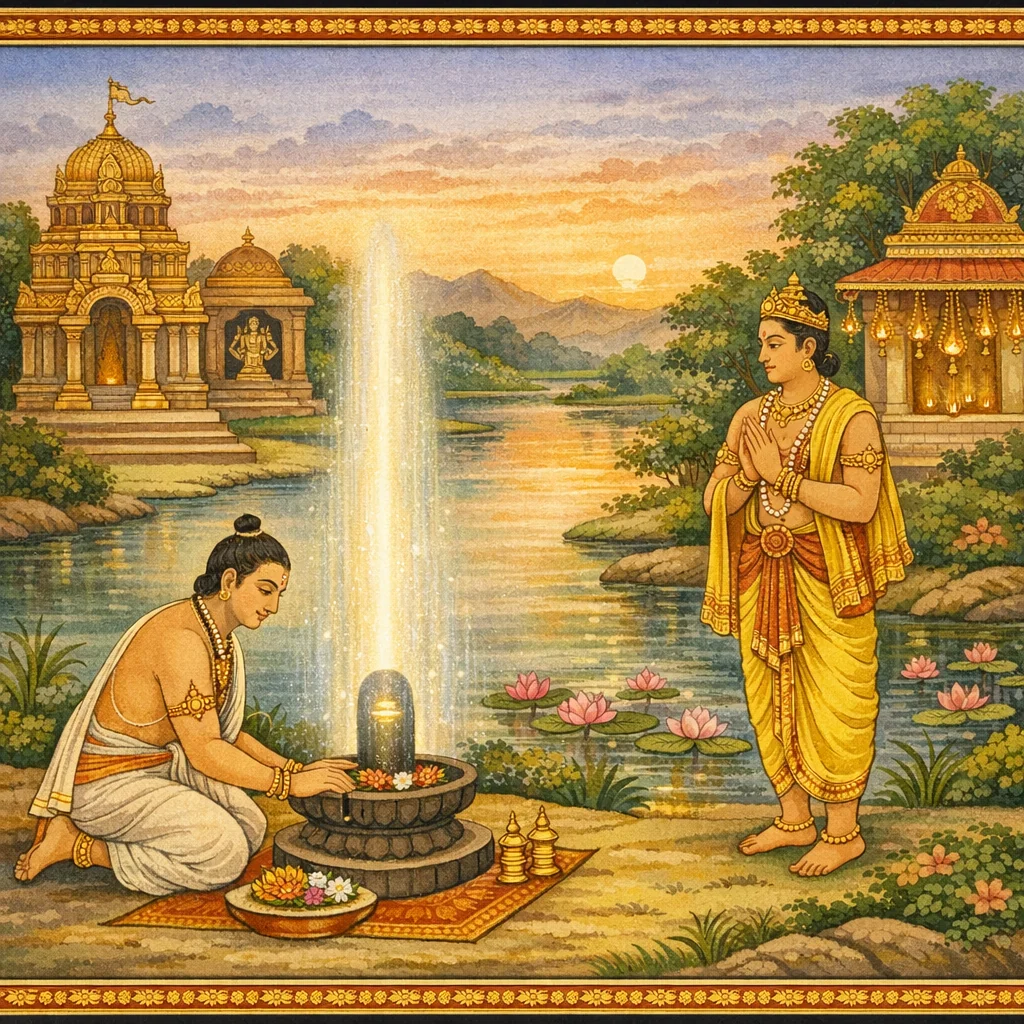
Sūta recounts how Puṣpa, having pleased Sūrya through a resolve of self-offering, consoles and guides the distressed brāhmaṇa Caṇḍaśarmā. Puṣpa foretells that Caṇḍaśarmā will not meet bodily downfall and that his lineage will become eminent among the Nāgaras. They move to the sacred Sarasvatī, settle on the southern bank, and establish an āśrama-like dwelling. Remembering an earlier vow connected with twenty-seven liṅgas, Caṇḍaśarmā undertakes disciplined practice: bathing in the Sarasvatī, observing purity, and performing japa of the six-syllabled mantra, along with recitation of liṅga-names and reverent prostration. He fashions liṅgas from clay and mud (kardama) and worships daily, keeping the ethical injunction not to disturb any liṅga even if poorly situated, until the count reaches twenty-seven. Pleased by this overflowing bhakti, Śiva reveals a liṅga from the earth and instructs him to worship it to gain the full fruit of the twenty-seven liṅgas; the same merit is promised to any devotee who worships it with devotion. Caṇḍaśarmā builds a prāsāda and names the liṅga Nāgareśvara, tying it to the remembrance of the town’s liṅgas, and later attains Śivaloka. Puṣpa also स्थापित establishes a Sūrya icon called Nāgarāditya at the Sarasvatī and receives the boon that worship there grants the complete fruit associated with the twelve solar forms at Cāmatkārapura. The chapter further introduces Caṇḍaśarmā’s wife Śākambharī, who installs Durgā on the auspicious riverbank; Devī promises immediate fruit to those who worship with bhakti, especially on Mahānavamī in the bright half of Āśvina, and the goddess becomes known by Śākambharī’s name. It concludes by affirming that worship after prosperity prevents obstacles to further growth.
Shlokas
Verse 1
सूत उवाच । एतस्मिन्नंतरे पुष्पः प्रहृष्टेनान्तरात्मना । चंडशर्मगृहं गत्वा दिष्ट्यादिष्ट्येति चाब्रवीत्
Sūta said: Meanwhile, Puṣpa—his inmost heart brimming with joy—went to Caṇḍaśarman’s house and cried out, “Fortune! Fortune!”
Verse 2
विवर्णवदनं दृष्ट्वा वाष्पपूर्णेक्षणं तदा । बान्धवैः सहितं सर्वैर्दारैर्भृत्यैस्तथा सुतैः
Then, seeing him with a pallid face and eyes brimming with tears—surrounded by all his kinsmen, together with wife, servants, and sons—
Verse 3
पुष्प उवाच । तवार्थे च मया सूर्यः कायत्यागेन तोषितः । पतितत्त्वं न ते काये तत्प्रसादाद्भविष्यति
Puṣpa said: For your sake, I pleased Sūrya by offering up my own body. By his grace, no fallen or ruined state shall come upon your body.
Verse 4
तव पुत्राश्च पौत्राश्च ये भविष्यंति वंशजाः । नागराणां च ते सर्वे भविष्यंति गुणाधिकाः
Your sons and grandsons—indeed all who shall be born in your lineage—will all become Nāgaras, endowed with surpassing virtues.
Verse 5
तस्मादुत्तिष्ठ गच्छामो नदीं पुण्यां सरस्वतीम् । तस्यास्तटे निवासाय कृत्वा चैवाश्रमं द्विज
Therefore arise; let us go to the holy river Sarasvatī. Upon her bank, for our dwelling, let us establish an āśrama, O twice-born one.
Verse 6
त्वया सह वसिष्यामि अहमेव न संशयः । अस्ति मे विपुलं वित्तं ये चान्ये तेऽनुयायिनः
I myself shall dwell with you—of this there is no doubt. I have abundant wealth, and there are also others who are your followers and attendants.
Verse 7
तान्सर्वान्पोषयिष्यामि त्यज्यतां मानसो ज्वरः । तच्छ्रुत्वा चण्डशर्मा तु पुत्रैर्बंधुभिरन्वितः
“I shall maintain and provide for them all—cast away the fever of the mind.” Hearing this, Caṇḍaśarmā, accompanied by his sons and kinsmen, prepared to act accordingly.
Verse 8
सरस्वतीं समुद्दिश्य निष्क्रांतो नगरात्ततः । स्थानं प्रदक्षिणीकृत्य नमस्कृत्य सुदुःखितः
Then, setting his intention upon the Sarasvatī, he departed from the city. Deeply afflicted, he circumambulated the sacred place and bowed in reverence.
Verse 9
बाष्पपूर्णेक्षणो दीन उत्तराभिमुखो ययौ । पुष्पेण सहितश्चैव मुहुर्मुहुः प्रबोधितः
His eyes brimming with tears, wretched and humbled, he went on facing north. And with Puṣpa beside him, he was again and again urged onward and awakened to his purpose.
Verse 10
ततः सरस्वतीं प्राप्य पुण्यां शीतजलां नदीम् । सेवितां मुनिसंघैस्तां लोलकल्लोलमालिनीम्
Then he reached the Sarasvatī—the holy river of cool, pure waters—attended by hosts of sages, and adorned with garlands of playful, rolling waves.
Verse 11
तस्या दक्षिणकूले स निवासमकरोत्तदा । पुष्पस्य मतिमास्थाय बन्धुभिः सकलैर्वृतः
There, on her southern bank, he then made his dwelling—accepting Puṣpa’s counsel—surrounded by all his relatives.
Verse 12
तस्यासीन्नगरस्थस्य प्रतिज्ञा चण्डशर्मणः । सप्तविंशति भिर्लिंगैर्दृष्टैभोक्ष्याम्यहं सदा
This was the vow of Caṇḍaśarmā while he lived in the city: “Only after beholding the twenty-seven liṅgas shall I ever take my meal.”
Verse 13
तां च संस्मरतस्तस्य प्रतिज्ञां पूर्वसंचिताम् । हृदयं दह्यते तस्य दिवानक्तं द्विजोत्तमाः
And as he remembered that vow—made earlier and firmly stored within—his heart burned day and night, O best of the twice-born.
Verse 14
स च स्नात्वा सरस्वत्यां शुचिर्भूत्वा समाहितः । षडक्षरस्य मन्त्रस्य जपं चक्रे पृथक्पृथक्
And he, having bathed in the Sarasvatī, becoming purified and composed, performed japa of the six-syllabled mantra—each repetition carefully and distinctly.
Verse 15
नाम चोच्चार्य लिंगस्य नमस्कारान्तमादधे । कर्दमेन द्विजश्रेष्ठाः पंचांगुलशतेन च
Uttering the name of the liṅga, he concluded with an act of obeisance. And with clay-mud—measured as a hundred spans of five fingers, O best of brāhmaṇas—he prepared the material for worship and installation.
Verse 16
संस्थाप्य पूजयेद्भक्त्या पुष्पधूपानुलेपनैः । प्राणरुद्राञ्जपन्पश्चाच्छ्रद्धया परया युतः
Having duly installed it, one should worship with devotion—offering flowers, incense, and fragrant unguents. Thereafter, endowed with supreme faith, one should perform japa of the Prāṇarudras.
Verse 17
दुःस्थितं सुस्थितं वापि शिवलिंगं न चालयेत् । इति मत्वा द्विजेन्द्रोऽसौ नैव तानि विसर्जयेत्
“Whether a Śiva-liṅga is ill-placed or well-placed, it should not be disturbed.” Holding to this principle, that best of brāhmaṇas did not abandon those liṅgas.
Verse 19
उपर्युपरि तेषां च कर्दमेन द्विजोत्तमाः । चक्रे लिंगानि नित्यं स सप्तविंशतिसंख्यया
And upon them, layer after layer, that excellent brāhmaṇa continually fashioned liṅgas from clay—twenty-seven in number.
Verse 20
अथ तुष्टो महादेवस्तस्य भक्त्यतिरेकतः । निर्भिद्य धरणीपृष्ठं तस्य लिंगमदर्शयत्
Then Mahādeva, pleased by the overflow of his devotion, split open the earth’s surface and revealed to him His liṅga.
Verse 21
अब्रवीत्सादरं तं च मेघगम्भीरया गिरा । चण्डशर्मन्प्रतुष्टोस्मि तव भक्त्याऽनया द्विज
And He spoke to him with reverence, in a voice deep as thunderclouds: “O Caṇḍaśarman, O brāhmaṇa, I am greatly pleased by this devotion of yours.”
Verse 22
तस्माल्लिंगमिदं नित्यं पूजयस्व प्रभक्तितः । सप्तविंशतिलिंगानां यतः फलमवाप्स्यसि
“Therefore worship this liṅga daily with wholehearted devotion; by it you shall obtain the fruit equal to (the worship of) twenty-seven liṅgas.”
Verse 23
अन्योपि च नरो भक्त्या यश्चैनं पूजयिष्यति । सप्तविंशतिलिंगानां सोऽपि श्रेयोऽभिलप्स्यति
“And any other person too, who worships this (liṅga) with devotion, shall likewise attain the higher good—the merit of (worshipping) twenty-seven liṅgas.”
Verse 24
एवमुक्त्वा स भगवांस्ततश्चादर्शनं गतः । चंडशर्मापि तं हृष्टः पूजयामास तत्त्वतः
Having spoken thus, the Blessed Lord then vanished from sight. And Caṇḍaśarman too, filled with joy, worshipped that (liṅga) in accordance with the true rite and understanding.
Verse 25
प्रासादं कारयामास तस्य लिंगस्य शोभनम् । नाम चक्रे ततस्तस्य विचार्य च मुहुर्मुहुः
He caused a splendid temple to be built for that liṅga. Then, reflecting again and again, he bestowed a name upon it.
Verse 26
नगरस्थित लिंगानां यस्मात्संस्मरणात्स्थितः । नागरेश्वरसंज्ञस्तु तस्मादेष भविष्यति
Because this liṅga stands established through the remembrance of the liṅgas situated in the city, therefore it shall be known by the name “Nāgareśvara.”
Verse 27
सूत उवाच । एवं संस्थाप्य तल्लिंगं चंडशर्मा द्विजोत्तमाः । आराधयामास तदा पुष्पधूपानुलेपनैः
Sūta said: Thus, having established that liṅga, Caṇḍaśarman—the foremost of brāhmaṇas—then worshipped it with offerings of flowers, incense, and unguents.
Verse 28
सप्तविंशतिलिंगानां प्राप्नोति च तथा फलम् । पूजितानां द्विजश्रेष्ठा नगरे यानि तानि च
O best of twice-born ones, he attains the very same merit as from worshipping the twenty-seven liṅgas—those that are worshipped there in the city.
Verse 29
ततः कालेन महता नागरेश्वरतुष्टितः । शिवलोकं गतः साक्षाद्यानमध्ये निवेशितः
Then, after a long time, having pleased Nāgareśvara, he went directly to Śiva’s world and was installed in the midst of the divine celestial car.
Verse 30
पुष्पोपि स्थापयामास पुष्पादित्यमथापरम् । पुण्ये सरस्वतीतीरे ततः पूजापरोऽभवत्
Puṣpa too established another deity, Puṣpāditya. Upon the holy bank of the Sarasvatī, he thereafter became wholly devoted to worship.
Verse 31
तस्यापि दर्शनं गत्वा प्रीत्या वचनमब्रवीत् । पुष्प तुष्टोस्मि भद्रं ते वरं प्रार्थय सुव्रत
Going to behold him, the deity spoke with affection: “Puṣpa, I am pleased with you—may you be blessed. O man of good vows, ask for a boon.”
Verse 32
अदेयमपि दास्यामि तस्मात्प्रार्थय मा चिरम्
“Even what is ordinarily not to be given, I will grant; therefore ask—do not delay.”
Verse 33
पुष्प उवाच । यदि तुष्टोऽसि मे देव यदि देयो वरो मम । तद्देहि याचमानस्य मम यद्धृदि संस्थितम्
Puṣpa said: “If you are pleased with me, O Lord, and if a boon is to be granted to me—then give to me, who ask, that which is set within my heart.”
Verse 34
चमत्कारपुरे देव तव या मूर्तयः स्थिताः । द्वादशैव प्रमाणेन पूज्याः सर्वदिवौकसाम्
“O Lord, the forms of yours that stand in Camatkārapura—twelve in measure—are worshipped by all the dwellers of heaven.”
Verse 35
तासां पूजाफलं कृत्स्नं संप्राप्नोतु नरो भुवि । यः पूजयति मूर्तिं ते यैषा संस्थापिता मया
“May a man on earth obtain the complete fruit of worship of all those (twelve forms), if he worships this form of yours which has been established by me.”
Verse 36
नागरादित्य इत्येषा ख्याता भवतु भूतले । येयं सरस्वतीतीरे प्रासादे स्थापिता मया
May this form be renowned on earth as Nāgarāditya—this one which I have installed in a temple upon the bank of the Sarasvatī.
Verse 37
सूत उवाच । स तथेति प्रतिज्ञाय गतश्चादर्शनं रविः । दीपवद्ब्राह्मणश्रेष्ठास्तदद्भुतमिवा भवत्
Sūta said: Having pledged, “So be it,” Ravi, the Sun, then vanished from sight. O best of brāhmaṇas, it appeared wondrous indeed—like a lamp suddenly withdrawn.
Verse 38
ततः कालेन महता पुष्पोपि द्विजसत्तमाः । सूर्यलोकमनुप्राप्तो विमानेन सुवर्चसा
Then, after a long time, O best of brāhmaṇas, even Puṣpa attained the world of the Sun, borne in a radiant celestial chariot.
Verse 39
शाकम्भरीति विख्याता भार्याऽसीच्चंडशर्मणः । तया संस्थापिता दुर्गा सरस्वत्याः शुभे तटे
Famed by the name Śākambharī, she was the wife of Caṇḍaśarman; and by her, Durgā was established upon the auspicious bank of the Sarasvatī.
Verse 41
पुत्रि तुष्टास्मि भद्रं ते शाकंभरि प्रगृह्यताम् । वरं यत्ते सदाभीष्टं मत्प्रसादादसंशयम्
“Daughter, I am pleased with you; may auspiciousness be yours, O Śākambharī. Accept a boon—whatever you always desire shall be granted by My grace, without doubt.”
Verse 42
शाकम्भर्युवाच । चतुःषष्टिगणा देवि मातृणां ये व्यवस्थिताः । चमत्कारपुरे ख्याता हास्यात्तुष्टिं व्रजंति याः
Śākambharī said: “O Goddess, the sixty-four companies of the Mothers, duly stationed—those famed in Camatkārapura, who are satisfied through sacred laughter—”
Verse 43
या रात्रौ बलिदानेन जाते वृद्धौ ततः परम् । तत्सर्वं जायतां पुण्यं यस्ते मूर्तिं प्रपूजयेत्
Whatever increase of benefit arises thereafter from the nighttime offering of bali—may all of it become merit for the one who duly worships your sacred image.
Verse 44
अत्रागत्य नदीतीरे यैषा संस्थापिता मया
Having come here to the riverbank, this (form of the Goddess) was installed by me—
Verse 45
श्रीदेव्युवाच । आश्विनस्य सिते पक्षे महानवमिसंज्ञिते । यो ममाग्रे समागत्य पूजयिष्यति भक्तितः
The Blessed Goddess said: “In the bright fortnight of Āśvina, on the day known as Mahānavamī, whoever comes before Me and worships with devotion—”
Verse 46
तस्य कृत्स्नं फलं सद्यो भविष्यति न संशयः । नागरस्य विशेषेण सत्यमेतन्मयोदितम्
“For that devotee, the complete fruit will arise immediately—there is no doubt. In Nāgara, this sacred region especially, this is true; thus have I declared.”
Verse 47
एवमुक्त्वा तु सा देवी ततश्चादर्शनं गता । तस्या नाम्ना च सा देवी प्रोक्ता शाकम्भरी भुवि
Having spoken thus, that Goddess then vanished from sight. And on earth, that Goddess came to be known by her name as “Śākambharī.”
Verse 48
वृद्धेरनंतरं तस्या यः पूजां कुरुते नरः । तस्य वृद्धेर्न विघ्नः स्यात्कदाचिद्द्विजसत्तमाः
O best of Brahmins, the man who worships her after seeking prosperity—his prosperity will never, at any time, be met with obstacles.
Verse 164
इति श्रीस्कांदे महापुराण एकाशीतिसाहस्र्यां संहितायां षष्ठे नागरखण्डे श्रीहाटकेश्वरक्षेत्रमाहात्म्ये नागरेश्वरनागरादित्यशाकम्भर्युत्पत्तिवर्णनंनाम चतुःषष्ट्युत्तरशततमोऽध्यायः
Thus ends, in the revered Skanda Mahāpurāṇa—within the eighty-one-thousand-verse Saṃhitā, in the sixth division, the Nāgara Khaṇḍa—within the Māhātmya of the sacred Śrī Hāṭakeśvara holy region, the chapter entitled “The Account of the Origin of Nāgareśvara, Nāgarāditya, and Śākambharī,” being Chapter 164.