Adhyaya 16
Chapter 16, spoken by Sūta, teaches that in the sacred field born of Hāṭakeśvara (hāṭakeśvara-sambhava kṣetra), the highest priority is devotional nearness to—and service of—the presence of Raktaśṛṅga. The wise are urged to set aside other pursuits and attend to that holy presence with faith. The teaching is framed as a hierarchy of merits, relativizing renowned paths of religious merit: dāna (gifts), ritual performance (kriyākāṇḍa), yajñas such as Agniṣṭoma with full fees, severe vratas like Cāndrāyaṇa and Kṛcchra, and famous tīrthas such as Prabhāsa and the Gaṅgā. In direct comparison, it is said that none of these equals even one sixteenth of this kṣetra’s merit. Examples widen the claim: royal sages of old attained siddhi there; and even animals, birds, serpents, and predators, when destroyed by time, are said to reach a divine abode through their connection with the place. The chapter ends with a graded doctrine of purification: tīrthas purify by residence, but Hāṭakeśvara-kṣetra purifies even by remembrance—more by sight, and most of all by touch—presenting sanctity as mediated through embodied encounter.
Shlokas
Verse 1
। सूत उवाच । तस्मात्सर्वप्रयत्नेन त्यक्त्वाऽन्या निखिलाः क्रियाः । रक्तशृंगस्य सांनिध्यं सेवनीयं विचक्षणैः
Sūta said: Therefore, with every effort—abandoning all other activities—the wise should resort to and attend upon the sacred presence of Raktaśṛṅga.
Verse 2
किं दानैः किं क्रियाकांडैः किं यज्ञैः किं व्रतैरपि । तत्क्षेत्रं सेवयेद्भक्त्या हाटकेश्वरसंभवम्
What need is there of gifts, of elaborate rites, of sacrifices, or even of vows? With devotion one should instead worship and frequent that holy region associated with Hāṭakeśvara.
Verse 3
अग्निष्टोमादयो यज्ञाः सर्वे संपूर्णदक्षिणाः । तस्य क्षेत्रस्य पुरतः कलां नार्हंति षोडशीम्
Sacrifices such as the Agniṣṭoma—though performed with every gift and dakṣiṇā fully completed—do not equal even a sixteenth part of the merit that shines before that sacred kṣetra.
Verse 4
चान्द्रायणानि कृच्छ्राणि तथा सांतपनानि च । तस्य क्षेत्रस्य पुरतः कलां नार्हंति षोडशीम्
Cāndrāyaṇa observances, Kṛcchra penances, and Sāṃtapana austerities as well—none of these equals even a sixteenth part of the merit of that sacred kṣetra.
Verse 5
प्रभासाद्यानि तीर्थानि गङ्गाद्याः सरितस्तथा । तस्य क्षेत्रस्य पुरतः कलां नार्हंति षोडशीम्
Even famed pilgrimage places beginning with Prabhāsa, and rivers beginning with the Gaṅgā—none of them equals even a sixteenth part of the merit of that sacred kṣetra.
Verse 6
भूमिदानानि सर्वाणि धर्माः सर्वे दयादिकाः । तस्य क्षेत्रस्य पुरतः कलां नार्हंति षोडशीम्
All gifts of land, and all forms of dharma such as compassion and the rest—none of these equals even a sixteenth part of the merit of that sacred kṣetra.
Verse 7
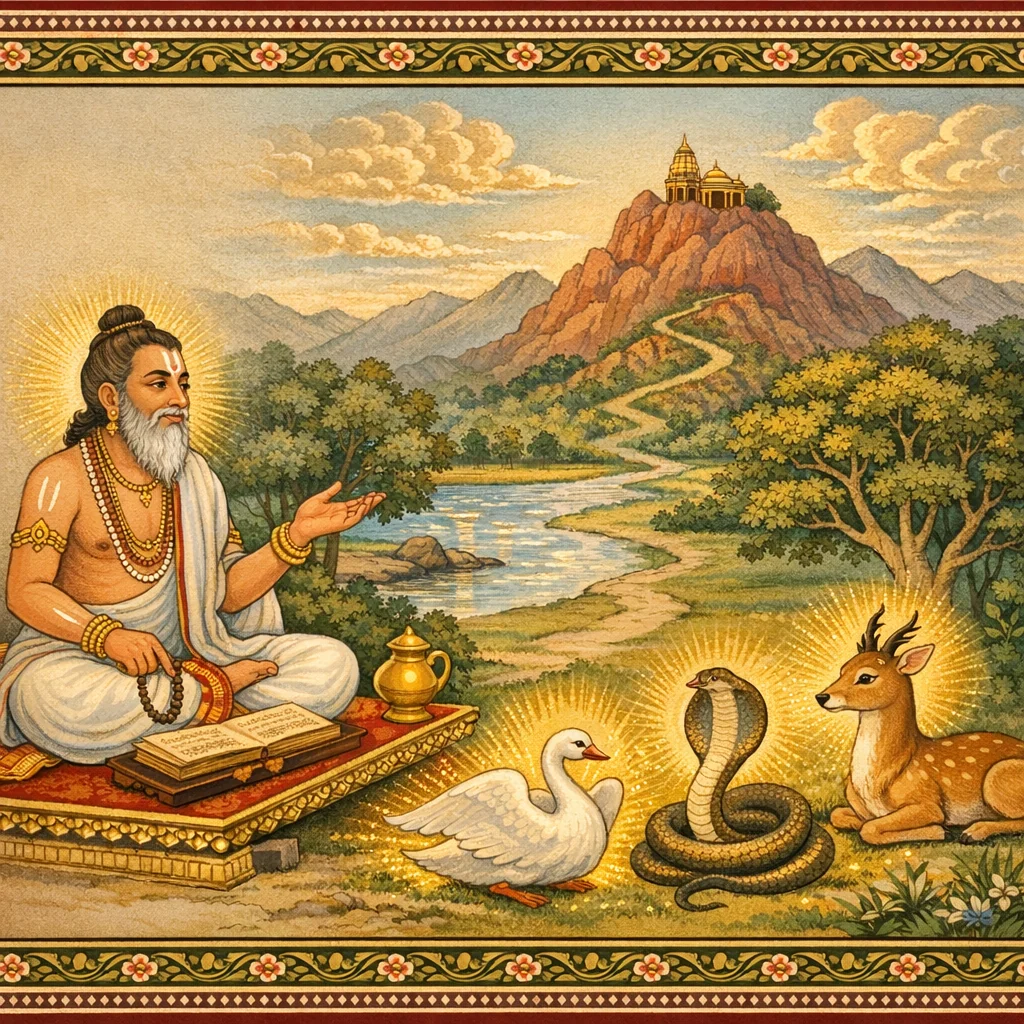
तत्र राजर्षयः पूर्वं प्रभूताः सिद्धिमागताः । पशवः पक्षिणः सर्पाः सिंहव्याघ्रा मृगादयः
There, in former times, many royal sages (rājarṣi) attained perfection (siddhi). Even living beings—beasts, birds, serpents, lions, tigers, deer, and others—were touched by the power of that place.
Verse 9
तत्र कालवशान्नष्टास्तेऽपि प्राप्ता दिवालयम् । यस्तत्र व्रतहीनोऽपि कृषिकर्मरतोऽपि वा
There, even those who perished under the dominion of Time attained the abode of the gods. Indeed, whoever is there—even if without vows, even if devoted only to the work of farming—…
Verse 10
श्रूयतां परमं गुह्यं तस्य क्षेत्रस्य संभवम् । पुनंति क्षेत्रतीर्थानि संवासादिह मानवान्
Hear the supreme secret concerning the origin of that sacred region. The tīrthas and holy fords of that kṣetra purify human beings here, simply through dwelling (there).
Verse 11
हाटकेश्वरजं क्षेत्रं पुनाति स्मरणादपि । किं पुनर्दर्शनाद्विप्राः स्पर्शनाच्च विशेषतः
O brāhmaṇas, the sacred region of Hāṭakeśvara purifies even by mere remembrance; how much more, then, by beholding it—and most especially by touching it.
Verse 16
इति श्रीस्कांदे महापुराण एकाशीतिसाहस्र्यां संहितायां षष्ठे नागरखण्डे हाटकेश्वरक्षेत्रमाहात्म्ये रक्तशृङ्गसांनिध्यसेवनफलश्रैष्ठ्यवर्णनंनाम षोडशोऽ ध्यायः
Thus ends the sixteenth chapter, called “The Description of the Supreme Excellence of the Fruit gained by Serving in the Presence of Raktaśṛṅga,” in the Hāṭakeśvara-kṣetra Māhātmya, within the sixth Nāgara Khaṇḍa of the Śrī Skanda Mahāpurāṇa, in the Saṃhitā of eighty-one thousand verses.