Adhyaya 159
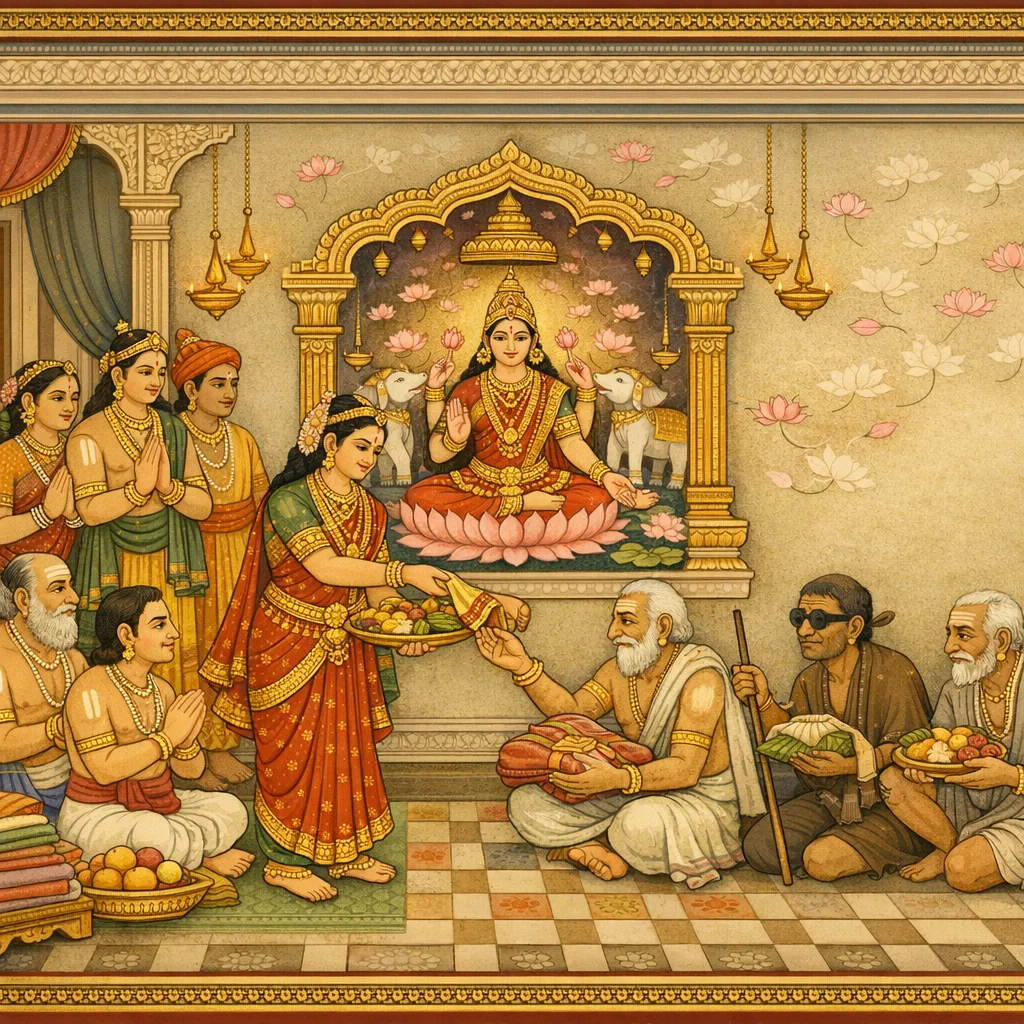
Sūta recounts an episode in a temple setting: Puṣpa arrives joyfully at Maṇibhadra’s residence with his relatives, amid auspicious music of conch and drums. The narrative presents prosperity as arising through Bhāskara’s grace and as something that carries social responsibility within the community. Puṣpa gathers his kin and reflects on the fickleness of fortune, calling Lakṣmī “cala,” ever-moving and unstable. Remembering his former state as a long season of hardship, he recognizes the transience of wealth and, under a truth-vow, resolves to distribute his resources widely. He then apportions garments and ornaments to relatives according to rank, gives wealth and clothing with faith to Veda-knowing Brahmins, and provides food and garments to performers—especially to the poor and the blind. Finally, he eats with his wife, dismisses the assembled people, and thereafter lives with the obtained wealth in an orderly, deliberate way. The chapter thus models ethical wealth-management: prosperity is sanctified through ritualized generosity and care for the community in a kṣetra-linked sacred environment.
Shlokas
Verse 1
सूत उवाच । पुष्पोऽपि तां समादाय माहिकाख्यां वरांगनाम् । स तदा प्रययौ हृष्टो मणिभद्रस्य मंदिरम्
Sūta said: Puṣpa too, taking with him the noble woman named Māhikā, then set out joyfully toward Maṇibhadra’s residence.
Verse 2
शंखतूर्यनिनादेन सर्वैस्तैः स्वजनैर्वृतः । न कस्य तत्र संभूतो विकल्पस्तत्समुद्भवः
Amid the blare of conches and trumpets, surrounded by all his own people, no one there entertained any doubt or suspicion arising from that situation.
Verse 3
भास्करस्य प्रसादेन तथैवान्यस्य कर्हिचित् । सोऽपि मंदिरमासाद्य यथात्मपितृसंभवम्
By the grace of Bhāskara (the Sun)—and at times by another’s favor as well—he too reached that mansion, in a manner befitting his lineage and his paternal standing.
Verse 4
उपविश्य ततो मध्ये बन्धून्सर्वान्समाह्वयत् । अद्य तावद्दिने मह्यं तुलाग्रं कमला श्रिता
Then, seating himself in the midst, he summoned all his kinsmen. “Today indeed, for me, Lakṣmī has come to rest upon the tip of the balance,” he declared, exulting in his fortune.
Verse 5
चलितापि पुनश्चास्याः सुपत्न्या वाक्यतः स्थिता । कियंतं चैव कालं मे कार्पण्यं महदास्थितम्
Though she was ready to depart again, she remained—held back by the words of that virtuous co-wife. “For how long,” he reflected, “has great wretchedness and helpless poverty clung to me?”
Verse 6
ज्ञातमद्य चला लक्ष्मीस्तेन त्यक्तं सुदूरतः । तस्माद्बंधुजनैः सार्धं देवैर्विप्रैश्च कृत्स्नशः । संविभक्तां करिष्यामि सत्येनात्मानमालभे
“Today I have understood that fortune is fickle; therefore I have cast it far away. Hence, together with my kinsmen—and wholly, with the gods and the Brahmins—I shall distribute it in shares. By truth, I bind myself to this resolve.”
Verse 7
एवमुक्त्वा ततः सर्वान्समाहूय पृथक्पृथक् । स नामभिर्ददौ वस्त्रं भूषणानि यथार्हतः
Having spoken thus, he then summoned everyone—one by one—and, calling each by name, gave garments and ornaments to each according to their due.
Verse 8
ततो वेदविदो विप्रान्समाहूय स नामभिः । एकैकस्य ददौ वित्तं सवस्त्रं श्रद्धयान्वितः
Then he summoned the Brahmins learned in the Vedas, calling each by name, and to every single one he gave wealth together with garments, filled with faith.
Verse 9
ततस्तु नर्तकेभ्यश्च दीनांधेभ्यो विशेषतः । ददौ भोज्यं समि ष्टान्नं सवस्त्रं च द्विजोत्तमाः
Thereafter, and especially to dancers, to the poor, and to the blind, the best of the twice-born gave food—choice cooked offerings—and also garments.
Verse 10
ततस्तु स्वयमेवान्नं बुभुजे भार्यया सह । विसृज्य तान्समायातान्स्वजनान्ब्राह्मणैः सह
Then he himself ate food together with his wife, after respectfully dismissing those who had come—his kinsmen along with the Brahmins.
Verse 11
एवं तेन तदा प्राप्तं वित्तं च परसंभवम् । बुभुजे स्वेच्छया नित्यं तदा भार्यासमन्वितः
Thus, with the wealth he had obtained then—arising from another source—he lived and enjoyed as he wished each day, at that time accompanied by his wife.
Verse 159
इति श्रीस्कांदे महापुराण एकाशीति साहस्र्यां संहितायां षष्ठे नागरखण्डे हाटकेश्वरक्षेत्रमाहात्म्ये पुष्पविभवप्राप्तिवर्णनंनामैकोनषष्ट्युत्तरशततमोऽध्यायः
Thus ends the one-hundred-and-fifty-ninth chapter, called “The Description of Attaining Prosperity through Puṣpa’s Fortune,” in the Hāṭakeśvara-kṣetra-māhātmya of the sixth book, the Nāgarakhaṇḍa, within the Śrī Skanda Mahāpurāṇa, in the eighty-one-thousand-verse compendium.