Adhyaya 157
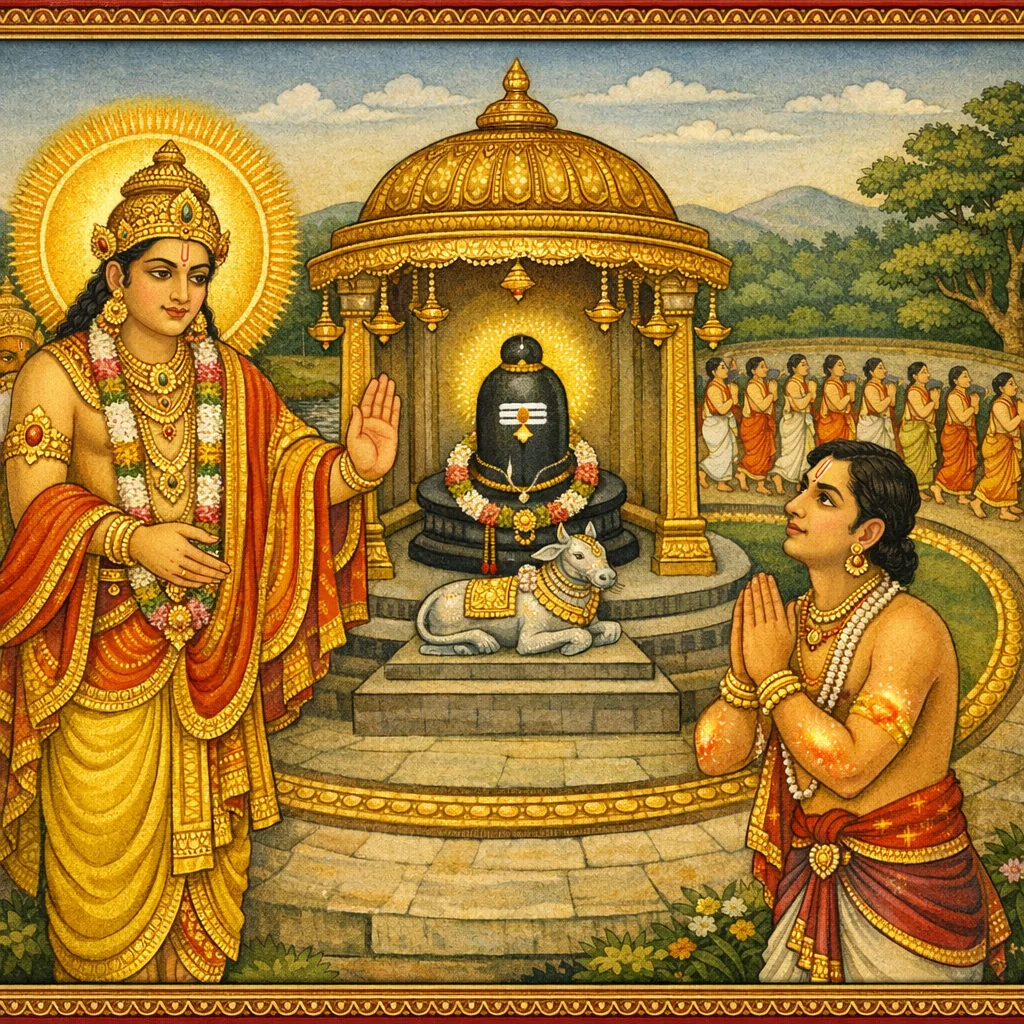
Chapter 157 offers a tightly ordered teaching on how ritual efficacy depends upon intention. Sūta relates that the brāhmaṇa Puṣpa, distressed and angered, refuses to eat until he finds a remedy for a fault he believes has occurred, and he seeks a deity or mantra famed for giving immediate results. People direct him to a Sun shrine at Cāmatkārapura, said to have been established by Yājñavalkya, and describe the observance: on a Sunday that falls on the seventh lunar day (saptamī), a devotee holding fruit performs 108 pradakṣiṇās to gain the desired success; they also mention Śāradā in Kāśmīra as granting accomplishments through fasting. Puṣpa goes to Cāmatkārapura, bathes, completes 108 circumambulations, and offers extended praise with ritual acts. The narrative rises into a detailed homa sequence—altar preparation (kuśāṇḍikā), mantra-guided placements, and oblations—until Puṣpa attempts an extreme offering of his own flesh, revealing a tāmasic, coercive mode of worship. Sūrya appears, restrains him, and grants two pills (white and black) that allow temporary disguise and return to his own form, along with knowledge connected to a wealthy man in Vaidīśa named Maṇibhadra. Puṣpa then asks why the promised immediate fruit of the 108 pradakṣiṇās did not manifest. Sūrya explains that actions done in a tāmasic disposition become fruitless: outward correctness cannot compensate for corrupted intention. He heals Puṣpa’s wounds and disappears, leaving the central doctrine that bhāva—the mental and ethical quality of one’s heart—governs the outcome of ritual.
Shlokas
Verse 1
सूत उवाच । एवं संबोधितस्तैस्तु लोकैः पुष्पस्तदा द्विजाः । तानब्रवीत्ततः कुद्धो न करिष्यामि भोजनम्
Sūta said: Thus addressed by those people, Puṣpa the brāhmaṇa then spoke to them in anger: “I will not take food.”
Verse 2
यावन्न चास्य पापस्य करिष्यामि प्रतिक्रियाम् । तद्वदध्वं महाभागा देवो वा देवताऽथवा
“So long as I have not performed the proper remedy for this sin, tell me, O noble ones—whether it is a Deva or some Devatā who must be approached.”
Verse 3
तथान्ये सिद्धमन्त्रा वा सद्यः प्रत्ययकारकाः । आराधिता यथा सद्यो मानुषाणां वरप्रदाः
“Or else tell me of other perfected mantras that bring immediate assurance—those which, when duly worshiped, promptly grant boons to human beings.”
Verse 4
जना ऊचुः । एको देवः स्थितश्चात्र सद्यःप्रत्ययकारकः । तथैका देवता चात्र श्रूयते जगती तले
The people said: “Here a single Deva is established, bringing immediate certainty (by granting swift, visible results). And here upon the earth’s surface, one particular Devatā, a goddess, is also spoken of.”
Verse 5
पुष्प उवाच । कोऽसौ देवः कियद्दूरे कस्मिन्स्थाने व्यवस्थितः । तथा च देवता ब्रूत दयां कृत्वा ममोपरि
Puṣpa said: “Who is that Deva? How far away is he, and in what place is he established? And tell me also of that Devatā—have compassion upon me.”
Verse 6
जना ऊचुः । चमत्कारपुरे सूर्यो याज्ञवल्क्यप्रतिष्ठितः । अस्ति विप्र श्रुतोऽस्माभिः सद्यः प्रत्ययकारकः
The people said: “In Camatkārapura there is Sūrya, the Sun-god, installed by Yājñavalkya. O brāhmaṇa, we have heard that he is truly there, bringing immediate certainty—granting swift, tangible results.”
Verse 7
सूर्यवारेण सप्तम्यां फलहस्तः प्रदक्षिणाम् । यः करोति नरस्तस्य ह्यष्टोत्तरशतं द्विज
On a Sunday, on Saptamī (the seventh lunar day), the man who performs pradakṣiṇā with fruit in his hand—O brāhmaṇa—should complete one hundred and eight circumambulations.
Verse 8
तस्य सिद्धिप्रदः सम्यङ्मनसा वांछितं ददेत् । तथान्या शारदा नाम देवी काश्मीरसंस्थिता
That Sūrya bestows siddhi and, in due measure, grants what the mind desires. Likewise, there is another goddess named Śāradā, established in Kāśmīra.
Verse 9
उपवासकृतेरेव सापि सिद्धिप्रदायिनी । तच्छ्रुत्वा वचनं तेषां जनानां स द्विजोत्तमाः
She too bestows siddhi, precisely through the observance of upavāsa (fasting). Hearing these words spoken by the people, that excellent brāhmaṇa (Puṣpa)…
Verse 10
समुद्दिश्य चमत्कारं तस्मात्स्थानात्ततः परम् । चमत्कारपुरं प्राप्य सप्तम्यां सूर्यवासरे
Then, setting his aim upon that ‘Camatkāra’ (wonder-working shrine), he departed from that place and went onward, reaching Camatkārapura on Saptamī, on a Sunday.
Verse 11
तत्रागत्य ततः स्नात्वा शुचिर्भूत्वा समाहितः । गतः संति ष्ठते यत्र याज्ञवल्क्यकृतो रविः
Arriving there, he bathed; becoming pure and composed in mind, he went to the place where Ravi, the Sun established by Yājñavalkya, stands.
Verse 12
ततः प्रदक्षिणाः कृत्वा अष्टोत्तरशतं मिताः । नालिकेराणि चादाय श्रद्धया परयाः युतः
Then, having performed one hundred and eight measured circumambulations, and taking coconuts as offerings, he was filled with the highest faith.
Verse 13
ततः क्षुत्क्षामकंठः स परिश्रांतस्तदग्रतः । उपविष्टो जपं कुर्वन्सूर्येष्टैः स्तवनैस्तदा
Thereafter, his throat parched from hunger and himself weary, he sat down before the deity. Then he performed japa, praising Sūrya with hymns dear to the Sun.
Verse 14
मंडलब्राह्मणाद्यैश्च तारं स्वरमुपाश्रितः । सप्तयुंजर वाद्यैश्च अग्निरेवेति भक्तितः
Supported by the Maṇḍala-brāhmaṇas and others, he raised a high, resonant chant; and with the music of the sevenfold instruments, he devoutly proclaimed, “Agni indeed (is to be worshipped).”
Verse 15
आदित्यव्रतसंज्ञाद्यैः सामभिर्दृढभक्तिभाक् । क्षुरिकामंत्रपूर्वैश्च तथैवाथर्वणोद्भवैः
Steadfast in devotion, he praised the deity with Sāman-chants known by names such as the Ādityavrata, and likewise with mantras beginning with the Kṣurikā, and with those arising from the Atharva tradition.
Verse 16
यावदन्योर्कवारस्तु नैव तुष्टो दिवाकरः । पौर्णमासीदिने प्राप्ते वैराग्यं परमं गतः
So long as it was another (unsuitable) day, the Sun was not pleased; but when the day of the Full Moon arrived, he attained the highest dispassion (vairāgya) and purity of resolve.
Verse 17
ततः पुष्पो विधायाथ स्नानं धौतांबरः शुचिः । भूनाम्ना साध्य भूमिं च स्थंडिलार्थं द्विजोत्तमाः
Then, having made the floral offering, he bathed; wearing washed garments and purified, that best of the twice-born prepared the ground with the “Bhū” formula for establishing the sthaṇḍila, the ritual altar-space.
Verse 18
स्थंडिलं हस्तमात्रं च स्थंडिले प्रत्यकल्पयत् । अग्निमीऌएतिमंत्रेण ततोऽग्निं स निधाय च
He fashioned a sthaṇḍila measuring a hand’s span and arranged the rite upon it; then, with the mantra beginning “Agnim īḷe…”, he installed the sacred fire.
Verse 19
तृणैः परिस्तृणामीतिकृत्वोपस्तरणं ततः । आब्रह्मन्निति मन्त्रेण दत्त्वा ब्रह्मासनं ततः
Then, spreading sacred grass with the formula “paristṛṇāmi”, he made the proper covering; thereafter, with the mantra “ā brahman…”, he offered the seat for Brahman, the priestly and divine principle.
Verse 20
सुत्रामाणमिति प्रोच्य समिधःस्थापनं च यत् । प्रोक्षणीपात्रमासाद्य प्रोक्षणं कृतवांस्ततः
Reciting “Sutrāmāṇam…”, he set the kindling-sticks (samidh) in place; then, taking up the sprinkling vessel (prokṣaṇī), he performed the purificatory ritual sprinkling.
Verse 21
पात्राणामथ सर्वेषां स्रुवादीनां यथाक्रमम् । ततः प्रकल्पयामास हविःस्थाने निजां तनुम्
Next, he arranged all the vessels—beginning with the ladles (sruva) and the rest—in their proper order; then he duly positioned himself at the place where the havis, the oblations, are offered.
Verse 22
न्यायं तु देवतास्थाने स आचार्यविधानतः । ग्रहणं प्रोक्षणं चैव सूर्याय त्वेति चोत्तरम्
At the deity’s shrine he carried out the proper rite according to the teacher’s ordinance—receiving the offering, sprinkling it with purifying water, and then concluding with the utterance: “For Sūrya—this is for You.”
Verse 23
अयं त इध्म आत्मेति जप्त्वाथ समिधं ततः । अग्निसोमेति मन्त्राभ्यां हुत्वा चाज्याहुती ततः
Muttering, “This fuel is Your very Self,” he offered the kindling; thereafter, with the two mantras “Agnī–Soma…,” he poured ghee oblations into the fire.
Verse 24
कृत्वा व्याहृतिहोमं तु भूर्भुवः स्वेति भो द्विजाः । ये ते शतेति मन्त्राद्यैर्हुत्वात्रैव च दारुणम्
O twice-born ones, having performed the vyāhṛti-homa with “Bhūḥ, Bhuvaḥ, Svaḥ,” he then offered right there, with the mantras beginning “ye te śata…,” a fierce and dreadful oblation.
Verse 25
आह्वयामास वह्निं च प्रत्यक्षो भव देव मे । एवं मन्त्रेण कृत्वा तं संमुखं ज्वलनं ततः
He invoked Agni: “Become manifest before me, O my divine Lord!” By such a mantra he caused the blazing fire to appear directly before him.
Verse 26
कालीकरालिकाद्याश्च सप्तजिह्वाश्च याः स्मृताः । तासामाह्वानकं कृत्वा ततो दीप्ते हविर्भुजि
And the seven tongues of Fire that are remembered—beginning with Kālī and Karālikā—having invoked them, then, when the oblation-eater (the Fire) blazed forth…
Verse 27
जुहाव च स मांसानि स्वानि चोत्कृत्त्य शस्त्रतः । लोमभ्यः स्वाहेति विदिशो दिग्भ्यो दत्त्वा ततः परम्
And he offered his own flesh, cutting it with a weapon; and uttering ‘Svāhā to the hairs!’ he made offerings to the intermediate directions—then further still…
Verse 28
अग्नये स्विष्टकृतैति यावदात्मानमाक्षिपेत् । तावद्धृतः स सूर्येण स्वहस्तेन समंततः
As he was about to cast himself (into the fire), saying ‘To Agni Sviṣṭakṛt (Svāhā),’ at that very moment he was restrained on all sides by Sūrya with his own hand.
Verse 29
धृतश्च सादरं तेन मा विप्र कुरु साहसम् । नेदृग्घोमः कृतः क्वापि कदाचित्केनचिद्द्विज
Restraining him respectfully, he said: ‘O brāhmaṇa, do not commit rashness. Never anywhere has such a homa been performed by anyone at any time, O twice-born.’
Verse 30
तुष्टोऽहं च महाभाग ब्रूहि किं करवाणि ते । अदेयमपि दास्यामि यत्ते मनसिवर्तते
“I am pleased, O greatly fortunate one. Tell me—what shall I do for you? Even what is normally not to be given, I shall grant, whatever abides in your mind.”
Verse 31
पुष्प उवाच । यदि तुष्टोसि देवेश यदि देयो वरो मम । तद्देयं गुटिकायुग्मं यदर्थं प्रार्थयाम्यहम्
“Puṣpa said: ‘If you are pleased, O Lord of gods, and if a boon is to be granted to me—then grant that pair of pellets (guṭikās) for which I am praying.’”
Verse 32
वैदिशे नगरे चास्ति मणिभद्रो महाधनी । कुब्जांगः क्षत्रियो देव जरावलिसमन्वितः
In the city of Vidiśā there dwells Maṇibhadra, exceedingly wealthy—a kṣatriya, O Lord, hunchbacked in body and marked by the garland of old age.
Verse 33
अब्रह्मण्यो महानीचः कीनाशो जनदूषितः । द्वयोरेकां यदा वक्त्रे सदा चैव करोम्यहम्
He is hostile to brāhmaṇas, utterly base, a miserly wretch, a defiler among people. And whenever there are two (shares), I always make them into one in his mouth (that is, I continually reduce his portion).
Verse 34
तदा मे तादृशं रूपमविकल्पं भवत्विति । यदा पुनर्गृहीत्वा तां द्वितीयां प्रक्षिपाम्यहम्
Then let me assume that very form, without any uncertainty. And when I take up the second one and cast it in again…
Verse 35
ततश्च सहजं रूपं मम भूयात्सुरेश्वर । वैदिशे नगरे चास्ति मणिभद्रः सुरेश्वर
And thereafter, O Lord of the gods, may my own natural form return. In the city of Vaidīśa there is one named Maṇibhadra, O Lord of the gods.
Verse 36
अपरं तस्य यत्किंचिद्धनधान्यादिकं गृहे । तत्सर्वं विदितं मे स्यात्तथा देव प्रजायताम्
Further, whatever wealth, grain, and the like he has in his house—may all of that become known to me. So may it be granted, O God.
Verse 37
किं वानेन बहूक्तेन तस्य मित्राणि बांधवाः । व्यवहारास्तथा सर्वे प्रकटाः स्युः सदैव हि
But what is the use of speaking at length? May his friends and kinsmen, and likewise all his dealings, be ever manifest to me.
Verse 38
न कश्चिज्जायते तत्र विकल्पः कस्यचित्क्वचित् । मम तस्याधम स्यापि सर्वकृत्येषु सर्वदा
There, no doubt would ever arise for anyone at any time. Even if I were the lowest in status, in all tasks, always, I would be effective.
Verse 39
भास्कर उवाच । गृहाण त्वं महाभाग गुटिकाद्वितयं शुभम् । शुक्लं कृष्णं च वक्त्रस्थं विभेद जननं महत्
Bhāskara said: “O fortunate one, take this auspicious pair of pellets—one white and one black. Kept in the mouth, they produce a great power of differentiation, with distinct effects.”
Verse 40
शुक्लया तस्य रूपं च तव नूनं भविष्यति । कृष्णयापि पुनः स्वं च संप्राप्स्यसि महाद्विज
By the white one, you will surely take on his form; and by the black one, O great brāhmaṇa, you will again regain your own form.
Verse 41
पुष्प उवाच । अपरं वद मे देव संदेहं हृदये स्थितम् । यत्त्वां पृच्छामि देवेश तव कीर्तिविवर्धनम्
Puṣpa said: “Tell me something further, O God—there is a doubt lodged in my heart. What I ask you, O Lord of gods, is for the increase of your glory.”
Verse 42
मया श्रुतं सुरश्रेष्ठ सप्तम्यां सूर्यवासरे । यस्ते प्रदक्षिणानां च कुर्यादष्टोत्तरं शतम् । तस्य त्वं तत्क्षणादेव फलहस्तस्य सिद्धिदः
I have heard, O best of the gods, that on the seventh lunar day, when it is Sunday, whoever performs for you one hundred and eight pradakṣiṇā (circumambulations)—to him you grant siddhi that very instant, as though placing the fruit of merit into his hand, giving immediate result.
Verse 43
मूर्खस्यापि च पापस्य सर्वदोषान्वितस्य च । चतुर्वेदस्य मे कस्मात्तीर्थयात्रापरस्य च
Whether it be even for a foolish sinner, laden with every fault—or for one versed in the four Vedas and devoted to tīrtha-yātrā (pilgrimage)—how, and why, is it so in my case?
Verse 44
सप्तरात्रे गते तुष्टो होम एवंविधे कृते
When the seven nights had passed, and this kind of homa (fire-offering) had been duly performed, the Lord became satisfied.
Verse 46
यत्किंचित्क्रियते विप्र तामसं भावमाश्रितैः । तत्सर्वं जायते व्यर्थं किं न वेत्ति भवा निदम्
O Brāhmaṇa, whatever act is done by those who have taken refuge in a dull, tamasic disposition—everything becomes fruitless. Why do you not know this?
Verse 47
एवमुक्त्वा ततः सूर्यस्तस्य गात्राण्युपास्पृशत् । खंडितानि स्वहस्तेन निर्व्रणानि कृतानि च
Having spoken thus, Sūrya then touched his limbs; and with his own hand he made the mangled parts whole, restoring them free of wounds.
Verse 48
अब्रवीच्च पुनः पुष्पं प्रसन्न वदनः स्थितः । अनेनैव विधानेन यः करोति कुशंडिकाम्
And again, standing there with a serene countenance, he spoke to Puṣpa: “Whoever performs the kuśaṇḍikā rite by this very procedure…”
Verse 49
श्रीसूर्य उवाच । तामसेन तु भावेन त्ववा सर्वमिदं कृतम् । तेन सर्वं वृथा जातं त्वया सर्वं च यत्कृतम्
Śrī Sūrya said: “But you did all this with a tamasic disposition; therefore everything has become vain—everything that was done by you.”
Verse 51
एवमुक्त्वा सहस्रांशुस्तत्रैवां तरधीयत । दीपवल्लक्षितो नैव केन मार्गेण निर्गतः
Having spoken thus, Sahasrāṃśu (the thousand-rayed Sun) vanished right there. He was not seen even like a lamp—nor was it known by what path he departed.
Verse 157
इति श्रीस्कांदे महापुराण एकाशीतिसाहस्र्यां संहितायां षष्ठे नागरखण्डे हाटकेश्वरक्षेत्रमाहात्म्ये सूर्यसकाशात्पुष्पब्राह्मणस्य वरलब्धिवर्णनंनाम सप्तपञ्चाशदुत्तरशततमोऽध्यायः
Thus, in the holy Skanda Mahāpurāṇa, in the Ekāśītisāhasrī Saṃhitā, in the sixth division—the Nāgara Khaṇḍa—within the Māhātmya of Hāṭakeśvara Kṣetra, ends the one-hundred-and-fifty-seventh chapter, called “The Account of Puṣpa Brāhmaṇa Obtaining a Boon from Sūrya.”