Adhyaya 153
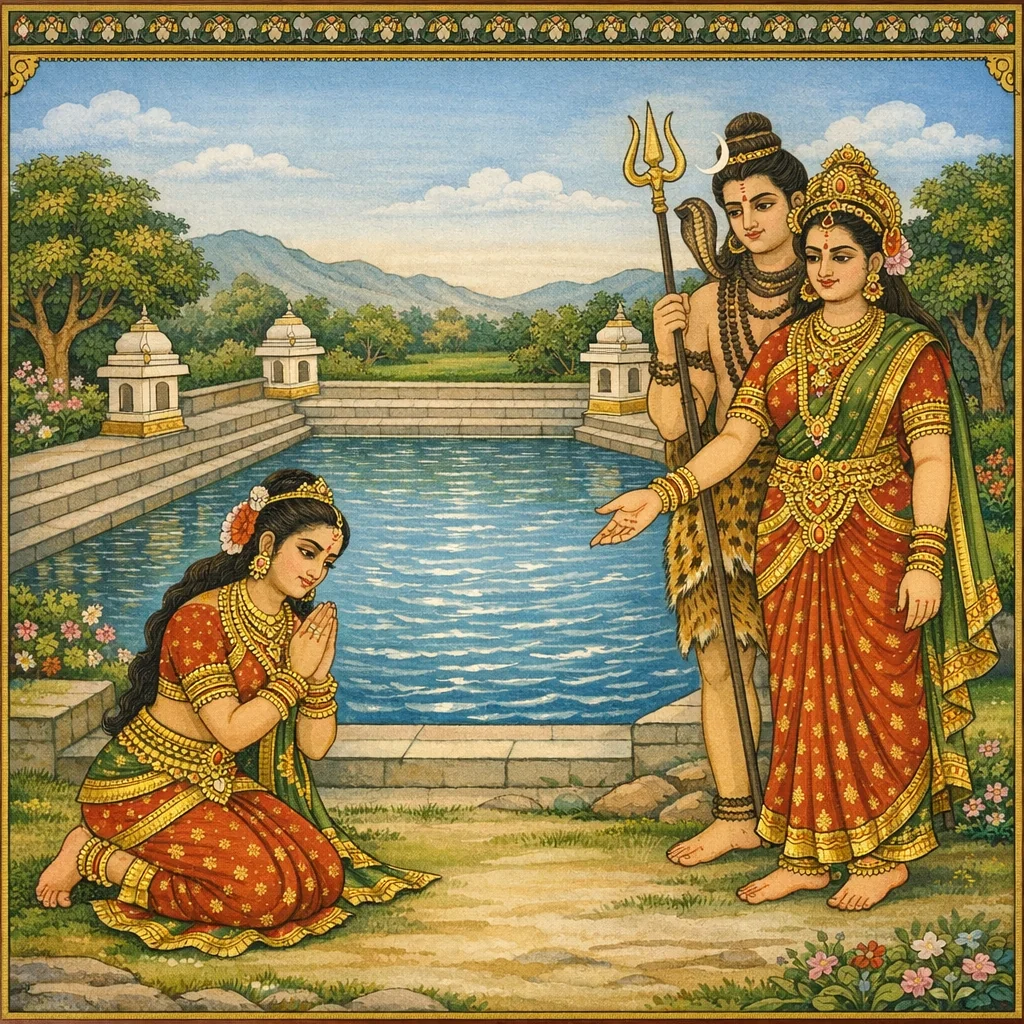
Sūta proclaims the excellence of Rūpatīrtha, a sacred ford where bathing in the proper manner is said to turn lack of beauty into beauty and bestow auspicious fortune. He then relates its origin: Brahmā fashions an apsaras of unparalleled loveliness, Tilottamā, who comes to Kailāsa to honor Śiva. As Tilottamā performs pradakṣiṇā, Śiva’s attention is portrayed through the manifestation of additional faces aligned with her circumambulation, and Pārvatī’s reaction becomes the spark of a cosmic disturbance. Nārada interprets the episode in a sharp, socially resonant way, intensifying Pārvatī’s response. When Pārvatī restrains Śiva’s eyes, a destructive imbalance threatens the worlds; Śiva therefore manifests an additional eye to protect creation, gaining the epithet Tryambaka, “the Three-Eyed.” Pārvatī then curses Tilottamā into deformity; Tilottamā pleads, and Pārvatī relents by directing her to a tīrtha that Pārvatī herself establishes. Bathing on prescribed tithis—especially Māgha-śukla-tṛtīyā, and later also Caitra-śukla-tṛtīyā at midday—restores Tilottamā’s beauty and institutes a recurring ritual observance. Tilottamā creates a broad, pure-water pond, Apsaraḥ-kuṇḍa. The phalaśruti stresses benefits for women (auspiciousness, exemplary desirability, and superior offspring) and for men (beauty and prosperity across many births), presenting the tīrtha as a calendrically regulated site of embodied and social well-being.
Shlokas
Verse 1
सूत उवाच । तथान्यदपि तत्रास्ति रूपतीर्थमनुत्तमम् । यत्र स्नातो नरः सम्यग्विरूपो रूपवान्भवेत्
Sūta said: “Moreover, there exists there an unsurpassed sacred ford called Rūpa-tīrtha. Whoever bathes there properly, even if ill-formed, becomes endowed with beauty.”
Verse 2
पूर्वं भगवता तेन ब्रह्मणा लोक कर्तृणा । सृष्टिं कृत्वा च विस्तीर्णां यथोक्तं च चतुर्विधाम्
Formerly, that Blessed Brahmā—the maker of the worlds—having created the vast creation, as proclaimed, in its fourfold arrangement…
Verse 3
ततः स चिन्तयामास रूपसंचयसंयुताम् । एकामप्सरसं दिव्यां देवमायां सृजाम्यहम्
Then he reflected: “I shall create a single divine Apsaras, endowed with a treasury of beauty—Deva-māyā herself.”
Verse 4
ततश्च सर्वदेवानां समादाय तिलंतिलम् । रूपं च निर्ममे पश्चादत्याश्चर्यमयीं च ताम्
Then, gathering from all the gods a ‘sesame-seed portion’—a minute share from each—he fashioned her beauty, and thereafter created her as one made wholly of wondrous marvel.
Verse 5
यां दृष्ट्वा क्षोभमापन्नः स्वयमेव पितामहः
Seeing her, even Pitāmaha (Brahmā) himself was stirred into agitation.
Verse 6
ततस्तां प्रेषयामास कैलासं प्रति पद्मजः । गच्छ देवि महादेवं प्रणमस्व शुचिस्मिते
Then Padmajā (Brahmā) sent her toward Kailāsa, saying: “Go, O Goddess—bow to Mahādeva, O you of the pure smile.”
Verse 7
ततः सा सत्वरं गत्वा कैलासं पर्वतोत्तमम् । अपश्यच्छंकरं तत्र निर्विष्टं पार्वतीसमम्
Then she swiftly went to Kailāsa, the best of mountains, and there she saw Śaṅkara seated together with Pārvatī.
Verse 9
शंकरोऽपि च तां दृष्ट्वा विस्मयं परमं गतः । सुदृष्टां नाकरोद्भीत्या पार्श्वस्थां वीक्ष्य पार्वतीम् । ततः प्रदक्षिणां चक्रे सा प्रणम्य महेश्वरम् । श्रद्धया परया युक्ता कृतांजलिपुटा स्थिता
Even Śaṅkara, on seeing her, was seized by the highest wonder. Yet, fearing impropriety, he did not look upon her fully, but instead glanced at Pārvatī standing at his side. Then she performed pradakṣiṇā and bowed to Maheśvara; endowed with supreme faith, she stood with hands joined in reverence.
Verse 10
यावद्दक्षिणपार्श्वस्था तावद्वक्त्रं स दक्षिणम् । प्रचकार महादेवस्तदुपाकृष्टलोचनः
So long as she stood at his right side, Mahādeva kept his face turned to the right, his eyes drawn toward her.
Verse 11
पश्चिमायां यदा साऽभूत्प्रदक्षिणवशाच्छुभा । पश्चिमं वदनं तेन तदर्थं च कृतं ततः
When that auspicious lady, by the force of her pradakṣiṇā, came to the western side, then for that very reason a western face was fashioned—precisely for that purpose.
Verse 12
एवमुत्तरसंस्थायां तस्यां देवेन शंभुना । उत्तरं वदनं क्लृप्तं गौरीभीतेन चेतसा । न ग्रीवां चालयामास कथंचिदपि स द्विजाः
In the same way, when she was positioned to the north, the god Śambhu fashioned a northern face, his mind fearful of Gaurī. And, O twice-born ones, he did not move his neck in any manner at all.
Verse 13
एतस्मिन्नंतरे तत्र नारदो मुनिपुंगवः । अब्रवीत्पार्वतीं पश्चात्प्रणिपत्य महेश्वरम्
Meanwhile, there, Nārada—the foremost of sages—spoke to Pārvatī, after first bowing down to Maheśvara.
Verse 14
नारद उवाच । पश्य पार्वति ते पत्युश्चेष्टितं गर्हितं यथा । दृष्ट्वा रूपवतीं नारीं कृतं ।मुखचतुष्टयम्
Nārada said: “Look, Pārvatī—how blameworthy is your husband’s conduct: on seeing a beautiful woman, he has fashioned for himself four faces.”
Verse 16
हास्यस्य पदवीमद्य त्वं गमिष्यसि पार्वति । सर्वासां देवपत्नीनां ज्ञात्वान्यासक्तमीश्वरम्
“Today, Pārvatī, you will become the object of ridicule among all the wives of the gods, once they learn that the Lord is attached to another.”
Verse 17
एतद्देवि विजानासि यादृक्चित्तं शिवोद्भवम् । अस्या उपरि वेश्याया निंदिताया विचक्षणैः
“Goddess, you know well what kind of mind is born of Śiva. Yet it is toward this courtesan—condemned by the discerning—that it turns.”
Verse 18
समादाय निजे हर्म्य एतां संस्थापयिष्यति । परं लज्जासमोपेतो न ब्रवीति वचः शुभे
“Taking her, he will install her within his own palace; yet, overcome with shame, he will not speak a single word, O fair one.”
Verse 19
अहमेतद्विजानामि न त्वया सदृशी क्वचित् । अस्ति नारी तथाऽन्योपि विजानाति सुरेश्वरि
“I know this: nowhere is there any woman like you; nor is there any other woman who understands as you do, O queen of the gods.”
Verse 20
ततो निरोधया मास द्रुतं सा पर्वतात्मजा । सर्वनेत्राणि देवस्य महिषीधर्ममाश्रिता
Then the Daughter of the Mountain swiftly restrained him; embracing the dharma of a lawful wife, she closed all the eyes of the god.
Verse 21
एतस्मिन्नंतरे शैला विशीर्यंति समंततः । मर्यादां संत्यजंति स्म सर्वे च मकरालयाः
Meanwhile, mountains began to split apart on every side, and all the oceans—abodes of the makaras—abandoned their boundaries.
Verse 22
प्रलयस्य समुत्थानं संजातं द्विजसत्तमाः । तावद्ब्रह्मदिनं प्राप्तं परमं सृष्टिलक्षणम्
O best of the twice-born, the rising forth from pralaya came to pass; then the supreme “day of Brahmā” arrived, marked by the defining signs of creation.
Verse 23
निमेषेण पुनस्तस्य प्रलयस्य प्रजापतेः । ब्रह्मणः सा निशा प्रोक्ता सर्वं तोयमयं भवेत्
Again, in but a blink, that pralaya of Prajāpati, Lord of creatures, takes place; it is declared the “night of Brahmā,” when all becomes wholly water.
Verse 24
अथ तत्र गणाः सर्वे भृगिनंदिपुरःसराः । सोऽपि देवमुनिर्भीतस्तामुवाच सुरेश्वरीम्
Then, there, all the gaṇas assembled, led by Bhṛgi and Nandin. And that divine sage too, afraid, addressed the Goddess Sureśvarī, sovereign Lady of the gods.
Verse 25
मुंचमुंच सुरज्येष्ठे देवनेत्राणि संप्रति । नोचेन्नाशः समस्तस्य लोकस्यास्य भविष्यति
“Release them, release them now, O eldest among the gods—the divine eyes! Otherwise the destruction of this entire world will come to pass.”
Verse 26
एवं प्रोक्ताऽपि सा देवी यावच्च न मुमोच तम् । तावद्देवेन लालाटं विसृष्टं लोचनं परम्
Though thus addressed, the Goddess did not release it; and so the God, from his forehead, emitted a supreme eye.
Verse 27
कृपाविष्टेन लोकानां येन रक्षा प्रजायते । न शक्तो वारितुं देवीं प्राणेभ्योऽपि गरीयसीम्
Moved by compassion for the worlds—through which their protection arises—he was not able to restrain the Goddess, who was weightier than life-breath itself.
Verse 28
अंबिकां विबुधाः प्राहुस्त्र्यंबकाणि यतो द्विजाः । तस्मात्संकीर्त्यते लोके त्र्यंबकश्च सुरेश्वरः
O twice-born, because the wise call Ambikā ‘Tryambakā’ (she of the three eyes), therefore the Lord of the gods is celebrated in the world as ‘Tryambaka’ as well.
Verse 29
ततः संत्यज्य तं देवं देवी पर्वतपुत्रिका । प्रोवाच कोपरक्ताक्षी पुरःस्थां तां तिलोत्तमाम्
Then the Goddess, the daughter of the mountain, leaving that God aside, spoke—her eyes reddened with anger—to Tilottamā who stood before her.
Verse 30
यस्मान्मे दयितः पापे त्वया रूपाद्विडंबितः । चतुर्वक्त्रः कृतस्तस्मात्त्वं विरूपा भव द्रुतम्
“Since you, O sinful one, have mocked my beloved because of your beauty and made him four-faced, therefore become deformed at once!”
Verse 31
ततः सा सहसा भूत्वा तत्क्षणाद्भग्ननासिका । शीर्णकेशा बृहद्दंता चिपिटाक्षी महोदरा
At once, in that very moment, she became broken-nosed, with disheveled hair, large teeth, flattened eyes, and a greatly swollen belly.
Verse 32
अथ वीक्ष्य निजं देहं तथाभूतं वराप्सराः । प्रोवाच वेपमाना सा कृतांजलिपुटा स्थिता
Then that excellent Apsaras, seeing her own body become thus, trembling, stood with folded hands and spoke.
Verse 33
अहं संप्रेषिता देवि प्रणामार्थं त्रिशूलिनः । ब्रह्मणा तेन चायाता युष्माकं च विशेषतः
“Goddess, I was sent by the Trident-bearing Lord (Śiva) to offer obeisance. And by that Brahmā too I have been dispatched—especially to pay respects to you.”
Verse 34
निर्दोषाया विरागायास्तस्माद्युक्तं न ते भवेत् । शापं दातुं प्रसादं मे तस्मात्त्वं कर्तुमर्हसि
“Since I am faultless and without ill intent, it would not be proper for you to curse me. Therefore, you ought to show me favor, not give a curse.”
Verse 35
तस्यास्तद्वचनं श्रुत्वा दीनं सत्यं च पार्वती । पश्चात्तापसमोपेता ततः प्रोवाच सुप्रियम्
Hearing her words—humble and truthful—Pārvatī, filled with remorse, then spoke gently to her beloved.
Verse 36
स्त्रीस्वभावात्समायातः कोपोऽयं त्वां प्रति द्रुतम् । तस्मादागच्छ गच्छावो मया सार्धं धरातले
“By the quickness of a woman’s nature, this anger rose swiftly toward you. So come—let us go together to the earth.”
Verse 37
तत्रास्ति रूपदं तीर्थं मया चोत्पादितं स्वयम् । माघशुक्लतृतीयायां स्नानार्थं विमलोदकम्
“There is a sacred ford there that bestows beauty—created by me myself—its waters pure for bathing on the bright third day of Māgha.”
Verse 38
या नारी प्रातरुत्थाय तत्र स्नानं समाचरेत् । सा स्याद्रूपवती नूनमदृष्टे रविमंडले
“Any woman who rises early and bathes there will surely become beautiful—before even beholding the circle of the sun.”
Verse 39
सदा माघे तृतीयायां तत्र स्नानं करोम्यहम् । अद्य सा तत्र यास्यामि स्नानाय कृतनिश्चया
“Every year on the third day in Māgha I bathe there. Today too I shall go there, firmly resolved to bathe.”
Verse 40
सूत उवाच । एवमुक्त्वा समादाय सा देवी तां तिलोत्तमाम् । हाटकेश्वरजे क्षेत्रे रूपतीर्थं जगाम च
Sūta said: Having spoken thus, the Goddess took Tilottamā with her and went to Rūpatīrtha in the sacred region of Hāṭakeśvara.
Verse 41
तत्र स्नानं स्वयं चक्रे विधिपूर्वं सुरेश्वरी । तस्या ह्यनन्तरं सापि भक्तियुक्ता तिलोत्तमा
There the Queen of the Gods herself performed the bath according to proper rite; immediately after her, Tilottamā too—filled with devotion—bathed.
Verse 42
ततः कांतिमती जाता तत्क्षणादेव भामिनी । पूर्वमासीयद्थारूपा तथासाऽभूद्विशेषतः
Then, in that very instant, the radiant lady became filled with lustre. She regained her former beauty—and indeed became even more exceptionally splendid.
Verse 43
अथ तुष्टिसमायुक्ता तां प्रणम्य सुरेश्वरीम् । प्रोवाच विस्मयाविष्टा हर्षगद्गदया गिरा
Then, filled with contentment, she bowed to the Goddess, the Sovereign of the gods. Overcome with wonder, she spoke in a voice choked with joy.
Verse 44
प्राप्तं रूपं महादेवि त्वत्प्रसादाच्चिरन्तनम् । ब्रह्मलोकं गमिष्यामि मामनुज्ञातुमर्हसि
O Great Goddess, by your grace I have obtained my ancient, original beauty. I shall now depart for Brahmaloka; please grant me leave to go.
Verse 45
गौर्युवाच । वरं यच्छामि ते पुत्रि यत्किंचिद्धृदि संस्थितम् । तस्मात्प्रार्थय विश्रब्धा न वृथा मम दर्शनम्
Gaurī said: “Daughter, I grant you a boon—whatever desire abides within your heart. Therefore ask without fear; my appearing before you shall not be in vain.”
Verse 46
तिलोत्तमोवाच । अहमत्र करिष्यामि क्षेत्रे तीर्थं निजं शुभे । त्वत्प्रसादेन तद्देवि यातु ख्यातिं धरातले
Tilottamā said: “O auspicious Goddess, here in this sacred field I shall establish my own tīrtha. By your grace, O Devī, may that tīrtha become renowned upon the earth.”
Verse 47
त्वया तत्रापि कर्तव्यं वर्षांते स्नानमेव हि । हितार्थं सर्वनारीणां रूपसौभाग्यदायकम्
And you too must perform bathing there at the end of the rainy season. It is for the welfare of all women and bestows beauty and good fortune.
Verse 48
गौर्युवाच । चैत्रशुक्लतृतीयायां सदाहं त्वत्कृते शुभे । स्नानं तत्र करिष्यामि मध्याह्ने समुपस्थिते
Gaurī said: “O auspicious one, for your sake I shall always bathe there on the third lunar day of the bright fortnight of Caitra, when midday has arrived.”
Verse 49
हितार्थं सर्वनारीणां तव वाक्यादसंशयम् । या तत्र दिवसे नारी तस्मिंस्तीर्थे करिष्यति
For the welfare of all women—without doubt, by your word—whatever woman bathes at that tīrtha on that day…
Verse 50
स्नानं सा सौख्यसंयुक्ता भविष्यति सुखान्विता । स्पृहणीया च नारीणां सर्वासां धरणीतले
She will be endowed with comfort and happiness, living in joy. And among all women upon the earth, she will become one whom others long to emulate.
Verse 51
पुरुषोऽपि सुभक्त्या यस्तत्र स्नानं करिष्यति । सप्तजन्मानि रूपाढ्यः ससौभाग्यो भविष्यति
Even a man who, with true devotion, bathes there will be endowed with beauty and good fortune for seven births.
Verse 52
सूत उवाच । एवमुक्ता तदा देव्या साप्सरा द्विजसत्तमाः । चक्रे कुण्डं सुविस्तीर्णं विमलोदप्रपूरितम्
Sūta said: Thus addressed by the Goddess, that Apsaras—O best of twice-born—fashioned a broad and spacious sacred pond, filled with clear and spotless water.
Verse 53
उपकंठे ततस्तस्य स्थापयामास पार्वतीम् । ततो जगाम संहृष्टा ब्रह्मलोकं तिलोत्तमा
Then, upon its bank, she installed Pārvatī. Thereafter Tilottamā, delighted at heart, departed for Brahmā’s world.
Verse 54
ततः प्रभृति संजातं कुण्डमप्सरसा कृतम् । स्नानमात्रैर्नरैर्यत्र सौभाग्यं लभ्यते द्विजाः
From that time onward arose this pond made by the Apsaras. By bathing there alone, people obtain good fortune—O twice-born.
Verse 55
नारीभिश्च विशेषेण पुत्रप्राप्तिरनुत्तमा । तथान्यदपि यत्किंचिद्वांछितं हृदये स्थितम्
And for women in particular, the blessing of obtaining sons is unsurpassed. Likewise, whatever other desire—anything cherished within the heart—is fulfilled there.
Verse 153
इति श्रीस्कांदे महापुराण एकाशीतिसाहस्र्यां संहितायां षष्ठे नागरखण्डे श्रीहाटकेश्वरक्षेत्रमाहात्म्येऽप्सरःकुण्डोत्पत्तिमाहात्म्यवर्णनंनाम त्रिपंचाशदुत्तरशततमोऽध्यायः
Thus ends, in the revered Skanda Mahāpurāṇa—within the Saṃhitā of eighty-one thousand verses—in the sixth book, the Nāgara Khaṇḍa, in the Māhātmya of Śrīhāṭakeśvara-kṣetra, the chapter entitled “The Glorification of the Origin of Apsarāḥ-kuṇḍa,” being Chapter 153.