Adhyaya 144
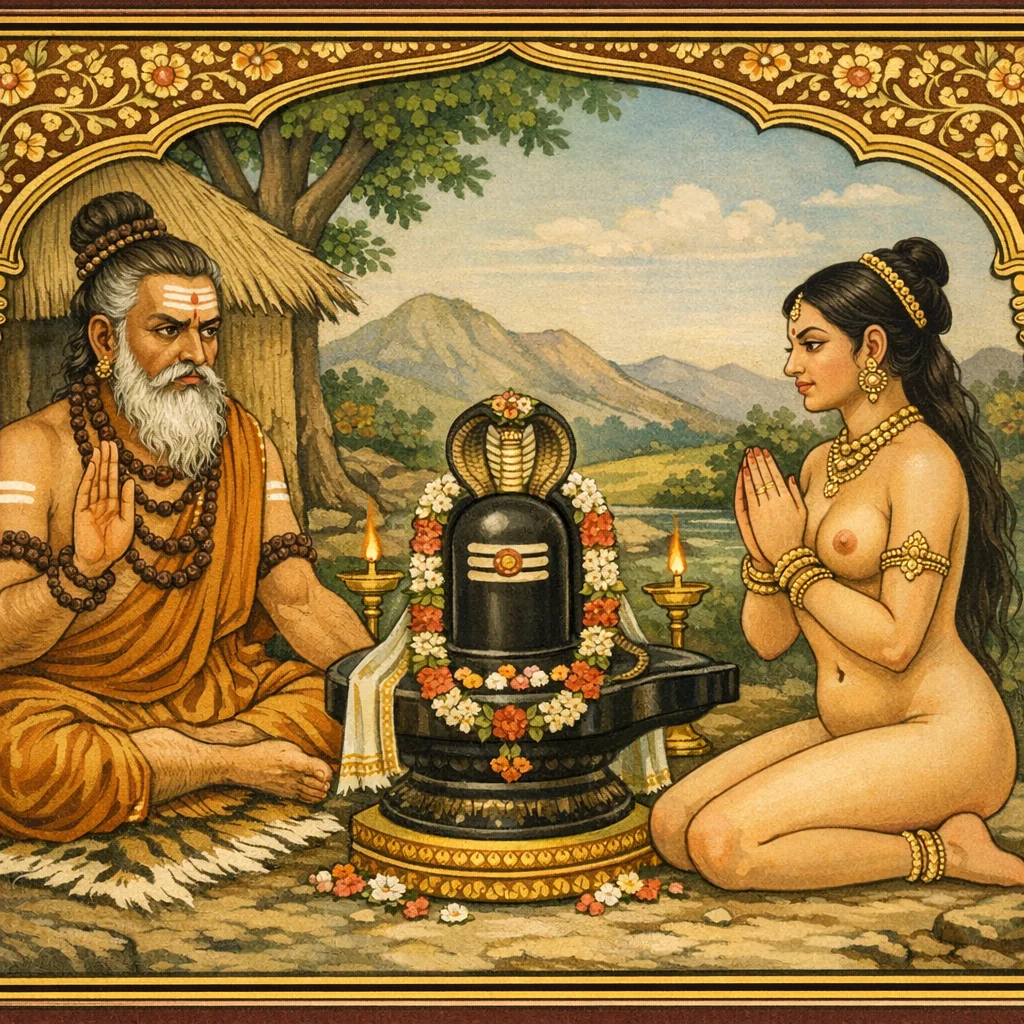
Chapter 144, narrated by Sūta, weaves an origin-myth together with the sanction of worship. Rambhā, after events involving the sage Jābāli, bears a daughter who is entrusted to him and named Phalavatī. Raised in the hermitage, she is encountered by the gandharva Citrāṅgada; their illicit union provokes Jābāli’s wrath, leading to violence against the girl and a curse upon Citrāṅgada that becomes a crippling disease, stripping him of movement and flight. On Caitra-śukla-caturdaśī, the scene shifts to a Śaiva pīṭha: Śiva arrives at Citreśvara with gaṇas and fierce yoginīs who demand offerings. In an extreme act of surrender, Citrāṅgada and Phalavatī offer their own “flesh”; Śiva inquires into their plight and grants the remedy—install Śiva’s liṅga at the pīṭha and worship it for a year, by which the disease is gradually removed and celestial status restored. Phalavatī is established as a yoginī of the pīṭha, remaining in a nude iconographic state, worshipped as a bestower of desired fruits. A disputation then unfolds between Jābāli and Phalavatī on the moral valuation of women, framed as theological discourse and ethical reasoning, ending in reconciliation. Worship of the triad—Phalavatī, Jābāli, and Citrāṅgadeśvara—is taught to yield continuing siddhi, and the closing phalaśruti proclaims the account “all-desire-giving” for those who hear or recite it, in this world and beyond.
Shlokas
Verse 1
सूत उवाच । सा गत्वा त्रिदिवं पश्चात्सहस्राक्षं सुरैर्युतम् । प्रोवाच भगवन्दिष्ट्या क्षोभितोऽसौ महामुनिः
Sūta said: Then she went to heaven and addressed Sahasrākṣa (Indra), who was accompanied by the gods: “O Lord, by destiny that great sage has indeed been provoked.”
Verse 2
तपस्तस्य हतं कृत्स्नं यत्कृच्छ्रेण समाचितम् । तथा निस्तेजसत्वं च नीतस्त्वं सुखभाग्भव
All his austerity—painfully amassed through severe hardship—has been destroyed; and you have been brought to a state bereft of splendor. Now, become one who partakes of ease and repose.
Verse 3
एवमुक्त्वाऽथ सा रंभा शंसिता निखिलैः सुरैः । अमोघरेतसस्तस्य दध्रे गर्भं निजोदरे
Having spoken thus, Rambhā—praised by all the gods—conceived within her own womb the embryo of that sage, whose seed was unfailing.
Verse 4
जाबालिरपि कृत्वा च पश्चात्तापमनेकधा । भूयस्तु तपसि स्थित्वा स्थितस्तत्रैव चाश्रमे
Jābāli too, having repented in many ways, once again took his stand in austerity and remained there, in that very hermitage.
Verse 5
ततस्तु दशमे मासि संप्राप्ते सुषुवे शुभाम् । कन्यां सरोजपत्राक्षीं दिव्यलक्षणलक्षिताम्
Then, when the tenth month arrived, she gave birth to an auspicious daughter—lotus-petal-eyed, adorned with marks of divine signs.
Verse 6
अथ तां मानुषोद्भूतां मत्वा तस्यैव चाश्रमम् । गत्वा मुमोच प्रत्यक्षं तस्यर्षेश्चेदमब्रवीत्
Then, thinking her to be born among humans, she went to that very hermitage, set her plainly before the sage, and spoke these words.
Verse 7
तव वीर्यसमुद्भूतामेनां मज्जठरोषिताम् । कन्यकां मुनिशार्दूल तस्मात्पालय सांप्रतम्
This maiden has arisen from your potency and has dwelt within my womb. Therefore, O tiger among sages, protect her now.
Verse 8
न स्वर्गे विद्यते वासो मानुषाणां कथंचन । एतस्मात्कारणात्तुभ्यं मया ब्रह्मन्समर्पिता
There is no dwelling in heaven for human beings in any way. For this reason, O Brahmin, she has been entrusted by me to you.
Verse 9
एवमुक्त्वा ययौ रंभा सत्वरं त्रिदशालयम् । जाबालिरपि तां दृष्ट्वा कन्यकां स्नेहमाविशत्
Having spoken thus, Rambhā swiftly departed for the abode of the Thirty (the gods). And Jābāli too, on seeing that maiden, became filled with tender affection for her.
Verse 10
ततस्तां कन्यकां कृत्वा सुष्ठु गुप्ते लतागृहे । रसैर्मिष्टफलोद्भूतैः पुपोष च दिवानिशम्
Then, placing that maiden in a well-hidden bower of creepers, he nourished her day and night with juices drawn from sweet fruits.
Verse 11
सापि कन्या परां वृद्धिं शनैर्याति दिनेदिने । शुक्लपक्षं समासाद्य यथा चन्द्रकला दिवि
That maiden too grew steadily, day by day—like the moon’s digit in the sky as it advances through the bright fortnight.
Verse 12
यथायथाथ सा याति वृद्धिं कमललोचना । तथातथास्य सुस्नेहो जाबालेरप्यवर्धत
As that lotus-eyed girl grew ever more, so too did Jābāli’s gentle affection for her steadily increase.
Verse 13
सा शिशुत्वे मृगैः सार्द्धं पक्षिभिश्च सुशोभना । क्रीडां चक्रे सुविश्रब्धैर्वर्धयंती मुनेर्मुदम्
In her childhood, that lovely girl played with deer and birds in easy trust, thereby increasing the sage’s joy.
Verse 14
ततो बाल्यं परित्यक्त्वा वल्कलावृतगात्रिका । तस्यर्षेः सर्वकृत्येषु साहाय्यं प्रकरोति च
Then, leaving childhood behind and wearing garments of bark, she began to assist that sage in all his daily duties.
Verse 15
समित्कुशादि यत्किंचित्फलपुष्पसमन्वितम् । वनात्तदानयामास तस्य प्रीतिमवर्धयत्
Whatever she could—firewood, kuśa grass, and the like, along with fruits and flowers—she brought from the forest, thereby increasing his satisfaction and affection.
Verse 16
ततः कतिपयाहस्य फलार्थं सा मृगेक्षणा । निदाघसमये दूरं स्वाश्रमात्प्रजगाम ह
Then, after some days, that doe-eyed girl went far from her own hermitage in the hot season, seeking fruits.
Verse 17
एतस्मिन्नंतरे तत्र विमानवरमाश्रितः । प्राप्तश्चित्रांगदोनाम गन्धर्वस्त्रिदिवौकसाम्
Meanwhile, in that very place, a Gandharva of the heavenly realms—named Citrāṅgada—arrived, seated in an excellent vimāna.
Verse 18
तेन सा विजने बाला पूर्णचन्द्रनिभानना । दृष्टा चांद्रमसी लेखा पतितेव धरातले
In that lonely place he saw the young girl, her face like the full moon—like a streak of moonlight that had fallen upon the earth.
Verse 19
ततः कामपरीतांगः सोवतीर्य धरातलम् । विमानान्मधुरैर्वाक्यैस्तामुवाच कृतांजलिः
Then, his body overcome by desire, he descended from the vimāna onto the earth; and with sweet words he addressed her, his hands joined in reverence.
Verse 20
का त्वं कमलगर्भाभा निर्जनेऽथ महावने । भ्रमस्येकाकिनी बाले वनमध्ये सुलोचने
Who are you, radiant like the heart of a lotus, wandering alone in this lonely great forest—O young girl, O fair-eyed one—in the midst of the woods?
Verse 21
कन्योवाच । अहं फलवतीनाम जाबालेर्दुहिता मुने । फलपुष्पार्थमायाता तदर्थमिह कानने
The maiden said: “O sage, I am named Phalavatī, the daughter of Jābāli. I have come here into the forest for the sake of fruits and flowers.”
Verse 22
चित्रांगद उवाच । कुमारब्रह्मचारी स श्रूयते मुनिसत्तमः । तत्कथं तस्य वामोरु त्वं जाता भार्यया विना
Citrāṅgada said: “That great sage is renowned as a celibate brahmacārin. How then, O fair-thighed one, were you born to him without a wife?”
Verse 23
कन्योवाच । सत्यमेतन्महाभाग नास्ति दारपरिग्रहः । तस्यर्षेः किं तु संजाता यथा तन्मेऽवधारय
The maiden said: “It is true, O noble one—he has not taken a wife. Yet I was indeed born of that sage; hear from me how it came to be.”
Verse 24
रंभा नामाप्सरास्तेन पुरा दृष्टा सुरांगना । ततः कामपरीतेन सेविता च यथासुखम्
“Once he beheld an apsaras named Rambhā, a celestial maiden. Then, overcome by desire, he consorted with her according to his pleasure.”
Verse 25
ततस्तदुदराज्जाता देवलोके महत्तरे । तयापि चेह तस्यर्षेर्भूय एव नियोजिता
“Then I was born from her womb in the exalted realm of the gods; and she herself sent me here again, entrusting me to that sage.”
Verse 26
एवं स मे पिता जातो जाबालिर्मुनिसत्तमः । पोषिताऽहं ततस्तेन नानाफलसमुद्रवैः
“Thus Jābāli, the best of sages, became my father; and thereafter he nurtured me with abundant stores of many kinds of fruits.”
Verse 27
ततः फलवती नाम कृतं तेन महात्मना । ममानुरूपमेतद्धि यन्मां त्वं परिपृच्छसि
Therefore that great-souled one bestowed on me the name “Phalavatī.” Truly it befits me—this is why you ask about me.
Verse 28
चित्रांगद उवाच । तव रूपं समालोक्य कामस्याहं वशं गतः । तस्माद्भजस्व मां भीरु नो चेद्यास्यामि संक्षयम्
Citrāṅgada said: “Seeing your beauty, I have fallen under the power of desire. Therefore, O timid one, accept me—otherwise I shall come to ruin.”
Verse 29
अहं चित्रांगदोनाम गन्धर्वस्त्रिदिवौकसाम् । तीर्थयात्राकृते प्राप्तः क्षेत्रेऽस्मिञ्छ्रद्धयाऽन्वितः
I am Citrāṅgada by name, a Gandharva among the dwellers of heaven. Having undertaken a pilgrimage to the sacred tīrthas, I have come to this holy kṣetra, endowed with faith.
Verse 30
कन्योवाच । कुमारधर्मिणी चाहमद्यापि वशगा पितुः । कामधर्मं न जानामि चित्रांगद कथंचन
The maiden said: “I still live by the discipline of a maiden and remain under my father’s authority. I do not understand the ways of passion at all, O Citrāṅgada.”
Verse 31
तस्मात्प्रार्थय मे तातं स मां तुभ्यं प्रदास्यति । अनुरूपाय योग्याय तरुणाय मनस्विनीम्
Therefore, request my father; he will give me to you—since you are fitting, worthy, and youthful—and I am a woman of resolve.
Verse 32
ममापि रुचितं चित्ते तव वाक्यमिदं शुभम् । धन्याहं यदि ते कण्ठमालिंगामि यथेच्छया
Your auspicious words delight even my heart. Blessed would I be, if I might embrace your neck as I desire.
Verse 33
चित्रांगद उवाच । न शक्नोमि महाभागे तावत्कालं प्रतीक्षितुम् । मां दहत्येष गात्रोत्थः सुमहान्कामपावकः
Citrāṅgada said: “O fortunate one, I cannot wait so long. This mighty fire of desire, rising from my very limbs, burns me.”
Verse 34
तस्मात्कुरु प्रसादं मे रतिदानेन शोभने । को जानाति हि तच्चित्तं कीदृग्रूपं भविष्यति
Therefore, O lovely one, show me favor by granting the gift of pleasure. For who can know what form that mind will take, if it is denied?
Verse 35
कन्योवाच । एवं ते वर्तमानस्य मम तातः प्रकोपतः । दहिष्यति न संदेहः शापं दत्त्वा सुदारुणम्
The maiden said: “If you act in this way, my father—angered—will surely burn you, without doubt, after giving a most dreadful curse.”
Verse 36
चित्रांगद उवाच । तव तातः स कालेन मां दहिष्यति मानदे । कामानलः पुनः सद्य एष भस्म करिष्यति
Citrāṅgada said: “Your father may burn me in due time, O honored lady; but this fire of desire will, right now, reduce me to ashes.”
Verse 37
एवमुक्त्वाऽथ तां बालां वेपमानां त्रपावतीम् । गृहीत्वा दक्षिणे पाणौ प्रविवेश सुरालयम्
Having spoken thus, he took the young girl—trembling and full of modest shame—by her right hand and entered the celestial abode.
Verse 38
तत्र तां रमयामास तदा कामप्रपीडितः । तत्कालजातरागांधां निर्लज्जत्वमुपागताम्
There he sported with her, tormented at that time by desire; and she, blinded by passion newly arisen in that very moment, fell into shamelessness.
Verse 39
एवं तस्याः समं तेन स्थिताया दिवसो गतः । निमेषवन्मुनिश्रेष्ठास्ततश्चास्तं गतो रविः
Thus, as she remained there together with him, the day passed as though in a single blink, O best of sages; and then the Sun went down to set.
Verse 40
एतस्मिन्नंतरे विप्रो जाबालिर्दुःख संयुतः । अनायातां सुतां ज्ञात्वा परिबभ्राम सर्वतः
Meanwhile, the brāhmaṇa Jābāli, overcome with grief, realizing that his daughter had not returned, wandered about everywhere in search of her.
Verse 41
अहो सा दुहिता मह्यं किमु व्यालैः प्रभक्षिता । वृक्षं कंचित्समारूढा पतिता धरणी तले
“Alas! What has happened to my daughter? Has she been devoured by wild beasts? Or, having climbed some tree, has she fallen upon the ground?”
Verse 42
किं वा जलाशयं कंचित्प्राप्य गाधमजानती । निमग्ना तत्र सा बाला संप्रविष्टा जलार्थिनी
Or perhaps, seeking water, she came upon a pond without knowing its depth; and that young girl sank there, having entered it to draw water.
Verse 43
एवं स प्रलपन्विप्रो बभ्राम गहने वने । कुशकण्टकविद्धांगः क्षुत्पिपासासमाकुलः
Thus, lamenting, the brāhmaṇa wandered through the dense forest—his body pierced by kuśa-grass and thorns, tormented by hunger and thirst.
Verse 44
यंयं शृणोति शब्दं स मृगपक्षिसमुद्भवम् । रजन्यां तत्र निर्याति मत्वा फलवतीं च ताम्
Whatever sound he heard—arising from deer or birds—at night he would rush there, imagining it to be her, and hoping for a blessed outcome.
Verse 45
अथ क्रमात्समायातो हरहर्म्यं स सन्मुनिः । यत्र चित्रांगदोपेता सा संतिष्ठति कन्यका
Then, in due course, that noble sage arrived at Hara’s mansion, where the maiden stood, adorned with radiant ornaments upon her limbs.
Verse 46
निःशंका जल्पमाना च रागवाक्यान्यनेकशः । अनर्हाणि कुमारीणां ब्रह्मजानां विशेषतः
She spoke without hesitation, uttering again and again words tinged with passion—speech unbecoming for maidens, and especially for one born in a brāhmaṇa family.
Verse 47
ततः स सुचिरं श्रुत्वा दूरस्थो विस्मयान्वितः । कुमार्याश्चेष्टितं दृष्ट्वा कोपसंरक्तलोचनः
Then, having listened for a long time from a distance in astonishment, and seeing the maiden’s behavior, his eyes reddened with anger.
Verse 48
अथ दुद्राव वेगेन गृह्य काष्ठसमुच्चयम् । द्वाभ्यामेव विनाशाय भर्त्समानो मुहुर्मुहुः
Then he ran forward in haste, seizing a bundle of sticks; again and again he threatened her with destruction, scolding her repeatedly.
Verse 49
धिग्धिक्पापसमाचारे कौमार्यं दूषितं त्वया । लांछनं च समानीतं मम लोकत्रयेऽपि च
“Fie upon you, vile practitioner of sin! By you my maidenhood has been defiled, and a stain has been brought upon me—even across the three worlds.”
Verse 50
नितरां पतिमासाद्य कर्मणानेन चाधमे । तस्मादनेन पापेन युक्तां त्वां नाशयाम्यहम्
“Having thoroughly approached (taken) a husband by this base deed, therefore—since you are bound to this sin—I shall destroy you.”
Verse 51
एवमुक्त्वा प्रहारं स यावत्क्षिपति सन्मुनिः । तावच्चित्रांगदो नष्टो व्योममार्गेण सत्वरम्
Having spoken thus, just as the holy sage was about to hurl a blow, Citrāṅgada vanished at once, fleeing swiftly by the path of the sky.
Verse 52
विवस्त्रा सापि तत्रैव खिन्नांगी कामसेवया । न शशाक क्वचिद्गंतुं समुत्थाय ततः क्षितौ
She too, left unclothed there, her body exhausted by forced indulgence in lust, could not rise from the ground and go anywhere at all.
Verse 53
ततः काष्ठप्रहारोघैर्हत्वा तां पतितां क्षितौ । मृतामिति परिज्ञाय स क्रोधपरिवारितः
Then, striking her with a torrent of blows from a piece of wood, he killed her as she lay fallen on the ground; realizing she was dead, he remained enveloped in rage.
Verse 54
ततश्चित्रांगदस्यापि ददौ शापं सुदारुणम् । स दृष्ट्वाऽकाशमार्गेण गच्छमानं भयातुरम्
Then he also pronounced a most dreadful curse upon Citrāṅgada, seeing him travel through the sky-path, terrified.
Verse 55
य एष कन्यकां मह्यं धर्षयित्वा समुत्पतेत् । स पतत्वचिरात्पापश्छिन्नपक्ष इवांडजः
“This sinner—who, after assaulting my maiden, tries to fly away—shall quickly fall down, like a bird with its wings cut.”
Verse 56
कुष्ठव्याधिसमायुक्तश्चलितुं नैव च क्षमः । एतस्मिन्नन्तरे भूमौ स पपात नभस्तलात्
Afflicted with the disease of leprosy and unable even to move, in that very moment he fell from the sky down to the earth.
Verse 57
कुष्ठव्याधिसमायुक्तः स च चित्रांगदो युवा । ततस्तं स मुनिः प्राह काष्ठोद्यतकरः क्रुधा
That young Citrāṅgada, afflicted with leprosy, then was addressed by the sage—his hand raised with a stick, in anger.
Verse 58
कस्त्वं पापसमाचार येन मे धर्षिता बलात् । कुमारी तन्नयाम्येष त्वामद्य यम शासनम्
“Who are you, man of sinful conduct, by whom my maiden was violated by force? Therefore, today I shall send you to Yama’s punishment.”
Verse 59
चित्रांगद उवाच । अहं चित्रांगदोनाम गन्धर्वस्त्रिदिवौकसाम् । तीर्थयात्राप्रसंगेन क्षेत्रेऽस्मिन्समुपागतः
Citrāṃgada said: “I am Citrāṃgada by name, a Gandharva among the dwellers of heaven. By occasion of a pilgrimage to sacred fords, I have come to this holy kṣetra.”
Verse 60
ततस्तु कन्यकां दृष्ट्वा कामदेववशं गतः
Then, upon seeing the maiden, he fell under the sway of Kāma, the god of desire.
Verse 61
ततः सेवितवानत्र लताहर्म्ये जनच्युते । तस्मात्कुरु क्षमां मह्यं दीनस्य प्रणतस्य च
Thereafter, in this place—within the vine-covered arbor—he consorted with the maiden. Therefore, grant forgiveness to me, for I am distressed and bowing in submission.
Verse 62
यथा व्याधेर्भवेन्नाशो यथा स्याद्गगने गतिः । भूयोऽपि त्वत्प्रसादेन स्वल्पः कोपो हि साधुषु
As disease is brought to an end, and as one gains passage through the sky, so too—by your grace—let the anger of the virtuous be slight and soon appeased.
Verse 63
जाबालिरुवाच । ईदृग्रूपधरस्त्वं हि मम वाक्याद्भविष्यसि । एषापि मत्सुता पापा वस्त्रहीना सदेदृशी
Jābāli said: “Indeed, by my word you shall assume such a form. And this sinful daughter of mine too shall remain thus—bereft of garments, in this very condition.”
Verse 64
भविष्यति न संदेहो जीवयिष्यति चेत्क्वचित् । यद्येषा धास्यति क्वापि वस्त्रं गात्रे निजे क्वचित्
“So it shall be—there is no doubt—if she should survive anywhere at all. And if ever she puts on a garment upon her own body, anywhere…”
Verse 65
तन्नूनं च शिरोऽप्यस्याः फलिष्यति न संशयः । एवमुक्त्वा विकोपश्च स जगाम निजाश्रमम्
“Then surely her head too will be struck down—there is no doubt.” Having spoken thus, and remaining in wrath, he went to his own hermitage.
Verse 66
चित्रांगदोऽपि तत्रैव तया सार्धं तथा स्थितः । कस्यचित्त्वथ कालस्य तत्र क्षेत्रे समाययौ
Citrāṃgada too remained there, in that same manner, together with her. Then, after some time had passed, (a divine presence) arrived at that sacred kṣetra.
Verse 67
चैत्रशुक्लचतुर्दश्यां भगवाञ्छशिशेखरः । गन्तुं चित्रेश्वरे पीठे गणै रौद्रैः समावृतः । योगिनीभिः प्रचण्डाभिः सार्धं प्राप्ते निशामुखे
On the fourteenth lunar day of the bright fortnight of Caitra, the Blessed Lord, the Moon-crested One (Śiva), set out for the seat at Citreśvara—surrounded by fierce gaṇas and accompanied by terrifying Yoginīs—when night had begun.
Verse 68
अथ प्राप्ते निशार्धे तु योगिन्यस्ताः सुदारुणाः । महामांसं महामांसमित्यूचुर्भक्षणाय वै
Then, when midnight had come, those exceedingly dreadful Yoginīs cried out for food, saying, “Great flesh! Great flesh!”
Verse 69
नृत्यमानाः पुरस्तस्य देवदेवस्य शूलिनः । सस्पर्धा गणमुख्यैस्तैर्नर्तमानैः समंततः
Dancing before that Trident-bearing Lord of lords, the foremost Gaṇas danced all around—rivaling one another in their exuberant performance.
Verse 70
यस्तत्र समये तासां महामांसं प्रयच्छति । मंत्रपूतं स संसिद्धिं समवाप्नोति वांछिताम्
Whoever, at that very time, offers them the great meat-offering—purified by mantra—attains the desired accomplishment in full.
Verse 71
मद्यं मांसं तथा चान्यन्नैवेद्यं वा फलादिकम् । तस्य सिद्धिः समादिष्टा यथा स्वहृदये स्थिता
Whether it be wine, meat, or other offerings—naivedya such as fruits and the like—his success is declared to accord with what is held within his own heart (his intended aim).
Verse 72
एतस्मिन्नंतरे कन्या सा जाबालिसमुद्भवा । स च चित्रांगदस्तत्र गत्वा प्रोवाच सादरम्
Meanwhile, that maiden—born of Jābāli—appeared. And Citraṅgada went there and spoke with due reverence.
Verse 73
अस्मदीयमिदं मांसं योगिन्यो हर्षसंयुताः । भक्षयन्तु यथासौख्यं स्वयमेव प्रकल्पितम्
“Let the Yoginīs—filled with joy—eat this meat that is ours as they please; it has been prepared by us ourselves.”
Verse 74
अथ तं पुरुषं दृष्ट्वा कुष्ठव्याधिसमावृतम् । विवस्त्रां कन्यकां तां च सर्वास्ता विस्मयान्विताः
Then, seeing that man afflicted with the disease of leprosy, and also that maiden unclothed, all of them were struck with astonishment.
Verse 75
ते च सर्वे गणा रौद्राः स च देवस्त्रिलोचनः । पप्रच्छ कौतुकाविष्टस्तत्र चित्रांगदं प्रभुः
And all those fierce Gaṇas, and that three-eyed Lord as well—seized by curiosity—the Master there questioned Citraṅgada.
Verse 76
कस्त्वं धैर्यसमायुक्तो महत्सत्त्वे व्यवस्थितः । यः प्रयच्छसि जीवं त्वं कीटस्यापि सुवल्लभम्
“Who are you—endowed with steadfast courage, established in great virtue—who would give life, so dearly cherished, even to an insect?”
Verse 77
केयं च वसनैंर्हीना त्वया सार्धं गतव्यथा । प्रयच्छति निजं देहं यद्देयं नैव कस्यचित्
“And who is this woman, bereft of garments, who has come with you without distress—who offers her own body, a gift not to be given to just anyone?”
Verse 78
सूत उवाच । ततः स कथयामास सर्वमात्मविचेष्टितम् । यथा कन्यासमं संगः कृतः शापश्च सन्मुनेः
Sūta said: Then he recounted all that had come to pass through his own actions—how he had entered into association with the maiden, and how he had incurred the curse of a noble sage.
Verse 79
ततश्चित्रांगदं दृष्ट्वा स गन्धर्वं दिवौकसाम् । तथारूपं कृपाविष्टस्ततः प्रोवाच शंकरः
Then Śaṅkara, seeing the Gandharva Citrāṅgada—one among the celestial beings—fallen into such a state, was filled with compassion and spoke.
Verse 80
मम संदर्शनं प्राप्य न मृत्युर्जायते क्वचित् । न वृथा दर्शनं चैतत्तस्मात्प्रार्थय सादरम्
“Having attained My darśana, death does not arise for one at any time. This vision is not in vain—therefore ask with reverence.”
Verse 81
चित्रांगद उवाच । व्याधिनाऽहं सुनिर्विण्णस्तेन देवात्र चागतः । येन व्याधिक्षयो भावी देहनाशेन शंकर
Citrāṅgada said: “Afflicted and utterly wearied by disease, I have come here to You, O God. O Śaṅkara, by what means will this disease come to an end—even if it requires the destruction of this body?”
Verse 82
तस्मात्कुरु क्षयं व्याधेर्यदि यच्छसि मे वरम् । खेचरत्वं पुनर्देहि येन स्वर्गं व्रजाम्यहम्
Therefore, if You would grant me a boon, bring my disease to an end. And bestow upon me again the power to move through the sky, that I may return to heaven.
Verse 83
श्रीशंकर उवाच । त्वं स्थापयात्र मल्लिंगं पीठे गन्धर्वसत्तम । ततश्चाराधय प्रीत्या यावद्वर्षमुपस्थितम्
Śrī Śaṅkara said: “O best of Gandharvas, establish here a clay liṅga upon a pedestal. Then worship it with devotion until a full year has passed.”
Verse 84
यथायथा सुपूजां त्वं मल्लिंगस्य करिष्यसि । दिनेदिने तथा व्याधेस्तव नाशो भविष्यति
In whatever measure you perform excellent worship of that clay liṅga, day by day in the same measure your disease will be destroyed.
Verse 85
ततस्तु खे गतिं प्राप्य पुनः स्वर्गं प्रयास्यसि । मत्प्रसादान्न सन्देहः सत्यमेतन्मयोदितम्
Then, attaining movement through the sky, you will go again to heaven. By My grace there is no doubt—this is truth, as spoken by Me.
Verse 86
एषापि कन्यका यस्मात्प्रविष्टा पीठमध्यतः । तस्मात्फलवतीनाम योगिनी सम्भविष्यति
And since this maiden has entered into the midst of the pedestal, therefore a Yoginī named Phalavatī will come to be here.
Verse 87
अनेनैव तु रूपेण नग्नत्वेन व्यवस्थिता । मुख्यामवाप्स्यते पूजां वांछितं च प्रदास्यति । पूजकानां स्थितं चित्ते शतसंख्यगुणं तदा
Established in this very form—remaining unclad—she shall receive foremost worship and shall grant what is desired. Then, for the worshippers, the intention held within the mind shall be fulfilled a hundredfold.
Verse 88
एतां संपूजयेन्मर्त्यः पीठमेतत्ततः परम् । पूजयिष्यति तस्येष्टा सिद्धिरेवं भविष्यति
A mortal should duly worship her, and then worship this pedestal as the higher support. For the one who worships, the desired accomplishment shall arise in this very way.
Verse 89
एवमुक्त्वा ततः साऽथ हर्षेण महताऽन्विता । योगिनीवृंदमध्यस्था नृत्यं चक्रे ततः परम्
Having spoken thus, she then—filled with great joy—stood amidst the host of Yoginīs and thereafter performed a sublime dance.
Verse 90
एवं बभूव सा तत्र योगिनी च वरांगना । तथा चक्रे परं नृत्यं यथा तुष्टो महेश्वरः
Thus, there she appeared as a Yoginī and as an excellent maiden; and she performed a supreme dance in such a way that Maheśvara became pleased.
Verse 91
ततः प्रोवाच तां हृष्टः सर्वयोगिनिसंनिधौ । अनेन तव नृत्येन गीतेन च विशेषतः
Then, delighted, he spoke to her in the presence of all the Yoginīs: “By this dance of yours—and especially by your song—…”
Verse 92
परितुष्टोस्मि ते वत्से तस्माच्छृणु वचो मम । निशीथेऽद्य दिने प्राप्ते यस्ते पूजां करिष्यति
Beloved child, I am wholly pleased with you; therefore listen to my words. When midnight arrives on this very day, whoever performs your worship…
Verse 93
सुरा मांसान्नसत्कारैर्मंत्रैरागमसंभवैः । स भविष्यति तत्कालं शापानुग्रहशक्तिमान्
With offerings of liquor, meat, and food, together with due honors and with mantras born of the Āgamas, that worshipper will at once be endowed with the power to curse and to bless.
Verse 94
बंधनं मोहनं चापि शत्रोरुच्चाटनं तथा । करिष्यति न सन्देहो वशीकरणमेव च
He will accomplish binding, delusion, and the driving away of an enemy; without doubt he will also perform subjugation (vaśīkaraṇa).
Verse 95
त्रिकोणं कुण्डमास्थाय दिशां पालान्प्रपूजयेत् । क्षेत्रपालं च सर्वास्ता देवता गमनोद्भवाः
Establishing a triangular fire-pit (kuṇḍa), one should first worship the guardians of the directions, and also Kṣetrapāla; and all those deities that arise as attendants for the rite’s onward course.
Verse 96
तथा चत्वरपूजां च प्रकृत्वा विधिपूर्वकम् । पश्चात्त्वां पूजयित्वा च होमं यश्च करिष्यति
Likewise, having duly performed the worship of the fourfold precinct (catvara-pūjā) according to rule, and then worshipped you, whoever then performs the fire-offering (homa)…
Verse 97
शत्रुवामपदोत्थेन स्पृष्टेन रजसाऽथवा । गुग्गुलेन सहस्रांतं स्तंभनं च करिष्यति
Using dust touched by the enemy’s left footprint—or else using guggulu—he shall perform stambhana (paralysis, immobilization), bringing it to completion with a thousand recitations or offerings.
Verse 98
यश्च शत्रुं हृदि स्थाप्य शत्रूद्वर्तनसंभवम् । मलं धात्रीफलैः सार्धं मोहनं स करिष्यति
And whoever, fixing the enemy within his heart in focused intention, uses the impurity produced from an enemy-linked udvartana (rubbing with unguent or powder), together with dhātrī fruits (āmalakī), shall perform mohana (bewilderment, enchantment).
Verse 99
यः शत्रोः स्नानजं तोयं गृहीत्वा चाथ कर्दमम् । शिवनिर्माल्यसंयुक्तं जुह्वयिष्यति पावके
Whoever takes the water from an enemy’s bath, along with mud, and offers it into the sacred fire mixed with Śiva’s nirmālya (the consecrated remnants of worship), shall by this rite be able to subdue that enemy.
Verse 100
तवाग्रे स नरो नूनं शत्रुमुच्चाटयिष्यति । एषोपि तव संगेन तव चित्रांगदः प्रियः । संप्राप्स्यति च सत्पूजामनुषंगात्त्वदुद्भवात्
Before you, that man shall surely drive away and overpower his enemy. And this dear Citrāṅgada of yours as well—through association with you—will attain honorable worship, by the auspicious consequence of what has arisen from you.
Verse 101
फलवत्युवाच । यदि देव प्रसन्नो मे तथान्यमपि सद्वरम्
Phalavatī said: “If, O Lord, you are pleased with me, then grant me also another excellent boon.”
Verse 102
हृदिस्थं देहि मे सौख्यं येन संजायतेऽखिलम् । पिता ममैष जाबालिर्निर्मुक्तो वसनैः सदा
Bestow upon me that inward peace abiding in the heart, by which all good is brought forth. And as for my father, Jābāli—he remains ever bereft of proper clothing.
Verse 103
अहं यथा तथात्रैव संतिष्ठतु दिवानिशम् । येन संतापमायाति पश्यन्मम विरोधिनीम्
Let her remain right here, day and night, in whatever condition I am in—so that, seeing my rival, she is seized with burning distress.
Verse 104
क्रीडां ब्राह्मणवंशस्य मद्यमांससमुद्भवाम् । मद्यगन्धं समाघ्राति मांसं पश्यति संस्कृतम् । मां स्वच्छंदरतां नित्यं दुःखं याति दिनेदिने
Let her witness the disgraceful ‘sport’ that brings dishonor upon a brāhmaṇa lineage, arising from liquor and meat. Let her smell the stench of wine and see meat prepared; and seeing me ever living freely according to my own will, let her fall into sorrow day after day.
Verse 105
श्रीभगवानुवाच । एवं भविष्यति प्रोक्तं संजातं चाधुना शुभे । अहं यास्यामि कैलासं त्वं तिष्ठात्र यथोदिता
The Blessed Lord said: “So shall it be, as you have spoken—and it has come to pass even now, O auspicious one. I shall depart for Kailāsa; you remain here, as I have instructed.”
Verse 106
सूत उवाच । एवं स भगवान्प्रोक्त्वा गतश्चादर्शनं हरः । योगिन्यश्चैव ताः सर्वाः स्वेस्वे स्थाने व्यवस्थिताः
Sūta said: “Having spoken thus, that Lord Hara departed and became invisible. And all those yoginīs, indeed, remained established each in her own place.”
Verse 107
चित्रांगदोपि तत्रैव कृत्वा प्रासादमुत्तमम् । लिंगं संस्थापयामास देवदेवस्य शूलिनः
Citrāṅgada too, in that very place, built an excellent temple and installed a liṅga of the Trident-bearing Lord, the God of gods.
Verse 108
ततश्चाराधयामास दिवारात्रमतंद्रितः
Thereafter, tireless and unwavering, he worshipped day and night.
Verse 109
ततः संवत्सरस्यांते व्याधिमुक्तः सुरूपधृक् । विमानवरमारूढो जगाम त्रिदशालयम् । सोऽपि जाबालिनामाथ विवस्त्र समपद्यत
Then, at the end of a year, he was freed from disease and assumed a beautiful form. Mounting an excellent celestial chariot, he went to the abode of the gods. But Jābāli too thereafter fell into a state of nakedness and shame, into destitution.
Verse 110
जनहास्यकरो लोके स्थितस्तत्रैव सर्वदा । पश्यमानो विकारांस्तान्दुःखितः स्वसुतोद्भवान्
Becoming an object of people’s ridicule in the world, he remained there continually, sorrowing as he watched those deformities that had arisen through his own offspring.
Verse 111
ततश्च गर्हयामास स्त्रीणां जन्म महामुनिः । तस्मिन्पीठे समासाद्य दुःखेन महताऽन्वितः
Then the great sage began to censure even the very birth as a woman. Reaching that sacred seat (pīṭha), he was overwhelmed with profound sorrow.
Verse 112
अहो पापात्मनां पुंसां संभविष्यंति योषितः । यासामीदृक्समाचारो द्विजवंशोद्भवास्वपि
Alas—women are born from sinful men; and even among those born in brāhmaṇa lineages, their conduct can become of such a kind!
Verse 113
सकृदेव मया संगः कृतो नार्या समन्वितः । आजन्ममरणं यावत्पापं प्राप्तं यथेदृशम्
Only once did I associate with a woman; yet from birth until death I have incurred sin of this very sort.
Verse 114
ये पुनस्तासु संसक्ताः सदैव पुरुषाधमाः । का तेषां जायते लोके गतिर्वेद्मि न चिंतयन्
And those base men who are always entangled with them—what destiny do they attain in this world? I cannot even bear to think of it.
Verse 115
एवं तस्य ब्रुवाणस्य योगिन्यस्ताः क्रुधान्विताः । तमूचुर्ब्राह्मणं तत्र घृणया परिवारितम्
As he spoke thus, those Yoginīs, filled with anger, addressed that brāhmaṇa there—surrounding him with stern disapproval.
Verse 116
योगिन्य ऊचुः । मा निंदां कुरु मूढात्मंस्त्वं स्त्रीणां योगमाश्रितः । एतच्चराचरं विश्वं स्त्रीभिः संधार्यते यतः
The Yoginīs said: “Do not revile women, O deluded one—for you yourself depend upon the yoga, the power of women. For this entire moving and unmoving universe is sustained by the feminine powers.”
Verse 117
याभिः संजनितः शेषः कूर्मश्च तदनंतरम् । याभ्यां संधार्यते पृथ्वी यस्यां विश्वं प्रतिष्ठितम्
By Her was Śeṣa brought forth, and thereafter Kūrma as well; by Her the earth is upheld—upon Her this whole cosmos stands established.
Verse 118
धन्येयं ते सुता मूढ या प्राप्ता योगमुत्तमम् । प्राप्ता च परमं स्थानं स्तोकैरेवात्र वासरैः
Blessed indeed is your daughter, O deluded one—she has attained the highest yoga; and in only a few days here she has reached the supreme state.
Verse 119
त्वं पुनर्मूर्खतां प्राप्तश्छांदसं मार्गमास्थितः । अविद्यया समायुक्तः संसारेऽत्र भ्रमिष्यसि
But you, having again fallen into folly and taken to the chāndasa path, will—bound together with ignorance—continue to wander here in this cycle of worldly existence.
Verse 120
मुनिरुवाच । स्त्रियो निंद्यतमाः सर्वाः सर्वावस्थासु दुःखदाः । इहलोके परे चैव ताभ्यः सौख्यं न लभ्यते
The sage said: “Women are all most blameworthy; in every condition they bring sorrow. In this world and in the next as well, happiness is not obtained through them.”
Verse 121
यदर्थं निहतः शुम्भो निशुम्भश्च महासुरः । रावणो दण्डभूपश्च तथान्येऽपि सहस्रशः
For that very purpose Śumbha and Niśumbha—the great demons—were slain; for that purpose Rāvaṇa and king Daṇḍa too were struck down, and likewise thousands of others—(this sacred power is proclaimed in this Tīrtha’s glorification).
Verse 122
प्राप्य तादृग्द्विजं कांतं गौतमं स्त्रीस्वभावतः । अहिल्या शक्रमासाद्य चकमे शीलवर्जिता
Though she had obtained such a worthy and beloved twice-born sage—Gautama—yet, through the wavering ascribed here to her womanly nature, Ahalyā, bereft of chastity, drew near to Śakra (Indra) and longed for union with him.
Verse 123
कन्योवाच । यच्च निंदसि मूढात्मन्संति निंद्याश्च योषितः । तद्वदस्व मया सार्धं येन त्वां बोधयाम्यहम्
The maiden said: “O deluded one, you censure women, declaring that there are women who are blameworthy. Tell me all of it, together with me—so that I may awaken you to right understanding.”
Verse 124
न तेऽस्ति हृदये बुद्धिर्न लज्जा न दया मुने । किमंत्यजोऽपि तत्कर्म कुरुते यत्त्वया कृतम्
O sage, there is no discernment in your heart—no shame, no compassion. What you have done is such that even an outcaste would not commit that deed.
Verse 125
अहं तावत्प्रहारेण त्वया व्यापादिताऽधम । स्त्रीहत्योद्भवपापस्य न चिन्ता विधृता हृदि
“By your blow I have indeed been slain, O wretch. Yet in my heart I held no fear at all of the sin that arises from the killing of a woman.”
Verse 126
विशेषेण सुतायाश्च कोपाविष्टेन चेतसा । गच्छंति पातकान्यत्र प्रायश्चित्तैः पृथग्विधैः
Here, by various distinct acts of expiation (prāyaścitta), sins are driven away—especially those committed with a mind seized by anger, and even those arising in relation to one’s own daughter.
Verse 127
स्त्रीवधोत्थं पुनर्याति यदि तत्त्वं प्रकीर्तय । एतन्मे न च दुःखं स्याद्यद्धतास्मि द्विजाधम
“If you truly proclaim the saving truth, then the sin born of killing a woman will return upon you again. For me there would be no sorrow in this—that I have been slain by a brahmin-wretch.”
Verse 128
यच्छप्ता नग्नसद्भावं नीता तत्पातकं च ते । कल्पांतेऽपि सुदुर्बुद्धे न संयास्यति कुत्रचित्
Because you were cursed, you have been driven into the state of nakedness; and that very sin has come upon you. O wicked-minded one, even at the end of an aeon, it will not be extinguished for you anywhere.
Verse 129
तस्माद्भुंक्ष्व सुदुःखार्तः स्थितोऽत्रैव मया सह । न भूयो निंदसि प्रायो न च व्यापादयिष्यसि
Therefore, O one afflicted by intense sorrow, remain here with me and take your meal. You will no longer, as before, indulge in censure, nor will you again commit violence or cause harm.
Verse 130
अनिंद्या योषितः सर्वा नैता दुष्यंति कर्हिचित् । मासिमासि रजो ह्यासां दुष्कृतान्यपकर्षति
Women are not to be reviled; they do not become defiled at any time. For month by month, their menstrual flow indeed draws away their misdeeds.
Verse 131
मुनि रुवाच । स्त्रियः पापसमाचारा नैताः शुध्यंति कर्हिचित् । परकांते रतिर्यासामंत्यजत्वं प्रयच्छति
The sage said: “Women of sinful conduct—such women never become purified. And those whose delight is in another’s beloved are led to the state of an outcaste.”
Verse 132
कन्योवाच । मा मैवं वद मूढात्मन्नमेध्या इति योषितः । अत्र श्लोकः पुरा गीतो मनुना तं निबोध मे
The maiden said: “Speak not thus, O deluded one—do not call women ‘impure.’ Here a verse was once sung by Manu; learn it from me.”
Verse 133
ब्राह्मणाः पादतो मेध्या गावो मेध्यास्तु पृष्ठतः । अजाश्वा मुखतो मेध्या स्त्रियो मेध्याश्च सर्वतः
“Brāhmaṇas are pure from the feet; cows are pure from the back; goats and horses are pure from the mouth; and women are pure in every respect.”
Verse 134
मुनिरुवाच । ब्राह्मणाः सर्वतो मेध्या गावो मेध्याश्च सर्वतः । अजाश्वा मुखतो मेध्या न मेध्याश्च स्त्रियः क्वचित्
The sage said: “Brāhmaṇas are pure in every respect, and cows are pure in every respect. Goats and horses are pure from the mouth; but women are not pure at any time.”
Verse 135
कन्योवाच । तस्य चिंतामणिर्हस्ते तस्य कल्पद्रुमो गृहे । कुबेरः किंकरस्तस्य यस्य स्यात्कामिनी गृहे
The maiden said: “For him, the wish-fulfilling jewel Cintāmaṇi is in his hand; for him, the wish-granting tree Kalpadruma stands in his home; and Kubera becomes his servant—he in whose house there is a beloved woman.”
Verse 136
मुनिरुवाच । तस्यापदोऽखिला दुःखं दुःखं तस्याखिलं गृहे । नरकः सर्वतस्तस्य यस्य स्यात्कामिनीगृहे
The sage said: “For him, every misfortune is suffering; in his home, everything is suffering. Hell surrounds him on every side—he in whose house there is a lust-driven woman.”
Verse 137
कन्योवाच । यानि कान्यत्र सौख्यानि भोगस्थानानि यानि च । धर्मार्थकामजातानि तानि स्त्रीभ्यो भवंति हि
The maiden said: “Whatever joys are found here, and whatever places of enjoyment there may be—those born of dharma, artha, and kāma indeed arise because of women.”
Verse 138
मुनिरुवाच । यानि कानि सुदुःखानि क्लेशानि यानि देहिनाम् यानि कष्टान्यनिष्टानि स्त्रीभ्यस्तानि भवंति च
The sage said: “Whatever intense sufferings and afflictions there are for embodied beings, and whatever hardships and undesired troubles exist—those too arise because of women.”
Verse 139
कन्योवाच । धर्मार्थकाममोक्षान्स्त्री चतुरोऽपि चतसृभिः । वह्निप्रदक्षिणाभिस्तान्विवाहेऽपि प्रदर्शयेत्
The maiden said: “A woman, by the four circumambulations of the sacred fire, sets forth even in marriage the four aims—dharma, artha, kāma, and mokṣa.”
Verse 140
मुनिरुवाच । संसारभ्रमणं नारी प्रथमेऽपि समागमे । वह्निप्रदक्षिणान्यायव्याजेनैव प्रदर्शयेत्
The sage said: “In the very first union, a woman makes one behold the wandering of saṃsāra itself—under the pretext of the rule of circumambulating the sacred fire.”
Verse 141
कन्योवाच । के नाम न विरज्यंति ज्ञानाढ्या अपि मानवाः । कर्णांतलग्ननेत्रांतां दृष्ट्वा पीन पयोधराम्
The maiden said: “Who indeed would not be stirred with passion—even people rich in knowledge—on seeing a full-bosomed woman, her eyes reaching as it were to the edges of her ears?”
Verse 142
मुनिरुवाच । के नाम न विनश्यंति मूढज्ञाना नितंबिनीम् । रम्यबुद्ध्योपसर्पंति ये ज्वालाः शलभा इव
The sage said: “Who would not be ruined—those whose ‘knowledge’ is folly—when they draw near a voluptuous woman, deeming her delightful, like moths rushing into a flame?”
Verse 143
कन्योवाच । निर्मुखौ च कठोरौ च प्रोद्धतौ च मनोरमौ । स्त्रीस्तनौ सेवते धन्यो मधुमांसे विशेषतः
The maiden said: “Hard and uplifted, pleasing though ‘without a face’—blessed is he who indulges in a woman’s breasts, especially in the season of spring.”
Verse 144
मुनिरुवाच । आभोगिनौ मंडलिनौ तत्क्षणान्मुक्तकंचुकौ । वरमाशीविषौ स्पृष्टौ न तु पत्न्याः पयोधरौ
The sage said: “Better to touch two hooded, coiled serpents that in an instant shed their coverings—than to touch the breasts of one’s wife.”
Verse 145
कन्योवाच । न चासां रचनामात्रं केवलं रम्यमंगिभिः । परिष्वंगोऽपि रामाणां सौख्याय पुलकाय च
The maiden said: “It is not merely their bodily form that is charming to those embodied; even the embrace of beloved women brings pleasure and thrills (gooseflesh).”
Verse 146
मुनिरुवाच । न चासां रचनामात्रं रम्यं स्यात्पापदं दृशः । वपुः स्पृष्टं विनाशाय स्त्रीणां प्रेत्य नरकाय च
The sage said: “Their form is not truly ‘delightful’; for the eyes it becomes a cause of sin. Touching the body leads to ruin—and, after death, to hell.”
Verse 147
कन्योवाच । को नाम न सुखी लोके को नाम सुकृती न च । स्पृहणीयतमः को न स्त्रीजनो यस्य रज्यते
The maiden said: “Who in this world is not happy? Who is not possessed of merit? And who is not most to be envied—he for whom the company of women is enamored?”
Verse 148
मुनिरुवाच । को न मुक्तिं व्रजेत्तत्र को न शस्यतरो भवेत् । को न स्यात्क्षेमसंयुक्तः स्त्रीजने यो न रज्यते
The sage said: “Who would not go toward liberation? Who would not become truly praiseworthy? And who would not be established in safety and well-being—he who is not attached to the company of women?”
Verse 149
कन्योवाच । संसारांतः प्रसुप्तस्य कीटस्यापि प्ररोचते । स्त्रीशरीरं नरस्यात्र किं पुनर्न विवेकिनः
The maiden said: “Even a worm lying asleep within the mire of saṃsāra finds something pleasing. So too, in this world, a woman’s body seems attractive to a man—how much more so to one who lacks discernment.”
Verse 150
मुनिरुवाच । अमेध्यजा तस्य यथा तथा तद्रोचनं कृमेः । तथा संसारसूतस्य स्त्रीशरीरं च कामिनः
The sage said: “Just as a worm, born from filth, finds that very filth agreeable—so does a lust-driven man, spun by the threads of saṃsāra, find delight in a woman’s body.”
Verse 151
कन्योवाच । सौख्यस्थानं नृणां किंचिद्वेधसा ऽन्यदपश्यता । शाश्वतं चिंतयित्वाथ स्त्रीरत्नमिदमाहृतम्
The maiden said: “The Creator, seeing no other resting-place of happiness for men, reflected on what is enduring and then brought forth this jewel—womanhood.”
Verse 152
मुनिरुवाच । बंधनं जगतः किंचिद्वेधसाऽन्यदपश्यता । स्त्रीरूपेण ततः कोपि पाशोऽयं स्त्रीमयः कृतः
The sage said: “The Creator, seeing no other bond for the world, fashioned this snare in the form of woman—this noose wrought of fascination.”
Verse 153
सूत उवाच । एवं स मुनिशार्दूलस्तयातीव समागमे । निरुत्तरीकृतो यावत्ततः प्राह निजां सुताम्
Sūta said: “Thus that tiger among sages, being fully answered by her in the course of the discussion, fell silent; then he spoke to his own daughter.”
Verse 154
मुनिरुवाच । त्वया सह न संवादो मया कार्योऽधुना क्वचित् । या त्वं बालापि मामेवं निषेधयसि सर्वतः
The sage said: “Now I have no further discussion to conduct with you at all—for you, though still a girl, restrain me in every way like this.”
Verse 155
तस्माद्धन्यतरं मन्ये अहमात्मानमद्य वै । यस्य मे त्वं सुता ईदृगीदृक्छास्त्रविचक्षणा
“Therefore, today I consider myself most fortunate—since you are my daughter, so discerning and so skilled in understanding the scriptures.”
Verse 156
तस्मान्न मे महाभागे कोपः स्वल्पोऽपि विद्यते । तस्माद्यथेच्छया क्रीडां कुरु योगिनिमध्यगा
“Therefore, O noble one, there is not even the slightest anger in me. So do as you wish—continue your sport, you who move among the yoginīs.”
Verse 157
ततः सा लज्जिता दृष्ट्वा पितरं स्नेहवत्सलम् । प्रणिपत्य पुनःप्राह योगिनीमध्यसंस्थिता
Then she, feeling ashamed on seeing her father so full of affection, bowed down and spoke again, seated among the yoginīs.
Verse 158
अज्ञानाद्यदि वा ज्ञानात्त्वं निषिद्धो मया प्रभो । क्षंतव्यं सकलं मेऽद्य वालिकाया विशेषतः
“Whether out of ignorance or even out of (misapplied) knowledge, if I have restrained you, O lord—please forgive all of it today, especially since I am only a young girl.”
Verse 159
अत्र पीठे समागत्य प्रथमं ते द्विजोत्तमाः । पूजां सर्वे करिष्यंति मानवा भक्तितत्पराः । पश्चाच्च सर्वपीठस्य यास्यंति च परां गतिम्
Having come first to this sacred pīṭha, the best of the twice-born are honored with worship; and devoted people, intent on bhakti, perform worship here. Thereafter, by the grace of this supreme pīṭha, they attain the highest state.
Verse 160
एवं सा तत्र संजाता जाबालिमुनिसंभवा । जाबालिश्च मुनिश्रेष्ठस्तथा चित्रांगदेश्वरः
Thus she came into being there, born of the sage Jābāli. And Jābāli—best among sages—was there, as well as Citraṅgadeśvara (the Lord of Citraṅga).
Verse 161
त्रयाणामपि यस्तेषां पूजां मर्त्यः समाचरेत् । दिवसेदिवसे तत्र स सिद्धिं समवाप्नुयात्
Any mortal who performs worship of those three there—day after day—surely attains spiritual accomplishment (siddhi).
Verse 162
नासाध्यं विद्यते किंचित्तावदत्र धरातले । पूज्यते भूमिपालाद्यैर्भोगान्दिव्यांस्तथा लभेत्
Here upon this earthly plane, nothing is unattainable. One becomes worthy of honor even among kings and the like, and likewise gains divine enjoyments and blessings.
Verse 163
तस्मात्सर्वप्रयत्नेन स मुनिः सा च कन्यका । पूजनीया विशेषेण स देवोऽथ महेश्वरः
Therefore, with every effort, that sage and that maiden should be worshipped—most especially—and likewise that God, Maheśvara.
Verse 164
एतद्वः सर्वमाख्यातमाख्यानं सर्वकामदम् । पठतां शृण्वतां चैव इहलोके परत्र च
All this has been told to you—this narrative that grants every desired aim. For those who recite it and those who hear it, it bears fruit both in this world and in the world beyond.