Adhyaya 138
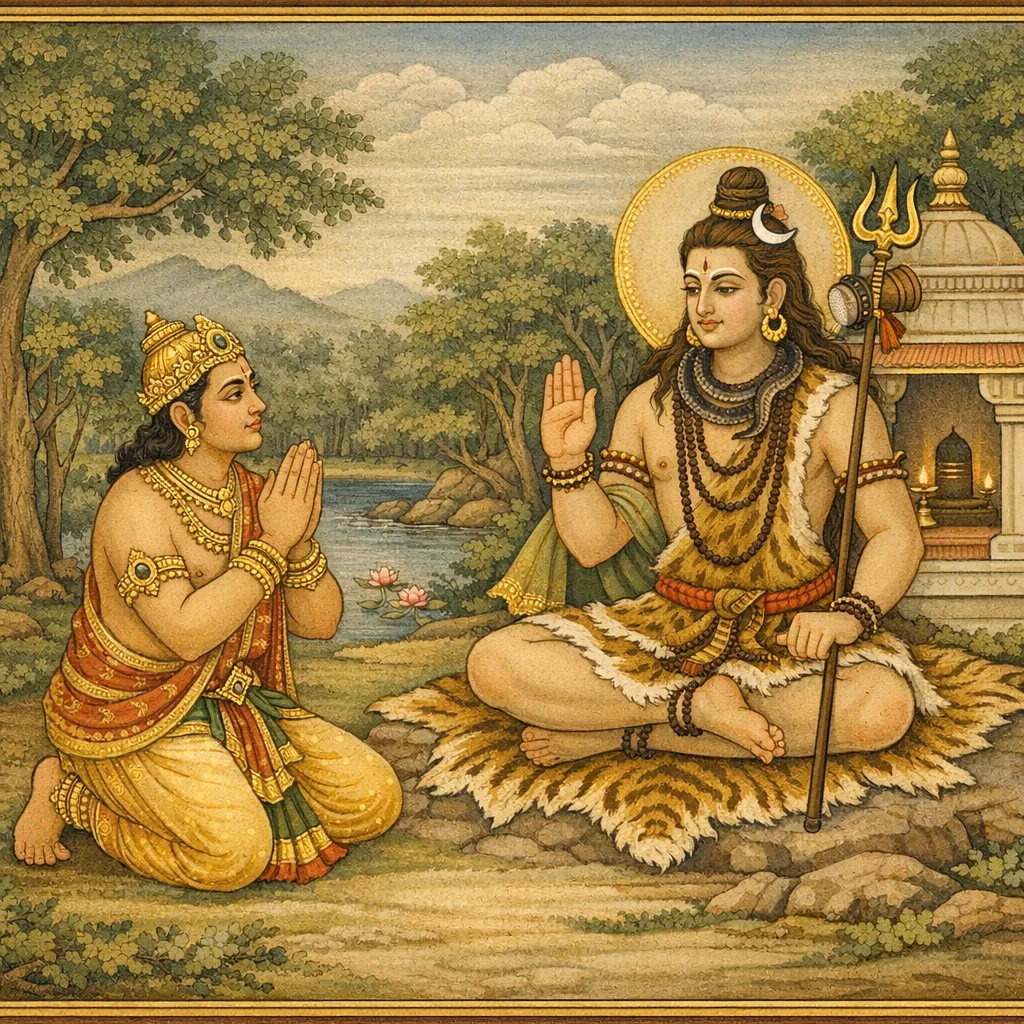
The ṛṣis ask Sūta about the austerities and contemplative disciplines Dharmarāja (Yama) undertook to counter the curse of the sage Māṇḍavya. Sūta relates that Dharmarāja, distressed by the curse, performed tapas in a sacred field, established a shrine like a royal pavilion for Kapardin (Śiva), and worshiped with flowers, incense, and fragrant unguents. Pleased, Mahādeva offered him a boon. Dharmarāja submits that though he upheld his own dharma, he was cursed to be born from a Śūdra womb, and he fears the suffering and the destruction of kin (jñāti-nāśa). Śiva declares that a sage’s utterance cannot be overturned: Dharmarāja will indeed be born as a Śūdra, yet will have no offspring; and though he will witness kin-loss, grief will not overpower him, since others will not heed his prohibitions and thus his emotional burden is lessened. Śiva then foretells a didactic life: for a hundred years he will remain dharma-inclined, giving many counsels for the welfare of relatives, even if they are faithless and morally fallen. After the hundred years, he will relinquish the body through the “Brahma-gate” (brahma-dvāra) and attain mokṣa. The chapter closes by identifying the fulfillment as Dharmarāja’s descent as Vidura, born by Vyāsa (Pārāśarya)’s arrangement in a dāsī’s womb, making Māṇḍavya’s words true; hearing this account is praised as sin-destroying.
Shlokas
Verse 1
ऋषय ऊचुः । किं कृतं धर्मराजेन तपोध्यानादिकं च यत् । मांडव्यशापनाशाय तदस्माकं प्रकीर्तय
The sages said: “What austerity, meditation, and related disciplines did Dharmarāja perform to annul Māṇḍavya’s curse? Please recount that to us.”
Verse 2
सूत उवाच । मांडव्य शापमासाद्य धर्मराजः सुदुःखितः । तपस्तेपे द्विजश्रेष्ठास्तस्मिन्क्षेत्रे व्यवस्थितः
Sūta said: “Having incurred Māṇḍavya’s curse, Dharmarāja became deeply distressed. O best of the twice-born, he undertook austerities, remaining established in that sacred field.”
Verse 3
प्रासादं देवदेवस्य संविधाय कपर्दिनः । अव्यग्रं पूजयामास पुष्पधूपानुलेपनैः
Having arranged a shrine-temple for the God of gods—Kapardin (Śiva)—he worshiped Him with an undistracted mind, offering flowers, incense, and fragrant unguents.
Verse 4
ततः कालेन महता तुष्टस्तस्य महेश्वरः । प्रोवाच वरदोऽस्मीति प्रार्थयस्व यदीप्सितम्
Then, after a long time, Maheśvara was pleased with him and said, “I am the giver of boons—ask for whatever you desire.”
Verse 5
धर्मराज उवाच । अहं देव पुरा शप्तो मांडव्येन महात्मना । स्वधर्मे वर्तमानोऽपि सर्वदोषविवर्जितः
Dharmarāja said: “O Lord, long ago I was cursed by the great-souled Māṇḍavya—though I was abiding in my own dharma and free from every fault.”
Verse 6
कुपितेन च तेनोक्तं शूद्रयोनौ भविष्यसि
And, angered, he said to me: “You shall be born in a Śūdra womb.”
Verse 7
तत्रापि च महद्दुःखं ज्ञातिनाशसमुद्रवम् । मच्छापजनितं सद्यो जातिजं समवाप्स्यसि
“Even there you will meet great sorrow arising from the destruction of kinsmen—an affliction born of birth itself, brought forth at once by my curse.”
Verse 8
तस्मात्त्राहि सुरश्रेष्ठ तस्या योनेः सकाशतः । कथं चैतद्विधो भूत्वा तस्यां जन्म करोम्यहम्
Therefore, O best among the gods, protect me from that womb. How, being such as I am, can I take birth in that condition?
Verse 9
तत्रापि च महदुःखं ज्ञातिनाशसमुद्भवम् । एतदर्थे सुरश्रेष्ठ मया चाराधितो भवान्
And even there, in that birth, there will be great sorrow arising from the destruction of kinsmen. For this very reason, O best of gods, I have worshiped You.
Verse 10
श्रीभगवानुवाच । न तस्य सन्मुनेर्वाक्यं शक्यते कर्तुमन्यथा । तस्माच्छूद्रोऽपि भूत्वा त्वं न संतानमवाप्स्यसि
The Blessed Lord said: “The word of that noble sage cannot be made otherwise. Therefore, even after becoming a Śūdra, you shall not obtain progeny.”
Verse 11
ज्ञातिक्षयं प्रदृष्ट्वापि नैव दुःखमवाप्स्यसि । यतो निषिध्यमानापि न करिष्यंति ते वचः
Even on seeing the destruction of your kinsmen, you will not fall into sorrow—because, though they are warned, they will not heed your words.
Verse 12
एतस्मात्कारणाच्चित्ते न ते दुःखं भविष्यति । ज्ञातिजं धर्मराजैतत्सत्यमेव मयोदितम्
For this very reason, no grief will arise in your mind. O Dharmarāja, this is the truth I have spoken—your sorrow is connected with your kin.
Verse 13
स्थित्वा वर्षशतं प्राज्ञ त्वं शूद्रो धर्मवत्सलः । उपदेशान्बहून्दत्त्वा ज्ञातिभ्यो हितकाम्यया । अपि श्रद्धा विहीनेषु पापात्मसु सदैव हि
O wise one, though you dwell for a hundred years as a Śūdra, you will be devoted to dharma. Seeking the welfare of your kinsmen, you will give them many instructions, even though they are ever sinful and devoid of faith.
Verse 14
ततो वर्षशते पूर्णे ब्रह्मद्वारेण केवलम् । आत्मानं सम्यगुत्सृज्य मोक्षमेव प्रयास्यसि
Then, when the hundred years are complete, by the Brahma-gate alone you will duly cast off the body and go to liberation itself.
Verse 15
एवमुक्त्वा स भगवान्गतश्चादर्शनं ततः । धर्मराजोऽपि तं शापं भेजे मांडव्यसंभवम्
Having spoken thus, the Lord then vanished from sight. And Dharmarāja, too, underwent that curse which had arisen from Māṇḍavya.
Verse 16
तदा विदुररूपेण ह्यवतीर्य धरातले । मांडव्यस्य वचः सत्यं स चकार महामतिः
Then, descending to the earth in the form of Vidura, that great-souled one made Māṇḍavya’s words come true.
Verse 17
जातो भगवता साक्षाद्व्यासेनामिततेजसा । पाराशर्येण विप्रेण दासीगर्भसमुद्भवः
He was born directly through the divine Vyāsa of immeasurable splendor—Parāśara’s son, the brahmin—arising from the womb of a maidservant.
Verse 18
एतद्वः सर्वमाख्यातं धर्मराजसमुद्भवम् । आख्यानं यदहं पृष्टः सर्वपातकनाशनम्
Thus I have told you all this account born of Dharmarāja’s manifestation—the narrative I was asked about—which destroys all sins.
Verse 138
इति श्रीस्कांदे महापुराण एकाशीतिसाहरस्र्यां संहितायां षष्ठे नागरखण्डे हाटकेश्वरक्षेत्रमाहात्म्ये धर्मराजेश्वरोत्पत्तिवर्णनंनामाष्टात्रिंशदुत्तरशततमोअध्यायः
Thus ends the one-hundred-and-thirty-eighth chapter, entitled “Description of the Origin of Dharmarājeśvara,” in the Hāṭakeśvara-kṣetra Māhātmya of the sixth Nāgara Khaṇḍa, within the Skanda Mahāpurāṇa (the eighty-one-thousand-verse Saṃhitā).