Adhyaya 130
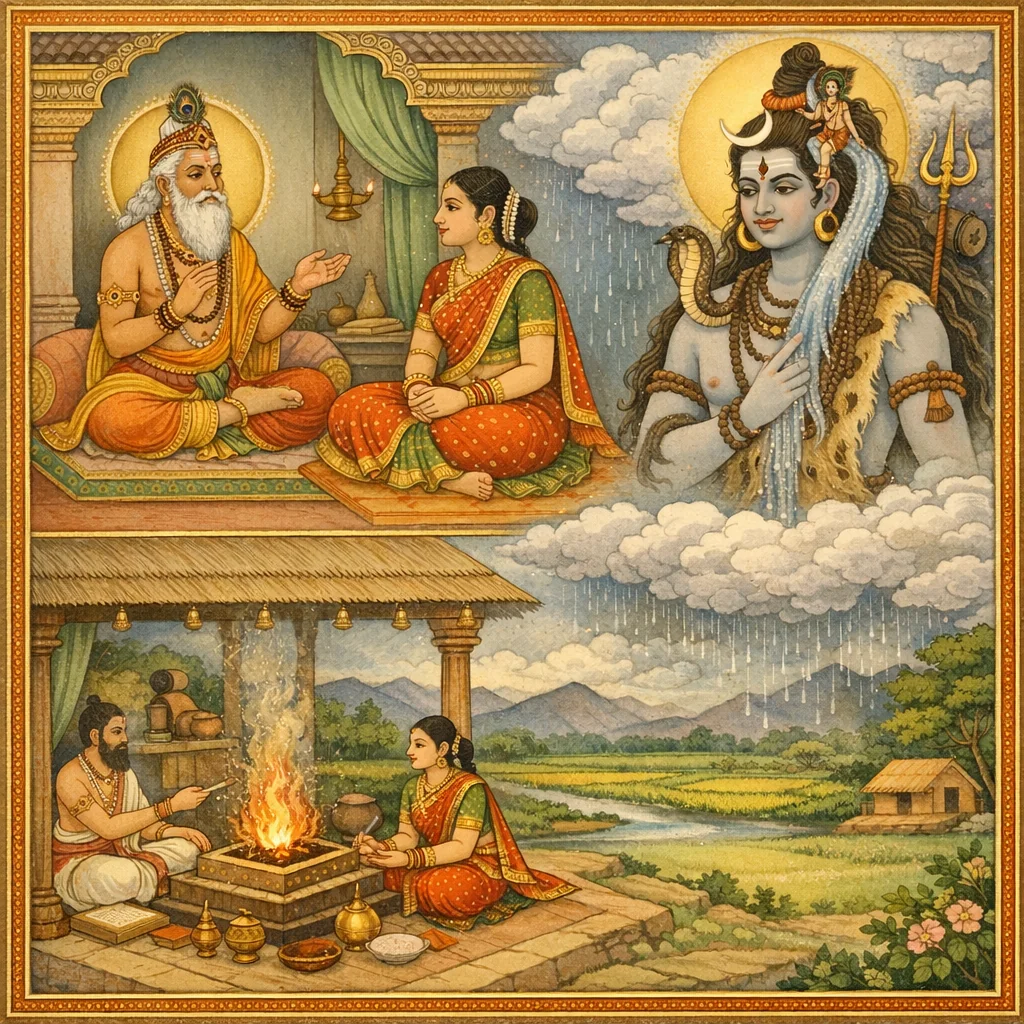
Chapter 130 opens with the Ṛṣis questioning Sūta about Yājñavalkya’s household, naming his two wives—Maitreyī and Kātyāyanī—and pointing to two associated tīrthas/kundas where bathing is said to bestow auspicious results. The narrative then turns to Kātyāyanī’s saptnī-duḥkha, the distress of co-wife rivalry, as she witnesses Yājñavalkya’s attachment to Maitreyī. Her sorrow is shown in her conduct—she withdraws from bathing, eating, and laughter. Seeking a remedy, she approaches Śāṇḍilī, renowned for marital harmony, and requests a confidential upadeśa to cultivate a husband’s affectionate and respectful disposition. Śāṇḍilī recounts her background at Kurukṣetra and conveys Nārada’s instruction: in Hāṭakeśvara-kṣetra, Devī Gaurī is worshiped through pañcapinḍa offerings, to be performed with steady śraddhā for a full year, with special observance on tṛtīyā. The chapter also weaves in a theological rationale through a dialogue of Devī and Deva about Gaṅgā upon Śiva’s head, linking it to the world’s maintenance—rainfall, agriculture, yajña, and cosmic balance—thus uniting social ethics, vow-based ritual, and cosmological reasoning in a tīrtha-centered teaching.
Shlokas
Verse 1
ऋषय ऊचुः । याज्ञवल्क्यसुतः सूत यस्त्वया परिकीर्तितः । कतमा तस्य माताभूत्सर्वं नो ब्रूहि विस्तरात्
The sages said: “O Sūta, the son of Yājñavalkya whom you have mentioned—who was his mother? Tell us everything in detail.”
Verse 2
सूत उवाच । तस्य भार्याद्वयं श्रेष्ठमासीत्सर्वगुणान्वितम् । एका गुणवती तस्य मैत्रेयीति प्रकीर्तिता
Sūta said: “He had two excellent wives, endowed with every virtue. One virtuous wife of his was renowned as Maitreyī.”
Verse 3
ज्येष्ठा चान्याथ कल्याणी ख्याता कात्यायनीति च । यस्याः कात्यायनः पुत्रो वेदार्थानां प्रजल्पकः
And the other, the elder, auspicious one was famed as Kātyāyanī—she whose son was Kātyāyana, an eloquent expounder of the meanings of the Vedas.
Verse 4
ताभ्यां कुण्डद्वयं तत्र संतिष्ठति सुशोभनम् । यत्र स्नाता नरा यांति लोकांस्तांश्च महोदयान्
From those two there exists there a splendid pair of sacred ponds. Having bathed there, people go to those worlds that are of great prosperity and exalted rise.
Verse 5
कात्यायन्याश्च तीर्थस्य शांडिल्यास्तीर्थमुत्तमम् । पतिव्रतात्वयुक्तायास्तथान्यत्तत्र संस्थितम्
And there is the tīrtha of Kātyāyanī, and the supreme tīrtha of Śāṇḍilyā; likewise, another sacred place is established there for one endowed with the dharma of devoted wifehood (pativratā).
Verse 6
यत्र कात्यायनी प्राप्ता शांडिल्या प्रतिबोधिता । वैराग्यं परमं प्राप्ता सपत्नीदुःखदुःखिता
At that place Kātyāyanī arrived and was instructed by Śāṇḍilyā; afflicted by the sorrow born of a co-wife, she attained the highest dispassion (vairāgya).
Verse 8
तत्र या कुरुते स्नानं तृतीयायां समाहिता । नारी मार्गसिते पक्षे सा सौभाग्यवती भवेत् । अथ दौर्भाग्यसंपन्ना काणा वृद्धाऽथ वामना । अभीष्टा जायते सा च तत्प्रभावाद्द्विजोत्तमाः
O best of the twice-born, a woman who, with a steady and focused mind, bathes there on the third lunar day (tṛtīyā) in the bright fortnight of Mārgaśīrṣa becomes fortunate, blessed with marital happiness and worldly prosperity. Even if she is burdened by misfortune—blind in one eye, aged, or dwarfed—by the power of that sacred tīrtha she becomes as desired.
Verse 9
ऋषय ऊचुः । कीदृक्सपत्निजं दुःखं कात्यायन्या उपस्थितम् । उपदेशः कथं लब्धः शांडिल्याः सूत कीदृशः
The sages said: “What kind of sorrow, born of a co-wife, came upon Kātyāyanī? And the instruction of Śāṇḍilyā—O Sūta—how was it obtained, and what was its nature?”
Verse 10
कात्यायन्या समाचक्ष्व कौतुकं नो व्यवस्थितम् । सामान्यो भविता नैष उपदेशस्तयेरितः
“Explain to us the matter concerning Kātyāyanī; our curiosity is firmly set. This instruction spoken by her will not be ordinary, but truly significant.”
Verse 11
सूत उवाच । मैत्रेय्या सह संसक्तं याज्ञवल्क्यं विलोक्य सा । कात्यायनी सुदुःखार्ता संजाता चेर्ष्यया ततः
Sūta said: Seeing Yājñavalkya closely attached to Maitreyī, Kātyāyanī was overwhelmed by profound sorrow, and then jealousy (īrṣyā) arose within her.
Verse 12
सा न स्नाति न भुंक्ते च न हास्यं कुरुते क्वचित् । केवलं बाष्पपूर्णाक्षी निःश्वासाढ्या बभूव ह
She neither bathed nor ate, and she did not laugh at any time. Her eyes were filled only with tears, and she became laden with heavy sighs.
Verse 13
ततः कदाचिदेवाथ फलार्थं निर्गता बहिः । अपश्यच्छांडिलीनाम पतिपार्श्वे व्यवस्थिताम्
Then, once, when she went outside in search of fruits, she saw a woman named Śāṇḍilī standing by her husband’s side.
Verse 14
कृतांजलिपुटां साध्वी विनयावनता स्थिताम् । सोऽपि तस्या मुखासक्तः सानुरागः प्रसन्नदृक्
She—the virtuous woman—stood with hands folded, bowed in humility. And he too, with loving attachment, kept his gaze on her face, looking pleased.
Verse 15
गुणदोषोद्भवां वार्तामापृच्छ्याकथयत्तथा । सा च तौ दंपती दृष्ट्वा संहृष्टावितरेतरम्
After asking, he spoke with her about matters arising from virtues and faults. And she, seeing that husband and wife delighted in one another, took note of their mutual joy.
Verse 16
चित्ते स्वे चिंतयामास सुधन्येयं तपस्विनी । यस्याः पतिर्मुखासक्तो गुणदोषप्रजल्पकः । सानुरागश्च सुस्निग्धो नान्यां नारीं बिभर्त्ति च
In her heart she reflected: “Fortunate indeed is this ascetic woman, whose husband is devoted to her face, who converses with her about virtues and faults; affectionate and deeply tender, he does not keep any other woman.”
Verse 17
एवं संचित्य सा साध्वी भूयोभूयो द्विजोत्तमाः । जगाम स्वाश्रमं पश्चान्निंद्यमाना स्वकं वपुः
Thinking thus again and again, O best of the twice-born, that virtuous woman returned afterward to her own hermitage, reproaching her own condition.
Verse 18
ततः कदाचिदेकांते स्थितां तां शांडिलीं द्विजाः । बहिर्गते भर्तरि च तस्याः कार्येण केनचित्
Then, at a certain time, O brāhmaṇas, while Śāṇḍilī was dwelling in seclusion and her husband had gone outside on some errand, an occasion arose to approach her.
Verse 19
कात्यायनी समागम्य ततः पप्रच्छ सादरम् । वद कल्याणि मे कंचिदुपदेशं महोदयम्
Then Kātyāyanī came near and respectfully asked: “O auspicious lady, tell me some instruction that brings great uplift.”
Verse 20
मुखप्रेक्षः सदा भर्त्ता येन स्त्रीणां प्रजायते । नापमानं करोत्येव दुरुक्तवचनैः क्वचित्
A husband who is ever attentive and kindly disposed thereby becomes dear to women; and he never humiliates them at any time with harsh, ill-spoken words.
Verse 21
नान्यां संगच्छते नारीं चित्तेनापि कथंचन । अहं भर्तुः कृतैर्दुःखैरतीव परिपीडिता । सपत्नीजैर्विशेषेण तस्मान्मे त्वं प्रकीर्तय
He does not unite with any other woman—nor even in his mind, in any way. Yet I am sorely afflicted by the sorrows caused by my husband, especially through rival wives; therefore, O revered one, tell me the remedy.
Verse 22
यथा ते वशगो भर्त्ता संजातः कामदः सदा । मनसापि न संदध्यान्नारीमेष कथंचन
So that your husband becomes obedient to your will—ever a fulfiller of your desires—and so that he may not, even in thought, turn toward another woman in any way.
Verse 23
शांडिल्युवाच । शृणु साध्वि प्रवक्ष्यामि तवाहं गुह्यमुत्तमम् । यथा ममाभवद्वश्यो मुखप्रेक्षस्तथा पतिः
Śāṇḍilya said: Listen, O virtuous lady; I shall tell you the supreme secret—by which my husband became compliant and ever attentive, always looking to my face; so too may your husband become.
Verse 24
मम तातः कुरुक्षेत्रे शांडिल्यो मुनिसत्तमः । वानप्रस्थाश्रमेऽतिष्ठत्पूर्वे वयसि संस्थितः
My father—Śāṇḍilya, the best of sages—dwelt at Kurukṣetra, abiding in the vānaprastha āśrama, having entered that earlier stage of disciplined withdrawal.
Verse 25
तत्रैकाहं समुत्पन्ना कन्या तस्य महात्मनः । वृद्धिं गता क्रमेणाथ तस्मिन्नेव तपोवने
There I was born as the daughter of that great-souled one; and in due course I grew up, right there in that very grove of austerities.
Verse 26
करोमि तत्र शुश्रूषां होमकाले यथोचिताम् । नीवारादीनि धान्यानि नित्यं चैवानयाम्यहम्
There I rendered proper service at the time of the homa, the fire-offering; and daily I would bring grains such as nīvāra, wild rice, and the like.
Verse 27
कस्यचित्त्वथ कालस्य नारदो मुनिसत्तमः । आश्रमे मम तातस्य सुश्रांतः समुपागतः
Then, at some time, Nārada—the best of sages—arrived at my father’s hermitage, weary from travel.
Verse 28
तातादेशात्ततस्तत्र मया स विश्रमः कृतः । पादशौचादिभिः कृत्यैः स्नानाद्यैश्च तथापरैः
Then, at my father’s command, I arranged his rest there, performing the duties of service—washing his feet, preparing his bath, and other such ministrations.
Verse 29
ततो भुक्तावसानेऽथ निविष्टः मुखसंस्थित । मम मात्रा परिपृष्टो विनयाद्वरवर्णिनि
Then, when the meal was finished, he sat down facing them. My mother, with courteous humility, questioned him—O fair lady.
Verse 30
एकेयं कन्यकास्माकं जाते वयसि संस्थिते । संजाता मुनिशार्दूल प्राणेभ्योऽपि गरीयसी
We have but this one daughter; now that she has come of age, she has become—O tiger among sages—dearer to us even than our own life-breath.
Verse 31
तदस्याः कीर्तय क्षिप्रं सुखोपायं सुखोदयम् । व्रतं वा नियमं वा त्वं होमं वा मन्त्रमेव वा
Therefore, tell us quickly an easy means that brings her auspicious happiness—be it a sacred vow (vrata), a discipline (niyama), a fire-offering (homa), or a mantra.
Verse 32
येन चीर्णेन भर्त्ता स्यात्सुसौम्यः सद्गुणान्वितः । प्रियंवदो मुखप्रेक्षः परनारीपराङ्मुखः
By performing that observance, may she obtain a husband who is gentle and handsome, endowed with virtues—sweet-spoken, pleasing in countenance, and turned away from other men’s wives.
Verse 33
तस्यास्तद्वचनं श्रुत्वा स मुनिस्तदनंतरम् । चिरं ध्यात्वा वचः प्राह प्रसन्नवदनस्ततः
Hearing her words, the sage then, after long contemplation, spoke—his face serene and gracious.
Verse 34
हाटकेश्वरजे क्षेत्रे पञ्चपिंडा व्यवस्थिता । गौरी गौर्या स्वयं तत्र स्थापिता परमेश्वरी
In the sacred field of Hāṭakeśvara, five piṇḍas are established; there the Supreme Goddess—Gaurī—was herself installed by Gaurī.
Verse 35
तामेषा वत्सरं यावच्छ्रद्धया परया युता । सदा पूजयतु प्रीत्या तृतीयायां विशेषतः
Let this girl worship Her for a full year, endowed with supreme faith—always with love, and especially on the third lunar day (tṛtīyā).
Verse 36
ततो वर्षांतमासाद्य संप्राप्स्यति यथोचितम् । भर्त्तारं नात्र संदेहो यादृग्रूपं यथोचितम्
Then, when the year is completed, she will obtain a husband suited to her—of fitting form and worth; of this there is no doubt.
Verse 37
तत्र पूर्वं गता गौरी परित्यज्य महेश्वरम् । गंगेर्ष्यया महाभागे ज्ञात्वा क्षेत्रं सुसिद्धिदम्
Formerly, Gaurī went there, leaving Maheśvara behind; through jealousy of Gaṅgā, O greatly fortunate one, she came to know that kṣetra as a giver of excellent attainments.
Verse 38
ततः सा चिंतयामास कां देवीं पूजयाम्यहम् । सौभाग्यार्थं यतोऽन्या मां पूजयंति सुरस्त्रियः
Then she reflected: “Which Goddess should I worship for the sake of marital auspiciousness—since other divine women worship me?”
Verse 39
तस्मादहं प्रभक्त्याढ्या स्वयमात्मानमेव च । आत्मनैव कृतोत्साहा पूजयिष्यामि सिद्धये
Therefore, filled with devoted love, I shall worship my very Self—rousing my own resolve by myself—for the sake of attainment.
Verse 40
ततः प्राणाग्निहोत्रोत्थैर्मंत्रैराथर्वणैः शुभैः । मृत्पिंडान्पंच संयोज्य ह्येकस्थाने समाहिता
Then, with auspicious Atharvan mantras arising from the rite of the prāṇāgnihotra, the Goddess—fully composed—joined together five lumps of clay and gathered them into a single place.
Verse 41
पृथ्वीमपश्च तेजश्च वायुमाकाशमेव च । तेषु संयोजयामास मृत्पिंडेषु निधाय सा
She then placed within them earth, water, fire, wind, and also ether, and thereby united these elements by depositing them into the clay-lumps.
Verse 42
महद्भूतानि चैतानि पञ्च देवी यतव्रता । ततः संपूजयामास पुष्पधूपानुलेपनैः
These five were the great elements; and the Goddess, steadfast in her vow, then worshipped them fully with flowers, incense, and fragrant unguents.
Verse 43
अथ तां तत्र विज्ञाय तपःस्थां गिरजां भवः । तन्मंत्राकृष्टचित्तश्च सत्वरं समुपागतः
Then Bhava (Śiva), recognizing Girijā there as one abiding in austerity, and his mind drawn by her mantras, quickly came to that place.
Verse 44
प्रोवाच च प्रहृष्टात्मा कस्मात्त्वमिह चागता । मां मुक्त्वा दोषनिर्मुक्तं मुखप्रेक्षं सदा रतम्
Joyful at heart, he spoke: “Why have you come here, leaving me—faultless—ever delighting in gazing upon your face?”
Verse 45
तस्मादागच्छ कैलासं वृषारूढा मया सह । अथवा कारणं ब्रूहि यदि दोषोऽस्ति मे क्वचित्
“Therefore come to Kailāsa with me, seated upon the bull; or else tell me the reason—if there is any fault in me anywhere.”
Verse 46
देव्युवाच । त्वं मूर्ध्ना जाह्नवीं धत्से मूर्तां पदजलात्मिकाम् । तस्मान्नाहं गमिष्यामि मंदिरं ते कथंचन
The Goddess said: “You bear on your head Jāhnavī (Gaṅgā), embodied as the water that issued from the Lord’s feet. Therefore I will not go to your dwelling—by no means at all.”
Verse 47
यावन्न त्यजसि व्यक्तं मम सापत्न्यतां गताम् । तथा नित्यं प्रणामं त्वं करोषि वृषभध्वज
“So long as you do not clearly abandon that which has become my co-wifehood (rivalry), and so long as you daily offer obeisance, O Bull-bannered Lord…”
Verse 48
प्रत्यक्षमपि मे नित्यं संध्यायाश्च न लज्जसे । तस्मादेतत्परित्यज्य कर्म लज्जाकरं परम्
Even in my very presence each day, and even at the time of twilight worship (sandhyā), you are not ashamed. Therefore abandon this act—an exceedingly shame-bringing deed.
Verse 49
आकारयसि मां देव तत्स्याद्यदि मतं मम । अन्यथाहं न यास्यामि तव हर्म्ये कथंचन । एतच्छ्रुत्वा यदिष्टं ते कुरुष्व वृषभध्वज
O God, if my view is to prevail, then command it so. Otherwise I will not go to your palace in any way. Having heard this, do what is pleasing to you, O Bull-bannered Lord (Vṛṣabhadhvaja).
Verse 50
देव उवाच नाहं सौख्येन तां गंगां धारयामि सुरेश्वरि
The Deva said: “O queen of the gods (Sureśvarī), I do not bear that Gaṅgā with ease or comfort.”
Verse 51
भगीरथेन भूपेन प्रार्थितो ज्ञाति कारणात् । दिव्यं वर्षसहस्रं तु तपस्तप्त्वा सुदारुणम्
Requested by King Bhagīratha for the sake of his ancestors, he performed fierce austerity (tapas) for a divine thousand years.
Verse 52
येन नो याति पातालं गंगा स्वर्गपरिच्युता । तस्मात्त्वं देव मद्वाक्यात्स्वमूर्ध्ना वह जाह्नवीम्
So that the Gaṅgā—fallen from heaven—may not plunge into the netherworld (Pātāla), therefore, O Deva, at my request, bear Jāhnavī upon your own head.
Verse 53
मया तस्य प्रतिज्ञातं धारयिष्याम्यसंशयम् । आकाशाज्जाह्नवीवेगं पतंतं धरणीतले
I promised him: “Without doubt I shall bear it”—the rushing force of Jāhnavī (Gaṅgā) as she falls from the sky onto the face of the earth.
Verse 54
नो चेद्व्रजेत पातालं यदत्र विषयेस्थिम् । ततोऽहं संप्रवक्ष्यामि तदिहैकमनाः शृणु
If she did not descend to Pātāla and remain within this realm, then I shall explain it—listen here with a single-pointed mind.
Verse 55
एषा गंगा वरारोहे मम मूर्ध्नो विनिर्गता । हिमवंतं नगं भित्त्वा द्विधा जाता ततः परम्
“This Gaṅgā, O fair-hipped one, issued forth from my head; then, cleaving the mountain Himavat, she became two streams thereafter.”
Verse 56
ततः सिंध्वभिधाना सा पश्चिमं सागरं गता । शतानि नव संगृह्य नदीनां परमेश्वरि
“Then one stream, called Sindhu, went to the western ocean, gathering nine hundred rivers, O supreme goddess.”
Verse 57
तथा गंगाभिधाना च सैव प्राक्सागरं गता । तावतीश्च समादाय नदीः पर्वतनन्दिनि
“Likewise the other stream, called Gaṅgā, went to the eastern ocean, taking in just as many rivers, O daughter of the mountain.”
Verse 58
एवमष्टादशैतानि नदीनां पर्वतात्मजे । शतानि सागरे यांति तेन नित्यं स तिष्ठति
Thus, O mountain-born one, these eighteen hundreds of rivers flow into the ocean; therefore the ocean ever remains full.
Verse 59
सततं शोष्यमाणोऽपि वाडवेन दिवानिशम् । समुद्रसलिलं मेघाः समादाय ततः परम्
Though continually dried up day and night by the submarine fire (Vāḍava), the clouds draw up the ocean’s waters, and thereafter…
Verse 60
मर्त्यलोके प्रवर्षंति ततः सस्यं प्रजायते । सस्येन जीवते लोकः प्रभवन्ति मखास्तथा । मखांशेन सुराः सर्वे तृप्तिं यांति ततः परम्
In the mortal world, rains fall; from rain, crops are born. By crops the world lives, and from that arise sacrifices as well. Through their share in the sacrifices, all the gods attain satisfaction thereafter.
Verse 61
एतस्मात्कारणान्मूर्ध्नि देवि गंगां दधाम्यहम् । न स्नेहात्कामतो नैव जगद्येन प्रवर्तते
For this very reason, O Goddess, I bear Gaṅgā upon my head—not out of mere affection, nor from desire, but because by her the world continues to function.
Verse 62
अथवा सन्त्यजाम्येनां यदि मूर्ध्नः कथंचन । तद्दूरं वेगतो भित्त्वा पृथ्वीं याति रसातलम्
Or if, by any chance, I were to release her from my head, she would, with tremendous force, pierce far through the earth and plunge down to Rasātala.
Verse 63
ततः शोषं व्रजेदाशु समुद्रः सरितां पतिः । और्वेण पीयमानोऽत्र ततो वृष्टिर्न जायते । वृष्ट्यभावाज्जगन्नाशः सत्यमेतन्मयोदितम्
Then the ocean—the lord of rivers—would quickly dry up, being drunk here by the Auruva fire; and thereafter no rain would arise. From the absence of rain comes the ruin of the world—this is truly what I declare.
Verse 64
एवं गंगाकृते प्रोक्तं मया तव सुरेश्वरि । शृणु सन्ध्याकृतेऽन्यच्च येन तां प्रणमाम्यहम्
Thus, O Queen of the gods, I have explained to you the reason concerning Gaṅgā. Now hear also another reason connected with Sandhyā, by which I bow to her.