Adhyaya 12
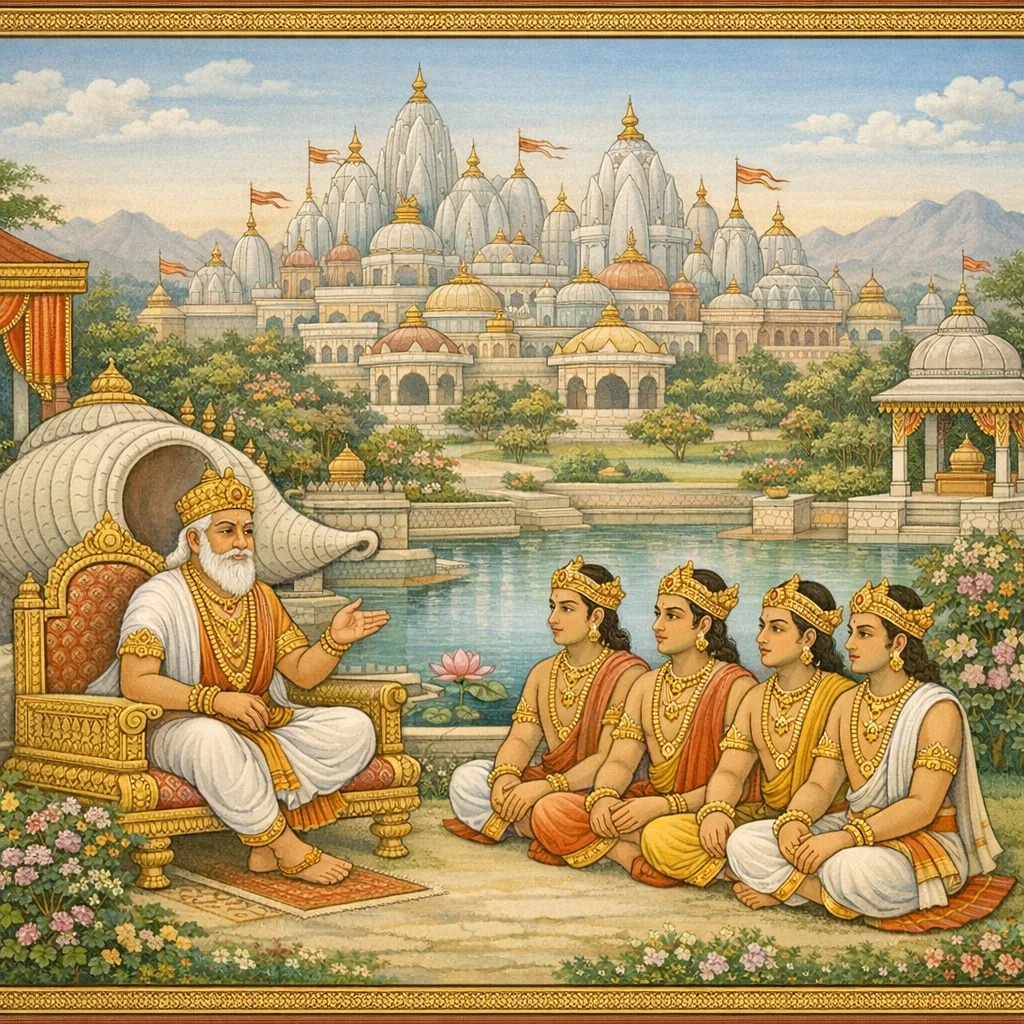
Sūta recounts how King Vasudhāpāla builds a splendid city, likened to Indra’s Purandara-pura. It is adorned with jewel-like homes, crystal palaces comparable to the peaks of Kailāsa, banners, golden gateways, tanks with gem-like steps, gardens, wells, and all civic instruments. When fully furnished, the king offers (nivedya) this settlement to eminent brāhmaṇas, and is portrayed as having fulfilled his dharmic duty. At Śaṅkha-tīrtha he summons his sons, grandsons, and retainers and issues a directive of governance: the donated city must be protected with sustained effort so that all brāhmaṇas remain content. The chapter then sets forth the moral law of outcomes—rulers who guard the brāhmaṇas with devotion gain extraordinary radiance, invincibility, prosperity, longevity, health, and a flourishing lineage through brāhmaṇical grace; those who act with hostility incur suffering, defeat, separation from loved ones, illness, censure, disruption of lineage, and finally descent to Yama’s realm. It ends with the king entering austerity, while his descendants obey his instruction, establishing continuity in custodial dharma.
Shlokas
Verse 1
। सूत उवाच । एवं स वसुधापालो ब्राह्मणेभ्यः स्वशक्तितः । ददौ तु नगरं कृत्वा पुरंदरपुरोपमम्
Sūta said: Thus that protector of the earth, according to his capacity, built a city like the city of Purandara (Indra) and gave it to the Brāhmaṇas.
Verse 2
मुक्ताप्रवालवैडूर्यरत्नहेमविचित्रितैः । भ्राजमानं गृहश्रेष्ठैर्द्यौर्नक्षत्रगणैरिव
Variegated with pearls, coral, vaidūrya gems, precious stones, and gold, it shone with its finest houses—like the sky with its multitudes of stars.
Verse 3
प्रासादैः स्फाटिकैश्चैव कैलासशिखरोपमैः । पताकाशोभितैर्दिव्यैः समंतात्परिवारितम्
It was surrounded on every side by crystal-like palaces, like the peaks of Kailāsa, divinely adorned with fluttering sacred banners.
Verse 4
कांचनैः सुविचित्रैश्च प्रोन्नतैरमलैः शुभैः । तोरणानां सहस्रैश्च शोभितं सुमनोहरम्
It was exceedingly delightful, adorned with thousands of gateways—golden, exquisitely wrought, lofty, spotless, and auspicious.
Verse 5
मणिसोपानशोभाभिर्दीर्घिकाभिः समंततः । आरामकूपयंत्राद्यैः सर्वोपकरणैर्युतम् । निवेद्य ब्राह्मणेंद्राणां कृतकृत्यो बभूव सः
He had the town adorned on every side with long reservoirs, beautified by jewel-like steps, and furnished with gardens, wells, water-lifting devices, and every necessary provision. Then he formally offered it to the foremost of the Brahmins, and thus felt his duty fully accomplished.
Verse 6
शंखतीर्थे स्थितो नित्यं समाहूय ततः सुतान् । पुत्रान्पौत्रांस्तथा भृत्यान्वाक्यमेतदुवाच ह
Dwelling continually at Śaṅkhatīrtha, he then summoned his sons—together with grandsons and attendants—and spoke these words.
Verse 7
एतत्पुरं मया कृत्वा ब्राह्मणेभ्यो निवेदितम् । भवद्भिर्मम वाक्येन रक्षणीयं प्रयत्नतः
“This town I have built and dedicated to the Brahmins. By my command, you must protect it with all diligence.”
Verse 9
यथा स्युर्ब्राह्मणाः सर्वे सुखिनो हृष्टमानसाः । युष्माभिः पालनं कार्यं तथा सर्वैः समाहितैः । यश्चैतान्भक्तिसंयुक्तः पालयिष्यति भूमिपः । अन्योऽपि परमं तेजः स संप्राप्स्यति भूतले
So that all the Brahmins may remain happy and glad at heart, you all—fully attentive—must govern and protect accordingly. Any king who, endowed with devotion, will protect these Brahmins and their endowment, even if he be another ruler who comes later, shall attain supreme splendor upon the earth.
Verse 10
अजेयः सर्वशत्रूणां प्रतापी स्फी तिसंयुतः । भविष्यति न सन्देहो ब्राह्मणानां स पालनात्
By protecting the Brahmins, he will be unconquerable by all enemies—valiant and endowed with prosperity. Of this there is no doubt: it comes from safeguarding the Brahmins.
Verse 11
पुत्रपौत्रसुभृत्याढ्यो दीर्घायू रोगवर्जितः । ब्राह्मणानां प्रसादेन मम वाक्याद्भविष्यति
By the grace of the Brahmins—and by my injunction—he shall be rich in sons, grandsons, and good attendants; long-lived and free from disease.
Verse 12
यः पुनर्द्वेषसंयुक्तः संतापं चैव नेष्यति । एतान्ब्राह्मणशार्दूलान्नरकं स प्रयास्यति
But whoever is driven by hatred will come to torment; and if he harms these tiger-like Brahmins, he will go to hell.
Verse 13
तथा दुःखानि संप्राप्य दृष्ट्वा नैकान्पराभवान् । वियोगानिष्टबन्धूनां व्याधिग्रस्तो विगर्हितः
He will meet manifold sorrows and witness many defeats—separated from beloved relatives, stricken by illness, and scorned.
Verse 14
वंशोच्छेदं समासाद्य गमिष्यति यमालयम् । तस्मात्सर्वप्रयत्नेन रक्षणीयमिदं पुरम् । मम वाक्याद्विशेषेण हितमिच्छद्भिरात्मनः
Meeting with the extinction of his lineage, he will go to Yama’s abode. Therefore, with every effort this city must be protected—especially by my command—by those who seek their own welfare.
Verse 15
एवं स भूपतिः सर्वांस्ता नुक्त्वा तपसि स्थितः । तेऽपि सर्वे तथा चक्रुर्यथा तेन च शिक्षिताः
Thus the king, having spoken all this to them, took his stand in austerity; and they too acted accordingly, just as he had instructed them.