Adhyaya 114
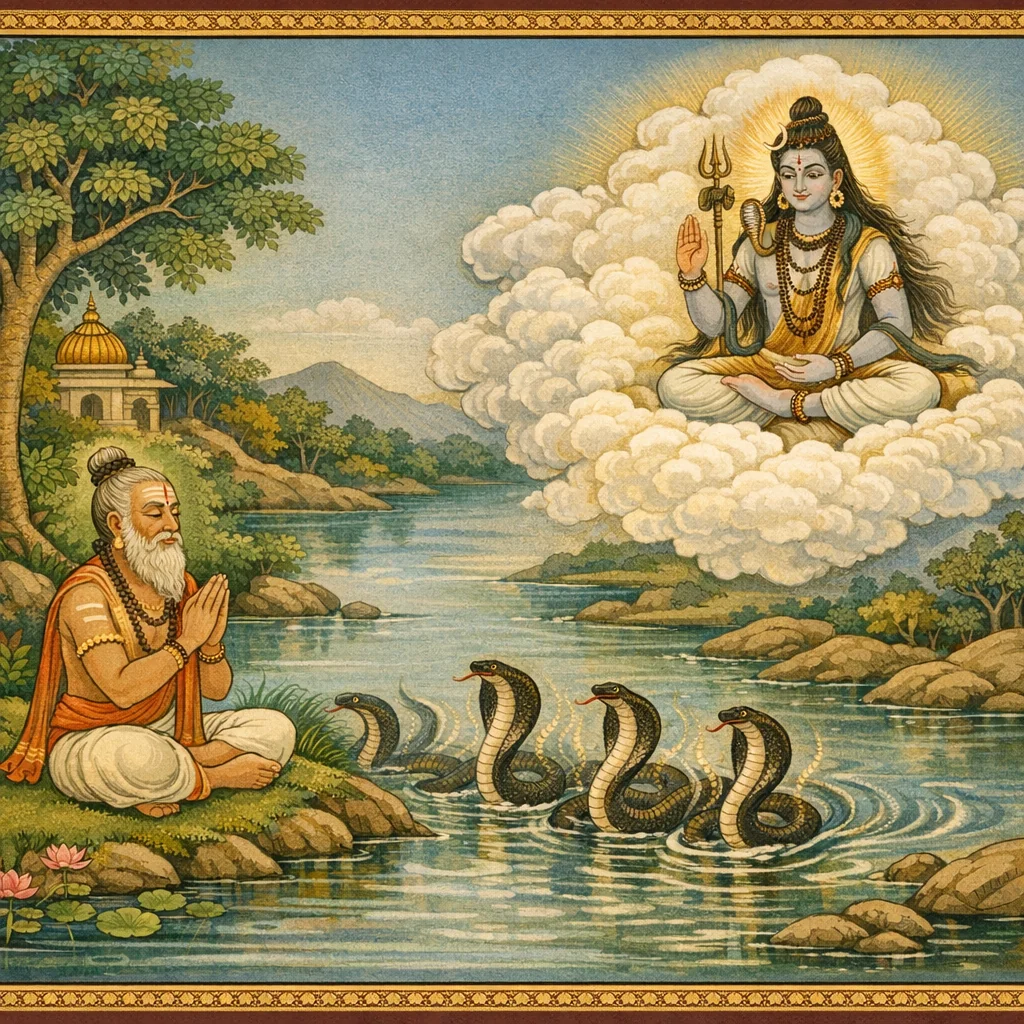
Sūta recounts a crisis-and-restoration centered on the Brahmin ascetic Trijāta. Shamed in society because of his mother’s fault, he seeks rehabilitation through fierce tapas and worship of Śiva beside a water-source. Śiva appears, grants him grace, and promises that in time he will be honored among the Brahmins of Cāmatkārapura. The narrative then turns to that city: Kratha, son of Devarāta, proud and rash, strikes and kills a nāga child, Rudramāla, on Śrāvaṇa kṛṣṇa-pañcamī near Nāga-tīrtha. The nāga parents and serpent hosts assemble; Śeṣa leads retaliation, devours the offender, and devastates Cāmatkārapura, leaving a depopulated region occupied by serpents and barred to human entry. Terrified Brahmins seek Trijāta, who petitions Śiva to destroy the serpents. Śiva refuses indiscriminate punishment, stressing the child’s innocence and the ritual sanctity of pañcamī in Śrāvaṇa, when nāgas are to be worshipped. Instead he bestows a siddha, tri-syllabic mantra—“na garaṃ na garaṃ”—whose utterance neutralizes venom and drives serpents away; those who remain become vulnerable. Trijāta returns with the survivors, proclaims the mantra, the serpents flee or are subdued, and the settlement becomes famed as “Nagara.” The phalaśruti declares that reciters or hearers of this account are freed from fear born of serpents.
Shlokas
Verse 1
सूत उवाच । सोऽपि विप्रो द्विजश्रेष्ठा विस्फोटकपरिप्लुतः । लज्जया परया युक्तो गत्वा किंचिद्वनांतरम्
Sūta said: That brāhmaṇa too—though a foremost among the twice-born—was covered with eruptive sores; overwhelmed by deep shame, he went away into a secluded part of the forest.
Verse 2
ततो वैराग्यमापन्नो रौद्रे तपसि संस्थितः । त्यक्त्वा गृहादिकं सर्वं स्नेहं दारसुतोद्भवम्
Then, attaining dispassion, he took to fierce austerities—abandoning home and all else, and renouncing the attachments that arise from wife and children.
Verse 3
नियमैः संयमैश्चैव शोषयन्नात्मनस्तनुम् । किंचिज्जलाश्रयं गत्वा स्थापयित्वा महेश्वरम्
With vows and self-restraint he made his body grow lean; then, going to a certain refuge by the waters, he established Maheśvara (Śiva) there.
Verse 4
ततः कालेन महता तुष्टस्तस्य महेश्वरः । प्रोवाच दर्शनं गत्वा प्रार्थयस्व यथेप्सितम्
After a long time Maheśvara was pleased with him. Appearing in a vision, he said: “Ask for whatever you desire.”
Verse 5
त्रिजात उवाच । मातृदोषादहं देव वैलक्ष्यं परमं गतः । मध्ये ब्राह्मणमुख्यानामानर्त्ताधिपतेस्तथा
Trijāta said: “O Lord, because of my mother’s fault I have fallen into extreme disgrace—humiliated in the midst of eminent brāhmaṇas, and likewise before the ruler of Ānarta.”
Verse 6
अहं शक्नोमि नो वक्तुं कस्यचिद्दर्शितुं विभो । त्रिजातोऽस्मीति विज्ञाय भूरिविद्यान्वितोऽपि च
“O Mighty One, I cannot speak to anyone or show myself to anyone; though I possess abundant learning, once people know that I am ‘Trijāta’, I am shunned.”
Verse 7
तस्मात्सर्वोत्तमस्तेषामहं चैव द्विजन्मनाम् । यथा भवामि देवेश तथा नीतिर्विधीयताम्
“Therefore, O Lord of the gods, ordain the means by which I may become the very best among those twice-born (dvija).”
Verse 8
श्रीभगवानुवाच । चमत्कारपुरे विप्रा ये वसंति द्विजोत्तम । तेषां सर्वोत्तमो नूनं मत्प्रसादाद्भविष्यसि
The Blessed Lord said: “O best of brāhmaṇas, among the brāhmaṇas who dwell in Camatkārapura, by My grace you shall surely become the foremost.”
Verse 9
तस्मात्कालं प्रतीक्षस्व कञ्चित्त्वं ब्राह्मणोत्तम । समये समनुप्राप्ते त्वां च नेष्यामि तत्र वै
“Therefore, O best of brāhmaṇas, wait for some time. When the proper time arrives, I shall indeed lead you there.”
Verse 10
एवमुक्त्वा स देवेशस्ततश्चादर्शनं गतः । ब्राह्मणोऽपि तपस्तेपे तथा संपूजयन्हरम्
Having spoken thus, the Lord of the gods then vanished from sight. The brāhmaṇa too undertook austerities, continuing to worship Hara (Śiva) with due reverence.
Verse 11
कस्यचित्त्वथ कालस्य मत्कारपुरे द्विजाः । मौद्गल्यान्वयसंभूतो देवरातोऽभवद्द्विजः
Now, after some time, in the city called Matkārapura, there was a twice-born man named Devarāta, born in the lineage of Maudgalya.
Verse 12
तस्य पुत्रः क्रथोनाम यौवनोद्धतविग्रहः । सदा गर्वसमायुक्तः पौरुषे च व्यवस्थितः
His son was named Kratha—arrogant in the flush of youth, ever filled with pride, and set upon displays of manly prowess.
Verse 13
स कदाचिद्ययौ विप्रो नागतीर्थं प्रति द्विजाः । श्रावणस्यासिते पक्षे पंचम्यां पर्यटन्वने
Once, that brāhmaṇa set out toward Nāga-tīrtha, O twice-born ones, wandering through the forest on the fifth lunar day of the dark fortnight of Śrāvaṇa.
Verse 14
अथापश्यत्स नागेन्द्रतनयं भूरिवर्च्चसम् । रुद्रमालमिति ख्यातं जनन्या सह संगतम्
Then he saw the son of the serpent-king, radiant with great splendor—known as Rudramāla—together with his mother.
Verse 15
अथाऽसौ तं समालोक्य सुलघुं सर्प पुत्रकम् । जलसर्पमिति ज्ञात्वा लगुडेन व्यपोथयत्
Seeing that very small serpent-child, and taking him to be merely a water-snake, he struck him with a club.
Verse 16
हन्यमानेन तेनाथ प्रमुक्तः सुमहान्स्वनः । हा मातस्तात तातेति विपन्नोऽस्मि निरागसः
As he was being beaten, a very loud cry burst forth: “O Mother! O Father! Father!”—“I am perishing, though I am without fault.”
Verse 17
सोऽपि श्रुत्वाऽथ तं शब्दं ब्राह्मणो मानुषोद्भवम् । सर्पस्य भयसंत्रस्तः सत्वरं स्वगृहं ययौ
Hearing that cry—human in origin—the brāhmaṇa became terrified of the serpent and hurried quickly back to his own home.
Verse 18
अथ सा जननी तस्य निष्क्रांता सलिलाश्रयात् । यावत्पश्यति तीरस्थं तावत्पुत्रं निपातितम्
Then his mother came forth from her watery abode; and as she looked toward the bank, she saw her son lying there, struck down.
Verse 19
ततो मूर्च्छामनुप्राप्ता दृष्ट्वा पुत्रं तथाविधम् । यष्टिप्रहारनिर्भिन्नं सर्वांगरुधिरोक्षितम्
Then, seeing her son in that condition—pierced by blows of the staff and drenched with blood over his whole body—she fell into a swoon.
Verse 20
अथ लब्ध्वा पुनः संज्ञां प्रलापानकरोद्बहून् । करुणं शोकसंतप्ता वाष्पपर्याकुलेक्षणा
Then, regaining consciousness again, she uttered many laments—piteous and heart-rending—tormented by grief, her eyes clouded and trembling with tears.
Verse 21
हाहा पुत्र परित्यक्त्वा मां च क्वासि विनिर्गतः । अनावृत्तिकरं स्थानं किं स्नेहो नास्ति ते मयि
“Alas, my son! Leaving me behind, where have you gone? Have you departed to that place from which there is no return? Do you have no affection for me?”
Verse 22
केन त्वं निहतः पुत्र पापेन च दुरात्मना । निष्पापोऽपि च पुत्र त्वं कस्य क्रुद्धोऽद्यवै यमः
“By whom have you been slain, my son—by what sinful, wicked one? Though you are guiltless, my child, at whom indeed is Yama angry today?”
Verse 23
सपुरस्य सराष्ट्रस्य सकुटुंबस्य दुर्मतेः । येन त्वं निहतोऽद्यापि पंचम्यां पूजितो न च
May that evil-minded one—together with his city, his realm, and his entire family—who has slain you, not be honoured even on the Pañcamī day of worship.
Verse 24
रजसा क्रीडयित्वाऽद्य समागत्य चिरादथ । कामेनोत्संगमागत्य ग्लानिं नैष्यति चांबरम्
After playing in the dust, you would return at day’s end after a long while; then, yearningly climbing into my lap, you would soil and crumple your garment.
Verse 25
गद्गदानि मनोज्ञानि जनहास्यकराणि च । त्वया विनाऽद्य वाक्यानि को वदिष्यति मे पुरः
Those stammering, charming words that made people laugh—without you today, who will speak such words before me?
Verse 26
पितुरुत्संगमाश्रित्य कूर्चाकर्षणपूर्वकम् । कः करिष्यति पुत्राऽद्य सतोषं भवता विना
Clinging to his father’s lap and first tugging at his tuft of hair—who, my son, will do that today and bring such contentment, without you?
Verse 27
निषिद्धोऽसि मया वत्स त्वमायातोऽनुपृष्ठतः । मर्त्यलोकमिमं तात बहुदोषसमाकुलम्
You were forbidden by me, dear child—yet you came following behind. This mortal world, my son, is filled with countless faults.
Verse 28
एवं विलप्य नागी सा संक्रुद्धा शोककर्षिता । तं मृतं सुतमादाय जगामानंतसंनिधौ
Thus lamenting, that Nāgī—angered and weighed down by grief—took up her dead son and went into the presence of Ananta.
Verse 29
ततस्तदग्रतः क्षिप्त्वा तं मृतं निजबालकम् । प्रलापानकरोद्दीना वियुक्ता कुररी यथा
Then, casting her dead little child before him, she—wretched—broke into lamentation again, like a kurarī-bird separated from its mate.
Verse 30
नागराजोऽपि तं दृष्ट्वा स्वपुत्रं विनिपातितम् । जगाम सोऽपि मूर्च्छां च पुत्रशोकेन पीडितः
Seeing his own son lying struck down, even the king of the Nāgas collapsed into a swoon, tormented by grief for his child.
Verse 31
ततः सिक्तो जलैः शीतैः संज्ञां लब्ध्वा स कृच्छ्रतः । प्रलापान्कृपणांश्चक्रे प्राकृतः पुरुषो यथा
Then, sprinkled with cold water, he regained consciousness with difficulty and began to utter pitiable lamentations—like an ordinary man.
Verse 32
एतस्मिन्नंतरे नागाः सर्वे तत्र समागताः । रुरुदुर्दुःखिताः संतो बाष्पपर्याकुलेक्षणाः
Meanwhile, all the Nāgas gathered there. Grief-stricken, they wept, their eyes clouded and trembling with tears.
Verse 33
वासुकिः पद्मजः शंखस्तक्षकश्च महाविषः । शंखचूडः सचूडश्च पुंडरीकश्च दारुणः
Vāsuki, Padmaja, Śaṅkha, Takṣaka, Mahāviṣa, Śaṅkhacūḍa, Sacūḍa, and Puṇḍarīka the fierce—all these Nāgas came.
Verse 34
अञ्जनो वामनश्चैव कुमुदश्च तथा परः । कम्बलाश्वतरौ नागौ नागः कर्कोटकस्तथा
Añjana, Vāmana, Kumuda and another besides; the two Nāgas Kambala and Aśvatara; and also the Nāga Karkoṭaka—they too assembled.
Verse 35
पुष्पदंतः सुदंतश्च मूषको मूषकादनः । एलापत्रः सुपत्रश्च दीर्घास्यः पुष्पवाहनः
Puṣpadanta, Sudanta, Mūṣaka, Mūṣakādana, Elāpatra, Supatra, Dīrghāsya, and Puṣpavāhana—these Nāgas also came.
Verse 36
एते चान्ये तथा नागास्तत्राऽयाताः सहस्रशः । पुत्रशोकाभिसतप्तं ज्ञात्वा तं पन्नगाधिपम्
These and many other Nāgas came there by the thousands, knowing that the lord of serpents was scorched by grief for his son.
Verse 37
ततः संबोध्य ते सर्वे तमीशं पवनाशनम् । पूर्ववृत्तैः कथोद्भेदैर्दृष्टांतैर्विविधैरपि
Then they all sought to awaken and console that lord—Pavanāśana—using accounts of past events, narrative illustrations, and many kinds of examples.
Verse 38
एवं संबोधितस्तैस्तु चिरात्पन्नगसत्तमः । अग्निदाह्यं ततश्चक्रे तस्य पुत्रस्य दुःखितः
Thus addressed by them, after a long while the foremost of the Nāgas—still grieving—then arranged the fire-cremation (agni-dāha) for his son.
Verse 39
जलदानस्य काले च सर्पान्सर्वानुवाच सः । सर्वान्नागान्प्रदानार्थं तोयस्य समुपस्थितान्
And at the time of the water-offering (jaladāna), he addressed all the serpents—indeed, all the Nāgas who had assembled to present the sacred water.
Verse 40
नाहं तोयं प्रदास्यामि स्वपुत्रस्य कथंचन । भवद्भिः प्रेरितोऽप्येवं तथान्यैरपि बांधवैः
“I will not offer even a drop of water to my own son—under any circumstance—even if urged by you, and likewise by other kinsmen as well.”
Verse 41
यावत्तस्य न दुष्टस्य मम पुत्रांतकारिणः । सदारपुत्रभृत्यस्य विहितो न परिक्षयः
“So long as destruction is not ordained for that wicked man—the slayer of my son—together with his wife, children, and servants, I will not perform the offering.”
Verse 42
एवमुक्त्वा ततः शेषः शोधयामास तं द्विजम् । येन संसूदितः पुत्रो दंडकाष्ठेन पाप्मना
Having spoken thus, Śeṣa then set about to track down and identify that brāhmaṇa—the sinful man by whom the son had been slain with a wooden staff.
Verse 43
ततः प्रोवाच तान्नागान्पार्श्वस्थान्पन्नगाधिपः । हाटकेश्वरजे क्षेत्रे यांतु मे सुहृदुत्तमाः
Then the lord of serpents addressed the nagas standing nearby: "Go, my best friends, to the sacred field of Hatakeshwara."
Verse 44
पुत्रघ्नं तं निहत्याऽशु सकुटुम्बपरिग्रहम् । चमत्कारपुरं सर्वं भक्षणीयं ततः परम्
"Swiftly kill that slayer of a son, together with all his household; and thereafter the entire city of Camatkarapura is to be devoured."
Verse 45
तत्रैव वसतिः कार्या समस्तैः पन्नगोत्तमैः । यथा भूयो वसेन्नैव तथा कार्यं च तत्पुरम्
"All you foremost serpents must dwell there itself, and that city must be dealt with in such a way that it is never inhabited again."
Verse 46
एवमुक्तास्ततस्तेन नागाः प्राधान्यतः श्रुताः । गत्वाथ सत्वरं तत्र प्रथमं तं द्विजोत्तमम्
Thus addressed by him, the leading nagas—having heeded his words—went swiftly there, and first approached that foremost brahmana.
Verse 47
देवरातसुतं सुप्तं भक्षयित्वा ततः परम् । तत्कुटुंबं समग्रं च क्रोधेन महतान्विताः
After devouring Devarata's son as he slept, they then—filled with great wrath—devoured his entire household as well.
Verse 48
ततोऽन्यानपि संक्रुद्धा बालान्वृद्धान्कुमारकान् । भक्षयामासुः सर्वे ते तिर्यग्योनिगता अपि
Then, inflamed with wrath, they devoured others as well—children, the aged, and the young; all of them, though born of animal wombs, did so.
Verse 49
एतस्मिन्नंतरे जातः पुरे तत्र सुदारुणः । आक्रंदो ब्राह्मणेंद्राणां सर्पभक्षणसंभवः
In the meantime, in that city there arose a most dreadful wailing among the foremost brāhmaṇas, caused by the serpents’ devouring of people.
Verse 50
तत्र भूमौ तथाऽन्यच्च यत्किंचिदपि दृश्यते । तत्सर्वं पन्नगैर्व्याप्तं रौद्रैः कृष्णवपुर्धरैः
There, upon the ground—and whatever else could be seen—everything was pervaded by serpents: fierce in temperament, bearing dark-hued bodies.
Verse 51
एतस्मिन्नंतरे प्राप्ताः केचिन्मृत्युवशं गताः । विषसं घूर्णिताः केचित्पतिता धरणीतले
In the meantime, some fell under the power of death; others, reeling from venom, collapsed upon the surface of the earth.
Verse 52
अन्ये गृहादिकं सर्वं परित्यज्य सुतादि च । वित्रस्ताः परिधावंति वनमुद्दिश्य दूरतः
Others, abandoning their homes and all possessions—along with their children and kin—ran about in terror, heading toward the forest far away.
Verse 53
अन्ये मंत्रविदो विप्राः प्रयतंते समंततः । मंदं धावंति संत्रस्ता गृहीत्वौषधयः परे
Some brāhmaṇas, skilled in mantras, strove on every side; others, frightened, ran slowly, carrying medicinal herbs with them.
Verse 54
एवं तत्पुरमुद्दिश्य सर्वे ते पन्नगोत्तमाः । प्रचरंति यथा कश्चिन्न तत्र ब्राह्मणो वसेत्
Thus, targeting that city, all those foremost serpents moved about so that no brāhmaṇa could dwell there.
Verse 55
अथ शून्यं पुरं कृत्वा सर्वे ते पन्नगोत्तमाः । व्यचरन्स्वेच्छया तत्र तीर्थेष्वायतनेषु च
Then, having emptied the city, all those foremost serpents wandered there at will—through the tīrthas and the sacred shrines as well.
Verse 56
न कश्चित्पन्नगः क्षेत्रात्त्यक्त्वा निर्याति बाह्यतः । प्रविशेन्न परः कश्चित्तत्र क्षेत्रे च मानवः
No serpent, having left that sacred tract, went outside; and no other person at all entered that region.
Verse 57
व्यवस्थैवं समुद्भूता सर्पाणां मानुषैः सह । वधभक्षणजा न्योन्यं बाह्याभ्यंतरसंभवा
Thus arose an arrangement between the serpents and the humans—born of mutual killing and devouring, occurring both outside and within the region.
Verse 58
एतस्मिन्नंतरे शेषो मुक्त्वा दुःखं सुतोद्भवम् । प्रहृष्टः प्रददौ तोयं तस्य जातिभिरन्वितः
Meanwhile, Śeṣa—freed from the sorrow born of his son—rejoiced and bestowed water, accompanied by his clans, the lineages of serpents (nāgas).
Verse 59
अथ ते ब्राह्मणाः केचित्सर्पेभ्यो भयविह्वलाः । सशोका दिङ्मुखान्याशु ते सर्वे संगता मिथः
Then some brāhmaṇas, overwhelmed by fear of the nāgas, sorrowful, quickly turned their faces toward the directions, and all gathered together among themselves.
Verse 60
ततो वनं समाजग्मुस्त्रिजातो यत्र संस्थितः । हरलब्धवरो हृष्टः सुमहत्तपसि स्थितः
Then they went to the forest where Trijāta was staying—joyful, having obtained a boon from Hara (Śiva), and firmly established in very great austerity.
Verse 61
स दृष्ट्वा ताञ्जनान्सर्वांस्तथा दुःखपरिप्लुतान् । पुत्रदारादिकं स्मृत्वा रुदतः करुणं बहु
Seeing all those people so overwhelmed by sorrow, and remembering his son, wife, and the rest, he wept greatly and piteously.
Verse 62
सोऽपि दुःखसमायुक्तो दृष्ट्वा तान्स्वपुरोद्भवान् । ब्राह्मणेंद्रांस्ततः प्राह बाष्पव्याकुललोचनः
He too, filled with grief, on seeing those who had come from his own city, then addressed the foremost of the brāhmaṇas, his eyes troubled with tears.
Verse 63
शृण्वंतु ब्राह्मणाः सर्वे वचनं मम सांप्रतम् । मया विनिर्गतेनैव तत्पुरात्तोषितो हरः
Let all the brāhmaṇas now hear my words. By my very departure from that city, Hara (Śiva) has been pleased.
Verse 64
तेन मह्यं वरो दत्तो वांछितो द्विजसत्तमाः । गृहीतो न मयाद्यापि प्रार्थयिष्यामि सांप्रतम्
Therefore, O best of the twice-born, a desired boon has been granted to me. I have not yet taken it up; I shall now make my request.
Verse 65
यथा स्यात्संक्षयस्तेषां नागानां सुदुरात्मनाम् । यैः कृतं नः पुरं कृत्स्नमुद्रसं पापकर्मभिः
May there be the destruction of those utterly wicked Nāgas, by whose evil deeds our entire city has been made deserted and laid waste.
Verse 66
एवमुक्त्वाऽथ विप्रः स त्रिजातः परमेश्वरम् । प्रार्थयामास मे देव तं वरं यच्छ सांप्रतम्
Having spoken thus, that brāhmaṇa Trijāta prayed to Parameśvara: “O my Lord, grant that boon now.”
Verse 67
ततः प्रोवाच देवेशः प्रार्थयस्व द्रुतं द्विज । येनाभीष्टं प्रयच्छामि यद्यपि स्यात्सुदुर्लभम्
Then the Lord of the gods said: “Ask quickly, O brāhmaṇa. By this means I shall grant your desired wish, even if it be very difficult to obtain.”
Verse 68
त्रिजात उवाच । नागैरस्मत्पुरं कृत्स्नं कृतं जनविवर्जितम् । तत्तस्मात्ते क्षयं यांतु सर्वे वृषभवाहन
Trijāta said: “The Nāgas have made our entire city bereft of people. Therefore, O Lord whose banner is the Bull (Vṛṣabhavāhana), let them all go to destruction.”
Verse 69
येन तत्पूर्यते विप्रैर्भूयोऽपि सुरसत्तम । ममापि जायते कीर्तिः स्वस्थानोद्धरणोद्भवा
“So that it may again be filled with brāhmaṇas, O best among the gods; and so that fame may arise for me as well—born from the restoration of my own place.”
Verse 70
श्रीभगवानुवाच । नायुक्तं विहितं विप्र पन्नगैस्तैर्महात्मभिः । निर्दोषश्चापि पुत्रोऽत्र येषां विप्रेण सूदितः
The Blessed Lord said: “O brāhmaṇa, that ordinance established by those great-souled serpents is not proper. For here, even a blameless son has been slain at the hands of a brāhmaṇa.”
Verse 71
विशेषेण द्विजश्रेष्ठ संप्राप्ते पंचमीदिने । तत्राऽपि श्रावणे मासि पूज्यंते यत्र पन्नगाः
“Especially, O best of the twice-born, when the fifth lunar day arrives—and in particular in the month of Śrāvaṇa—serpents are worshipped in that place.”
Verse 72
तस्मात्तेऽहं प्रवक्ष्यामि सिद्धमंत्रमनुत्तमम् । यस्योच्चारणमात्रेण सर्प्पाणां नश्यते विषम्
“Therefore I shall tell you an unsurpassed, perfected mantra—by whose mere utterance the poison of serpents is destroyed.”
Verse 73
तं मंत्रं तत्र गत्वा त्वं तद्विप्रैरखिलैर्वृतः । श्रावयस्व महाभाग तारशब्देन सर्वशः
Go there, and surrounded by all those brāhmaṇas, O fortunate one, have that mantra proclaimed everywhere with the “tāra” sound.
Verse 74
तं श्रुत्वा ये न यास्यंति पातालं पन्नगाधमाः । युष्मद्वाक्याद्भविष्यंति निर्विषास्ते न संशयः
Those base serpents who, upon hearing it, do not depart to Pātāla—by your very word they will become free of poison; of this there is no doubt.
Verse 75
त्रिजात उवाच । ब्रूहि तं मे महामंत्रं सर्वतीक्ष्णविनाशनम् । येन गत्वा निजं स्थानं सर्पानुत्सादयाम्यहम्
Trijāta said: “Tell me that great mantra which destroys every fierce peril, by which—having gone to my own place—I may subdue the serpents.”
Verse 76
श्रीभगवानुवाच । गरं विषमिति प्रोक्तं न तत्रास्ति च सांप्रतम् । मत्प्रसादात्त्वया ह्येतदुच्चार्यं ब्राह्मणोत्तम
The Blessed Lord said: “What is called ‘gara’—poison—will not remain there now. By my grace, O best of brāhmaṇas, this is indeed to be uttered by you.”
Verse 77
न गरं न गरं चैतच्छ्रुत्वा ये पन्नगाधमाः । तत्र स्थास्यंति ते वध्या भविष्यंति यथासुखम्
Hearing this—“No poison, no poison!”—those vile serpents will remain there, fit to be slain, and will be dealt with accordingly.
Verse 78
अद्यप्रभृति तत्स्थानं नगराख्यं धरातले । भविष्यति सुविख्यातं तव कीर्तिविवर्धनम्
From this day onward, that place upon the earth shall be renowned by the name “Nagara”; it will be widely celebrated and will increase your fame.
Verse 79
तथान्योपि च यो विप्रो नागरः शुद्धवंशजः । नगराख्येन मंत्रेण अभिमंत्र्य त्रिधा जलम्
Likewise, any other brāhmaṇa—one who is a Nāgara and born of a pure lineage—after consecrating water three times with the mantra called “Nagara” …
Verse 80
प्राणिनं काल संदष्टमपि मृत्युवशंगतम् । प्रकरिष्यति जीवाढ्यं प्रक्षिप्य वदने स्वयम्
Even a living being already bitten by Time—fallen under the very sway of death—this three-syllabled mantra, when placed into the mouth, will restore and make full of life.
Verse 81
अन्यत्रापि स्थितो मर्त्यो मंत्रमेतं त्रिरक्षरम् । यः स्मरिष्यति संसुप्तो न हिंस्यः स्यादहेर्हि सः
Even if a mortal is elsewhere, whoever remembers this three-syllabled mantra—even while asleep—will not be harmed by a serpent.
Verse 82
स्थावरं जंगमं वापि कृत्रिमं वा गरं हि तत् । तदनेन च मंत्रेण संस्पृष्टं त्वमृतायितम्
Whether the poison is from the immobile or the mobile, or even artificially prepared—once touched by this mantra, it becomes as though it were nectar.
Verse 83
अजीर्णप्रभवा रोगा ये चान्ये जठरोद्भवाः । मंत्रस्यास्य प्रभावेन सर्वे यांति द्रुतं क्षयम्
Diseases born of indigestion, and other ailments arising from the belly—by the power of this mantra, all of them swiftly pass into destruction.
Verse 84
एवमुक्त्वाऽथ तं विप्रं भगवान्वृषभध्वजः । जगामादर्शनं पश्चाद्यथा दीपो वितैलकः
Having thus spoken to that brāhmaṇa, the Blessed Lord, whose banner bears the bull, then vanished from sight—like a lamp when its oil is spent.
Verse 85
त्रिजातोऽपि समं विप्रैर्हतशेषैस्तु तैर्द्रुतम् । जगाम संप्रहृष्टात्मा चमत्कारपुरं प्रति
Then Trijāta too—together with those brāhmaṇas who had swiftly overcome the remaining danger—set out with a delighted heart toward Camatkārapura.
Verse 86
एवं ते ब्राह्मणाः सर्वे त्रिजातेन समन्विताः । न गरं न गरं प्रोच्चैरुच्चरंतः समाययुः
Thus all those brāhmaṇas, accompanied by Trijāta, went on their way, loudly repeating again and again: “No poison, no poison!”
Verse 87
हाटकेश्वरजं क्षेत्रं यत्तद्व्याप्तं समंततः । रौद्रैराशीविषैः क्रूरैः शेषस्यादेशमाश्रितेः
That sacred region of Hāṭakeśvara was spread on every side, filled all around with dreadful, cruel venomous serpents, acting under the command of Śeṣa.
Verse 88
अथ ते पन्नगाः श्रुत्वा सिद्धमंत्र शिवोद्भवम् । निर्विषास्तेजसा हीनाः समन्तात्ते प्रदुद्रवुः
Then those serpents, hearing the perfected mantra born of Śiva, were stripped of venom and splendor, and fled in all directions.
Verse 89
वल्मीकान्केचिदासाद्य चित्ररंध्रांतरोद्भवान् । अन्ये चापि प्रजग्मुश्च पातालं दंदशूककाः
Some of those snakes rushed into anthills with strange inner passages; others too—those crawling serpents—went down to Pātāla, the netherworld.
Verse 90
ये केचिद्भयसंत्रस्ता वार्द्धक्येन निपीडिताः । वालत्वेन तथा चान्ये शक्नुवंति न सर्पितुम्
Some were terrified by fear; others were crushed by old age; and still others, because of childhood, were unable even to crawl away.
Verse 91
ते सर्वे ब्राह्मणेन्द्रैस्तैः कृतस्य प्रतिकारकैः । निहताः पन्नगास्तत्र दंडकाष्ठैः सहस्रशः
There all those serpents were slain by the thousands with sticks, by those foremost brāhmaṇas who carried out the remedy against what had been done.
Verse 92
एवमुत्साद्य तान्सर्वान्ब्राह्मणास्ते गतव्यथाः । तं त्रिजातं पुरस्कृत्य स्थानकृत्यानि चक्रिरे
Thus, having destroyed them all, those brāhmaṇas—freed from distress—honoured Trijāta as their leader and performed the sacred rites and duties of the place.
Verse 93
एवं तन्नगरं जातमस्मात्कालादनंतरम् । देवदेवस्य भर्गस्य प्रसादेन द्विजोत्तमाः
Thus that settlement came into being soon thereafter, O best of the twice-born, through the grace of Bharga, the God of gods.
Verse 94
एतद्यः पठते नित्यमाख्यानं नगरोद्भवम् । न तस्य सर्पजं क्वापि कथंचिज्जायते भयम्
Whoever recites daily this account of the city’s origin—no fear arising from serpents will ever, in any place, befall him in any manner.
Verse 114
इति श्रीस्कादे महापुराण एकाशीतिसाहस्र्यां संहितायां षष्ठे नागरखण्डे हाटकेश्वरक्षेत्रमाहात्म्ये नगरसंज्ञोत्पत्तिवर्णनंनाम चतुर्दशोत्तरशततमोऽध्यायः
Thus ends, in the revered Skanda Mahāpurāṇa—within the eighty-one-thousand-verse compilation—within the sixth, the Nāgarakhaṇḍa, in the Māhātmya of Hāṭakeśvara-kṣetra, the chapter called “The Description of the Origin of the Name ‘Nagara’,” being Chapter 114.