Adhyaya 109
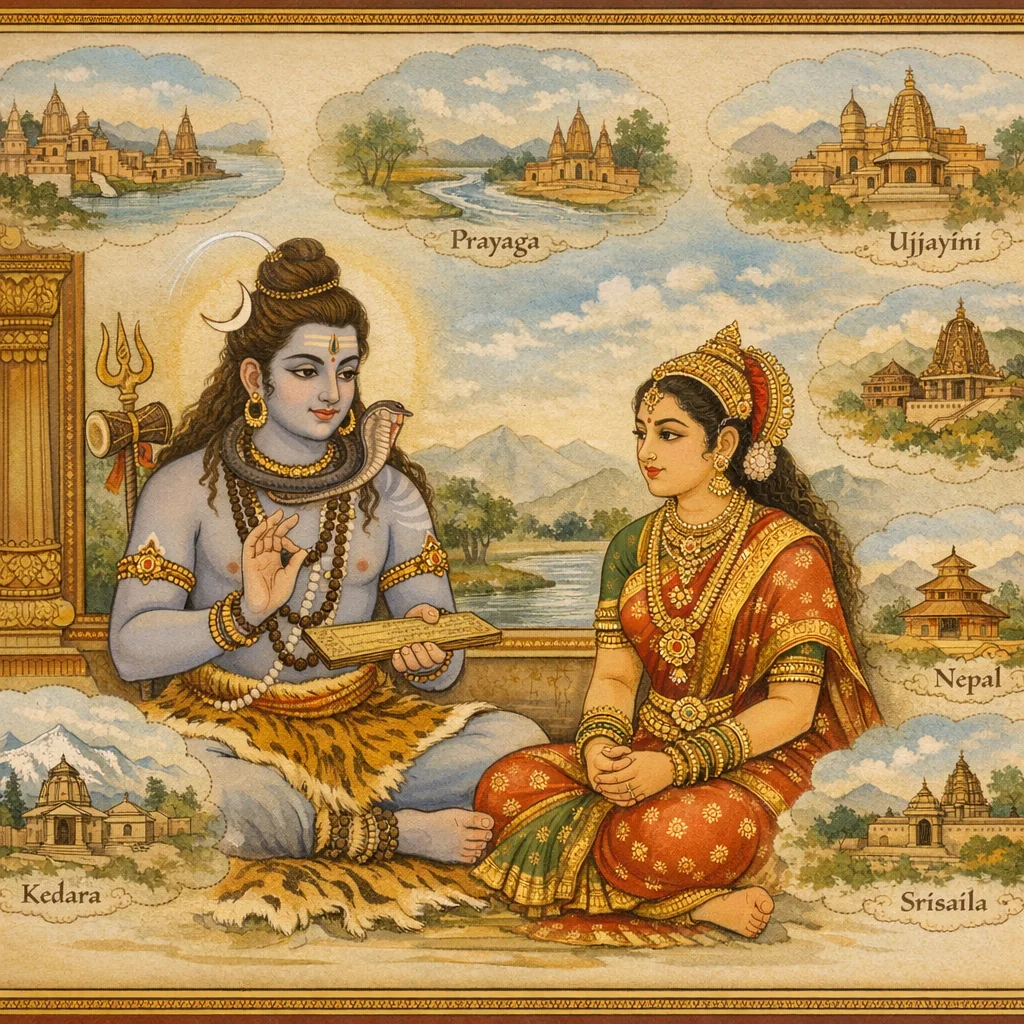
This adhyāya unfolds as a Śaiva dialogue. Īśvara declares that he has revealed the “essence-collection of tīrthas” (tīrthasamuccaya) and affirms his presence in every pilgrimage site for the welfare of the gods and devotees. He then teaches a liberating means: one who bathes at these tīrthas, beholds the deity, and recites the appropriate name gains fruition oriented toward mokṣa. Śrī Devī asks for a complete list of which name should be recited at which tīrtha. Īśvara replies with a catalogue linking many sacred places to specific epithets/forms of Śiva—for example, Vārāṇasī—Mahādeva; Prayāga—Maheśvara; Ujjayinī—Mahākāla; Kedāra—Īśāna; Nepal—Paśupālaka; Śrīśaila—Tripurāntaka. The chapter ends with a phalaśruti: hearing or reciting this list destroys sins; the wise should recite it at the three times (morning, noon, evening), especially those initiated into Śiva; and even keeping it written in one’s home is said to ward off disturbances from bhūtas/pretas, disease, serpents, thieves, and other harms.
Shlokas
Verse 1
। ईश्वर उवाच । एतत्ते सर्वमाख्यातं यत्पृष्टोऽस्मि वरानने । सर्वेषामेव तीर्थानां सारं तीर्थसमुच्चयम्
Īśvara said: “O fair-faced one, I have now told you everything that I was asked. What follows is the very essence of all tīrthas—their collected compendium.”
Verse 2
एतेष्वहं वरारोहे सर्वेष्वेव व्यवस्थितः । नाम्ना चान्येषु तीर्थेषु त्रिदशानां हितार्थतः
O graceful one, I truly abide in all these tīrthas; and in other tīrthas too I am present under specific names, for the welfare of the gods.
Verse 3
यो मामेतेषु तीर्थेषु स्नात्वा पश्यति मानवः । कीर्तयेत्कीर्तनान्नाम्ना स नूनं मोक्षमाप्नुयात्
Whoever, having bathed in these tīrthas, beholds Me and praises Me by chanting My name, surely attains mokṣa—liberation.
Verse 4
श्रीदेव्युवाच । येषु तीर्थेषु यन्नाम कीर्तनीयं तव प्रभो । तत्कार्त्स्येन मम ब्रूहि यच्चहं तव वल्लभा
Śrī Devī said: “O Lord, in which tīrthas should which of Your names be chanted? Tell me this in full, for I am Your beloved.”
Verse 5
ईश्वर उवाच । वाराणस्यां महादेवं प्रयागे च महेश्वरम् । नैमिषे देवदेवं च गयायां प्रपितामहम्
Īśvara said: “In Vārāṇasī I am praised as Mahādeva; in Prayāga, as Maheśvara; in Naimiṣa, as Devadeva; and in Gayā, as Prapitāmaha.”
Verse 6
कुरुक्षेत्रे विदुः स्थाणुं प्रभासे शशिशेखरम् । पुष्करे तु ह्यजागन्धिं विश्वं विश्वेश्वरे तथा
In Kurukṣetra they know Me as Sthāṇu; in Prabhāsa, as Śaśiśekhara; in Puṣkara indeed, as Ajāgandhi; and likewise in Viśveśvara I am praised as Viśva.
Verse 7
अट्टहासे महानादं महेन्द्रे च महाव्रतम् । उज्जयिन्यां महाकालं मरुकोटे महोत्कटम्
At Aṭṭahāsa, I am Mahānāda; at Mahendra, Mahāvrata; in Ujjayinī, Mahākāla; and at Marukoṭa, Mahotkaṭa.
Verse 8
शंकुकर्णे महातेजं गोकर्णे च महाबलम् । रुद्रकोट्यां महायोगं महालिंगं स्थलेश्वरे
At Śaṃkukarṇa, I am Mahātejas; at Gokarṇa, Mahābala; at Rudrakoṭī, Mahāyoga; and at Sthaleśvara, Mahāliṅga.
Verse 9
हर्षिते च तथा हर्षं वृषभं वृषभध्वजे । केदारे चैव ईशानं शर्वं मध्यमकेश्वरे
At Harṣita, he is known as Harṣa, the giver of joy; at Vṛṣabhadhvaja, as Vṛṣabha, the Lord whose banner bears the Bull. At Kedāra, he is revered as Īśāna, the Sovereign; and at Madhyamakeśvara, as Śarva, the auspicious Destroyer.
Verse 10
सुपर्णाक्षं सहस्राक्षे सुसूक्ष्मं कार्तिकेश्वरे । भवं वस्त्रापथे देवि ह्युग्रं कनखले तथा
At Sahasrākṣa he is worshipped as Suparṇākṣa; at Kārtikeśvara as Susūkṣma, the Subtlest. O Devī, at Vastrāpatha he is revered as Bhava, the source of becoming, and at Kanakhala as Ugra, the fierce Protector.
Verse 11
भद्रकर्णे शिवं चैव दण्डके दण्डिनं तथा । ऊर्ध्वरेतं त्रिदण्डायां चण्डीशं कृमिजांगले
At Bhadrakarṇa he is adored as Śiva; at Daṇḍaka as Daṇḍin, the Lord who chastises. At Tridaṇḍā he is known as Ūrdhvaretas, the ascetic of uplifted energy, and at Kṛmijāṅgala as Caṇḍīśa, the Lord of fierce might.
Verse 12
कृत्तिवासं तथैकाम्रे छागलेये कपर्दिनम् । कालिञ्जरे नीलकण्ठं श्रीकण्ठं मण्डलेश्वरे
At Ekāmra he is celebrated as Kṛttivāsa (the One clad in skin); at Chāgaleya as Kapardin (the Lord with matted locks). At Kāliñjara he is praised as Nīlakaṇṭha (blue-throated), and at Maṇḍaleśvara as Śrīkaṇṭha (the glorious-throated Lord).
Verse 13
विजयं चैव काश्मीरे जयन्तं मरुकेश्वरे । हरिश्चन्द्रे हरं चैव पुरश्चन्द्रे च शंकरम्
In Kāśmīra he is known as Vijaya (Victory); at Marukeśvara as Jayanta (the Ever-triumphant). At Hariścandra he is worshipped as Hara (the Remover), and at Puraścandra as Śaṅkara (the Beneficent).
Verse 14
जटिं वामेश्वरे विन्द्यात्सौम्यं वै कुक्कुटेश्वरे । भूतेश्वरं भस्मगात्रे ओंकारेऽमरकण्टकम्
At Vāmeśvara he is to be known as Jaṭin (the matted-haired ascetic); at Kukkuṭeśvara as Saumya (the gentle one). At Bhasmagātra he is Bhūteśvara (Lord of beings), and at Oṃkāra as Amarakaṇṭaka (the immortal peak).
Verse 15
त्र्यंबकं च त्रिसंध्यायां विरजायां त्रिलोचनम् । दीप्तमर्केश्वरे ज्ञेयं नेपाले पशुपालकम्
At Trisaṃdhyā he is Tryambaka (the three-eyed Lord); at Virajā he is Trilocana (the one with three eyes). At Arkeśvara he is to be known as Dīpta (the Radiant), and in Nepāla as Paśupālaka (Protector of all beings).
Verse 16
यमलिंगं च दुष्कर्णे कपाली करवीरके । जागेश्वरे त्रिशूली च श्रीशैले त्रिपुरांतकम्
At Duṣkarṇa he is revered as Yamaliṅga; at Karavīraka as Kapālī (the skull-bearer). At Jāgeśvara he is Triśūlī (the trident-holder), and at Śrīśaila he is Tripurāntaka (the destroyer of Tripura).
Verse 17
रोहणं तु अयोध्यायां पाताले हाटकेश्वरम् । कारोहणे नकुलीशं देविकायामुमापतिम्
In Ayodhyā he is called Rohaṇa; in Pātāla, Hāṭakeśvara. At Kārohaṇa he is Nakulīśa, and at Devikā he is Umāpati, the Lord of Umā.
Verse 18
भैरवे भैरवाकारममरं पूर्वसागरे । सप्तगोदावरे भीमं स्वयंभूर्निर्मलेश्वरे
At Bhairava he manifests in the form of Bhairava; in the Eastern Ocean he is worshipped as Amara, the Deathless. At Saptagodāvara he is Bhīma, and at Nirmaleśvara he is Svayaṃbhū, self-manifest.
Verse 19
कर्णिकारे गणाध्यक्षं कैलासे तु गणाधिपम् । गंगाद्वारे हिमस्थानं जल लिंगे जलप्रियम्
At Karṇikāra he is Gaṇādhyakṣa; on Kailāsa, Gaṇādhipa. At Gaṅgādvāra (Haridvāra) he is Himasthāna, and at Jala-liṅga he is Jalapriya—thus are Śiva’s forms known in their sacred seats.
Verse 20
अनलं वाडवेऽग्नौ च भीमं बदरिकाश्रमे । श्रेष्ठे कोटीश्वरं चैव वाराहं विन्ध्यपर्वते
In the Vāḍava fire he is Anala; in the Badarikā hermitage he is Bhīma. In Śreṣṭha he is Koṭīśvara, and on the Vindhya mountain he is Vārāha—these are the famed liṅga-forms of Śiva in their holy seats.
Verse 21
हेमकूटे विरूपाक्षं भूर्भुवं गन्धमादने । लिंगेश्वरे च वरदं लंकायां च नरांतकम्
On Hemakūṭa he is Virūpākṣa; on Gandhamādana he is Bhūrbhuva. At Liṅgeśvara he is Varada, and in Laṅkā he is Narāntaka—thus are proclaimed Śiva’s holy forms tied to their places.
Verse 22
अष्टषष्टिरियं देवि तवाख्याता विशेषतः । पठतां शृण्वतां वापि सर्वपातकनाशिनी
O Goddess, this set of sixty-eight has been declared to you in particular; for those who recite it, or even hear it, it destroys all sins.
Verse 23
तस्मात्सर्वप्रयत्नेन कीर्तनीया विचक्षणैः । कालत्रयेऽपि शुचिभिर्विशेषाच्छिवदीक्षितैः
Therefore, the wise should proclaim it with every effort—being pure in all the three times (morning, noon, and evening), and especially those initiated into Śiva’s discipline should do so.
Verse 24
लिखितापि वरारोहे यस्यैषा तिष्ठते गृहे । न तत्र जायते दोषो भूतप्रेतसमुद्भवः
O fair-hipped Lady, even if merely written down, in whose house this remains—there no affliction arising from bhūtas or pretas is ever born.
Verse 25
न व्याधेर्न च सर्पाणां न चौराणां वरानने । नान्येषां भूभुजादीनां कदाचिदपि कुत्रचित्
O lovely-faced Lady, there is no fear of disease, nor of serpents, nor of thieves—nor of other threats such as kings and their agents—ever, anywhere.