Adhyaya 105
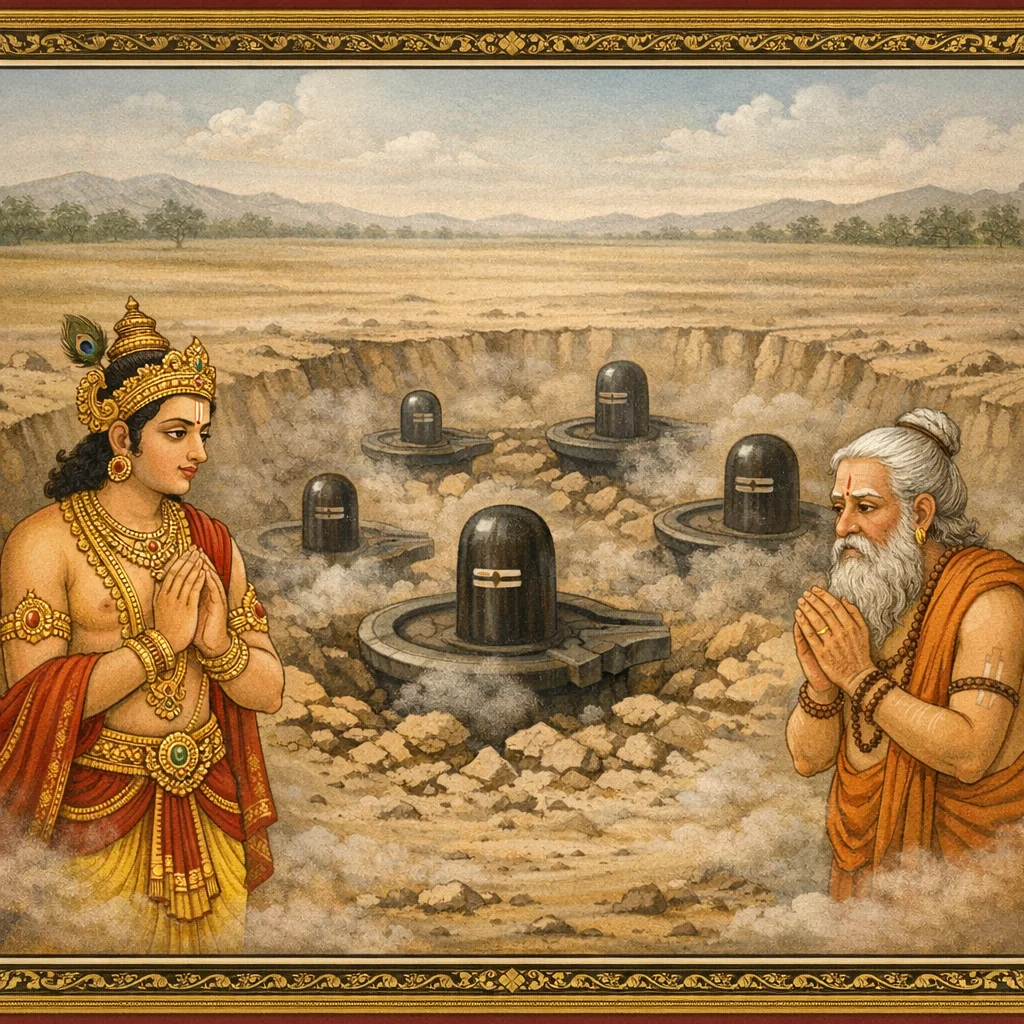
Sūta recounts events at a calendrical juncture (the sun’s presence in Tulā is noted), when an ancient sacred ground once associated with liṅga-manifestations becomes choked with dust and deposits, hiding the liṅgas from sight. With the liṅgas concealed, the kṣetra is said to regain kṣema—security and well-being—and this restored safety extends even to other realms, since the visible markers have been lost. In a later age-cycle, King Bṛhadaśva arrives from Śālva-deśa and, seeing a broad tract without palatial buildings, resolves to construct one. He summons many artisans and orders deep clearing and excavation. As they dig, numerous four-faced liṅgas appear. Confronted with a land saturated by such potent sacred forms, the king collapses and dies at once, and the artisans present perish as well. From that time onward, no mortal dares to build a palace there, nor even to dig a pond or a well, out of fearful reverence. Thus a local prohibition is preserved as an etiological memory of sacred danger and awe within the tīrtha tradition of Hāṭakeśvara-kṣetra.
Shlokas
Verse 1
सूत उवाच । अथ प्राप्ते दिनाधीशे तुलायां द्विजसत्तमाः । प्रेता लिंगोद्भवां भूमिं पूरयामासुरेव हि
Sūta said: When the Sun entered Tulā (Libra), O best of brāhmaṇas, the departed spirits (pretas) indeed began to fill the ground from which the liṅgas had arisen.
Verse 2
यत्किंचित्तत्र संस्थं तु आद्यतीर्थं सुरालयम् । तत्सर्वं व्यन्तरैस्तैश्च पांसुभिः परिपूरितम्
Whatever was established there—the primeval tīrtha and the divine abode—was wholly filled and choked by those vyantaras and by dust.
Verse 3
ततः क्षेमं समुत्पन्नं क्षेत्रे तत्र द्विजोत्तमाः । अन्येषामपि लोकानां लिंगैस्तैर्लुप्तिमागतैः
Then, O best of brāhmaṇas, well-being arose in that sacred field; while in other realms those same liṅgas, vanishing from sight, brought about a sense of loss.
Verse 4
कस्यचित्त्वथ कालस्य बृहदश्वो महीपतिः । शाल्वदेशात्समायातः कस्मिश्चिद्युगपर्यये
After some time had passed, King Bṛhadaśva, a ruler of the earth, came from the land of Śālva at a certain turning of the age.
Verse 5
स दृष्ट्वा विपुलां भूमिं प्रासादैः परिवर्जिताम् । प्रासादार्थं मतिं चक्रे तत्र क्षेत्रे द्विजोत्तमाः
Seeing that broad expanse of land devoid of temples, he resolved—there in that sacred field, O best of brāhmaṇas—to build a prāsāda (temple).
Verse 6
शिल्पिनश्च समाहूयानेकांस्तत्र सहस्रशः । शोधयामास तां भूमिमधस्ताद्बहुविस्तृताम्
Summoning artisans there—many, even by the thousands—he set about clearing and purifying that land, digging down into its wide-spread depths beneath.
Verse 7
भूमौ निखन्यमानायां ततो लिंगानि भूरिशः । चतुर्वक्त्राणि तान्येव यांति दृष्टेश्च गोचरम्
As the ground was being dug, numerous liṅgas came into view—those very four-faced liṅgas entering the range of sight.
Verse 8
ततः स पार्थिवस्तैश्च लिंगैर्दृष्ट्वा वृतां भुवम् । तत्क्षणान्मृत्युमापन्नः शिल्पिभिश्च समन्वितः
Then that king, seeing the earth all around covered with those liṅgas, at that very moment met his death—together with the artisans who had accompanied him.
Verse 9
ततःप्रभृति नो तत्र कश्चिन्मर्त्यो महीतले । प्रासादं कुरुते भीत्या तडागं कूपमेव च
From that time onward, in that place upon the earth, no mortal builds a palace; and out of fear, none even makes a pond or a well.
Verse 105
इति श्रीस्कान्दे महापुराण एकाशीतिसाहस्र्यां संहितायां षष्ठे नागरखण्डे हाटकेश्वरक्षेत्र माहात्म्ये राक्षसलिंगच्छेदनंनाम पञ्चोत्तरशततमोऽध्यायः
Thus, in the revered Skanda Mahāpurāṇa, in the Saṃhitā of eighty-one thousand ślokas, within the sixth division—the Nāgara-khaṇḍa—under the Māhātmya of Hāṭakeśvara-kṣetra, ends the one-hundred-and-fifth chapter entitled “The Cutting of the Demon’s Liṅgas.”