Adhyaya 102
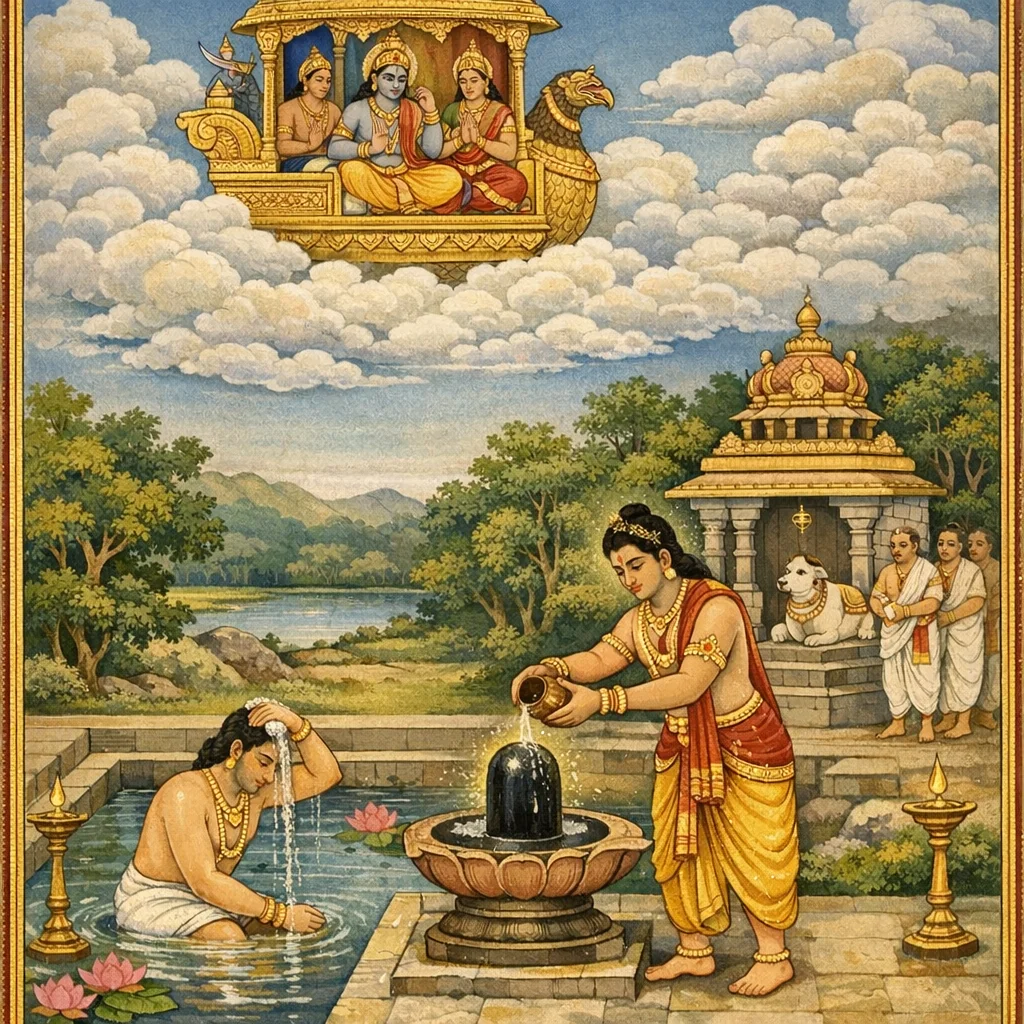
Sūta recounts how, as Rāma journeys back to his own abode in the Puṣpaka-vimāna, the aerial chariot suddenly becomes motionless. Questioned by Rāma, Hanūmān (Vāyusuta) investigates and reports that directly below lies the auspicious Hāṭakeśvara kṣetra, where Brahmā is said to be present and where divine hosts—Ādityas, Vasus, Rudras, Aśvins, and other siddha beings—abide; because the sanctity there is so concentrated, the Puṣpaka cannot pass beyond it. Rāma descends with vānaras and rākṣasas, surveys the tīrthas and shrines, bathes (including mention of a wish-fulfilling kuṇḍa), performs rites of purification and ancestral offerings, and reflects on the kṣetra’s extraordinary merit. He resolves to establish a liṅga in continuity with an earlier precedent attributed to Keśava, and to commemorate Lakṣmaṇa, described as having ascended to heaven; he also intends an auspicious, visible form together with Sītā. With devotion Rāma installs five prasādas, and others likewise set up their own liṅgas. The chapter ends with a phalaśruti: regular morning darśana grants the fruit of hearing the Rāmāyaṇa, and reciting Rāma’s deeds on Aṣṭamī and Caturdaśī yields merit comparable to an Aśvamedha. In this way it weaves sacred geography, temple-foundation rationale, ritual practice, and merit theology into a single instructive legend.
Shlokas
Verse 1
सूत उवाच । संप्रस्थितस्य रामस्य स्वकीयं सदनं प्रति । यदाश्चर्यमभून्मार्गे श्रूयतां द्विजसत्तमाः
Sūta said: As Rāma set out toward his own abode, a wondrous event occurred on the way. Hear of it, O best of the twice-born.
Verse 2
नभोमार्गेण गच्छत्तद्विमानं पुष्पकं द्विजाः । अकस्मादेव सञ्जातं निश्चलं चित्रकृन्नृणाम्
O brāhmaṇas, as the Puṣpaka aerial chariot was moving along the path of the sky, it suddenly became motionless—an astonishing sight for people.
Verse 3
अथ तन्निश्चलं दृष्ट्वा पुष्पकं गगनांगणे । रामो वायुसुतस्येदं वचनं प्राह विस्मयात्
Then, seeing the Puṣpaka motionless in the open sky, Rāma, in amazement, spoke these words to the son of Vāyu (Hanumān).
Verse 4
त्वं गत्वा मारुते शीघ्रं भूमिं जानीहि कारणम् । किमेतत्पुष्पकं व्योम्नि निश्चलत्वमुपागतम्
Go swiftly, O Māruti, and learn the cause upon the earth: why has this Puṣpaka in the sky become motionless?
Verse 5
कदाचिद्धार्यते नास्य गतिः कुत्रापि केनचित् । ब्रह्मदृष्टिप्रसूतस्य पुष्पकस्य महात्मनः
At no time, in no place, is its movement ever restrained by anyone—of that great Puṣpaka, born of Brahmā’s vision.
Verse 6
बाढमित्येव स प्रोच्य हनूमान्धरणीतलम् । गत्वा शीघ्रं पुनः प्राह प्रणिपत्य रघूत्तमम्
Saying, “So be it,” Hanumān swiftly went down to the earth; then, returning, he spoke again after bowing to Raghūttama (Rāma).
Verse 7
अत्रास्याधः शुभं क्षेत्रं हाटकेश्वर संज्ञितम् । यत्र साक्षाज्जगत्कर्ता स्वयं ब्रह्मा व्यवस्थितः
Beneath this lies an auspicious sacred field named Hāṭakeśvara, where Brahmā himself—the direct creator of the world—abides.
Verse 8
आदित्या वसवो रुद्रा देववैद्यौ तथाश्विनौ । तत्र तिष्ठन्ति ते सर्वे तथान्ये सिद्धकिन्नराः
There abide the Ādityas, the Vasus, the Rudras, and also the Aśvins—the divine physicians—along with other Siddhas and Kinnaras.
Verse 9
एतस्मात्कारणान्नैतदतिक्रामति पुष्पकम् । तत्क्षेत्रं निश्चलीभूतं सत्यमेतन्मयोदितम्
For this reason the Puṣpaka does not go beyond this point. Over that kṣetra it becomes still and unmoving—this is the truth as spoken by me.
Verse 11
सर्वैस्तैर्वानरैः सार्धं राक्षसैश्च पृथग्विधैः । अवतीर्य ततो हृष्टस्तस्मिन्क्षेत्रे समन्ततः
Then, descending there together with all those Vānaras and with the various kinds of Rākṣasas, he rejoiced on every side throughout that sacred field.
Verse 12
तीर्थमालोकयामास पुण्यान्यायतनानि च । ततो विलोकयामास पितामहविनिर्मिताम् । चामुण्डां तत्र च स्नात्वा कुण्डे कामप्रदायिनि
He beheld the sacred tīrtha and the holy shrines abiding there in merit. Then he looked upon Cāmuṇḍā, said to have been established by the Grandsire (Brahmā); and bathing in the desire-fulfilling pond (kuṇḍa), he performed the tīrtha’s purifying rite.
Verse 13
ततो विलोकयामास पित्रा तस्य विनिर्मितम् । रामः स्वमिव देवेशं दृष्ट्वा देवं चतुर्भुजम्
Then Rāma looked upon the Lord of Gods—radiant and four-armed—enshrined there, said to have been established by his father; and seeing that divine form, he revered Him as his own chosen Lord.
Verse 14
राजवाप्यां शुचिर्भूत्वा स्नात्वा तर्प्य निजान्पितॄन् । ततश्च चिन्तयामास क्षेत्रे त्र बहुपुण्यदे
Becoming pure, he bathed in the Rājavāpī (royal tank) and offered tarpana to satisfy his own ancestors; thereafter he reflected within that holy field, exceedingly rich in merit.
Verse 15
लिंगं संस्थापयाम्येव यद्वत्तातेन केशवः । तथा मे दयितो भ्राता लक्ष्मणो दिवमाश्रितः
“Indeed I shall establish a liṅga—just as my father established Keśava. And my beloved brother Lakṣmaṇa has now taken refuge in the heavenly realm.”
Verse 16
यस्तस्य नामनिर्दिष्टं लिंगं संस्थापयाम्यहम् । तं चापि मूर्तिमंतं च सीतया सहितं शुभम् । क्षेत्रे मेध्यतमे चात्र तथात्मानं दृषन्मयम्
“I shall establish that liṅga, designated by his very name. And here, in this most sanctifying kṣetra, I shall also set up an auspicious embodied image together with Sītā, and likewise a stone-formed image of myself.”
Verse 17
एवं स निश्चयं कृत्वा प्रासादानां च पंचकम् । स्थापयामास सद्भक्त्या रामः शस्त्रभृतां वरः
Thus, having made his resolve, Rāma—the foremost among weapon-bearers—established with true devotion a set of five temples.
Verse 18
ततस्ते वानराः सर्वे राक्षसाश्च विशेषतः । लिंगानि स्थापयामासुः स्वानिस्वानि पृथक्पृथक्
Then all those Vānaras—and especially the Rākṣasas—each separately established their own liṅgas.
Verse 19
तत्रैव सुचिरं कालं स्थितास्ते श्रद्धयाऽन्विताः । ततो जग्मुरयोध्यायां विमानवरमाश्रिताः
There itself they remained for a long time, filled with faith; thereafter, having mounted an excellent celestial chariot, they went to Ayodhyā.
Verse 20
एतद्वः सर्वमाख्यातं यथा रामेश्वरो महान् । लक्ष्मणेश्वरसंयुक्तस्तस्मिंस्तीर्थे सुशोभने
All this has been told to you—how the great Rāmeśvara, united with Lakṣmaṇeśvara, shines forth in that splendid tīrtha.
Verse 21
यस्तौ प्रातः समुत्थाय सदा पश्यति मानवः । स कृत्स्नं फलमाप्नोति श्रुते रामायणेऽत्र यत्
Whoever, rising at dawn, regularly beholds those two deities, attains in full the fruit here declared through the hearing of the Rāmāyaṇa.
Verse 22
अथाष्टम्यां चतुर्दश्यां यो रामचरितं पठेत् । तदग्रे वाजिमेधस्य स कृत्स्नं लभते फलम्
Whoever recites the sacred account of Rāma on the eighth and on the fourteenth lunar day attains in full the merit obtained from an Aśvamedha sacrifice.
Verse 102
सूत उवाच । तस्य तद्वचनं श्रुत्वा कौतूहलसमवितः । पुष्पकं प्रेरयामास तत्क्षेत्रं प्रति राघवः
Sūta said: Hearing those words, Rāghava—filled with eager wonder—set the Puṣpaka aerial chariot in motion toward that sacred kṣetra.