Adhyaya 10
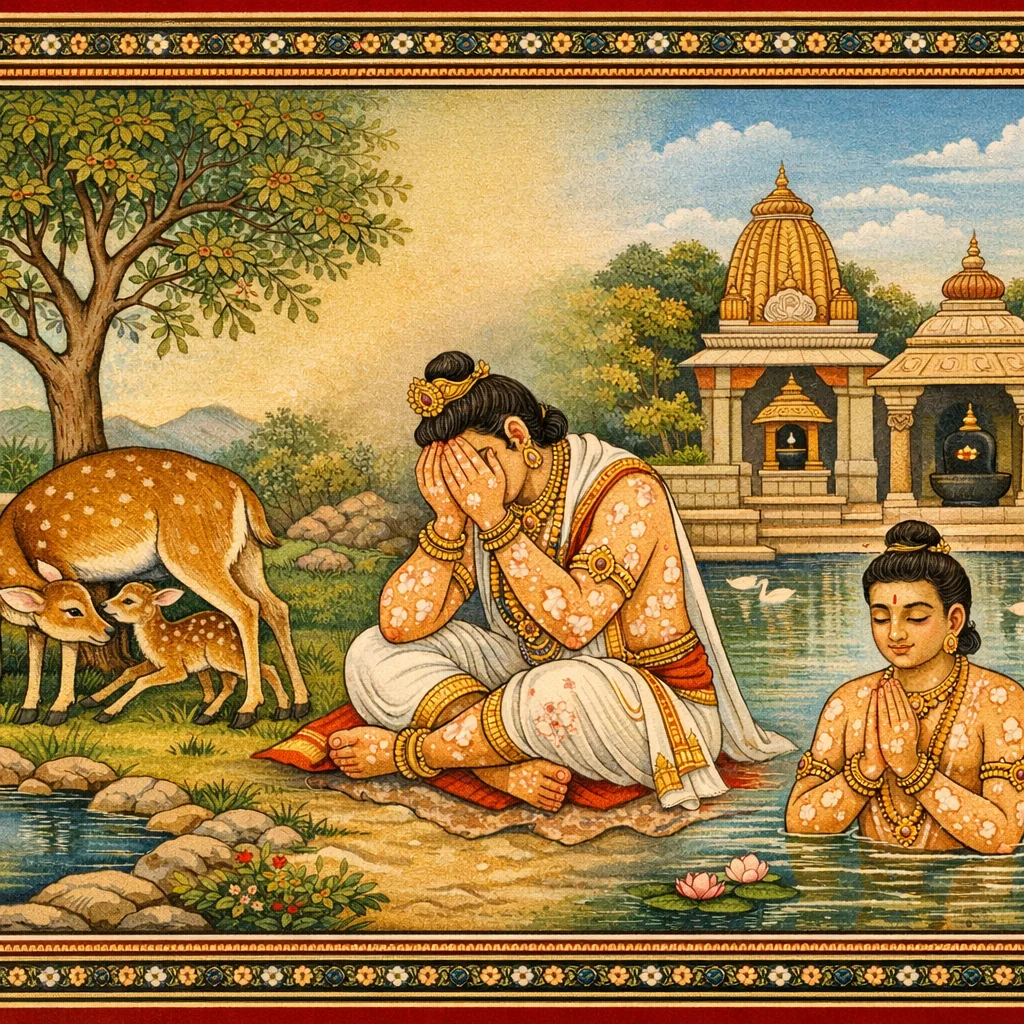
Sūta recounts an episode concerning Camatkāra, a ruler of the Ānarta region. While hunting, the king sees a doe calmly nursing her fawn beneath a tree and, in a surge of exhilaration, shoots her with an arrow. Mortally wounded, the doe speaks to him: she grieves less for her own death than for the helpless fawn still dependent on milk. She then states a dharmic restraint upon kṣatriya hunting: to kill a creature that is mating, asleep, nursing/feeding, or otherwise vulnerable (including water-dependent animals) draws the killer into sin. On this ground she utters a curse that the king will immediately be afflicted with a leprosy-like disease (kuṣṭha). The king offers a defense from royal duty—reducing game—yet the doe concedes only the general principle and insists that this limiting rule was violated here. After the doe dies, the king indeed becomes diseased, recognizes the consequence, and resolves on tapas and Śiva-pūjā as remedial disciplines. He cultivates equanimity toward friend and enemy and undertakes tīrtha pilgrimage. In time, instructed by brāhmaṇas, he goes to the famed Śaṅkhatīrtha in Hāṭakeśvara-kṣetra, renowned for destroying ailments; bathing there, he is instantly freed from the affliction and becomes radiant, affirming the tīrtha’s saving power and the embedded ethic of restraint.
Shlokas
Verse 2
सूत उवाच । आनर्त्ताधिपतिर्भूपश्चमत्कार इति स्मृतः । एतस्मिन्नंतरे प्राप्तस्तत्र हंतुं वने मृगान् । स ददर्श मृगीं दूरान्निश्चलांगीं तरोरधः । स्तनं सुताय यच्छंतीं विश्वस्तामकुतोभयाम्
Sūta said: There was a king, lord of Ānarta, remembered by the name Camatkāra. At that time he came to the forest to hunt deer. From a distance he saw a doe beneath a tree, motionless-limbed, calmly nursing her fawn—trusting and free from fear on every side.
Verse 3
अथ तां पार्थिवस्तूर्णं शरेणानतपर्वणा । जघानाकर्णकृष्टेन मर्मस्थाने प्रहर्षितः
Then the king swiftly struck her with an arrow whose joints did not bend, drawn back to the ear; it hit a vital spot, and he did so in excited fervor.
Verse 4
सहसा सा हता तेन गार्द्ध्रपत्रेण पत्रिणा । दिशो विलोकयामास समंताद्व्यथयार्दिता
Suddenly wounded by him with that feathered arrow, fletched like a vulture’s wing, she—afflicted by pain—looked around in all directions.
Verse 5
अथ दृष्ट्वा महीपालं नातिदूरे धनुर्धरम् । प्रोवाचाश्रुपरिक्लिन्नवदना सुतवत्सला
Then, seeing the king close by, bow in hand, the doe—her face drenched with tears, overflowing with love for her young—spoke to him.
Verse 6
मृग्युवाच । अयुक्तं पृथिवीपाल यत्त्वयैतदनुष्ठितम् । हताऽहं बालवत्साऽद्य शरेणानतपर्वणा
The doe said: “O protector of the earth, what you have done is improper. Today I have been struck down by your arrow—though I am a mother with a young one.”
Verse 7
नाऽहं शोचामि भूपाल मरणं स्वशरीरगम् । यथेमं वालकं दीनं क्षीरास्वादनलंपटम्
“O king, I do not grieve for death coming upon my own body as much as I grieve for this poor little one—helpless, yearning for the taste of milk.”
Verse 8
यस्मात्त्वयेदृशं कर्म निर्दयं समनुष्ठितम् । कुष्ठव्याधिसमायुक्तस्तस्मात्सद्यो भविष्यसि
Because you have performed such a pitiless deed, therefore at once you shall be afflicted with the disease of leprosy.
Verse 9
राजोवाच । स्वधर्म एष भूपानां कुर्वंति मृगसंक्षयम् । तस्मात्स्वधर्मसंयुक्तं न मां त्वं शप्तुमर्हसि
The king said: “This is the appointed duty of kings—to reduce the beasts of the forest. Therefore, since I acted in accordance with my own dharma, you ought not curse me.”
Verse 10
मृग्युवाच । सत्यमेतन्महीपाल यत्त्वया परिकीर्तितम् । क्षत्त्रियाणां वधार्थाय मृगाः सृष्टाः स्वयंभुवा
The doe said: “O king, what you have stated is true: by the Self-born (Brahmā), animals were indeed created for the warriors’ hunting.”
Verse 11
परं तेन विधिस्तेषांकृतो यस्तं महीपते । शृणुष्वाऽवहितो भूत्वा वदंत्या मम सांप्रतम्
Yet, O king, for them a specific rule was laid down. Now hear it from me—be attentive as I speak.
Verse 12
सुप्तं मैथुनसंयुक्तं स्तनपानक्रियोद्यतम् । हत्वा मृगं जलासक्तं नरः पापेन लिप्यते
If a man kills an animal that is asleep, engaged in mating, intent on suckling, or absorbed in drinking water, he becomes tainted with sin.
Verse 13
एतस्मात्कारणाच्छापस्तव दत्तो मया नृप । न कामतो न मृत्योर्वा सत्येनात्मानमालभे
For this very reason, O king, I have bestowed this curse upon you—not out of desire, nor out of fear of death. By truth, I make this solemn assertion.
Verse 14
एवमुक्त्वा मृगी प्राणान्सा मुमोच व्यथान्विता । कुष्ठव्याधिसमायुक्तः सोऽपि राजा बभूव ह
Having spoken thus, the doe—tormented with pain—gave up her life-breath. And that king too, indeed, became afflicted with the disease of leprosy.
Verse 15
स दृष्ट्वा कुष्ठसंयुक्तं पार्थिवः स्वं कलेवरम् । ततः स्वान्सेवकानाह समाहूय सुदुःखितः
Seeing his own body afflicted with leprosy, the king, overwhelmed with sorrow, summoned his attendants, gathered them, and addressed them.
Verse 16
अहं तपश्चरिष्यामि पूजयिष्यामि शंकरम् । तावद्यावत्प्रणाशो मे कुष्ठव्याधेर्भविष्यति
“I shall undertake tapas—holy austerities—and worship Śaṅkara, until my leprosy-disease is completely destroyed.”
Verse 17
यत्किंचित्त्रिषु लोकेषु प्रार्थयंति नराः सुखम् । तत्सर्वं तपसा साध्यं तस्मात्कार्यं मया तपः
“Whatever happiness people seek in the three worlds—everything is attainable through tapas, holy austerity; therefore, I must perform tapas.”
Verse 20
समः शत्रुषु मित्रेषु समलोष्टाश्मकांचनः । भूत्वा कालं नयिष्यामि यावत्कालस्य संस्थितिः
Becoming even-minded toward enemies and friends alike, and regarding clod, stone, and gold as the same, I shall pass my time in such discipline for as long as time allows.
Verse 21
एवं तान्सेवकान्भूपः सोऽभिधाय विसृज्य च । तीर्थयात्रा परो भूत्वा बभ्राम वसुधातले
Having thus spoken to those attendants and dismissed them, the king became wholly devoted to pilgrimage and wandered across the face of the earth.
Verse 22
ततः कालेन महता प्राप्य विप्रसमुद्भवम् । उपदेशं नृपः प्राप्तः शंखतीर्थं महोदयम्
Then, after a long time, the king encountered a Brahmin and received instruction concerning the greatly auspicious Śaṅkhatīrtha.
Verse 23
हाटकेश्वरजे क्षेत्रे सर्वव्याधिविनाशकम् । विख्यातं त्रिषु लोकेषु पूरितं स्वच्छवारिणा
In the sacred region of Hāṭakeśvara lies that tīrtha which destroys all diseases—renowned in the three worlds and filled with clear, pure water.
Verse 24
तत्राऽसौ स्नानमात्रेण तत्क्षणात्पार्थिवोतमः । कुष्ठव्याधिवि निर्मुक्तः संजातः सुमहाद्युतिः
There, by bathing alone, that excellent king was instantly freed from the leprosy-disease and became radiant with great splendor.