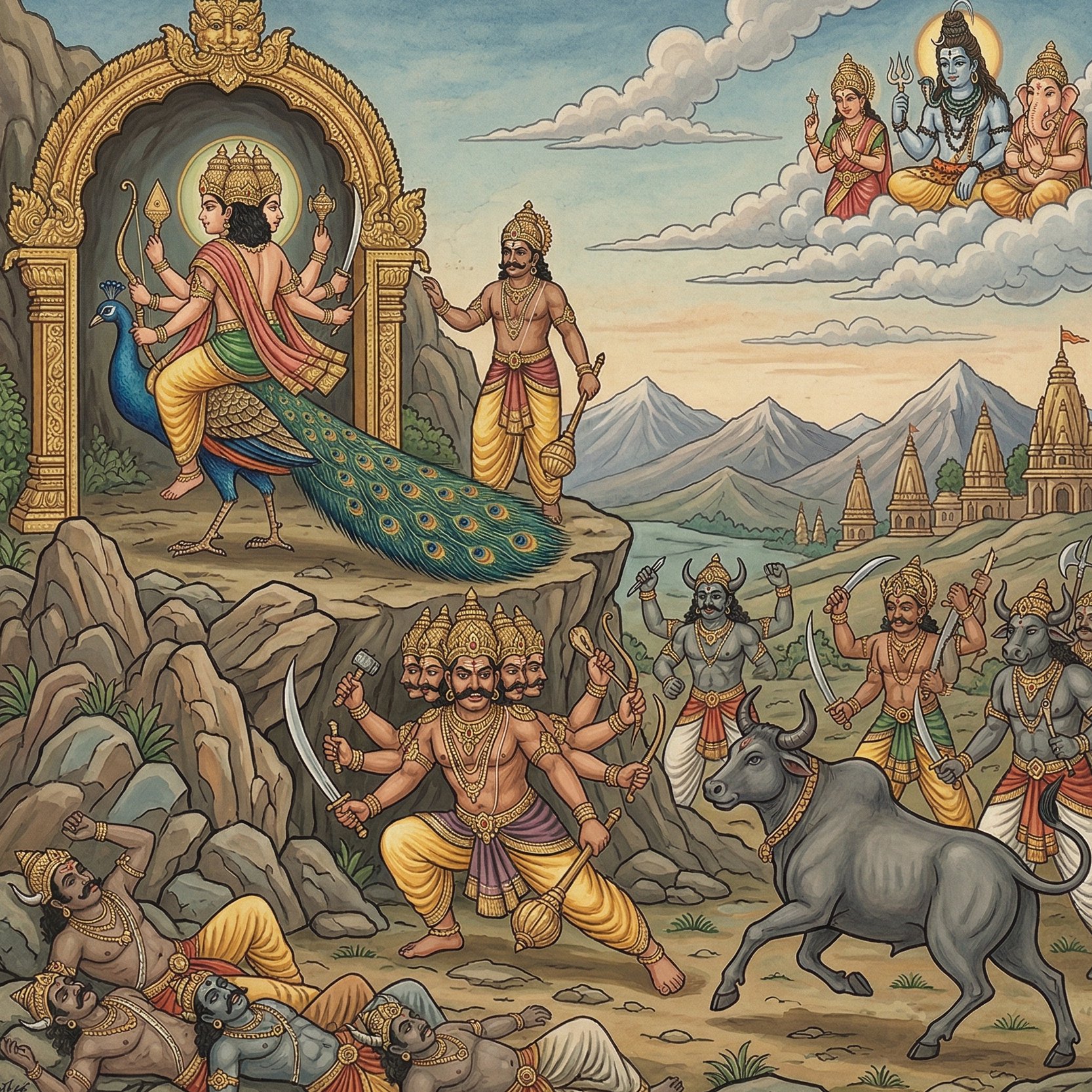
Avanti Kshetra Mahatmya
Avanti Kshetra Mahatmya
This section is situated in the sacred topography of Avantī, traditionally associated with Ujjayinī (Ujjain) in central India. It presents the region as a Śaiva kṣetra defined by Mahākāla and by a network of tīrthas, liṅgas, and ritual landscapes (including cremation-ground symbolism). The narrative frames Avantī as a comparandum within a pan-Indian pilgrimage hierarchy (e.g., Kurukṣetra, Vārāṇasī, Prabhāsa), thereby integrating local sanctity into an all-India Purāṇic map.
Adhyayas in Avanti Kshetra Mahatmya
71 chapters to explore.
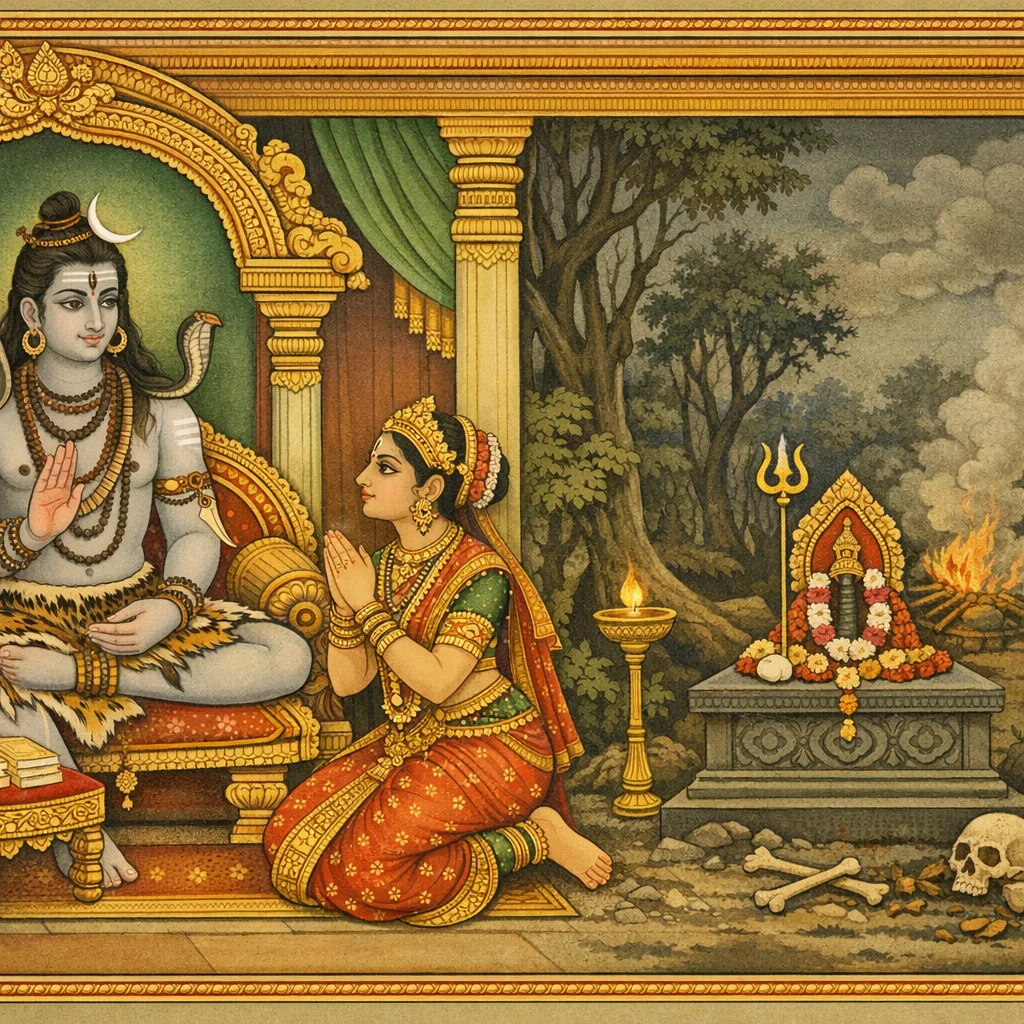
Adhyaya 1
महाकालवनमाहात्म्य-प्रश्नोत्तरम् | Mahākālavanamāhātmya: Dialogues on the Glory of Mahākāla’s Sacred Grove
Adhyāya 1 begins with invocatory salutations and a Śaiva-style hymn, praising Mahākāla as the primal Divine Presence revealed through the liṅga. In dialogue, Umā asks for an ordered account of the foremost tīrthas and sacred rivers; Īśvara names pan-Indian holy sites—Gaṅgā, Yamunā, Narmadā; Kurukṣetra, Gayā, Prabhāsa, Naimiṣa; Kedāra, Puṣkara, Kāyāvarohaṇa—then proclaims Mahākālavanam as supremely auspicious. Mahākālavanam is portrayed as a vast kṣetra that destroys severe impurities, grants bhukti–mukti (worldly fulfillment and liberation), and remains efficacious even at cosmic dissolution. Umā seeks a fuller description of the region’s particular tīrthas and liṅgas, and the narrative shifts to a transmission scene between Sanatkumāra and Vyāsa. Vyāsa asks why the place is called Mahākālavanam, why it is termed a “guhya” forest, a pīṭha, an ūṣara, and a śmaśāna, and what fruits come from dwelling there, dying there, bathing, and giving. Sanatkumāra explains these titles through origin-definitions: sins “perish” there; it is a pīṭha through association with the Mothers; death there prevents rebirth; and Śiva favors cremation-ground symbolism. The chapter ends by ranking Mahākālavanam above other famed tīrthas through a comparative, multiplicative hierarchy of merit, affirming that the fivefold cluster—forest, pīṭha, kṣetra, ūṣara, śmaśāna—is uniquely united in Mahākālapura.
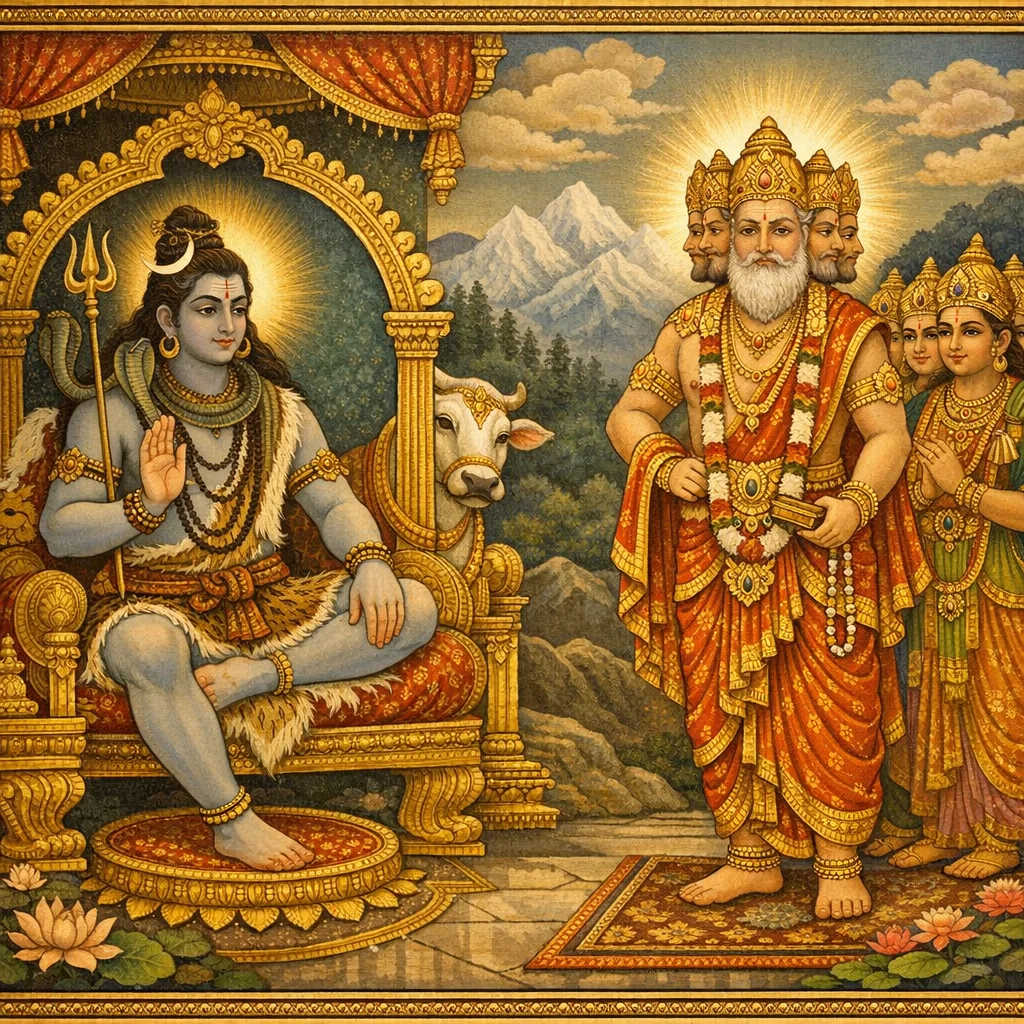
Adhyaya 2
Mahākāla, Brahmā’s Stuti, and the Origin of Nīlalohita (Rudra)
Sanatkumāra narrates a primordial scene akin to cosmic dissolution, where only Mahākāla (Śiva) remains as the sovereign principle. For creation, a golden cosmic egg arises and divides into earth below and heaven above; Brahmā appears in the middle and is commanded by Mahākāla/Śiva to undertake creation. Seeking knowledge, Brahmā receives the Veda with its six auxiliaries, yet continues austerities and offers a long stuti, praising Śiva as beyond the three guṇas and as the very ground of creation, preservation, and dissolution. Śiva replies with a boon that also instructs: from Brahmā’s mental desire for a son emerges Nīlalohita (Rudra), fierce in form, and he is directed toward the Himālaya. Brahmā’s titles “Brahmā” and “Pitāmaha” are affirmed through a distinct theological rationale. Later, Brahmā grows proud of his creative power; the devas, overwhelmed by the radiance of his fifth face, seek refuge in Mahēśvara. Śiva manifests, subdues the arrogance, and severs Brahmā’s fifth head with his thumbnail, giving rise to the Kapālin motif; the devas then praise Śiva as Mahākāla, Kapālin, and the remover of suffering. Thus the chapter weaves cosmology, hymn, and a warning against pride while explaining the origins of Śiva’s names and forms.
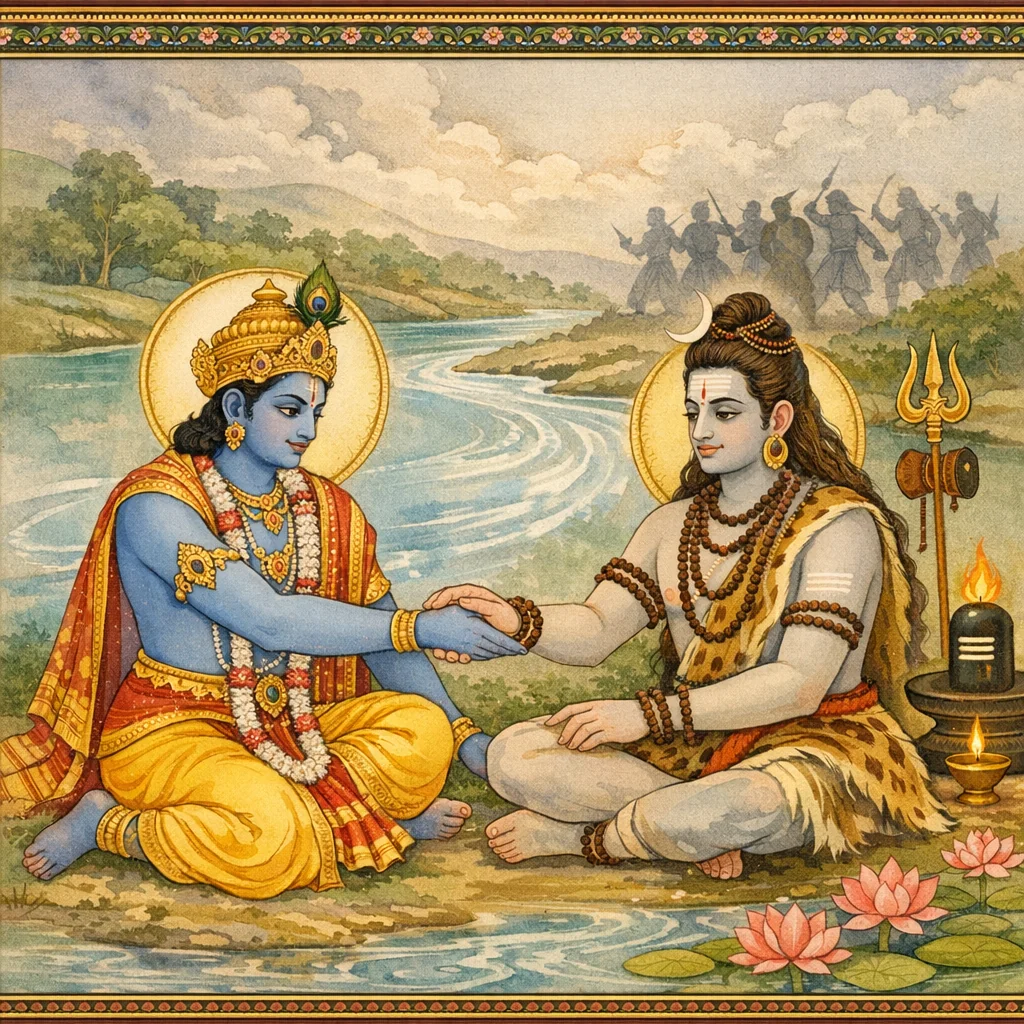
Adhyaya 3
Śiprā-prādurbhāvaḥ and Nara-Nārāyaṇa-saṃbandhaḥ (Origin of the Śiprā and the Nara–Nārāyaṇa Link)
Sanatkumāra recounts that Brahmā, angered and veiled by tamas, brings forth from sweat a formidable, armed and armored being and sends it toward Rudra. Rudra reflects that this one should not be slain and will become Viṣṇu’s companion, and so he goes to Viṣṇu’s hermitage. There Rudra begs alms (bhikṣā) holding a blazing skull-bowl (kapāla). Seeing Rudra fit to receive, Viṣṇu offers his right arm; Rudra pierces it with a trident, and from the divine blood arises the pure, swift river Śiprā, described in its measure and duration. As the kapāla fills, further churning of the blood produces a crowned warrior named Nara; Rudra declares that Nara and Nārāyaṇa will be famed together in a yuga for protecting the worlds and fulfilling divine purposes. A prolonged combat follows between the sweat-born and blood-born figures, ending in divine arbitration and their destined placement in later ages. The chapter concludes with Viṣṇu instructing Brahmā on expiation (prāyaścitta) through the arrangement of the three fires (agni-traya) and sustained worship, framing ethical restoration after transgressive intent.
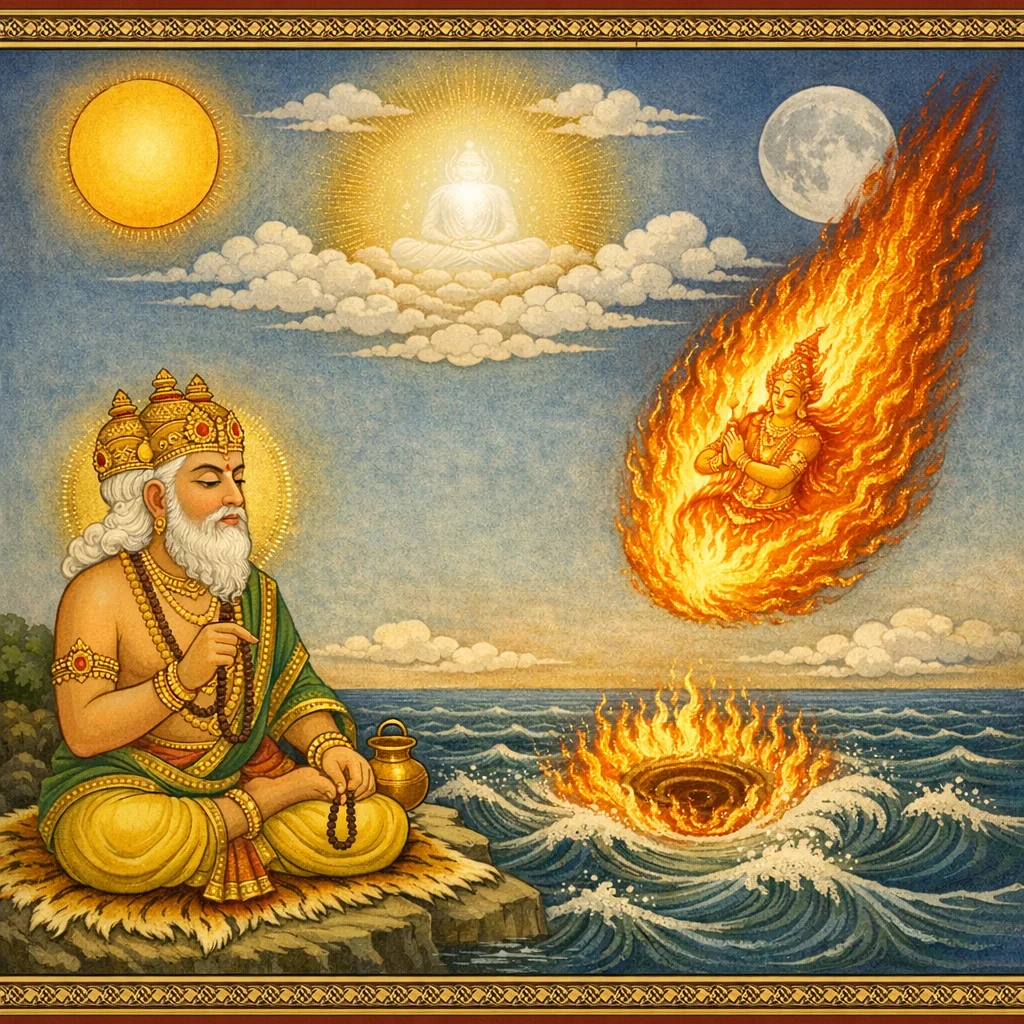
Adhyaya 4
अग्नितेजःसर्गः तथा नर-उत्पत्तिप्रसङ्गः (Origin of Agni’s Tejas and the Context of Nara’s Emergence)
Chapter 4 unfolds as a theological dialogue in question-and-answer form. Vyāsa asks how the extraordinary archer Nara—said to arise in connection with a kapāla (skull motif) and the craft/agency of Viśvakarman—relates to Rudra (Śiva), Viṣṇu, and Brahmā, and why Brahmā’s “fifth face” becomes significant in the story. Sanatkumāra replies by tying these questions to a cosmogonic account: after tapas and Vedic utterance, Agni emerges from Brahmā’s mind, then plunges downward in an uncontrolled blaze. Brahmā seeks to steady and nourish him through yajña, even by sacrificial self-offerings. Brahmā then differentiates and assigns multiple “fires” (mapped through vowel symbolism a/i/u) to cosmic functions and abodes—solar, lunar, and terrestrial/sea forms such as the vaḍavāmukha. The chapter also teaches the norm of saṃskṛtā vāc (cultivated, regulated speech) as a purifying, life-sustaining principle for dvija communities. A hymn of praise follows, with Brahmā extolling Agni’s many-formed tejas, culminating in a theophanic vision of the supreme principle governing creation and sustenance. The conclusion returns to the Nara–Nārāyaṇa frame and a phalaśruti promising spiritual elevation, including brahma-sālokya, for those who understand and faithfully hear this “tejas-sarga,” while also indicating the greatness of Paśupati (Śiva).
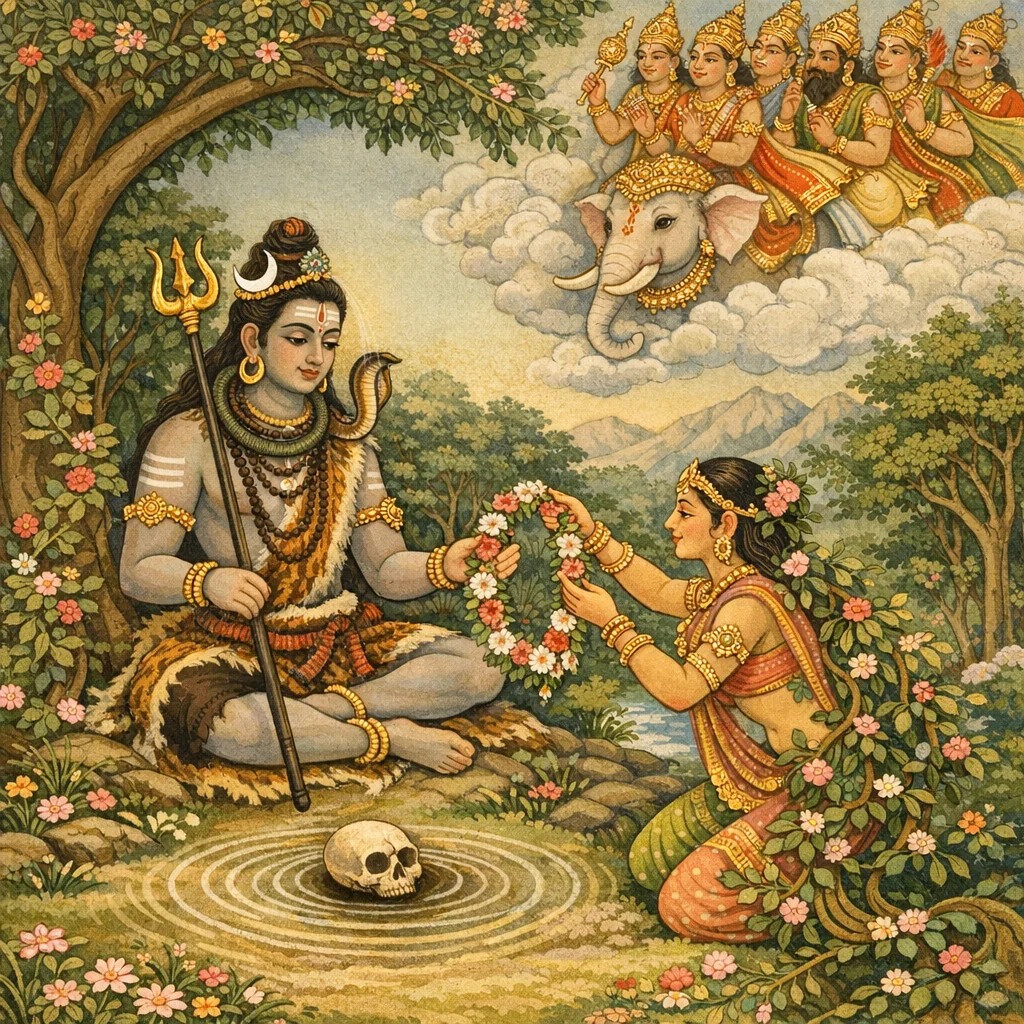
Adhyaya 5
Kuśasthalī-vanavarṇana and Kapāla-nikṣepa (Description of the Kuśasthalī Forest and the Casting Down of the Kapāla)
The chapter opens in dialogue: Vyāsa asks what followed the earlier conflict and what expiatory or consequential acts were undertaken by Brahmā, Janārdana (Viṣṇu), and Śaṅkara. Sanatkumāra replies that Brahmā is engaged in agnihotra, using materials from the forest, and he recalls the austerities of Nara–Nārāyaṇa at Badaryāśrama for the welfare of all beings. The narrative then turns to Śiva as Kapālapāṇi, who arrives at Kuśasthalī and enters an exceptionally auspicious forest. A long, crafted description portrays trees, creepers, blossoms, birds, winds, and seasonal moods as offering devotional hospitality. The forest presents flowers to Rudra; Śiva accepts them and grants boons to the trees—protection from fire, wind, water, sun, lightning, and cold, along with perpetual bloom, abiding youth, and wish-fulfilling qualities. After dwelling there, Śiva casts the kapāla to the ground, causing a cosmic tremor that disturbs oceans, mountains, celestial vehicles, and the three worlds. Alarmed, the devas approach Brahmā for the cause; Brahmā explains the kapāla-bearing episode—Śiva severing Brahmā’s fifth head, seeking alms from Nārāyaṇa, and entering Kuśasthalī—and leads them to propitiate Rudra to receive his grace and a boon.
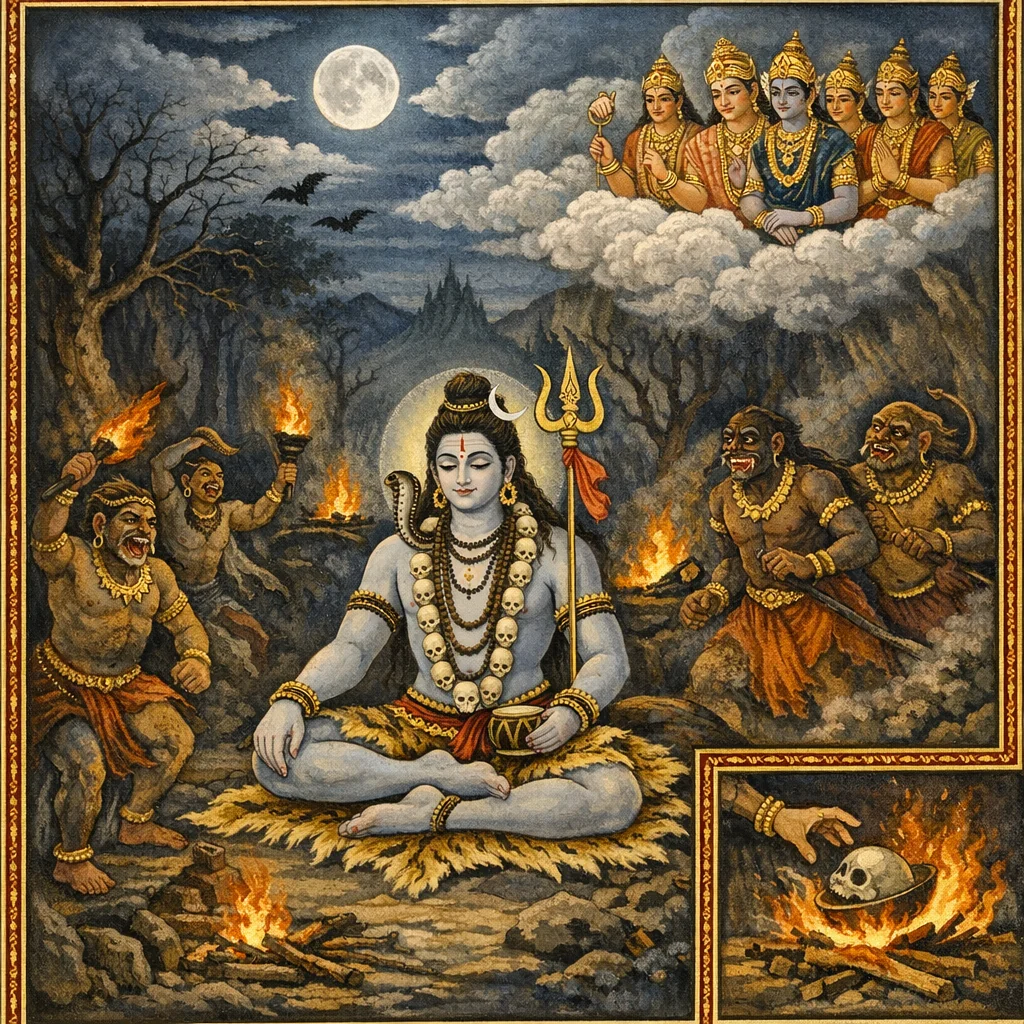
Adhyaya 6
महापाशुपतव्रत-दीक्षा, महाकालवन-प्रादुर्भाव, कपालव्रत-विधानम् (Mahāpāśupata Vrata Initiation, Mahākālavana Epiphany, and the Kapāla-vrata Framework)
Sanatkumāra recounts how the devas enter a flower-laden forest in search of Mahādeva, yet cannot behold him despite their efforts. A doctrinal clarification follows: divine vision depends on inner qualification—Śiva is approached through the triad of śraddhā (faith), jñāna (spiritual knowledge), and tapas/yoga (austerity and yogic discipline), with a distinction between perceiving the manifest (sakala) and the unmanifest (niṣkala). Brahmā urges the devas to receive Śaiva dīkṣā and to worship steadily; preparations are made for a Śaiva yajña, and the devas are initiated and granted an exalted observance known as the Mahāpāśupata vrata. Śiva then appears, surrounded by formidable gaṇas of many forms; the devas praise him with a litany of sacred epithets. Śiva acknowledges their disciplined practice, bestows boons, and explains a protective act involving the casting of a kapāla (skull) that caused cosmic disturbance to neutralize an asura threat. Śiva further presents Mahākālavana as a renowned, esoteric sacred forest and śmaśāna, and outlines the kapāla-vrata ethos: ascetic marks such as bhasma and rudrākṣa, restraint, avoidance of harmful company, and the grave fault of insulting the vow. The chapter closes with a phalaśruti, assuring benefits to those who recite or listen with focused attention.
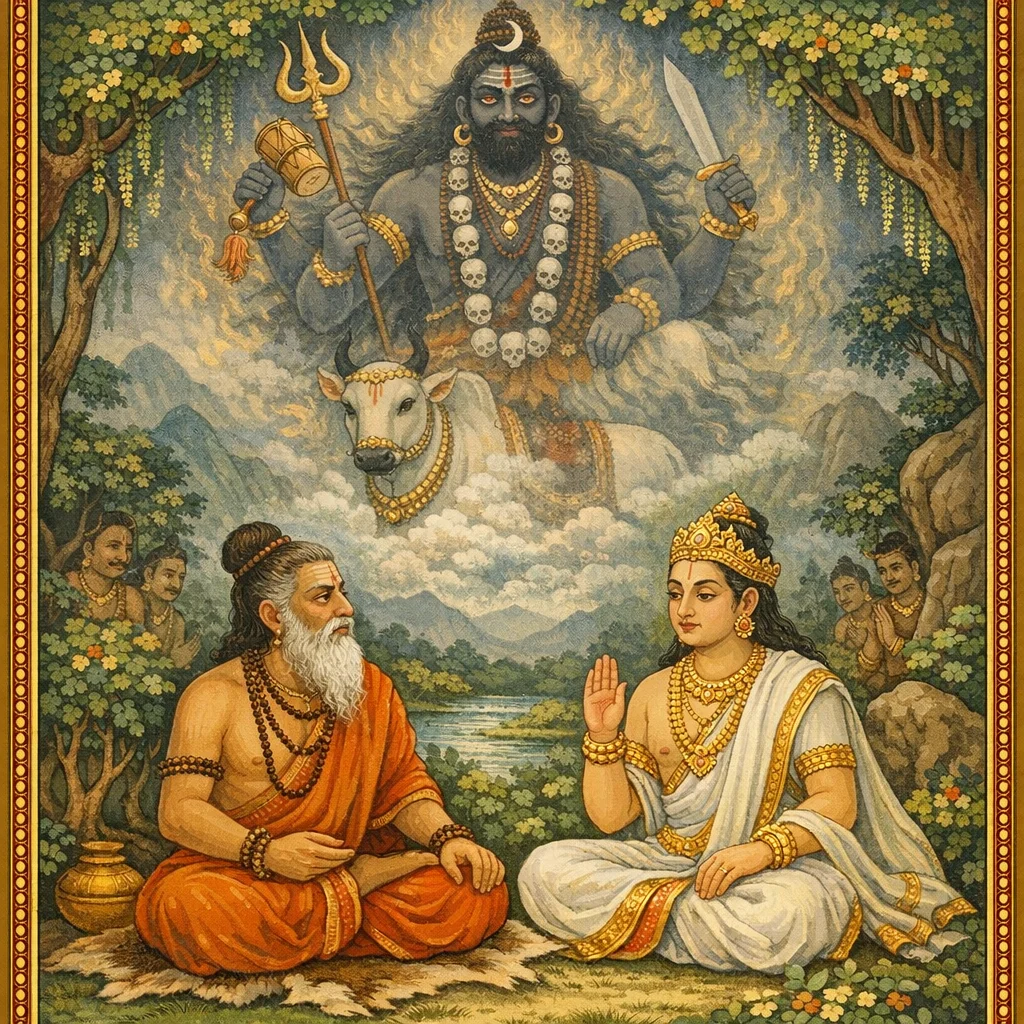
Adhyaya 7
रुद्रभक्तित्रिविधविभागः तथा क्षेत्रवासिफलनिर्णयः (Threefold Rudra-Bhakti and the फल of Residence in Mahākālavana)
Chapter 7 opens with Vyāsa’s formal question about the proper method (vidhi) for men and women of all varṇa and āśrama who wish to reside in Mahākālavana in order to attain Rudra’s realm. Sanatkumāra replies by presenting a threefold classification of Rudra-bhakti: (1) mental devotion (mānasī) rooted in dhyāna and dhāraṇā; (2) bodily and disciplinary devotion (kāyikī) through vows, fasting, and restraint of the senses; and (3) outward ritual devotion (laukikī) through offerings, fragrances, lamps, garments, banners, music, and hospitality. He further distinguishes Vedic action (vaidikī)—agnihotra, darśa–pūrṇamāsa rites, mantra-recitation, and saṃhitā study—when performed with Rudra as the intended object. The chapter then introduces an explicitly ādhyātmikī, contemplative-analytic register in the streams of Sāṅkhya and Yoga, outlining a tattva hierarchy (prakṛti/प्रधान as insentient, puruṣa as the conscious enjoyer, and Rudra as a higher principle/agent) and teaching a yogic visualization of Mahākāla (pañcavaktra, trilocana, and other iconographic marks). Finally, it enumerates graded post-mortem fruits for residents of the kṣetra: from brahma-sāyujya/mokṣa for certain renunciant dispositions, to prolonged enjoyment in Rudraloka with attendant beings (guhyakas), and later rebirths endowed with prosperity, status, and devotion—according to one’s āśrama practice (gṛhastha, brahmacarya, vānaprastha), austerity, and manner of death within Mahākālavana.
Adhyaya 8
Kalakaleśvara–Kalahanāśana-kuṇḍa and the Apsarā-tīrtha: Ritual Merit, Protection, and Origin Narratives
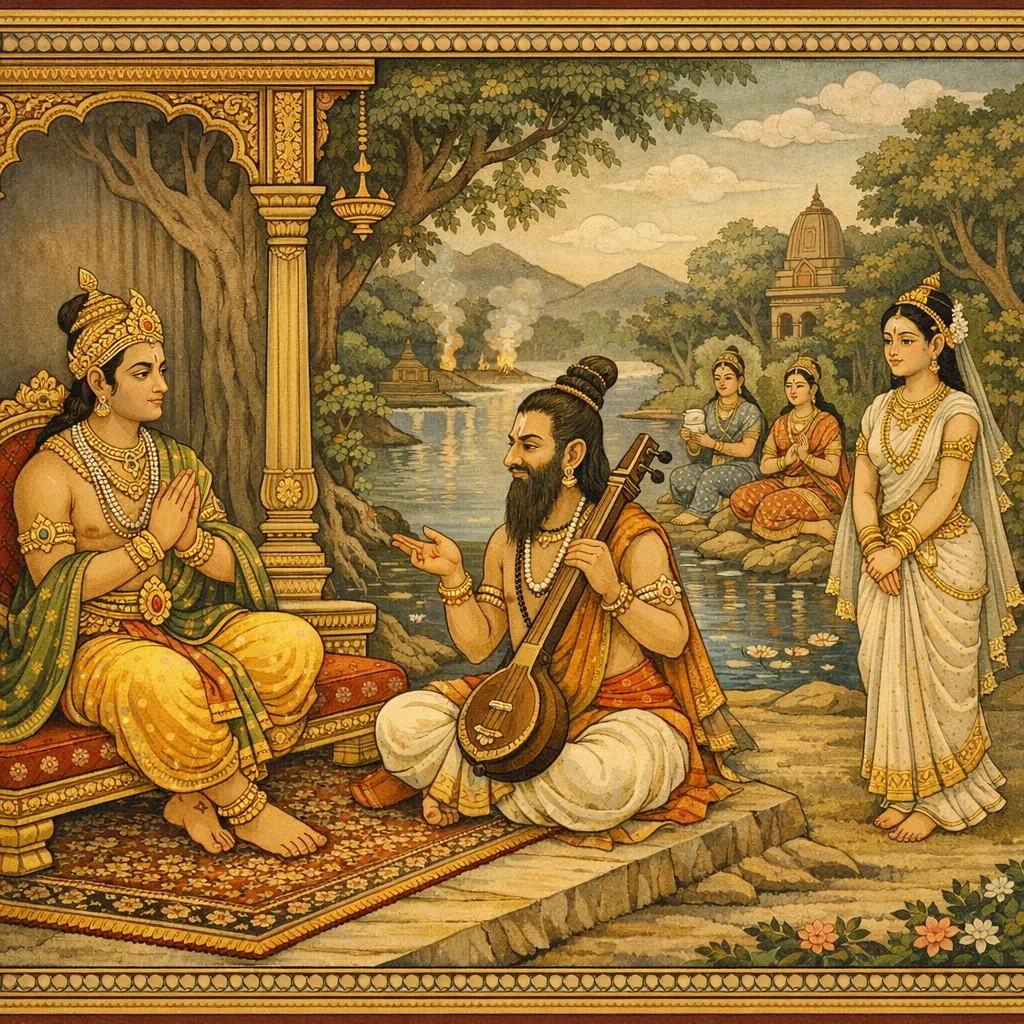
Chapter 8 is framed as a dialogic dossier of theology and ritual. Vyāsa asks a soteriological question: if ethical discipline (ācāra, self-control) leads to Rudraloka, what becomes of those without observance—women, mlecchas, śūdras, animals, and persons lacking ascetic capacity—who die in Mahākālavan? Sanatkumāra replies with a place-based doctrine: death “by Time” within Mahākāla’s precinct is told to grant entry to Rudraloka, with the body transformed and the soul enjoying Śiva’s nearness. The teaching is then grounded in local sacred geography. A conflict between Śiva and Gaurī brings forth Kalakaleśvara and establishes the Kalahanāśana-kuṇḍa, where bathing and worship—along with a night fast—are praised as uplifting an extensive lineage. Another cluster situates the Pṛṣṭhamātṛ (guardian “back-mothers”) and Maṇikarṇikā as protective and purificatory nodes, promising release from sins and safety from thieves, spirits, and planetary afflictions. The narrative turns to an apsaras origin: Nara-Nārāyaṇa’s tapas, Indra’s attempted disruption, and the emergence of Urvaśī. Purūravas’ longing leads him to Mahākālavan, where Nārada teaches a vrata and “weighing” offerings (tila, lavaṇa, śarkarā, guḍa, madhu) to Pārvatī for beauty, prosperity, and conjugal stability. The chapter closes by naming further tīrthas such as Māhiṣa-kuṇḍa and their power to ward off preta–rākṣasa–piśāca afflictions.
Adhyaya 9
महाकपाल-प्रादुर्भावः तथा शिवतडाग-रौद्रसरः-माहात्म्यम् (Origin of Mahākapāla and the Glory of Śiva’s Tank/Raudra Lake)
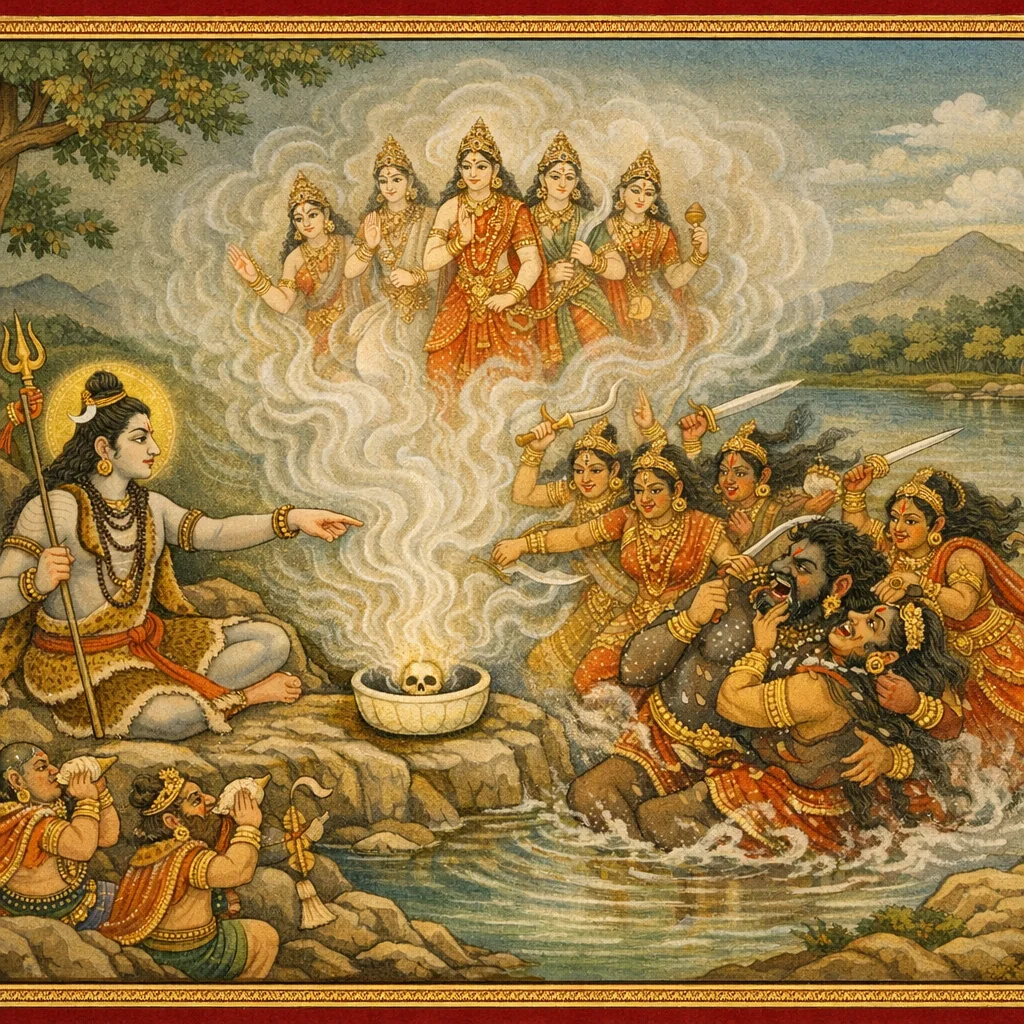
Vyāsa asks about the rise of the buffalo-formed menace (Māhiṣa), the manifestation of the Mothers (Mātṛs), and how Rudra’s power works within the sacred kṣetra. Sanatkumāra recounts that Mahādeva, bearing a radiant skull-fragment (kapāla-khaṇḍa) infused with Brahma-tejas, sets it—by divine play—within the holy region before the gaṇas. A dreadful sound then erupts, drawing the asura Hālāhala, a tormentor of the devas, strengthened by boons and taking a buffalo form, along with vast forces. Śiva commands the gaṇas to neutralize the oncoming foe; they fight in concert with varied weapons and coordinated volleys, bringing the asura down. After his fall, Śiva declares pride to be the cause of ruin. From the established kapāla arise fierce, luminous Mothers, the Kāpālamātṛs, who rush in and consume the daitya, fixing the local identity and the name Mahākapāla for that place-object. The account then connects this deed to the emergence and renown of Śiva’s tank (Śiva-taḍāga) / Raudra lake, praised as a purifier equal in efficacy to the ablutions of great sacrifices. The chapter closes with pilgrimage ethics and phala: Brahmā’s visitation, the site famed as a “ladder” to heaven, Rudra-loka promised to those who die there, and exalted rewards for one-pointed listeners.
Adhyaya 10
कुटुंबिकेश्वरतीर्थमाहात्म्य (Kutumbikeśvara Tīrtha-Māhātmya)
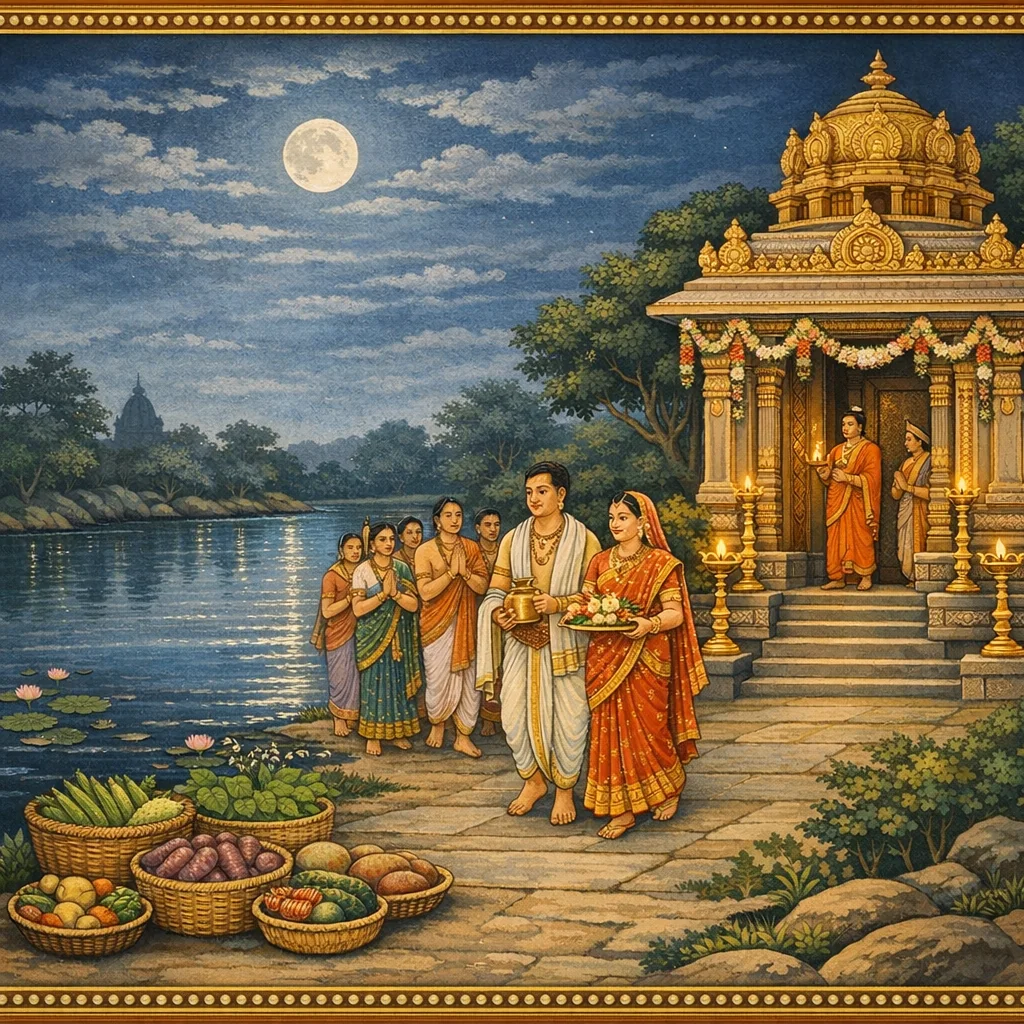
Sanatkumāra describes a tīrtha famed across the three worlds, connected with Mahādeva and known as the self-manifest (svayaṃbhūta) Kutumbikeśvara. Temple darśana and allied rites are presented as means of purification and spiritual ascent: one who is purified, performs śrāddha according to rule, and beholds the deity is said to be freed from sins accumulated over seven births. The teaching then commends food-charity on the tīrtha’s bank—vegetables and tubers—as a meritorious act leading to a “supreme state.” Vrata instructions follow: a single fast on Pauṣa śukla pratipad or aṣṭamī yields Aśvamedha-like merit; darśana on the Āśvinī full moon is linked to reaching heaven through devotion to Mahādeva’s ritual paṭṭa-bandha (bond/garland). On Caitra śukla pañcamī, fasting and offerings of aromatics (camphor, saffron, musk, sandal) and ghṛta-pāyasa, together with feeding a Brahmin couple, are prescribed, culminating in the promised attainment of Rudra-loka for an extended cosmological duration.
Adhyaya 11
विद्याधरतीर्थमाहात्म्यम् (The Māhātmya of Vidyādhara Tīrtha)
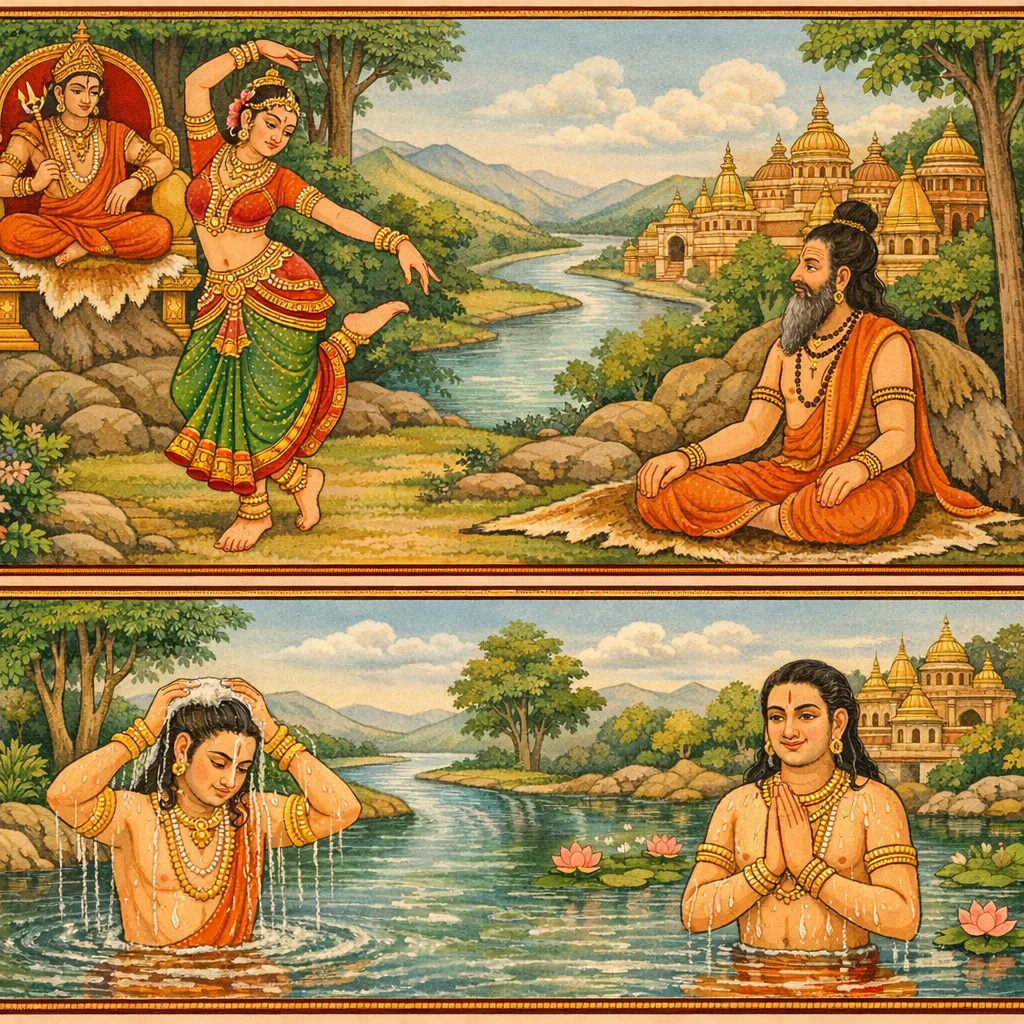
The chapter begins by proclaiming the greatness of Vidyādhara Tīrtha: one who bathes there with purity is said to attain the rank of “lord of the Vidyādharas.” Vyāsa asks Sanatkumāra how this tīrtha arose within the sacred kṣetra. Sanatkumāra recounts its origin: a Vidyādhara chief, adorned with a captivating pārijāta garland, visits Indra’s abode and, during Menakā’s dance, gives her the garland. Indra, angered by the impropriety and the disruption of the performance, curses him to fall to the earth. When the Vidyādhara seeks mercy, Indra directs him to Avantī, pointing to a Gaṅgā-linked cave and saying that to its north lies an eminent tīrtha famed in the three worlds as “Vidyādhara.” The Vidyādhara reaches Avantī, bathes at the delightful tīrtha, and by its power regains his former celestial status. The chapter ends with a phalaśruti: offering flowers and sandal paste there grants complete enjoyments and blessings in this world and beyond, presenting the tīrtha as a means of restoration, merit, and ethically guided devotion.
Adhyaya 12
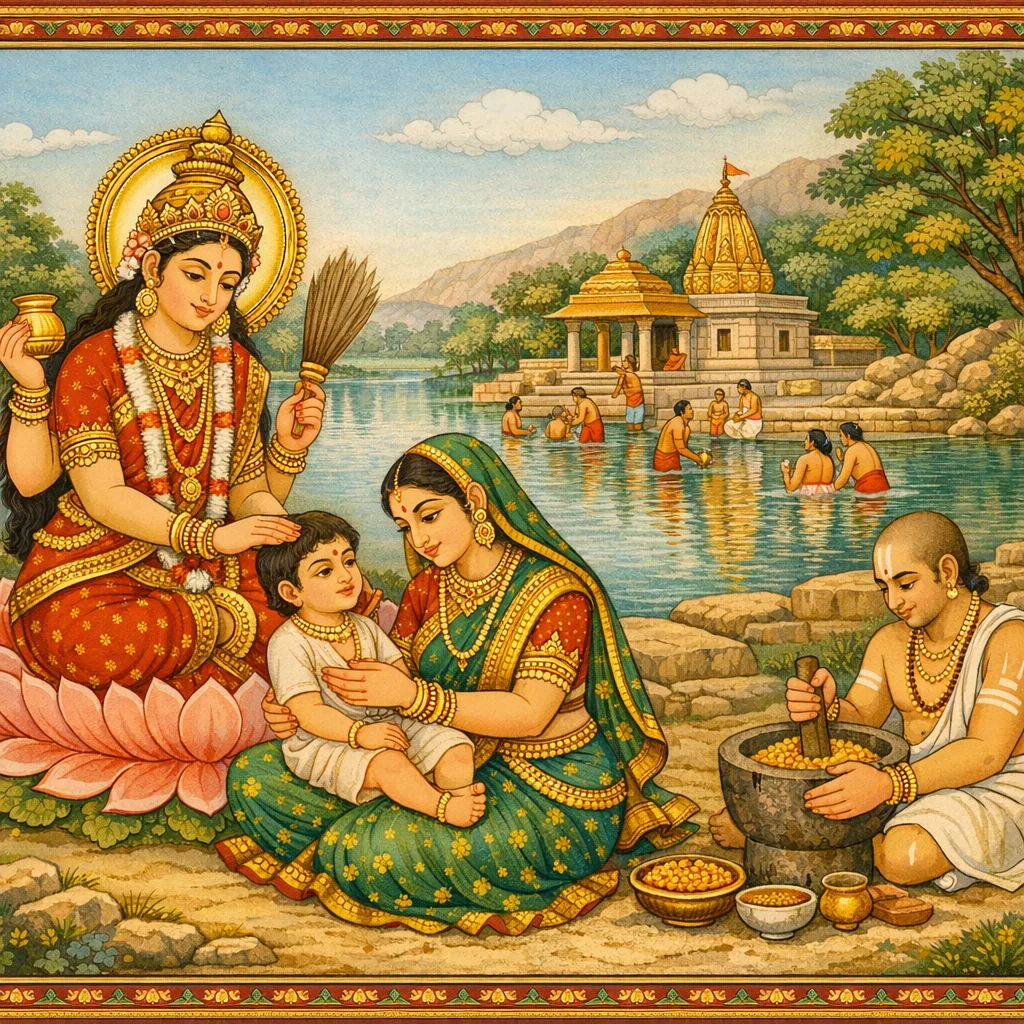
Mārkaṭeśvara-tīrtha and Śītalā Darśana (मर्कटेश्वरतीर्थ-शीतलादर्शन)
Sanatkumāra describes an eminent sacred spot called Mārkaṭeśvara and a celebrated tīrtha praised as the giver of all desired aims (sarvakāmapradāyaka). The phalaśruti declares that bathing there yields merit comparable to the fruit of gifting a hundred cows (gośata-phala). A practical, healing rite is then taught for pacifying eruptive afflictions (visphoṭa) and for the welfare of children: lentils (masūra) are to be measured and pounded at that place, its efficacy attributed to the cooling power of Goddess Śītalā (śītalāyāḥ prabhāva). The chapter further extols the devotional darśana of Śītalā—remover of demerit (duritāpahā)—promising that devotees will not be marked by wrongdoing, poverty, fear of disease, or graha-related affliction, thus joining place-based ritual, protective theology, and a concise assurance of wellbeing and social stability.
Adhyaya 13
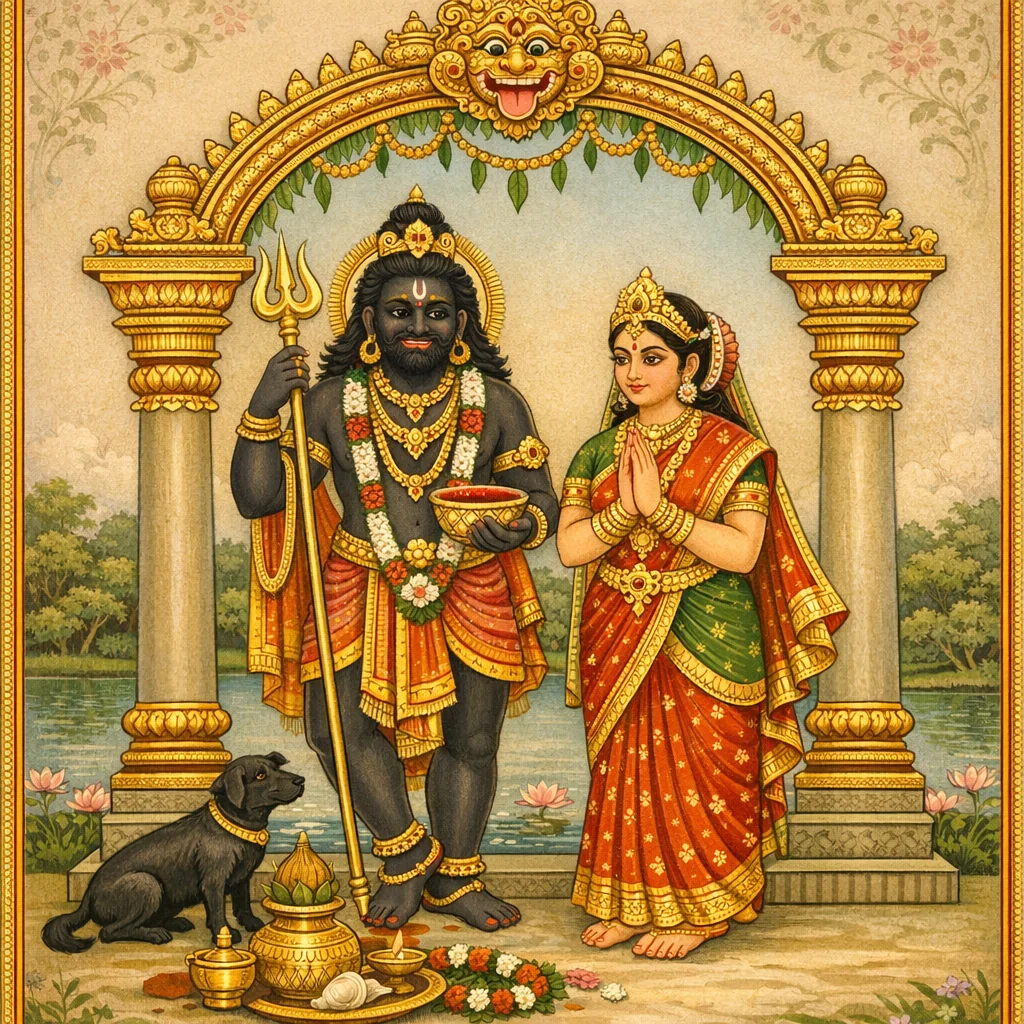
Svargadvāra-tīrtha: Bhairava–Ambikā Darśana and Śrāddha-Pūjā Phala (स्वर्गद्वारतीर्थे भैरवाम्बिकादर्शन-श्राद्धपूजाफलम्)
Chapter 13 records Sanatkumāra’s teaching to Vyāsa on the ritual power and saving merit of the Svargadvāra-tīrtha (“Gate of Heaven”) in Avantīkṣetra. It sets out a sacred sequence: bathing at Svargadvāra, taking darśana of Bhairava, and then performing śrāddha there with devotion for the Pitṛs. The rite is said to benefit both the performer and the ancestors, and the place is praised as a passage leading to Rudra’s supreme abode. The chapter also affirms the Goddess’s presence: Ambikā is described as standing before Bhairava, and her darśana frees any person, male or female, from all sins. A festival instruction follows: on Mahānavamī, offering bali to the Goddess—using items named in the source such as an animal-offering substitute, buffalo, liquor, meat, and an auspicious bilva garland—is declared in the phalāśruti to grant “all siddhis.” It concludes by reiterating that bathing and worship of Maheśvara at this spot lead the devotee through Svargadvāra to Rudra’s dwelling.
Adhyaya 14
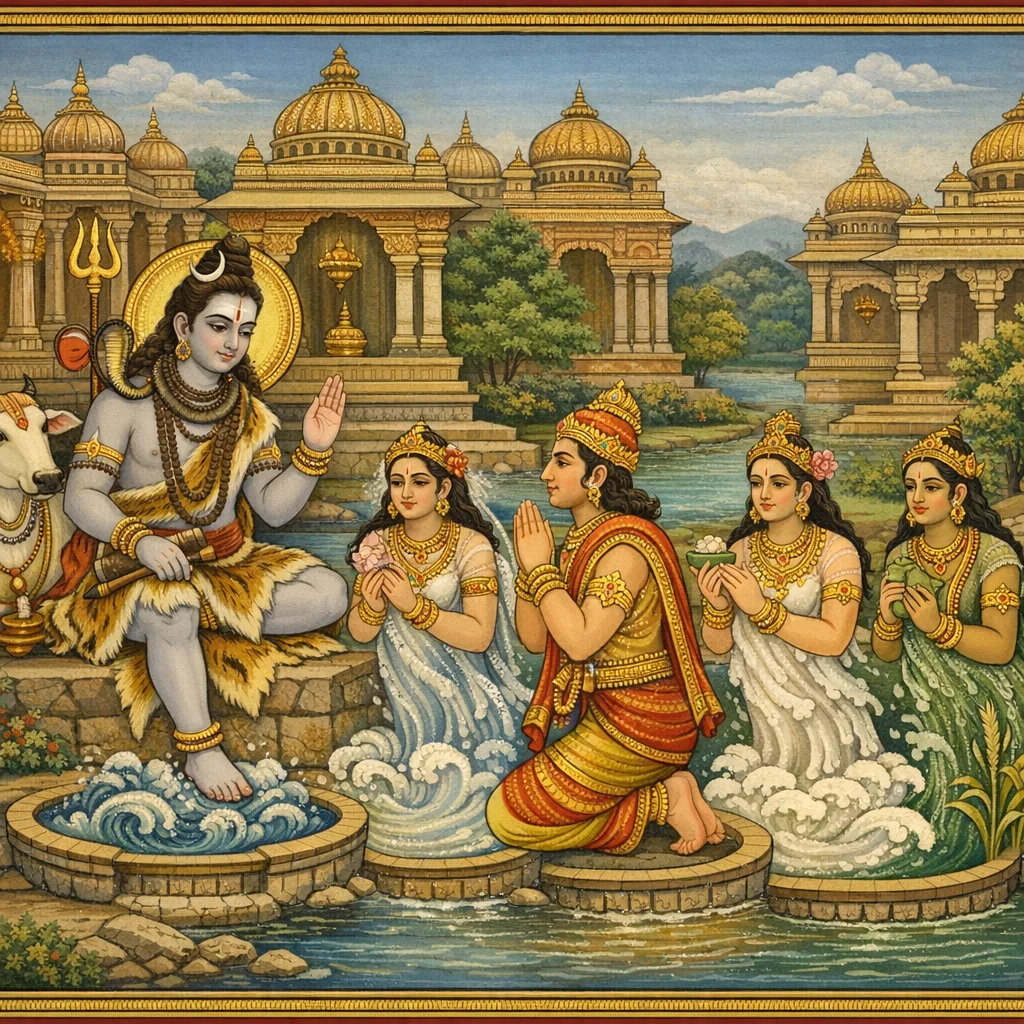
राजस्थलसमीपे चतुर्समुद्रसंगमः — The Convergence of Four Oceans near Rajāsthāla
This chapter presents Rajāsthāla as a Śaiva pilgrimage center and relates an extraordinary sacred‑geographical claim: near Śiva’s site the four archetypal oceans—salt (kṣāra), milk (kṣīra), curd (dadhī), and sugarcane‑juice (ikṣu)—are found together. Vyāsa asks how oceans said to lie at the far cosmographic boundaries could be co-located. Sanatkumāra answers with an origin legend: King Sudyumna and Queen Sudarśanā long for a child; the queen consults the sage Dālbhya, who prescribes bathing in divinely established “son‑granting” waters and worship of Śaṅkara. Sudyumna propitiates Śiva, who directs him to Avanti/Kuşasthalī and promises that, by divine command, the oceans will come and remain there as a partial manifestation (kalā) until the end of the aeon. The oceans consent and affirm the fruit: through bathing one gains a son marked with auspicious signs. The chapter then lays out a yātrā sequence across the four oceans—snāna in each, śrāddha for ancestors, worship of Śiva (Pārvatīpati), and prescribed dānas such as salt, milk, curd‑rice, jaggery, copper vessels, gold, grains, garments, arghya, and the gift of a milk‑yielding cow. The phalaśruti concludes with prosperity, pleasing offspring, long heavenly reward, and eventual mokṣa.
Adhyaya 15
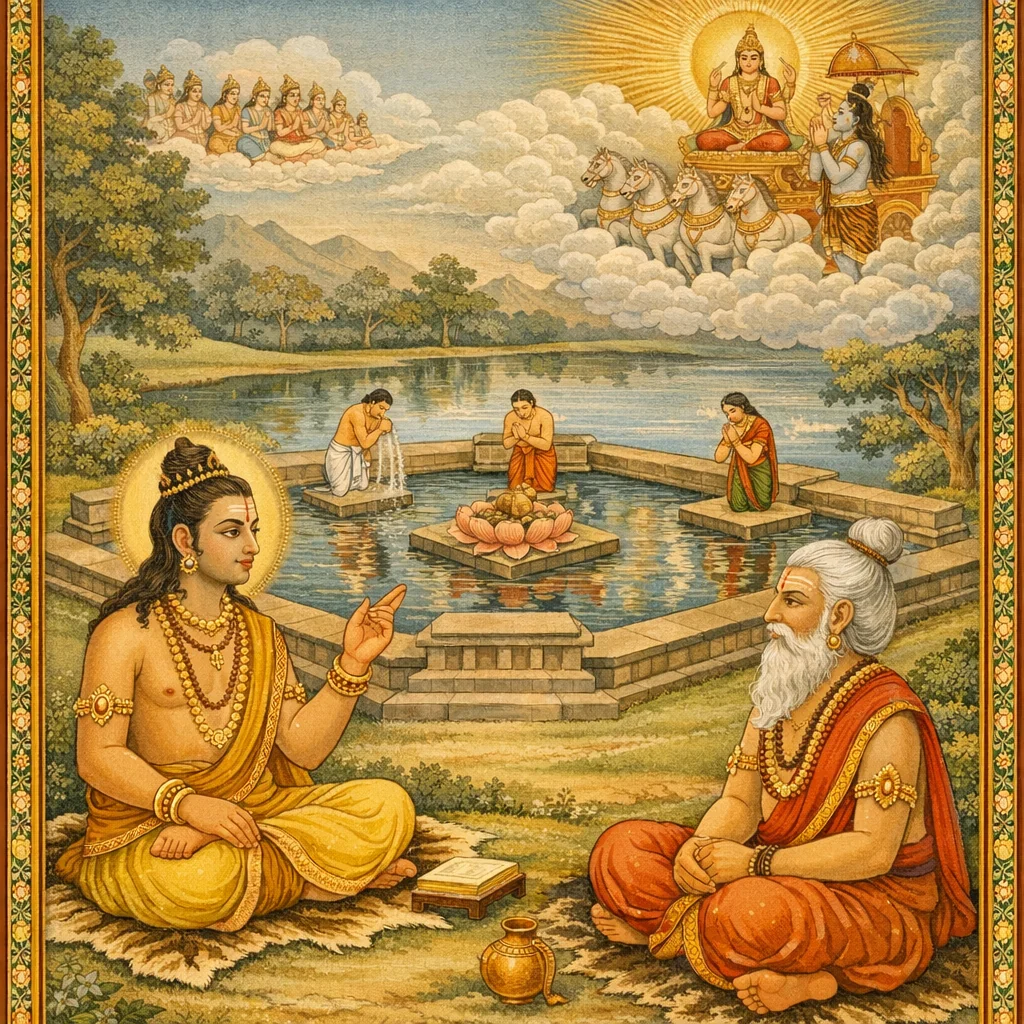
शंकरवापिका–शंकरादित्यतीर्थमाहात्म्य (Śaṅkaravāpikā and Śaṅkarāditya Tīrtha: Glory and Merits)
This chapter is a theological discourse of Sanatkumāra to Vyāsa. It first proclaims the great tīrtha called Śaṅkaravāpikā, explaining its sacred origin: the water used by Śiva to cleanse a skull (kapāla-kṣālana) was cast away and became a well/pond, thereby naming and sanctifying the place. It then lays down the Arkāṣṭamī observance—bathing so as to cover the directions and the very center of the vāpi, followed by disciplined giving: haviṣyānna and other foods, with vegetables and roots, offered to brāhmaṇas—presenting pilgrimage as ethical redistribution. The phalaśruti promises well-being “here and beyond,” along with prosperity and honor for those who recite or publicize this māhātmya. Next comes a second origin account: Śiva (Pinākī, Vṛṣabhadhvaja) praises Sūrya and receives a boon, asking that the Sun remain there “by a portion” (aṃśena) for the welfare of all embodied beings. Thus the tīrtha Śaṅkarāditya is established and named, witnessed by gods, daityas, gandharvas, and kinnaras, who worship both Śaṅkara and Āditya. The chapter concludes that darśana of Śaṅkarāditya surpasses the merit of all sacrifices and gifts, granting protection from disease, poverty, grief, and separation.
Adhyaya 16
Gandhavatī-Tīrtha Prādurbhāva and Śrāddha–Dāna Phala (गन्धवतीतीर्थप्रादुर्भावः श्राद्धदानफलम्)
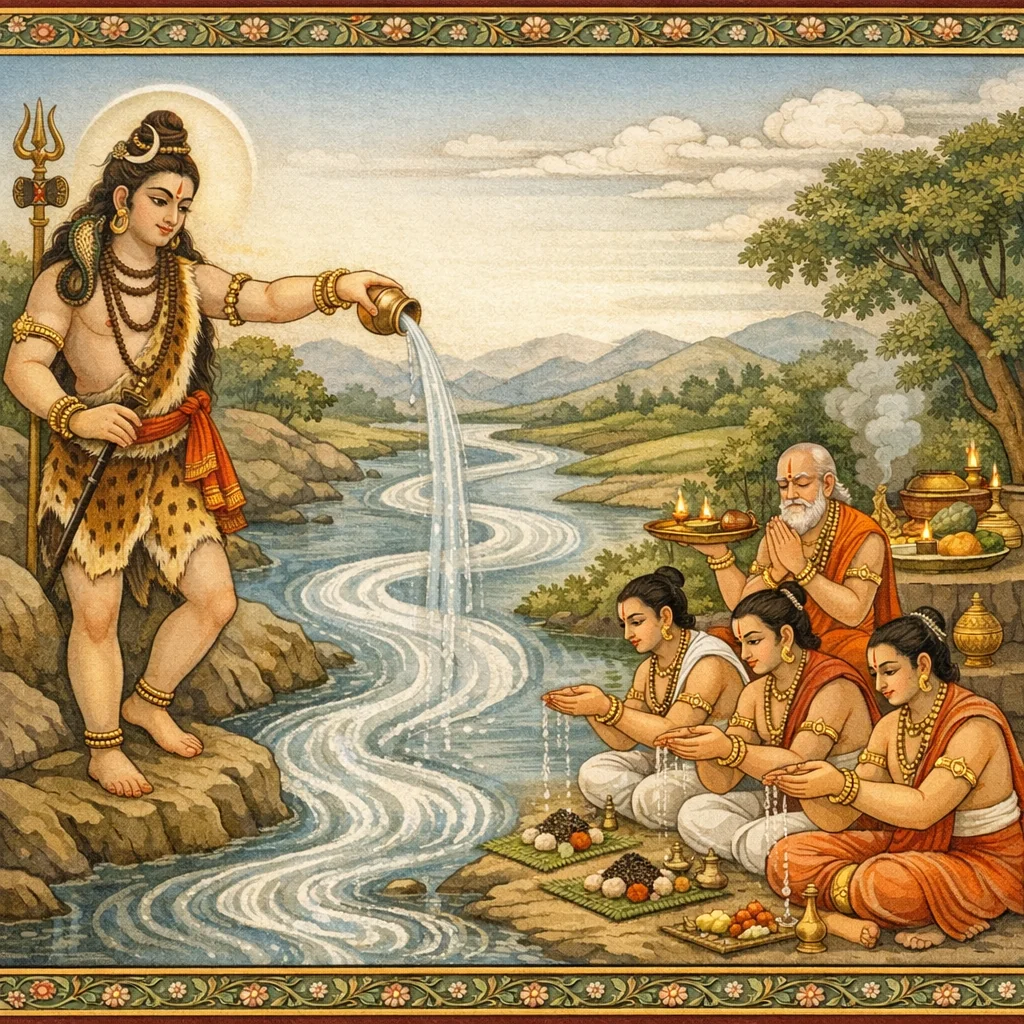
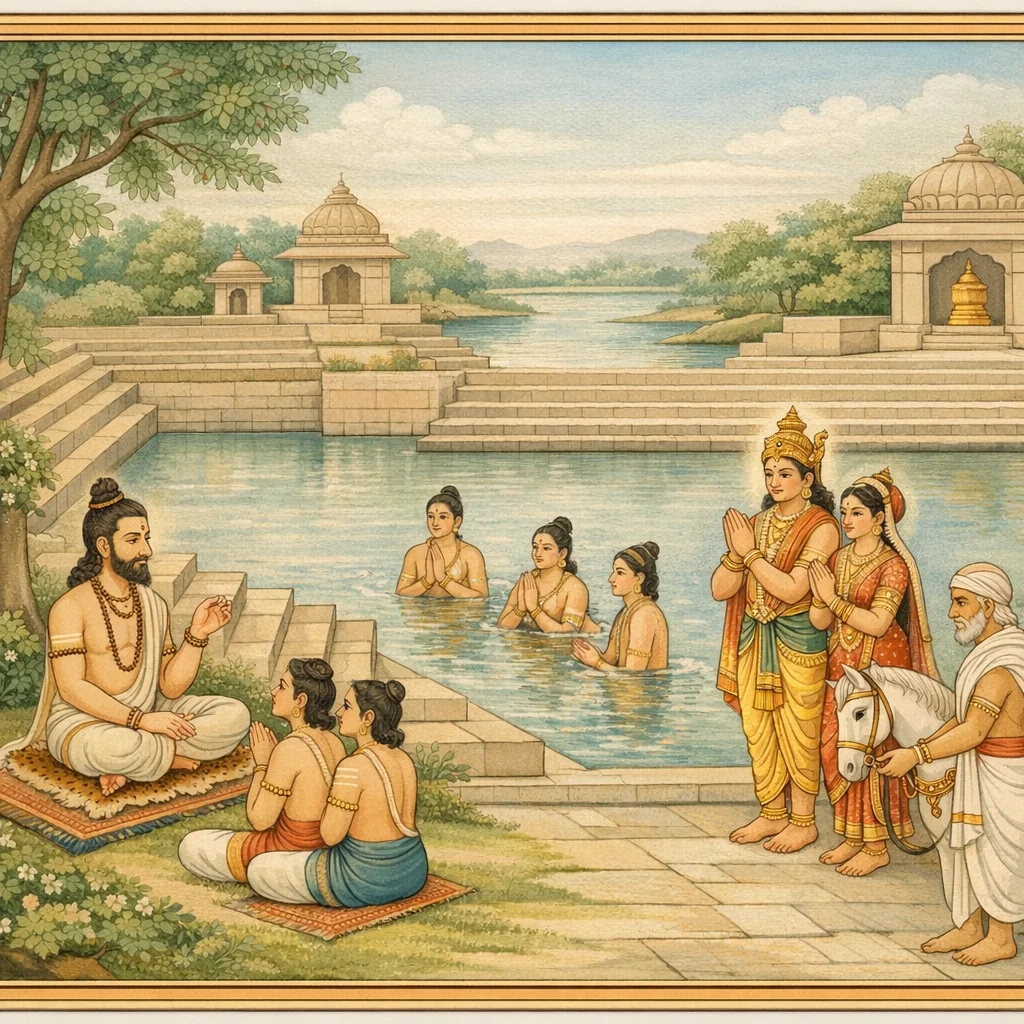
Sanatkumāra instructs Vyāsa about an “excellent among tīrthas” born from a Śaiva episode. Maheśvara, carrying water in a skull for skull-cleansing (kapāla-kṣālana), washes and then casts that water upon the earth, whereupon an unsurpassed tīrtha manifests as the holy river Gandhavatī, famed throughout the three worlds. The chapter then turns to ritual and moral guidance: bathing there is praised, and śrāddha and tarpaṇa performed at that site are declared akṣaya—imperishable in their fruit. The pitṛs are said to abide on the southern bank, awaiting offerings from descendants—pāyasa, grains, and piṇḍas mixed with honey and sesame—by which they gain prolonged satisfaction and the performer wins enduring heavenly merit. Śrāddha is further presented as a rite that pleases a wide range of beings—devas, pitṛs, gandharvas, yakṣas, humans, animals, and other creatures. Auspicious times are listed (tithis such as navamī, aṣṭamī, amāvāsyā, pūrṇimā; solar transitions; and select lunar–nakṣatra conditions), and the teaching concludes that purity of mind and means, proper timing, correct method, worthy recipients, and supreme devotion determine the desired results.
Adhyaya 17
दशाश्वमेधमाहात्म्यवर्णनम् | The Glory of Daśāśvamedha (Tīrtha Merit Discourse)
Sanatkumāra proclaims a tīrtha-phalashruti focused on the Daśāśvamedha site in Avantīkṣetra. He declares that bathing there (snāna) and then receiving the darśana of Maheśvara (Śiva) yields the combined fruit of ten Aśvamedha sacrifices, making merit attainable through devotion to a sacred place rather than only through royal capacity for grand rites. A chain of exemplars—Manu, Yayāti, Raghu, Uśanas, Lomasha, Atri, Bhṛgu, Vyāsa, Dattātreya, Purūravas, Nahuṣa, and Nala—is cited as testimony to the tīrtha’s efficacy. The chapter also prescribes an observance: in the month of Caitra, on the bright eighth (śukla aṣṭamī), one should worship with bhakti and gift a well-formed, virtuous horse to a brāhmaṇa. The promised result is prolonged honor in Śivaloka in proportion to the horse’s hairs, followed by a return to earthly sovereignty, presenting a morally ordered economy of ritual, gift, and consequence.
Adhyaya 18
Ekānaṃśā-devī Utpattiḥ and Pūjā-Phala (एकानंशादेवीोत्पत्तिः पूजाफलम्)
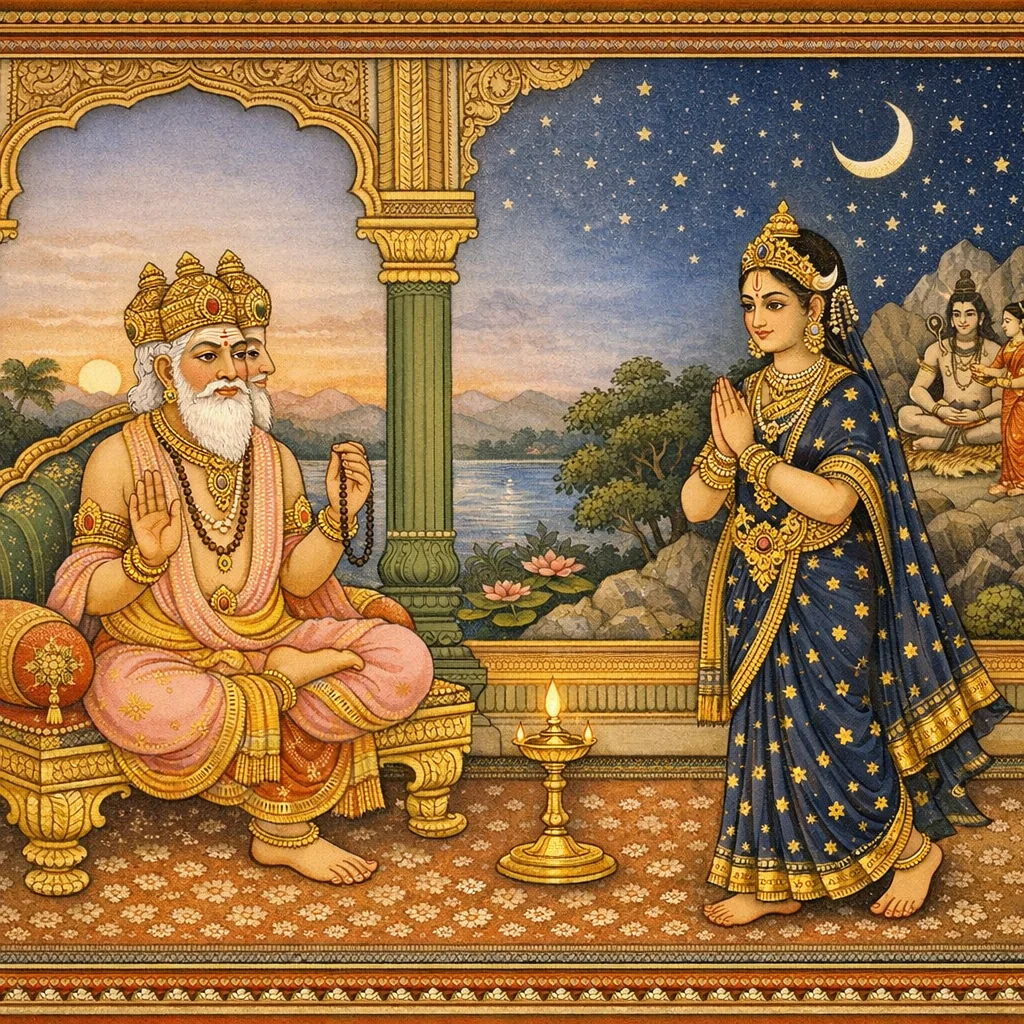
This adhyāya unfolds as a dialogue: Vyāsa asks Sanatkumāra to relate the origin of the Goddess Ekānaṃśā, praised as the destroyer of all sin (sarva-pāpa-praṇāśinī). Sanatkumāra first sets a ritual-theological frame, declaring that orderly worship according to prescribed rite (vidhāna-pūjā) of this renowned Goddess bestows “all siddhis,” including attainments such as aṇimā and other powers, along with protective and empowering ritual supports promised as definite fruits. The narration then turns to mythic beginnings: at the dawn of Kṛtayuga, Brahmā summons the personified Night, Rātri/Vibhāvarī, and instructs her about the menace of the asura Tāraka and the need for a divine birth that will end the danger. The account interweaves Satī’s rebirth as Pārvatī, Śiva’s ascetic waiting, and the destined sequence leading to their union and the birth of a radiant offspring meant to overcome hostile forces. Finally, Ekānaṃśā is praised through a litany of forms and functions—Gāyatrī with an Om-like face, prosperity and fame, knowledge and the supreme goal. It is affirmed that those who behold and worship her attain their aims, and that she should be meditated upon with devoted bhakti.
Adhyaya 19
हरसिद्धि-प्रादुर्भावः (Origin and Significance of Harasiddhī)
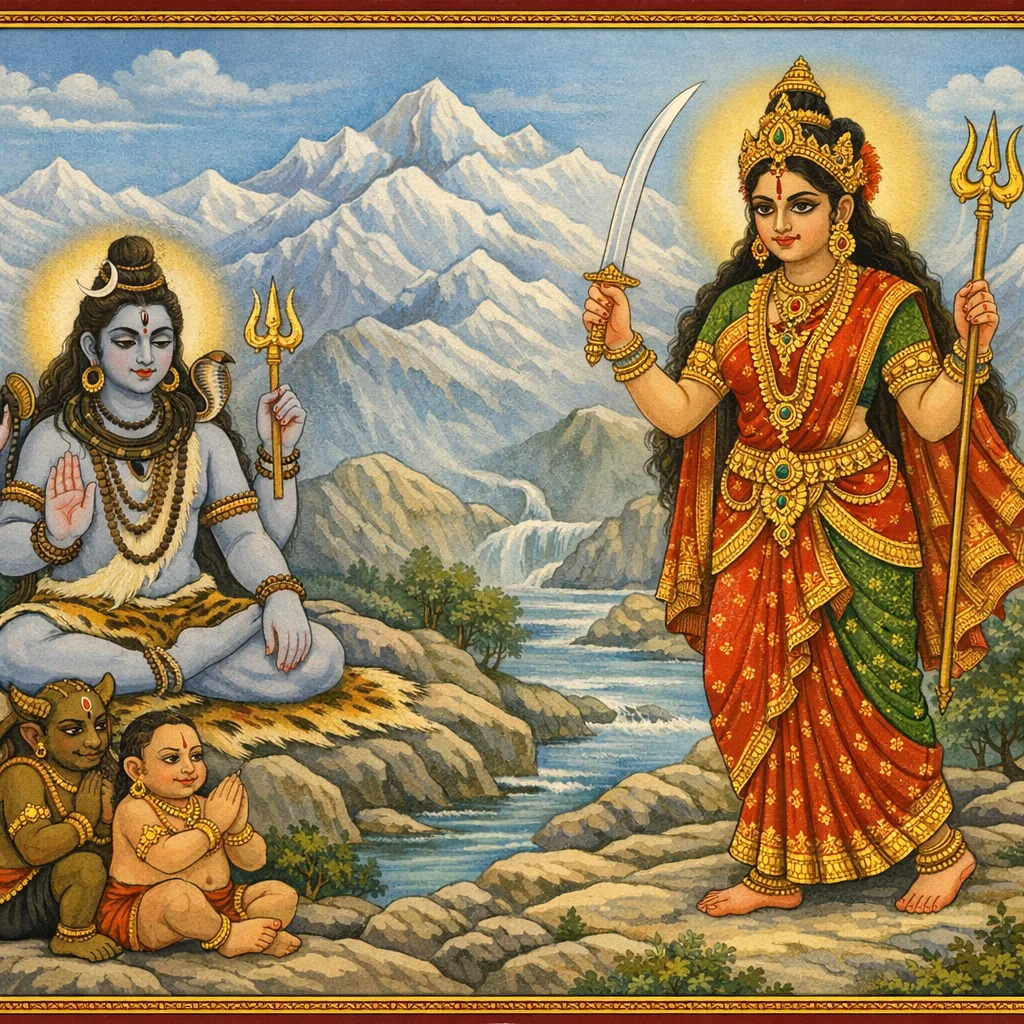
Sanatkumāra recounts the origin and significance of Harasiddhī within the sacred Mahākāla/Avantī complex, praising her as a power-conferring goddess who grants accomplishment. Two mighty daityas, Caṇḍa and Pracaṇḍa, shatter cosmic order by uprooting the heavens and arriving at Kailāsa; they confront Śiva, propose a gambling contest, and are branded “devakaṇṭakas,” obstacles to the gods. In the ensuing turmoil, Śiva’s gaṇas are subdued and Nandin is grievously wounded. The Devī (identified with Pārvatī/Śakti) is invoked and appears before Śiva; with fierce resolve she strikes down the two daityas. Śiva then declares that she will be renowned in the world as Harasiddhī, bestower of siddhi and fulfillment, and that her worship and darśana yield the desired fruits. The chapter ends with phalāśruti: devoted vision of Harasiddhī grants inexhaustible aims and a Śaiva afterlife; remembrance of the four-syllable mantra “harasiddhī” removes fear of enemies and prevents poverty. Mahānavamī worship, including a prescribed bali offering, is linked to royal prosperity; and the ritual killing of buffaloes on Mahānavamī is asserted to be sinless for the slayer while granting heavenly ascent to the offerings.
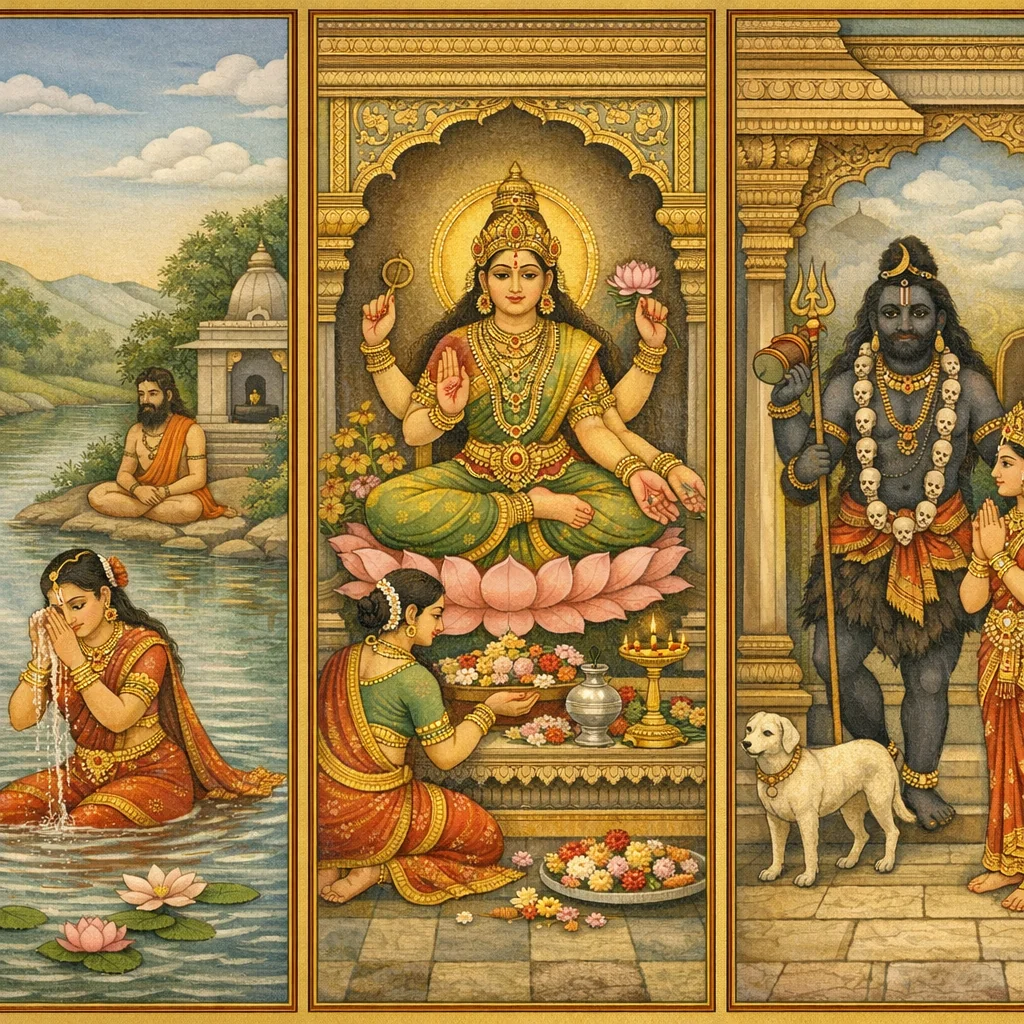
Adhyaya 20
वटयक्षिणी-माहात्म्य तथा अवन्तीक्षेत्रे शिवदर्शन-तीर्थस्नान-फलश्रुति (Vaṭayakṣiṇī Mahātmya and the Fruits of Śiva-Darśana & Tīrtha-Snāna in Avantī)
This chapter is a phalaśruti-style catalogue of observances and place-specific fruits within Avantīkṣetra. Sanatkumāra teaches a month-long devotional regimen: to seek the darśana of Vaṭayakṣiṇī and worship her with steady reverence, including offerings of golden flowers. He then prescribes a focused rite on the fourteenth lunar day (caturdaśī): bathing (snāna) and the gift of sesame (tila) to prevent or remove piśāca-affliction; its merit extends to one’s lineage and to the families the donor intentionally dedicates. Finally, he sets out a sequence of darśanas at many Śaiva tīrthas and shrines—some connected with the Śiprā and others elsewhere—each tied to a distinct result: release from sins, escape from Yama’s realm, attainment of Rudra’s world, aśvamedha-equivalent merit, freedom from disease, royal prosperity, long enjoyment in heaven, success and victory, deliverance from major sins, protection from serpents and poverty, and the merit of many sacrifices through Bhairava-darśana at “Svargadvāra,” turning sacred geography into a ritual itinerary.
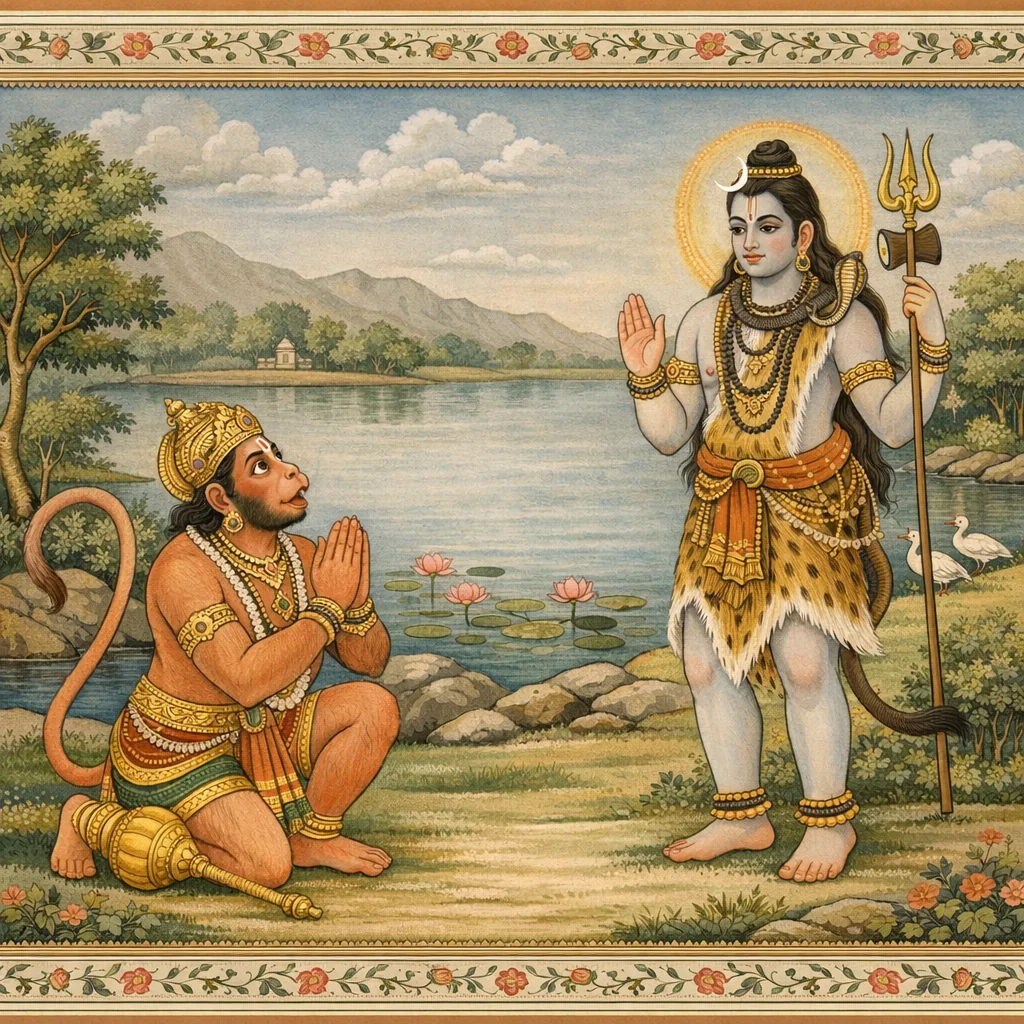
Adhyaya 21
हनुमत्केश्वर-प्रतिष्ठा (Establishment of Hanumatkeśvara)
The chapter is cast as a dialogue: Vyāsa asks for the ancient, timeless account (sanātanī vṛttapūrva) of Hanumatkeśvara, and Sanatkumāra narrates it. The story is set after Rāma’s victory over Rāvaṇa and his return with Sītā, with sages in attendance. When Agastya praises Mahādeva’s incomparable valor in battle and likens it to that of Vāyusuta (Hanumān), Hanumān longs to obtain a liṅga from Laṅkā as a tangible sign of his devotional standing. Hanumān approaches Vibhīṣaṇa, who offers him a choice among six liṅgas earlier established by Rāvaṇa before his bid to conquer the three worlds. Hanumān selects a pearl-like liṅga; Vibhīṣaṇa explains that it was once associated with Dhanada (Kubera), who worshiped it three times daily and was freed from bondage through its efficacy—thus affirming the liṅga’s ritual potency and protective power. Bearing it onward, Hanumān reaches Avantikā on the seventh day and installs it at Rudrasaras; when he then tries to lift it again, he cannot, and the deity instructs him to have it permanently established there in Hanumān’s name. The phalaśruti concludes: Saturday darśana removes fear of enemies and grants victory; devotees are protected from theft, poverty, and misfortune; oil anointing (tailābhiṣeka) relieves diseases and planetary afflictions; and those who behold with devotion attain mokṣa.
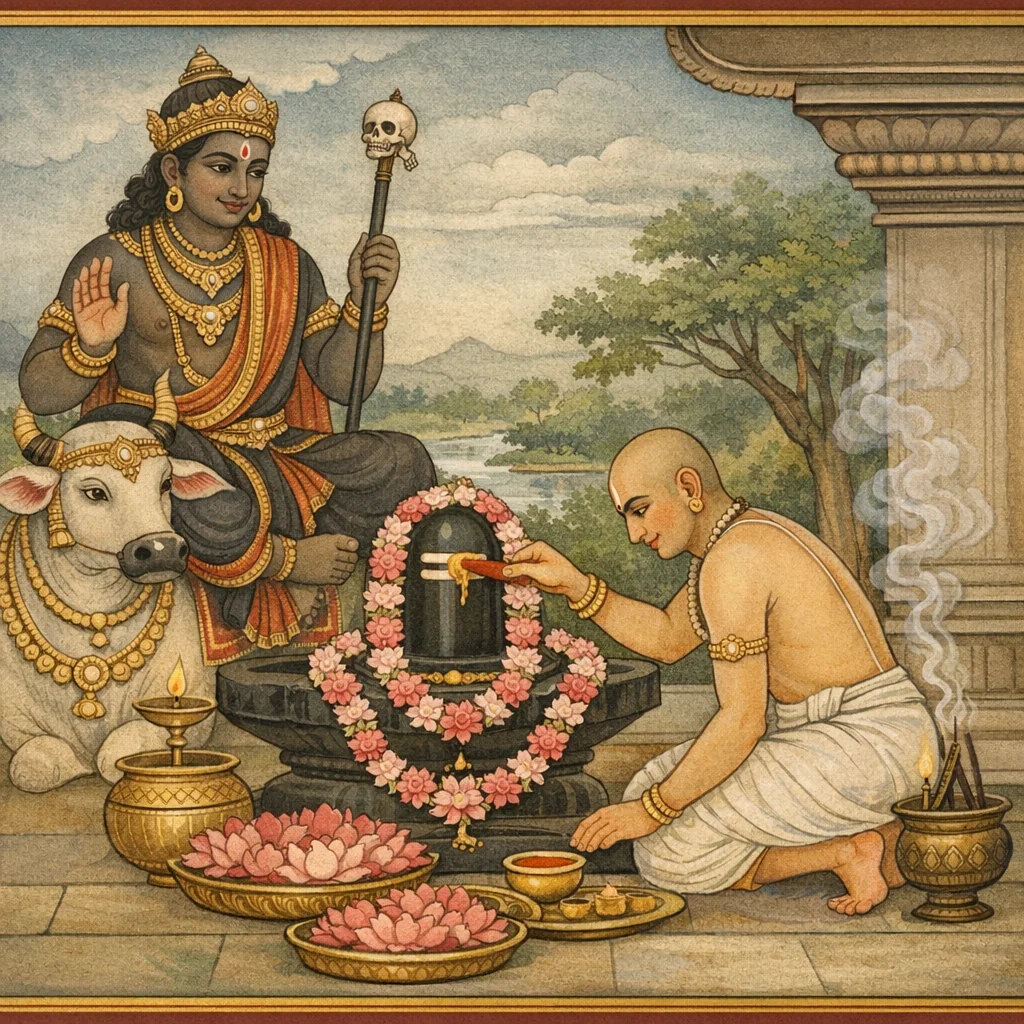
Adhyaya 22
Yameśvara–Koṭitīrtha–Mahākāla Māhātmya (Rudrasaras and Ritual Merits)
This chapter is framed as Sanatkumāra’s instruction to Vyāsa, setting out place-centered rites and their promised fruits (phalāśruti). It begins with a concise worship of Yameśvara: after bathing in sesame-infused water one beholds the deity, anoints with saffron, offers lotuses, presents incense—especially kṛṣṇāgaru—and gives sesame and rice. By such devotion, Yama is said to become “like a father” even toward the departed, so that the realm of death is softened by merit. The discourse then extols the superior tīrtha Rudrasaras, famed in the three worlds: bathing there and taking darśana of Koṭeśvara Śiva removes all impurity and leads to Rudra-loka. A detailed reckoning of merit follows—śrāddha performed there surpasses great Vedic sacrifices, and any offering to the ancestors becomes koṭi-guṇita. After bathing, meditation on the “supreme syllable” is likened to a serpent shedding its skin, signifying moral and spiritual release. Further observances are taught: early-morning bathing and darśana of Mahākāla yields the fruit of gifting a thousand cows; dwelling in purity for seven nights equals thousands of cāndrāyaṇa observances; and night vigil (jāgara) with worship and a great ablution is praised. The chapter closes with seasonal worship in Kārtikī and Vaiśākhī, preparing a balanced paste of camphor, saffron, sandal, and agaru, ground on stone and applied to Mahākāla, promising the status of Rudra’s attendant (anu-cara).
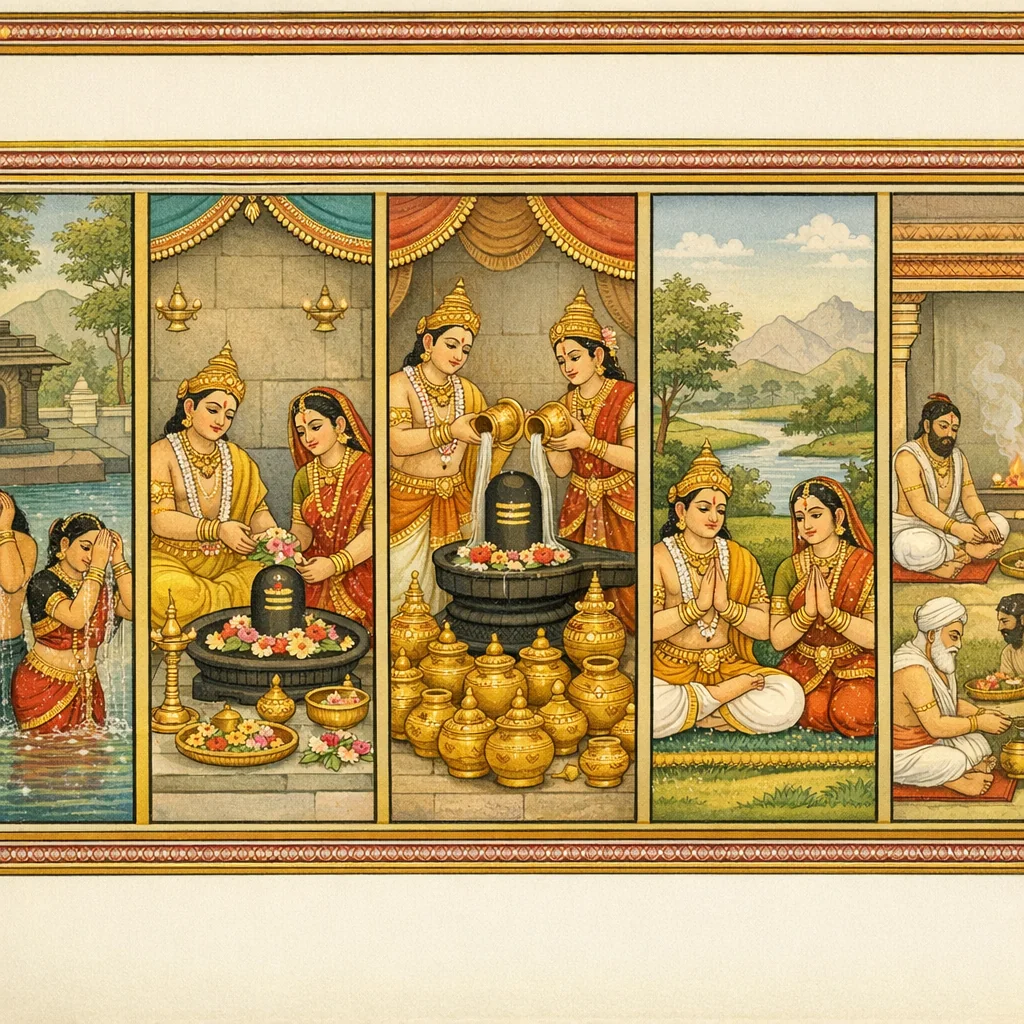
Adhyaya 23
महाकालयात्रा-विधिः (Mahākāla Pilgrimage Procedure and Merits)
Sanatkumāra sets forth an ordered yātrā within Avantīkṣetra, beginning with ritual bathing at Rudra’s lake and then moving through a prescribed sequence of Śiva-sites and named liṅgas. The chapter reads as a procedural itinerary, enjoining darśana, namaskāra, and pūjā with fragrances and flowers, and at certain stations specifying exact snāna/abhiṣeka measures (such as ghee and large numbers of water pots). At each stop a dense phalaśruti proclaims the fruits of worship: purification and release from grievous sins, protection such as the removal of bad dreams, relief from ailments including skin disease, and the gaining of prosperity or siddhi. Pilgrimage ethics are also taught—the pilgrim should be intent, faithful, self-controlled, and explicitly free from financial deceit. A formal concluding act is given: sitting before the deity, offering repeated salutations, dedicating the yātrā to Mahādeva, and praying for deliverance from the “ocean of saṃsāra.” Merit is magnified through comparisons (pradakṣiṇā equated with vast gifts) and culminates in communal duties—feeding Śiva-devotees and the vulnerable, gifting a milch cow with full provisions—thereby extending the yātrā’s merit to ancestors and one’s lineage in long-lasting heavenly enjoyment.
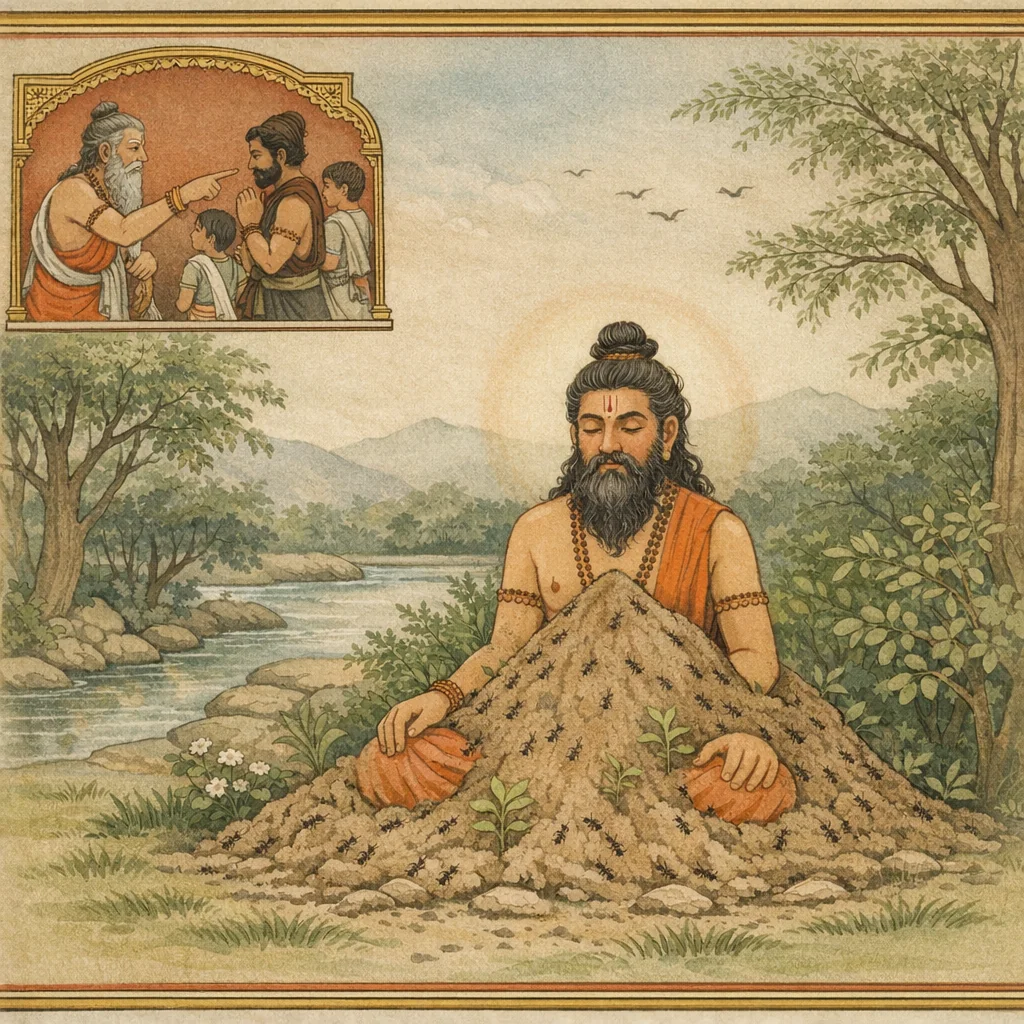
Adhyaya 24
वाल्मीकेश्वर-माहात्म्य (Valmīkeśvara Māhātmya: The Etiology of Poetic Attainment)
This adhyāya unfolds as Vyāsa’s question and Sanatkumāra’s reply concerning Valmīkeśvara, a liṅga in Avantī whose darśana and worship are said to bestow kavित्व—poetic power. It traces a fall from dharma and a return to grace: Sumati, a Bhṛgu-line brāhmaṇa, migrates during drought; his son Agniśarman rejects Vedic study and later joins violent brigands, forgetting the Veda, his lineage-marks, and learning. When Agniśarman meets the Seven Sages on their tīrtha-journey, he threatens them. Ṛṣi Atri challenges his moral reasoning and sends him to ask his family whether they will share the karmic burden of the violence he commits “for their sake.” Each relative refuses any share in the sin; struck by remorse, Agniśarman surrenders to the sages. They prescribe sustained meditation and mantra-japa at one spot. After thirteen years an anthill (valmīka) forms around him; the sages dig him out, restore him, and name him Vālmīki. He then worships Maheśvara at Kuśasthalī, attains poetic mastery, and composes the Rāmāyaṇa. Hence the deity becomes famed in Avantī as Valmīkeśvara, granting poetic attainment through worship and darśana.
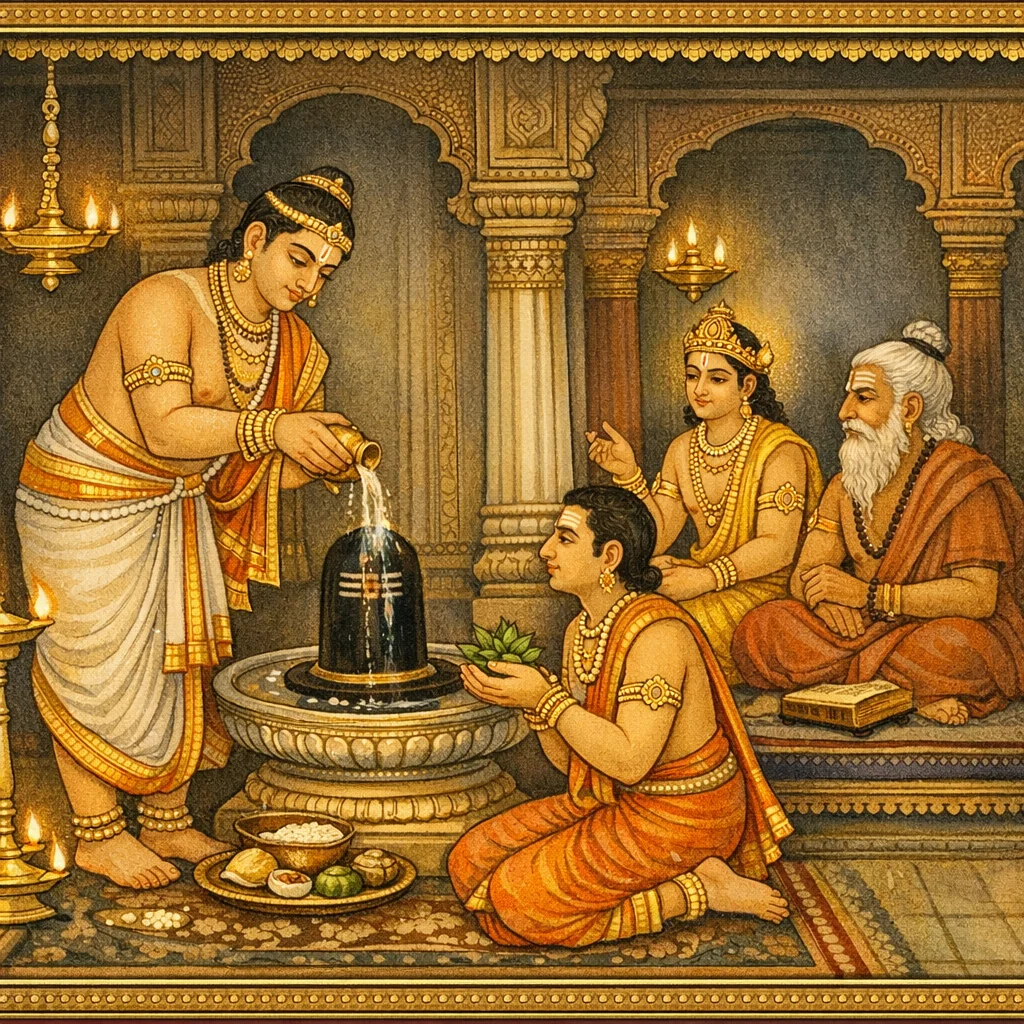
Adhyaya 25
Tīrtha-Phala of Avantīkṣetra: Worship of Named Śiva-Liṅgas and Observance-Based Merits (तीर्थफलप्रकरणम्)
This chapter is a prescriptive, theological catalogue spoken by Sanatkumāra to Vyāsa. It lists several named Śiva-sites—Śukreśvara, Bhīmeśvara, Gargeśvara, Kāmeśvara, Cūḍāmaṇi, and Caṇḍīśvara—each linked with specific rites and declared spiritual results. The observances include worship with white flowers and fragrant unguents, careful pūjā and darśana, bathing the liṅga with sesame oil and sesame-water, offering bilva leaves, fasting (upavāsa) on appointed lunar days (caturdaśī, the bright-half navamī of Kārttika, and kṛṣṇāṣṭamī), and performing dāna, notably the gift of a thousand cows. The chapter’s logic is systematic: disciplined vows and fasts (vrata, upavāsa), material offerings (tilataila, kuṅkuma, bilva), and devotional intent (bhāva, bhakti) are presented as means that yield fearlessness, increase of dharma, lasting well-being, release from bondage, and attainment of Rudraloka or Svarga. It concludes that visiting these tīrthas with a purified mind leads to Śambhu’s delightful realm.
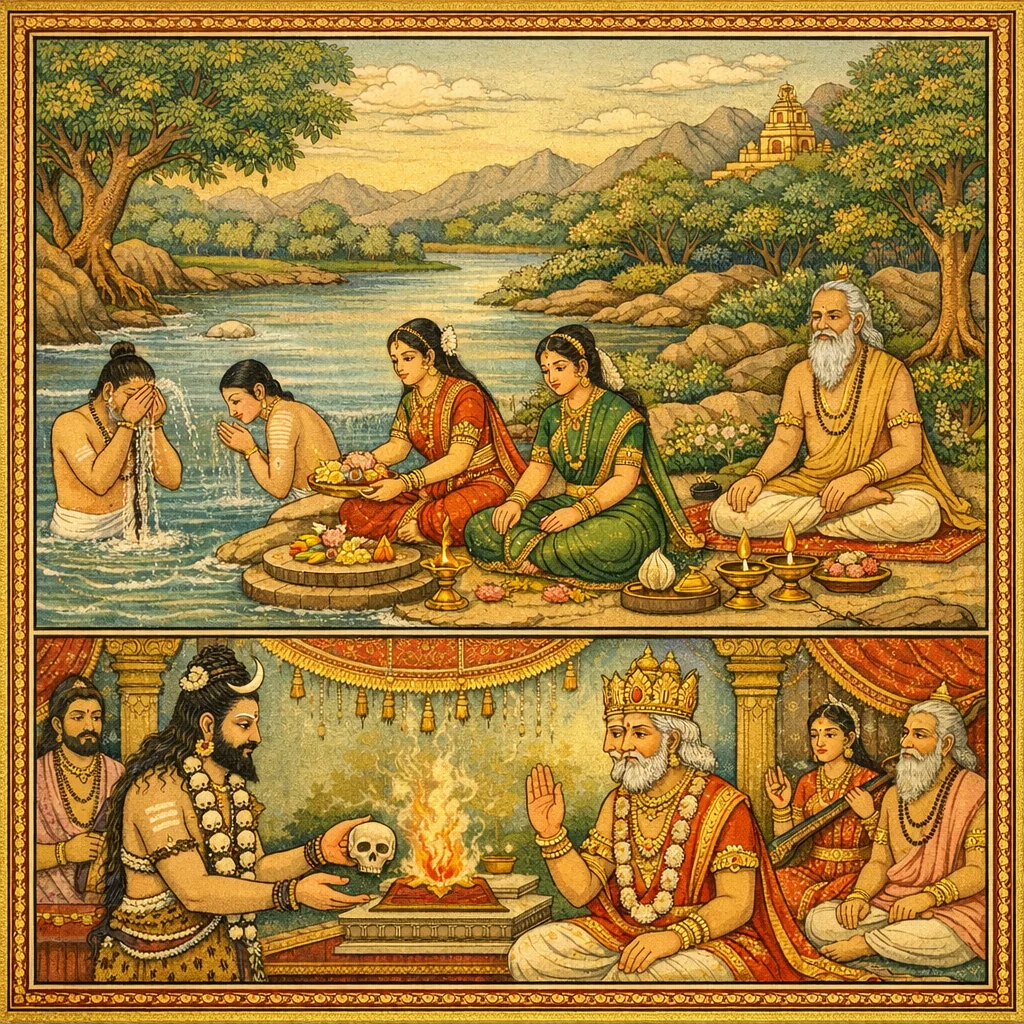
Adhyaya 26
Pañceśānī-yātrāvidhi, Kṣetra-dvārapāla-nirdeśa, Mandākinī-tīrtha-māhātmya (पञ्चेशानी-यात्राविधिः, क्षेत्रद्वारपाल-निर्देशः, मन्दाकिनीतीर्थ-माहात्म्यम्)
The chapter begins with Vyāsa asking for authoritative standards to confirm the sanctity and boundaries of Mahākālavana. Sanatkumāra replies by transmitting what he earlier heard from Brahmā, establishing a lineage of scriptural authority. The kṣetra is then described as a one-yojana sacred domain, adorned with golden gates and jeweled thresholds, protected by mighty dvārādhyakṣas appointed for the world’s welfare. A directional register names the guardians: Piṅgaleśa in the east, Kāyāvarohaṇeśvara in the south, Vitteśa in the west, and Uttareśvara in the north. A yātrā-vidhi is prescribed according to lunar dates, especially around Kṛṣṇapakṣa Caturdaśī and the sun–moon conjunction. Centering worship of Pañceśānī, the pilgrim visits shrines in sequence with fasting, ritual bathing (snāna), offerings of fragrance, flowers, incense (dhūpa), and naivedya, night observance, and repeated return to Mahākāleśvara. The chapter concludes with social-ritual duties—feeding five Śiva-devoted brāhmaṇas and making graded gifts tied to specific shrines (chariot, elephant, horse, bull, cow)—and a phalaśruti promising heavenly enjoyment with one’s ancestors. Further catalogues extend the merit-map: circumambulation of Kuśasthalī; worship or vision of Padmāvatī, Svarṇaśṛṅgāṭikā, Avantinī, Amarāvatī, Ujjayinī, and Viśālā, with stated post-mortem destinations and sin-remissions. The narrative then turns to the Mandākinī tīrtha, where Brahmā recounts its establishment and the multiplied fruits of bathing, japa, and dāna, including seasonal gift prescriptions (go-dāna, ghṛtadhenu, tila-dhenu, jala-dhenu). A longer didactic legend tells of Śiva’s disguised entry into Brahmā’s sacrifice, ensuing conflict and curse dynamics affecting brāhmaṇas, and the later restoration and assurance for the devoted and ethically disciplined, reaffirming the tīrtha and kṣetra as a supremely favored sacred realm.
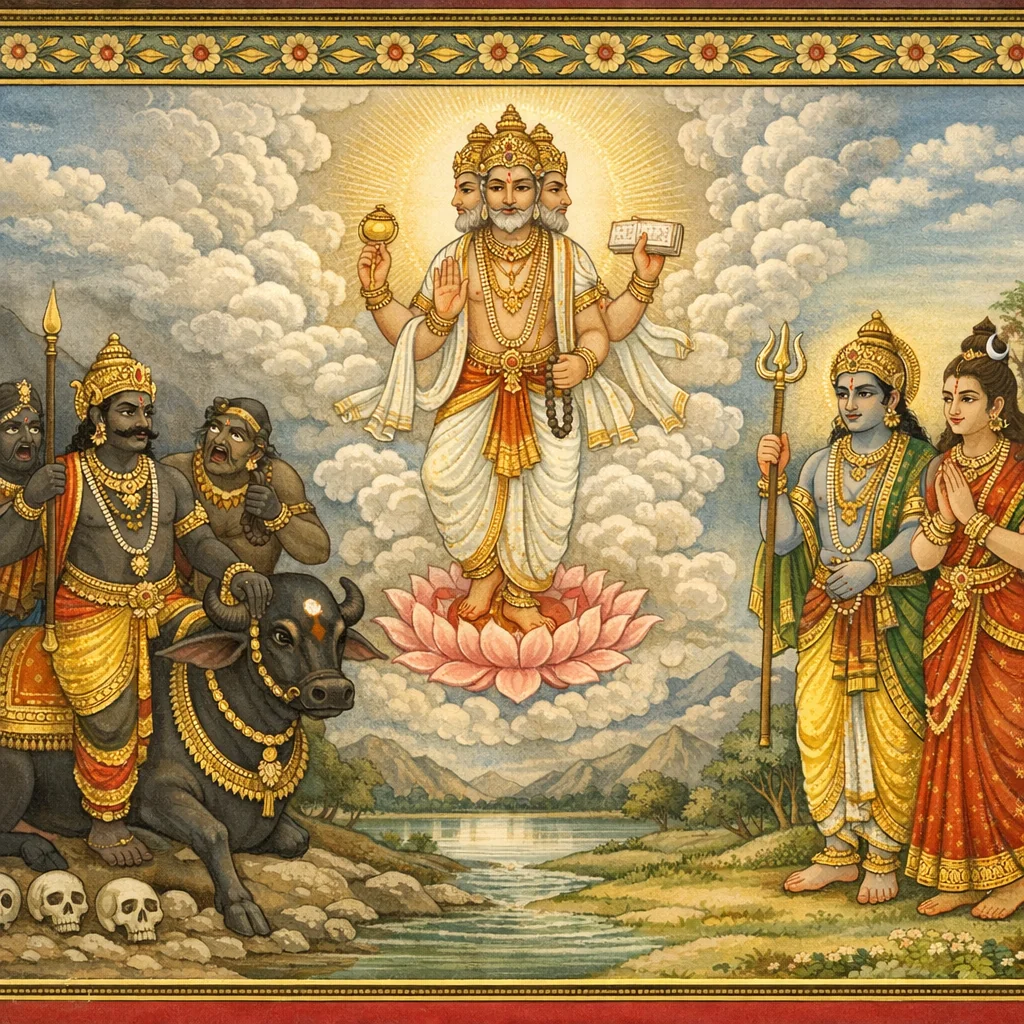
Adhyaya 27
Aṃkapāda-darśana and the Yamaloka Episode (Sāndīpani’s Son and the Five Forms at Kuśasthalī)
Adhyāya 27, framed as a dialogue between Vyāsa and Sanatkumāra, proclaims a saving assurance: whoever beholds Rāma and Janārdana (Viṣṇu) at the sacred spot called Aṃkapāda will not encounter Yama’s realm, even when weighed down by grave wrongdoing. It then relates how Rāma and Kṛṣṇa, incarnating to relieve the earth’s burden, go to Ujjayinī to study under the brāhmaṇa Sāndīpani and master the Vedas and allied disciplines in an extraordinary, accelerated span. Entering Mahākālavana with their teacher, they are praised as protectors of the righteous and restorers of order. Asked for guru-dakṣiṇā, Sāndīpani requests his son, lost in the ocean; Kṛṣṇa and Rāma trace the loss to the sea-daitya Pañcajana (in timi-form), obtain the conch, and—riding a formidable chariot granted by Varuṇa—proceed to Yamaloka. The conch’s sound and Viṣṇu’s presence cause punishments and hell-realms to diminish, freeing beings bound by sin; Yama’s attendants resist, Narāntaka is defeated, and Yama advances with Citragupta and his forces. As Kāla raises the daṇḍa, Brahmā intervenes, lauding Rāma’s cosmic sustaining power and urging restraint; Kṛṣṇa states the purpose—retrieving the guru’s son as pledged—and Yama returns the child. The phalaśruti concludes with place-based soteriology: from that day, those who die at Aṃkapāda in Avantī do not see Yama. Those who behold the fivefold forms at Kuśasthalī—including Mahākāla, Viśvarūpa Govinda, and Keśava as Śaṅkha-uddhāra—avoid niraya and attain auspicious results. Further verses praise bathing (health and freedom from untimely death), offerings, and śrāddha, culminating in rebirth in pure lineages and eventual return to Viṣṇuloka.
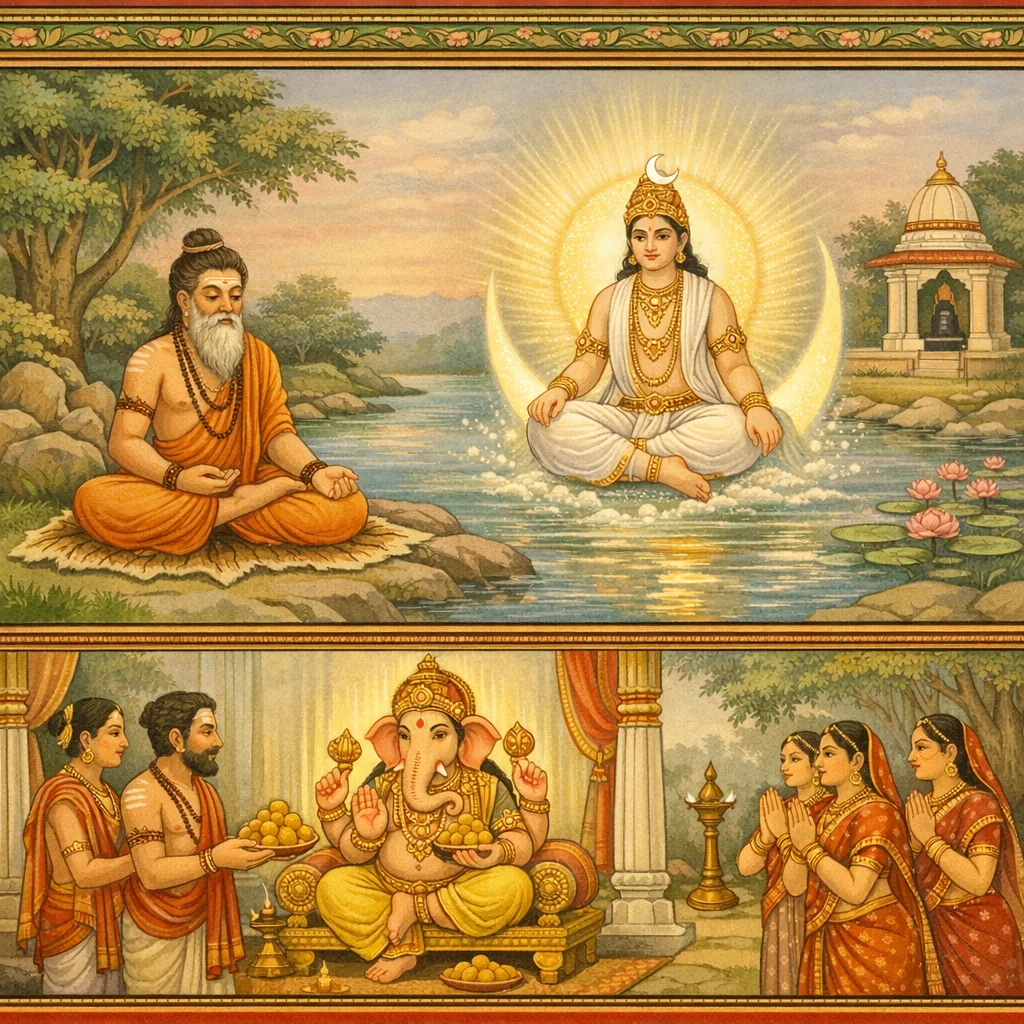
Adhyaya 28
अध्याय २८: चन्द्रादित्य–करभेश्वर–गणेश–सोमवतीतीर्थमाहात्म्य (Chapter 28: Mahatmya of Candrāditya, Karabheśvara, Gaṇeśa, and Somavatī Tīrtha)
Chapter 28 is a composite tīrtha-theological catalogue spoken by Sanatkumāra to Vyāsa. It opens by praising Candrāditya, declaring that worship with gandha (fragrance), puṣpa (flowers), dhūpa (incense), and naivedya (food offering) grants sālokya—abiding in divine proximity—and lasting merit. The discourse then turns to Karabheśvara: while sporting in a forest with the devas, Śiva assumes a karabha (donkey-like) form; the devas fail to recognize him until Brahmā and Gaṇanāyaka (Vināyaka) reveal the secret. Śiva then establishes a divine liṅga called Karabheśvara, with powerful promises of fruit for bathing and worship there. Next, Gaṇeśa is hailed as “lḍḍuka-priya,” fond of lḍḍuka sweets, and a vrata-like observance—especially on caturthī—is prescribed: bathing in the Śiprā, wearing red garments, offering red flowers and red sandal, performing mantra-snāna, and presenting lḍḍuka as naivedya, yielding obstacle-removal and auspicious results. The chapter also enumerates further sacred nodes—Kusumeśa, Jayeśvara, the Śiva-dvāra liṅga, Mārkaṇḍeśvara, Brahma-saras/Brahmeśvara, Yajñavāpī, and multiple kuṇḍas—each with distinct merits. The latter half gives an extended origin account of Somavatī, arising from Atri’s tapas and the manifestation of Soma, and said to purify even grave transgressions. Merit is amplified by calendrical conjunctions such as amāvasyā falling on somavāra, and by times like vyatīpāta. It narrates Soma’s affliction and restoration through worship of Someśvara in Avanti, and closes by linking daily merit to the worship of Somanātha in Saurāṣṭra.
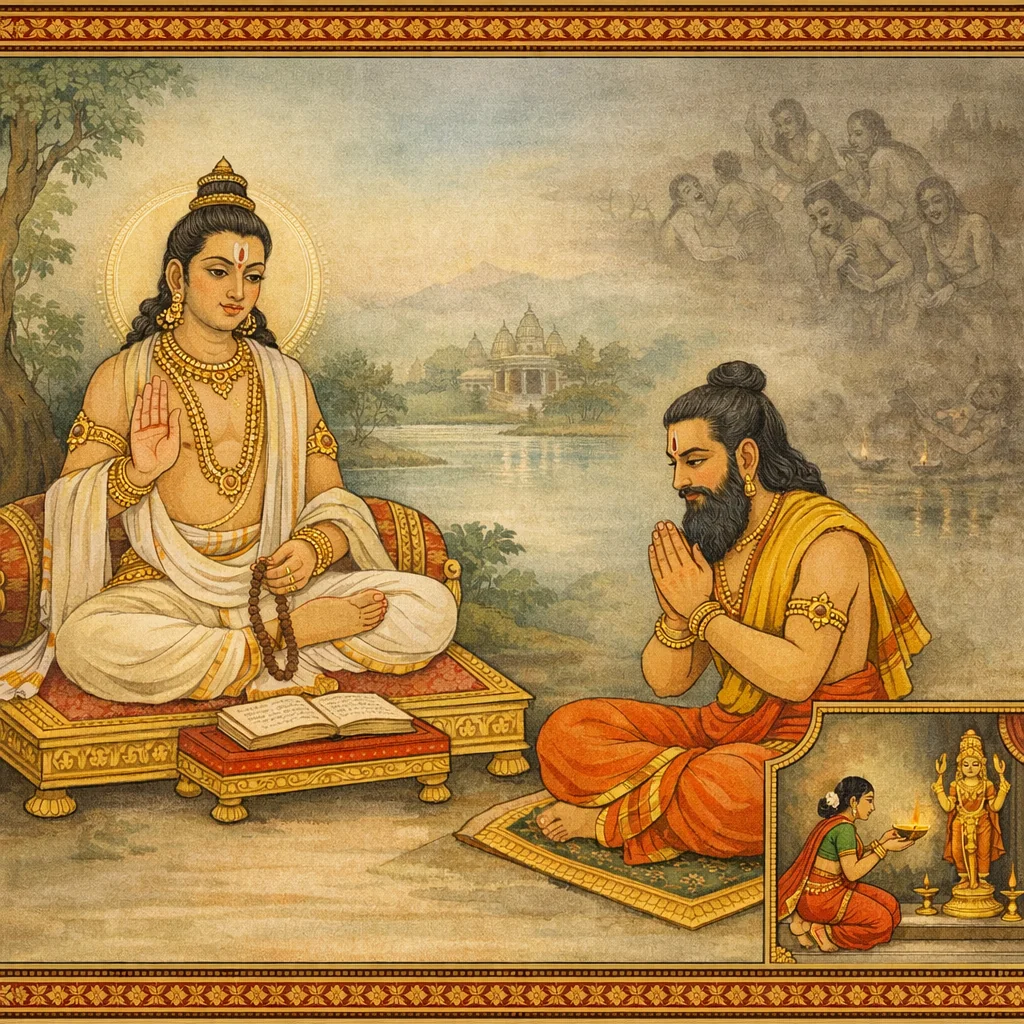
Adhyaya 29
अनरकतীर्थमाहात्म्य एवं नरकवर्णन (Glory of Anaraka Tīrtha and an Ethical Account of Narakas)
Chapter 29 is framed as a dialogue in which Vyāsa asks Sanatkumāra about the number, whereabouts, and causes of the narakas (hell-realms), and how beings fall into them through wrongful conduct. Sanatkumāra lists many named narakas and depicts punishments as precisely proportionate to karma, offering a grave ethical warning within a teaching on moral responsibility. The discourse then turns to remedy: it proclaims the extraordinary power of Anaraka Tīrtha—bathing there and beholding Maheśvara is said to prevent even grievous sinners from seeing or undergoing naraka. Yet it also insists that genuine remorse and prāyaścitta (expiation) are essential, and teaches that the highest expiation is sustained Śiva-smarana, the unbroken remembrance of Śambhu. The chapter concludes with a calendrical injunction: on Kārttika kṛṣṇa-caturdaśī one should offer a lamp (dīpa-dāna) before Devadeva, joining ritual observance to ethical purification and devotional orientation.
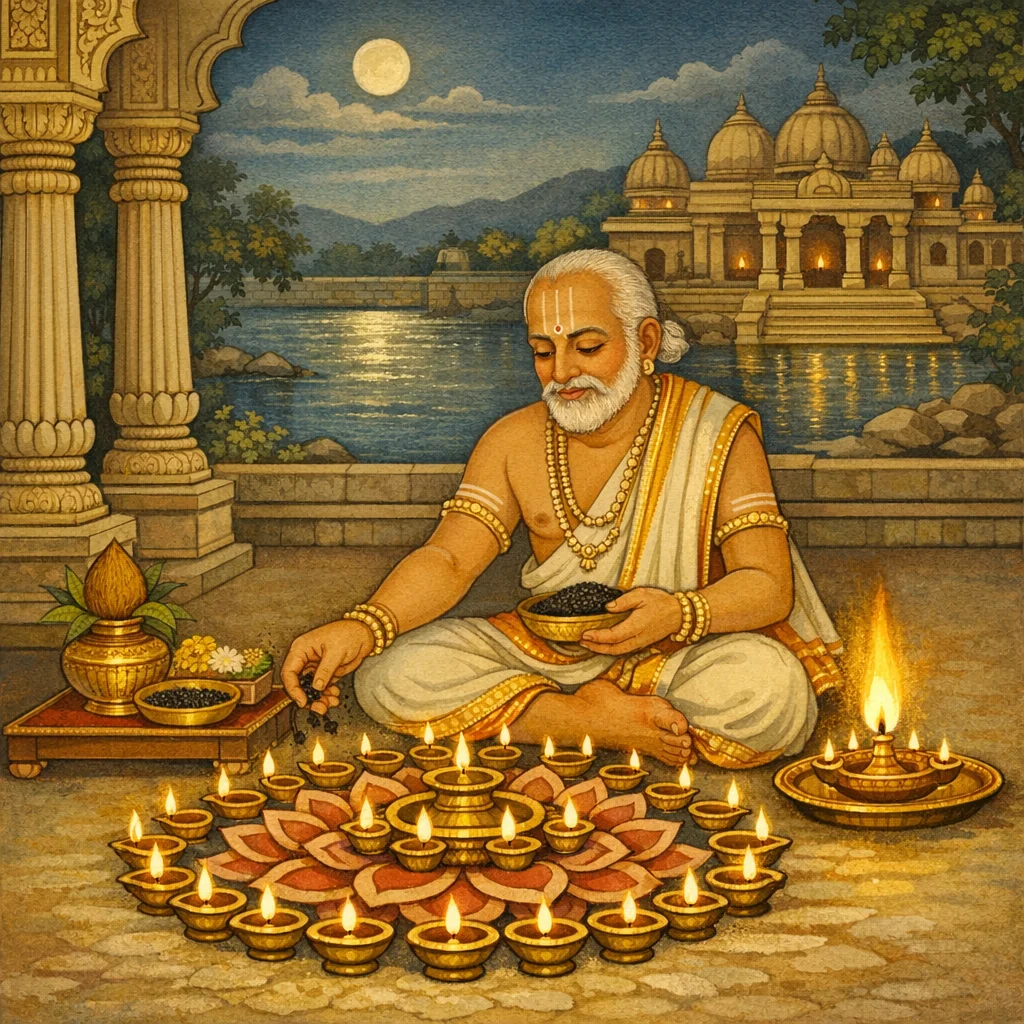
Adhyaya 30
Dīpadāna-Māhātmya and Anarakā-Tīrtha Vidhi (दीपदानमाहात्म्य तथा अनरकातीर्थविधिः)
Chapter 30 is framed as a dialogue: Vyāsa asks about the merit and origin of ritual lamp-offering (dīpa-dāna), and Sanatkumāra replies with an origin-story set in the Kṛtayuga. Pārvatī, troubled by a darkness upon her body and seeking auspicious radiance, departs for austerities; with Śaṅkara absent, the cosmos falls into gloom, since his three eyes are identified with the sun, the moon, and fire. Beings in all realms lament the loss of light and safety. A divine voice—named Keśava/Dāmodara/Viṣṇu—teaches that among gifts, dīpa-dāna is especially praised, recalling how a superior lamp once arose (with Nāgas as key agents) to dispel the netherworld’s darkness, making the lamp a welfare-bearing power across worlds. The chapter then turns to ritual prescription: a Kārttika observance at Avantī’s Anarakā tīrtha on the fourteenth day of the dark fortnight, with Yama-directed offerings of black sesame and mantras, followed by offering a ghee-filled lamp. Detailed instructions for constructing and installing a multi-lamp lotus/maṇḍala arrangement—wicks, vessels, offerings, and gifts to worthy brāhmaṇas—conclude with a phalaśruti promising exalted enjoyments and ascent to heaven.
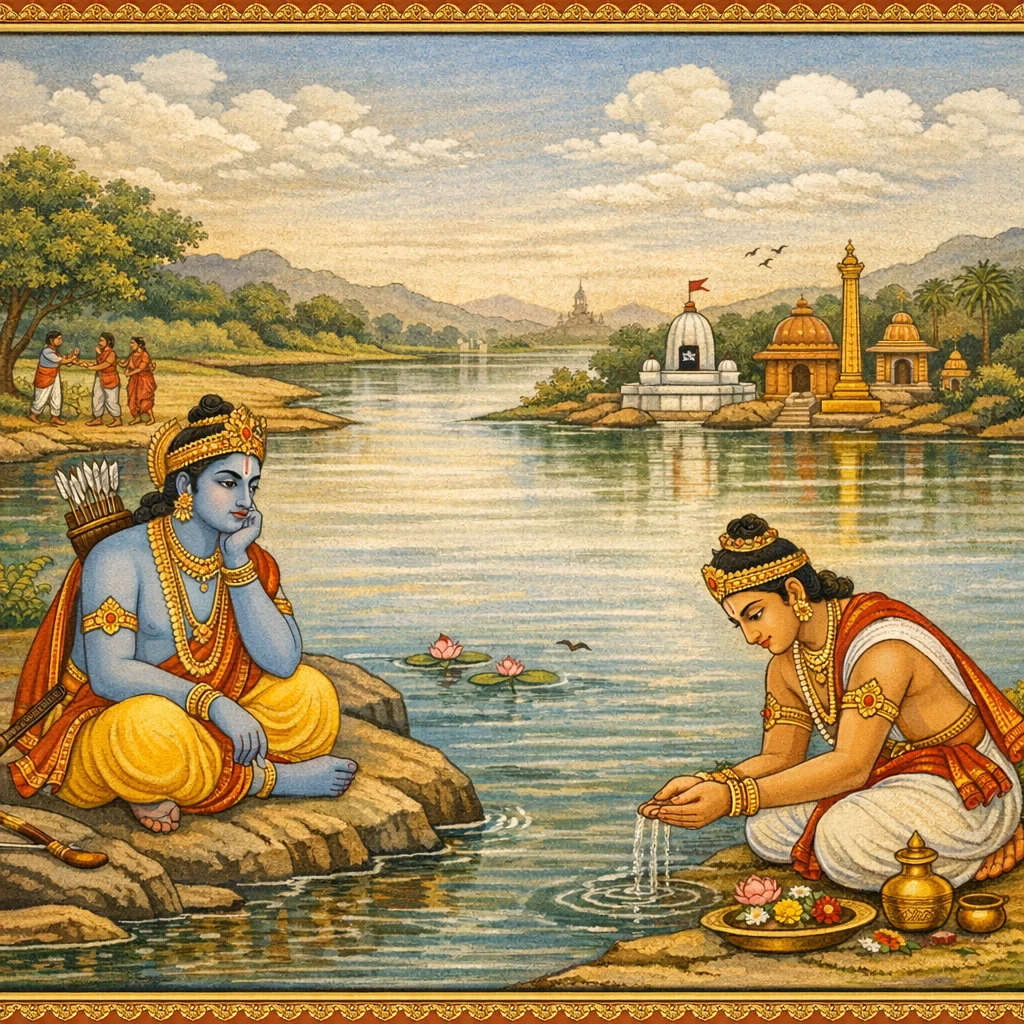
Adhyaya 31
Adhyāya 31 — Kedāreśvara to Rāmeśvara: Tīrtha Network, Phalaśruti, and the Kuśasthalī Legend
This chapter functions as an indexed pilgrimage map of the Avantī region, listing many tīrthas and liṅga-shrines with explicit phalaśruti. Sites such as Kedāreśvara, Jaṭeśvara (at Jaṭāśṛṅga), Indratīrtha/Indreśvara, Kuṇḍeśvara, Gopatīrtha/Gopeśvara, Chipiṭātīrtha, and Vijaya/Ānandeśvara are paired with acts like snāna (sacred bathing), darśana, pūjā, and upavāsa, and with promised results—release from sin, ascent to Śiva-loka or Indra-loka, and avoidance of lower rebirths. The narrative then turns to Kuśasthalī within the Avantī/Ujjayinī setting and introduces Rāmeśvara as a liṅga granting both bhukti and mukti. Rāma’s concern about “viyoga,” separation from his kin, frames the assurance that the Lord’s darśana preserves auspicious continuity. A divine voice commands Rāma to establish a liṅga in his own name; Lakṣmaṇa installs it, and ritual bathing with Śiprā water is arranged, alongside an ethical reflection that self-interest in this kṣetra can strain social bonds—illuminating the tension between the brothers. The chapter closes by adding further tīrtha merits (Saubhāgya-tīrtha, Ghṛta-tīrtha, worship of Yogīśvarī, Śaṅkhāvarta, Sudhodaka/Sudheśvara for mokṣa), stories of brahmahatyā-remission (Kiṃpuna; Durdharṣa linked to Sūrya), and a long list of additional sites—Gopīndra, Gaṅgā-tīrtha, Puṣpakaraṇḍa, Uttareśvara, Bhūteśvara, Ambālikā, Ghaṇṭeśvara, Puṇyeśvara, Lampeśvara, Sthavira Vināyaka, Navanadī-Parvatī, Kāmodaka, and Prayāgeśa—reinforcing its role as a comprehensive guide for sacred travel.
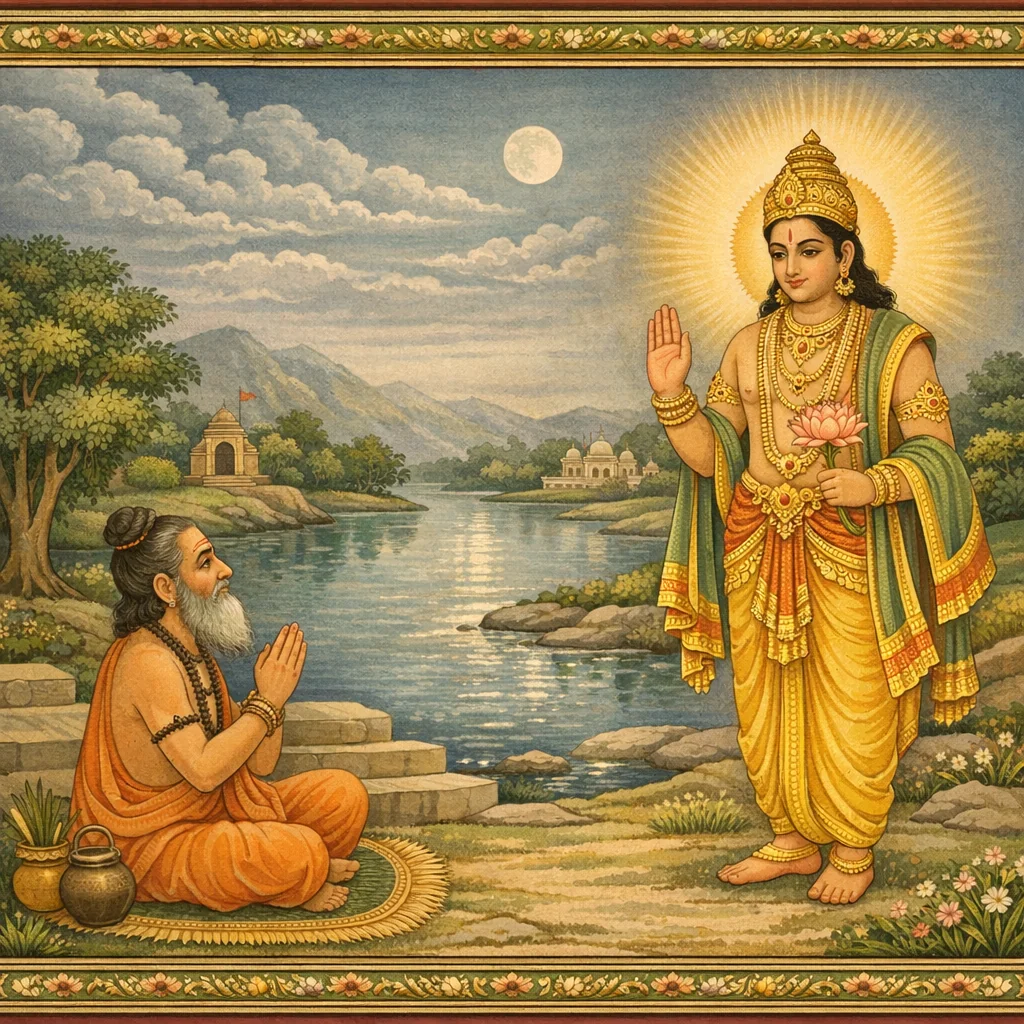
Adhyaya 32
नरादित्य-प्रतिष्ठा तथा केशवार्क-माहात्म्य (Installation of Narāditya and the Glory of Keśavārka)
Sanatkumāra recounts a theologically framed origin story of a solar shrine identified with Narāditya, a healing and purificatory form of Āditya. The tale first recalls Arjuna’s heroic service to Indra—defeating formidable foes as his guru-dakṣiṇā—after which Indra grants a boon and transfers two venerable icons once worshipped by Brahmā, Viṣṇu, and Prajāpati/Dakṣa. Indra commands Arjuna to install the icons at Kuśasthalī: one on the northern bank of the Śiprā, where Keśavārka is said to abide as a remover of sins. He links the place to public pilgrimage cycles, especially the Āṣāḍhī and Kaumudī yātrās, marked by theophanic signs of clouds, rain, and divine attendance. Nārada summons Kṛṣṇa to coordinate the rites: Arjuna installs in the east, while Kṛṣṇa proceeds north, using conch-sound as a ritual marker. At the installation the solar deity manifests overwhelming tejas, then assumes a gentle form, grants abhaya, and confirms the chosen site. Arjuna offers an extended stotra praising the Sun as cosmic regulator, dispeller of darkness, protector in peril, and a locus where divine functions converge. The Sun bestows boons—enduring presence there and prosperity for devoted worshippers—and the chapter closes by warning that lack of devotion causes human undertakings to fail in bearing fruit.
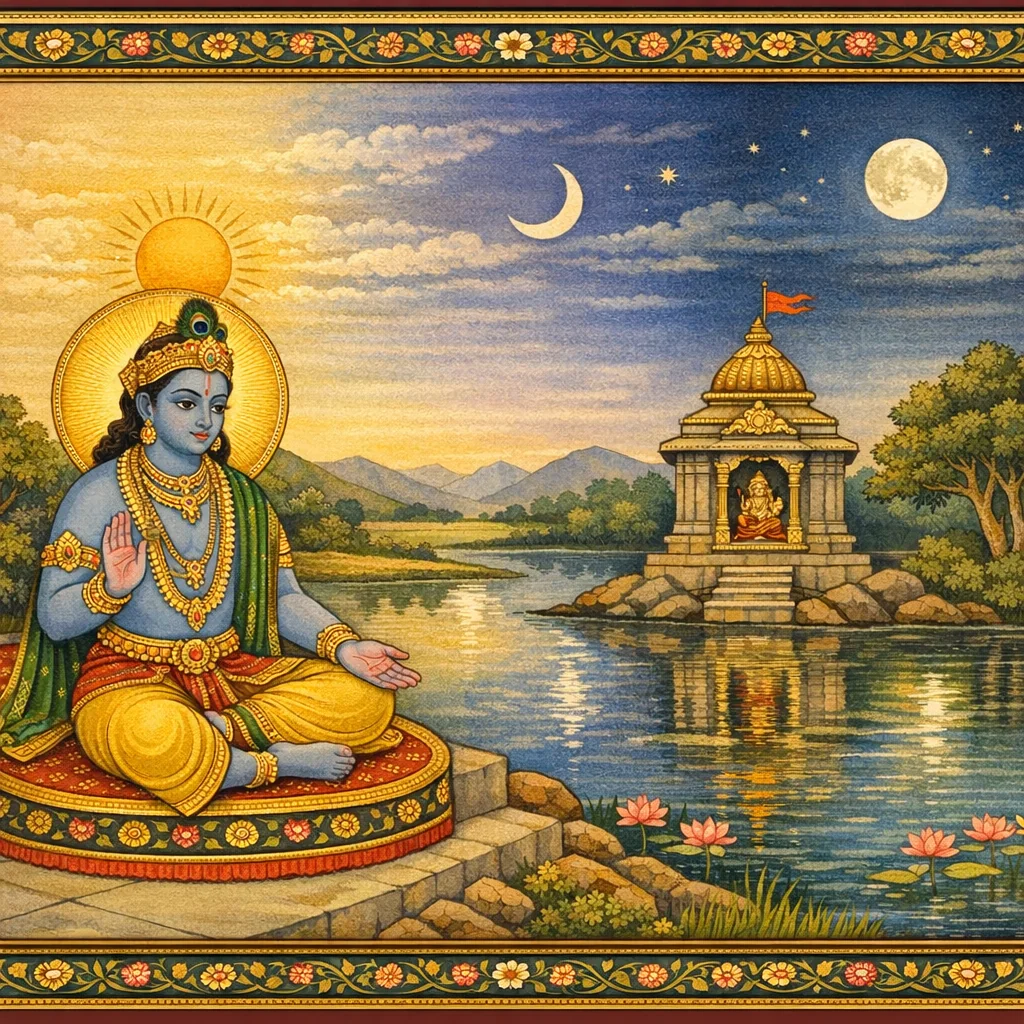
Adhyaya 33
Keśavārka-Stotra and the Merit of Reṇutīrtha (केशवार्कस्तोत्रं रेणुतीर्थमहिमा च)
Chapter 33 offers a theological teaching on venerating the Sun through a carefully structured hymn. Sanatkumāra sets the scene: Nārāyaṇa establishes a conch, and with intense concentration blows it and praises Bhāskara by a specific stotra. Voiced within a dialogue by Śrī Kṛṣṇa, the hymn unfolds a long series of solar epithets—Āditya, Ravi, Sūrya, Divākara, Sahasrāṃśu, Mārtaṇḍa, and more—proclaiming the Sun as regulator of the cosmos, witness of deeds, source of awakening, and giver of desired results. A triadic doctrine is stated: the Sun is Brahmā at dawn, Rudra at midday, and Viṣṇu at day’s end, with corresponding color-forms. The stotra is identified as a divine corpus of eight hundred names recited by Viṣṇu, and its phalaśruti promises the devoted reciter auspicious progress, prosperity, progeny, brilliance, intelligence, and higher attainment. The teaching is then tied to sacred place: beholding the Keśavārka form removes sins and grants honor in the solar world; nearby lies Reṇutīrtha, whose very sight likewise destroys sins without doubt.
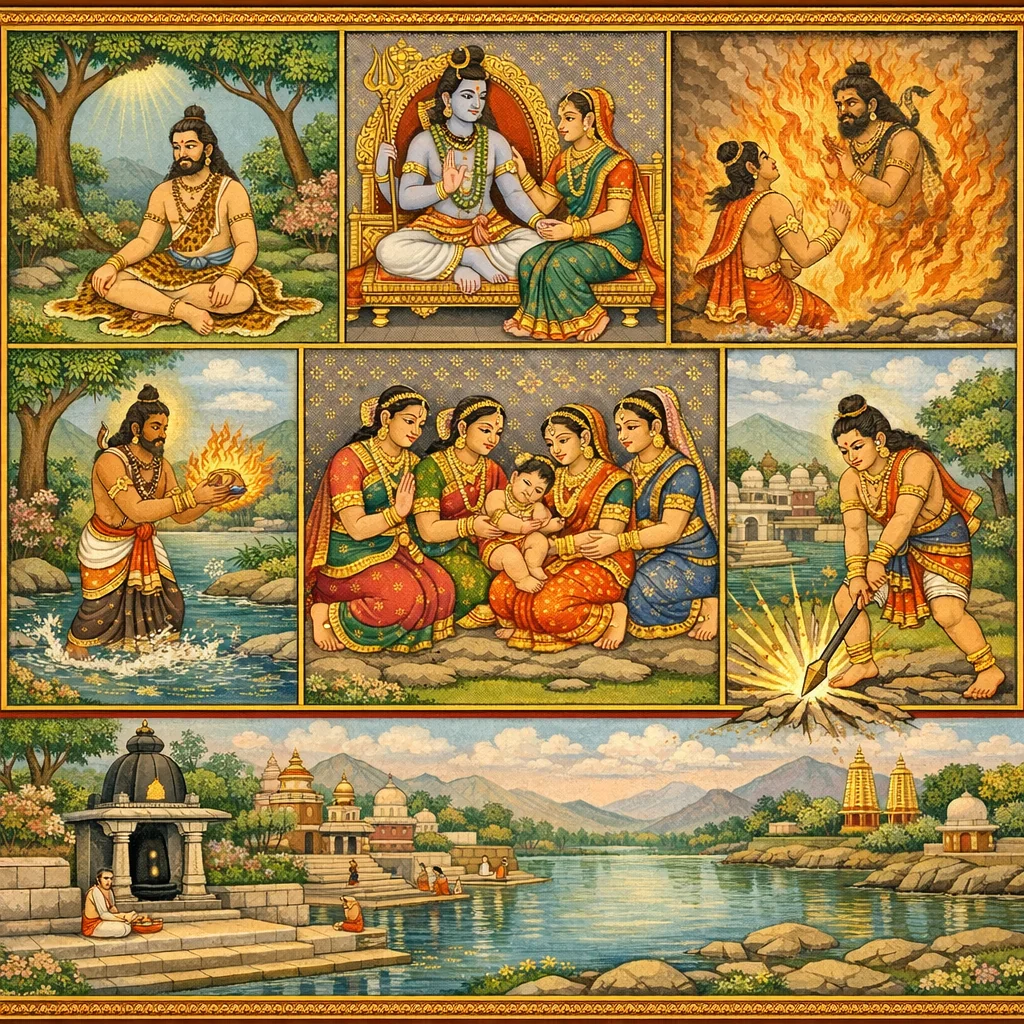
Adhyaya 34
शक्तिभेद-कोटितीर्थ-माहात्म्य तथा स्कन्दोत्पत्ति (Śaktibheda and Koṭitīrtha Māhātmya with the Account of Skanda’s Manifestation)
This chapter is framed as a sage-to-sage theological exposition: Sanatkumāra answers Vyāsa’s question about Skanda’s manifestation and the local tīrtha called Śaktibheda in Avantī. It opens with the devas’ defeat by the asuras and Indra’s austerities, after which Śiva promises to bring forth a mighty commander for the gods. The account then weaves together Śiva’s withdrawal into meditation, Pārvatī’s tapas, the burning of Kāma, and the eventual divine marriage. A pivotal causal chain is set out: Śiva’s retas is conveyed by Agni to Gaṅgā; the Kṛttikās and other maternal figures enter the gestation motif, culminating in Skanda’s six-faced manifestation and his consecration as Devasenāpati, commander of the divine hosts. These pan-Indian myths are anchored in Avantī’s sacred landscape: Skanda’s śakti is cast down, forming the Śaktibheda tīrtha and giving rise to many tīrthas, while Brahmā establishes Koṭitīrtheśvara (Śiva) at Koṭitīrtha. The concluding phalaśruti highlights rites at Koṭitīrtha—snāna, Śiva-darśana, śrāddha, and dāna (including gifting a milch cow and vṛṣotsarga)—with specified merits, presented as ethical guidance for pilgrims.
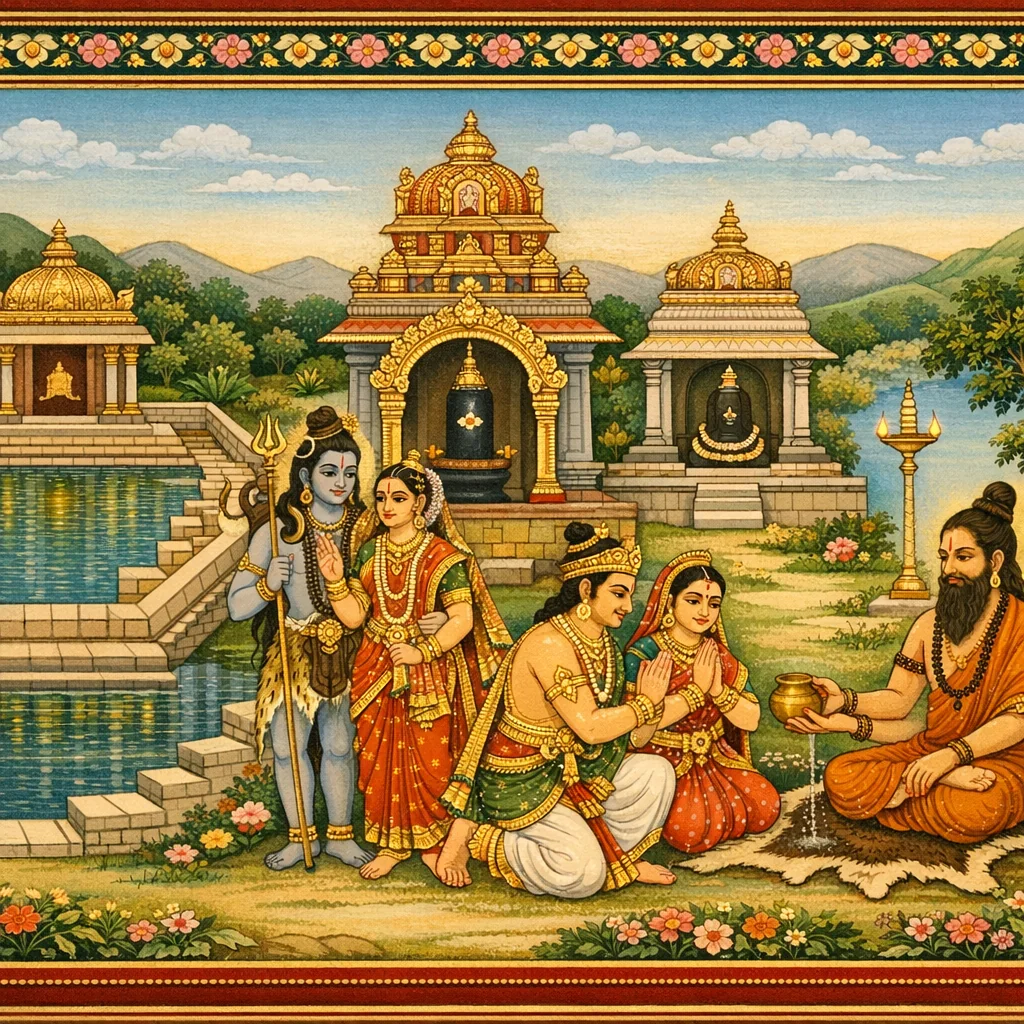
Adhyaya 35
अवन्तीक्षेत्रे तीरथस्नान-पूजा-व्रतानां फलवर्णनम् / Merit-Statements on Bathing, Worship, and Vows in Avanti
Chapter 35 of the Avantī Khaṇḍa is a compact ritual and sacred-geography catalogue taught by Sanatkumāra. It lists Avanti tīrtha practices and their declared results: bathing in named vāpyāḥ such as “Svarṇakṣurā” and “Viṣṇuvāpyā,” living with conquered senses (jita-indriya), taking darśana of Maheśvara, worshipping Abhayeśvara, and visiting Agastyeśvara with steady, focused devotion. The teaching links seasonal observance (Caitra/Phālguna) with jāgara and upavāsa as disciplines of purification. For Agastyeśvara it prescribes an ordered offering regimen: fashion an Agastya figure in gold or silver according to one’s means, adorn it with pañcaratna and cloth, worship with timely fruits and flowers, and maintain a long vrata for seven years. An arghya-mantra to Agastya (“Kāśapuṣpa-pratīkāśa… Kumbhayone…”) is given, followed by phala statements—prosperity and offspring, heaven after death, noble rebirth, and eventual yogic excellence; regular hearing or recitation removes pāpa and grants joy in the muni-loka.
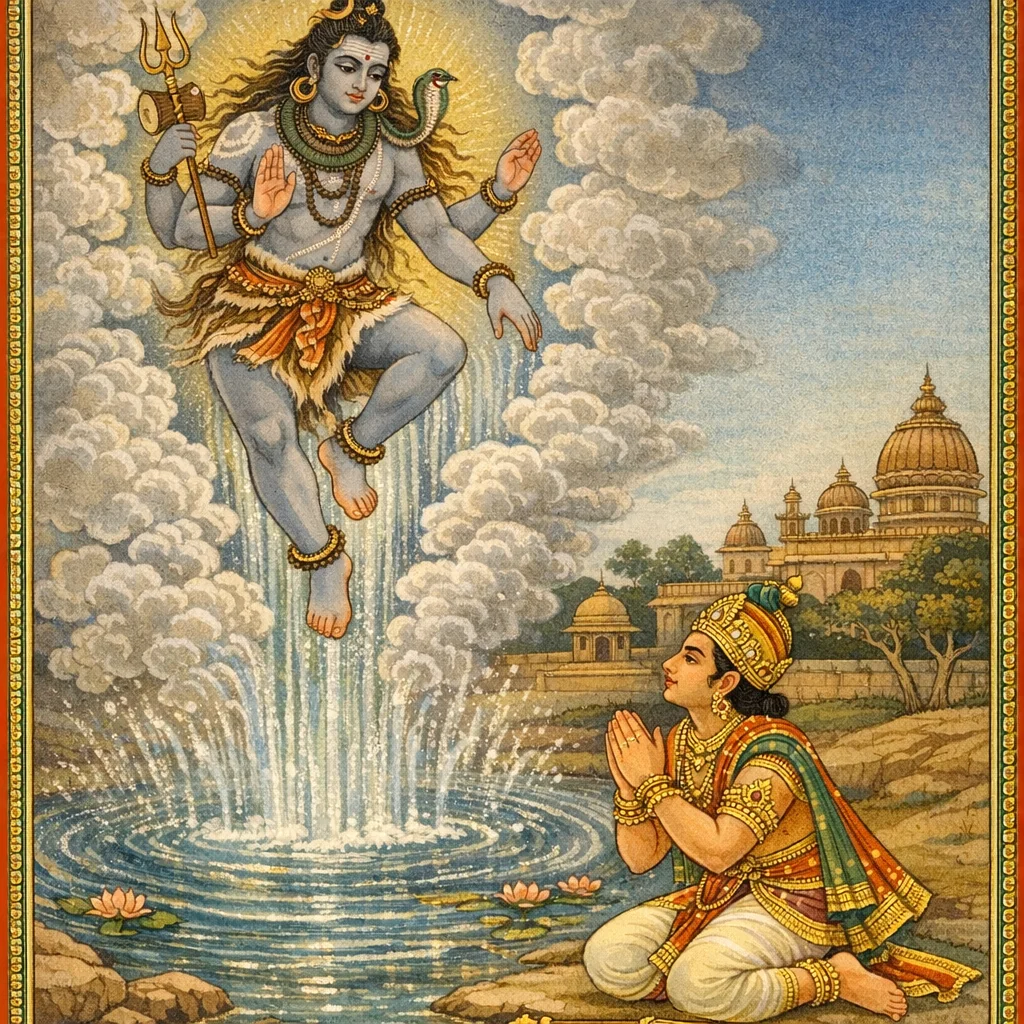
Adhyaya 36
Ujjayinī’s Kalpa-Names, Mahākāla’s Descent, Naradīpa Darśana, and Śaṅkhoद्धāraṇa Tīrtha
The chapter begins with Vyāsa asking the origins and reasons for the celebrated sacred names of the Avantīkṣetra—Mahākāla, Śivapada, Koṭīśvara/Koṭitīrtha, Naradīpa, Śaṅkhoद्धāraṇa, Śūleśvara, Oṃkāra, Dhūtapāpa, Aṅgāreśvara—and why Ujjayinī is famed as a “seven-kalpa” city. Sanatkumāra replies by giving the city’s seven kalpa-names—Svarṇaśṛṅgā, Kuśasthalī, Avantikā, Amarāvatī, Cūḍāmaṇi, Padmāvatī, and Ujjayinī—and declares the purifying merit gained by reciting them. A mythic sequence follows: Indra slays Kaṇakadānava (Andhaka’s son) and seeks Śiva’s refuge. Śiva reveals a vast Bhairava-like viśvarūpa and descends with one foot, producing a revered water-body; the footprint-site is known as Śivapada, and the “splitting of a koṭi of sins” establishes the renown of Koṭitīrtha. Andhaka then attacks, the gods tremble, and Śiva intervenes in battle as Mahākāla. As Andhaka’s tamas (darkness) spreads, the Sun manifests in human form as Narāditya/Naradīpa, restoring visibility. The chapter gives darśana and pūjā guidelines, auspicious times, and the phala of seeing Naradīpa, including attainment of Sūryaloka; it also describes Naradīpa’s ratha-yātrā in Jyeṣṭha (śukla dvitīyā), with directions for viewing, pulling the chariot, circumambulation, and related offerings. Finally, after Andhaka’s defeat, Viṣṇu sounds the conch and a tīrtha called Śaṅkhoद्धāraṇa arises near Viṣṇu and a liṅga. Fasts, darśana benefits, and protective outcomes are taught for those who worship properly, including offerings such as yoginī-bali.
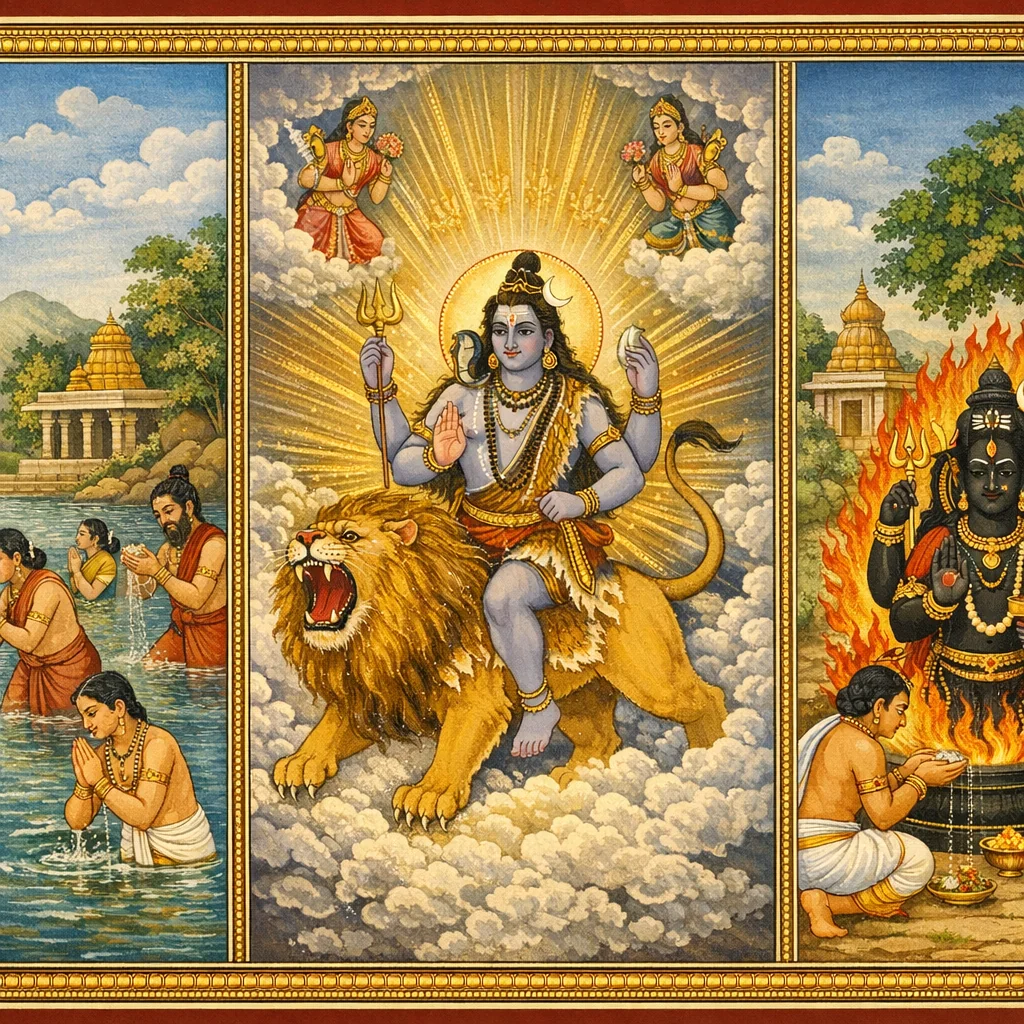
Adhyaya 37
Dhūtapāpa–Śūleśvara–Abhayeśvara–Vaṭamātr̥–Kaṇṭeśvara–Singeśvara–Vināyaka–Aṅgāreśvara Māhātmya (Chapter 37)
Sanatkumāra recounts a chain of sacred place-foundings in Avantīkṣetra connected with Andhaka’s destruction. When Andhaka is pierced by the trident, the arising sound is praised as oṃkāra and as Śiva’s epiphany; ritual bathing and meditative discipline are taught as means to wash away sins. As the trident moves to the waters of Bhogavatī, the names Śūleśvara and the tīrtha Dhūtapāpa arise, and specific fast-days are prescribed for devotees. When blood-born asuras surge again, the gods bring forth Mother-goddesses—Brahmāṇī, Kaumārī, and fierce forms culminating in Cāmuṇḍā—who become renowned as the Vaṭamātr̥s near a banyan; after bathing, their darśana grants purification and merit in their realm. Śiva’s lion-roar episode establishes Siṅheśvara and Kaṇṭeśvara as protective nodes against harm and fear. Śiva’s assurance of “abhaya” gives rise to Abhayeśvara, where disciplined worship is said to equal great sacrificial merit and to free one from fear of hostile beings. Obstacle-removal is then linked to Mahāvināyaka with monthly caturthī worship. Finally, the origin of Angāraka (Mars) from Śiva’s perspiration leads to Aṅgāreśvara, detailing arghya offerings on caturthī or Tuesday and promising benefits in this world and beyond.
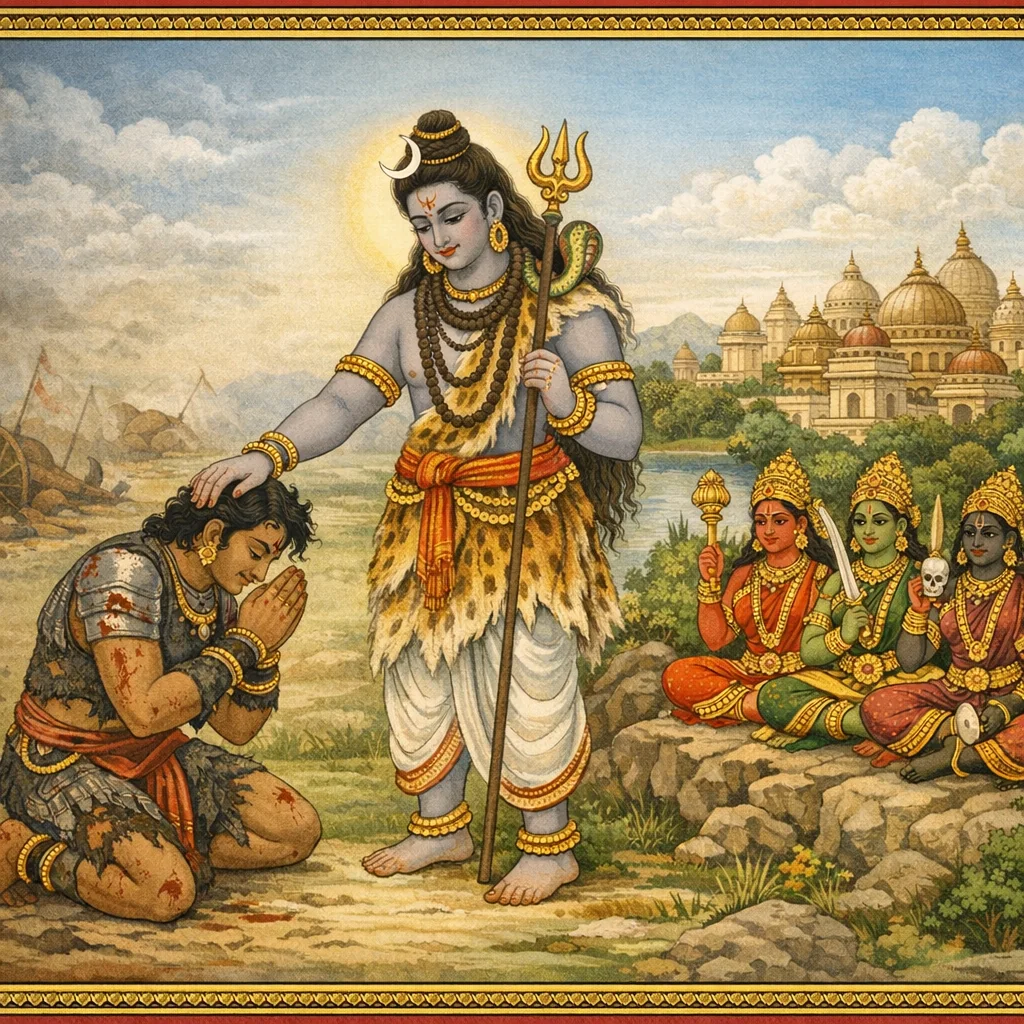
Adhyaya 38
अन्धकस्तुतिः—चामुण्डारुधिरपानं, शिववरदानं, आवन्त्यमातरः-स्थापनम् (Andhaka’s Hymn, Cāmuṇḍā’s Blood-Drinking, Śiva’s Boon, and the स्थापना of the Āvantya Mothers)
Adhyāya 38, narrated by Sanatkumāra, presents a closely linked theological episode. First, Cāmuṇḍā intervenes fiercely, drinking the rākṣasa’s remaining blood; her face becomes terrifyingly radiant, and Andhaka’s body turns powerless as his māyā and strength collapse. Gripped by existential fear and without refuge, Andhaka adopts a sāttvika disposition, abandons rajas and tamas, and offers a long hymn of surrender to Śaṅkara, praising Śiva as creator, moral governor of pleasure and pain, bearer of the Gaṅgā and the crescent moon, and the supreme refuge. A phalaśruti is included: a pure-living Śiva-bhakta who recites or hears this is said to attain an undiminishing Śiva-loka. Śiva then appears, grants divine sight, and offers any desired boon. Andhaka does not seek rival cosmic stations, but asks for gaṇapatya—status among Śiva’s gaṇas. Śiva grants him honored, enduring, sorrow-free leadership with yogic powers, and Andhaka departs as a gaṇa. Next, goddesses led by Brahmāṇī arrive; Śiva consoles Cāmuṇḍā and addresses the blood-eating goddesses, naming them “Āvantya-mātaraḥ” for their origin and power in Avanti, assigning them a stable abode, sin-destroying capacity, and boon-giving roles. He declares that devotional darśana on Śrāvaṇa amāvāsyā brings prosperity—sons, wealth, beauty, learning—and charges them to protect the city across kalpas. The chapter ends by praising the hearing of this narrative as a path to Rudra’s realm.
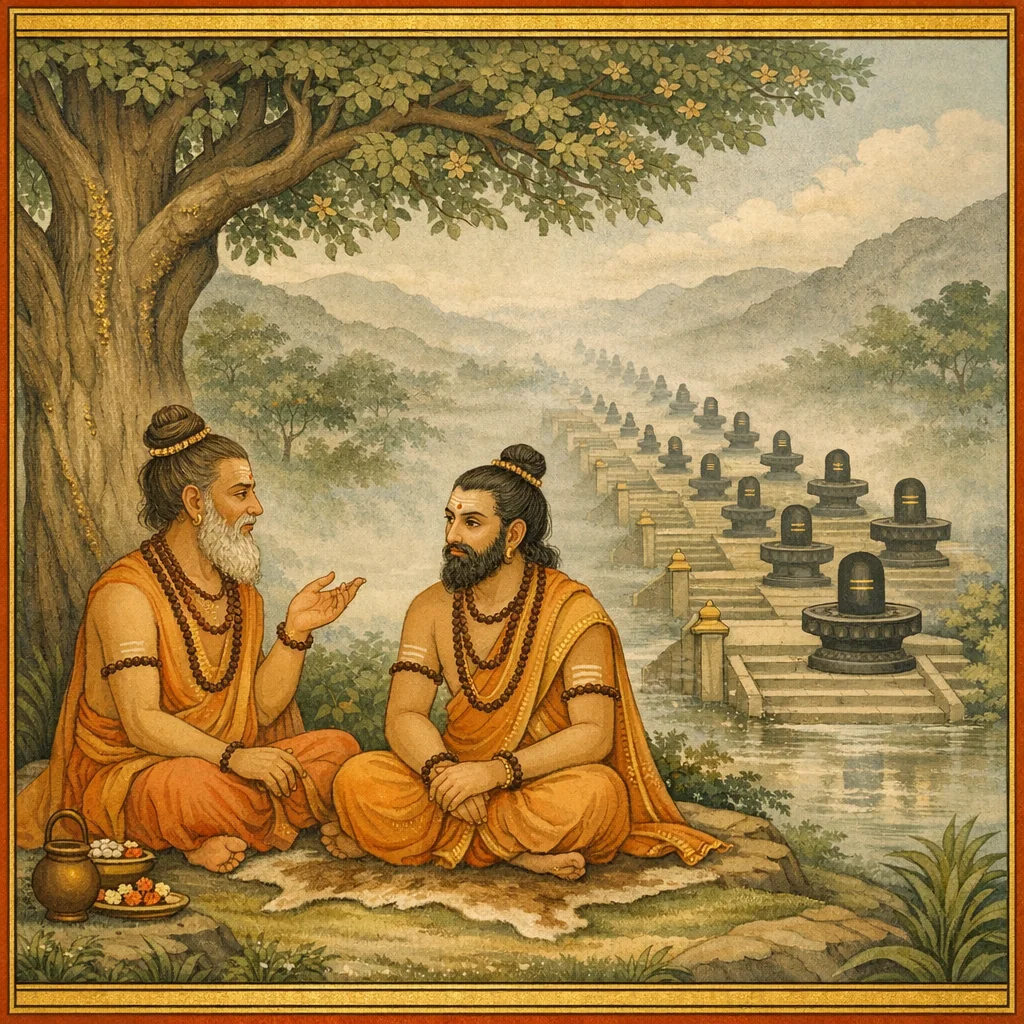
Adhyaya 39
Mahākālavane Tīrtha-Liṅga-Ānantya and Śravaṇa-Phala (महाकालवने तीर्थलिङ्गानन्त्यं श्रवणफलम्)
Chapter 39 is framed as a question-and-answer dialogue. After the kṣetra’s greatness is praised, Vyāsa asks Sanatkumāra for numerical clarity about (1) the tīrthas and (2) the liṅgas within Mahākālavana. Sanatkumāra replies with a deliberately hyperbolic reckoning: the liṅgas are so countless that their number is effectively “unknowable,” proclaiming the site’s inexhaustible sanctity. The teaching then turns from counting to spiritual qualification. Anyone born there—whether desire-driven (sakāma) or desireless (akāma)—is said to be honored in Śiva’s world. Bathing at the tīrthas and becoming ritually pure (snātvā, śuci-bhūtvā) are linked with dwelling in Śiva’s realm, and the kṣetra is hailed as foremost among sacred places. The chapter ends with a phalaśruti: listening with great devotion (mahābhaktyā śravaṇa) grants the “supreme goal” (paramā gati), making the very hearing of the text a transformative practice.
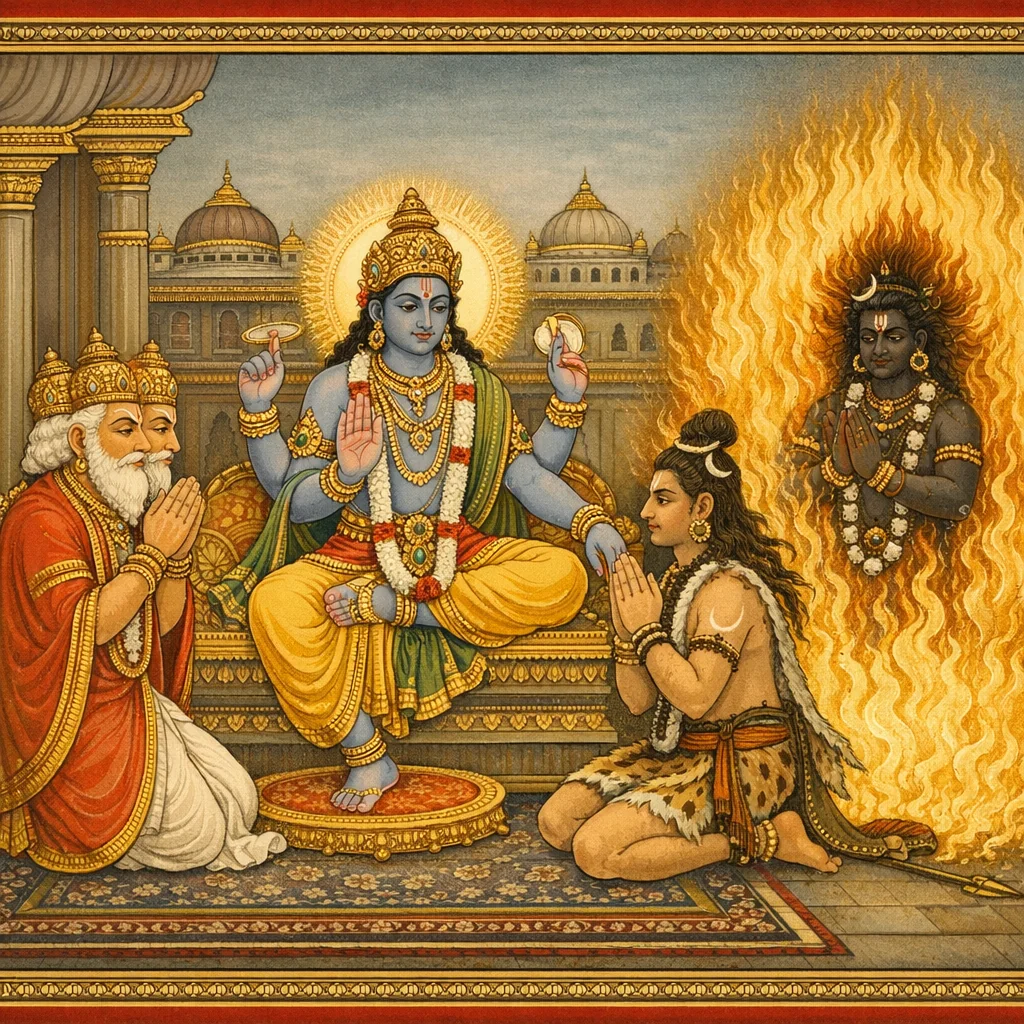
Adhyaya 40
कनकशृङ्गा-नामनिर्वचनम् | The Etymology of “Kanakaśṛṅgā” and the Sacred Status of Avantī
Adhyāya 40 unfolds as a dialogue on sacred geography and the meanings of names. After hearing that this kṣetra dispels fear and grants salvation, Vyāsa asks Sanatkumāra why the city/region is known by many names—Kanakaśṛṅgā, Kuśasthalī, Avantī, Padmāvatī, and Ujjayinī. Sanatkumāra frames the explanation in an earlier kalpa, citing a tradition passed from Brahmā to Vāmadeva. In the embedded account, Brahmā and Maheśvara approach Viṣṇu as the sovereign protector of the world, requesting a stable, imperishable sacred abode and tīrtha. Viṣṇu assigns them designated abodes (north and south) and describes Mahākāla’s fiery, world-sustaining form, surrounded by gaṇas. The city is portrayed as a divine creation for līlā and universal welfare, adorned with golden-crested palaces fashioned by Viśvakarman. The chapter culminates in explicit name-etymology: because the city is proclaimed “hema-śṛṅga” (golden-crested), it becomes renowned as Kanakaśṛṅgā. It closes by affirming that Brahmā, Viṣṇu, and Maheśvara remain there in japa, granting devotees the desired fruits.
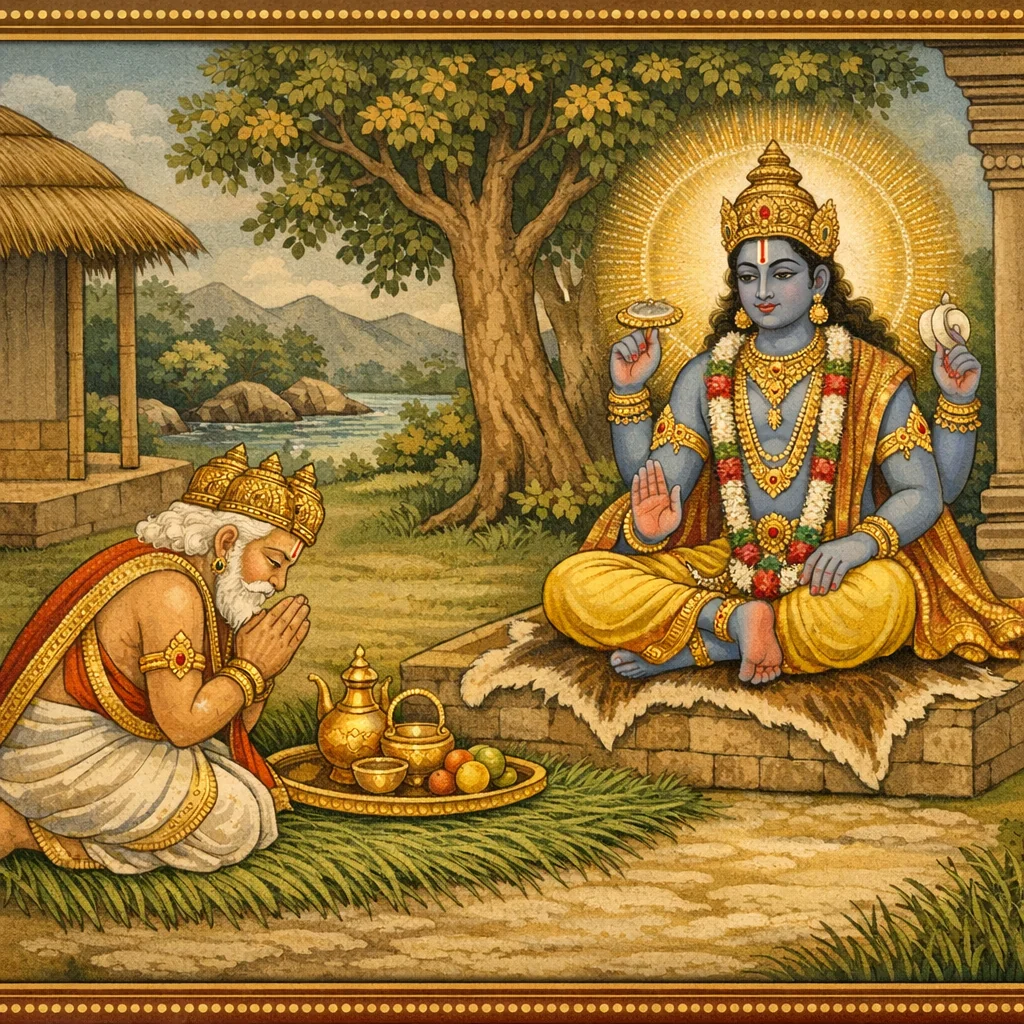
Adhyaya 41
Kuśasthalī-nāmakaraṇa and Brahmā’s Stuti of Viṣṇu (कुशस्थली-नामकरणं ब्रह्मस्तुतिश्च)
Sanatkumāra recounts to Vyāsa an early cosmic episode in which creation becomes pervaded by mutual hostility among all orders of beings—devas and dānavas, humans, siddhas and vidyādharas, even animals and birds—showing the collapse of restraint and harmony. Seeing this turmoil, Brahmā, the Creator, turns inward in meditative absorption and takes refuge in Hari/Viṣṇu, the remover of distress. Viṣṇu manifests in a universal form and speaks to Brahmā, affirming the power of dhyāna-yoga and his own office as Preserver. Brahmā rises, offers ritual hospitality (pādya, ācamanīya, madhuparka), and delivers an extended stuti proclaiming Viṣṇu’s sovereignty through sacred names and functions—Upendra, Vāsudeva, Viśvasena, Kṛṣṇa, Jiṣṇu—together with iconographic signs (śaṅkha, cakra, dhvaja, Garuḍa as vāhana) and the ever-auspicious presence of Śrī. Pleased, Viṣṇu asks to be shown a purified “maṇḍala” and a stable site connected with Sadāśiva. Brahmā points out a holy place associated with Cyavana’s āśrama; there Viṣṇu sits upon ground strewn with kuśa grass. Together they establish the name “Kuśasthalī,” explained from the kuśa covering, and the narrative affirms the site’s fame throughout the three worlds.
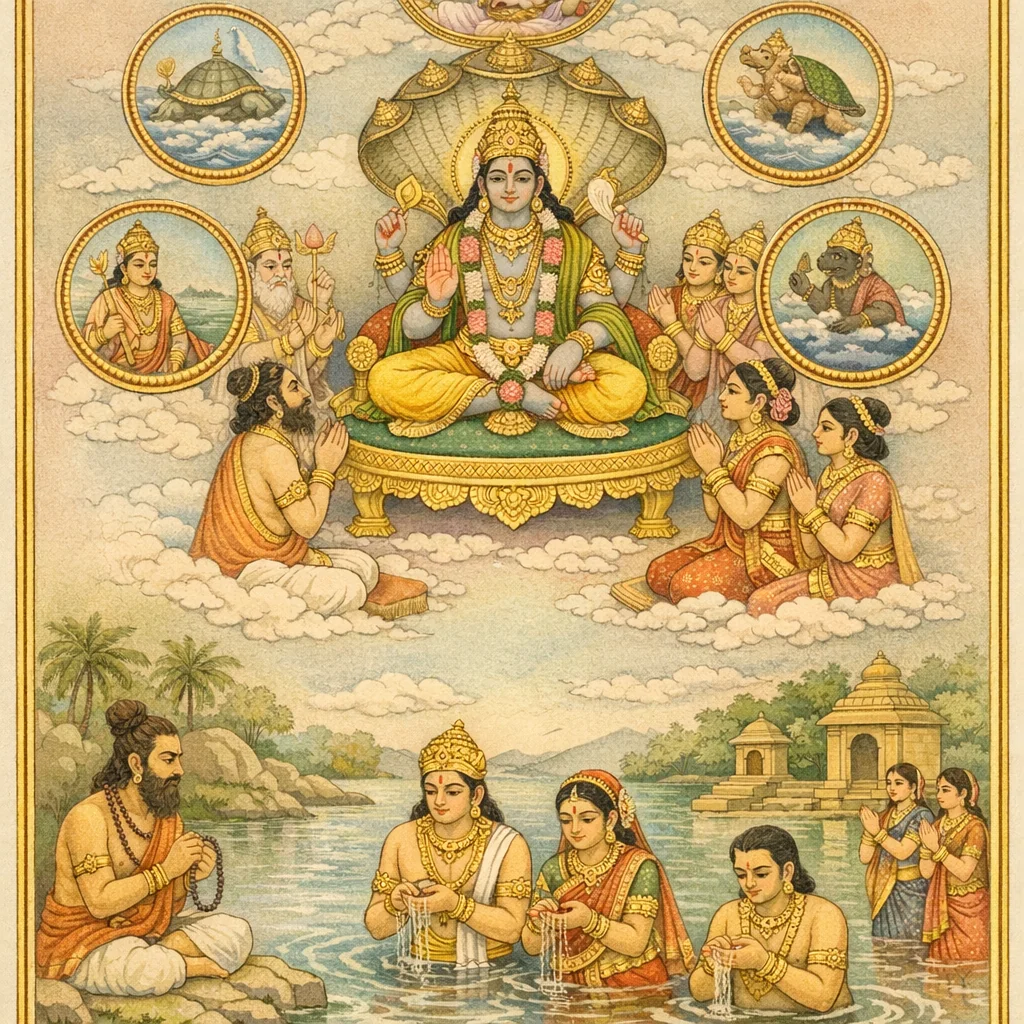
Adhyaya 42
अवन्तीकुशस्थली-माहात्म्यं तथा पैशाचमोचनतीर्थ-प्रशंसा (Avanti–Kushasthalī Māhātmya and Praise of Paiśācamocana Tīrtha)
Sanatkumāra recounts an episode from an earlier kalpa: the devas, defeated by an opposing power and diminished in merit, seek refuge and guidance. They approach Prajāpati (Brahmā) and proceed to the divine abode associated with Viṣṇu, portrayed in ideal celestial splendor. There the devas offer manifold praise to Vāsudeva, invoking His avatāra-forms—Kūrma, Nṛsiṃha, Varāha, Rāma, Buddha, and Kalki—as signs of cosmic protection. An incorporeal voice then directs them to Mahākālavan, proclaiming the city of Kuśasthalī as the all-fulfilling sacred center, especially because Śiva is said to remain present there through every cycle of time. The discourse exalts Kuśasthalī above great tīrthas through repeated “tenfold” comparisons and declares that gifts and rites performed there become akṣaya (inexhaustible). The devas reach the harmonious, ethically exemplary city and find the tīrtha called Paiśācamocana; after bathing, recitation, offerings, and charity, they regain inexhaustible merit, overcome their foes, and return to their abodes. The chapter ends with a phalaśruti: hearing or reciting this account removes sins and grants prosperity, progeny, and exalted standing in Śiva’s realm.
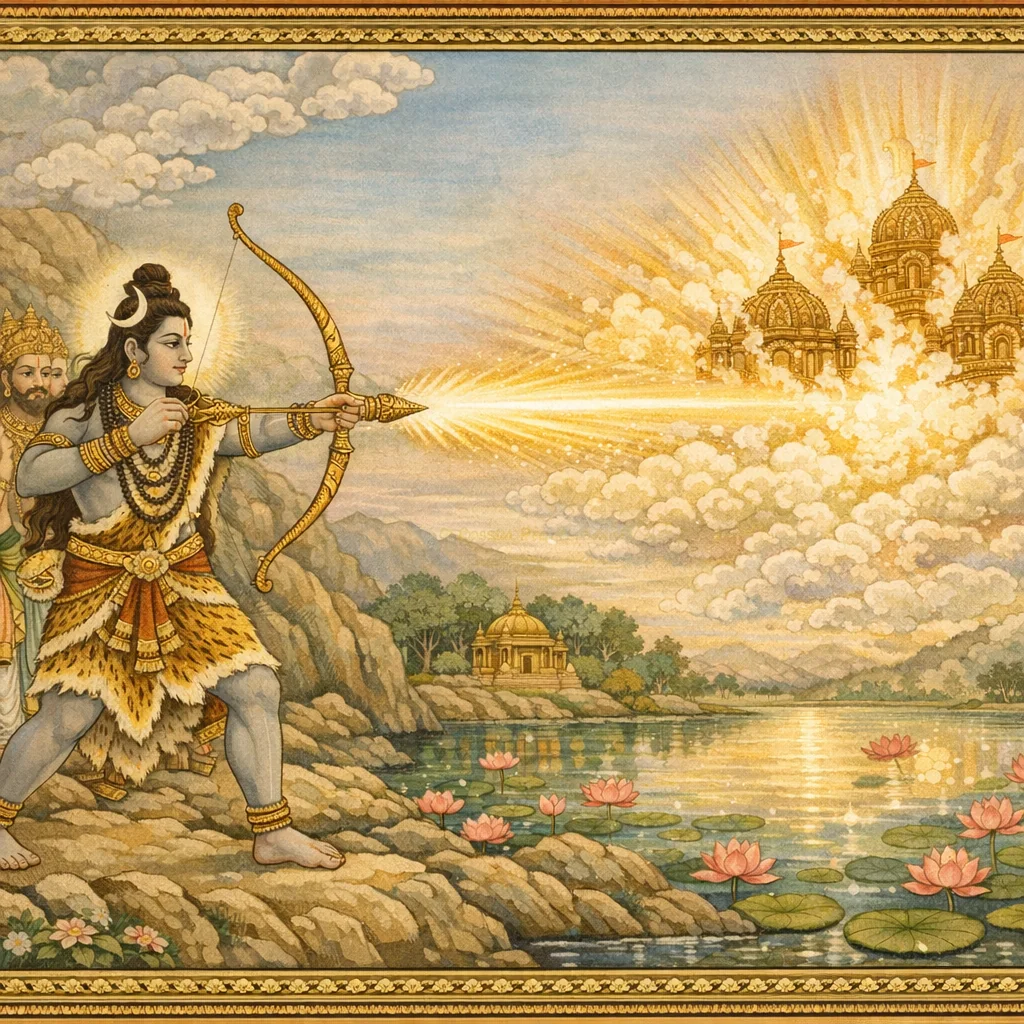
Adhyaya 43
त्रिपुरवधः—अवन्त्याः उज्जयिनीनामप्राप्तिः (Slaying of Tripura and the Renaming/Glorification of Ujjayinī)
Sanatkumāra narrates to Vyāsa a theological and ethical account that grounds Ujjayinī’s sanctity in the episode of Tripura. Tripura, an asura-king, performs fierce tapas and gains a boon of near-invulnerability against many classes of beings; he then devastates divine and human order. Ritual life collapses: agnihotra and soma rites cease, the svāhā/svadhā/vāṣaṭ formulas fall silent, festivals vanish, temples and Śiva-pūjā decline, and social virtues (dāna, dayā, upakāra, tapas) erode—showing dharma as the foundation of civilization. The weakened devas approach Brahmā, who leads them to Mahākālavan in Avantī. There, at Rudrasaras, he performs snāna, dāna, japa, and homa and petitions Mahākāla (Śiva). Śiva reveals the means of victory and emphasizes that offerings made in Avantī are imperishable. The gods then propitiate Cāmuṇḍā/Durgā, who grants Śiva the supreme Pāśupata weapon. Śiva destroys Tripura along with his māyā, returns to Avantī, and cosmic and social normalcy is restored: yajñas and festivals resume, sacred fires burn peacefully, and the city’s fame is established. The chapter ends with a phalaśruti: dwelling in Ujjayinī fulfills aims such as learning, wealth, progeny, happiness, wisdom, and love; hearing or reciting this account removes sins and yields merit likened to the gift of a thousand cows.
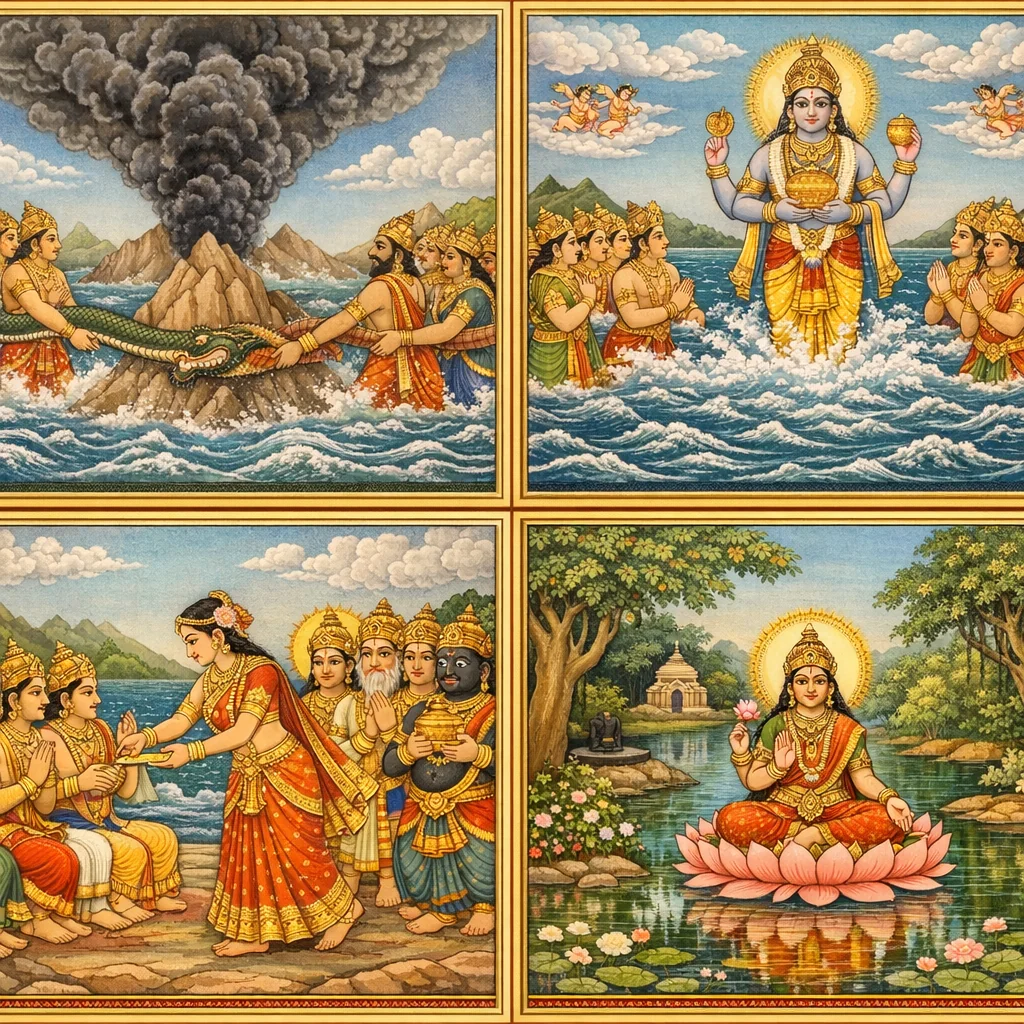
Adhyaya 44
पद्मावती-प्रादुर्भावः, राहु-केतु-तीर्थमहिमा च (The Manifestation of Padmāvatī and the Glory of the Rāhu–Ketu Tīrtha)
Sanatkumāra narrates to Vyāsa a localized account of the samudra-manthana (churning of the ocean) in Avantī, teaching about conflict, the rightful distribution of sacred boons, and the ritual sanction of holy sites. Devas and asuras churn with Meru as the churning rod and Vāsuki as the rope, and fourteen ratnas arise—Lakṣmī, Kaustubha, Pārijāta, Dhanvantari, the moon, Kāmadhenū, Airāvata, and the halāhala poison among them. When a dispute over the treasures erupts, Nārada intervenes and Hari (Viṣṇu) assumes Mohinī-form to guide events so that amṛta reaches the devas. Rāhu infiltrates and drinks the nectar; Viṣṇu severs his head, yet by contact with amṛta he endures as Rāhu and Ketu. The flowing blood is localized as a great tīrtha in this kṣetra, praised for removing faults and averting Rāhu-affliction for those who bathe with purity and right intent. The narrative then assigns the ratnas to deities and realms, culminating in Padmā’s settlement in Mahākālavana and the naming of the place as Padmāvatī. Prescribed observances—snāna, dāna, arcana, and tarpaṇa to devas and pitṛs—are said to free one from sin, poverty, and misfortune, extending benefit to one’s lineage. The phalaśruti concludes that hearing or reciting this account grants exalted merit comparable to great Vedic sacrifices.
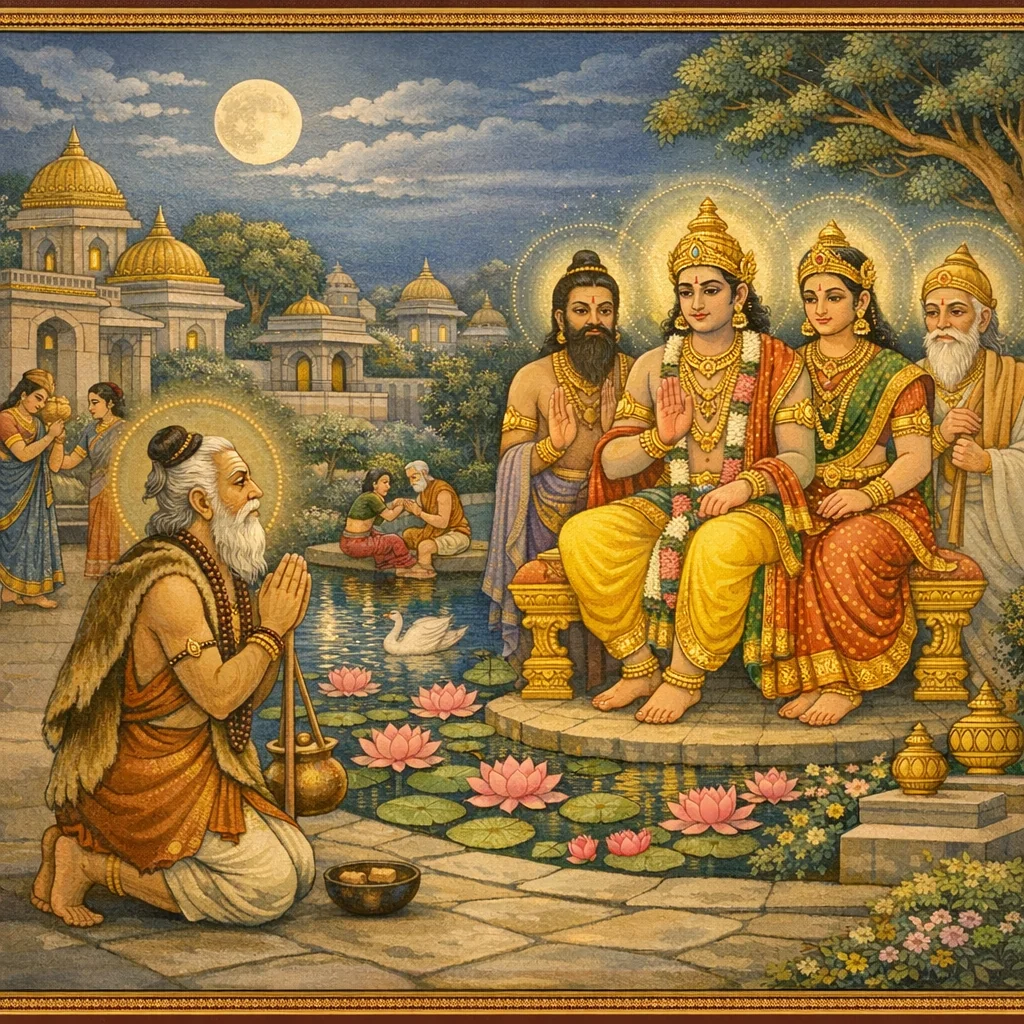
Adhyaya 45
कुमुद्वती-प्रादुर्भावः (The Manifestation and Glory of Kumudvatī / Padmāvatī)
This adhyāya unfolds as a layered dialogue: Sanatkumāra speaks to Vyāsa and conveys Lomasha’s account of a supremely meritorious city encountered on pilgrimage. Lomasha calls it “most secret among secrets,” a place where Hara (Śiva) is present, and where mere darśana—devout beholding—is said to erase even grave sin. The narrative then widens into a cosmic catalogue of those who gather there—Brahmā, Rudras, Ādityas, Vasus, Viśvedevas, Maruts, Gandharvas, Siddhas, Bhairavas, Vināyakas, Devīs, and other beings—marking the site as a microcosm of divine order. The city is portrayed as an ideal moral ecology: no sorrow, disease, poverty, discord, or ethical weakness; citizens are mutually helpful, disciplined, and instructive; and the whole place shines with a perpetual moonlike radiance. Its name is explained: because kumuda lotuses bloom unceasingly, it is called Kumudvatī and is identified as Padmāvatī. Finally, ritual efficacy is affirmed—śrāddha performed there prevents ancestors from “falling” from heaven, and all acts such as bathing, gifting, fire offerings, and worship become akṣaya, imperishable in fruit—concluding with praise of the city’s ancient sanctity.
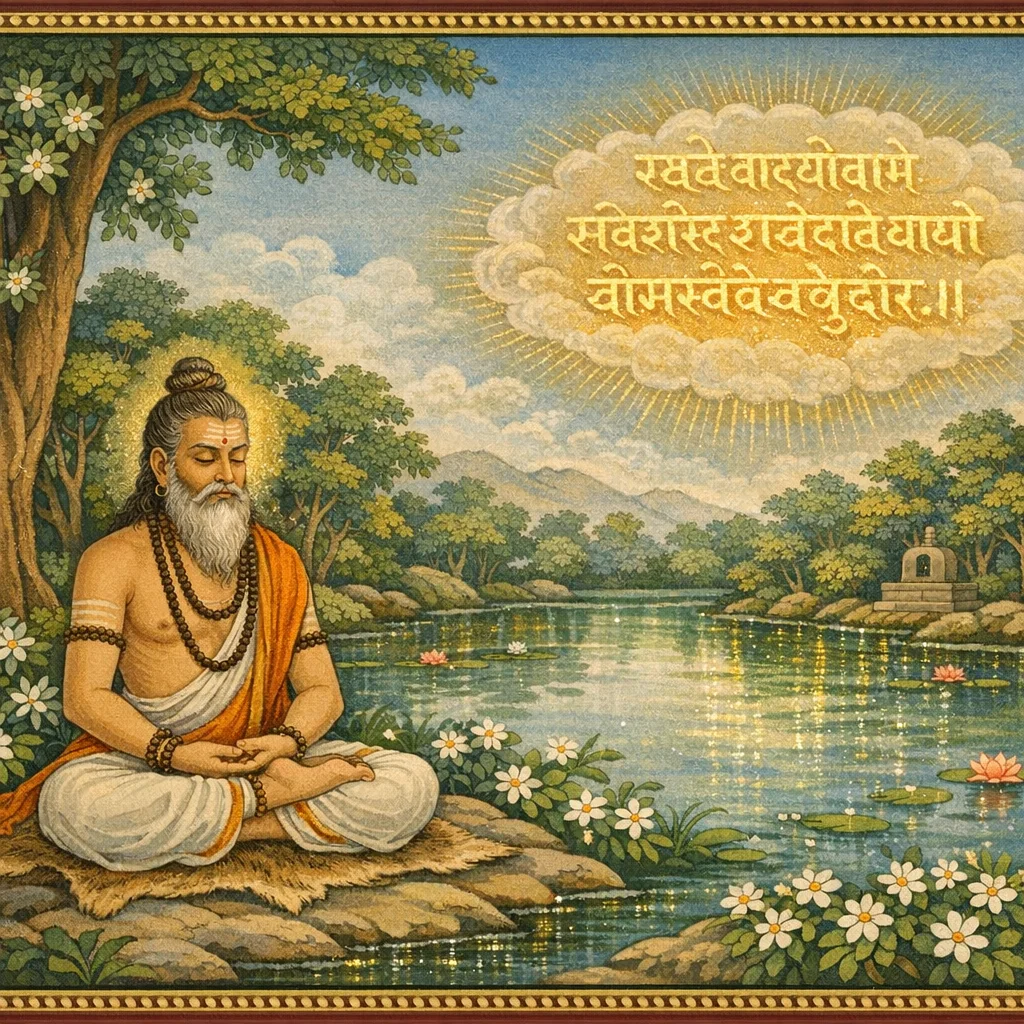
Adhyaya 46
कुशस्थली-अमरावती-सम्भववर्णनम् | The Rise of Kuśasthalī as an Amarāvatī-like Sacred City
Chapter 46 is cast as Sanatkumāra’s teaching to Vyāsa on how Kuśasthalī attained a sacred eminence like Amarāvatī. Marīci Kāśyapa performs severe, long tapas in the auspicious Mahākālavana, steadfast in ascetic restraint. A bodiless divine voice grants boons: an enduring lineage and widespread fame, and it honors Aditi’s shared austerity and protective presence. It foretells the birth of divine sons—foremost among them Viṣṇu and Indra—thereby establishing Kāśyapa as a Prajāpati. The narrative then turns to glorifying the holy landscape: Nandana-like splendor, wish-fulfilling motifs such as Kāmadhenu, sacred Pārijāta flora, and jewel-filled lakes like Bindu-saras with Mānas-like imagery and auspicious beings. It proclaims that whatever is divine in the cosmos is present in Mahākālavana, shaping its inhabitants into deva-like form and conduct. The phalaśruti concludes with pilgrimage practice: those who come, perform snāna and dāna, and behold Maheśvara gain worldly attainments and, after death, reach Śiva’s abode. Reciting or hearing this chapter yields merit likened to the Śatarudrīya.
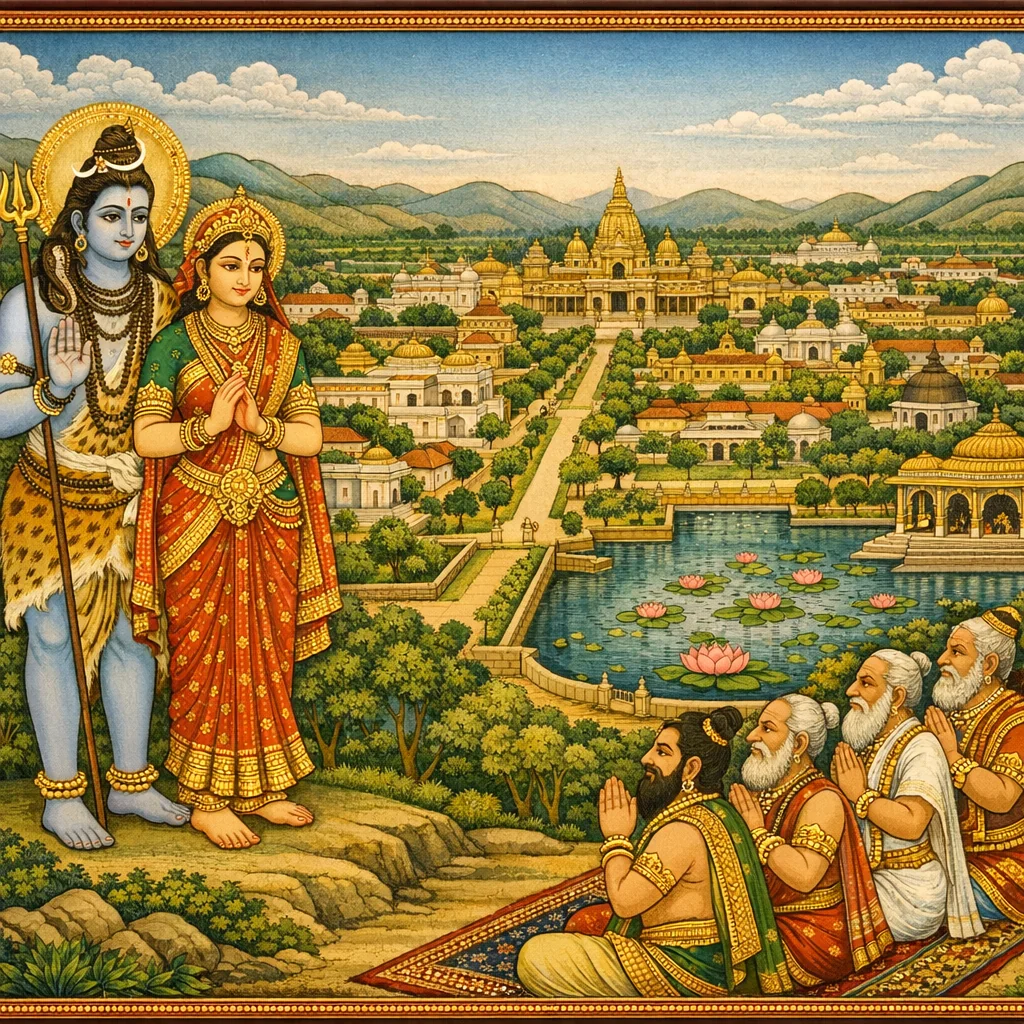
Adhyaya 47
विशालाभिधानकथनम् (Narration of the Naming and Glory of Viśālā)
Sanatkumāra relates to Vyāsa an ancient account, attributed to Brahmā, of a supremely secret and powerfully purifying kṣetra. As Śiva moves through a forest with Umā, a vast congregation—devas, asuras, gaṇas, Mothers (devīs), Vināyakas, Vetālas, Bhairavas, yakṣas, siddhas, ṛṣis with their families, celestial musicians, and other classes—gathers in inward contemplation and worship of Umāpati. Seeing them exposed to wind, rain, and sun, Pārvatī asks Śiva to provide a beautiful dwelling suited to their needs. By the power of yogamāyā, Śiva manifests a great radiant city, described in rich urban and ecological detail: markets and squares, mansions and jewel-walls, gem-inlaid thresholds, banners, waterworks, ponds and lotuses, birds and gardens, music and learning, sacrifices and life-cycle rites, public recitation, and the arts. The city is named Viśālā, praised as peerless on earth and able to grant both worldly welfare and aims leading toward liberation. In a phalaśruti-style close, it is declared that uttering the name “Viśālā” exalts one in Śiva’s realm; śrāddha performed there yields imperishable merit; and even hearing this narrative is said to purify at once from grave wrongdoing.
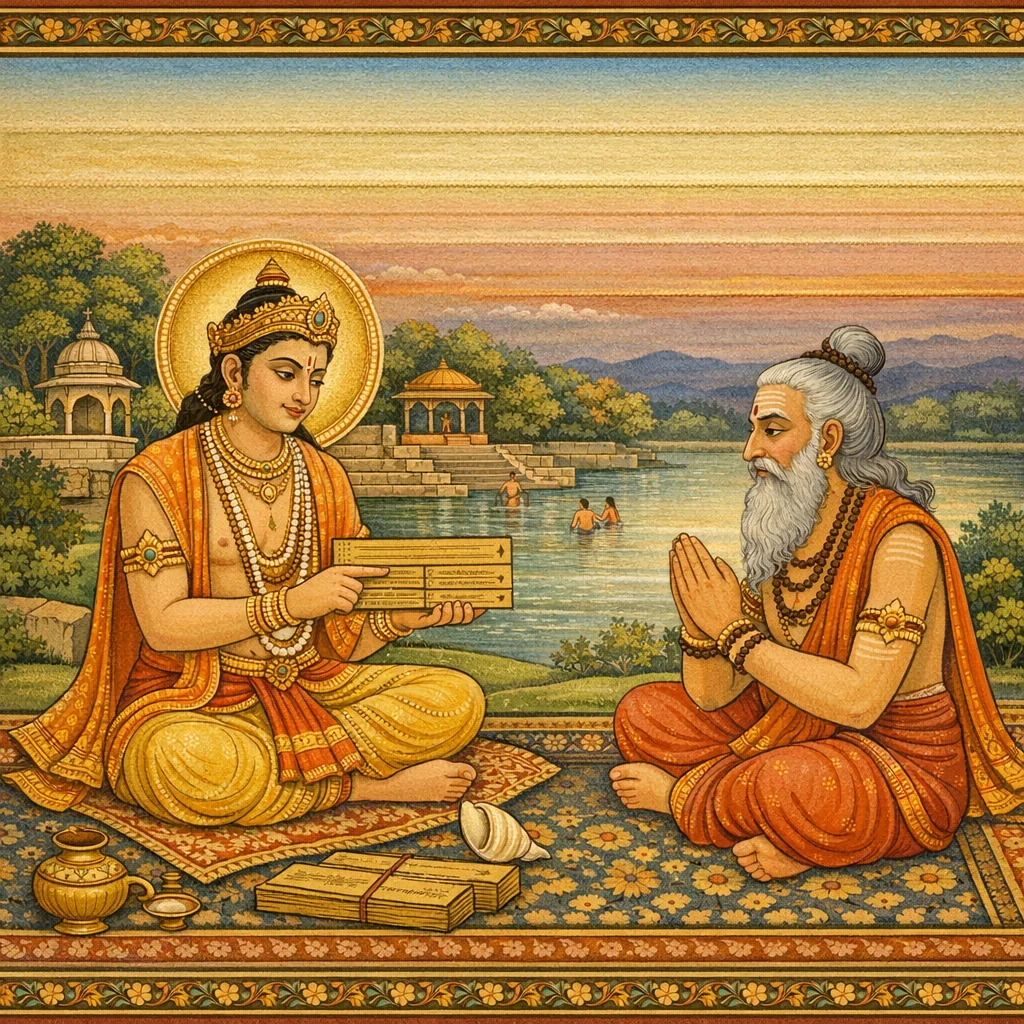
Adhyaya 48
प्रतिकल्प-कालमान-प्रशंसा (Pratikalpa and the Measures of Cosmic Time)
This chapter is cast as Sanatkumāra’s instruction to Vyāsa, first laying down norms of confidentiality and eligibility for receiving a purāṇic teaching on time-reckoning and cosmic cycles. It then unfolds a graded scheme of time: from nimēṣa and kāṣṭhā up to muhūrta, day and night, fortnight, month, season, and year, with comparative scales for humans, the Pitṛs (ancestors), and the Devas. Next it explains the four yugas along with their sandhyā and sandhyāṃśa transition periods, defines a manvantara as a multiplication of the caturyuga, and describes the kalpa (Brahmā’s day) and Brahmā’s night as measures of a thousand yugas. Against this cosmological backdrop, the narrative praises the exceptional stability of Mahākālavana and the city known as Kuśasthalī/Pratikalpā, said to manifest repeatedly across kalpas. The chapter concludes with a phala-oriented assurance: disciplined observances at Pratikalpā—especially Mahēśvara-darśana, rites connected with Vaiśākha Paurṇamāsī, and bathing in the Śiprā—are portrayed as granting enduring spiritual results, and even hearing or teaching this account is declared purificatory.
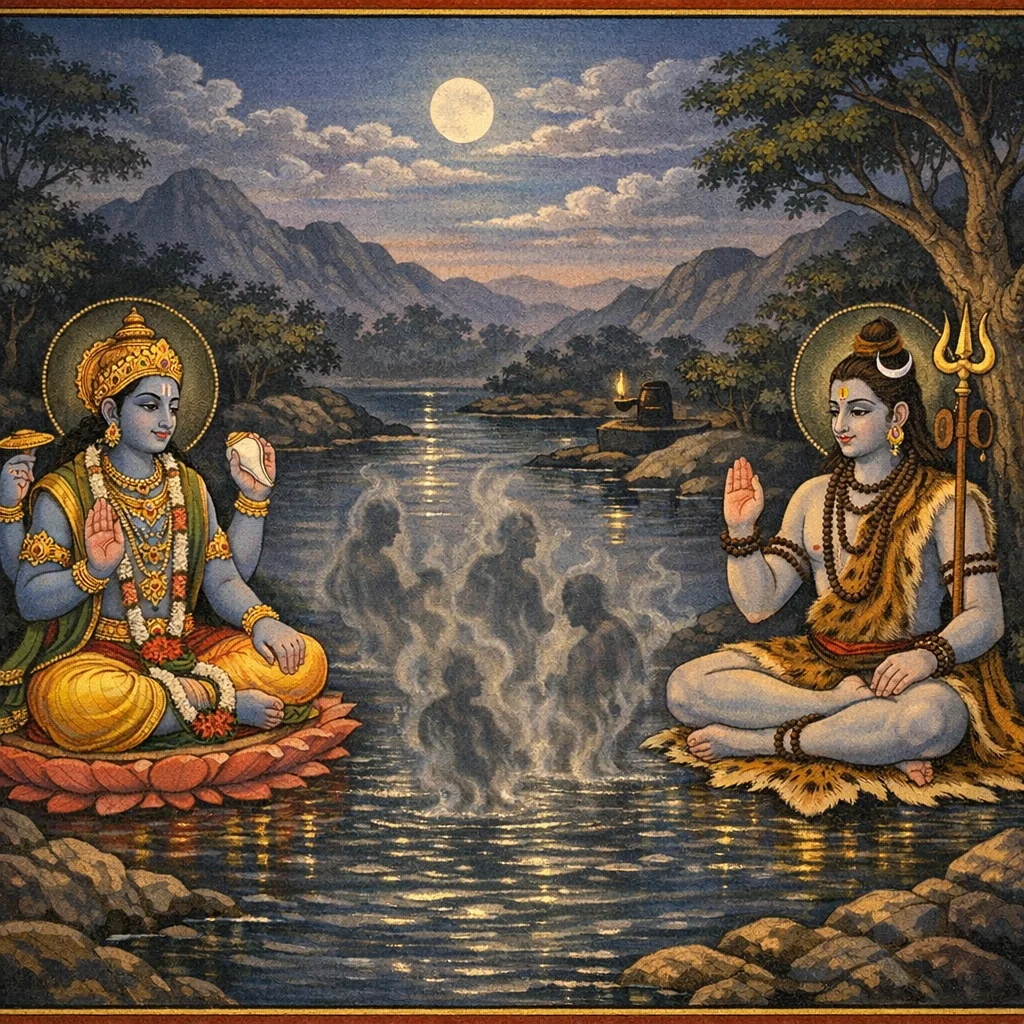
Adhyaya 49
शिप्राया माहात्म्ये ज्वरानुग्रहः (Śiprā Māhātmya: The Bestowal of Relief from Fever)
This chapter unfolds as a Vyāsa–Sanatkumāra dialogue within the Avantī-kṣetra māhātmya. After recalling many regional tīrthas and site-legends, Vyāsa asks for a brief yet auspicious account of the sacred story of the Śiprā river. Sanatkumāra proclaims Śiprā’s singular greatness: her waters grant liberation even by mere proximity, and her presence spans multiple realms—Vaikuṇṭha, the divine world, Mahādvāra, and Pātāla—thus establishing a layered sacred geography. Two origin-episodes then explain her sanctity. First, Rudra, bearing the skull-bowl as a mendicant, approaches Viṣṇu for alms; a fierce encounter releases a stream of blood that becomes the Śiprā. Second, the Hari–Hara conflict gives rise to the Māheśvara fever (jvara) and a countering Vaiṣṇava heat; both are pacified when they immerse in the Śiprā at Mahākālavana, confirming the river as jvaraghnī, the destroyer of fever. The phalāśruti concludes that those who listen attentively to this divine account are freed from fear born of fever-affliction.
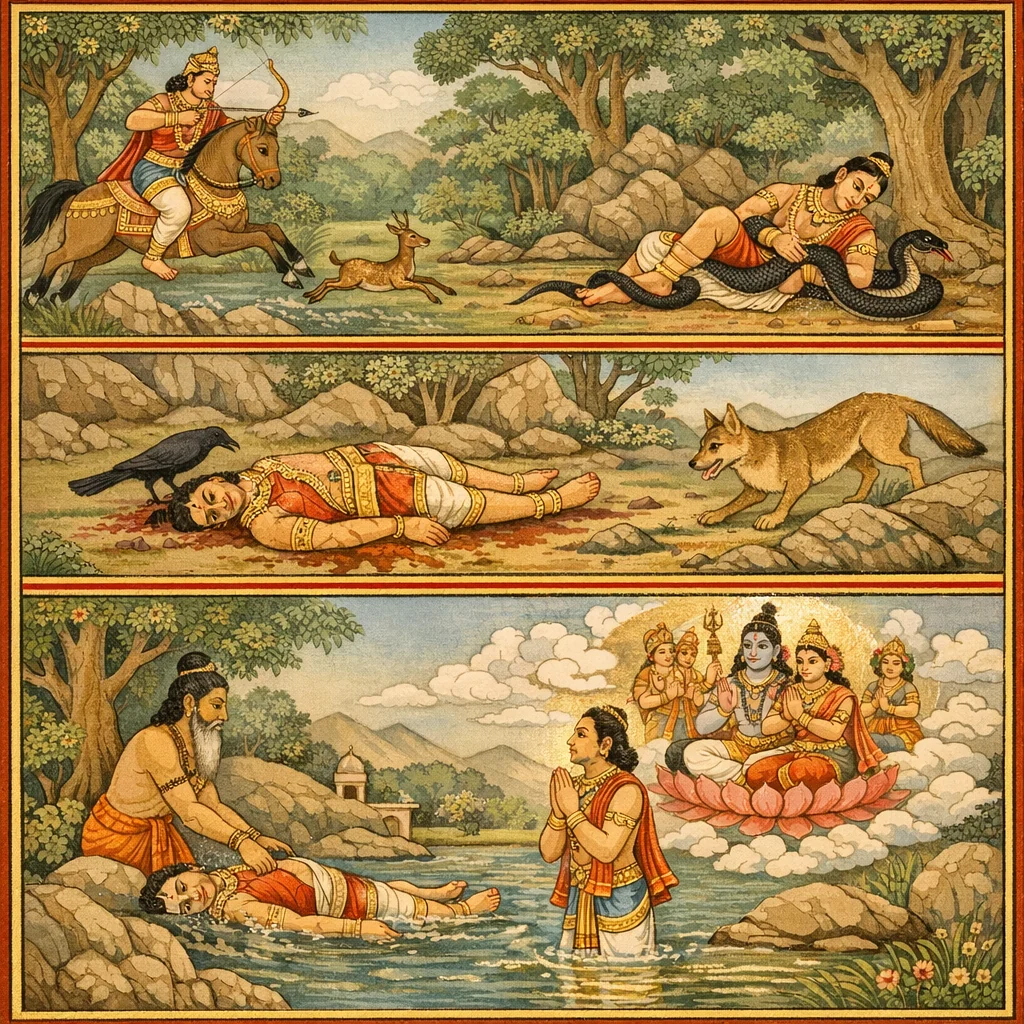
Adhyaya 50
शिप्रामाहात्म्ये दमनराजमोक्षः (Śiprā-māhātmya: The Liberation of King Damana)
Sanatkumāra explains to Vyāsa the purifying power of the Śiprā river through a cautionary narrative. King Damana, portrayed as a flagrant violator of dharma in social, ritual, and moral life, enters the forest near Mahākālavana on a hunt, becomes separated, and dies from a serpent’s bite. Yama’s messengers seize him, and he undergoes post-mortem punishments in accordance with karmic causality. Meanwhile his corpse is scavenged; a crow carries off a small piece of flesh which, by residual karmic momentum, falls into the waters of Śiprā. The text declares that mere contact with Śiprā-water instantly transforms the karmic condition of that remnant: Damana manifests in a Śiva-like form, disrupting Yama’s jurisdiction. Dharmarāja (Yama) then explains that Śiprā is sarva-pāpa-harā, the supreme remover of sin—so that touching its water, dying upon its bank, or even uttering its name redirects beings toward Śiva’s realm. The chapter praises Śiprā as surpassing other tīrthas and concludes by affirming its fame and the liberating fruit of hearing this dialogue (śravaṇa-phala).
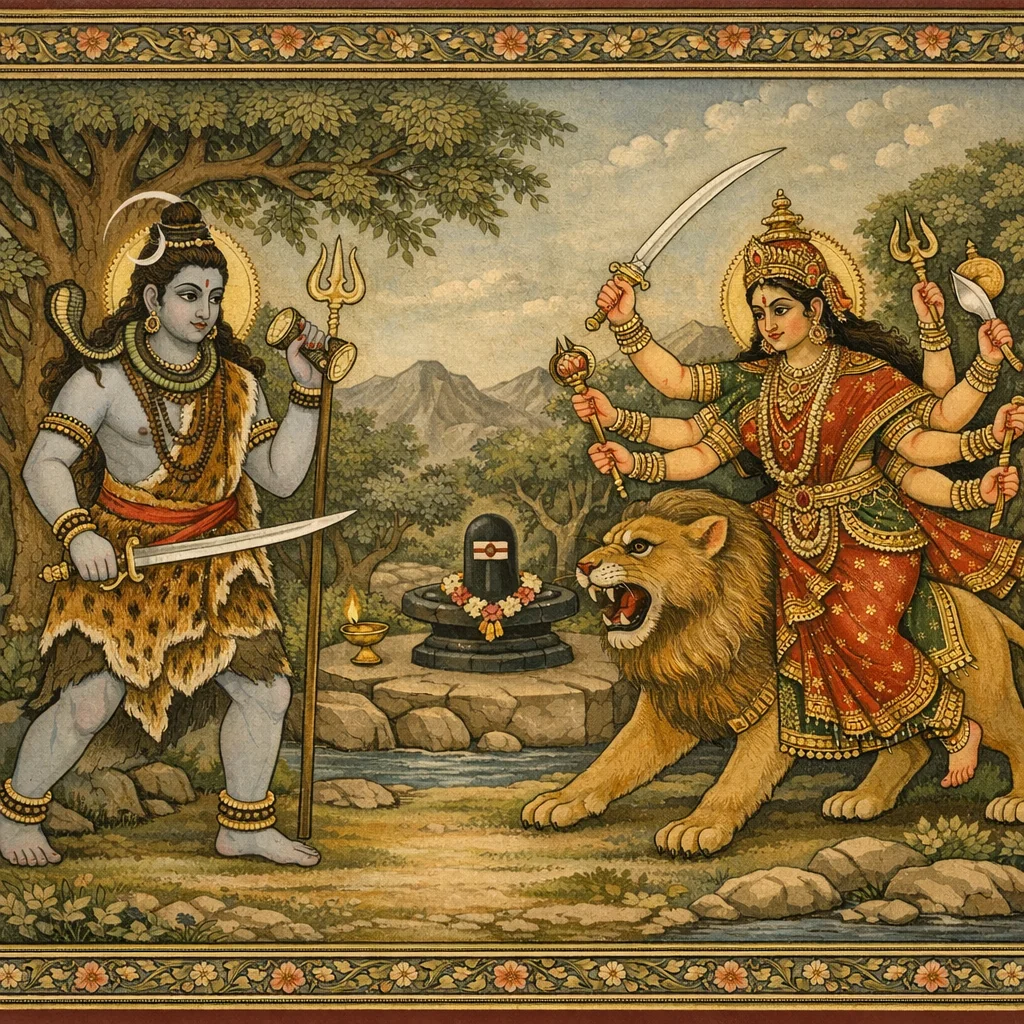
Adhyaya 51
शिप्रामाहात्म्ये अमृतोद्भवत्वकथनम् / The Legend of Shiprā as ‘Amṛtodbhavā’
Sanatkumāra tells Vyāsa why the Shiprā is called “amṛtodbhavā,” the river associated with amṛta (nectar). In nāgaloka, Rudra/Śaṅkara comes to Bhogavatī as a hungry mendicant carrying a kapāla, begging alms from house to house; none give, violating atithi-dharma, the sacred duty of hospitality. Enraged and tormented by hunger, he leaves the city and, through his third eye, consumes the nectar stored in twenty-one protective kuṇḍas that sustain the Nāgas, throwing the cosmos into disturbance and filling them with dread. With their families the Nāgas seek refuge in Hari. A bodiless voice declares their fault to be neglecting Śiva’s request and directs them to Mahākālavana, to the Shiprā—praised as purifier of the three worlds and fulfiller of desires—to bathe properly and worship Mahādeva. They arrive to behold a great tīrtha thronged with ṛṣis, devas, siddhas, and pilgrims performing sandhyā rites and giving dāna. After ritual bathing and an elaborate pūjā with flowers, sandal, lamps, naivedya, and dakṣiṇā, the Nāgas hymn Śiva with many epithets. Śiva appears, confirms the chain of cause, and grants remedy: by the merit of Shiprā-snāna the nectar will return to their homes. He instructs them to carry Shiprā water and pour it into the twenty-one kuṇḍas, which will become permanently amṛta again. Thus the Shiprā becomes renowned across worlds as “amṛtodbhavā”; the phalaśruti proclaims that bathing and observances there remove wrongdoing and protect from calamity, separation, disease, and poverty, and that hearing or reciting this account yields merit like the gift of a thousand cows.
Adhyaya 52
शिप्रामाहात्म्य तथा वाराह-उत्पत्ति-प्रसङ्गः (Śiprā-māhātmya and the Varāha-restoration narrative)
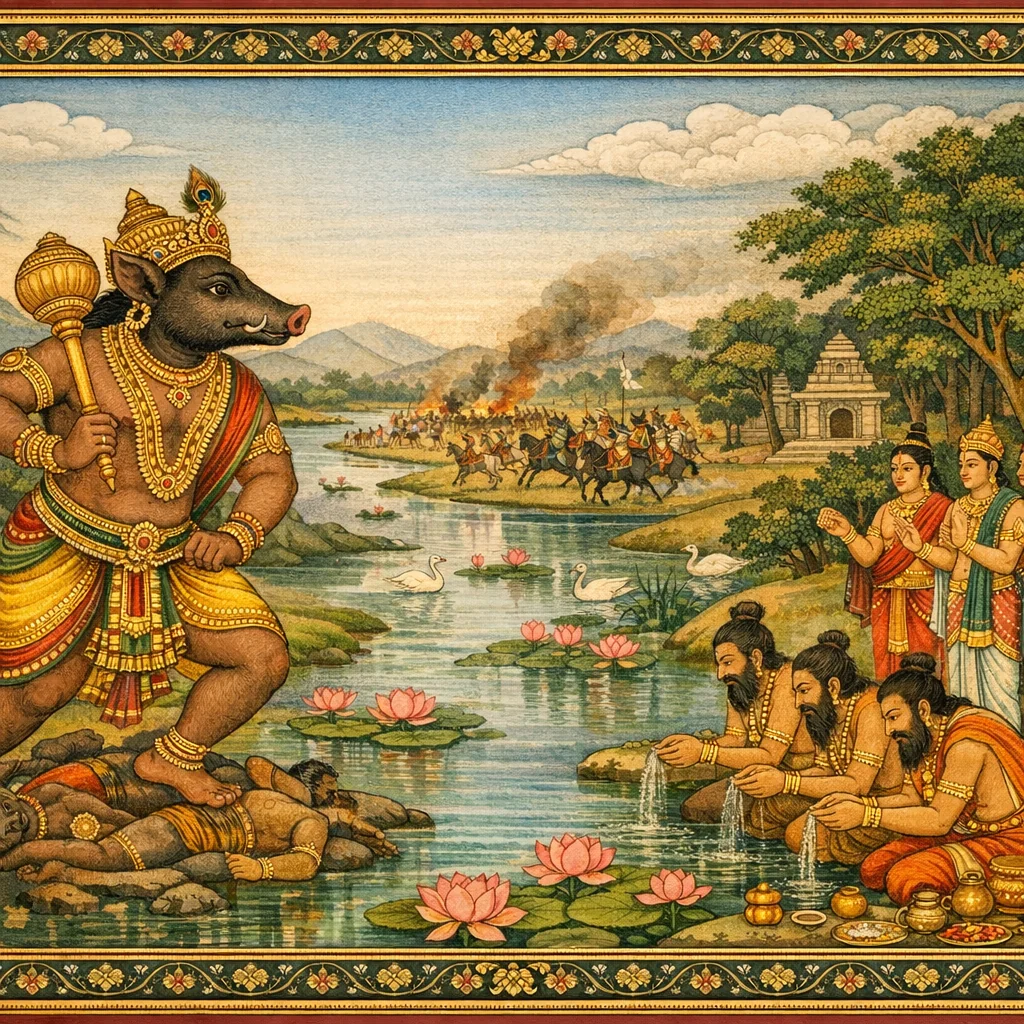
This adhyāya begins with Sanatkumāra praising the greatness of the river Śiprā, declaring that merely hearing its māhātmya bestows high ritual merit, and emphasizing Śiprā’s special sanctity in Avantī and the revered direction of its flow. The narration then turns to a cosmic crisis: the daitya Hiraṇyākṣa subjugates the worlds, drives the devas from svarga, and disrupts sacrificial order and social-ritual norms. The devas seek refuge with Brahmā, who recalls an earlier episode involving the four Kumāras and the gatekeepers Jaya and Vijaya, explaining their fall into asuric births over three lifetimes (including Hiraṇyākṣa). As dharma declines, Viṣṇu assumes the Varāha form, wages a prolonged battle, defeats Hiraṇyākṣa, and restores the earth and cosmic stability. From this restoration, sacred geography is linked to divine embodiment: Śiprā is said to arise from the deity’s heart, overflowing with bliss-bearing waters and adorned with lotus-lakes, birds, sages, and ritual activity. Mahākālavan and its associated tanks are praised as places where bathing, offerings, and śrāddha yield exalted results; the devas, following Viṣṇu’s instruction, perform rites there and regain their worlds. The chapter closes by indicating a fuller origin account of Śiprā as Varāha’s “daughter” and a river born from Viṣṇu’s body.
Adhyaya 53
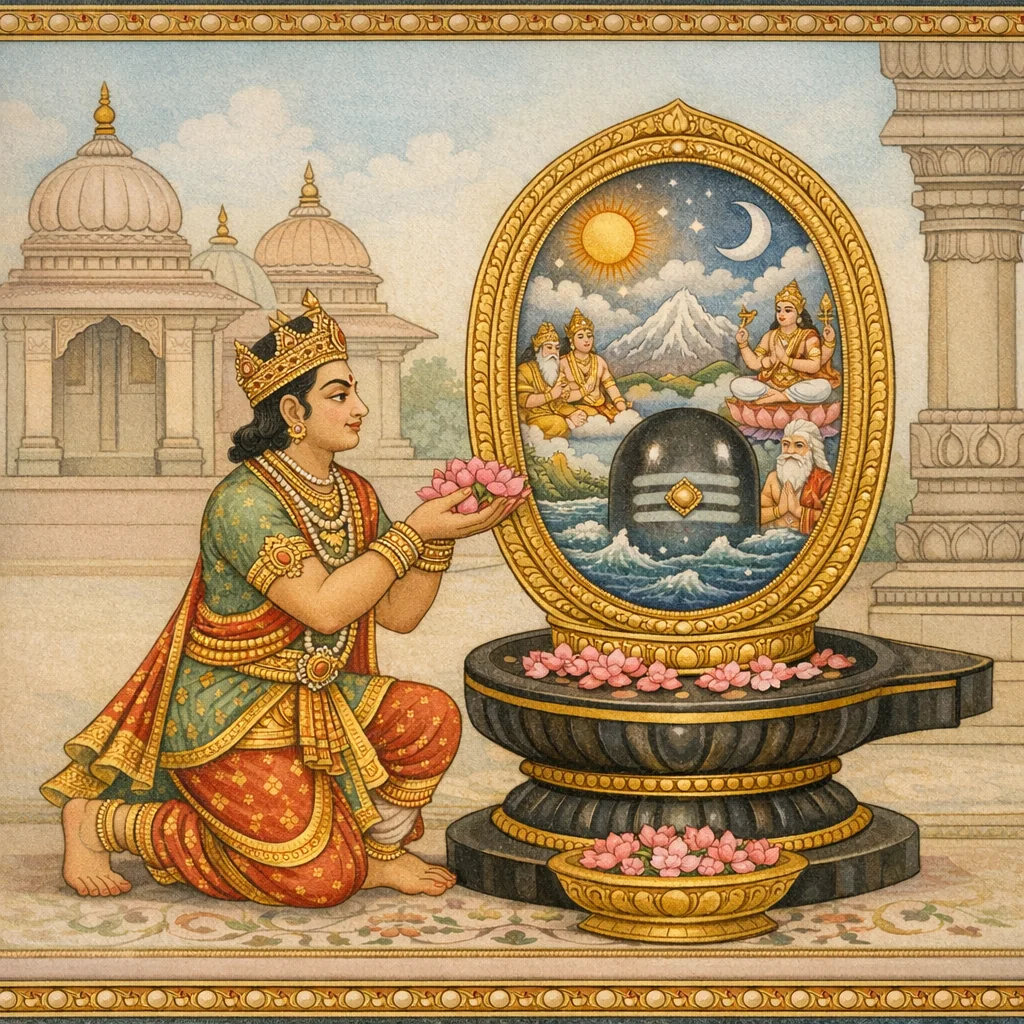
सुन्दरकुण्डोत्पत्तिः पिशाचमोचनतीर्थमाहात्म्यं च (Origin of Sundara Kuṇḍa and the Glory of Piśāca-mocana Tīrtha)
Adhyāya 53 is framed as a dialogue: Vyāsa asks the identity, origin, and fruit of the place called Sundara Kuṇḍa. Sanatkumāra replies that it is a supreme tīrtha in Avanti, destroying sins and granting desired results. An origin-myth follows in pralaya imagery: at cosmic dissolution a peak linked with Vaikuṇṭha falls into the fearsome yet secret Mahākālavana, and at once a jewel-like kuṇḍa arises—adorned with ratna steps, pure waters, and divine flora and fauna. The kuṇḍa is further praised as the embodied abode of enduring principles—Vedas, śāstras, Purāṇas, mantras (including Oṁkāra and Gāyatrī), and measures of time—where devas and semi-divine beings take refuge, fearing defects of the kalpa. The chapter declares Viṣṇu and Śiva, together with Śakti, as resident there, and states a merit: staying a fortnight or a month yields prolonged residence in Vaikuṇṭha; even small creatures attain Śaiva destinations by dying there. It then explains the tīrtha-name Piśāca-mocana through an exemplum: Devala, a southern brāhmaṇa of repeated ethical transgressions, commits grave crimes and undergoes long post-mortem punishments (narakas and preta-state) before taking a piśāca body. Reaching Mahākālavana, he is slain by a lion near the liṅga and kuṇḍa; entering the water, a bone is dislodged, and by the tīrtha’s merit his sins are extinguished. His subtle essence is said to enter the liṅga, establishing the site as a liberative purifier. The conclusion gives ritual instructions: bathe at Piśāca-mocana, worship Piśāca-mocaneśa, perform great gifts, and recite or hear this narrative—each bringing purification and high merit, with a phalaśruti praised as equivalent to the Aśvamedha.
Adhyaya 54
नीलगङ्गा-तीर्थप्रादुर्भावः तथा दुग्धकुण्डमाहात्म्यम् (Origin of Nīlagangā Tīrtha and the Glory of Dugdhakuṇḍa)
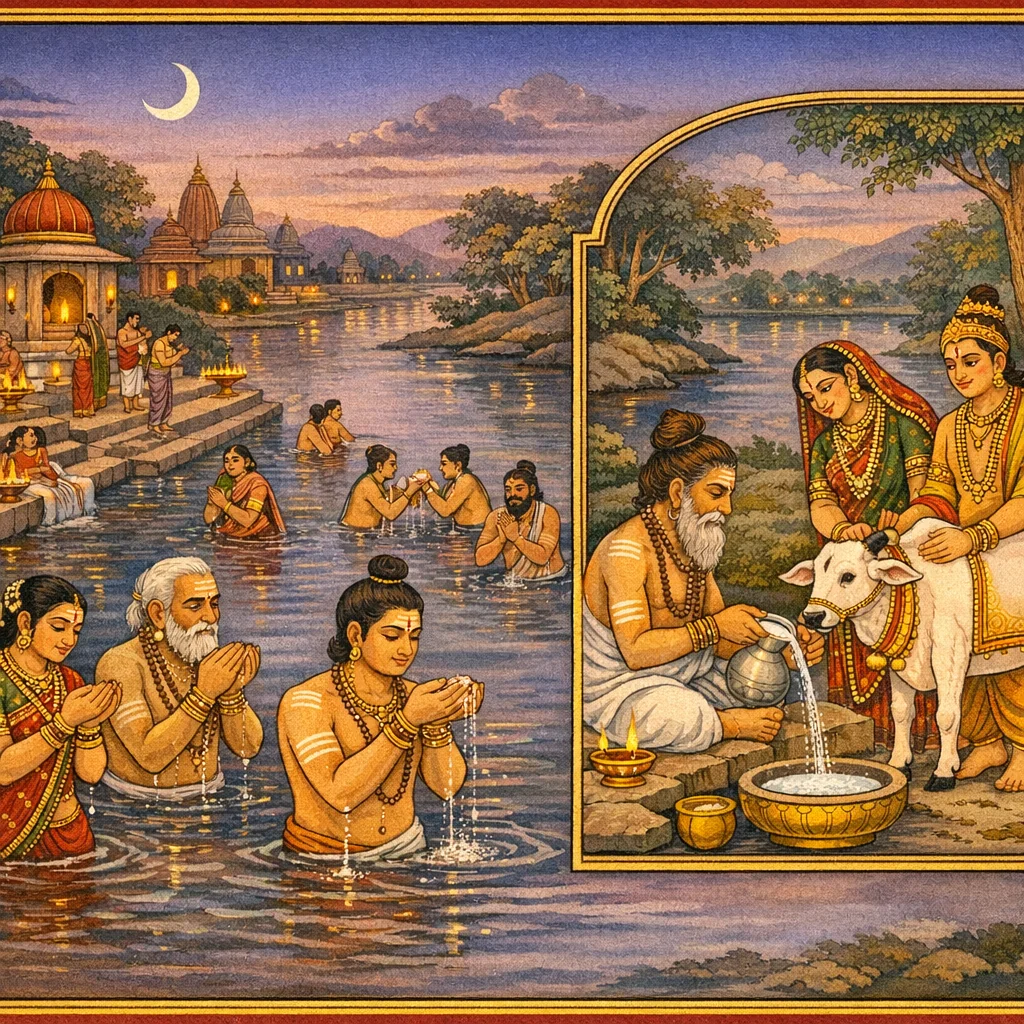
This chapter unfolds as a didactic dialogue: Vyāsa asks Sanatkumāra when Nīlagangā came to Śiprākuṇḍa. Sanatkumāra declares the tīrtha’s merit—bathing in Nīlagangā and worshiping at Saṅgameśvara removes faults born of harmful association and restores purity. An origin tale follows. Gaṅgā, weighed down by the accumulated impurities of humankind, laments that she has grown dark and seeks a way to regain her sanctity. Brahmā directs her to the Mahākālavana region, where the Śiprā purifies even by mere sight. Reaching sacred spots (including the setting of Añjanī’s āśrama) and entering there, Gaṅgā is cleansed, changing from a “nīla” appearance to “śukla” purity, thereby establishing the tīrtha known as Nīlagangā. The chapter then prescribes observances: snāna at this tīrtha and worship of Hanumat, with special emphasis on Mahālaya śrāddha during the dark fortnight of Āśvina—tilāñjali, feeding brāhmaṇas, and related offerings are said to uplift ancestors and grant them lasting satisfaction. A second tīrtha, Dugdhakuṇḍa, is introduced, famed for a tradition of depositing a “milk-offering,” removing obstacles and bestowing prosperity; bathing, drinking its water, and gifting a cow are praised as bringing welfare and heavenly attainment after death, after which one is guided onward to Puṣkara for further rites.
Adhyaya 55
Vindhyavāsinī-Stuti, Agastya’s Petition, and the Vimalodā Tīrtha Phalāśruti (Chapter 55)
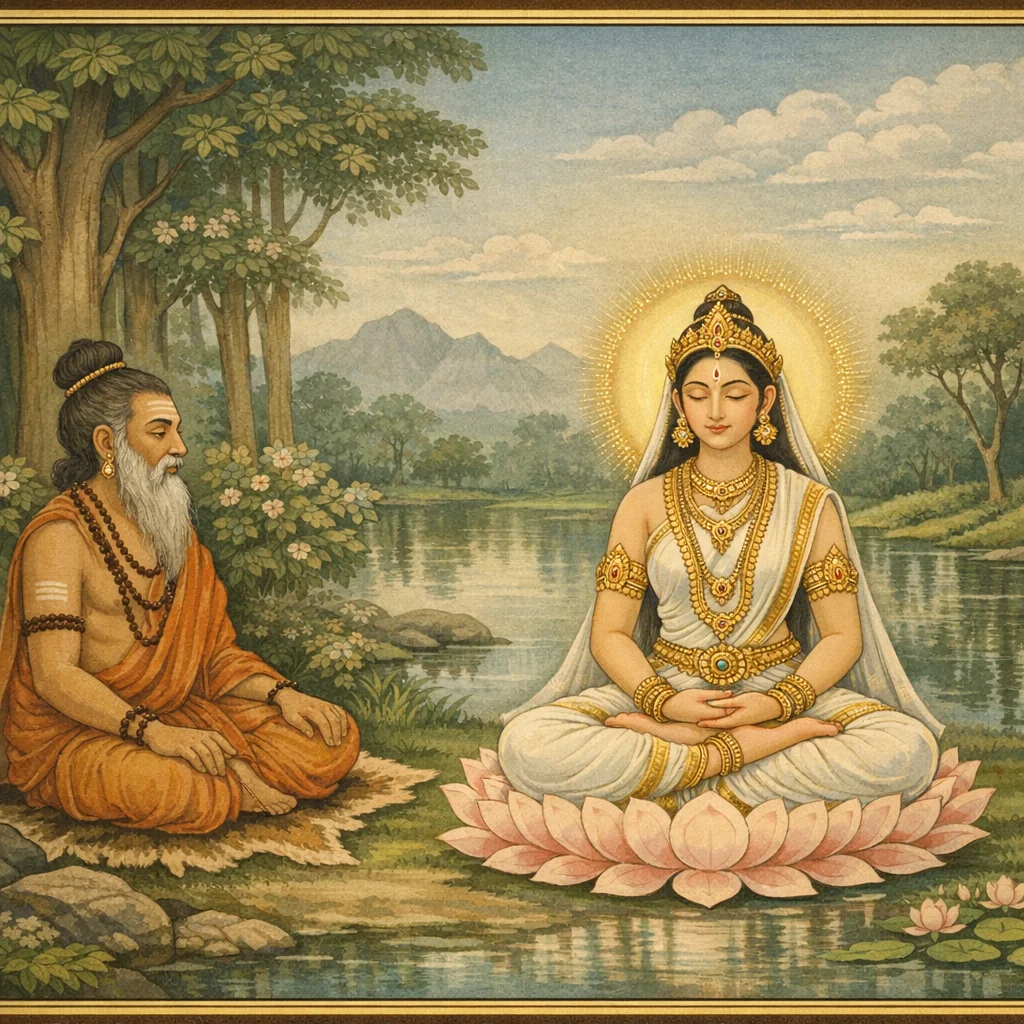
The chapter begins with Vyāsa asking Sanatkumāra how the Vindhya mountain came to appear in the delightful Mahākāla forest, and by whose agency. Sanatkumāra recalls an earlier calamity: the Revā (Narmadā) swells and inundates the earth, spreading fear through the worlds. To protect the earth, sages and gods approach Agastya, who performs single-minded devotion to Bhavānī as Vindhyavāsinī. A long hymn follows, praising the Goddess as protector, destroyer of hostile powers, bestower of boons, and as many revered sacred forms (including associations with Gāyatrī and other holy personifications). Pleased, the Goddess appears and offers a boon; Agastya asks her to restrain the dangerous flooding of the Revā. She proceeds to the auspicious Mahākāla forest, and Agastya declares he will check the rising goddess-power, commanding that the Vindhya mountain must not rise until he returns from a southern mission—linking cosmic order to ascetic duty. The narration then turns to Kuśasthalī/Ujjayinī and the Vimalodā tīrtha: bathing and worship there, along with offerings and feeding learned guests, are said to grant complete benefits—protection from threats, prosperity, longevity, purification, and attainment of Śiva’s abode. Special mention is made of women afflicted by social or ritual misfortunes; bathing at Vimalodā and beholding Vindhyavāsinī removes defects and bestows auspicious results, including progeny and marital fortune. The chapter ends with a phalāśruti: reading or hearing this account yields merit likened to the gift of a thousand cows.
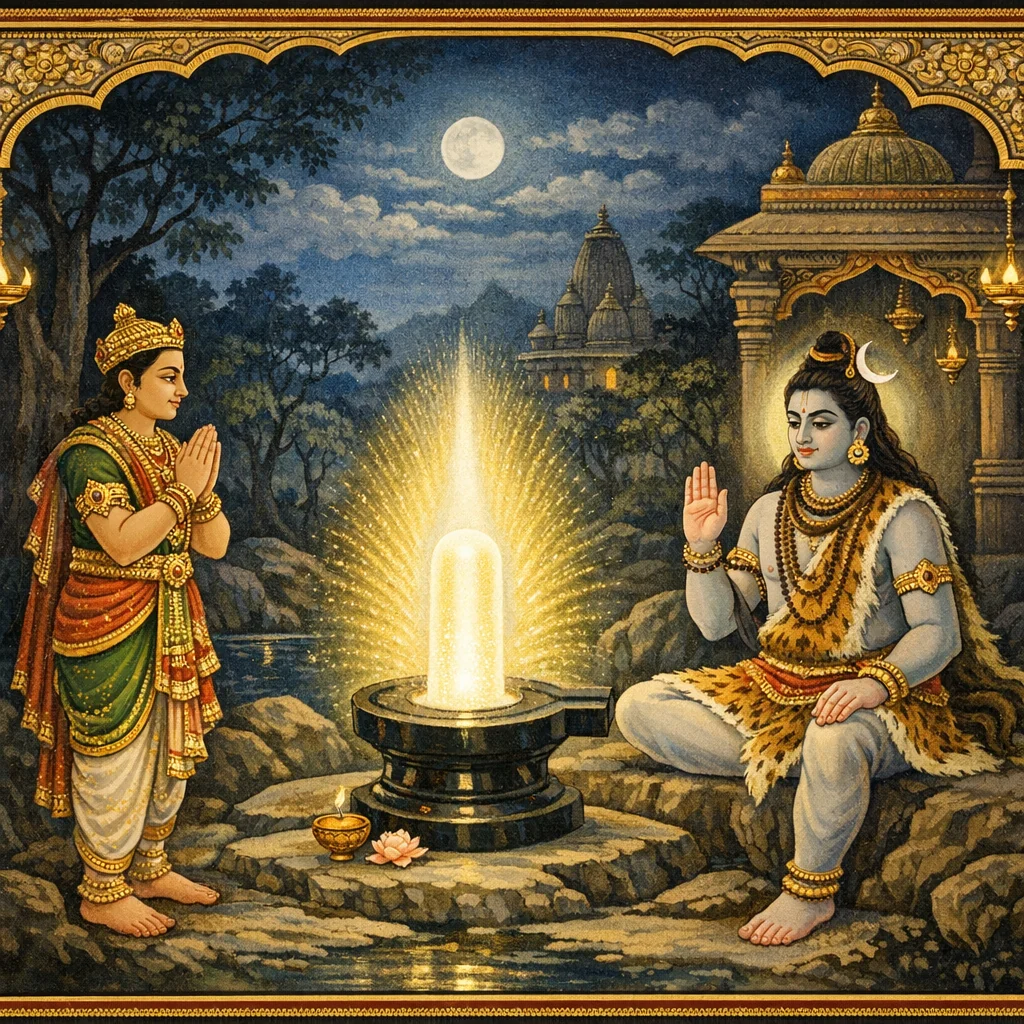
Adhyaya 56
क्षातासंगममाहात्म्यं (Glory of the Kṣātā–Shiprā Confluence and Associated Tīrthas)
This chapter, cast as a dialogue, has Sanatkumāra proclaim the holiness of the confluence-tīrtha where the river Kṣātā meets the Shiprā in Mahākālavana. Mere bathing at this junction is said to cleanse sin and grant salvific merit. A special observance is taught: when amāvasyā (new-moon day) falls on a Saturday, one should perform śrāddha, offer tila-water to the ancestors, and worship or take darśana of a revered stationary liṅga (sthāvara-liṅga), whereby afflictions connected with Śanaiścara (Saturn) are pacified. An origin account follows: purifying rivers such as Revā and Carmanvatī are praised, and Kṣātā, reaching Mahākālavana, becomes identified with the supreme tīrtha called Kṣātā-saṅgama. A mythic digression explains why the Sun is called “viraja” (free from impurity) through the Tvaṣṭṛ–Sāvitrī/Chāyā episode, leading to the birth of Śanaiścara and grounding the calendar-linked rite. The chapter also points to nearby pilgrimage sites—Dharma-sara (associated with Yama’s austerities and Maruti’s presence) and Cyavana’s āśrama/Cyavaneśvara (linked to the Aśvins and the gaining of divine sight). It ends with a phalaśruti declaring that hearing or reciting this account yields vast merit, comparable to great gifts, thus serving as a sacred ritual–geographical index.
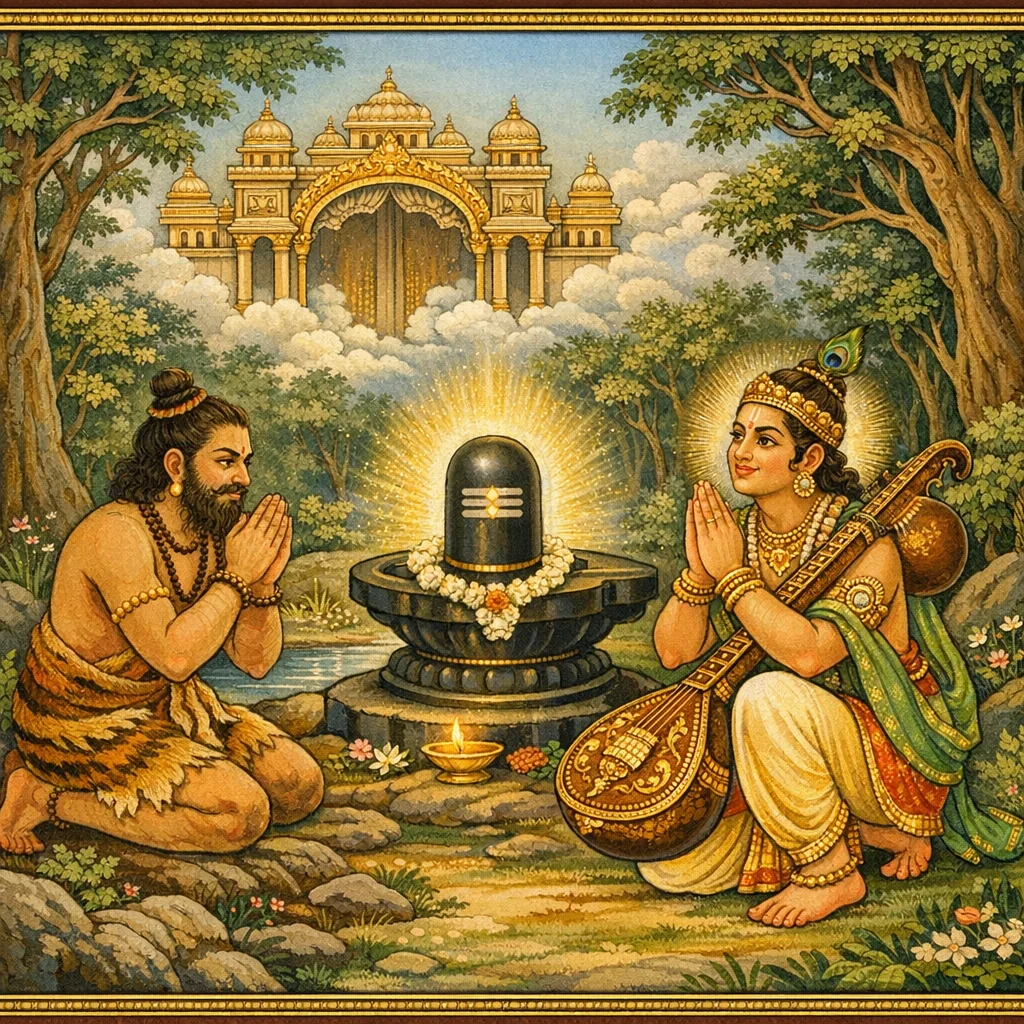
Adhyaya 57
गयातीर्थ-प्रशंसा तथा महाकालवने गुह्यतीर्थ-प्रकाशनम् (Praise of Gayā-tīrtha and the Revelation of Secret Tīrthas in Mahākālavana)
This chapter unfolds as a dialogue between Sanatkumāra and Vyāsa, re-situating the renowned Gayā-tīrtha within the sacred landscape of Mahākālavana in Avantī. Sanatkumāra proclaims Gayā the supreme tīrtha: bathing there frees one from the three debts (ṛṇa-traya) and, after honoring the devas and the pitṛs (ancestors), leads toward Viṣṇu’s realm. When Vyāsa asks how a place famed in Kikāṭa can be known within Mahākālavana, Sanatkumāra replies with a purifying account whose very hearing benefits one’s forebears. He then depicts an ideal Kṛtayuga under King Yugādidēva, where dharma stands “on four feet” and prosperity, health, social concord, and Vedic ritual regularity prevail. The turn comes when the dānava Tuhāṇḍa subjugates the world, suppressing Vedic rites, worship, and the svadhā/svāhā offerings, collapsing the dharma-path. Devas and sages seek Brahmā’s refuge; Brahmā approaches Viṣṇu, and a bodiless voice commands them to hasten to Mahākālavana—an exceptionally pure, hidden region where māyā cannot prevail. The voice enumerates a dense tīrtha-network: the wish-fulfilling Śiprā, Mahākālī and the Mothers’ powers, Gayā and Phalgu, Buddha-Gayā and Ādya-Gayā, Viṣṇu’s “sixteen-footed” tīrtha linked to Gadādhara, Prācī Sarasvatī, an imperishable nyagrodha, and a liberation-granting stone (śilā) for pretas. The chapter culminates in strong ancestral soteriology: mere entry into this sacred field is said to uplift pitṛs even from hellish states toward heaven and higher spiritual attainments.
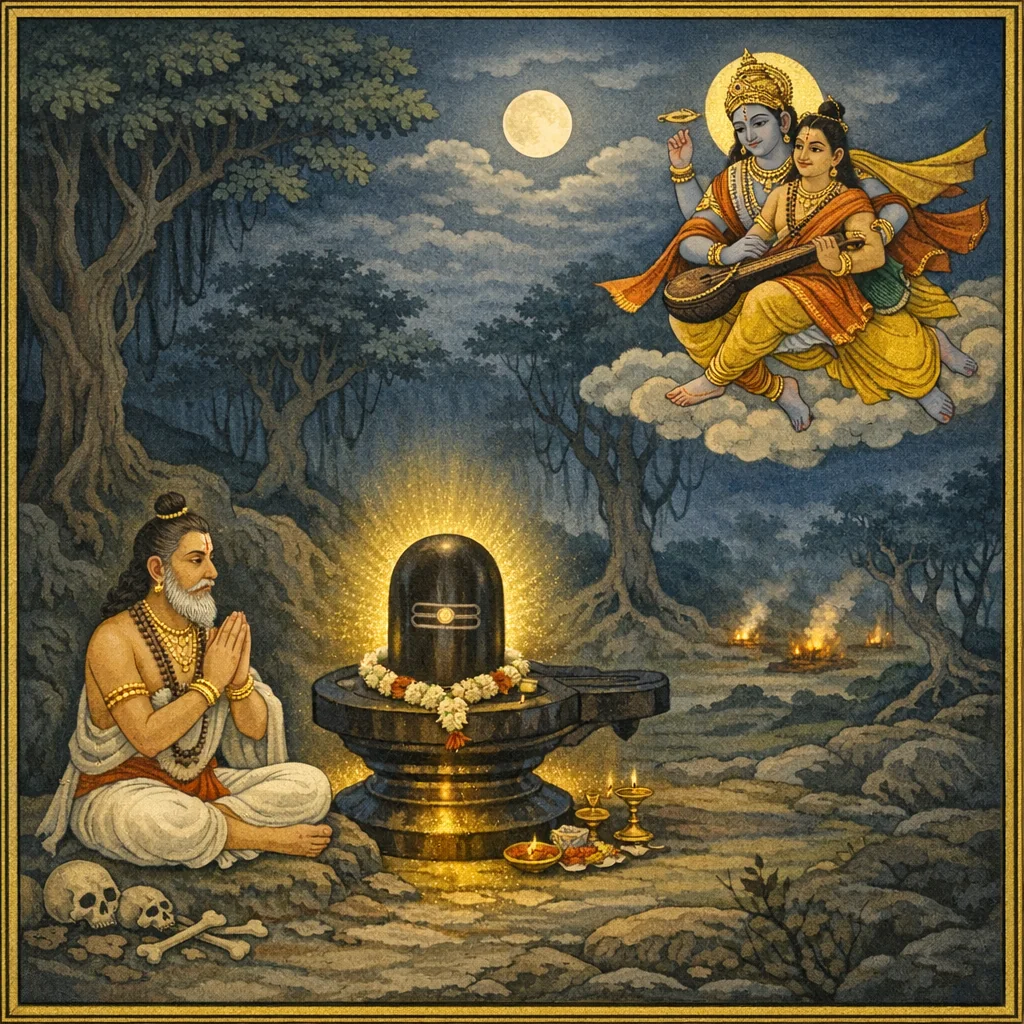
Adhyaya 58
Śrāddha-vidhi and Pitṛ-gaṇa Taxonomy in Avantī (श्राद्धविधिः पितृगणविचारश्च)
Chapter 58 unfolds as a didactic dialogue. Vyāsa asks for a fuller account of śrāddha—its supreme fruit, the extent of ancestral satisfaction, and the principles by which pitṛ categories are defined. Sanatkumāra replies by establishing śrāddha as a foundational ritual-ethical institution on which dharma and sacrificial order are said to rest, defining it as offerings made with śraddhā (reverent faith) addressed to devas and pitṛs. He then describes a cosmological reciprocity between devas and pitṛs and sets out a taxonomy of seven pitṛ groups, distinguishing their mūrta/amūrta (embodied/unembodied) forms, their abodes, and their relation to yogic attainment. Within this framework, pitṛ-kārya is declared superior to deva-kārya; practitioner qualifications are prescribed—brahmacarya, self-control, purity, freedom from anger, and scriptural grounding—with special emphasis on performance at tīrthas. The chapter compares degrees of satisfaction and fruit across sacred sites, culminating in praise of Gayā and especially Mahākālavana/Avantī. It closes with a broad salvific catalogue, listing many kinds of difficult or socially unanchored deaths for whom śrāddha at this tīrtha is recommended as an uplift. The final framing presents these observances as a means to be released from the “three debts” (ṛṇa-traya) and to attain desired aims through proper practice.
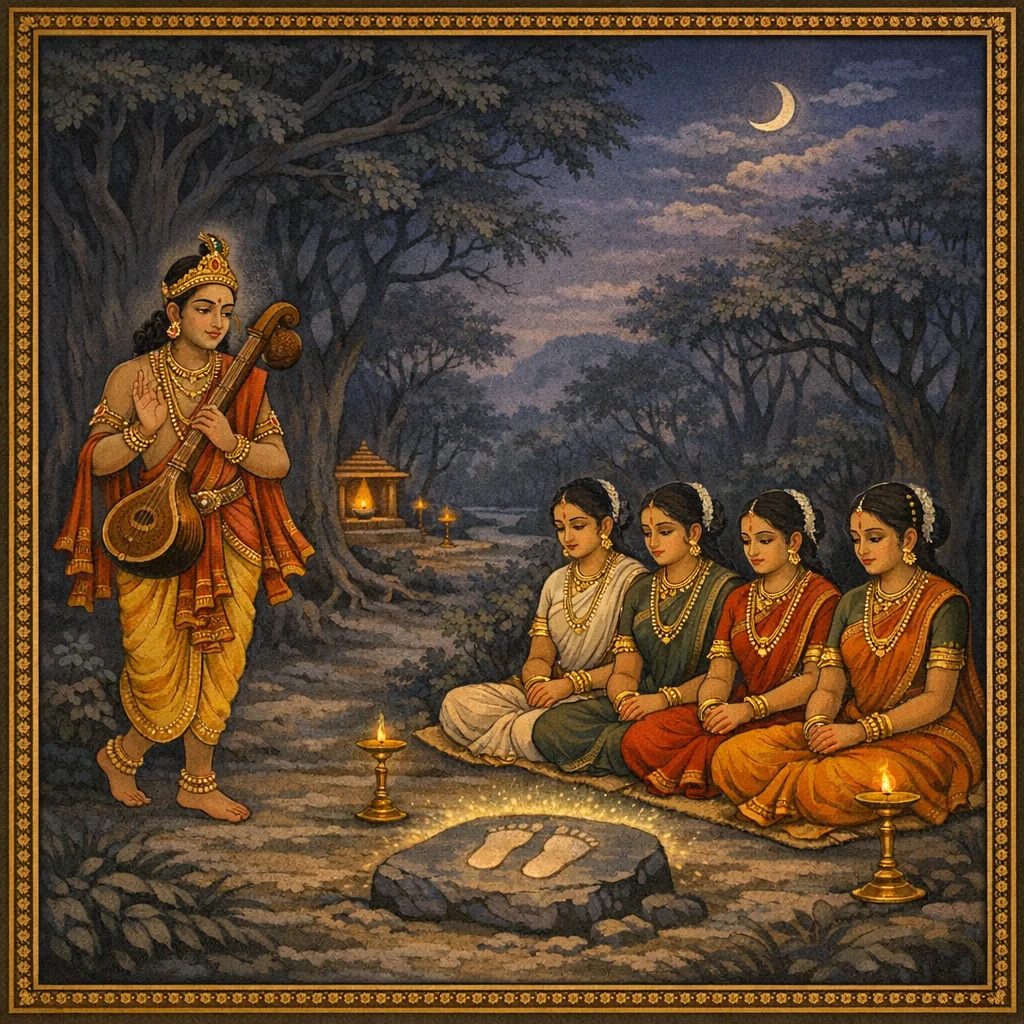
Adhyaya 59
गयातीर्थमाहात्म्य (Gaya Tīrtha Māhātmya in Avanti)
This adhyāya presents a theological dialogue in which Sanatkumāra explains to Vyāsa the presence and potency of a Gayā-associated tīrtha within Avanti, especially in the Mahākālavana. It first enumerates Gayā’s sanctifying features and the proper rites—bathing, gifting, and correctly performed śrāddha—stressing that the same fruits arise when these are done at the designated tīrtha-sites. Viṣṇu/Janārdana is praised as a paternal-form presence, connected with release from the “three debts” (ṛṇa-traya) through rightly oriented ancestral ritual. A localization account follows: the Gayā tīrtha is said to have been established in ancient Avanti and later linked with Kai-kaṭa; an asura is subdued through the symbolism of Gadādhara’s footprint and the consecration of that spot’s glory. The chapter then specifies ritual timing—ongoing legitimacy of Gayā-śrāddha, the annual Mahālaya observance with astrological markers, and an Anvaṣṭakā-related emphasis on maternal śrāddha. The latter half introduces a didactic legend of the seven sages’ wives (ṛṣipatnīs), socially displaced due to a stain on reputation, who are guided by Nārada to the Avanti Gayā tīrtha and the Akṣaya-vata. By fasting, vigil, and disciplined conduct on Ṛṣi-saṃjñitā Pañcamī, they regain purity and are reintegrated into household life. The phalaśruti affirms enduring merit from gifts at this site and equates hearing or reciting the account with the fruit of great sacrifices.
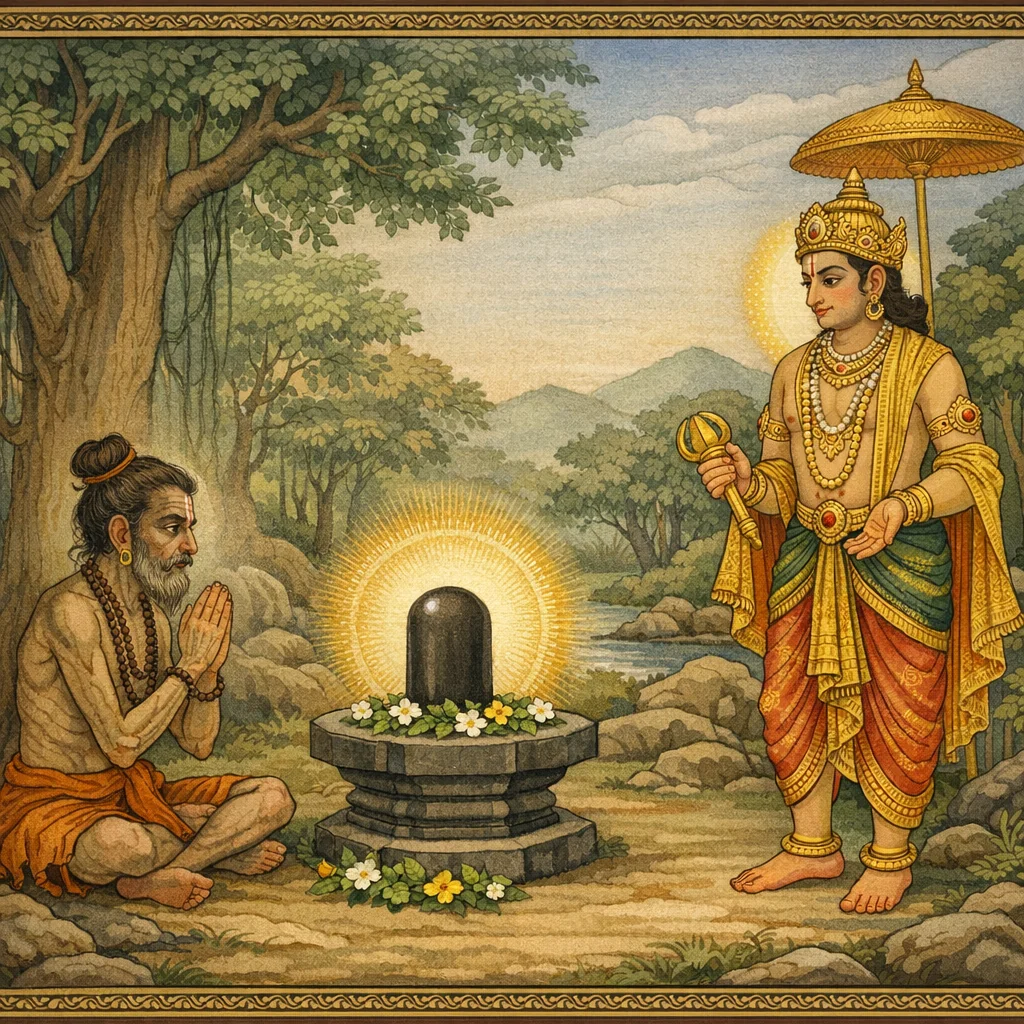
Adhyaya 60
पुरुषोत्तमतीर्थ-मलमासव्रतविधिः (Purushottama Tīrtha and the Adhika-māsa Vrata Procedure)
The chapter begins in a transmission frame: Vyāsa asks for a fuller account of the supreme tīrtha called Purushottama, and Sanatkumāra introduces the tale as sin-destroying by mere hearing. The scene shifts to Vaikuṇṭha, where Lakṣmī questions Viṣṇu about the proper vidhi for meritorious acts—dāna, snāna, tapas, and śrāddha—and how time, place, festival days, and tīrthas shape their results. Viṣṇu lists auspicious occasions (full/new moon, saṅkrānti, eclipses, vyatīpāta, and others), names major tīrthas, and declares that offerings in Avantī become akṣaya, yielding imperishable fruit. The discourse then centers on the intercalary month, Adhika-māsa (also called malimluca/malamāsa): what it is, how it arises astronomically (a month without a solar saṅkrānti), and which rites are to be avoided (certain saṃskāras) while devotional observances and vows are encouraged. Viṣṇu identifies himself as the lord of Adhika-māsa—Purushottama—and places his named tīrtha in Mahākālavana, promising stable welfare and enduring merit to those who bathe and keep vows there. A detailed vrata-vidhi follows: selecting specific lunar days, taking the vow, worshipping Vāsudeva with kumbha installation, offering pañcāmṛta, naivedya, lamps and incense, performing ārati, reciting the arghya-mantra and prayers, then feeding and honoring brāhmaṇas with gifts and concluding with communal eating. The chapter ends with a phala statement: neglect of Adhika-māsa observance leads to poverty and sorrow, while proper worship grants prosperity and protection from misfortune.
Adhyaya 61
अधिमास-स्नान-दानादि-माहात्म्यवर्णन (Adhimāsa: The Merit of Bathing, Charity, and Worship)
Sanatkumāra instructs Vyāsa on the ritual and theological merit of observing Adhimāsa (the intercalary lunar month) within the sacred sphere of Avantī. He declares that Adhimāsa disciplines undertaken outside the Mahākālavana setting are spiritually misdirected, whereas observance at the tīrtha called Purushottama bestows enduring worlds (sanātana lokāḥ). The chapter enjoins worship of Purushottama (Viṣṇu) and also devotion to Umā together with Śaṅkara, presenting a harmonized devotional order across Vaiṣṇava and Śaiva frames within one pilgrimage ecology. It further prescribes the Bhādrapada śukla ekādaśī vow: fasting (upavāsa) and nocturnal vigil (jāgaraṇa), with Viṣṇu-pūjā and a “water-journey” (jalayātrā) connected to Purushottama-sara, promising progeny, wealth, longevity, and health. It then situates nearby sacred nodes: Jāṭeśvara Mahādeva on a bank linked to Bhagīratha’s tapas and the narrative of Gaṅgā’s descent; and, to the northeast, Rāma Bhārgava’s austerity site by the Kauśikī river, where bathing removes grave sins, culminating in the purifying darśana of Rāmeśvara.
Adhyaya 62
गोमतीतीर्थकुण्डमाहात्म्यवर्णनम् | The Māhātmya of Gomatī Tīrtha and the Origin of Gomatī Kuṇḍa
This chapter unfolds as a multi-voiced theological discourse on the origin and ritual authority of Gomatī Kuṇḍa. Vyāsa asks Sanatkumāra when and how the ancient Gomatī Kuṇḍa came into being. Recalling an instructive gathering of sages (including Śaunaka), the text frames the topic through comparisons of sanctity among famed rivers and cities, establishing an order of sacred places. The narrative then turns to a teaching legend: the guru Sāndīpani and his two brahmacārī students, Rāma and Kṛṣṇa, question his absence at dawn. He explains his daily discipline—bathing in the Gomatī and performing sandhyā worship—setting forth a normative model of steady practice. At the etiological heart of the chapter, Gomatī is said to manifest/arrive near a Śiva-associated yajña-kuṇḍa, with Sarasvatī also present, and the site thereafter becomes known as “Gomatī Kuṇḍa.” The conclusion gives calendar-based observances—especially Bhādrapada kṛṣṇa aṣṭamī and a Caitra vow up to ekādaśī—emphasizing snāna, upavāsa, jāgaraṇa, Viṣṇu-pūjā, honoring Vaiṣṇavas and brāhmaṇas, and a phalaśruti promising purification and attainment of Viṣṇu-loka for those who listen.
Adhyaya 63
कंथडेश्वर-गंगेश्वर-वीरेश्वर-तीर्थमाहात्म्यं तथा वामनकुण्ड-प्रसङ्गः (Kaṇṭhaḍeśvara, Gaṅgeśvara, Vīreśvara Tīrtha-Māhātmya and the Vāmanakuṇḍa Episode)
Adhyāya 63 unfolds in two linked movements. First, Sanatkumāra explains the merit of key Avantī tīrthas: Kaṇṭhaḍeśvara is praised as an unsurpassed bathing-place where snāna together with Mahādeva-darśana removes demerit and uplifts the devotee. The account then turns to a confluence near Gaṅgeśvara, framed by Gaṅgā’s descent from heaven and Śiva’s holding her upon his head; here, snāna and Gaṅgeśa-darśana are said to equal the merit of bathing in the Gaṅgā and to lead, after death, to higher realms such as Viṣṇu-loka. Vīreśvara is introduced as another station where residence and worship purify and grant a “heroic” loka. Next, the chapter introduces Vāmanakuṇḍa, famed in the three worlds; mere sight is declared to expiate even grave wrongdoing, and the place is tied to the Prahlāda–Bali narrative frame. Vyāsa asks its origin, and Sanatkumāra responds with a historical-theological teaching: Prahlāda’s virtues are listed, Bali’s righteous rule is described, Nārada’s provocation leads Bali to confront the devas, and the devas seek Brahmā, who directs them to specific tīrthas and devotional procedures. Ritual guidance (a dhyāna-formula for Viṣṇu and a Gaṇeśa salutation for removing obstacles) is woven together with a long stotra presented as a salvific recitation. Overall, the chapter binds place (tīrtha) to practice (upāsanā, japa, pūjā) and to ethical eligibility, portraying pilgrimage as disciplined devotion rather than incidental travel.
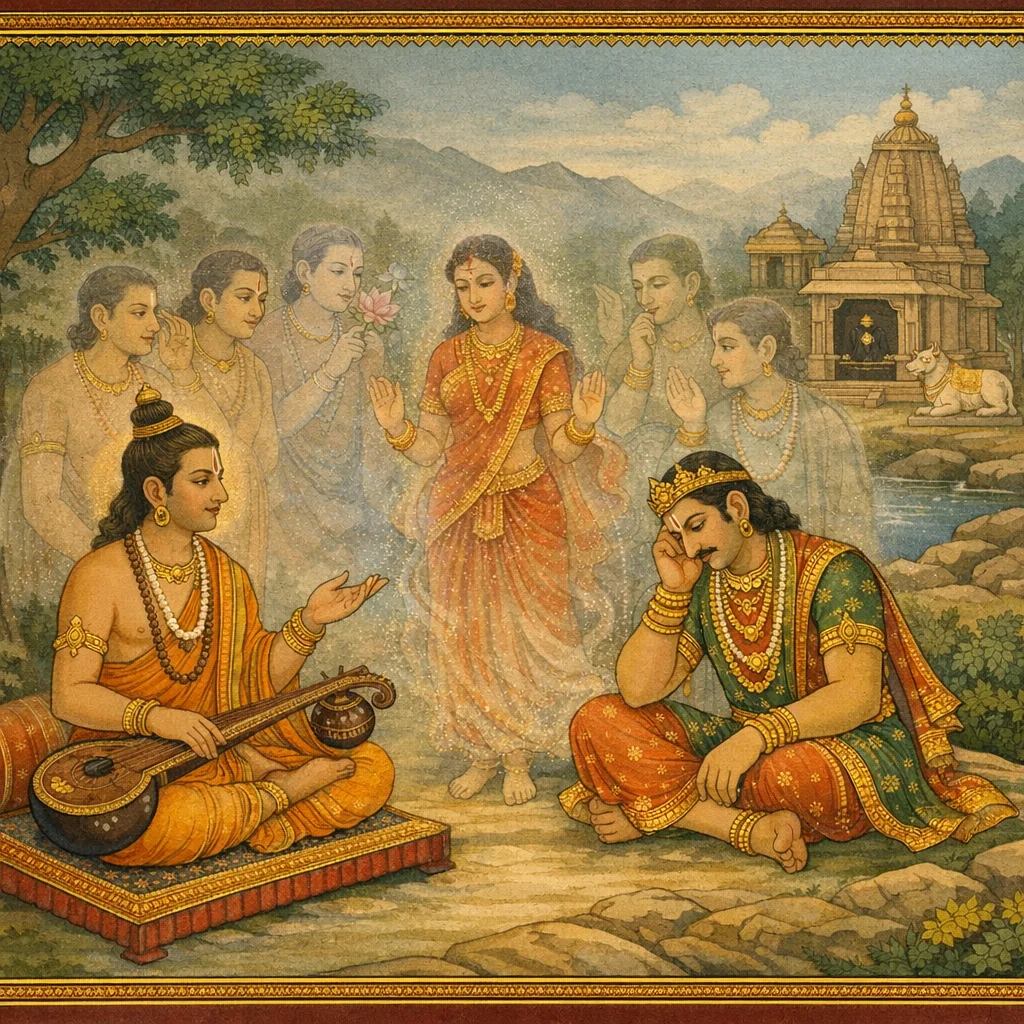
Adhyaya 64
कालभैरवतीर्थयात्रावर्णनम् / Description of the Pilgrimage to Kālabhairava Tīrtha
Adhyāya 64 presents a structured tīrtha-māhātmya centered on Kālabhairava Tīrtha. Sanatkumāra promises to describe Vīreśvara and the merit of bathing, and points to a foremost nāga-associated sacred ford named Kālabhairava, praised for fulfilling aims and relieving suffering through mere darśana. When Vyāsa asks why it is famed, an origin account portrays Bhairava as a yogic protector who repels hostile forces linked with yoginī-groups and destroys ruinous afflictions such as kṛtyās and personified calamities. Bhairava’s presence is then fixed on the bank of the Shiprā—especially the auspicious northern side—and tied to calendrical observances: worship on key tithis, notably aṣṭamī, navamī, and above all caturdaśī, with a special emphasis on a Sunday in Āṣāḍha’s bright fortnight. Practical ritual instructions follow: offerings of leaves, flowers, arka, fragrances, naivedya, tāmbūla, garments, and scents, along with feeding brāhmaṇas, homa, and tarpana, all framed as means to attain “all aims” and auspiciousness. A substantial stotra section describes Bhairava’s iconography and qualities, culminating in the benefits of the Bhairavāṣṭaka: the destruction of bad dreams and support amid disputes, danger, royal displeasure, warfare, bondage, and poverty, declaring that disciplined reciters find nothing they desire unattainable. The chapter closes by urging those fearful of worldly existence to strive for snāna-dāna and worship at this tīrtha.
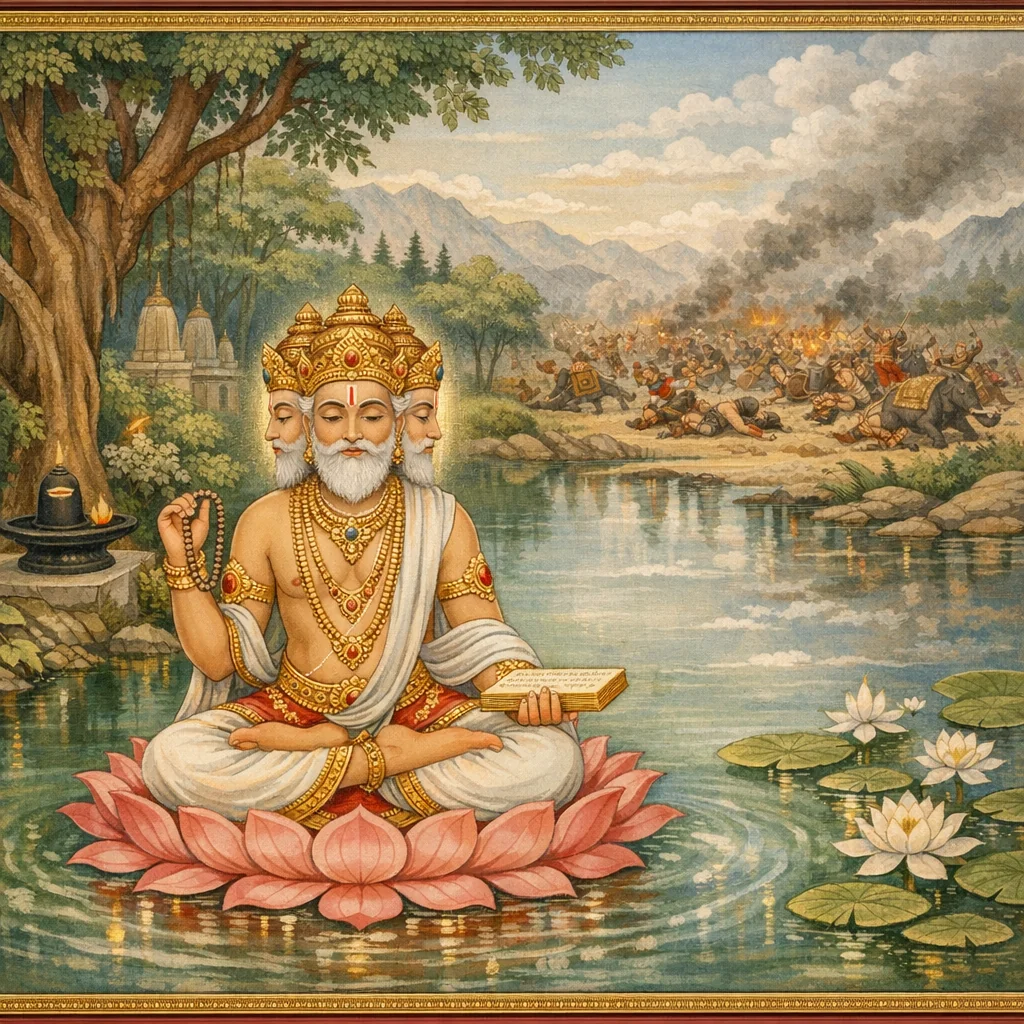
Adhyaya 65
Nāgatīrtha-Māhātmya and the Settlement of the Nāgas in Mahākālavana (नागतीर्थमाहात्म्यं तथा नागनिवासवर्णनम्)
The chapter begins with Vyāsa asking Sanatkumāra to explain Nāgatīrtha more fully—its greatness and when its glory was proclaimed. Sanatkumāra replies with a purifying account, declaring that even hearing it is liberating. He recalls the Nāgas’ suffering through a maternal curse and the peril of Janamejaya’s serpent-sacrifice, from which they are saved by Āstīka’s intervention. Seeking a fearless dwelling, the Nāgas ask Āstīka for a secure abode. Āstīka directs them to the southern region of Mahākālavana, linked to an ancient tīrtha and a Nāga-settlement where Hari is present as Śeṣaśāyī (Viṣṇu in yoganidrā). The sanctity of the site is strengthened by naming exemplary sages and attainments—Lomāśa, Mārkaṇḍeya, Kapila, Harīścandra, and the Seven Sages—affirming that Mahākālavana’s power steadies time and removes curse-born दोष. Named Nāgas—Elāpatra, Kambala, Karkoṭaka, Dhanañjaya, Vāsuki, Takṣaka, Nīla, Padmaka, and Arbuda—arrive, establish their stations, and bring forth new tīrthas and kuṇḍas, praised as highly merit-giving and sin-destroying, frequented by siddhas, gandharvas, ṛṣis, and apsarases. A Śvetadvīpa-like paradise is described with sacred trees, birds, fragrances, and treasures. Bathing is said to lead to Vaikuṇṭha; at Ramāsara one becomes śrīmān; and at the tīrtha of Bali’s āśrama, rites grant immediate purification. The chapter ends with ritual guidance: offerings and dāna—ideally the gift of land—yield enduring increase. In Śrāvaṇa, on darśa, on pañcamī, and on Somavāra, Nāga-pūjā is prescribed; and darśa-śrāddha is declared akṣaya, fulfilling desired aims.
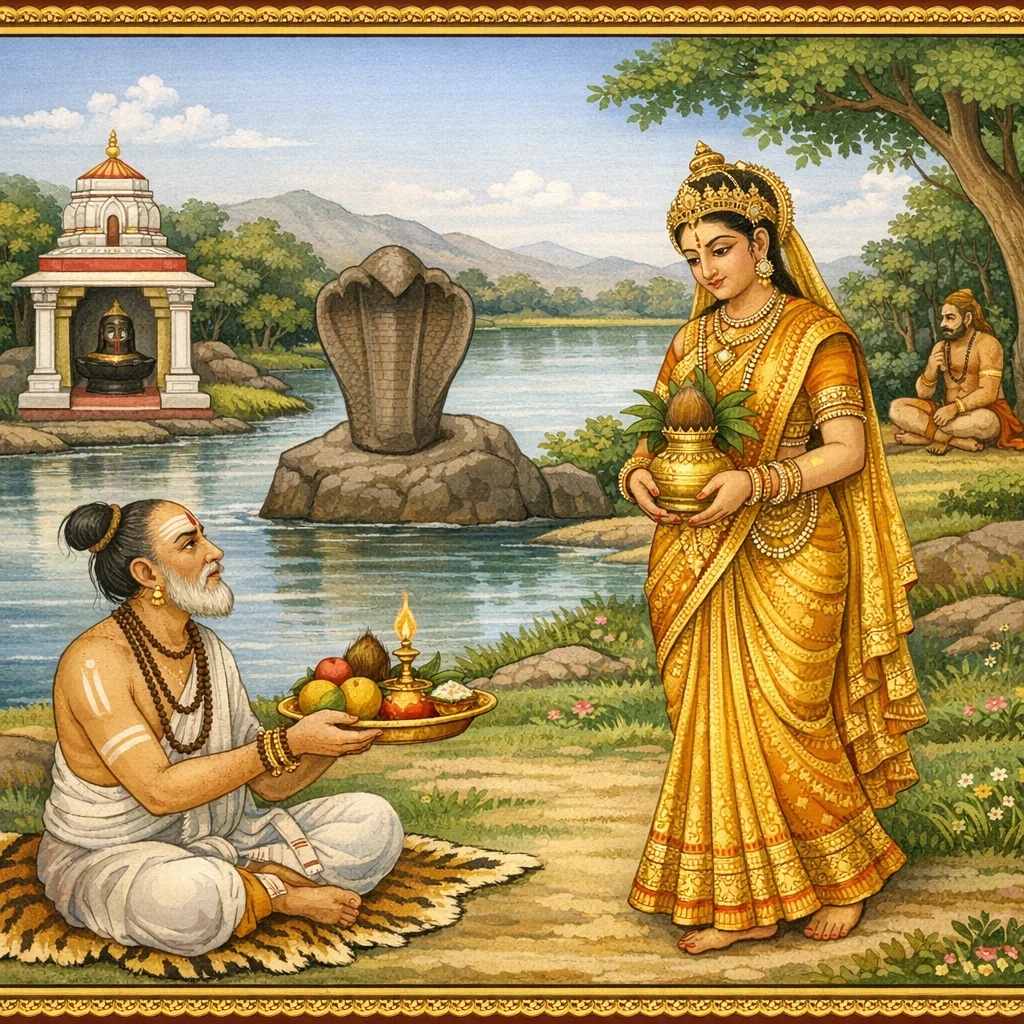
Adhyaya 66
नृसिंहतीर्थ-माहात्म्य तथा सावित्रीव्रत-फलश्रुति (Glory of Nṛsiṃha Tīrtha and the Fruits of the Sāvitrī Vrata)
Sanatkumāra continues instructing Vyāsa, declaring that in Avantī there is a supreme tīrtha connected with Mahātmā Nṛsiṃha, where mere darśana removes sin. The Hiranyakaśipu episode is retold with place-linked emphasis: the Earth, burdened by asuric rule, approaches Brahmā in the emblematic form of a cow. Brahmā recounts the demon’s fierce tapas and Gāyatrī-upāsanā, and the boon that made him nearly invulnerable through many exclusions (not by day or night, not in sky or on earth, not by wet or dry, not by weapons, not by various beings), yet leaving one loophole—death by a hero’s single hand-strike. The narrative then turns to sacred geography: Brahmā directs the devas to Mahākālavana on the Shiprā and specifies the Nṛsiṃha tīrtha’s location by shrine-based markers (near Saṅgameśvara; between signs such as Karkarāja and the southern bank). The devas perform snāna, dāna, and arcana there, regain their stations, and Hari appears as Nṛsiṃha to slay the demon with one blow, fulfilling the boon’s logic. Ongoing midday worship at the tīrtha is commended, and benefits are stated: worship on Nṛsiṃha-tithi/caturdaśī brings Lakṣmī’s favor; darśana of Agastyeśvara removes worldly scarcity; and Hanumān is noted as a siddha presence. Finally, the chapter outlines the Sāvitrī-vrata and a model dāna—offering a golden Sāvitrī with auspicious items to a learned brāhmaṇa—promising prosperity, enjoyment, heaven, and for women, marital affection and protection from widowhood as the declared phala.
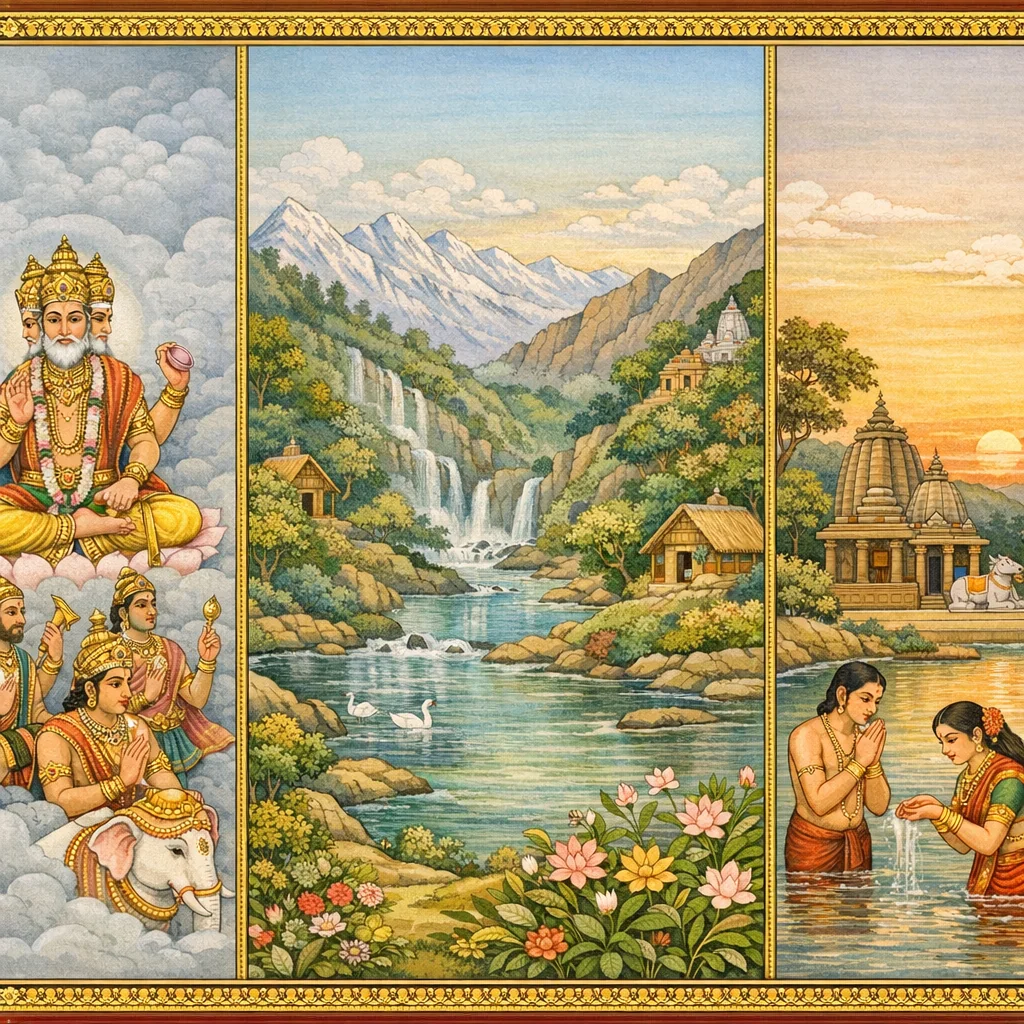
Adhyaya 67
कुटुम्बेश्वरतीर्थमाहात्म्य (Kutuṃbeśvara Tīrtha Māhātmya)
Chapter 67 proclaims the greatness of Kutuṃbeśvara as a famed seat of Mahādeva, and of its tīrtha, said to bestow in full the merit-fruit of all tīrthas. The place is linked to primordial austerities: Dakṣa Prajāpati undertakes prolonged tapas for the prosperity of his lineage, and Brahmā is described as attaining a purified lotus-form through severe penance. Mahādeva’s eminence is further affirmed by a living cultic sign—a four-faced liṅga—declared to be “visible even today,” rooting the myth in present geography. The chapter also establishes the presence of the Goddess (Bhadrakālī/Bhadrāpīṭhadharā) and Bhairava as the kṣetrapāla at the threshold, emphasizing protection and the continuity of divine attendants. For times of distress—epidemics and social turmoil included—it prescribes practical rites: regular homa with specified grains/seeds, worship of the guardian, and disciplined conduct. Merit is articulated through snāna, Mahādeva-pūjā, and focused dāna (notably the gift of kūṣmāṇḍa) to ascetic Brahmins, promising prosperity and household flourishing (“kutuṃbī” status). A calendrical vrata is highlighted on Phālguna śukla caturdaśī, linked with trayoḍaśī in a Śivarātri frame: night vigil, bilva-water offerings, fragrances, flowers, lamps, and feeding seven Brahmins, with the phalāśruti praised as equal to great sacrifices.
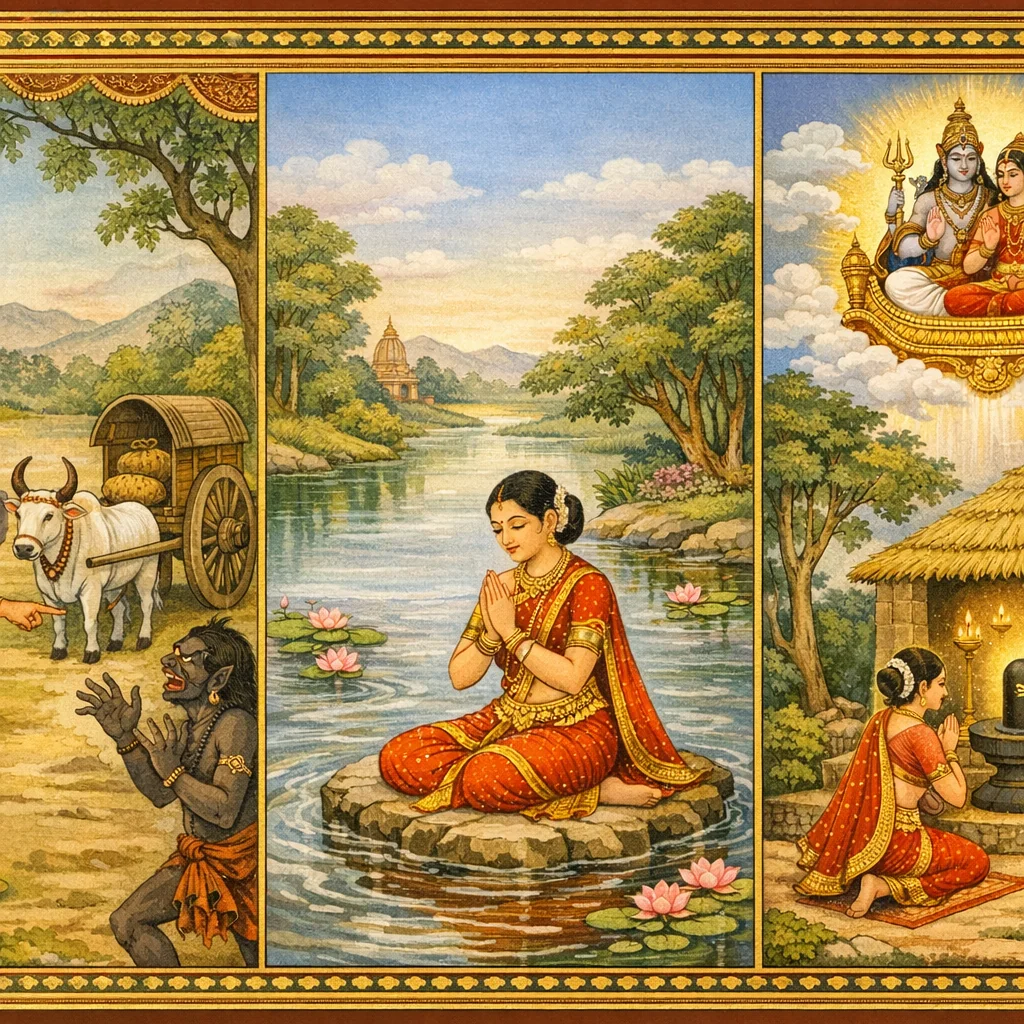
Adhyaya 68
अखण्डेश्वरमहिमवर्णनम् | The Glory of Akhaṇḍeśvara and Akhaṇḍa-saras
Sanatkumāra instructs Vyāsa on a sequence of sacred nodes in Avantīkṣetra. He first proclaims Devaprayāga, near the Kṣiprā and connected with Somatīrtha, as a supremely purifying tīrtha; bathing there is linked with the merit of beholding Mādhava, a deity said to grant desired results. He then introduces Ānanda-bhairava, whose mere darśana is declared to dissolve sin and remove fear of punishment, presenting the place as a moral safeguard. A calendrical note follows, naming an auspicious conjunction (Jyeṣṭha month, bright fortnight, tenth lunar day, Budha/Hasta, vyatīpāta, etc.) on which bathing yields the complete fruit of tīrthas. The discourse turns to a didactic exemplum: the disciplined brāhmaṇa Dharmāśarma, troubled by a disruption of his vrata, consults Nārada, who recounts the case of the transgressive brāhmaṇa Brahmadatta. Dying near the Godāvarī/Gautamī bank, he accidentally received the “air-contact” of innumerable tīrthas during Siṃhastha, and Yama’s court released him. The teaching explains how sacred geography can mitigate karmic consequence, even as such associations can provoke anxiety about vrata-bhaṅga. Nārada prescribes Mahākālavana’s Koṭitīrtha and, north of it, Akhaṇḍa-saras near Akhaṇḍeśvara, where mere darśana equals yajña-fruit. Dharmāśarma bathes in Akhaṇḍa-saras, beholds Maheśvara, and immediately attains meritorious worlds, concluding with a phala-focused praise of Akhaṇḍeśvara as a foremost tīrtha.
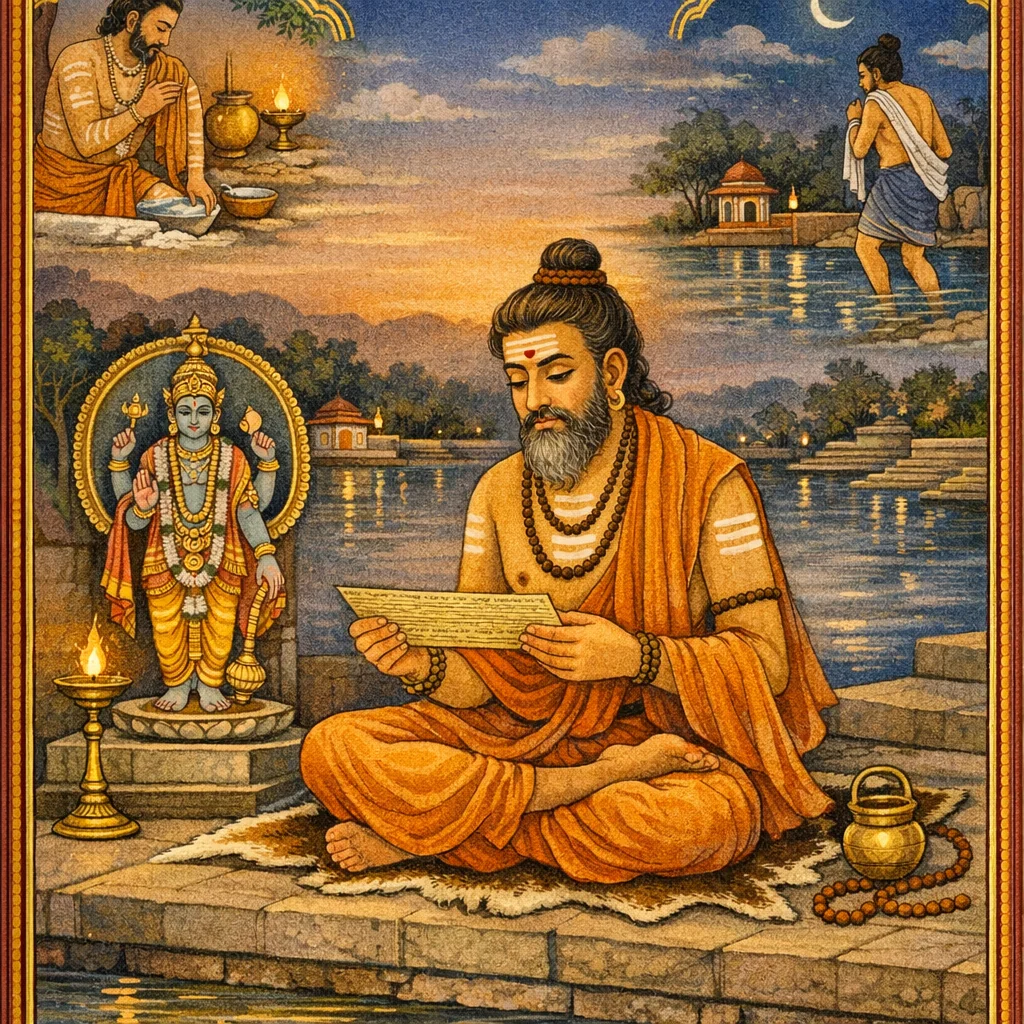
Adhyaya 69
कर्कराजतीर्थमाहात्म्य एवं चातुर्मास्यस्नानविधिः (Karkarāja Tīrtha Māhātmya and Cāturmāsya Bathing Discipline)
Adhyāya 69 presents an authority-grounded theological discourse on the supreme tīrtha on the bank of the Śiprā, Karkarāja. Sanatkumāra introduces it as a site earlier praised by Brahmā in reply to Mārkaṇḍeya’s question, thereby establishing a sacred lineage of transmission and legitimacy. The chapter links the tīrtha’s saving power to calendrical threshold periods—especially Cāturmāsya, when Hari is said to be “asleep,” and the Dakṣiṇāyana. Deaths occurring in these intervals are described as leading to difficult post-mortem courses, for which Karkarāja is portrayed as a remedial refuge. Brahmā teaches that ritual bathing (snāna), remembrance of Viṣṇu, and disciplined vrata observance during Cāturmāsya are decisive, while deeds done without such purification are declared fruitless. Practical rules are given: avoid night-bathing, avoid hot-water bathing in specified contexts, and when physically unable, use alternatives such as bhasma-snāna or mantra-snāna. The tīrtha is further exalted by the claim that the merits of many pilgrimage sites dwell in Karkarāja’s waters. The chapter ends with a phalaśruti stating that hearing or reciting this account prevents the faults said to arise from negligence during Cāturmāsya.
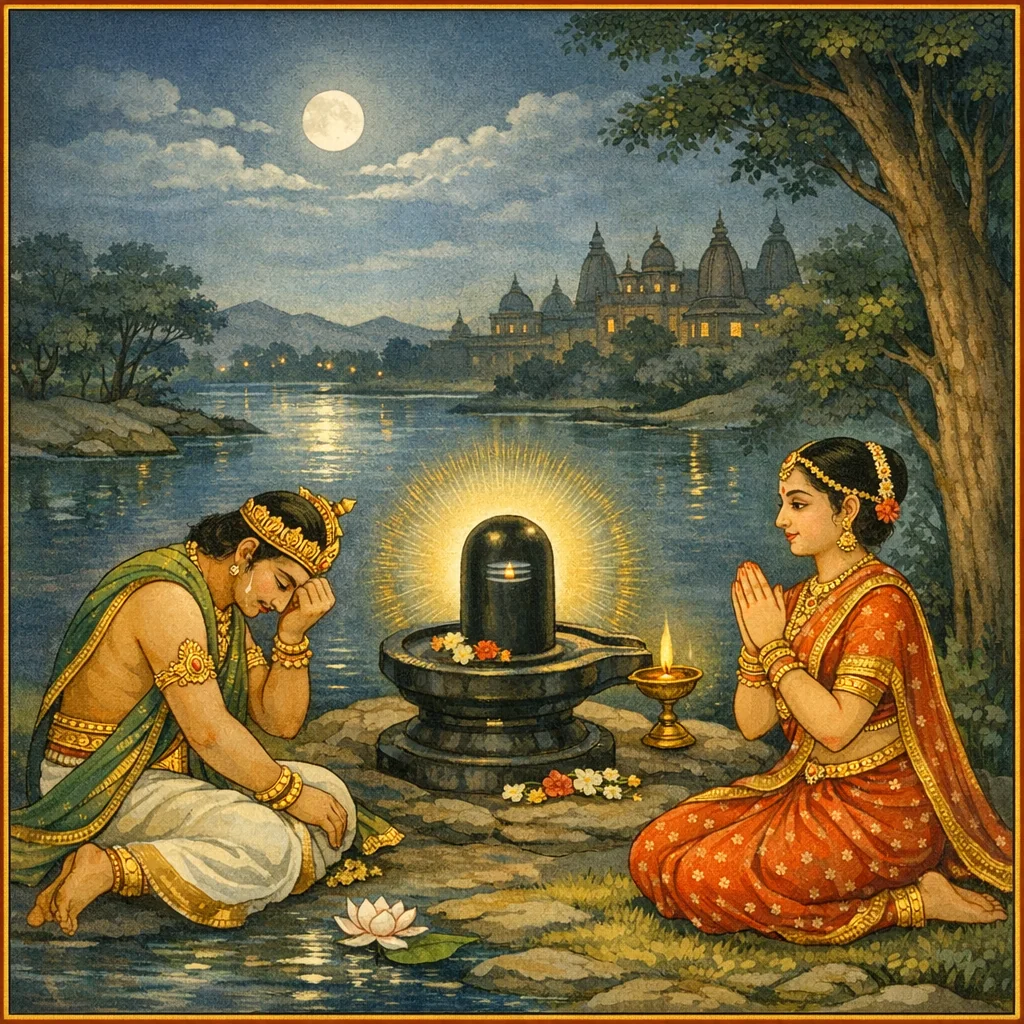
Adhyaya 70
तीर्थ-देवयात्रा-प्रशंसा तथा महाकालवन-देवतासूची (Tīrtha and Devayātrā Protocol; Deity Catalog of Mahākālavana)
Adhyāya 70 opens with Sanatkumāra describing sacred places near Meru: the wish-fulfilling lake Ramyasaras and the tīrtha Bindu-sara, said to grant desired aims through ritual bathing and charitable giving. He also notes calendrical observances, especially in Bhādrapada, including an auspicious caturthī connected with Gaṇādhipa (Gaṇeśa). The site Manah-kāmeśvara is praised as fulfilling intentions through darśana and snāna. Vyāsa then requests a systematic account of Avantī’s tīrthas and shrines; Sanatkumāra replies that they are innumerable, stressing their density with cosmological comparisons. A practical discipline is set forth as devayātrā: maintaining purity, morning preparation, Viṣṇu-smaraṇa, bathing (such as at Rudra-saras), and then performing deity-appropriate abhiṣeka and pūjā at each tīrtha. An Umā–Maheśvara dialogue is embedded, cataloging the sacred ecology of Mahākālavana—principal rivers, groups of deities (Vināyakas, Bhairavas, Rudras, Ādityas), extensive lists of liṅgas, the four gate-guardian liṅgas in the cardinal directions, and the Navagraha tīrthas used for protective rites. The phalaśruti declares that devayātrā relieves hardships (including those attributed to planetary afflictions), grants worldly stability—wealth, progeny, learning, victory—and culminates in auspicious continuity aligned with Śiva’s realm.
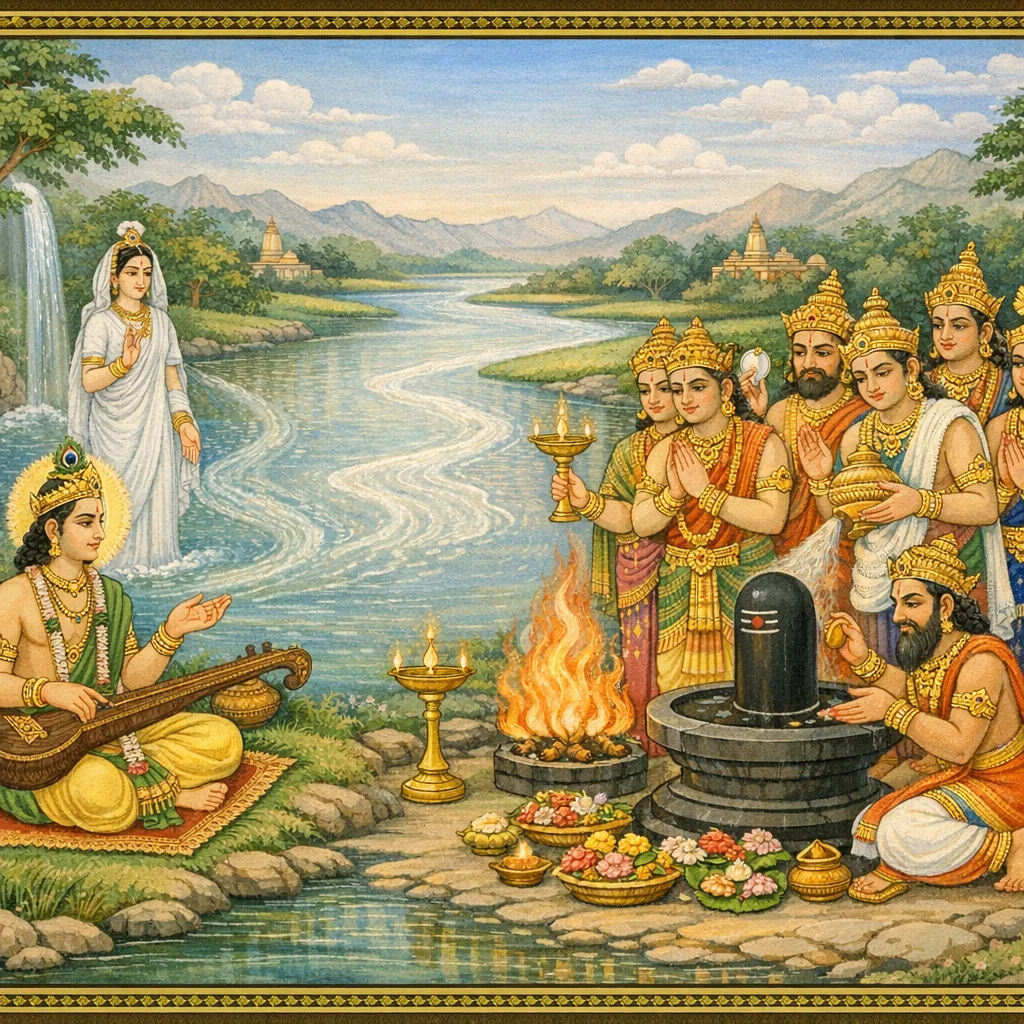
Adhyaya 71
महाकालवने तीर्थप्रशंसा (Praise and Enumeration of Tīrthas in Mahākālavana)
Chapter 71 is conveyed through a layered chain of dialogue. Vyāsa asks Sanatkumāra to explain further the number and character of the tīrthas in Avantī’s Mahākālavana. Sanatkumāra introduces it as a sin-destroying account rooted in an Umā–Maheśvara conversation, prompted by Nārada’s inquiry. Nārada requests Mahādeva to describe the tīrthas present in the auspicious Mahākālavana. Mahādeva replies that the famed tīrthas of the earth—including those connected with Puṣkara—are found in this supreme forest as well, and that the sacred sites and liṅgas are “asankhyāta,” beyond counting. Specific scenes are evoked, such as the tīrtha called Paiśācamocana, where seasonal phenomena are described. Though precise enumeration is admitted to be impossible, Mahādeva offers a practical principal list: prominent tīrthas correspond in renown to the days of the year. The teaching then turns to ritual timing and merit—completing a full year’s circuit yields the “Avantī-yātrikā,” and a properly performed pilgrimage grants extraordinary spiritual fruit, especially in Vaiśākha, when five days in Avantī are said to equal long residence in Kāśī. The chapter ends with a phalaśruti: devoted recitation or hearing increases Śiva-bhakti, merit, and good repute, and is said to uplift one’s lineage toward Śiva’s state.
FAQs about Avanti Kshetra Mahatmya
It foregrounds Avantī as a Mahākāla-centered kṣetra whose sanctity is described as exceptionally potent, including claims of enduring efficacy and rare accessibility even for celestial beings.
The section repeatedly associates the kṣetra with purification from major transgressions, the granting of bhukti and mukti, and the idea that residence, worship, and contact with the sacred landscape yield heightened merit.
Core legends include the naming and classification of Mahākālavanam (as kṣetra, pīṭha, ūṣara, and śmaśāna), and transmission narratives where sages (notably Sanatkumāra) explain the site’s theological status to authoritative listeners.