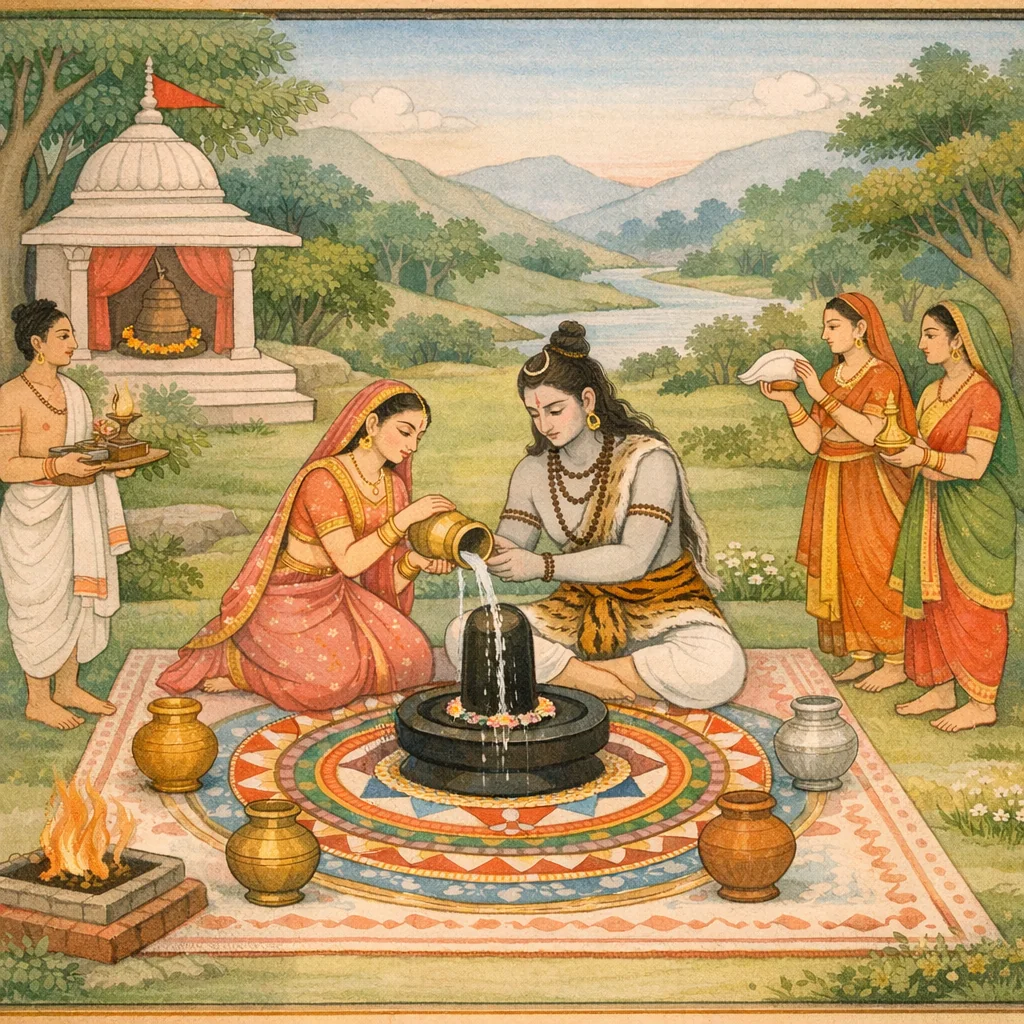
शिवाचार्याभिषेकविधिः / Rite of Consecrating a Śiva-Teacher (Śivācārya Abhiṣeka)
Adhyāya 20 sets forth the formal abhiṣeka by which a duly prepared disciple—purified by saṃskāra and observing the Pāśupata-vrata—is installed as a Śivācārya according to proper yogic and ritual qualification. The rite begins with constructing the maṇḍala “as before” and worshipping Parameśvara. Five kalaśas are placed in the directions and the center, assigned to Śaiva powers/kalās: Nivṛtti in the east/front, Pratiṣṭhā in the west, Vidyā in the south, Śānti in the north, and Parā in the center. Protective rites (rakṣā), the dhainavī mudrā, mantra-consecration of the vessels, and offerings up to the pūrṇāhuti are performed according to precedent. The disciple enters the maṇḍala with head uncovered, and mantra-tarpaṇa and other preliminaries are completed. The teacher seats him for abhiṣeka, performs sakalīkaraṇa (making complete), binds/manifests the five-kalā form, and ritually hands the disciple over to Śiva. Abhiṣeka is then administered in sequence beginning with the Nivṛtti vessel; afterward the teacher places “Śiva’s hand” upon the disciple’s head and formally enjoins him as a Śivācārya. Further worship follows, with a prescribed homa of 108 offerings, concluding in a final full oblation.
Shlokas
Verse 1
उपमन्युरुवाच । अथैवं संस्कृतं शिष्यं कृतपाशुपतव्रतम् । आचार्यत्वे ऽभिषिंचेत तद्योगत्वेन चान्यथा
Upamanyu said: “Then, having thus duly purified and prepared the disciple—one who has undertaken the Pāśupata observance—the preceptor should anoint him by abhiṣeka into the rank of teacher; otherwise, it should be done only according to that disciple’s fitness for the discipline of yoga.”
Verse 2
मण्डलं पूर्ववत्कृत्त्वा संपूज्य परमेश्वरम् । स्थापयत्पञ्चकलशान्दिक्षु मध्ये च पूर्ववत्
Having prepared the ritual maṇḍala as before and duly worshipped Parameśvara (Lord Śiva), one should then place the five consecration pots (pañca-kalaśa) in the directions and one in the centre, just as prescribed earlier.
Verse 3
निवृत्तिं पुरतो न्यस्य प्रतिष्ठां पश्चिमे घटे । विद्यां दक्षिणतः शांतिमुत्तरे मध्यतः पराम्
Placing Nivṛtti in the front, and Pratiṣṭhā in the vessel to the west; placing Vidyā to the south, Śānti to the north, and the Supreme (Parā) in the center—thus should one arrange these divine powers in the ritual setting.
Verse 4
कृत्वा रक्षादिकं तत्र बद्ध्वा मुद्रां च धैनवीम् । अभिमंत्र्य घटान्हुत्वा पूर्णांतं च यथा पुरा
There, having performed the protective rites (rakṣā) and the rest, and having applied the Dhainavī mudrā, he should consecrate the pots with mantra; then, offering oblations, he should complete the rite up to the final pūrṇāhuti—just as prescribed earlier.
Verse 5
प्रवेश्य मंडले शिष्यमनुष्णीषं च देशिकः । तर्पणाद्यं तु मंत्राणां कुर्यात्पूर्वावसानकम्
Having led the disciple—without head‑covering—into the consecrated maṇḍala, the teacher (deśika) should perform, beginning with the rite of tarpaṇa, the preliminary concluding observances of the mantras, completing them in due order.
Verse 6
ततः संपूज्य देवेशमनुज्ञाप्य च पूर्ववत् । अभिषेकाय तं शिष्यमासनं त्वधिरोहयेत्
Thereafter, having duly worshipped the Lord of the gods and, as before, obtained His permission, the preceptor should seat that disciple upon the ritual seat, in order to perform the consecratory ablution (abhiṣeka).
Verse 7
सकलीकृत्य तं पश्चात्कलापञ्चकरूपिणम् । न्यस्तमंत्रतनुं बद्ध्वा शिवं शिष्यं समर्पयेत्
Then, having made it complete—formed of the five kalās—and having bound and secured the disciple whose body has been consecrated by the placing of mantras, one should formally offer that auspicious disciple to Śiva.
Verse 8
ततो निवृत्तिकुंभादिघटानुद्धृत्य वै क्रमात् । मध्यमान्ताच्छिवेनैव शिष्यं तमभिषेचयत्
Then, lifting up in due order the ritual vessels—beginning with the Nivṛtti-kumbha—Śiva Himself consecrated that disciple, from the middle up to the end of the rite.
Verse 9
शिवहस्तं समर्प्याथ शिशोः शिरसि देशिकः । शिवभावसमापन्नः शिवाचार्यं तमादिशेत्
Then the preceptor, placing the ‘hand of Śiva’ upon the child’s head, and entering the state of Śiva-consciousness, should appoint him as a Śiva-teacher (Śivācārya).
Verse 10
अथालंकृत्य तं देवमाराध्य शिवमण्डले । शतमष्टोत्तरं हुत्वा दद्यात्पूर्णाहुतिं ततः
Then, having adorned that deity and duly worshipped Him within the Śiva-maṇḍala, one should offer one hundred and eight oblations into the sacred fire; thereafter, one should present the final, complete oblation (pūrṇāhuti).
Verse 11
पुनः सम्पूज्य देवेशं प्रणम्य भुवि दंडवत् । शिरस्यंजलिमाधाय शिवं विज्ञापयेद्गुरुः
Having once again duly worshipped the Lord of the gods, and bowing on the ground like a staff, the guru—placing folded hands upon his head—should then submit his humble request to Lord Śiva.
Verse 12
भगवंस्त्वत्प्रसादेन देशिकोयं मया कृतः । अनुगृह्य त्वया देव दिव्याज्ञास्मै प्रदीयताम्
O Blessed Lord, by Your grace I have been made a competent preceptor. O Deva, in Your compassion, please bestow upon him the divine command—Your sacred authorization and guidance.
Verse 13
एवं विज्ञाप्य शिष्येण सह भूयः प्रणम्य च । शिवं शिवागमं दिव्यं पूजयेच्छिववद्गुरुः
Thus, having instructed and informed him, and again bowing down together with the disciple, the Guru—Shiva-like in conduct—should worship the auspicious Lord Shiva and the divine Śivāgama, the sacred Shaiva scripture.
Verse 14
पुनः शिवमनुज्ञाप्य शिवज्ञानस्य पुस्तकम् । उभाभ्यामथ पाणिभ्यां दद्याच्छिष्याय देशिकः
Having once again sought Lord Shiva’s permission, the preceptor should present the book of Shiva-knowledge to the disciple, offering it reverently with both hands.
Verse 15
स ताम्मूर्ध्नि समाधाय विद्यां विद्यासनोपरि । अधिरोप्य यथान्यायमभिवंद्य समर्चयेत्
Placing that sacred Knowledge upon his head, he should then enthrone that Vidyā upon the seat of learning; and, according to the prescribed rule, he should bow to it and worship it with due reverence.
Verse 16
अथ तस्मै गुरुर्दद्याद्राजोपकरणान्यपि । आचार्यपदवीं प्राप्तो राज्यं चापि यतो ऽर्हति
Then the Guru should also bestow upon him the royal insignia and the requisites of kingship. For, having attained the status of an Ācārya, he is indeed worthy of sovereignty as well.
Verse 17
अथानुशासनं कुर्यात्पूर्वैराचरितं यथा । यथा च शिवशास्त्रोक्तं यथा लोकेषु पूज्यते
Then one should lay down and follow the proper discipline exactly as it was practiced by the ancients—just as it is taught in Śiva’s own scriptures, and in the manner that is honored and revered among the worlds.
Verse 18
शिष्यान्परिक्ष्य यत्नेन शिवशास्त्रोक्तलक्षणैः । संस्कृत्य च शिवज्ञानं तेभ्यो दद्याच्च देशिकः
After carefully examining the disciples by the marks taught in the Śiva-śāstras, the preceptor should duly purify and refine them, and then impart to them the knowledge of Śiva.
Verse 19
एवं सर्वमनायासं शौचं क्षांतिं दयां तथा । अस्पृहामप्यसूयां च यत्नेन च विभावयेत्
Thus, with deliberate effort, one should cultivate—without strain—purity, forbearance, and compassion, along with contentment free from craving and a mind devoid of envy.
Verse 20
इत्थमादिश्य तं शिष्यं शिवमुद्वास्य मंडलात् । शिवकुंभानलादींश्च सदस्यानपि पूजयेत्
Having thus instructed that disciple, he should ceremonially dismiss Śiva from the maṇḍala; and he should also worship the Śiva-kumbha (consecrated vessel), the sacred fire, and the other officiants present.
Verse 21
युगपद्वाथ संस्कारान्कुर्वीत सगणो गुरुः । तत्र यत्र द्वयं वापि प्रयोगस्योपदिश्यते
Then the Guru—together with his assisting attendants—should perform the prescribed consecratory saṃskāras, either all at once or in the manner instructed. Wherever the ritual procedure teaches two alternatives, he should act accordingly.
Verse 22
तदादावेव कलशान्कल्पयेदध्वशुद्धिवत् । कृत्वा समयसंस्कारमभिषेकं विनाखिलम्
At the very outset, one should arrange the kalaśas, the consecrated water-pots, in the manner prescribed for adhva-śuddhi, the purification of the ritual path. Having performed the samaya-saṃskāra—initiation and sacred covenant—one should then carry out the complete abhiṣeka, the consecratory ablution, without omission.
Verse 23
समभ्यर्च्य शिवं भूयः कृत्वा चाध्वविशोधनम् । तस्मिन्परिसमाप्ते तु पुनर्देवं प्रपूजयेत्
Having once again duly worshipped Lord Śiva and performed the purification of the adhvan (the ritual path and its principles), when that is completed one should again worship the God—Śiva—yet again.
Verse 24
हुत्वा मंत्रन्तु संतर्प्य संदीप्याशास्य चेश्वरम् । समर्प्य मंत्रं शिष्यस्य पाणौ शेषं समापयेत्
Having offered the oblation and duly satisfied the mantra-deity, and having kindled the sacred fire and invoked and propitiated the Lord, the teacher should place the mantra into the disciple’s hand; then he should complete the remaining rites.
Verse 25
अथवा मंत्रसंस्कारमनुचिंत्याखिलं क्रमात् । अध्वशुद्धिं गुरुः कुर्यादभिषेकावसानिकम्
Or else, having carefully contemplated the entire consecration (saṃskāra) of the mantra in its proper sequence, the Guru should perform the purification of the adhvans (the ritual-cosmic pathways), concluding it with the rite of abhiṣeka (sacred ablution).
Verse 26
तत्र यः शान्त्यतीतादिकलासु विहितो विधिः । स सर्वो ऽपि विधातव्यस्तत्त्वत्रयविशोधने
In that context, whatever procedure is prescribed in the successive kalās beginning with Śānti and extending to Atītā—every part of that procedure must be duly performed for the purification of the three fundamental realities (tattva-traya).
Verse 27
शिवविद्यात्मतत्त्वाख्यं तत्त्वत्रयमुदाहृतम् । शक्तौ शिवस्ततो विद्यात्तस्यास्त्वात्मा समुद्बभौ
The triad of principles is declared as ‘Śiva’, ‘Vidyā’, and ‘Ātman’. Know that Śiva abides in Śakti; and from that (Śakti) the individual self (ātmā) comes forth into manifestation.
Verse 28
शिवेन शांत्यतीताध्वा व्याप्तस्तदपरः परः । विद्यया परिशिष्टो ऽध्वा ह्यात्मना निखिलः क्रमात्
By Śiva, the path (adhvan) beyond Peace (Śānti)—that supreme transcendent order—is pervaded; and that which is beyond it, the Highest, is also pervaded. By (His) Knowledge (Vidyā) the remaining levels of the cosmic path are sustained; and, in due sequence, the entire adhvan is pervaded by the Self (Ātman).
Verse 29
दुर्लभं शांभवं मत्वा मंत्रमूलं मनीषिणः । शाक्तं शंसीत संस्कारं शिवशास्त्रार्थपारगाः
Knowing the Śāmbhava (Śiva-born) initiation to be rare and the very root of mantra, the wise—those who have crossed to the far shore of the meaning of Śiva’s scriptures—should commend the Śākta consecratory rite as well.
Verse 30
इति ते सर्वमाख्यातं संस्काराख्यस्य कर्मणः । चातुर्विध्यमिदं कृष्ण किं भूय श्रोतुमिच्छसि
Thus, O Kṛṣṇa, I have fully explained to you the fourfold division of the rite known as saṃskāra. What more do you still wish to hear?
Frequently Asked Questions
A structured consecration/installation of a qualified disciple as an ācārya (Śivācārya), including maṇḍala worship, kalaśa स्थापना, sequential abhiṣeka, and homa with pūrṇāhuti.
They encode a graded Śaiva ontology/energy-map (kalā framework): Nivṛtti, Pratiṣṭhā, Vidyā, Śānti, and Parā, ritually “pouring” a staged transformation that culminates in central Parā and Śiva-bhāva.
Śiva-bhāva (assimilation to Śiva) and formal authorization as Śivācārya, enacted through mantra-tanu/nyāsa, abhiṣeka progression, and the sealing acts of homa and pūrṇāhuti.
Read Shiva Purana in the Vedapath app
Scan the QR code to open this directly in the app, with audio, word-by-word meanings, and more.