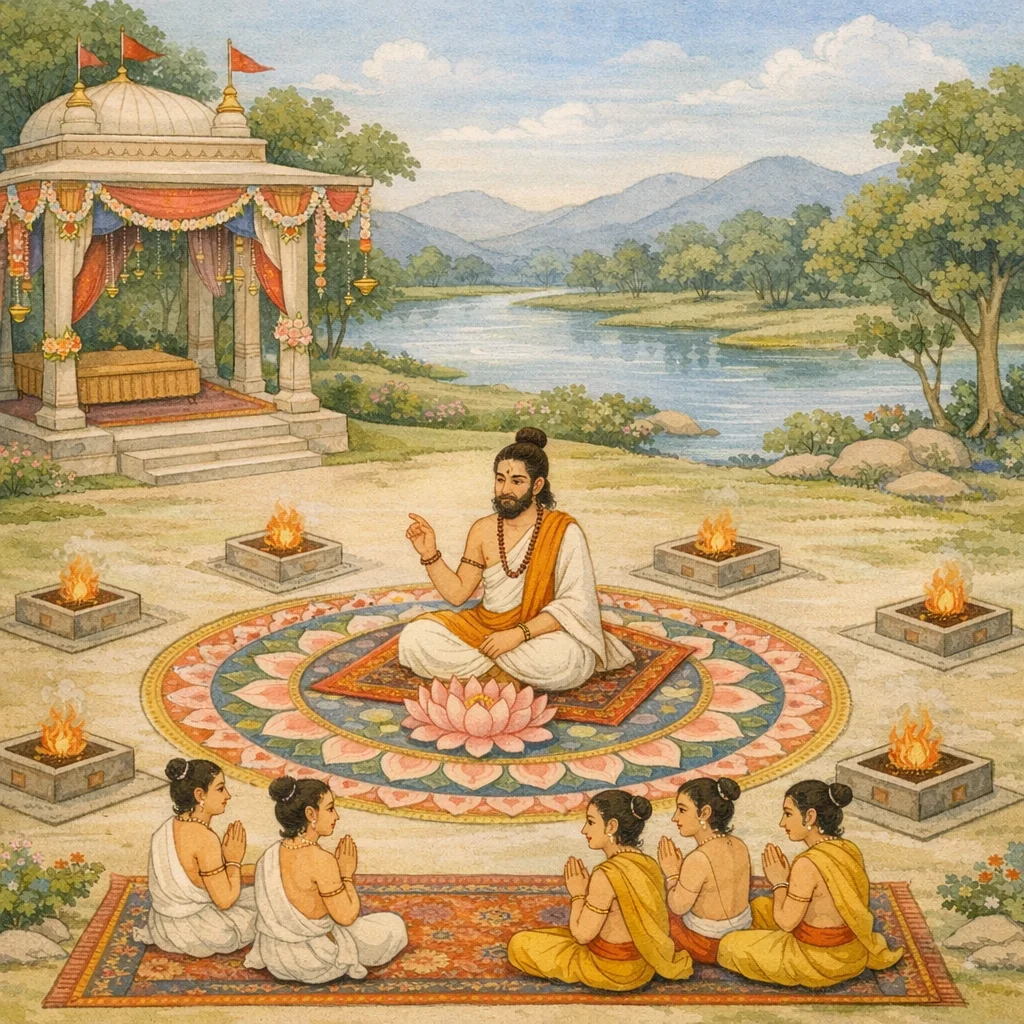
समयाह्वय-संस्कारः — Rite of ‘Samayāhvaya’ and the Preparatory Layout (Maṇḍapa, Vedi, Kuṇḍas, Maṇḍala, Śiva-kumbha)
Adhyāya 16 begins with Upamanyu prescribing the initial consecratory rite called samayāhvaya-saṃskāra, to be performed on an auspicious day in a clean and faultless place. It then teaches site-examination (bhūmi-parīkṣā) by signs such as smell, color, taste, and other qualities, after which a maṇḍapa is to be built according to śilpi-śāstra. A vedi is set up and multiple kuṇḍas are arranged in the eight directions, with a special sequence oriented toward the Īśāna (northeast) quarter; optionally a principal kuṇḍa may be placed on the western side, and the central layout is beautified. The vedi is adorned with canopies, flags, and garlands, and an auspicious maṇḍala is drawn in the center with colored powders—luxurious golden/red powders for the wealthy, and accessible substitutes such as sindūra, rice/śālī or nivāra powders for the poor, showing graded ritual accessibility. The text specifies lotus-maṇḍala proportions (one-hand or two-hand measures), detailing the sizes of the pericarp (karṇikā), stamens (kesarāṇi), and petals, and emphasizes placement and ornamentation especially in the Īśāna sector. Finally, grains, sesame, flowers, and kuśa grass are strewn, and a properly marked Śiva-kumbha is prepared, marking the transition from spatial preparation to formal invocation and the rites that follow.
Shlokas
Verse 1
उपमन्युरुवाच । पुण्ये ऽहनि शुचौ देशे बहुदोषविवर्जिते । देशिकः प्रथमं कुर्यात्संस्कारं समयाह्वयम्
Upamanyu said: On an auspicious day, in a pure place free from many defects, the spiritual preceptor (deśika) should first perform the consecratory rite called “samaya-āhvaya,” the invocation of the sacred observance, thereby establishing the disciple in the proper rule and orientation for the worship of Śiva.
Verse 2
परीक्ष्य भूमिं विधिवद्गंधवर्णरसादिभिः । शिल्पिशास्त्रोक्तमार्गेण मण्डपं तत्र कल्पयेत्
After examining the ground in the proper manner—by its fragrance, color, taste, and other signs—one should then construct a maṇḍapa there according to the procedure taught in the treatises of the sacred architects.
Verse 3
कृत्वा वेदिं च तन्मध्ये कुण्डानि परिकल्पयेत् । अष्टदिक्षु तथा दिक्षु तत्रैशान्यां पुनः क्रमात्
Having prepared the vedī (altar), one should arrange the kuṇḍas (fire-pits) in its midst—set out according to the eight directions; and then, in due order, begin again from the Īśāna (north-east) direction.
Verse 4
प्रधानकुंडं कुर्वीत यद्वा पश्चिमभागतः । प्रधानमेकमेवाथ कृत्वा शोभां प्रकल्पयेत्
Let the worshipper construct the principal fire-pit (kuṇḍa), or else place it on the western side. Having made only one such principal altar, he should then arrange its proper beauty and auspicious embellishment for the rite.
Verse 5
वितानध्वजमालाभिर्विविधाभिरनेकशः । वेदिमध्ये ततः कुर्यान्मंडलं शुभलक्षणम्
Then, adorning the place in many ways with canopies, banners, and garlands, one should prepare—at the very center of the altar—a maṇḍala marked with auspicious signs.
Verse 6
रक्तहेमादिभिश्चूर्णैरीश्वरावाहनोचितम् । सिंदूरशालिनीवारचूर्णैरेवाथ निर्धनः
For invoking the Lord Īśvara (Śiva) in worship, powders made from red substances, gold and the like are considered fitting. But one who is poor may perform the same invocation using only powders of vermilion, rice, and sugar.
Verse 7
एकहस्तं द्विहस्तं वा सितं वा रक्तमेव वा । एकहस्तस्य पद्मस्य कर्णिकाष्टांगुला मता
“(The lotus to be employed) may be of one hand-span or two hand-spans; it may be white or else red. For a lotus of one hand-span, the pericarp (central whorl, karṇikā) is considered to measure eight finger-breadths.”
Verse 8
केसराणि तदर्धानि शेषं चाष्टदलादिकम् । द्विहस्तस्य तु पद्मस्य द्विगुणं कर्णिकादिकम्
The filaments (kesaras) are to be made half of that measure, while the remaining parts—beginning with the eight petals—are to be arranged accordingly. For a lotus of two hands’ span, the pericarp (karṇikā) and the other inner parts are to be made double in measure.
Verse 9
कृत्वा शोभोपशोभाढ्यमैशान्यां तस्य कल्पयेत् । एकहस्तं तदर्धं वा पुनर्वेद्यः तु मंडलम्
Having prepared it, one should arrange in its north‑eastern (Īśāna) quarter an area richly adorned with beauty and auspicious embellishments. Then, on the altar again, one should mark out a maṇḍala measuring one hasta—or half of that.
Verse 10
व्रीहितंदुलसिद्धार्थतिलपुष्पकुशास्तृते । तत्र लक्षणसंयुक्तं शिवकुंभं प्रसाधयेत्
Upon a spread of rice and grains, mustard-seed, sesame, flowers, and kuśa grass, one should there duly arrange and adorn the Śiva-kumbha—the sacred water-pot for Śiva—endowed with the prescribed auspicious marks.
Verse 11
सौवर्णं राजतं वापि ताम्रजं मृन्मयं तु वा । गन्धपुष्पाक्षताकीर्णं कुशदूर्वांकुराचितम्
Whether made of gold, silver, copper, or even clay—let it be strewn with fragrance, flowers, and unbroken grains of rice (akṣata), and adorned with kuśa grass and fresh shoots of dūrvā; thus it becomes fit for Śiva’s worship.
Verse 12
सितसूत्रावृतं कंठे नववस्त्रयुगावृतम् । शुद्धाम्बुपूर्णमुत्कूर्चं सद्रव्यं सपिधानकम्
Around its neck it should be bound with a white thread and covered with a pair of new cloths; it should be furnished with a tufted top, filled with pure water, containing the proper substances, and provided with a lid.
Verse 13
भृङ्गारं वर्धनीं चापि शंखं च चक्रमेव वा । विना सूत्रादिकं सर्वं पद्मपत्रमथापि वा
A water-vessel (bṛṅgāra), a sprinkling pot (vardhanī), a conch (śaṅkha), or even a discus (cakra)—any such item—when it is without the consecrating thread and related sanctifying accessories, is wholly (ritually) ineffective; even a lotus-leaf offered is the same.
Verse 14
तस्यासनारविंदस्य कल्पयेदुत्तरे दले । अग्रतश्चंदनांभोभिरस्त्रराजस्य वर्धनीम्
On the northern petal of that lotus-seat, one should arrange the prescribed placement; and in front, with sandal-scented water, one should prepare the “vardhanī”—the ritual vessel for the Lord of Weapons, the presiding divine power of the mantra and implements.
Verse 15
मण्डलस्य ततः प्राच्यां मंत्रकुंभे च पूर्ववत् । कृत्वा विधिवदीशस्य महापूजां समाचरेत्
Then, on the eastern side of the ritual maṇḍala, and also at the mantra-infused consecration pot (kumbha) as done before, one should, in accordance with the prescribed rule, perform the great worship (mahāpūjā) of the Lord Īśa.
Verse 16
अथार्णवस्य तीरे वा नद्यां गोष्ठे ऽपि वा गिरौ । देवागरे गृहे वापि देशे ऽन्यस्मिन्मनोहरे
Then, whether on the shore of the ocean, on a riverbank, in a cow-shed, upon a mountain, in a temple, in one’s own home, or in any other delightful place—there, with a steady mind, one should undertake the worship and contemplation of Śiva, the Pati who grants release from bondage.
Verse 17
कृत्वा पूर्वोदितं सर्वं विना वा मंडपादिकम् । मंडलं पूर्ववत्कृत्वा स्थंडिलं च विभावसोः
Having completed everything previously prescribed—optionally omitting the pavilion and related structures—one should prepare the ritual maṇḍala as before, and also arrange the sthaṇḍila, the consecrated ground for Vibhāvas, the sacred fire.
Verse 18
प्रविश्य पूजाभवनं प्रहृष्टवदनो गुरुः । सर्वमंगलसंयुक्तः समाचरितनैत्यकः
Entering the hall of worship, the Guru—his face radiant with joy—endowed with every auspicious sign, began to perform the daily rites in due order.
Verse 19
महापूजां महेशस्य कृत्वा मण्डलमध्यतः । शिवकुंभे तथा भूयः शिवमावाह्य पूजयेत्
After performing the great worship of Maheśa in the center of the consecrated maṇḍala, one should again invoke Śiva into the Śiva-kumbha (consecration pot) and worship Him there as well.
Verse 20
पश्चिमाभिमुखं ध्यात्वा यज्ञरक्षकमीश्वरम् । अर्चयेदस्त्रवर्धन्यामस्त्रमीशस्य दक्षिणे
Having meditated upon the Lord as facing the west—the Sovereign who protects the sacrifice—one should worship, on the Lord’s right side, the divine weapon in its ‘astra-vardhinī’ form, the aspect that augments the weapon’s power.
Verse 21
मन्त्रकुम्भे च विन्यस्य मन्त्रं मन्त्रविशारदः । कृत्वा मुद्रादिकं सर्वं मन्त्रयागं समाचरेत्
The adept, well-versed in mantra, should install the mantra in the mantra-pot (kumbha); then, having performed all mudrās and allied rites, he should duly carry out the mantra-yajña, the worship-sacrifice constituted of mantra.
Verse 22
ततश्शिवानले होमं कुर्याद्देशिकसत्तमः । प्रधानकुण्डे परितो जुहुयुश्चापरे द्विजाः
Thereafter, the most excellent preceptor should perform the homa into the Śiva-fire; and the other twice-born priests, stationed all around the principal fire-pit, should also offer oblations.
Verse 23
आचार्यात्पादमर्धं वा होमस्तेषां विधीयते । प्रधानकुण्ड एवाथ जुहुयाद्देशिकोत्तमः
For those rites, their fire-offering is prescribed as a quarter—or at most a half—of what is performed for the ācārya. Then, in the principal fire-pit alone, the eminent deśika should make the oblations.
Verse 24
स्वाध्यायमपरे कुर्युः स्तोत्रं मंगलवाचनम् । जपं च विधिवच्चान्ये शिवभक्तिपरायणाः
Some devotees, wholly devoted to Śiva-bhakti, undertake svādhyāya—self-study of the sacred teachings. Others recite stotras (hymns) and utter auspicious benedictions; and still others perform japa in the proper manner enjoined by the scriptures.
Verse 25
नृत्यं गीतं च वाद्यं च मंगलान्यपराणि च । पूजनं च सदस्यानां कृत्वा सम्यग्विधानतः
Having duly performed—according to proper procedure—dance, song, instrumental music, other auspicious observances, and the honoring (worship) of the assembled participants, the rite should then proceed further in orderly sequence.
Verse 26
पुण्याहं कारयित्वाथ पुनः संपूज्य शंकरम् । प्रार्थयेद्देशिको देवं शिष्यानुग्रहकाम्यया
Then, after having the auspicious rite (puṇyāha) performed and again worshipping Śaṅkara, the teacher should pray to the Lord, seeking His grace for the welfare and blessing of the disciples.
Verse 27
प्रसीद देवदेवेश देहमाविश्य मामकम् । विमोचयैनं विश्वेश घृणया च घृणानिधे
Be gracious, O Lord of the gods. Enter my body. O Lord of the universe, out of compassion—O treasure-house of mercy—release this one from bondage and suffering.
Verse 28
अथ चैवं करोमीति लब्धानुज्ञस्तु देशिकः । आनीयोपोषितं शिष्यं हविष्याशिनमेव वा
Then the preceptor (deśika), having obtained permission and resolving, “So shall I do,” should bring forward the disciple who has been kept in observance of fasting—or at least one who subsists on havis, the sanctified oblation-food.
Verse 29
एकाशनं वा विरतं स्नातं प्रातःकृतक्रियम् । जपंतं प्रणवं देवं ध्यायंतं कृतमंगलम्
He should be one who takes a single meal—or is abstinent—who has bathed and completed the morning observances; who repeats the sacred Praṇava (Oṁ) in japa, meditates on the Lord Śiva, and remains established in auspiciousness through sanctifying rites.
Verse 30
द्वारस्य पश्चिमस्याग्रमण्डले दक्षिणस्य वा । दर्भासने समासीनं विधायोदङ्मुखं शिशुम्
In the forecourt near the western doorway—or else near the southern one—having seated the child upon a seat of sacred kuśa grass, one should arrange him facing north.
Verse 31
स्वयं प्राग्वदनस्तिष्ठन्नूर्ध्वकायं कृतांजलिम् । संप्रोक्ष्य प्रोक्षणौतोयैर्मूर्धन्यस्त्रेण मुद्रया
Facing the east, he should himself stand upright with hands joined in reverence; then, using the water set aside for sprinkling, he should sanctify himself by sprinkling and, by forming the seal (mudrā) of the Mūrdhanya-astramantra, provide protective consecration for the rite.
Verse 32
पुष्पक्षेपेण संताड्य बध्नीयाल्लोचनं गुरुः । दुकूलार्धेन वस्त्रेण मंत्रितेन नवेन च
Then, gently striking (him) with a shower of flowers, the guru should bind the (disciple’s) eyes with half of a dukūla cloth—new and sanctified by mantra.
Verse 33
ततः प्रवेशयेच्छिष्यं गुरुर्द्वारेण मंडलम् । सो ऽपि तेनेरितः शंभोराचरेत्त्रिः प्रदक्षिणम्
Thereafter, the Guru should lead the disciple into the maṇḍala through its doorway. Guided by him, the disciple should then circumambulate Śambhu three times in pradakṣiṇā, keeping the Lord to the right in reverent worship.
Verse 34
ततस्सुवर्णसंमिश्रं दत्त्वा पुष्पांजलिं प्रभोः । प्राङ्मुखश्चोदङ्मुखो वा प्रणमेद्दंडवत्क्षितो
Then, offering the Lord a handful of flowers mixed with gold, one should bow down in full prostration upon the ground—facing either east or north.
Verse 35
ततस्संप्रोक्ष्य मूलेन शिरस्यस्त्रेण पूर्ववत् । संताड्य देशिकस्तस्य मोचयेन्नेत्रबंधनम्
Then the preceptor, as before, should sprinkle (the disciple) with the Mūla-mantra and the Śirasyāstra-mantra; and after a ritual striking to remove impurity and obstruction, he should release the bandage from that person’s eyes.
Verse 36
स दृष्ट्वा मंडलं भूयः प्रणमेत्साञ्जलिः प्रभुम् । अथासीनं शिवाचार्यो मंडलस्य तु दक्षिणे
Having beheld the consecrated maṇḍala once again, he should bow to the Lord with joined palms. Thereafter, the Śiva-teacher should sit on the southern side of the maṇḍala.
Verse 37
उपवेश्यात्मनस्सव्ये शिष्यं दर्भासने गुरुः । आराध्य च महादेवं शिवहस्तं प्रविन्यसेत्
Seating the disciple on a seat of darbha grass at his own left side, the guru—having first worshipped Mahādeva—should duly place the ‘Hand of Śiva’ (Śiva-hasta) upon him.
Verse 38
शिवतेजोमयं पाणिं शिवमंत्रमुदीरयेत् । शिवाभिमानसंपन्नो न्यसेच्छिष्यस्य मस्तके
Let the preceptor, making his hand charged with Śiva’s radiance, utter the Śiva-mantra; filled with the awareness of Śiva, he should place that hand upon the disciple’s head.
Verse 39
सर्वांगालंबनं चैव कुर्यात्तेनैव देशिकः । शिष्यो ऽपि प्रणमेद्भूमौ देशिकाकृतमीश्वरम्
Then the preceptor (deśika) should perform the rite of complete bodily support, placing the disciple under his full guiding protection and discipline. The disciple too should bow down to the ground, offering obeisance to the Lord (Īśvara) as established and manifested through the preceptor’s consecratory act.
Verse 40
ततश्शिवानले देवं समभ्यर्च्य यथाविधि । हुताहुतित्रयं शिष्यमुपवेश्य यथा पुरा
Thereafter, worshipping the Lord within the Śiva-fire according to the prescribed rite, he performed the threefold oblation; and, as before, he seated the disciple in the proper manner.
Verse 41
दर्भाग्रैः संस्पृशंस्तं च विद्ययात्मानमाविशेत् । नमस्कृत्य महादेवं नाडीसंधानमाचरेत्
Touching that seat or sacred support with the tips of kuśa-grass, and entering within himself through the power of spiritual knowledge, he should bow to Mahādeva and then undertake the practice of joining and steadying the nāḍīs, the subtle channels, for yogic concentration.
Verse 42
शिवशास्त्रोक्तमार्गेण कृत्वा प्राणस्य निर्गमम् । शिष्यदेहप्रवेशं च स्मृत्वा मंत्रांस्तु तर्पयेत्
Having, in the manner taught in Śiva’s scriptures, caused the prāṇa, the vital breath, to depart, and remembering also its entry into the disciple’s body, one should then satisfy the mantras with ritual offerings (tarpaṇa).
Verse 43
संतर्पणाय मूलस्य तेनैवाहुतयो दश । देयास्तिस्रस्तथांगानामंगैरेव यथाक्रमम्
To nourish and satisfy the root (mūla) of the mantra/Deity, ten oblations are to be offered with that very mantra. Likewise, for the limbs (aṅgas), three oblations each should be offered, using the respective aṅga-mantras in due order.
Verse 44
ततः पूर्णाहुतिं दत्त्वा प्रायश्चित्ताय देशिकः । पुनर्दशाहुतीन्कुर्यान्मूलमंत्रेण मंत्रवित्
Thereafter, the preceptor should offer the pūrṇāhuti—the final oblation—as an act of expiation. Then, as a knower of mantra, he should again perform ten oblations using the root mantra.
Verse 45
पुनः संपूज्य देवेशं सम्यगाचम्य देशिकः । हुत्वा चैव यथान्यायं स्वजात्या वैश्यमुद्धरेत्
Then the preceptor, having once again duly worshipped the Lord of gods and having properly performed ācamana, should offer the oblation according to the prescribed rule; by the rite appropriate to his own order, he should uplift the Vaiśya disciple, leading him toward auspiciousness and liberation under Śiva’s grace.
Verse 46
तस्यैवं जनयेत्क्षात्रमुद्धारं च ततः पुनः । कृत्वा तथैव विप्रत्वं जनयेदस्य देशिकः
Thus the preceptor should first confer upon him kṣātra-status together with the rite of upliftment; and thereafter, in the same prescribed manner, having duly performed the procedure, the guru should bring about for him brāhmaṇa-status as well.
Verse 47
राजन्यं चैवमुद्धृत्य कृत्वा विप्रं पुनस्तयोः । रुद्रत्वं जनयेद्विप्रे रुद्रनामैव साधयेत्
Thus, having raised the Kṣatriya and again making him a Brāhmaṇa in conduct, one should awaken Rudra-hood within that Brāhmaṇa; and it is the very Name of Rudra that accomplishes this attainment.
Verse 48
प्रोक्षणं ताडनं कृत्वा शिशोस्स्वात्मानमात्मनि । शिवात्मकमनुस्मृत्य स्फुरंतं विस्फुलिंगवत्
Having performed the sprinkling of sanctified water and the gentle ritual tapping, one should place the child’s individual self within one’s own Self; then, remembering that Self as of the nature of Śiva, one should contemplate it as throbbing forth—like a spark leaping out.
Verse 49
नाड्या यथोक्तया वायुं रेचयेन्मंत्रतो गुरुः । निर्गम्य प्रविशेन्नाड्या शिष्यस्य हृदयं तथा
Then the Guru, employing the mantra, should expel the vital breath (vāyu/prāṇa) through the nāḍī as prescribed; and, going forth, he should likewise enter through the nāḍī into the disciple’s heart.
Verse 50
प्रविश्य तस्य चैतन्यं नीलबिन्दुनिभं स्मरन् । स्वतेजसापास्तमलं ज्वलंतमनुचिंतयेत्
Entering into that Consciousness and remembering it as like a blue point (bindu), one should continuously contemplate it as blazing—its impurities driven away by its own innate radiance.
Verse 51
तमादाय तया नाड्या मंत्री संहारमुद्रया । न पूरकेण निवेश्यैनमेकीभावार्थमात्मनः
Then, taking it up through that nāḍī, the adept of mantra—by the saṃhāra (withdrawal) mudrā—should place it within, not by inhalation (pūraka), but for the purpose of merging it into the Self in oneness.
Verse 52
कुंभकेन तथा नाड्या रेचकेन यथा पुरा । तस्मादादाय शिष्यस्य हृदये तन्निवेशयेत्
As before—by retention (kumbhaka), by guiding it through the subtle channel (nāḍī), and by exhalation (recaka)—having thus drawn it forth, the teacher should cause that power to be established in the disciple’s heart.
Verse 53
तमालभ्य शिवाल्लब्धं तस्मै दत्त्वोपवीतकम् । हुत्वाहुतित्रयं पश्चाद्दद्यात्पूर्णाहुतिं ततः
Having taken that (sacred thread) obtained from Lord Śiva, one should invest him with the upavīta. Then, after offering three oblations into the fire, one should thereafter offer the final complete oblation (pūrṇāhuti).
Verse 54
देवस्य दक्षिणे शिष्यमुपवेश्यवरासने । कुशपुष्पपरिस्तीर्णे बद्धांजलिरुदङ्मुखम्
Then he seated the disciple on an excellent seat to the right of the Lord, spread over with kuśa grass and flowers, and made him sit facing north with palms joined in reverence.
Verse 55
स्वस्तिकासनमारूढं विधाय प्राङ्मुखः स्वयम् । वरासनस्थितो मंत्रैर्महामंगलनिःस्वनैः
Facing east, he himself assumed the svastikāsana posture and then sat upon a noble seat, while mantras—resounding with great auspiciousness—were being chanted.
Verse 56
समादाय घटं पूर्णं पूर्णमेव प्रसादितम् । ध्यायमानः शिवं शिष्यमाभिषिंचेत देशिकः
Taking up a brimming, fully consecrated water-pot, the preceptor—meditating on Lord Śiva—should perform the ritual abhiṣeka (ablution/initiation) for the disciple.
Verse 57
अथापनुद्य स्नानांबु परिधाय सितांबरम् । आचान्तोलंकृतश्शिष्यः प्रांजलिर्मंडपं व्रजेत्
Then, having wiped off the water after bathing and having donned clean white garments, the disciple—after performing ācamana and properly adorning himself—should go to the pavilion with folded hands.
Verse 58
उपवेश्य यथापूर्वं तं गुरुर्दर्भविष्टरे । संपूज्य मंडलं देवं करन्यासं समाचरेत्
Having seated him as before, the Guru upon a seat of darbha grass should duly worship the divine maṇḍala of the Lord and then perform kara-nyāsa—the ritual placing of mantra-power upon the hands—so that the worship of Śiva proceeds with consecrated awareness and right method.
Verse 59
ततस्तु भस्मना देवं ध्यायन्मनसि देशिकः । समालभेत पाणिभ्यां शिशुं शिवमुदीरयेत्
Then the preceptor (deśika), meditating in his mind upon the Lord while using the sacred ash (bhasma), should gently touch the child with both hands and utter the name of “Śiva”.
Verse 60
अथ तस्य शिवाचार्यो दहनप्लावनादिकम् । सकलीकरणं कृत्वा मातृकान्यासवर्त्मना
Then his Śaiva preceptor, following the procedure of Mātr̥kā-nyāsa (installation of the Mātr̥kā letters), performed the rites such as purification by fire and by sprinkling, and completed the sakalīkaraṇa—the consecratory integration of the worship.
Verse 61
ततः शिवासनं ध्यात्वा शिष्यमूर्ध्नि देशिकः । तत्रावाह्य यथान्यायमर्चयेन्मनसा शिवम्
Thereafter the preceptor, meditating on Śiva’s seat, should (inwardly) place it upon the disciple’s head; then, invoking Śiva there according to proper rite, he should worship Lord Śiva with the mind.
Verse 62
प्रार्थयेत्प्रांजलिर्देवं नित्यमत्र स्थितो भव । इति विज्ञाप्य तं शंभोस्तेजसा भासुरं स्मरेत्
With palms joined, one should pray to the Lord: “Be ever present here.” Having thus entreated Him, one should meditate on Śambhu, radiant with divine splendour.
Verse 63
संपूज्याथ शिवं शैवीमाज्ञां प्राप्य शिवात्मिकाम् । कर्णे शिष्यस्य शनकैश्शिवमन्त्रमुदीरयेत्
Then, having duly worshipped Śiva and received the Śaiva command—whose very essence is Śiva—one should softly utter the Śiva-mantra into the disciple’s ear.
Verse 64
स तु बद्धांजलिः श्रुत्वा मन्त्रं तद्गतमानसः । शनैस्तं व्याहरेच्छिष्यशिवाचार्यस्य शासनात्
Having heard the mantra, the disciple—hands joined in reverence and mind absorbed in that very mantra—should then recite it softly and steadily, in accordance with the command of the Śiva-teacher (Śivācārya).
Verse 65
ततः शाक्तं च संदिश्य मन्त्रं मन्त्रविचक्षणः । उच्चारयित्वा च सुखं तस्मै मंगलमादिशेत्
Thereafter, the adept—skilled in the science of mantras—should instruct him in the Śākta mantra; and, having recited it gently and with ease, he should pronounce blessings of auspiciousness upon him.
Verse 66
ततस्समासान्मन्त्रार्थं वाच्यवाचकयोगतः । समदिश्येश्वरं रूपं योगमासनमादिशेत्
Thereafter, having concisely set forth the meaning of the mantra through the relation of the expressed (vācyā) and the expresser (vācaka), one should clearly indicate the form of the Lord and prescribe the yogic posture (āsana) for meditation.
Verse 67
अथ गुर्वाज्ञया शिष्यः शिवाग्निगुरुसन्निधौ । भक्त्यैवमभिसंधाय दीक्षावाक्यमुदीरयेत्
Then, by the command of the Guru, the disciple—standing in the presence of Śiva, the consecrated fire, and the preceptor—having thus formed the intention with devotion, should solemnly utter the initiating words (of dīkṣā).
Verse 68
वरं प्राणपरित्यागश्छेदनं शिरसो ऽपि वा । न त्वनभ्यर्च्य भुंजीय भगवन्तं त्रिलोचनम्
Better is the relinquishing of life—or even the severing of one’s head—than that I should partake of food without first worshipping the Blessed Three-Eyed Lord (Śiva).
Verse 69
स एव दद्यान्नियतो यावन्मोहविपर्ययः । तावदाराधयेद्देवं तन्निष्ठस्तत्परायणः
He alone should continue the prescribed observance, so long as the delusion-born perversion of understanding persists. Until it is dispelled, he should worship that Lord—steadfastly established in Him and wholly devoted to Him as the supreme refuge.
Verse 70
ततः स समयो नाम भविष्यति शिवाश्रमे । लब्धाधिकारो गुर्वाज्ञापालकस्तद्वशो भवेत्
Thereafter, in Śiva’s hermitage, a time called “Samaya” will arise. Having obtained due authority, he will become an obedient executor of the Guru’s command, remaining under that discipline.
Verse 71
अतः परं न्यस्तकरो भस्मादाय स्वहस्ततः । दद्याच्छिष्याय मूलेन रुद्राक्षं चाभिमंत्रितम्
Thereafter, having composed himself with hands duly placed, he should take the sacred ash with his own hand and, with the root-mantra, give to the disciple a Rudrākṣa that has been duly consecrated by mantra.
Verse 72
प्रतिमा वापि देवस्य गूढदेहमथापि वा । पूजाहोमजपध्यानसाधनानि च संभवे
Whether it is an icon (pratimā) of the Lord, or even His subtle, hidden-bodied presence, O Śambhu—worship, fire-offerings, mantra-repetition, and meditation are all valid means of spiritual accomplishment.
Verse 73
सोपि शिष्यः शिवाचार्याल्लब्धानि बहुमानतः । आददीताज्ञया तस्य देशिकस्य न चान्यथा
That disciple too, receiving (those sacred things/teachings) from the Śiva-teacher with great reverence, should accept them only according to the command of that preceptor—and not otherwise.
Verse 74
आचार्यादाप्तमखिलं शिरस्याधाय भक्तितः । रक्षयेत्पूजयेच्छंभुं मठे वा गृह एववा
Having received everything from the ācārya, one should, in devotion, place it reverently upon one’s head. And one should protect and worship Lord Śambhu—whether in a maṭha (monastery) or in one’s own home.
Verse 75
अतः परं शिवाचारमादिशेदस्य देशिकः । भक्तिश्रद्धानुसारेण प्रज्ञायाश्चानुसारतः
Thereafter, the guru (deśika) should instruct him in Śivācāra—the observances and discipline of Śiva—according to his devotion and faith, and also in keeping with the measure of his understanding.
Verse 76
यदुक्तं यत्समाज्ञातं यच्चैवान्यत्प्रकीर्तितम् । शिवाचार्येण समये तत्सर्वं शिरसा वहेत्
Whatever has been spoken, whatever has been duly enjoined, and whatever else has been proclaimed—at the proper time, one should bear all of it upon one’s head as the command of the Śivācārya, the teacher of Śiva.
Verse 77
शिवागमस्य ग्रहणं वाचनं श्रवणं तथा । देशिकदेशतः कुर्यान्न स्वेच्छातो न चान्यतः
One should receive, recite, and also listen to the Śiva-Āgama only in the proper manner from an authorized teacher (deśika), in the right place and lineage—not by one’s own whim, nor from any random source.
Verse 78
इति संक्षेपतः प्रोक्तः संस्कारः समयाह्वयः । साक्षाच्छिवपुरप्राप्तौ नृणां परमसाधनम्
Thus, in brief, the consecratory observance called “Samaya” has been explained. For human beings, it is the supreme means for attaining Śivapura directly—the abode of Lord Śiva.
Frequently Asked Questions
Upamanyu introduces the samayāhvaya-saṃskāra, an initial consecratory rite performed by the deśika in an auspicious, pure, and defect-free place.
Īśāna is a Śaiva-privileged direction associated with Śiva’s sovereignty and auspicious emergence; placing/ornamenting key elements there encodes directional theology into the ritual space.
Śiva’s presence is mediated through structured loci: the pradhāna-kuṇḍa (central fire locus), the lotus-maṇḍala (diagrammatic body of invocation), and the Śiva-kumbha (vessel of consecratory embodiment).
Read Shiva Purana in the Vedapath app
Scan the QR code to open this directly in the app, with audio, word-by-word meanings, and more.