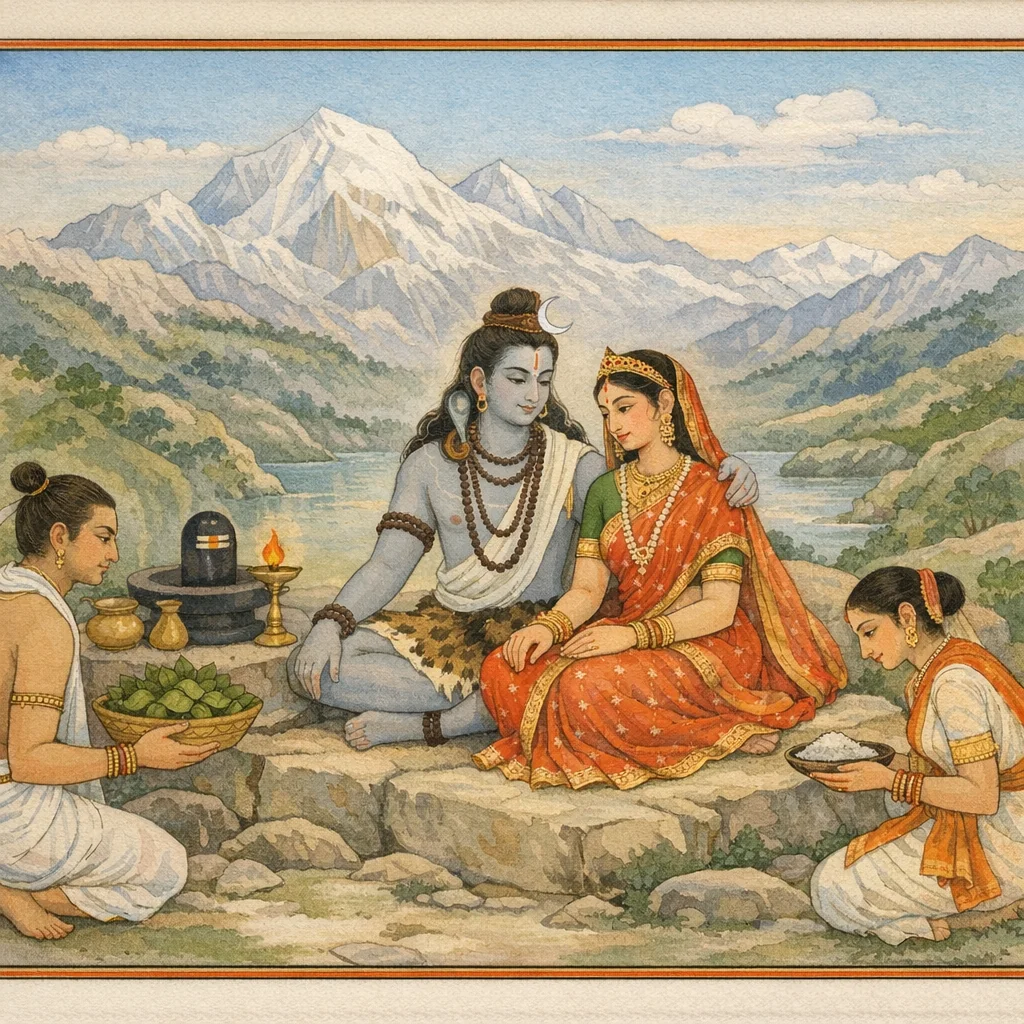
भक्ताधिकारि-द्विजधर्म-योगिलक्षणवर्णनम् / Duties of Qualified Devotees and Marks of Yogins
Śiva tells Devī that he will summarize varṇa-dharma and the discipline required of qualified devotees and learned twice-born (dvija) practitioners. The chapter lays out a regimen joining ritual regularity (thrice-daily bathing, agni-kārya, orderly liṅga worship), social-religious virtues (dāna, compassion, īśvara-bhāva), and moral restraints (truthfulness and ahiṃsā toward all beings). It also lists scholarly and ascetic duties—study, teaching, explanation, brahmacarya, śravaṇa, tapaḥ, kṣamā, and śauca—together with outward marks and observances such as śikhā, upavīta, uṣṇīṣa, uttarīya, wearing bhasma and rudrākṣa, and special worship on parvan days, especially caturdaśī. Dietary and purity rules are given through prescribed periodic intake (e.g., brahma-kūrca) and avoidance of forbidden or impure foods (stale food, certain grains, intoxicants even in smell, and unsuitable offerings). The discourse then condenses the yogic “liṅgas” (signs)—forbearance, peace, contentment, truth, non-stealing, celibacy, knowledge of Śiva, dispassion, service of bhasma, and withdrawal from all attachments—adding austerities like eating daytime alms. Overall, the chapter serves as a structured Śaiva code of conduct linking external observance, ethical purity, and yogic detachment.
Shlokas
Verse 1
ईश्वर उवाच । अथ वक्ष्यामि देवेशि भक्तानामधिकारिणाम् । विदुषां द्विजमुख्यानां वर्णधर्मसमासतः
Īśvara said: “Now, O Devēśī—Lady of the gods—I shall succinctly explain the proper eligibility and duties: those of devotees fit for this path, and especially of the learned foremost among the twice-born, in accordance with the principles of varṇa and dharma.”
Verse 2
त्रिः स्नानं चाग्निकार्यं च लिंगार्चनमनुक्रमम् । दानमीश्ररभावश्च दया सर्वत्र सर्वदा
Bathing three times, performing the sacred fire-rites, and worshipping the Śiva-liṅga in proper sequence; giving in charity, maintaining the attitude of bhakti toward the Lord, and showing compassion everywhere, at all times—these are to be observed.
Verse 3
सत्यं संतोषमास्तिक्यमहिंसा सर्वजंतुषु । ह्रीश्रद्धाध्ययनं योगस्सदाध्यापनमेव च
Truthfulness, contentment, faith in the divine (āstikya), and non-violence toward all beings; modesty, reverent faith (śraddhā), study of sacred teaching, the discipline of yoga, and constant instruction of others as well—these are the praised virtues.
Verse 4
व्याख्यानं ब्रह्मचर्यं च श्रवणं च तपः क्षमा । शौचं शिखोपवीतं च उष्णीषं चोत्तरीयकम्
Teaching the sacred doctrine, keeping the discipline of brahmacarya, listening attentively to scripture, practicing tapas and forbearance; purity, the topknot (śikhā) and the sacred thread (upavīta), the turban, and the upper cloth—these are the prescribed marks and observances of a Shaiva devotee.
Verse 5
निषिद्धासेवनं चैव भस्मरुद्राक्षधारणम् । पर्वण्यभ्यर्चनं देवि चतुर्दश्यां विशेषतः
O Devī, one should avoid what is forbidden, and duly wear sacred ash (bhasma) and rudrākṣa beads; and one should worship (Śiva) on holy observance-days—especially on the fourteenth lunar day (caturdaśī).
Verse 6
पानं च ब्रह्मकूर्चस्य मासि मासि यथाविधि । अभ्यर्चनं विशेषेण तेनैव स्नाप्य मां प्रिये
“And, month after month, drink the Brahmakūrca preparation according to the prescribed rule. Then worship Me with special devotion, and with that very (consecrated substance) bathe Me, O beloved.”
Verse 7
सर्वक्रियान्न सन्त्यागः श्रद्धान्नस्य च वर्जनम् । तथा पर्युषितान्नस्य यावकस्य विशेषतः
One should not abandon the food that sustains all sacred duties, nor reject food offered with faith. Likewise, one should avoid stale, leftover food—especially that made of yāvaka (a coarse barley preparation, such as barley-gruel).
Verse 8
मद्यस्य मद्यगन्धस्य नैवेद्यस्य च वर्जनम् । सामान्यं सर्ववर्णानां ब्राह्मणानां विशेषतः
Abstaining from intoxicating liquor, even from its very smell, and rejecting offerings (naivedya) tainted by it, is a common rule for all the social orders—most especially for Brāhmaṇas.
Verse 9
क्षमा शांतिश्च सन्तोषस्सत्यमस्तेयमेव च । ब्रह्मचर्यं मम ज्ञानं वैराग्यं भस्मसेवनम्
Forgiveness, peace, and contentment; truthfulness and non-stealing; the discipline of brahmacarya, the knowledge that is Mine, dispassion, and the devoted use of bhasma (sacred ash)—these are My virtues and observances, leading the bound soul toward Śiva’s liberating grace.
Verse 10
सर्वसंगनिवृत्तिश्च दशैतानि विशेषतः । लिंगानि योगिनां भूयो दिवा भिक्षाशनं तथा
Complete withdrawal from all attachments—these ten, in particular, are the distinctive marks of yogins. Moreover, they partake only of alms-food, and that too in the daytime alone.
Verse 11
वानप्रस्थाश्रमस्थानां समानमिदमिष्यते । रात्रौ न भोजनं कार्यं सर्वेषां ब्रह्मचारिणाम्
For those established in the vānaprastha stage, this same discipline is also prescribed. For all brahmacārins, eating at night should not be done.
Verse 12
अध्यापनं याजनं च क्षत्रियस्याप्रतिग्रहः । वैश्यस्य च विशेषेण मया नात्र विधीयते
Teaching the Veda and officiating sacrifices are not prescribed here for a Kṣatriya; for him, non-acceptance of gifts is enjoined. For a Vaiśya especially, these priestly acts are not ordained by me in this context.
Verse 13
रक्षणं सर्ववर्णानां युद्धे शत्रुवधस्तथा । दुष्टपक्षिमृगाणां च दुष्टानां शातनं नृणाम्
“(His duty is) the protection of all the social orders; and in battle, the slaying of enemies. Likewise, (he must) destroy wicked birds and beasts, and punish and subdue wicked men.”
Verse 14
अविश्वासश्च सर्वत्र विश्वासो मम योगिषु । स्त्रीसंसर्गश्च कालेषु चमूरक्षणमेव च
“Let there be distrust everywhere; but let there be trust in My yogins. Association with women should be only at the proper times, and likewise the guarding of the army alone (should be attended to).”
Verse 15
सदा संचारितैश्चारैर्लोकवृत्तांतवेदनम् । सदास्त्रधारणं चैव भस्मकंचुकधारणम्
With spies kept ever in motion, there was continual knowledge of the world’s affairs and happenings; and there was constant bearing of weapons, and also the wearing of the sacred ash-cloak (bhasma) as a holy covering.
Verse 16
राज्ञां ममाश्रमस्थानामेष धर्मस्य संग्रहः । गोरक्षणं च वाणिज्यं कृषिर्वैश्यस्य कथ्यते
For kings and for those established in the disciplines of the āśramas, this is the concise summary of dharma. For the Vaiśya, it is taught that the duties are the protection of cattle, trade, and agriculture.
Verse 17
शुश्रूषेतरवर्णानां धर्मः शूद्रस्य कथ्यते । उद्यानकरणं चैव मम क्षेत्रसमाश्रयः
The dharma of the Śūdra is declared to be service to the other social orders. Likewise, the making of gardens and taking refuge in my sacred domain (my holy field, the temple-land) are also commended.
Verse 18
धर्मपत्न्यास्तु गमनं गृहस्थस्य विधीयते । ब्रह्मचर्यं वनस्थानां यतीनां ब्रह्मचारिणाम्
For the householder, conjugal union with one’s lawful wife (dharma-patnī) is enjoined; but for forest-dwellers, renunciant ascetics (yati), and celibate students, brahmacarya—sacred continence—is prescribed.
Verse 19
स्त्रीणां तु भर्तृशुश्रूषा धर्मो नान्यस्सनातनः । ममार्चनं च कल्याणि नियोगो भर्तुरस्ति चेत्
For women, devoted service to the husband is the eternal dharma—there is no other. And, O auspicious one, worship of Me too becomes your duty, if there is the husband’s command or permission.
Verse 20
या नारी भर्तृशुश्रूषां विहाय व्रततत्परा । सा नारी नरकं याति नात्र कार्या विचारणा
A woman who, abandoning attentive service to her husband, becomes devoted only to vows and observances—such a woman goes to hell; of this there is no need for further deliberation.
Verse 21
अथ भर्तृविहीनाया वक्ष्ये धर्मं सनातनम् । व्रतं दानं तपः शौचं भूशय्यानक्तभोजनम्
Now I shall declare the eternal dharma for a woman bereft of her husband: the observance of vows, charitable giving, austerity (tapas), purity, sleeping upon the ground, and taking only a single meal at night—disciplines that steady the mind and turn it toward Śiva, the Lord who grants liberation (mokṣa).
Verse 22
ब्रह्मचर्यं सदा स्नानं भस्मना सलिलेन वा । शांतिर्मौनं क्षमा नित्यं संविभागो यथाविधि
Continence (brahmacarya) should ever be observed; purity should be maintained by constant bathing—either with sacred ash (bhasma) or with water—together with inner peace, mauna (disciplined silence), unfailing forgiveness, and the proper sharing of one’s means according to śāstric rule: these are to be practiced always.
Verse 23
अष्टाभ्यां च चतुर्दश्यां पौर्णमास्यां विशेषतः । एकादश्यां च विधिवदुपवासोममार्चनम्
On the eighth lunar day, on the fourteenth, and most especially on the full-moon day—and also on the eleventh (Ekādaśī)—one should duly observe fasting and worship Me (Śiva) according to the prescribed rule.
Verse 24
इति संक्षेपतः प्रोक्तो मयाश्रमनिषेविणाम् । ब्रह्मक्षत्रविशां देवि यतीनां ब्रह्मचारिणाम्
“Thus, O Goddess, I have briefly set forth the observances for those who abide in the disciplines of the āśramas—for brāhmaṇas, kṣatriyas, and vaiśyas, and also for the renunciant ascetics (yatīs) and the celibate students (brahmacārins).”
Verse 25
तथैव वानप्रस्थानां गृहस्थानां च सुन्दरि । शूद्राणामथ नारीणां धर्म एष सनातनः
“In the same way, O fair one, this is the eternal dharma for those who are in the forest-dweller stage and for householders as well; and likewise for Śūdras and for women.”
Verse 26
ध्येयस्त्वयाहं देवेशि सदा जाप्यः षडक्षरः । वेदोक्तमखिलं धर्ममिति धर्मार्थसंग्रहः
O Goddess, Lady of the gods, ever meditate upon Me; and ever repeat in japa the six-syllabled mantra (ṣaḍakṣara). “All dharma as taught in the Vedas”—this indeed is the compendium and very essence of dharma’s purpose.
Verse 27
अथ ये मानवा लोके स्वेच्छया धृतविग्रहाः । भावातिशयसंपन्नाः पूर्वसंस्कारसंयुताः
Now, those human beings in this world who, of their own free will, assume an embodied form (vigraha), endowed with an intense inner bhāva and accompanied by impressions of prior saṃskāra—are to be understood accordingly.
Verse 28
विरक्ता वानुरक्ता वा स्त्र्यादीनां विषयेष्वपि । पापैर्न ते विलिंपंते १ पद्मपत्रमिवांभसा
Whether one is detached (virakta) or even still attached (anurakta) to objects of sense—women and the like—sins do not smear that person, just as water does not cling to a lotus leaf.
Verse 29
तेषां ममात्मविज्ञानं विशुद्धानां विवेकिनाम् । मत्प्रसादाद्विशुद्धानां दुःखमाश्रमरक्षणात्
For those discerning ones who are purified, knowledge of My true Self arises. Yet even for the purified, by My grace, there remains the hardship that comes from protecting and maintaining the āśrama—the disciplined order of life.
Verse 30
नास्ति कृत्यमकृत्यं च समाधिर्वा परायणम् । न विधिर्न निषेधश्च तेषां मम यथा तथा
For them there is neither “what must be done” nor “what must not be done”; nor is samādhi their sole refuge. For them there is neither injunction nor prohibition—just as, for Me, it is so.
Verse 31
तथेह परिपूर्णस्य साध्यं मम न विद्यते । तथैव कृतकृत्यानां तेषामपि न संशयः
So too, here, for one who is fully perfected, there remains nothing for Me to be attained. In the same way, for those who have accomplished what must be accomplished, there is no doubt of that.
Verse 32
मद्भक्तानां हितार्थाय मानुषं भावमाश्रिताः । रुद्रलोकात्परिभ्रष्टास्ते रुद्रा नात्र संशयः
For the welfare of My devotees, they have assumed a human mode of being. Having descended from Rudra-loka, they are indeed Rudras—of this there is no doubt.
Verse 33
ममानुशासनं यद्वद्ब्रह्मादीनां प्रवर्तकम् । तथा नराणामन्येषां तन्नियोगः प्रवर्तकः
Just as My command impels even Brahmā and the other gods to act, so too, for human beings and all others, that very ordinance is the driving force behind their activity.
Verse 34
ममाज्ञाधारभावेन सद्भावातिशयेन च । तदालोकनमात्रेण सर्वपापक्षयो भवेत्
Supported by My command and empowered by an abundance of true devotion, by the mere act of beholding it, the destruction of all sins comes to pass.
Verse 35
प्रत्ययाश्च प्रवर्तंते प्रशस्तफलसूचकाः । मयि भाववतां पुंसां प्रागदृष्टार्थगोचराः
For those who are filled with heartfelt devotion toward Me, confirming inner certainties arise—harbingers of auspicious results—making even realities not previously perceived become directly accessible to their experience.
Verse 36
कंपस्वेदो ऽश्रुपातश्च कण्ठे च स्वरविक्रिया । आनंदाद्युपलब्धिश्च भवेदाकस्मिकी मुहुः
Trembling, perspiration, the falling of tears, and a change of voice in the throat—and again and again, an uncaused, sudden experience of bliss and the like—arise spontaneously in the devotee.
Verse 37
स तैर्व्यस्तैस्समस्तैर्वा लिंगैरव्यभिचारिभिः । मंदमध्योत्तमैर्भावैर्विज्ञेयास्ते नरोत्तमाः
Those best among men are to be recognized by these unfailing marks—whether seen individually or all together—manifesting as dispositions of three grades: mild, middling, and excellent.
Verse 38
यथायोग्निसमावेशान्नायो भवति केवलम् । स तथैव मम सान्निध्यान्न ते केवलमानुषाः
Just as iron, when permeated by fire, is no longer merely iron alone, so too—by My close Presence—you are not merely human beings.
Verse 39
हस्तपादादिसाधर्म्याद्रुद्रान्मर्त्यवपुर्धरान् । प्राकृतानिव मन्वानो नावजानीत पंडितः
Since the Rudras who bear mortal bodies share common features such as hands and feet, the wise should never, mistaking them for ordinary worldly beings, treat them with contempt.
Verse 40
अवज्ञानं कृतं तेषु नरैर्व्यामूढचेतनैः । आयुः श्रियं कुलं शीलं हित्वा निरयमावहेत्
When deluded men show contempt toward them, they forfeit lifespan, prosperity, family honor, and good conduct, and thus bring upon themselves a hellish downfall. In the Śaiva view, such disrespect becomes a binding pāśa that obstructs Śiva’s grace and the path to liberation.
Verse 41
ब्रह्मविष्णुसुरेशानामपि तूलायते पदम् । मत्तोन्यदनपेक्षाणामुद्धृतानां महात्मनाम्
Even the status attained by Brahmā, Viṣṇu, and the lords of the gods is weighed as nothing on the scale when compared with the state of those great souls who, freed by Me, depend on nothing other than Me.
Verse 42
अशुद्धं बौद्धमैश्वर्यं प्राकृतं पौरुषं तथा । गुणेशानामतस्त्याज्यं गुणातीतपदैषिणाम्
Prosperity sought through impure, merely intellectual (bauddha) means, and likewise worldly attainments born of nature (prākṛta) and of human effort (pauruṣa)—such forms of lordship belong to the sphere of the guṇas. Therefore, for those who seek the state beyond the guṇas, these are to be renounced.
Verse 43
अथ किं बहुनोक्तेन श्रेयः प्राप्त्यैकसाधनम् । मयि चित्तसमासंगो येन केनापि हेतुना
What need is there to say much? The one means to attain the Highest Good is this: let the mind become firmly attached to Me—by any cause whatsoever.
Verse 44
उपमन्युरुवाच । इत्थं श्रीकण्ठनाथेन शिवेन परमात्मना । हिताय जगतामुक्तो ज्ञानसारार्थसंग्रहः
Upamanyu said: “Thus, Śiva—the Supreme Self, Lord Śrīkaṇṭha—proclaimed for the welfare of the worlds this compendium that gathers the essential purport of the very essence of spiritual knowledge.”
Verse 45
विज्ञानसंग्रहस्यास्य वेदशास्त्राणि कृत्स्नशः । सेतिहासपुराणानि विद्या व्याख्यानविस्तरः
In this compendium of spiritual knowledge, the Vedas and the Śāstras are set forth in full, along with the Itihāsas and Purāṇas—learning elaborated through extensive exposition.
Verse 46
ज्ञानं ज्ञेयमनुष्ठेयमधिकारो ऽथ साधनम् । साध्यं चेति षडर्थानां संग्रहत्वेष संग्रहः
Knowledge, the knowable Reality, what is to be practiced, the qualified aspirant, the means, and the goal—these are the six topics; this teaching is a compendium that gathers them all in summary.
Verse 47
गुरोरधिकृतं ज्ञानं ज्ञेयं पाशः पशुः पतिः । लिंगार्चनाद्यनुष्ठेयं भक्तस्त्वधिकृतो ऽपि यः
The knowledge sanctioned by the Guru is to be understood as the true teaching—namely, the knowable triad: Pāśa (bondage), Paśu (the bound soul), and Pati (the Lord). And the duly qualified devotee should perform the prescribed observances, beginning with the worship of the Śiva-liṅga.
Verse 48
साधनं शिवमंत्राद्यं साध्यं शिवसमानता । षडर्थसंग्रहस्यास्य ज्ञानात्सर्वज्ञतोच्यते
The means of attainment begins with the mantra of Śiva, and the goal to be attained is likeness to Śiva. By knowing this compendium of the six categories of Śaiva doctrine, one is said to attain omniscience—true spiritual knowing.
Verse 49
प्रथमं कर्म यज्ञादेर्भक्त्या वित्तानुसारतः । बाह्येभ्यर्च्य शिवं पश्चादंतर्यागरतो भवेत्
First, one should perform acts such as sacrifice and other duties with devotion, according to one’s means. Having worshipped Śiva outwardly through external rites, one should thereafter become intent on the inner worship—offering the sacrifice within.
Verse 50
रतिरभ्यंतरे यस्य न बाह्ये पुण्यगौरवात् । न कर्म करणीयं हि बहिस्तस्य महात्मनाः
That great-souled one whose delight rests within and not in outer observances—out of reverence for the very holiness of inner purity—has no need to perform any external action (as a compulsion).
Verse 51
ज्ञानामृतेन तृप्तस्य भक्त्या शैवशिवात्मनः । नांतर्न च बहिः कृष्ण कृत्यमस्ति कदाचन
O Kṛṣṇa, for one who is satisfied with the nectar of spiritual knowledge, and who through devotion has become of the very nature of Śiva—both within and without—there remains no obligatory duty to be done at any time.
Verse 52
तस्मात्क्रमेण संत्यज्य बाह्यमाभ्यंतरं तथा । ज्ञानेन ज्ञेयमालोक्याज्ञानं चापि परित्यजेत्
Therefore, one should gradually renounce both the outer and the inner (attachments). With true knowledge, one should behold the Knowable Reality (the Supreme Lord, Pati), and thereby cast off ignorance as well.
Verse 53
नैकाग्रं चेच्छिवे चित्तं किं कृतेनापि कर्मणा । एकाग्रमेव चेच्चित्तं किं कृतेनापि कर्मणा
If the mind is not one-pointed in Śiva, what use is any action, even if performed? But if the mind is truly one-pointed in Śiva, what need is there of any action at all, even if performed?
Verse 54
तस्मात्कर्माण्यकृत्वा वा कृत्वा वांतर्बहिःक्रमात् । येन केनाप्युपायेन शिवे चित्तं निवेशयेत्
Therefore, whether one acts or refrains from action—whether following outer rites or inner discipline—by whatever means, one should firmly place the mind in Śiva. From that God-centered fixation arise the loosening of bonds and the ripening of liberation.
Verse 55
शिवे निविष्टचित्तानां प्रतिष्ठितधियां सताम् । परत्रेह च सर्वत्र निर्वृतिः परमा भवेत्
For the true and virtuous ones whose minds are absorbed in Śiva and whose understanding is firmly established, supreme peace and fulfillment arise everywhere—here in this world and also in the world beyond.
Verse 56
इहोन्नमः शिवायेति मंत्रेणानेन सिद्धयः । स तस्मादधिगंतव्यः परावरविभूतये
Here itself, through this mantra—“(Oṁ) Namaḥ Śivāya”—the siddhis, the spiritual attainments, arise. Therefore, through it Lord Śiva is to be realized, for the supreme and transcendent plenitude of His power—His parā and aparā vibhūti.
Frequently Asked Questions
The chapter is primarily prescriptive rather than narrative: it records Śiva’s instruction to Devī on conduct, observances, and yogic markers for devotees and dvijas, not a distinct mythic episode.
It frames ‘signs’ (liṅgas) of yogins as inner-realization validated by outer discipline: detachment (saṅga-nivṛtti), Śiva-jñāna, and purity are expressed through regulated worship, diet, and Śaiva markers (bhasma/rudrākṣa).
Rather than avatāras, the chapter highlights manifestations of Śaiva identity in practice—liṅga worship, bhasma-sevana, rudrākṣa-dhāraṇa, and vrata-timing (parvan/caturdaśī)—as embodied forms of devotion.
Read Shiva Purana in the Vedapath app
Scan the QR code to open this directly in the app, with audio, word-by-word meanings, and more.