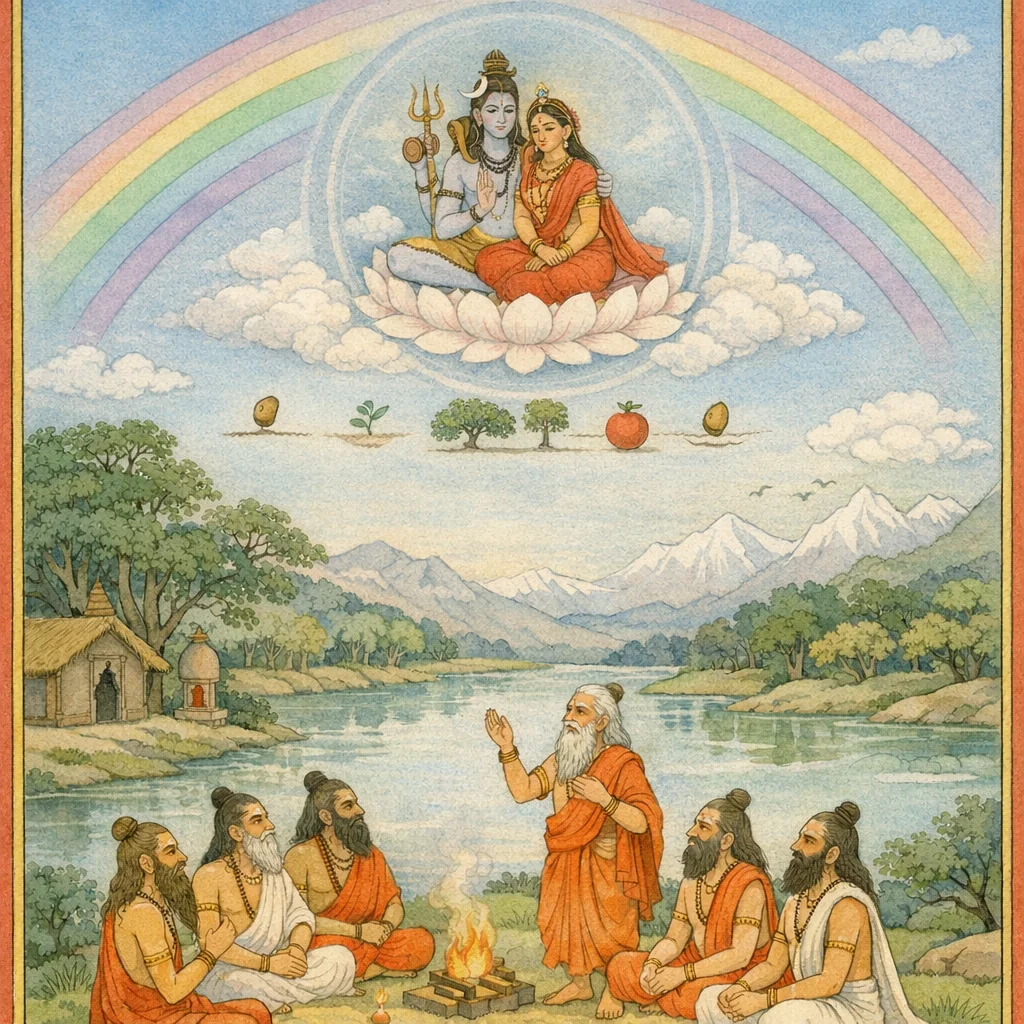
शक्त्यादिसृष्टिनिरूपणम् / The Account of Creation Beginning with Śakti
Adhyāya 9 begins with the sages asking how Parameśvara, by command (ājñā), creates and withdraws the whole cosmos as a supreme līlā, and what the first principle is from which all spreads and into which all is reabsorbed. Vāyu answers with a graded cosmogony: Śakti is the first manifestation, beyond the śāntyatīta level; from Śiva endowed with Śakti arise māyā and then the unmanifest avyakta. The chapter presents five padas—śāntyatīta, śānti, vidyā, pratiṣṭhā, nivṛtti—as a concise scheme of emanation (sṛṣṭi) under Īśvara’s impetus, and says dissolution (saṃhṛti) occurs in reverse order. The universe is pervaded by five kalās, and avyakta is a causal ground only insofar as it is “inhabited/activated” by the Self (Ātman). It then argues philosophically that neither avyakta nor ātman, taken abstractly, is the doer producing mahat and later specifics; prakṛti is insentient and puruṣa is not the knower here, so inert causes (pradhāna, atoms, etc.) cannot yield an ordered world without an intelligent cause. Thus the chapter affirms Śiva as the necessary conscious agent behind cosmogenesis.
Shlokas
Verse 1
मुनय ऊचुः । कथं जगदिदं कृत्स्नं विधाय च निधाय च । आज्ञया परमां क्रीडां करोति परमेश्वरः
The sages said: “How does the Supreme Lord—having fashioned this entire universe and then withdrawing it again—carry out His highest divine sport by His own sovereign command?”
Verse 2
किं तत्प्रथमसंभूतं केनेदमखिलं ततम् । केना वा पुनरेवेदं ग्रस्यते पृथुकुक्षिणा
What was the first to come into being? By whom is this entire universe pervaded? And by whom again is all this swallowed up—at dissolution—into the vast womb?
Verse 3
वायुरुवाच । शक्तिः प्रथमसम्भूता शांत्यतीतपदोत्तरा । ततो माया ततो ऽव्यक्तं शिवाच्छक्तिमतः प्रभोः
Vāyu said: First arose Śakti, transcending even the supreme state of quiescence (śānti). From Her arose Māyā; and then the Unmanifest (avyakta) came forth—from Śiva, the Lord endowed with Śakti.
Verse 4
शान्त्यतीतपदं शक्तेस्ततः शान्तिपदक्रमात् । ततो विद्यापदं तस्मात्प्रतिष्ठापदसंभवः
From Śakti arises the state beyond peace; thereafter, by the orderly ascent through the plane of Śānti, the plane of Vidyā (Knowledge) is attained. From that plane of Knowledge arises the manifestation of the plane called “Pratiṣṭhā,” the establishing foundation.
Verse 5
निवृत्तिपदमुत्पन्नं प्रतिष्ठापदतः क्रमात् । एवमुक्ता समासेन सृष्टिरीश्वरचोदिता
In due sequence, the state called “Nivṛtti” arose from the state called “Pratiṣṭhā.” Thus, in brief, this creation is declared to proceed under the impulse and governance of the Lord (Īśvara).
Verse 6
आनुलोम्यात्तथैतेषां प्रतिलोम्येन संहृतिः । अस्मात्पञ्चपदोद्दिष्टात्परस्स्रष्टा समिष्यते
By the forward order their manifestation proceeds, and by the reverse order their reabsorption takes place. From this teaching set forth in a fivefold formulation, the Supreme Creator is to be understood.
Verse 7
कलाभिः पञ्चभिर्व्याप्तं तस्माद्विश्वमिदं जगत् । अव्यक्तं कारणं यत्तदात्मना समनुष्ठितम्
Therefore this entire universe is pervaded by the five kalās (divine potencies); and that unmanifest cause (avyakta-kāraṇa) is established and governed by the Self—by the Lord as the inner ruler.
Verse 8
महदादिविशेषांतं सृजतीत्यपि संमतम् । किं तु तत्रापि कर्तृत्वं नाव्यक्तस्य न चात्मनः
It is indeed accepted that the evolution of creation proceeds—from Mahat and the rest—down to the particularized elements. Yet even there, true agency does not belong to the Unmanifest (Prakṛti), nor to the Self (Ātman).
Verse 9
अचेतनत्वात्प्रकृतेरज्ञत्वात्पुरुषस्य च । प्रधानपरमाण्वादि यावत्किञ्चिदचेतनम्
Because Prakṛti is insentient, and because the bound puruṣa lacks true knowledge, everything from Pradhāna down to the atoms—whatever lies within that range—should be understood as insentient in itself.
Verse 10
तत्कर्तृकं स्वयं दृष्टं बुद्धिमत्कारणं विना । जगच्च कर्तृसापेक्षं कार्यं सावयवं यतः
This ordered world is directly seen to be the product of an agent; it cannot exist without an intelligent cause. For the universe is an effect dependent upon a maker, since it is a composite made of parts.
Verse 11
तस्माच्छक्तस्स्वतन्त्रो यः सर्वशक्तिश्च सर्ववित् । अनादिनिधनश्चायं महदैश्वर्यसंयुतः
Therefore, He is capable and fully independent—endowed with all powers and knowing all. This Lord is without beginning or end, and is possessed of great sovereignty (aiśvarya).
Verse 12
स एव जगतः कर्ता महादेवो महेश्वराः । पाता हर्ता च सर्वस्य ततः पृथगनन्वयः
He alone is the Creator of the universe—Mahādeva, the Great Lord. He alone protects and also withdraws everything. Therefore, He is distinct from all, without any comparable counterpart or equal.
Verse 13
परिणामः प्रधानस्य प्रवृत्तिः पुरुषस्य च । सर्वं सत्यव्रतस्यैव शासनेन प्रवर्तते
The transformation of Pradhāna (primordial Nature) and the activity of Puruṣa (the conscious principle)—all of it proceeds only under the governance of Satyavrata, the Lord of the true vow (Śiva).
Verse 14
इतीयं शाश्वती निष्ठा सतां मनसि वर्तते । न चैनं पक्षमाश्रित्य वर्तते स्वल्पचेतनः
Thus this eternal, steadfast conviction abides in the minds of the virtuous; but one of little understanding does not live by taking refuge in this standpoint of Truth.
Verse 15
यावदादिसमारंभो यावद्यः प्रलयो महान् । तावदप्येति सकलं ब्रह्मणः शारदां शतम्
From the very beginning of creation up to the great dissolution—so long indeed does the entire cosmic cycle extend: it amounts to a hundred autumnal years of Brahmā.
Verse 16
परमित्यायुषो नाम ब्रह्मणो ऽव्यक्तजन्मनः । तत्पराख्यं तदर्धं च परार्धमभिधीयते
For Brahmā—whose birth is unmanifest—his lifespan is called “Parama.” Of that measure of time, the portion known as “Parā,” and also its half, are designated “Parārdha.”
Verse 17
परार्धद्वयकालांते प्रलये समुपस्थिते । अव्यक्तमात्मनः कार्यमादायात्मनि तिष्ठति
At the end of two parārdhas, when cosmic dissolution (pralaya) has arrived, the Unmanifest (Avyakta) withdraws its own effects back into itself and abides in its own Self.
Verse 18
आत्मन्यवस्थिते ऽव्यक्ते विकारे प्रतिसंहृते । साधर्म्येणाधितिष्ठेते प्रधानपुरुषावुभौ
When the Unmanifest Reality abides in the Self and all modifications have been withdrawn, then—by virtue of their apparent similarity—both Pradhāna (primordial Nature) and Puruṣa (the individual conscious principle) remain poised there, as it were, established in that state.
Verse 19
तमः सत्त्वगुणावेतौ समत्वेन व्यवस्थितौ । अनुद्रिक्तावनन्तौ तावोतप्रोतौ परस्परम्
Tamas and sattva—these two guṇas—abide in a state of equilibrium. Unagitated and beginningless, they are mutually interwoven, warp and woof, within each other.
Verse 20
गुणसाम्ये तदा तस्मिन्नविभागे तमोदये । शांतवातैकनीरे च न प्राज्ञायत किंचन
Then, when the guṇas were in perfect equilibrium—when there was no differentiation and darkness prevailed—when even the winds were stilled and all was one undivided expanse, nothing whatsoever could be discerned.
Verse 21
अप्रज्ञाते जगत्यस्मिन्नेक एव महेश्वरः । उपास्य रजनीं कृत्स्नां परां माहेश्वरीं ततः
When this world was still unmanifest and unknown, Mahādeva alone existed, the one Maheśvara. Thereafter, having worshipped through the entire night the supreme Śaiva reality (Māheśvarī), the further divine unfolding took place.
Verse 22
प्रभातायां तु शर्वर्यां प्रधानपुरुषावुभौ । प्रविश्य क्षोभयामास मायायोगान्महेश्वरः
At the break of dawn, Mahādeva—through the power of His māyā-yoga—entered both Pradhāna (primordial Nature) and Puruṣa (the conscious principle) and stirred them into activity.
Verse 23
ततः पुनरशेषाणां भूतानां प्रभवाप्ययात् । अव्यक्तादभवत्सृष्टिराज्ञया परमेष्ठिनः
Then again, for all beings—through their arising and dissolution—creation proceeded from the Unmanifest (Avyakta), by the command of the Supreme Lord, Parameṣṭhin, the transcendent Ruler.
Verse 24
विश्वोत्तरोत्तरविचित्रमनोरथस्य यस्यैकशक्तिशकले सकलस्समाप्तः । आत्मानमध्वपतिमध्वविदो वदंति तस्मै नमः सकललोकविलक्षणाय
Salutations to that Lord who is beyond the universe—whose wondrous, ever-transcending intent encompasses all. In a single fragment of His power, the whole of existence is brought to completion. The knowers of the path declare Him to be the very Self, the Lord of the Path (Pati), distinct from and surpassing all worlds.
Frequently Asked Questions
A doctrinal cosmogony: Vāyu explains the first principle (Śakti), the emergence of māyā and avyakta, and the ordered emanation/dissolution of the cosmos under Śiva’s command.
They function as a graded metaphysical map of manifestation and reabsorption, marking successive levels/steps through which creation proceeds and through which dissolution retraces its path in reverse.
The chapter highlights pañca-kalā (five functional powers/parts) pervading the cosmos and situates avyakta as causal only when activated by the Self, ultimately subordinated to Śiva as conscious governor.
Ask anything about this verse
Curious about the meaning, context, or a word? Ask, and continue the conversation in the Vedapath app.
A free Google sign-in keeps your chat saved across web and the app.
Read Shiva Purana in the Vedapath app
Scan the QR code to open this directly in the app, with audio, word-by-word meanings, and more.