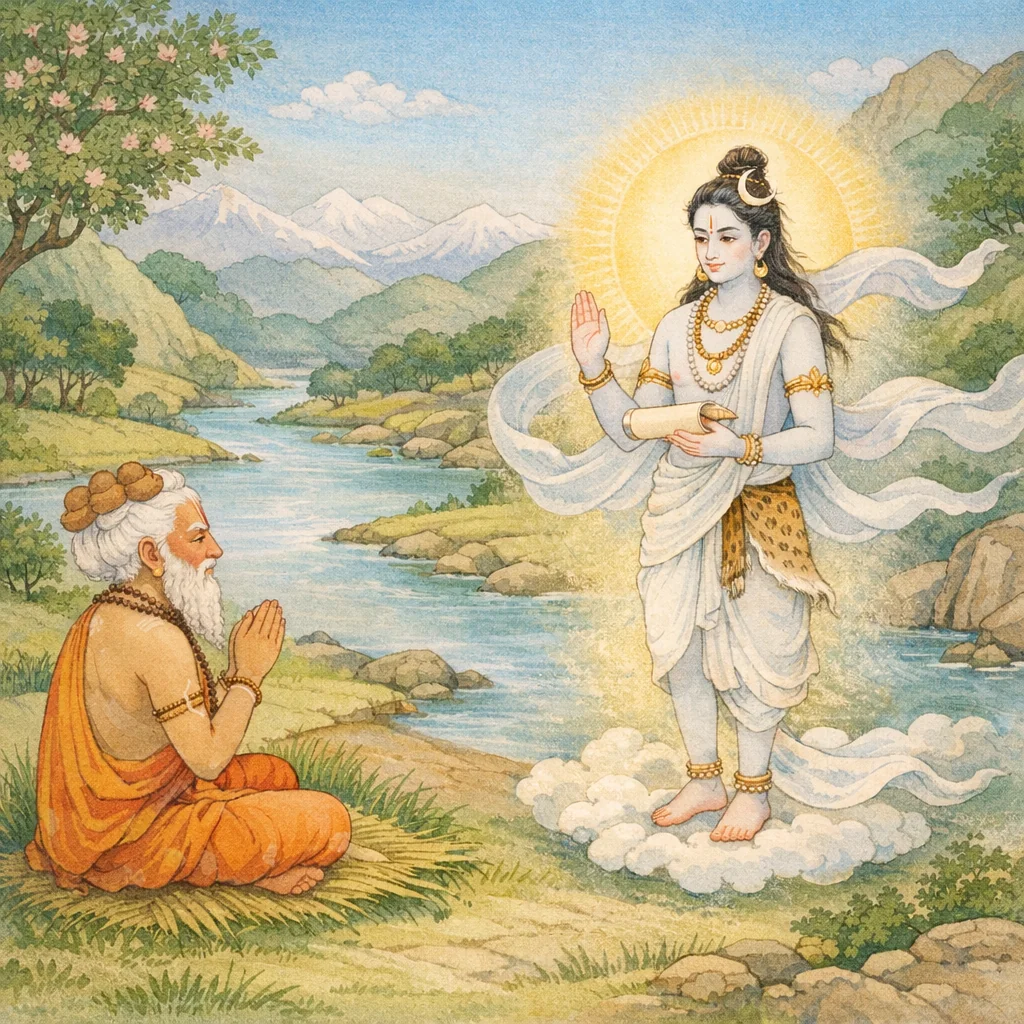
पशुपाशपतिज्ञान-प्राप्तिः (Acquisition of Paśupati–Pāśa Knowledge)
At Naimiṣāraṇya, Sūta presents the sages’ formal question to Vāyu: how he gained the knowledge accessible to Īśvara and how his Śaiva disposition arose. Vāyu replies by placing the teaching in the Śvetalohita kalpa: Brahmā, wishing to create, performs intense tapas. Pleased, the supreme Father Maheśvara appears in a divine youthful (kaumāra) form associated with “Śveta,” granting Brahmā direct darśana, the highest knowledge, and the Gāyatrī. Empowered, Brahmā becomes fit to create moving and unmoving beings. Vāyu then explains that what Brahmā heard as “amṛta” from Parameśvara, Vāyu received from Brahmā’s mouth through his own tapas. Asked what auspicious knowledge, firmly adopted, yields the highest fulfillment, Vāyu names it Paśupāśapati-jñāna and enjoins unwavering commitment (parā niṣṭhā) for seekers of true well-being.
Shlokas
Verse 1
सूत उवाच । तत्र पूर्वं महाभागा नैमिषारण्यवासिनः । प्रणिपत्य यथान्यायं पप्रच्छुः पवनं प्रभुम्
Sūta said: Then the greatly fortunate sages dwelling in Naimiṣāraṇya first bowed down in the proper manner, and thereafter questioned Lord Pavana (Vāyu), the sovereign.
Verse 2
नैमिषीया ऊचुः । भवान् कथमनुप्राप्तो ज्ञानमीश्वरगोचरम् । कथं च शिवभावस्ते ब्रह्मणो ऽव्यक्तजन्मनः
The sages of Naimiṣāraṇya said: “How did you attain that knowledge whose scope is the Lord Himself? And how did you come to possess Śiva-nature—though you are Brahmā, whose origin is unmanifest?”
Verse 3
वायुरुवाच । एकोनविंशतिः कल्पो विज्ञेयः श्वेतलोहितः । तस्मिन्कल्पे चतुर्वक्त्रस्स्रष्टुकामो ऽतपत्तपः
Vāyu said: “Know that the nineteenth aeon is called Śveta-Lohita. In that Kalpa, the four-faced one (Brahmā), desiring to bring forth creation, performed austerity.”
Verse 4
तपसा तेन तीव्रेण तुष्टस्तस्य पिता स्वयम् । दिव्यं कौमारमास्थाय रूपं रूपवतां वरः
Pleased by that intense austerity, his Father Himself—supreme among all who possess form—assumed a radiant youthful appearance and manifested before him.
Verse 5
श्वेतो नाम मुनिर्भूत्वा दिव्यां वाचमुदीरयन् । दर्शनं प्रददौ तस्मै देवदेवो महेश्वरः
Assuming the form of the sage named Śveta and uttering a divine speech, Mahādeva—Maheśvara, the God of gods—granted him darśana, the direct vision of His presence.
Verse 6
तं दृष्ट्वा पितरं ब्रह्मा ब्रह्मणो ऽधिपतिं पतिम् । प्रणम्य परमज्ञानं गायत्र्या सह लब्धवान्
Seeing the Father—Śiva, the Lord and Master even of Brahmā—Brahmā bowed in reverence and thereby attained the supreme knowledge, together with the Gāyatrī mantra.
Verse 7
ततस्स लब्धविज्ञानो विश्वकर्मा चतुर्मुखः । असृजत्सर्वभूतानि स्थावराणि चराणि च
Then the four-faced Brahmā—Viśvakarmā, having attained true knowledge—created all beings, both the immovable and the movable.
Verse 8
यतश्श्रुत्वामृतं लब्धं ब्रह्मणा परमेश्वरात् । ततस्तद्वदनादेव मया लब्धं तपोबलात्
Brahmā obtained the amṛta—the nectar of immortal wisdom—by hearing it from Parameśvara (Śiva). Thereafter, from Brahmā’s very mouth, I too received that same nectar, by the power born of austerity.
Verse 9
मुनय ऊचुः । किं तज्ज्ञानं त्वया लब्धं तथ्यात्तथ्यंतरं शुभम् । यत्र कृत्वा परां निष्ठां पुरुषस्सुखमृच्छति
The sages said: “What is that auspicious knowledge you have attained—truly in accord with reality and beyond mere worldly fact—by which, establishing the highest steadfastness (in Śiva), a person reaches true peace?”
Verse 10
वयुरुवाच । पशुपाशपतिज्ञानं यल्लब्धं तु मया पुरा । तत्र निष्ठा परा कार्या पुरुषेण सुखार्थिना
Vāyu said: “The knowledge of paśu (the bound soul), pāśa (bondage), and pati (the Lord) that I obtained long ago—one who seeks true well-being should establish the highest, unwavering devotion and steadiness in that (knowledge).”
Verse 11
अज्ञानप्रभवं दुःखं ज्ञानेनैव निवर्तते । ज्ञानं वस्तुपरिच्छेदो वस्तु च द्विविधं स्मृतम्
Sorrow is born of ignorance, and it is dispelled only by true knowledge. Knowledge is the clear discernment of reality; and reality is remembered in this teaching as of two kinds.
Verse 12
अजडं च जडं चैव नियंतृ च तयोरपि । पशुः पाशः पतिश्चेति कथ्यते तत्त्रयं क्रमात्
The conscious soul (non-insentient), the insentient principle, and the controller of them both—these three are taught in due order as the Paśu (bound soul), the Pāśa (bond), and the Pati (Lord).
Verse 13
अक्षरं च क्षरं चैव क्षराक्षरपरं तथा । तदेतत्त्रितयं भूम्ना कथ्यते तत्त्ववेदिभिः
The imperishable (akṣara) and the perishable (kṣara), and also That which is beyond both the perishable and the imperishable—this triad, in its vastness, is declared by the knowers of truth.
Verse 14
अक्षरं पशुरित्युक्तः क्षरं पाश उदाहृतः । क्षराक्षरपरं यत्तत्पतिरित्यभिधीयते
The imperishable is called the Paśu; the perishable is declared to be the Pāśa. That Supreme Reality which transcends both is spoken of as the Pati—the Lord, Śiva.
Verse 15
मुनय ऊचुः । किं तदक्षरमित्युक्तं किं च क्षरमुदाहृतम् । तयोश्च परमं किं वा तदेतद्ब्रूहि मारुत
The sages said: “What is declared to be the imperishable (akṣara), and what is called the perishable (kṣara)? And what is the Supreme beyond them both? O Māruta, tell us this clearly.”
Verse 16
वायुरुवाच । प्रकृतिः क्षरमित्युक्तं पुरुषो ऽक्षर उच्यते । ताविमौ प्रेरयत्यन्यस्स परा परमेश्वरः
Vāyu said: “Prakṛti is declared to be the perishable (kṣara), and the Puruṣa is spoken of as the imperishable (akṣara). Yet there is Another who impels and governs them both—He is the Supreme, the Transcendent Lord (Parameśvara), beyond all.”
Verse 17
मुनय ऊचुः । कैषा प्रकृतिरित्युक्ता क एष पुरुषो मतः । अनयोः केन सम्बन्धः कोयं प्रेरक ईश्वरः
The sages said: “What indeed is that which is called Prakṛti? And who is regarded as this Puruṣa? By what is the relation between these two established? And who is this impelling Lord, Īśvara?”
Verse 18
वायुरुवाच । माया प्रकृतिरुद्दिष्टा पुरुषो मायया वृतः । संबन्धो मूलकर्मभ्यां शिवः प्रेरक ईश्वरः
Vāyu said: “Māyā is declared to be Prakṛti, and the individual Puruṣa is veiled by that māyā. Bondage is through the root actions (mūla-karmas); yet Śiva is the impelling Lord, Īśvara, who presides as the inner mover.”
Verse 19
मुनय ऊचुः । केयं माया समा ख्याता किंरूपो मायया वृतः । मूलं कीदृक्कुतो वास्य किं शिवत्वं कुतश्शिवः
The sages said: “What indeed is this Māyā that is spoken of? What is its nature, and who is the one enveloped by Māyā? What is its root—of what kind is it, and from where does it arise? And what is ‘Śiva-hood’ (śivatva), and from where is Śiva known and realized?”
Verse 20
वायुरुवाच । माया माहेश्वरी शक्तिश्चिद्रूपो मायया वृतः । मलश्चिच्छादको नैजो विशुद्धिश्शिवता स्वतः
Vāyu said: “Māyā is the Lord’s power, the Māheśvarī śakti. The self is of the nature of pure consciousness (chid-rūpa), yet it becomes veiled by Māyā. Mala, the innate impurity, is what covers consciousness; but purity is Śivatā itself—Śiva-hood—by its very nature.”
Verse 21
मुनय ऊचुः । आवृणोति कथं माया व्यापिनं केन हेतुना । किमर्थं चावृतिः पुंसः केन वा विनिवर्तते
The sages said: “How does Māyā veil the all-pervading Reality, and for what cause does it do so? For what purpose does this veiling arise for a person, and by what means is that covering removed?”
Verse 22
वायुरुवाच । आवृतिर्व्यपिनो ऽपि स्याद्व्यापि यस्मात्कलाद्यपि । हेतुः कर्मैव भोगार्थं निवर्तेत मलक्षयात्
Vāyu said: Even for the all-pervading one there can be a veiling (limitation), because the covering power—beginning with kalā and the rest—pervades as well. For the sake of experience (bhoga), karma itself becomes the cause; and when impurity (mala) diminishes, that karma ceases to bind.
Verse 23
मुनय ऊचुः । कलादि कथ्यते किं तत्कर्म वा किमुदाहृतम् । तत्किमादि किमन्तं वा किं फलं वा किमाश्रयम्
The sages said: “What is this ‘Kalā’ and the rest that is spoken of? Is it an action (karma), or what is it declared to be? What is its beginning and what is its end? What is its fruit, and upon what support does it rest?”
Verse 24
कस्य भोगेन किं भोग्यं किं वा तद्भोगसाधनम् । मलक्षयस्य को हेतुः कीदृक्क्षीणमलः पुमान्
By whose experiencing does enjoyment occur—what, indeed, is the object enjoyed, and what are the means by which that enjoyment is accomplished? What is the cause of the destruction of impurity (mala), and what is a person like when his impurity has been exhausted?
Verse 25
वायुरुवाच । कला विद्या च रागश्च कालो नियतिरेव च । कलादयस्समाख्याता यो भोक्ता पुरुषो भवेत्
Vāyu said: “Kalā (limited agency), Vidyā (limited knowledge), Rāga (attachment), Kāla (time), and Niyati (necessity/constraint)—these are collectively called the ‘kalā and the rest’. The one who experiences them as their enjoyer is the puruṣa (the individual self).”
Verse 26
पुण्यपापात्मकं कर्म सुखदुःखफलं तु यत् । अनादिमलभोगान्तमज्ञानात्मसमाश्रयम्
That action which is of the nature of merit and demerit, whose fruit is pleasure and pain, which begins in the beginningless impurity and ends in mere experience and enjoyment, and which rests upon the self as ignorance—such is the karma that binds the soul.
Verse 27
भोगः कर्मविनाशाय भोगमव्यक्तमुच्यते । बाह्यांतःकरणद्वारं शरीरं भोगसाधनम्
Experience (bhoga) is for the wearing away of karma; therefore bhoga is called ‘unmanifest’ (avyakta), subtle at its root. The body—gateway of the outer senses and the inner instrument (mind)—is the means by which experience is undergone.
Verse 28
भावातिशयलब्धेन प्रसादेन मलक्षयः । क्षीणे चात्ममले तस्मिन् पुमाञ्च्छिवसमो भवेत्
By the grace (prasāda) gained through an intense elevation of devotion, the impurities (mala) are worn away. When that inner impurity is destroyed, the embodied soul becomes equal to Śiva in nature—sharing His purity and freedom—though not identical in lordship.
Verse 29
मुनय ऊचुः । कलादिपञ्चतत्त्वानां किं कर्म पृथगुच्यते । भोक्तेति पुरुषश्चेति येनात्मा व्यपदिश्यते
The sages said: “For the five principles beginning with Kalā, what distinct function (karma) is taught for each? And by what reason is the Self designated as ‘the enjoyer’ and as ‘Puruṣa’?”
Verse 30
किमात्मकं तदव्यक्तं केनाकारेण भुज्यते । किं तस्य शरणं भुक्तौ शरीरं च किमुच्यते
“What is the nature of that Unmanifest (avyakta)? By what form is it experienced? What is its refuge while it is being enjoyed/experienced? And what, indeed, is called the ‘body’?”
Verse 31
वायुरुवाच । दिक्क्रियाव्यंजका विद्या कालो रागः प्रवर्तकः । कालो ऽवच्छेदकस्तत्र नियतिस्तु नियामिका
Vāyu said: “Vidyā (limited knowledge) is that which reveals the directions and the powers of action. Kāla (time) is the impelling force in the form of rāga (attachment). There, time acts as the limiter, and niyati (cosmic order) is the regulator.”
Verse 32
अव्यक्तं कारणं यत्तत्त्रिगुणं प्रभवाप्ययम् । प्रधानं प्रकृतिश्चेति यदाहुस्तत्त्वचिंतकाः
That unmanifest causal principle—constituted of the three guṇas and serving as the source and dissolver of the world—is what the contemplatives of reality call “Pradhāna” and also “Prakṛti.”
Verse 33
कलातस्तदभिव्यक्तमनभिव्यक्तलक्षणम् । सुखदुःखविमोहात्मा भुज्यते गुणवांस्त्रिधा
From the (Lord’s) kalā—His limited manifestation—there arises that which becomes manifest, while still bearing the character of the unmanifest. Endowed with the guṇas, the embodied self experiences in threefold ways: pleasure, pain, and delusion.
Verse 34
सत्त्वं रजस्तम इति गुणाः प्रकृतिसंभवाः । प्रकृतौ सूक्ष्मरूपेण तिले तैलमिव स्थिताः
Sattva, rajas, and tamas—these are the guṇas born of Prakṛti. They abide within Prakṛti in a subtle form, just as oil remains present within the sesame seed.
Verse 35
सुखं च सुखहेतुश्च समासात्सात्त्विकं स्मृतम् । राजसं तद्विपर्यासात्स्तंभमोहौ तु तामसौ
Happiness, and that which becomes the cause of happiness, are briefly remembered as sāttvika. From their opposite arises rājasa; while inert rigidity and delusion (moha) are indeed tāmasa.
Verse 36
सात्त्विक्यूर्ध्वगतिः प्रोक्ता तामसी स्यादधोगतिः । मध्यमा तु गतिर्या सा राजसी परिपठ्यते
The upward course is declared to be sāttvika; the downward course is said to be tāmasika. And the course that is intermediate is recited as rājasika.
Verse 37
तन्मात्रापञ्चकं चैव भूतपञ्चकमेव च । ज्ञानेंद्रियाणि पञ्चैक्यं पञ्च कर्मेन्द्रियाणि च
Indeed, there are the five tanmātras (subtle elements) and the five bhūtas (gross elements); likewise, the five organs of knowledge as one set, and the five organs of action as well. These constitute the embodied field of experience bound by pāśa, over which Śiva, the Pati, is the supreme Lord.
Verse 38
प्रधानबुद्ध्यहंकारमनांसि च चतुष्टयम् । समासादेवमव्यक्तं सविकारमुदाहृतम्
Pradhāna (primordial nature), Buddhi (intellect), Ahaṃkāra (ego-principle), and Manas (mind)—this set of four, taken together in summary, is called the Avyakta (the unmanifest) as endowed with modifications (vikāra).
Verse 39
तत्कारणदशापन्नमव्यक्तमिति कथ्यते । व्यक्तं कार्यदशापन्नं शरीरादिघटादिवत्
That which has entered the state of being a cause is called the Unmanifest (avyakta). That which has entered the state of being an effect is called the Manifest (vyakta)—like a body, a pot, and the like.
Verse 40
यथा घटादिकं कार्यं मृदादेर्नातिभिद्यते । शरीरादि तथा व्यक्तमव्यक्तान्नातिभिद्यते
Just as an effect such as a pot is not truly separate from clay and the like (its material cause), so too the manifest—beginning with the body—is not truly separate from the unmanifest.
Verse 41
तस्मादव्यक्तमेवैक्यकारणं करणानि च । शरीरं च तदाधारं तद्भोग्यं चापि नेतरत्
Therefore, the Unmanifest alone is the cause of unity; and the sense-faculties, the body that supports them, and even the objects of experience are all dependent on That—there is nothing apart from It.
Verse 42
मुनय ऊचुः । बुद्धीन्द्रियशरीरेभ्यो व्यतिरेकस्य कस्यचित् । आत्मशब्दाभिधेयस्य वस्तुतो ऽपि कुतः स्थितिः
The sages said: “If there is some entity truly distinct from intellect, the sense-organs, and the body—what real basis can there be for the existence of that which is denoted by the word ‘Ātman’?”
Verse 43
वायुरुवाच । बुद्धीन्द्रियशरीरेभ्यो व्यतिरेको विभोर्ध्रुवम् । अस्त्येव कश्चिदात्मेति हेतुस्तत्र सुदुर्गमः
Vāyu said: “The Lord’s absolute distinctness from the intellect, the senses, and the body is indeed certain. Yet the subtle reasoning by which one ascertains, ‘There truly exists an inner Self (Ātman),’ is exceedingly difficult to grasp.”
Verse 44
बुद्धीन्द्रियशरीराणां नात्मता सद्भिरिष्यते । स्मृतेरनियतज्ञानादयावद्देहवेदनात्
The wise do not accept the intellect, the senses, or the body as the Self; for memory and the like are unsteady in their knowing, and bodily experience is limited only to the extent the body is felt.
Verse 45
अतः स्मर्तानुभूतानामशेषज्ञेयगोचरः । अन्तर्यामीति वेदेषु वेदांतेषु च गीयते
Therefore, to those who remember Him and directly realize Him, He becomes the field of all that is knowable—pervading all and present as the inner Witness. Hence, in the Vedas and in the Vedānta, He is praised as Antaryāmin, the Indwelling Lord.
Verse 46
सर्वं तत्र स सर्वत्र व्याप्य तिष्ठति शाश्वतः । तथापि क्वापि केनापि व्यक्तमेष न दृश्यते
He is there as the very All; indeed, He eternally abides, pervading everything everywhere. Yet even so, no one, nowhere, sees Him as something outwardly manifest.
Verse 47
नैवायं चक्षुषा ग्राह्यो नापरैरिन्द्रियैरपि । मनसैव प्रदीप्तेन महानात्मावसीयते १
That Supreme Great Self (the Lord) is not grasped by the eye, nor even by the other senses. He is ascertained only by the mind that has been kindled—made luminous through inner discipline and devotion.
Verse 48
न च स्त्री न पुमानेष नैव चापि नपुंसकः । नैवोर्ध्वं नापि तिर्यक्नाधस्तान्न कुतश्चन
He is neither woman nor man, nor even of neuter nature. He is not above, not across, not below—nor is He to be found from any direction whatsoever.
Verse 49
अशरीरं शरीरेषु चलेषु स्थाणुमव्ययम् । सदा पश्यति तं धीरो नरः प्रत्यवमर्शनात्
By inward contemplation, the steadfast wise one continually beholds Him—the bodiless Lord Śiva abiding within embodied beings, the unmoving Reality amid all that moves, the imperishable One.
Verse 50
किमत्र बहुनोक्तेन पुरुषो देहतः पृथक् । अपृथग्ये तु पश्यंति ह्यसम्यक्तेषु दर्शनम्
What need is there to say much here? The puruṣa, the conscious Self, is distinct from the body. Yet those who see no distinction—whose vision is unsteady and incorrect—remain in faulty understanding.
Verse 51
यच्छरीरमिदं प्रोक्तं पुरुषस्य ततः परम् । अशुद्धमवशं दुःखमध्रुवं न च विद्यते
This body, spoken of as belonging to the individual soul, is in truth something other than the Self. It is impure, helpless under bonds, a seat of suffering, and impermanent—there is no stability in it at all.
Verse 52
विपदां वीजभूतेन पुरुषस्तेन संयुतः । सुखी दुःखी च मूढश्च भवति स्वेन कर्मणा
Bound to that seed which becomes the source of misfortunes, the embodied soul—by his own karma—comes to be happy, sorrowful, and deluded.
Verse 53
अद्भिराप्लवितं क्षेत्रं जनयत्यंकुरं यथा । आज्ञानात्प्लावितं कर्म देहं जनयते तथा
Just as a field, when flooded with water, produces a sprout, so too karma, when inundated by ignorance, gives rise to embodiment—a new body.
Verse 54
अत्यंतमसुखावासास्स्मृताश्चैकांतमृत्यवः । अनागता अतीताश्च तनवो ऽस्य सहस्रशः
They are remembered as dwelling in extreme misery and as destined for inevitable death. Countless bodies of his—some yet to come and some already past—exist by the thousands.
Verse 55
आगत्यागत्य शीर्णेषु शरीरेषु शरीरिणः । अत्यंतवसतिः क्वापि न केनापि च लभ्यते
Again and again the embodied soul comes and goes among bodies that decay. Nowhere is an utterly permanent dwelling attained by anyone—only by taking refuge in the Supreme Lord Shiva, the liberating Pati, is one freed from bondage and made to abide.
Verse 56
छादितश्च वियुक्तश्च शरीरैरेषु लक्ष्यते । चंद्रबिंबवदाकाशे तरलैरभ्रसंचयैः
In these embodied beings, the Self is perceived as though covered and also as though separated by the bodies—just as the moon’s disc in the sky is at times veiled and at times revealed by shifting clusters of clouds.
Verse 57
अनेकदेहभेदेन भिन्ना वृत्तिरिहात्मनः । अष्टापदपरिक्षेपे ह्यक्षमुद्रेव लक्ष्यते
Here, the soul’s activity appears divided because of the differences among many bodies; as in the casting upon an eight-squared board, a single die-mark is perceived in various ways.
Verse 58
नैवास्य भविता कश्चिन्नासौ भवति कस्यचित् । पथि संगम एवायं दारैः पुत्रैश्च बंधुभिः
No one truly belongs to him, nor does he truly belong to anyone. With wife, children, and relatives, this is only a meeting along the road—an accidental companionship on the journey of saṁsāra.
Verse 59
यथा काष्ठं च काष्ठं च समेयातां महोदधौ । समेत्य च व्यपेयातां तद्वद्भूतसमागमः
Just as one piece of wood and another drift together upon the vast ocean, and having met, separate again—so too is the meeting of embodied beings: a temporary conjunction under the bonds of karma, not an eternal union.
Verse 60
स पश्यति शरीरं तच्छरीरं तन्न पश्यति । तौ पश्यति परः कश्चित्तावुभौ तं न पश्यतः
He perceives the body, but that very body does not perceive him. Yet some other, higher One perceives both of them—while those two, the knower and the known body, do not perceive That Supreme Seer.
Verse 61
ब्रह्माद्याः स्थावरांतश्च पशवः परिकीर्तिताः । पशूनामेव सर्वेषां प्रोक्तमेतन्निदर्शनम्
From Brahmā onward, down to the immovable beings, all are declared to be paśus—bound souls. This is stated as an illustration concerning all paśus, showing that every embodied being, from highest to lowest, remains bound without the liberating grace of Pati, Lord Śiva.
Verse 62
स एष बध्यते पाशैः सुखदुःखाशनः पशुः । लीलासाधनभूतो य ईश्वरस्येति सूरयः
This individual soul—the bound being (paśu)—is fettered by the bonds (pāśas) and made to taste, as it were, the eating of pleasure and pain. The wise declare that such a soul becomes an instrument for the Lord Īśvara’s divine play (līlā).
Verse 63
अज्ञो जंतुरनीशो ऽयमात्मनस्सुखदुःखयोः । ईश्वरप्रेरितो गच्छेत्स्वर्गं वा श्वभ्रमेव वा
This embodied being is ignorant and not the master of his own pleasure and pain. Driven by the Lord Īśvara’s prompting, he goes—either to heaven or into a wretched state, like falling into a pit.
Verse 64
सूत उवाच । इत्याकर्ण्यानिलवचो मुनयः प्रीतमानसाः । प्रोचुः प्रणम्य तं वायुं शैवागमविचक्षणम्
Sūta said: Thus hearing the words of Vāyu, the sages, their hearts made glad, bowed to that Vāyu—skilled in the Śaiva Āgamas—and then spoke.
Frequently Asked Questions
Brahmā’s intense tapas in the Śvetalohita kalpa leads to Maheśvara’s direct appearance (kaumāra form), granting darśana and supreme knowledge (with Gāyatrī), enabling creation.
It is Paśupāśapati-jñāna—Śaiva knowledge that frames liberation through understanding the Lord (Paśupati) and bondage (pāśa), requiring parā niṣṭhā for transformative realization.
Śiva is emphasized as Devadeva/Maheśvara/Parameśvara, appearing in a divine youthful (kaumāra) form and associated with the ‘Śveta’ motif in the narrative context.
Read Shiva Purana in the Vedapath app
Scan the QR code to open this directly in the app, with audio, word-by-word meanings, and more.