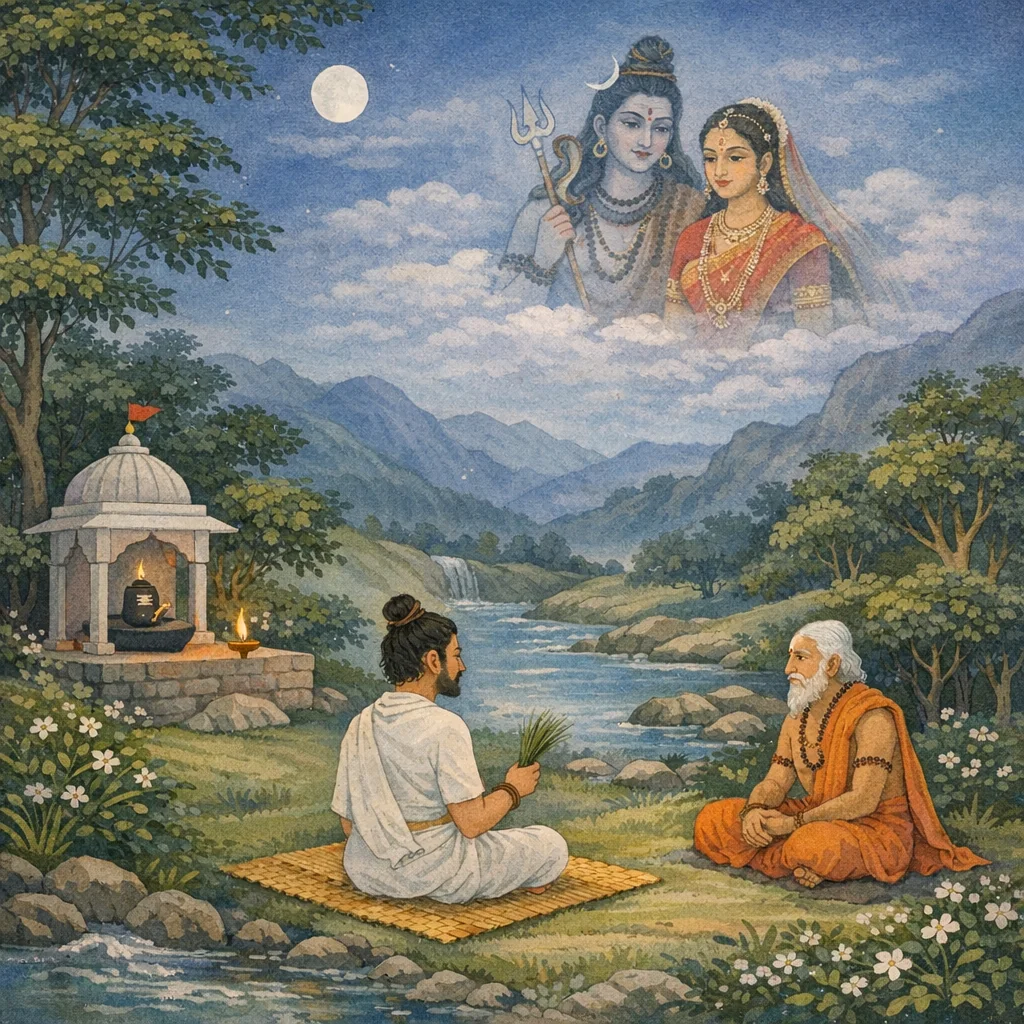
पाशुपतव्रतविधिः | The Procedure of the Supreme Pāśupata Vow
Adhyāya 33 begins with the sages asking to be taught the “supreme Pāśupata vrata,” a vow observed even by Brahmā and other deities, who thereby became “Pāśupatas.” Vāyu describes it as a secret, sin-destroying observance grounded in the Veda (linked with the Atharvaśiras). The chapter then lays out a detailed ritual order: choose an auspicious time (especially the full moon of Caitra), select a Śiva-connected place (kṣetra, garden, or forest with auspicious signs), bathe and complete daily rites, and seek the ācārya’s permission. The practitioner performs special worship and adopts purity marks—white garments, white yajñopavīta, and white garlands/anointing. Seated on a darbha seat and holding darbha, facing east or north, one performs triple prāṇāyāma, meditates on Śiva and Devī, and makes the saṅkalpa, “I undertake this vow,” entering a dīkṣita-like state. The vow’s duration is graded from lifelong to twelve years, then reduced to halves, twelve months, one month, twelve days, six days, and even a single day. Finally, the observance is set in motion through establishing the sacred fire (agnyādhāna) and the purificatory virajā-homa, joining intention, purity, and sacrificial action for the destruction of sin and alignment with Śiva.
Shlokas
Verse 1
ऋषय ऊचुः । भगवञ्छ्रोतुमिच्छामो व्रतं पाशुपतं परम् । ब्रह्मादयो ऽपि यत्कृत्वा सर्वे पाशुपताः स्मृताः
The sages said: “O venerable one, we wish to hear of the supreme Pāśupata observance—by performing which even Brahmā and the other gods are all regarded as Pāśupatas, devotees of Paśupati, Lord Śiva.”
Verse 2
वायुरुवाच । रहस्यं वः प्रवक्ष्यामि सर्वपापनिकृन्तनम् । व्रतं पाशुपतं श्रौतमथर्वशिरसि श्रुतम्
Vāyu said: “I shall declare to you a secret teaching that cuts off all sins—the Vedic (śrauta) Pāśupata observance, as heard in the Atharvaśiras.”
Verse 3
कालश्चैत्री पौर्णमासी देशः शिवपरिग्रहः । क्षेत्रारामाद्यरण्यं वा प्रशस्तश्शुभलक्षणः
The fitting time is the full-moon day of Caitra; the fitting place is a region belonging to, or consecrated to, Lord Śiva—whether a sacred field, a garden, or even a forest—so long as it is sanctioned by tradition and marked with auspicious signs.
Verse 4
तत्र पूर्वं त्रयोदश्यां सुस्नातः सुकृताह्निकः । अनुज्ञाप्य स्वमाचार्यं संपूज्य प्रणिपत्य च
There, beforehand, on the thirteenth lunar day, having bathed well and duly performed the daily rites, he sought permission from his own teacher; and having worshipped him fully, he bowed down in reverence as well.
Verse 5
पूजां वैशेषिकीं कृत्वा शुक्लांबरधरः स्वयम् । शुक्लयज्ञोपवीती च शुक्लमाल्यानुलेपनः
Having performed the special worship as prescribed, he should himself be clad in white garments, wearing a white sacred thread (yajñopavīta), and adorned with white garlands and white unguents.
Verse 6
ध्यात्वा देवं च देवीं च तद्विज्ञापनवर्त्मना । व्रतमेतत्करोमीति भवेत्संकल्प्य दीक्षितः
Having meditated upon the Lord Śiva and the Goddess Devī, and proceeding by the rite of formally informing and invoking Them, the initiated votary should make a resolve (saṅkalpa): “I shall undertake this vow.”
Verse 7
यावच्छरीरपातं वा द्वादशाब्दमथापि वा । तदर्धं वा तदर्धं वा मासद्वादशकं तु वा
It may be observed until the fall of the body (that is, for one’s whole lifetime), or else for twelve years; or for half of that, or again half of that; or at least for a period of twelve months.
Verse 8
तदर्धं वा तदर्धं वा मासमेकमथापि वा । दिनद्वादशकं वा ऽथ दिनषट्कमथापि वा
Or half of that period, or again half of it; or even a full month; or twelve days; or even six days—the discipline of worship and observance for Śiva may be undertaken for any of these durations.
Verse 9
तदर्धं दिनमेकं वा व्रतसंकल्पनावधि । अग्निमाधाय विधिवद्विरजाहोमकारणात्
The period for making the vow’s resolve (vrata-saṅkalpa) should be for half a day or for one full day. Then, having duly established the sacred fire according to rule, one should perform the Virajā-homa, for it is the cause of ritual purification (freedom from impurity).
Verse 10
हुत्वाज्येन समिद्भिश्च चरुणा च यथाक्रमम् । पूर्णामापूर्य तां भूयस्तत्त्वानां शुद्धिमुद्दिशन्
Having offered, in proper sequence, oblations of ghee, sacred fuel-sticks, and the cooked offering (caru), he again completed the concluding oblation (pūrṇāhuti), dedicating it to the purification of the tattvas, the fundamental principles of embodied existence.
Verse 11
जुहुयान्मूलमन्त्रेण तैरेव समिदादिभिः । तत्त्वान्येतानि मद्देहे शुद्ध्यंताम् १ त्यनुस्मरन्
He should offer oblations with the root-mantra (mūla-mantra), using those same fuel-sticks and the other prescribed materials, while inwardly recollecting: “May these tattvas within my body be purified.”
Verse 12
पञ्चभूतानि तन्मात्राः पञ्चकर्मेन्द्रियाणि च । ज्ञानकर्मविभेदेन पञ्चकर्मविभागशः
The five great elements, the subtle essences (tanmātras), and the five organs of action are described; and, by distinguishing knowledge from action, their functions are set forth in fivefold divisions.
Verse 13
त्वगादिधातवस्सप्त पञ्च प्राणादिवायवः । मनोबुद्धिरहं ख्यातिर्गुणाः प्रकृतिपूरुषौ
The seven bodily constituents beginning with skin, the five vital airs beginning with prāṇa, the mind and intellect, the sense of “I” (ahaṃkāra) and cognitive apprehension, the three guṇas, and also Prakṛti and Puruṣa—these are the principles that bind the individual soul; knowing them in truth, one turns toward Pati (Śiva), the liberator beyond bonds.
Verse 14
रागो विद्याकले चैव नियतिः काल एव च । माया च शुद्धिविद्या च महेश्वरसदाशिवौ
Desire (rāga), knowledge (vidyā), and limited agency (kalā), as well as limitation (niyati) and time (kāla)—and also Māyā and pure knowledge (śuddhavidyā), together with Maheśvara and Sadāśiva: these are the higher principles spoken of in this teaching.
Verse 15
शक्तिश्च शिवतत्त्वं च तत्त्वानि क्रमशो विदुः । मन्त्रैस्तु विरजैर्हुत्वा होतासौ विरजा भवेत्
They understand the tattvas in due order—beginning with Śakti and culminating in the principle of Śiva. But when one offers oblations with stainless (viraja) mantras, the sacrificer himself becomes stainless, freed from the taint of rajas.
Verse 16
शिवानुग्रहमासाद्य ज्ञानवान्स हि जायते । अथ गोमयमादाय पिण्डीकृत्याभिमंत्र्य च
Having attained Śiva’s grace, he indeed becomes endowed with true knowledge. Then, taking cow-dung, he forms it into a lump and, having sanctified it with mantra-recitation, proceeds with the rite.
Verse 17
विन्यस्याग्नौ च सम्प्रोक्ष्य दिने तस्मिन्हविष्यभुक् । प्रभाते तु चतुर्दश्यां कृत्वा सर्वं पुरोदितम्
Having duly placed the offerings into the sacred fire and purified them by sprinkling, on that day he should partake only of the prescribed oblation-food (havisya). Then, on the morning of the fourteenth lunar day (caturdaśī), having completed everything as previously enjoined, he should proceed with the rite in the proper manner.
Verse 18
दिने तस्मिन्निराहारः कालं शेषं समापयेत् । प्रातः पर्वणि चाप्येवं कृत्वा होमा वसानतः
On that day, remaining without food, one should pass the rest of the time in disciplined observance. Likewise, on the following morning at the sacred juncture (parvan), having done so, one should conclude by performing the homa (oblatory fire-offering) with proper completion rites.
Verse 19
उपसंहृत्य रुद्राग्निं गृह्णीयाद्भस्म यत्नतः । ततश्च जटिलो मुण्डी शिखैकजट एव वा
After duly concluding the Rudra-fire (Rudrāgni), one should carefully gather the holy ash (bhasma). Thereafter, in keeping with the discipline of Śiva’s vow, one may live as an ascetic with matted locks, or be shaven-headed, or keep a single topknot, or even a single matted lock.
Verse 20
भूत्वा स्नात्वा ततो वीतलज्जश्चेत्स्याद्दिगम्बरः । अपि काषायवसनश्चर्मचीराम्बरो ऽथ वा
Having performed the required observances and then bathed, one should be free from shame and, if appropriate, remain digambara—sky-clad. Or else one may wear ochre robes (kāṣāya), or be clothed in skins and bark-cloth, whatever is fitting, while pursuing the discipline directed to Śiva.
Verse 21
एकाम्बरो वल्कली वा भवेद्दण्डी च मेखली । प्रक्षाल्य चरणौ पश्चाद्द्विराचम्यात्मनस्तनुम्
Wearing a single garment—or clad in bark—he should also bear a staff (daṇḍa) and a girdle (mekhalā). After washing his feet, he should then perform ācamana twice, thus purifying his own body for Śiva’s worship and yogic discipline.
Verse 22
संकुलीकृत्य तद्भस्म विरजानलसंभवम् । अग्निरित्यादिभिर्मंत्रैः षड्भिराथर्वणैः क्रमात्
Then, having thoroughly mixed that sacred ash—born of the pure Virajā fire—one should, in due order, consecrate it with the six Atharvan mantras beginning with “Agni…”.
Verse 23
विभृज्यांगानि मूर्धादिचरणांतानि तैस्स्पृशेत् । ततस्तेन क्रमेणैव समुद्धृत्य च भस्मना
Having cleansed the limbs from the head down to the feet, one should touch them with that purifying substance. Then, in that same order, one should take up and apply the sacred ash (bhasma), proceeding step by step.
Verse 24
सर्वांगोद्धूलनं कुर्यात्प्रणवेन शिवेन वा । ततस्त्रिपुण्ड्रं रचयेत्त्रियायुषसमाह्वयम्
One should smear the sacred ash over the entire body while reciting the Praṇava (Oṁ) or the holy name of Śiva. Thereafter one should draw the Tripuṇḍra, the three ash-lines, invoking the threefold life—past, present, and future—so that they are purified by that consecration.
Verse 25
शिवभावं समागम्य शिवयोगमथाचरेत् । कुर्यात्स्त्रिसन्ध्यमप्येवमेतत्पाशुपतं व्रतम्
Having entered the state of Śiva—absorbed in His awareness—one should then practice Śiva-yoga. In this very manner, performing it at the three daily sandhyās (dawn, noon, and dusk), one should observe this Pāśupata vow.
Verse 26
भुक्तिमुक्तिप्रदं चैतत्पशुत्वं विनिवर्तयेत् । तत्पशुत्वं परित्यज्य कृत्वा पाशुपतं व्रतम्
This Pāśupata discipline bestows both worldly enjoyment and liberation; it removes paśutva, the condition of bound creaturehood. Therefore, abandoning that bondage, one should undertake the Pāśupata vow in devotion to Paśupati, Lord Śiva.
Verse 27
पूजनीयो महादेवो लिंगमूर्तिस्सनातनः । पद्ममष्टदलं हैमं नवरत्नैरलंकृतम्
Mahādeva, the Eternal One whose form is the Liṅga, is to be worshipped. For His worship one should offer a golden lotus of eight petals, adorned with the nine gems.
Verse 28
कर्णिकाकेशरोपेतमासनं परिकल्पयेत् । विभवे तदभावे तु रक्तं सितमथापि वा
One should prepare a seat furnished with a central whorl and surrounding filaments, like a lotus. If one has the means, one should use such a seat; if it is not available, one may use a red seat, or even a white one.
Verse 29
पद्मं तस्याप्यभावे तु केवलं भावनामयम् । तत्पद्मकर्णिकामध्ये कृत्वा लिंगं कनीयसम्
Let the sādhaka take a lotus; and if even that is unavailable, let it be a lotus formed purely by contemplation. In the very center of that lotus—within its pericarp—he should place (or visualize) a small Śiva-liṅga.
Verse 30
स्फीटिकं पीठिकोपेतं पूजयेद्विधिवत्क्रमात् । प्रतिष्ठाप्य विधानेन तल्लिंगं कृतशोधनम्
In due order, one should worship the crystal Liṅga set upon its pedestal, according to the proper rite. Having purified it and installed that Liṅga by the prescribed procedure, one should then proceed with its worship.
Verse 31
परिकल्प्यासनं मूर्तिं पञ्चवक्त्रप्रकारतः । पञ्चगव्यादिभिः पूर्णैर्यथाविभवसंभृतैः
Having duly arranged a seat and contemplated the Deity’s form according to Śiva’s five-faced manifestation, one should prepare the offerings—filled with pañcagavya and other sacred substances—gathered according to one’s means.
Verse 32
स्नापयेत्कलशैः पूर्णैरष्टापदसमुद्भवैः । गंधद्रव्यैस्सकर्पूरैश्चन्दनाद्यैस्सकुंकुमैः
One should bathe (perform abhiṣeka for) Śiva’s sacred Liṅga with full pitchers set upon an eight-petalled stand (aṣṭāpada), using fragrant substances—together with camphor, sandal and the like, and also saffron—thus completing the purificatory ablution for the Lord Pati, the Supreme Master and gracious giver of liberation.
Verse 33
सवेदिकं समालिप्य लिंगं भूषणभूषितम् । बिल्वपत्रैश्च पद्मैश्च रक्तैः श्वेतैस्तथोत्पलैः
After carefully anointing and preparing the Liṅga together with its pedestal (yoni-pīṭha), and adorning it with ornaments, one should worship it with bilva leaves, with lotuses—red and white—and likewise with utpala, the water-lilies.
Verse 34
नीलोत्पलैस्तथान्यैश्च पुष्पैस्तैस्तैस्सुगंधिभिः । पुण्यैः प्रशस्तैः पत्रैश्च चित्रैर्दूर्वाक्षतादिभिः
With blue lotuses and other kinds of fragrant flowers; with pure and auspicious leaves; and with variegated sacred offerings such as dūrvā grass and unbroken rice (akṣata), and the like.
Verse 35
समभ्यर्च्य यथालाभं महापूजाविधानतः । धूपं दीपं तथा चापि नैवेद्यं च समादिशेत्
Having duly worshipped Śiva according to one’s means, in the manner prescribed for the great rite of pūjā, one should then offer incense and a lamp, and also reverently present the naivedya, the food-offering.
Verse 36
निवेदयित्वा विभवे कल्याणं च समाचरेत् । इष्टानि च विशिष्टानि न्यायेनोपार्जितानि च
Having first offered according to one’s capacity, one should then practice what is auspicious. One should give and employ desirable and excellent things that have been earned righteously.
Verse 37
सर्वद्रव्याणि देयानि व्रते तस्मिन्विशेषतः । श्रीपत्रोत्पलपद्मानां संख्या साहस्रिकी मता
In that sacred vow, one should especially give all kinds of offerings in charity. For bilva leaves and for the flowers of the blue lotus and the lotus, the prescribed count is held to be a thousand.
Verse 38
प्रत्येकमपरा संख्या शतमष्टोत्तरं द्विजाः । तत्रापि च विशेषेण न त्यजेद्बिल्वपत्रकम्
O twice-born ones, for each offering there is another prescribed count—one hundred and eight. Even among these, one should especially never omit the bilva leaf in Śiva’s worship.
Verse 39
हैममेकं परं प्राहुः पद्मं पद्मसहस्रकात् । नीलोत्पलादिष्वप्येतत्समानं बिल्बपत्रकैः
They declare that a single golden lotus is superior to a thousand ordinary lotuses. Likewise, even among blue lotuses and other flowers, this offering is deemed equal in merit when made with bilva leaves for Lord Śiva.
Verse 40
पुष्पान्तरे न नियमो यथालाभं निवेदयेत् । अष्टाङ्गमर्घ्यमुत्कृष्टं धूपालेपौ विशेषतः
In offering flowers there is no rigid rule—one should present whatever is available. The eightfold arghya is held to be excellent; and, above all, incense and sacred unguents are especially praised in Śiva’s worship.
Verse 41
चन्दनं वामदेवाख्ये हरितालं च पौरुषे । ईशाने भसितं केचिदालेपनमितीदृशाम्
In the observance associated with Vāmadeva, sandal paste is applied; in that of Pauruṣa, yellow orpiment (haritāla); and in that of Īśāna, some prescribe bhasma, the sacred ash. Thus do certain authorities enjoin such anointing for these forms and disciplines.
Verse 42
न धूपमिति मन्यन्ते धूपान्तरविधानतः । सितागुरुमघोराख्ये मुखे कृष्णागुरुं पुनः
Because the incense-offerings are prescribed in distinct variations, it is not regarded as one single, uniform incense. For the face called Aghora, white agaru (sītāguru) is enjoined; and in another prescription, black agaru (kṛṣṇāguru) is set forth.
Verse 43
पौरुषे गुग्गुलं सव्ये सौम्ये सौगंधिकं मुखे । ईशाने ऽपि ह्युशीरादि देयाद्धूपं विशेषतः
For the Pauruṣa aspect, one should offer guggulu incense; on the left side, the Saumya fragrance; at the mouth, a sweet-scented perfume. And in the Īśāna direction as well, one should especially present incense made of uśīra and the like.
Verse 44
शर्करामधुकर्पूरकपिलाघृतसंयुतम् । चंदनागुरुकाष्ठाद्यं सामान्यं संप्रचक्षते
That mixture combined with sugar, honey, camphor, and tawny (kapilā) ghee—together with sandalwood, agaru (aloeswood), fragrant woods and the like—is declared to be the ‘common’ (standard) offering.
Verse 45
कर्पूरवर्तिराज्याढ्या देया दीपावलिस्ततः । अर्घ्यमाचमनं देयं प्रतिवक्त्रमतः परम्
Then one should offer a row of lamps, richly furnished with wicks of camphor. Thereafter, arghya and ācamanā are to be offered in proper sequence, presented before each revered face (of the Deity).
Verse 46
प्रथमावरणे पूज्यो क्रमाद्धेरम्बषण्मुखौ । ब्रह्मांगानि ततश्चैव प्रथमावरणेर्चिते
In the first enclosure (āvaraṇa) of worship, one should venerate in due order Heramba (Gaṇeśa) and Ṣaṇmukha (Kārttikeya). Thereafter, in that same first enclosure, the limbs—attendant aspects—of Brahmā are also to be worshipped.
Verse 47
द्वितीयावरणे पूज्या विघ्नेशाश्चक्रवर्तिनः । तृतीयावरणे पूज्या भवाद्या अष्टमूर्तयः
In the second enclosure, Vighneśa (Gaṇeśa) and the universal sovereigns (cakravartin) are to be worshipped. In the third enclosure, the Eight Manifest Forms (Aṣṭamūrti) beginning with Bhava are to be worshipped.
Verse 48
महादेवादयस्तत्र तथैकादशमूर्तयः । चतुर्थावरणे पूज्याः सर्व एव गणेश्वराः
There, Mahādeva and the other divine manifestations—indeed, the eleven forms as well—are all to be worshipped in the fourth enclosure; for all of them are truly lords of Śiva’s gaṇas, His attendant hosts.
Verse 49
बहिरेव तु पद्मस्य पञ्चमावरणे क्रमात् । दशदिक्पतयः पूज्याः सास्त्राः सानुचरास्तथा
Then, outside the lotus—upon its fifth enclosing circle in due order—the Lords of the ten directions should be worshipped, together with their weapons and also with their attendant retinues.
Verse 50
ब्रह्मणो मानसाः पुत्राः सर्वे ऽपि ज्योतिषां गणाः । सर्वा देव्यश्च देवाश्च सर्वे सर्वे च खेचराः
All the hosts of radiant celestial beings are mind-born sons of Brahmā; all the goddesses and gods—and even all those who move through the sky—are of that same divine origin.
Verse 51
पातालवासिनश्चान्ये सर्वे मुनिगणा अपि । योगिनो हि सखास्सर्वे पतंगा मातरस्तथा
Others too were present—the dwellers of Pātāla and all the hosts of sages. All the yogins, all friendly companions, and likewise the celestial beings and the Divine Mothers also gathered there.
Verse 52
क्षेत्रपालाश्च सगणाः सर्वं चैतच्चराचरम् । पूजनीयं शिवप्रीत्या मत्त्वा शंभुविभूतिमत्
Knowing that the Kṣetrapālas with their attendant hosts—and indeed this entire universe, moving and unmoving—are endowed with the power and glory of Śambhu, one should worship them for the pleasure of Śiva.
Verse 53
अथावरणपूजांते संपूज्य परमेश्वरम् । साज्यं सव्यं जनं हृद्यं हविर्भक्त्या निवेदयेत्
Then, at the conclusion of the āvaraṇa-pūjā, having fully honoured the Supreme Lord, one should devotionally offer the havis—pleasing and heart-delighting—together with ghee.
Verse 54
मुखवासादिकं दत्त्वा ताम्बूलं सोपदंशकम् । अलंकृत्य च भूयो ऽपि नानापुष्पविभूषणैः
Having offered mouth-perfumes and the like, and then betel-leaf (tāmbūla) prepared with condiments, he again adorned the revered one with ornaments and decorations made of many kinds of flowers.
Verse 55
नीराजनांते विस्तीर्य पूजाशेषं समापयेत् । चषकं सोपकारं च शयनं च समर्पयेत्
At the conclusion of the ārati, one should properly spread out the offerings and complete the remaining parts of the worship. Then one should present a cup with its accompaniments, and also offer the bed as a ritual service to the Lord.
Verse 56
चन्द्रसंकाशहारं च शयनीयं समर्पयेत् । आद्यं नृपोचितं हृद्यं तत्सर्वमनुरूपतः
One should offer a necklace gleaming like the moon, and also a worthy bed. These foremost gifts—fit for a king and pleasing to the heart—should all be presented with due propriety, in a manner befitting the recipient.
Verse 57
कृत्वा च कारयित्वा च हित्वा च प्रतिपूजनम् । स्तोत्रं व्यपोहनं जप्त्वा विद्यां पञ्चाक्षरीं जपेत्
Having performed the prescribed rites oneself—or had them performed—and having set aside the counter-worship done for the removal of obstacles, one should first recite the ‘Vyapohana’ stotra for purification. Then one should repeat the five-syllabled Vidyā (mantra)—the Pañcākṣarī—devoted to Śiva.
Verse 58
प्रदक्षिणां प्रणामं च कृत्वात्मानं समर्पयेत् । ततः पुरस्ताद्देवस्य गुरुविप्रौ च पूजयेत्
Having performed circumambulation and prostration, one should offer oneself in surrender. Thereafter, in the Lord’s presence, one should worship one’s guru and the brāhmaṇas as well.
Verse 59
दत्त्वार्घ्यमष्टौ पुष्पाणि देवमुद्वास्य लिंगतः । अग्नेश्चाग्निं सुसंयम्य ह्युद्वास्य च तमप्युत
Having offered arghya and eight flowers, one should respectfully conclude the worship of the Deva at the Liṅga. And having properly restrained and settled the sacred fire, one should duly conclude that rite as well.
Verse 60
प्रत्यहं च जनस्त्वेवं कुर्यात्सेवां पुरोदिताम् । ततस्तत्साम्बुजं लिंगं सर्वोपकरणान्वितम्
And each day, a devotee should perform the worship previously described. Then, with all the required ritual implements, he should duly serve that Liṅga—together with its water-offering and lotus adoration—as the sacred support for approaching Lord Śiva.
Verse 61
समर्पयेत्स्वगुरवे स्थापयेद्वा शिवालये । संपूज्य च गुरून्विप्रान्व्रतिनश्च विशेषतः
One should offer it to one’s own guru, or else install it in a temple of Śiva. And having duly worshipped the gurus, the Brahmin sages, and especially those who are observant of vows, one should proceed accordingly.
Verse 62
भक्तान्द्विजांश्च शक्तश्चेद्दीनानाथांश्च तोषयेत् । स्वयं चानशने शक्तः फलमूलाशने ऽथ वा
If one is able, one should gratify the Lord’s devotees, the twice-born, and also the helpless and the unprotected. And if one has the strength, one should oneself observe fasting (anāśana); otherwise, one may subsist on fruits and roots.
Verse 63
पयोव्रतो वा भिक्षाशी भवेदेकाशनस्तथा । नक्तं युक्ताशनो नित्यं भूशय्यानिरतः शुचिः
He should undertake the observance of taking only milk, or live on alms; he may eat only once a day, or take food only at night in measured quantity. Ever devoted to sleeping on the ground, he should remain pure—disciplined in body and conduct.
Verse 64
भस्मशायी तृणेशायी चीराजिनधृतो ऽथवा । ब्रह्मचर्यव्रतो नित्यं व्रतमेतत्समाचरेत्
Let him observe this vow constantly: sleeping upon sacred ash or upon grass, and wearing bark-cloth or a deerskin; and ever established in the vow of celibacy (brahmacarya).
Verse 65
अर्कवारे तथार्द्रायां पञ्चदश्यां च पक्षयोः । अष्टम्यां च चतुर्दश्यां शक्तस्तूपवसेदपि
On Sunday, on the day of Ārdrā (nakṣatra), on the fifteenth lunar day in either fortnight, and also on the eighth and fourteenth lunar days—if one is able, one should observe a fast (upavāsa) as a sacred vow on these occasions as well.
Verse 66
पाखण्डिपतितोदक्यास्सूतकान्त्यजपूर्वकान् । वर्जयेत्सर्वयत्नेन मनसा कर्मणा गिरा
With every effort, one should avoid—by mind, by deed, and by speech—heretics, the fallen, those whose water is ritually impure, those under the impurity of birth or death (sūtaka), and those beginning with the outcaste; for such association obstructs purity and steadiness on Śiva’s path.
Verse 67
क्षमदानदयासत्याहिंसाशीलः सदा भवेत् । संतुष्टश्च प्रशान्तश्च जपध्यानरतस्तथा
He should always be established in the virtues of forgiveness, generosity, compassion, truthfulness, and non-violence. Content and tranquil, he should likewise remain devoted to japa and meditation; thus he becomes fit for the Śaiva path, where the paśu (bound soul) is released from the pāśa (bondage) by the grace of Pati, Śiva.
Verse 68
कुर्यात्त्रिषवणस्नानं भस्मस्नानमथापि वा । पूजां वैशेषिकीं चैव मनसा वचसा गिरा
One should perform the three daily ablutions at the three sandhyās, or else bathe with sacred ash (bhasma). One should also offer the special worship—by mind, by speech, and by uttered words—dedicating all inner and outer faculties to Śiva.
Verse 69
बहुनात्र किमुक्तेन नाचरेदशिवं व्रती । प्रमादात्तु तथाचारे निरूप्य गुरुलाघवे
What is the use of saying much here? A vow-observer should never perform what is inauspicious and contrary to Śiva. But if, through negligence, such conduct occurs, then—after discerning what is heavy (a grave fault) and what is light (a minor fault)—one should proceed with the appropriate rectification.
Verse 70
उचितां निष्कृतिं कुर्यात्पूजाहोमजपादिभिः । आसमाप्तेर्व्रतस्यैवमाचरेन्न प्रमादतः
One should perform the proper expiation through worship, fire-offerings (homa), mantra-recitation (japa), and the like. Thus, until the vow is fully completed, one should proceed without negligence.
Verse 71
गोदानं च वृषोत्सर्गं कुर्यात्पूजां च संपदा । भक्तश्च शिवप्रीत्यर्थं सर्वकामविवर्जितः
For the pleasure of Lord Śiva alone, the devotee—free from all selfish desires—should perform the gifting of cows, the ceremonial release of a bull (vṛṣotsarga), and worship, offering his wealth in devotion.
Verse 72
सामान्यमेतत्कथितं व्रतस्यास्य समासतः । प्रतिमासं विशेषं च प्रवदामि यथाश्रुतम्
Thus, the general outline of this vow has been stated in brief. Now I shall declare, as it has been heard in the tradition, the specific observances to be followed in each month.
Verse 73
वैशाखे वज्रलिंगं तु ज्येष्ठे मारकतं शुभम् । आषाढे मौक्तिकं विद्याच्छ्रावणे नीलनिर्मितम्
In the month of Vaiśākha, one should worship the Vajra-liṅga; in Jyeṣṭha, the auspicious Emerald-liṅga; in Āṣāḍha, know the Pearl-liṅga; and in Śrāvaṇa, the liṅga fashioned of blue sapphire.
Verse 74
मासे भाद्रपदे चैव पद्मरागमयं परम् । आश्विने मासि विद्याद्वै लिंगं गोमेदकं वरम्
In the month of Bhādrapada, one should worship the supreme Liṅga made of padmarāga (ruby). In the month of Āśvina, know indeed that the prescribed form is the excellent Liṅga made of gomedaka (hessonite).
Verse 75
कार्तिक्यां वैद्रुमं लिंगं वैदूर्यं मार्गशीर्षके । पुष्परागमयं पौषे माघे द्युमणिजन्तथा
In Kārtika, one should worship the Liṅga made of coral; in Mārgaśīrṣa, the Liṅga of cat’s-eye gem; in Pauṣa, the Liṅga fashioned from topaz; and in Māgha, likewise, the Liṅga made of a radiant jewel.
Verse 76
फाल्गुणे चन्द्रकान्तोत्थं चैत्रे तद्व्यत्ययो ऽथवा । सर्वमासेषु रत्नानामलाभे हैममेव वा
In the month of Phālguna, one should use what is produced from the moonstone; in Chaitra, the reverse may also be done. In all months, if gemstones are not obtainable, then one may simply use gold alone.
Verse 77
हैमाभावे राजतं वा ताम्रजं शैलजन्तथा । मृन्मयं वा यथालाभं जातुषं चान्यदेव वा
If gold is unavailable, one may use silver, or copper, or stone as well; or an earthen form according to what is obtainable, or resin—indeed, any other suitable material too.
Verse 78
सर्वगंधमयं वाथ लिंगं कुर्याद्यथारुचि । व्रतावसानसमये समाचरितनित्यकः
Then, according to his liking, he should fashion a Liṅga made fragrant with all perfumes; and at the time of concluding the vow—having duly performed his daily obligatory observances—he should proceed with the rite.
Verse 79
कृत्वा वैशेषिकीं पूजां हुत्वा चैव यथा पुरा । संपूज्य च तथाचार्यं व्रतिनश्च विशेषतः
Having performed the special prescribed worship and offered oblations into the sacred fire just as in the ancient tradition, one should then duly honor the ācārya (spiritual preceptor), and especially show reverence to those who are vowed observers (vratins).
Verse 80
देशिकेनाप्यनुज्ञातः प्राङ्मुखो वाप्युदङ्मुखः । दर्भासनो दर्भपाणिः प्राणापानौ नियम्य च
Having received permission from the preceptor, facing either east or north, seated upon a kuśa-grass seat and holding kuśa in the hand, one should restrain and regulate the in-breath and out-breath (prāṇa and apāna).
Verse 81
जपित्वा शक्तितो मूलं ध्यात्वा साम्बं त्रियम्बकम् । अनुज्ञाप्य यथापूर्वं नमस्कृत्य कृताञ्जलिः
Having repeated the root-mantra to the best of his ability and meditated on Triyambaka—Śiva ever united with Umā—he sought permission as before; then, with palms joined, he bowed in reverent homage.
Verse 82
समुत्सृजामि भगवन्व्रतमेतत्त्वदाज्ञया । इत्युक्त्वा लिंगमूलस्थान्दर्भानुत्तरतस्त्यजेत्
“O Lord, by Your command I now bring this vow to its close.” Having said so, one should cast away the darbha-grass placed at the base of the Liṅga, discarding it toward the northern side.
Verse 83
ततो दण्डजटाचीरमेखला अपि चोत्सृजेत् । पुनराचम्य विधिवत्पञ्चाक्षरमुदीरयेत्
Then he should set aside even the staff, the matted jaṭā locks, the bark-garment, and the girdle. After again performing ācamana in the prescribed manner, he should recite the five-syllabled mantra: “Namaḥ Śivāya”.
Verse 84
यः कृत्वात्यंतिकीं दीक्षामादेहान्तमनाकुलः । व्रतमेतत्प्रकुर्वीत स तु वै नैष्ठिकः स्मृतः
He who, having received the supreme (final) initiation, remains steady and unagitated until the end of his life and faithfully performs this observance—he indeed is remembered as a Naiṣṭhika, firmly established in lifelong discipline.
Verse 85
सो ऽत्याश्रमी च विज्ञेयो महापाशुपतस्तथा । स एव तपतां श्रेष्ठ स एव च महाव्रती
Know him to be beyond all āśramas, and indeed the great Pāśupata. He alone is foremost among ascetics; he alone is the Mahāvratī, the observer of the great vow.
Verse 86
न तेन सदृशः कश्चित्कृतकृत्यो मुमुक्षुषु । यो यतिर्नैष्ठिको जातस्तमाहुर्नैष्ठिकोत्तमम्
Among seekers of liberation, none is equal to him—he has fulfilled what is to be fulfilled. The yati who has become a steadfast naiṣṭhika, unwavering in the discipline of his vow, is therefore called naiṣṭhikottama, the best among the naiṣṭhikas.
Verse 87
यो ऽन्वहं द्वादशाहं वा व्रतमेतत्समाचरेत् । सो ऽपि नैष्ठिकतुल्यः स्यात्तीव्रव्रतसमन्वयात्
Whoever observes this vow daily, or even for twelve days, becomes equal to a steadfast, lifelong naiṣṭhika—because the discipline is joined with intense austerity.
Verse 88
घृताक्तो यश्चरेदेतद्व्रतं व्रतपरायणः । द्वित्रैकदिवसं वापि स च कश्चन नैष्ठिकः
One who, anointed with ghee, performs this vow with steadfast devotion to vows—even for two days, three days, or even a single day—becomes thereby a true naiṣṭhika, a resolute observer of sacred discipline.
Verse 89
कृत्यमित्येव निष्कामो यश्चरेद्व्रतमुत्तमम् । शिवार्पितात्मा सततं न तेन सदृशः क्वचित्
One who, free from desire for results, observes the highest vow with the sole feeling, “This is my duty,” and who continually offers his very self to Śiva—nowhere is there anyone equal to such a person.
Verse 90
भस्मच्छन्नो द्विजो विद्वान्महापातकसंभवैः । पापैस्सुदारुणैस्सद्यो मुच्यते नात्र संशयः
A learned twice-born, covered with sacred ash (bhasma), is instantly freed even from the most dreadful sins arising from the great transgressions; of this there is no doubt.
Verse 91
रुद्राग्निर्यत्परं वीर्यन्तद्भस्म परिकीर्तितम् । तस्मात्सर्वेषु कालेषु वीर्यवान्भस्मसंयुतः
That supreme potency belonging to the fire of Rudra is proclaimed as bhasma, the sacred ash. Therefore, at all times, one adorned with bhasma becomes empowered and steadfast.
Verse 92
भस्मनिष्ठस्य नश्यन्ति देषा भस्माग्निसंगमात् । भस्मस्नानविशुद्धात्मा भस्मनिष्ठ इति स्मृतः
For one devoted to bhasma, impurities are destroyed through the union of ash and the consecrating fire. He whose inner being is purified by bathing with bhasma is remembered in tradition as a “bhasmaniṣṭha,” one steadfast in bhasma.
Verse 93
भस्मना दिग्धसर्वांगो भस्मदीप्तत्रिपुंड्रकः । भस्मस्नायी च पुरुषो भस्मनिष्ठ इति स्मृतः
He whose whole body is anointed with bhasma, whose Tripuṇḍra shines with that ash, and who bathes with bhasma—such a person is remembered as a “bhasmaniṣṭha,” one firmly established in Bhasma, the holy ash of Śiva.
Verse 94
भूतप्रेतपिशासाश्च रोगाश्चातीव दुस्सहाः । भस्मनिष्ठस्य सान्निध्याद्विद्रवंति न संशयः
Bhūtas, pretas, and piśācas—and even diseases exceedingly hard to endure—flee from the very presence of one who is steadfast in the sacred ash (bhasma); of this there is no doubt.
Verse 95
भासनाद्भासितं प्रोक्तं भस्म कल्मषभक्षणात् । भूतिभूतिकरी चैव रक्षा रक्षाकरी परम्
It is called “bhāsita” because it illumines the path of purity; and it is declared to be “bhasma” because it consumes impurities and sins. It bestows bhūti—auspicious power and prosperity—and it is the supreme protection, ever producing protection.
Verse 96
किमन्यदिह वक्तव्यं भस्ममाहात्म्यकारणम् । व्रती च भस्मना स्नातस्स्वयं देवो महेश्वरः
What more need be spoken here of the cause of the greatness of sacred ash (bhasma)? The Lord Mahādeva, Maheshvara himself, is a vow-observing ascetic, as though bathed and anointed with bhasma.
Verse 97
परमास्त्रं च शैवानां भस्मैतत्पारमेश्वरम् । धौम्याग्रजस्य तपसि व्यापदो यन्निवारिताः
This bhasma, belonging to the Supreme Lord Parameśvara, is the highest weapon of the Śaivas; by it the obstacles that arose during the austerities of Dhaumya’s elder brother were driven away.
Verse 98
तस्मात्सर्वप्रयत्नेन कृत्वा पाशुपतव्रतम् । धनवद्भस्म संगृह्य भस्मस्नानरतो भवेत्
Therefore, with every effort one should undertake the Pāśupata vow; and, gathering bhasma as though it were wealth, one should remain devoted to bathing and anointing oneself with sacred ash.
Frequently Asked Questions
The chapter teaches the vidhi (procedure) of the supreme Pāśupata vrata—how to choose time and place, obtain ācārya authorization, perform preparatory worship, adopt purity markers, and begin the vow through saṅkalpa and fire-rite framing.
‘Rahasya’ signals restricted, authoritative instruction, while the Atharvaśiras association anchors the vow in a Vedic/Upaniṣadic prestige-register, presenting the practice as both salvific (pāpa-kṣaya) and scripturally legitimized.
The votary meditates on both Deva (Śiva/Paśupati) and Devī, indicating a paired theistic focus in which contemplative alignment accompanies external observance, preparing the practitioner for vow-identity (pāśupata) and Śiva’s grace.
Read Shiva Purana in the Vedapath app
Scan the QR code to open this directly in the app, with audio, word-by-word meanings, and more.