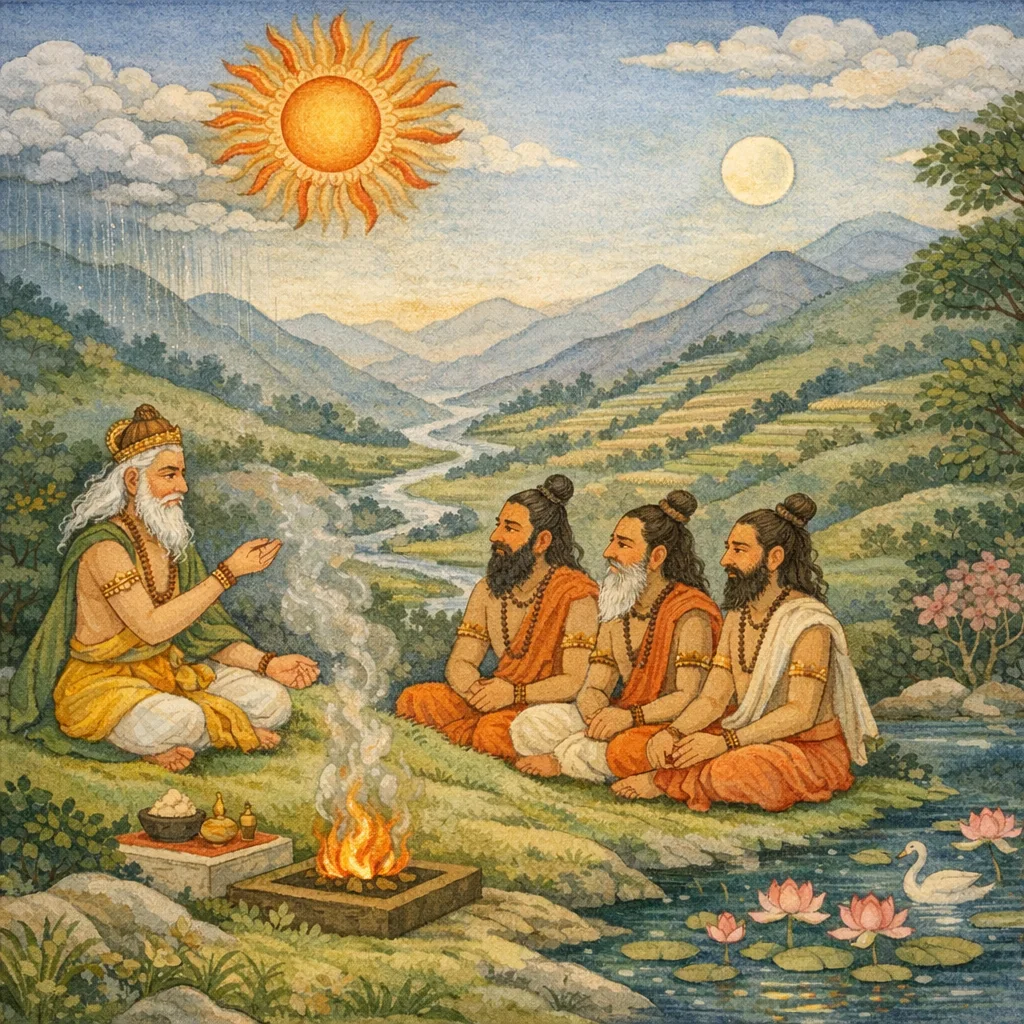
अग्नीषोमात्मकविश्ववर्णनम् / The Universe as Agni–Soma (Fire and Nectar)
Adhyāya 28 begins with the ṛṣis asking about an earlier teaching: why the deity (in the context of Devī/Śakti) is called “command” (ājñā), and why the cosmos is said to be agni–soma in nature and also “vāk–artha” (speech and meaning). Vāyu explains that agni is Śakti’s raudrī mode—fierce and luminous (taijasī)—while soma is her śākta mode—amṛta-filled, soothing, and pacifying. He links these to tejas (radiant power) and rasa/amṛta (sap, essence, nectar) as subtle, pervasive constituents within all beings. Their functions are distinguished: tejas works as solar/fire-like activity, while rasa works as somatic/watery nourishment; by their differentiated operations the moving and unmoving universe is sustained. Using sacrificial and ecological causality—oblation leading to crops, rain leading to growth—the discourse argues that the world’s stability depends on the agni–soma circuit. Finally, it describes a vertical polarity: fire rises upward in flames while soma/amṛta flows downward, presenting a cosmology where burning/ascension and flooding/nourishment coexist, aligning kālāgni below with Śakti above as complementary operations.
Shlokas
Verse 1
ऋषय ऊचुः । देवीं समादधानेन देवेनेदं किमीरितम् । अग्निषोमात्मकं विश्वं वागर्थात्मकमित्यपि
The sages said: “When the Lord was establishing and enthroning the Goddess, what precisely did He proclaim—that the whole universe is of the nature of Agni and Soma, and that it is also constituted of speech and meaning?”
Verse 2
आज्ञैकसारमैश्वर्यमाज्ञा त्वमिति चोदितम् । तदिदं श्रोतुमिच्छामो यथावदनुपूर्वशः
You have declared that the Lord’s sovereign power is, in essence, nothing but Command, and that “you are that Command” itself. Therefore we wish to hear this plainly, correctly, and in proper sequence.
Verse 3
वायुरुवाच । अग्निरित्युच्यते रौद्री घोरा या तैजसी तनुः । सोमः शाक्तो ऽमृतमयः शक्तेः शान्तिकरी तनुः
Vāyu said: “That blazing, fiery body—Rudrī, fierce and full of splendor—is called ‘Agni’. And ‘Soma’ is the Śākta, nectar-like body: the Śakti whose very form bestows peace.”
Verse 4
अमृतं यत्प्रतिष्ठा सा तेजो विद्या कला स्वयम् । भूतसूक्ष्मेषु सर्वेषु त एव रसतेजसी
That very foundation is amṛta, the immortal essence. She herself is tejas—splendor—vidyā, true knowledge, and kalā, divine power. In all the subtle states of the elements, she alone abides as both rasa, the inner essence, and tejas, the radiance that sustains them.
Verse 5
द्विविधा तेजसो वृत्तिसूर्यात्मा चानलात्मिका । तथैव रसवृत्तिश्च सोमात्मा च जलात्मिका
The function of tejas, the fire-principle, is twofold: one is of solar nature, and the other is of flame. In the same way, the function of rasa, the essence, is also twofold: one is of lunar nature—Soma—and the other is of water.
Verse 6
विद्युदादिमयन्तेजो मधुरादिमयो रसः । तेजोरसविभेदैस्तु धृतमेतच्चराचरम्
Tejas, radiant energy, is constituted of forms such as lightning; and rasa, taste-essence, is constituted of modes such as sweetness. Indeed, by the differentiations of tejas and rasa, this entire world—moving and unmoving—is sustained.
Verse 7
अग्नेरमृतनिष्पत्तिरमृतेनाग्निरेधते । अत एव हि विक्रान्तमग्नीषोमं जगद्धितम्
From Agni arises amṛta, the immortal essence, and by that very amṛta Agni is nourished and grows. Therefore the Agnīṣoma principle—Agni united with Soma—is truly mighty and works for the welfare of the whole world.
Verse 8
हविषे सस्यसम्पत्तिर्वृष्टिः सस्याभिवृद्धये । वृष्टेरेव हविस्तस्मादग्नीषोमधृतं जगत्
From the havis (oblatory offering) comes the prosperity of crops; for the increase of crops there is rainfall. And rainfall itself is born of the oblation; therefore this world is sustained by Agni and Soma.
Verse 9
अग्निरूर्ध्वं ज्वलत्येष यावत्सौम्यं परामृतम् । यावदग्न्यास्पदं सौम्यममृतं च स्रवत्यधः
This fire blazes upward so long as the gentle, supreme nectar (amṛta) remains; and so long as that gentle nectar—resting upon the seat of fire—continues to drip downward.
Verse 10
अत एव हि कालाग्निरधस्ताच्छक्तिरूर्ध्वतः । यावदादहनं चोर्ध्वमधश्चाप्लावनं भवेत्
Therefore Kālāgni, the Fire of Time, is below, while Śakti, the divine Power, is above; so long as there is burning upward and inundation downward, this cosmic order continues.
Verse 11
आधारशक्त्यैव धृतः कालाग्निरयमूर्ध्वगः । तथैव निम्नगः सोमश्शिवशक्तिपदास्पदः
The upward-moving Time-fire (kālāgni) is sustained solely by Ādhāra-Śakti, the Supporting Power. Likewise, the downward-moving Soma is the very ground and seat of Śiva’s Śakti, where the Śiva–Śakti principle becomes established.
Verse 12
शिवश्चोर्ध्वमधश्शक्तिरूर्ध्वं शक्तिरधः शिवः । तदित्थं शिवशक्तिभ्यान्नाव्याप्तमिह किञ्चन
Śiva is above and Śakti below; likewise, Śakti is above and Śiva below. Thus, in this way, there is nothing whatsoever in the universe that is not pervaded by Śiva and Śakti.
Verse 13
असकृच्चाग्निना दग्धं जगद्यद्भस्मसात्कृतम् । अग्नेर्वीर्यमिदं चाहुस्तद्वीर्यं भस्म यत्ततः
They declare that bhasma, the sacred ash, is the very potency of Fire—because the world, time and again, is burned by fire and reduced to ashes; therefore that resulting ash is said to be Fire’s power itself.
Verse 14
यश्चेत्थं भस्मसद्भावं ज्ञात्वा स्नाति च भस्मना । अग्निरित्यादिभिर्मन्त्रैर्बद्धः पाशात्प्रमुच्यते
Whoever, knowing thus the true nature and sanctity of bhasma, bathes with it and applies it, consecrated and protected by mantras beginning with “Agni…,” is released from the bonds (pāśa) that bind the soul.
Verse 15
अग्नेर्वीर्यं तु यद्भस्म सोमेनाप्लावितम्पुनः । अयोगयुक्त्या प्रकृतेरधिकाराय कल्पते
That bhasma, which is the very potency of Fire and is again moistened with Soma, when applied without the discipline of Yoga, becomes fit only for the sphere of Prakṛti (worldly nature), not for the highest Shaiva aim.
Verse 16
योगयुक्त्या तु तद्भस्म प्लाव्यमानं समन्ततः । शाक्तेनामृतवर्षेण चाधिकारान्निवर्तयेत्
But by the discipline of yoga, that sacred ash—thoroughly permeated on every side—should cause one to withdraw from worldly entitlements and claims, through the power (Śakti) of the nectar-like inner downpour.
Verse 17
अतो मृत्युंजयायेत्थममृतप्लावनं सदा । शिवशक्त्यमृतस्पर्शे लब्धं येन कुतो मृतिः
Therefore, to become the Conqueror of Death, this ever-present “immortal ferry” is gained through the deathless, nectar-like touch of Śiva’s Śakti. For one who has attained that contact, whence could death arise?
Verse 18
यो वेद दहनं गुह्यं प्लावनं च यथोदितम् । अग्नीषोमपदं हित्वा न स भूयो ऽभिजायते
Whoever truly knows, as taught, the secret inner “burning” and the “fording across” (of saṃsāra), abandoning the state bound to Agni and Soma (the ritualistic, dualistic condition), is not born again.
Verse 19
शिवाग्निना तनुं दग्ध्वा शक्तिसौम्या मृतेन यः । प्लावयेद्योगमार्गेण सो ऽमृतत्वाय कल्पते
He who burns the bodily sense in the fire of Śiva, and then—by the yogic path—floods it with the nectar-like, gentle power of Śakti, becomes fit for immortality, that is, liberation.
Verse 20
हृदि कृत्वेममर्थं वै देवेन समुदाहृतम् । अग्नीषोमात्मकं विश्वं जगदित्यनुरूपतः
Having firmly placed in the heart this teaching proclaimed by the Lord, one should understand—according to its true import—that the entire universe, the whole moving world, is of the nature of Agni and Soma, the two complementary powers.
Frequently Asked Questions
Rather than a narrative episode, the chapter is a doctrinal dialogue: the sages ask for clarification of a prior statement, and Vāyu delivers a metaphysical explanation of the cosmos as agni–soma and as vāk–artha.
Agni and soma are not merely Vedic deities but symbolic modalities of Śakti: agni is raudra tejas (transformative heat), soma is śākta amṛta (immortalizing, pacifying essence). Their interplay models both cosmology and inner spiritual energetics.
Agni manifests as upward-burning, solar/fire-like tejas; soma manifests as downward-flowing amṛta/rasa, watery nourishment. Together they sustain the carā–acarā (moving and unmoving) world through differentiated functions.
Read Shiva Purana in the Vedapath app
Scan the QR code to open this directly in the app, with audio, word-by-word meanings, and more.