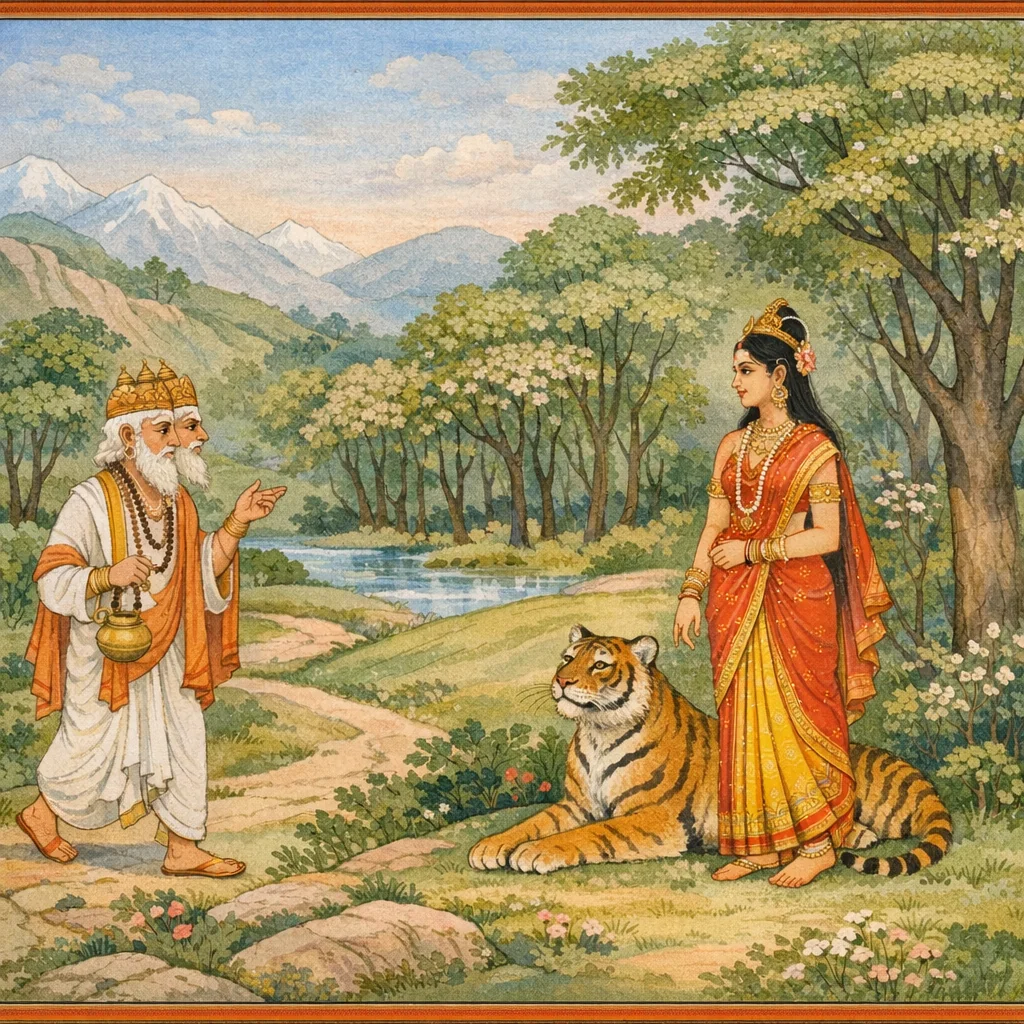
कौशिकी-गौरी तथा शार्दूलरूप-निशाचरस्य पूर्वकर्मवर्णनम् | Kauśikī-Gaurī and Brahmā’s account of the tiger-formed niśācara
This chapter, narrated within Vāyu’s dialogue, turns to Devī (Kauśikī-Gaurī) speaking with Brahmā about a tiger (śārdūla) that has taken refuge near her. She praises its single-minded devotion, declares that protecting it is dear to her, and foresees that Śaṅkara will grant it the rank of a gaṇeśvara and have it accompany her retinue. Brahmā laughs yet warns her, recounting the being’s former deeds: though in tiger-form, it is a wicked niśācara, a kāmarūpin (shape-shifter), who harmed cows and brāhmaṇas and therefore must inevitably reap the fruit of sin. The exchange highlights discernment within compassion—questioning indiscriminate grace toward the cruel—while still leaving open the possibility of elevation and transformation by divine will under Śiva’s sovereignty.
Shlokas
Verse 1
वायुरुवाच । उत्पाद्य कौशिकीं गौरी ब्रह्मणे प्रतिपाद्य ताम् । तस्य प्रत्युपकाराय पितामहमथाब्रवीत्
Vāyu said: Having brought forth Kauśikī—Gaurī—and presented her to Brahmā, the Grandfather (Brahmā), wishing to repay her service, then spoke.
Verse 2
देव्युवाच । दृष्टः किमेष भवता शार्दूलो मदुपाश्रयः । अनेन दुष्टसत्त्वेभ्यो रक्षितं मत्तपोवनम्
The Goddess said: “Have you seen this tiger that has come under my protection? By him my grove of austerities has been guarded from wicked creatures.”
Verse 3
मय्यर्पितमना एष भजते मामनन्यधीः । अस्य संरक्षणादन्यत्प्रियं मम न विद्यते
With his mind wholly offered to Me, this devotee worships Me with undivided understanding. For Me, nothing is dearer than protecting him.
Verse 4
भवितव्यमनेनातो ममान्तःपुरचारिणा । गणेश्वरपदं चास्मै प्रीत्या दास्यति शंकरः
Therefore, it is destined that this attendant of my inner apartments shall be so; and Śaṅkara, being pleased, will lovingly bestow upon him the rank of Gaṇeśvara, Lord of the Gaṇas.
Verse 5
एनमग्रेसरं कृत्वा सखीभिर्गन्तुमुत्सहे । प्रदीयतामनुज्ञा मे प्रजानां पतिना १ त्वया
Setting him in front as our leader, I am ready to go with my companions. Therefore, O Lord of beings, grant me your permission.
Verse 6
इत्युक्तः प्रहसन्ब्रह्मा देवीम्मुग्धामिव स्मयन् । तस्य तीव्रैः पुरावृत्तैर्दौरात्म्यं समवर्णयत्१
Thus addressed, Brahmā laughed and, smiling as though at an innocent maiden, recounted to the Goddess—through stern tales of the past—the cruel and wayward nature of that being.
Verse 7
ब्रह्मोवाच । पशौ देवि मृगाः क्रूराः क्व च ते ऽनुग्रहः शुभः । आशीविषमुखे साक्षादमृतं किं निषिच्यते
Brahmā said: “O Devī, beasts and wild creatures are cruel by nature—where, then, is your auspicious compassion toward them? Is nectar (amṛta) to be poured straight into the mouth of a venomous serpent?”
Verse 8
व्याघ्रमात्रेण सन्नेष दुष्टः को ऽपि निशाचरः । अनेन भक्षिता गावो ब्राह्मणाश्च तपोधनाः
Here there is some wicked night-roaming demon, disguised merely in the form of a tiger. By him, cows have been devoured, and even Brahmins rich in austerity have been eaten.
Verse 9
तर्पयंस्तान्यथाकामं कामरूपी चरत्यसौ । अवश्यं खलु भोक्तव्यं फलं पापस्य कर्मणः
Satisfying them according to their desires, he moves about assuming forms shaped by craving. Indeed, the fruit of sinful action must certainly be experienced.
Verse 10
अतः किं कृपया कृत्यमीदृशेषु दुरात्मसु । अनेन देव्याः किं कृत्यं प्रकृत्या कलुषात्मना
Therefore, what is the use of showing compassion to such wicked-souled people? And what purpose is served for the Goddess by this one, whose very nature is impure and whose inner being is defiled?
Verse 11
देव्युवाच । यदुक्तं भवता सर्वं तथ्यमस्त्वयमीदृशः । तथापि मां प्रपन्नो ऽभून्न त्याज्यो मामुपाश्रितः
The Goddess said: “All that has been spoken by you is true; indeed, this is so. Yet even so, he has taken refuge in me—one who has come under my shelter should not be cast away.”
Verse 12
ब्रह्मोवाच । अस्य भक्तिमविज्ञाय प्राग्वृत्तं ते निवेदितम् । भक्तिश्चेदस्य किं पापैर्न ते भक्तः प्रणश्यति
Brahmā said: Not recognizing his devotion, I have reported to you what happened before. But if devotion truly belongs to him, what can sins do? Your devotee does not perish.
Verse 13
पुण्यकर्मापि किं कुर्यात्त्वदीयाज्ञानपेक्षया । अजा प्रज्ञा पुराणी च त्वमेव परमेश्वरी
What can even meritorious action accomplish without reliance on Your divine knowledge? You alone are the Unborn, the Supreme Wisdom, the Primordial One—indeed, You are Parameśvarī.
Verse 14
त्वदधीना हि सर्वेषां बंधमोक्षव्यवस्थितिः । त्वदृते परमा शक्तिः संसिद्धिः कस्य कर्मणा
For all beings, the very order of bondage and liberation depends upon You. Apart from You, by whose action could there ever be the Supreme Power—or any true attainment of perfection?
Verse 15
त्वमेव विविधा शक्तिः भवानामथ वा स्वयम् । अशक्तः कर्मकरणे कर्ता वा किं करिष्यति
You alone are the manifold Śakti—whether as the power abiding in all beings or as Power itself. Without that power, what can any so‑called doer accomplish in the performance of actions?
Verse 16
विष्णोश्च मम चान्येषां देवदानवरक्षसाम् । तत्तदैश्वर्यसम्प्राप्त्यै तवैवाज्ञा हि कारणम्
For Viṣṇu, for me, and for all others—gods, Dānavas, and Rākṣasas alike—the attainment of their respective powers and lordships arises only from Your command; indeed, Your sanction alone is the true cause.
Verse 17
अतीताः खल्वसंख्याता ब्रह्माणो हरयो भवाः । अनागतास्त्वसंख्यातास्त्वदाज्ञानुविधायिनः
Countless indeed are the Brahmās, the Haris (Viṣṇus), and the Rudras that have already passed. Countless too are those yet to come—each acting in accordance with Your command.
Verse 18
त्वामनाराध्य देवेशि पुरुषार्थचतुष्टयम् । लब्धुं न शक्यमस्माभिरपि सर्वैः सुरोत्तमैः
O Goddess, Sovereign of the gods—without worshipping You, it is not possible for us, even for all the foremost among the devas, to obtain the four human aims (dharma, artha, kāma, and mokṣa).
Verse 19
व्यत्यासो ऽपि भवेत्सद्यो ब्रह्मत्वस्थावरत्वयोः । सुकृतं दुष्कृतं चापि त्वयेव स्थापितं यतः
Even an immediate reversal between the state of Brahmāhood and the condition of being an immobile being can occur—since it is indeed you who have established both merit and demerit (and their results).
Verse 20
त्वं हि सर्वजगद्भर्तुश्शिवस्य परमात्मनः । अनादिमध्यनिधना शक्तिराद्या सनातनी
You indeed are the primordial, eternal Śakti of Śiva, the Supreme Self, the sustainer of the entire universe—without beginning, middle, or end.
Verse 21
समस्तलोकयात्रार्थं मूर्तिमाविश्य कामपि । क्रीडसे २ विविधैर्भावैः कस्त्वां जानाति तत्त्वतः
For the orderly course of all the worlds, You enter into whatever form You choose. You sport in manifold modes of being—who, indeed, can know You in Your true reality?
Verse 22
अतो दुष्कृतकर्मापि व्याघ्रो ऽयं त्वदनुग्रहात् । प्राप्नोतु परमां सिद्धिमत्र कः प्रतिबन्धकः
Therefore, even though this tiger has performed sinful deeds, by Your grace may it attain the supreme perfection (liberation). Here, who could possibly stand as an obstacle?
Verse 23
इत्यात्मनः परं भावं स्मारयित्वानुरूपतः । ब्रह्मणाभ्यर्थिता गौरी तपसो ऽपि न्यवर्तत
Thus, recalling in a fitting manner her own higher spiritual disposition, Gaurī—entreated by Brahmā—desisted even from her austerities.
Verse 24
ततो देवीमनुज्ञाप्य ब्रह्मण्यन्तर्हिते सति । देवीं च मातरं दृष्ट्वा मेनां हिमवता सह
Then, having taken leave of the Goddess, and after Brahmā had vanished from sight, he beheld Menā, the Goddess’s mother, together with Himavān.
Verse 25
प्रणम्याश्वास्य बहुधा पितरौ विरहासहौ । तपः प्रणयिनो देवी तपोवनमहीरुहान्
Having bowed down, the Goddess consoled her parents again and again, for they could not bear the anguish of separation. Then, devoted to tapas—sacred austerity—she set out toward the great trees of the forest of penance, the holy grove where tapas is performed.
Verse 26
विप्रयोगशुचेवाग्रे पुष्पबाष्पं विमुंचतः । तत्तुच्छाखासमारूढविहगो दीरितै रुतैः
At the very front, stricken by the sorrow of separation, it shed “flower-tears.” And a bird perched upon that very branch cried out with long, lingering calls.
Verse 27
व्याकुलं बहुधा दीनं विलापमिव कुर्वतः । सखीभ्यः कथयंत्येवं सत्त्वरा भर्तृदर्शने
Seeing her husband, she became greatly agitated and again and again sank into wretchedness, as though crying out in lament; and in that very state she swiftly spoke these words to her companions.
Verse 28
पुरस्कृत्य च तं व्याघ्रं स्नेहात्पुत्रमिवौरसम् । देहस्य प्रभया चैव दीपयन्ती दिशो दश
Placing that tiger-like hero in the forefront, she went on out of affection as though he were her own son; and by the radiance of her body she seemed to illumine the ten directions.
Verse 29
प्रययौ मंदरं गौरी यत्र भर्ता महेश्वरः । सर्वेषां जगतां धाता कर्ता पाता विनाशकृत्
Gaurī set out for Mount Mandara, where her Lord Maheśvara abides—He, the Supreme Pati, is the sustainer of all worlds, their creator, their protector, and the agent of their dissolution.
Frequently Asked Questions
Devī (Kauśikī-Gaurī) seeks permission to take a refuge-seeking tiger with her attendants, while Brahmā reveals the tiger is actually a wicked niśācara with a violent past.
The chapter stages a tension between karuṇā (compassion) and viveka (discrimination), teaching that grace may elevate a being, yet karmic residues still demand reckoning—an ethical-theological balance central to Purāṇic Śaivism.
Kauśikī-Gaurī is highlighted as the compassionate divine feminine, and Śiva/Śaṅkara is implied as the sovereign who can confer gaṇeśvara status, integrating transformation and hierarchy within Śaiva order.
Read Shiva Purana in the Vedapath app
Scan the QR code to open this directly in the app, with audio, word-by-word meanings, and more.