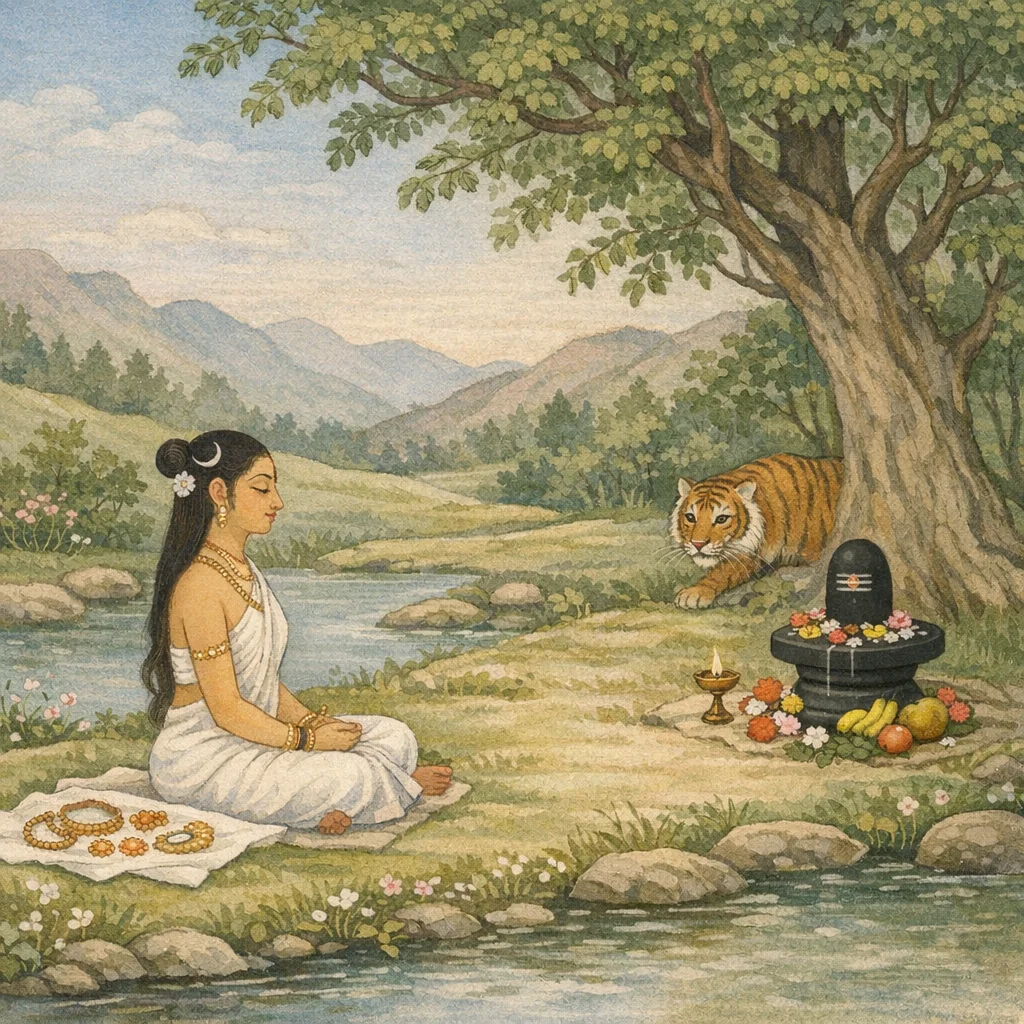
सत्याः पुनस्तपश्चर्या — Satī’s Return to Austerity (Tapas) and Fearless Liṅga-Worship
Adhyāya 25 relates how Satī, after circumambulating her husband Śiva and restraining the pain of separation, returns with discipline to Himalayan tapas. She revisits the very spot where she once practiced austerities with companions, then approaches her parents, Himavat and Menā, declares her resolve, receives permission, and re-enters the forest hermitage. There she renounces ornaments, dons the purified garb of an ascetic, and undertakes severe, difficult austerities while keeping Śiva’s lotus-feet constantly in her mind. Her inner focus is supported by outward observances: meditating on Śiva in a manifest liṅga and performing tri-sandhyā worship three times daily with forest offerings such as flowers and fruits. A perilous test follows when a wicked great tiger advances, yet becomes motionless as if painted, while Satī remains unshaken and fearless through innate steadiness and one-pointed devotion. The chapter thus weaves together pativratā devotion, tapas as spiritual discipline, liṅga-worship as embodied theology, and fearlessness as the fruit of concentrated Śaiva contemplation.
Shlokas
Verse 1
वायुरुवाच । ततः प्रदक्षिणीकृत्य पतिमम्बा पतिव्रता । नियम्य च वियोगार्तिं जगाम हिमवद्गिरिम्
Vāyu said: Thereafter, Ambā—the devoted wife, steadfast in her vow—circumambulated her Lord; and, restraining the anguish born of separation, she went to the Himālaya mountain.
Verse 2
तपःकृतवती पूर्वं देशे यस्मिन्सखीजनैः । तमेव देशमवृनोत्तपसे प्रणयात्पुनः
In the very place where she had formerly performed austerities along with her circle of companions, she again chose that same spot for tapas—out of loving devotion.
Verse 3
ततः स्वपितरं दृष्ट्वा मातरं च तयोर्गृहे । प्रणम्य वृत्तं विज्ञाप्य ताभ्यां चानुमता सती
Then, seeing her father and her mother in their home, Satī bowed down, informed them of what had occurred, and, having obtained their consent, proceeded accordingly.
Verse 4
पुनस्तपोवनं गत्वा भूषणानि विसृज्य च । स्नात्वा तपस्विनो वेषं कृत्वा परमपावनम्
Then, going again to the sacred grove of austerity, he cast aside all ornaments; after bathing, he assumed the supremely purifying guise of an ascetic.
Verse 5
संकल्प्य च महातीव्रं तपः परमदुश्चरम् । सदा मनसि सन्धाय भर्तुश्चरणपंकजम्
Resolving to undertake extremely intense austerity—most difficult to perform—she kept, at all times, in her mind the lotus-feet of her Lord (Śiva).
Verse 6
तमेव क्षणिके लिंगे ध्यात्वा बाह्यविधानतः । त्रिसन्ध्यमभ्यर्चयन्ती वन्यैः पुष्पैः फलादिभिः
Meditating on Him alone in a temporary (improvised) liṅga, she worshipped according to the outward ritual procedure, offering homage at the three junctions of the day with forest flowers and fruits and the like.
Verse 7
स एव ब्रह्मणो मूर्तिमास्थाय तपसः फलम् । प्रदास्यति ममेत्येवं नित्यं कृत्वा ऽकरोत्तपः
Resolving daily, “He alone—assuming the form of Brahmā—will grant me the fruit of my austerity,” she performed tapas with unwavering constancy.
Verse 8
तथा तपश्चरन्तीं तां काले बहुतिथे गते । दृष्टः कश्चिन्महाव्याघ्रो दुष्टभावादुपागमत्
Thus, as she continued her austerities, after a long time had passed, a certain great tiger saw her and, driven by wicked intent, drew near.
Verse 9
तथैवोपगतस्यापि तस्यातीवदुरात्मनः । गात्रं चित्रार्पितमिव स्तब्धं तस्यास्सकाशतः
Even when that exceedingly wicked-minded one approached her, his body became rigid in her very presence—like a figure painted on a canvas.
Verse 10
तं दृष्ट्वापि तथा व्याघ्रं दुष्टभावादुपागतम् । न पृथग्जनवद्देवी स्वभावेन विविच्यते
Even on seeing that tiger approach with a wicked intent, the Goddess did not discriminate like ordinary people do; by her own innate nature she remained discerning yet unshaken.
Verse 11
स तु विष्टब्धसर्वांगो बुभुक्षापरिपीडितः । ममामिषं ततो नान्यदिति मत्वा निरन्तरम्
But he, with all his limbs held rigid and tormented by the pressure of hunger, kept thinking without pause: “This flesh is mine—there is nothing else for me to eat besides this.”
Verse 12
निरीक्ष्यमाणः सततं देवीमेव तदा ऽनिशम् । अतिष्ठदग्रतस्तस्या उपासनमिवाचरत्
Then, gazing unceasingly upon the Goddess alone, he stood before her continually, behaving as though engaged in devoted worship.
Verse 13
देव्याश्च हृदये नित्यं ममैवायमुपासकः । त्राता च दुष्टसत्त्वेभ्य इति प्रववृते कृपा
Then compassion arose in the Lord: “This devotee of Mine ever abides in the Goddess’s heart; and he is a protector from wicked beings.”
Verse 14
तस्या एव कृपा योगात्सद्योनष्टमलत्रयः । बभूव सहसा व्याघ्रो देवीं च बुबुधे तदा
By the very power of Her grace, the three impurities were instantly destroyed; and that tiger, in a moment, became purified and then recognized the Goddess as the Divine Mother.
Verse 15
न्यवर्तत बुभुक्षा च तस्यांगस्तम्भनं तथा । दौरात्म्यं जन्मसिद्धं च तृप्तिश्च समजायत
His craving for food subsided, and the rigidity of his limbs also ceased. Even the innate wickedness he had carried from birth fell away, and contentment arose within him.
Verse 16
तदा परमभावेन ज्ञात्वा कार्तार्थ्यमात्मनः । सद्योपासक एवैष सिषेवे परमेश्वरीम्
Then, realizing with the highest inner disposition that his own life had become fulfilled, he—becoming at once a true worshipper—began devotedly to serve the Supreme Goddess (Parameśvarī).
Verse 17
दुष्टानामपि सत्त्वानां तथान्येषान्दुरात्मनाम् । स एव द्रावको भूत्वा विचचार तपोवने
Even among wicked beings, and likewise among other evil-minded ones, he himself became their remover and moved about in the forest of austerities.
Verse 18
तपश्च ववृधे देव्यास्तीव्रं तीव्रतरात्मकम् । देवाश्च दैत्यनिर्बन्धाद्ब्रह्माणं शरणं गताः
The Goddess’s austerity (tapas) grew—fierce, and of an even fiercer intensity. And the Devas, pressed hard by the Daityas’ oppression, went to Brahmā for refuge.
Verse 19
चक्रुर्निवेदनं देवाः स्वदुःखस्यारिपीडनात् । यथा च ददतुः शुम्भनिशुम्भौ वरसम्मदात्
Tormented by their enemies’ oppression and weighed down by their own sorrow, the gods made a solemn supplication, recounting in full how Śumbha and Niśumbha—drunk with the pride of boons—had behaved.
Verse 20
सो ऽपि श्रुत्वा विधिर्दुःखं सुराणां कृपयान्वितः । आसीद्दैत्यवधायैव स्मृत्वा हेत्वाश्रयां कथाम्
Hearing the gods’ distress, Brahmā—the Ordainer—moved by compassion, resolved to bring about the demons’ destruction, recalling the causally grounded account: the means and rationale by which that end could be fulfilled.
Verse 21
सामरः प्रार्थितो ब्रह्मा ययौ देव्यास्तपोवनम् । संस्मरन्मनसा देवदुःखमोक्षं स्वयत्नतः
Thus Brahmā, earnestly entreated, went to the Goddess’s forest of austerity, reflecting within on how, by his own effort, the gods might be freed from sorrow.
Verse 22
ददर्श च सुरश्रेष्ठः श्रेष्ठे तपसि निष्ठिताम् । प्रतिष्ठामिव विश्वस्य भवानीं परमेश्वरीम्
Then the foremost among the gods beheld Bhavānī, the Supreme Goddess, steadfast in the highest austerity—appearing like the very foundation and sustaining support of the universe.
Verse 23
ननाम चास्य जगतो मातरं स्वस्य वै हरेः । रुद्रस्य च पितुर्भार्यामार्यामद्रीश्वरात्मजाम्
And he bowed to her—the Mother of this universe, the noble Āryā, the exalted consort of his own father Hari (Viṣṇu), and also the revered wife of Rudra’s father—Āryā, daughter of the Lord of the Mountain.
Verse 24
ब्रह्माणमागतं दृष्ट्वा देवी देवगणैः सह । अर्घ्यं तदर्हं दत्त्वा ऽस्मै स्वागताद्यैरुपाचरत्
Seeing Brahmā arrive, the Goddess—together with the hosts of devas—offered him the arghya worthy of his station, and then honored him with words and acts of welcome and other courtesies.
Verse 25
तां च प्रत्युपचारोक्तिं पुरस्कृत्याभिनंद्य च । पप्रच्छ तपसो हेतुमजानन्निव पद्मजः
Honoring her courteous words of welcome and praising her, Padmaja (Brahmā) then asked the reason for her tapas, as though he did not already know it.
Verse 26
ब्रह्मोवाच । तीव्रेण तपसानेन देव्या किमिह साध्यते । तपःफलानां सर्वेषां त्वदधीना हि सिद्धयः
Brahmā said: “O Goddess, what is to be accomplished here by such intense tapas? For the attainments (siddhis) that arise from every fruit of austerity are indeed dependent upon you.”
Verse 27
यश्चैव जगतां भर्ता तमेव परमेश्वरम् । भर्तारमात्मना प्राप्य प्राप्तञ्च तपसः फलम्
He who is truly the Sustainer of all worlds—having realized that very Supreme Lord, the inner Lord and support of the self—one indeed attains the fruit of austerity.
Verse 28
अथवा सर्वमेवैतत्क्रीडाविलसितं तव । इदन्तु चित्रं देवस्य विरहं सहसे कथम्
Or else, all of this may indeed be only Your sacred līlā, Your sportive play. Yet this is truly astonishing—how can You endure separation from the Lord Mahādeva (Śiva)?
Verse 29
देव्युवाच । सर्गादौ भवतो देवादुत्पत्तिः श्रूयते यदा । तदा प्रजानां प्रथमस्त्वं मे प्रथमजः सुतः
The Goddess said: “When it is heard that, at the very beginning of creation, your divine manifestation arose from the Lord, then you are indeed the foremost among beings. You are my firstborn son, the first among progeny.”
Verse 30
५
“Five.” — A numeral marker in the manuscript/verse sequence indicating the count ‘five’.
Verse 31
यदा भवद्गिरीन्द्रस्ते पुत्रो मम पिता स्वयम् । तदा पितामहस्त्वं मे जातो लोकपितामह
When your son—O Lord of mountains—became my own father indeed, then you became my grandfather, O Grandfather of the worlds.
Verse 32
तदीदृशस्य भवतो लोकयात्राविधायिनः । वृत्तवन्तःपुरे भर्ता कथयिष्ये कथं पुनः
O Lord of the “inner city” (this body), You are of such a nature, ordaining the course and continuance of the world—how can I describe You yet again?
Verse 33
किमत्र बहुना देहे यश्चायं मम कालिमा । त्यक्त्वा सत्त्वविधानेन गौरी भवितुमुत्सहे
What need is there to say much of this body? Casting off this darkened state of mine, by the discipline of sattva (purity) I am resolved to become Gaurī.
Verse 34
ब्रह्मोवाच । एतावता किमर्थेन तीव्रं देवि तपः कृतम् । स्वेच्छैव किमपर्याप्ता क्रीडेयं हि तवेदृशी
Brahmā said: “O Goddess, for what purpose have you undertaken such severe austerities to this extent? Is your own free will alone not sufficient? For such a divine sport truly befits one like you.”
Verse 35
क्रीडा ऽपि च जगन्मातस्तव लोकहिताय वै । अतो ममेष्टमनया फलं किमपि साध्यताम्
O Mother of the universe, even Your divine līlā is truly for the welfare of the worlds. Therefore, by this very act, may some desired fruit for me also be accomplished.
Verse 36
निशुंभशुंभनामानौ दैत्यौ दत्तवरौ मया । दृप्तौ देवान्प्रबाधेते त्वत्तो लब्धस्तयोर्वधः
Two arrogant demons named Niśumbha and Śumbha—boons having been granted by me—are tormenting the gods. Yet their slaying has been obtained from you; from you alone will their destruction come to pass.
Verse 37
अलं विलंबनेनात्र त्वं क्षणेन स्थिरा भव । शक्तिर्विसृज्यमाना ऽद्य तयोर्मृत्युर्भविष्यति
Enough of delay here—be steady this very instant. For the Power (Śakti) being unleashed today will bring death to those two.
Verse 38
ब्राह्मणाभ्यर्थिता चैव देवी गिरिवरात्मजा । त्वक्कोशं सहसोत्सृज्य गौरी सा समजायत
Thus entreated by the brāhmaṇas, the Goddess—the daughter of the best of mountains—at once cast off her outer sheath of skin; and she became Gaurī (the fair, radiant one).
Verse 39
सा त्वक्कोशात्मनोत्सृष्टा कौशिकी नाम नामतः । काली कालाम्बुदप्रख्या कन्यका समपद्यत
Cast forth from her own sheath of skin, she came into being as a maiden—named Kauśikī; and as Kālī, dark like a rain-laden cloud, she manifested.
Verse 40
सा तु मायात्मिका शक्तिर्योगनिद्रा च वैष्णवी । शंखचक्रत्रिशूलादिसायुधाष्टमहाभुजा
She is that Śakti whose very nature is Māyā; she is also the Vaiṣṇavī Yoganidrā, the yogic slumber. Mighty and eight-armed, she bears weapons such as the conch, the discus, the trident, and others.
Verse 41
सौम्या घोरा च मिश्रा च त्रिनेत्रा चन्द्रशेखरा । अजातपुंस्पर्शरतिरधृष्या चातिसुन्दरी
She is gentle, she is terrible, and she is of blended aspect; she is three-eyed and bears the moon as her crest. She delights only in the touch of one who is no mere man—Śiva alone; she is unassailable and exceedingly beautiful.
Verse 42
दत्ता च ब्रह्मणे देव्या शक्तिरेषा सनातनी । निशुंभस्य च शुंभस्य निहंत्री दैत्यसिंहयोः
This eternal Power (Śakti) of the Goddess was bestowed upon Brahmā; she is the slayer of Niśumbha and Śumbha, lion-like among the daityas.
Verse 43
ब्रह्मणापि प्रहृष्टेन तस्यै परमशक्तये । प्रबलः केसरी दत्तो वाहनत्वे समागतः
Even Brahmā, filled with joy, bestowed upon that Supreme Śakti a mighty lion, which came to serve as her vehicle (vāhana).
Verse 44
विन्ध्ये च वसतिं तस्याः पूजामासवपूर्वकैः । मांसैर्मत्स्यैरपूपैश्च निर्वर्त्यासौ समादिशत्
And in the Vindhya region he arranged her dwelling; and, having worshipped her with offerings beginning with fermented drink, together with meat, fish, and ritual cakes, he then issued his command that all be carried out accordingly.
Verse 45
सा चैव संमता शक्तिर्ब्रह्मणो विश्वकर्मणः । प्रणम्य मातरं गौरीं ब्रह्माणं चानुपूर्वशः
She indeed is the acknowledged Śakti of Brahmā, the cosmic architect Viśvakarman. Having bowed in proper order, she first paid homage to Mother Gaurī and then to Brahmā.
Verse 46
शक्तिभिश्चापि तुल्याभिः स्वात्मजाभिरनेकशः । परीता प्रययौ विन्ध्यं दैत्येन्द्रौ हन्तुमुद्यता
Surrounded on every side by many of her own daughters—powers equal to herself—she set out for the Vindhya mountain, intent on slaying the two lords of the Daityas.
Verse 47
निहतौ च तया तत्र समरे दैत्यपुंगवौ । तद्बाणैः कामबाणैश्च च्छिन्नभिन्नांगमानसौ
There in that battle, the two foremost among the demons were slain by her. Pierced by her arrows—like the shafts of Kāma—they were left with limbs rent and minds shattered.
Verse 48
तद्युद्धविस्तरश्चात्र न कृतो ऽन्यत्र वर्णनात् । ऊहनीयं परस्माच्च प्रस्तुतं वर्णयामि वः
Here, I do not expand the battle in detail, since it has been described elsewhere. Yet, drawing what is fitting from that account, I shall now relate to you what is relevant to the present topic.
Frequently Asked Questions
Satī resumes severe austerities in the Himalaya with tri-sandhyā liṅga worship; a wicked tiger approaches but becomes motionless, while Satī remains unperturbed.
It functions as a paradigmatic ‘test of steadiness’: single-pointed Śiva-contemplation yields fearlessness and an unmoving mind, mirrored by the predator’s arrested motion.
Śiva is approached through liṅga-upāsanā (a meditated, externally worshiped liṅga) with forest-offerings, structured by the three daily sandhyās.
Read Shiva Purana in the Vedapath app
Scan the QR code to open this directly in the app, with audio, word-by-word meanings, and more.