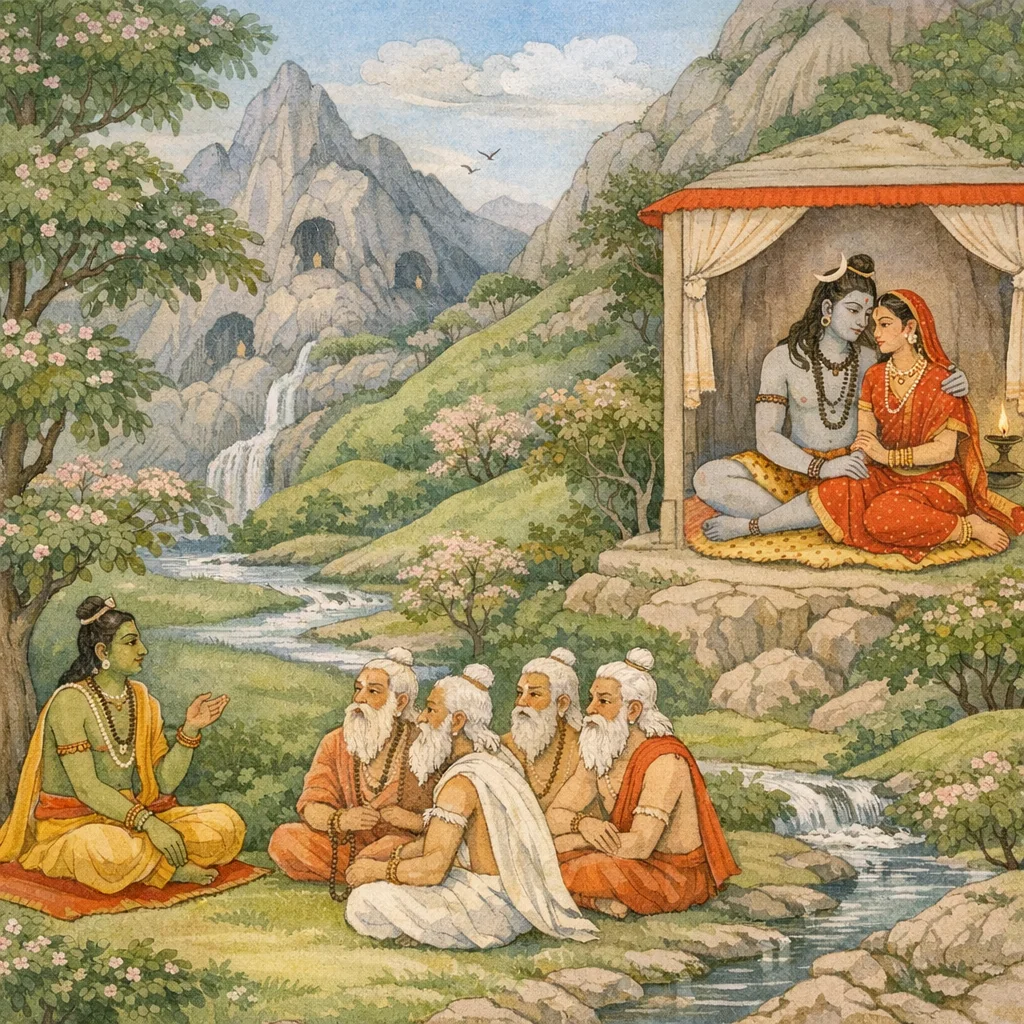
मन्दरगिरिवर्णनम् — Description of Mount Mandara as Śiva’s Residence (Tapas-abode)
Adhyāya 24 begins with the ṛṣis asking Vāyu about Hara (Śiva), who has “disappeared” (antardhāna) along with Devī and their attendants: where they went, where they dwell, and what they did before resting. Vāyu replies that Mount Mandara—splendid, with wondrous caves—is beloved of the Lord of the gods and chosen as a residence bound to tapas (ascetic power). The chapter then unfolds into an exalted topographical-theological praise: the mountain’s beauty is beyond description even with a thousand mouths or across vast ages, yet its signs may be told—its extraordinary prosperity (ṛddhi), its fitness as Īśvara’s abode, and its becoming an “inner palace” (antaḥpurī) to delight Devī. Because Śiva–Śakti are ever near, Mandara’s land and vegetation surpass the world, and its streams and cascades grant purifying merit through bathing and drinking. Thus Mandara is presented not merely as scenery but as a sacred node where tapas, divine intimacy, and natural auspiciousness converge, teaching the landscape itself as theology.
Shlokas
Verse 1
ऋषय ऊचुः । अन्तर्धानगतो देव्या सह सानुचरो हरः । क्व यातः कुत्र वासः किं कृत्वा विरराम ह
The sages said: “Hara, accompanied by the Goddess and His attendants, has vanished from sight. Where did He go, where does He dwell, and after doing what did He become still, ceasing His manifest activity?”
Verse 2
वायुरुवाच । महीधरवरः श्रीमान्मंदरश्चित्रकंदरः । दयितो देवदेवस्य निवासस्तपसो ऽभवत्
Vāyu said: “Mandara—the illustrious, foremost of mountains, adorned with wondrous caves—became the beloved abode for the austerities (tapas) of the God of gods, Lord Śiva.”
Verse 3
तपो महत्कृतं तेन वोढुं स्वशिरसा शिवौ । चिरेण लब्धं तत्पादपंकजस्पर्शजं सुखम्
He performed great austerity so that he might bear Śiva upon his own head; and after a long time he attained the bliss that arises from the touch of the Lord’s lotus-feet.
Verse 4
तस्य शैलस्य सौन्दर्यं सहस्रवदनैरपि । न शक्यं विस्तराद्वक्तुं वर्षकोटिशतैरपि
Even with a thousand mouths, the beauty of that sacred mountain cannot be described in full; even in hundreds of crores of years, it is not possible to speak of it in detail.
Verse 5
शक्यमप्यस्य सौन्दर्यं न वर्णयितुमुत्सहे । पर्वतान्तरसौन्दर्यं साधारणविधारणात्
Though it might be possible, I do not dare to describe the beauty of this place; for its loveliness surpasses that of other mountains and cannot be contained within ordinary description.
Verse 6
इदन्तु शक्यते वक्तुमस्मिन्पर्वतसुन्दरे । ऋद्ध्या कयापि सौन्दर्यमीश्वरावासयोग्यता
Yet this much can be said about this beautiful mountain: by some extraordinary divine prosperity, it possesses a splendor and fitness that make it worthy to be the abode of the Lord (Śiva).
Verse 7
अत एव हि देवेन देव्याः प्रियचिकीर्षया । अतीव रमणीयोयं गिरिरन्तःपुरीकृतः
Therefore indeed, the Lord—wishing to do what is dear to the Goddess—made this exceedingly delightful mountain His inner palace, His private abode.
Verse 8
मेखलाभूमयस्तस्य विमलोपलपादपाः । शिवयोर्नित्यसान्निध्यान्न्यक्कुर्वंत्यखिलंजगत्
Its encircling terraces and spotless stone steps, by the ever-present proximity of Śiva and Devī, make the entire world seem diminished—overawed by that divine majesty.
Verse 9
पितृभ्यां जगतो नित्यं स्नानपानोपयोगतः । अवाप्तपुण्यसंस्कारः प्रसरद्भिरितस्ततः
By the sacred waters belonging to the Pitṛs, the world is ever sustained through their use for bathing and drinking; from them purifying merit and holy impressions are obtained, spreading everywhere in all directions.
Verse 10
लघुशीतलसंस्पर्शैरच्छाच्छैर्निर्झराम्बुभिः । अधिराज्येन चाद्रीणामद्रीरेषो ऽभिषिच्यते
With the gentle, cool touch of crystal-clear waters streaming from mountain springs, and also with the overlordship of the mountains, this King of Mountains is, as it were, consecrated—anointed in abhiṣeka.
Verse 11
निशासु शिखरप्रान्तर्वर्तिना स शिलोच्चयः । चंद्रेणाचल साम्राज्यच्छत्रेणेव विराजते
At night, that lofty mountain—its summit crowned by the Moon—shines forth, as though the Moon were the royal parasol over the mountain-kingdom, proclaiming its sovereign splendor.
Verse 12
स शैलश्चंचलीभूतैर्बालैश्चामरयोषिताम् । सर्वपर्वतसाम्राज्यचामरैरिव वीज्यते
That mountain seemed to be fanned by the fluttering tresses of the maidens bearing yak-tail chāmara, like royal chowries of the whole sovereignty of mountains, waving all around it.
Verse 13
प्रातरभ्युदिते भानौ भूधरो रत्नभूषितः । दर्पणे देहसौभाग्यं द्रष्टुकाम इव स्थितः
When the sun had newly risen in the morning, the jewel-adorned mountain stood as though before a mirror, wishing to behold the splendor and auspicious beauty of its own body.
Verse 14
कूजद्विहंगवाचालैर्वातोद्धृतलताभुजैः । विमुक्तपुष्पैः सततं व्यालम्बिमृदुपल्लवैः
It was ever lively with the cooing of birds; its creeper-branches were lifted by the wind, its soft tender shoots hung down, and loosened flowers kept falling continuously.
Verse 15
लताप्रतानजटिलैस्तरुभिस्तपसैरिव । जयाशिषा सहाभ्यर्च्य निषेव्यत इवाद्रिराट्
Entangled with spreading creepers and surrounded by trees as though performing tapas, the king of mountains appeared as if worshipped with blessings of victory, and as if continually attended in reverent service.
Verse 16
अधोमुखैरूर्ध्वमुखैश्शृंगैस्तिर्यङ्मुखैस्तथा । प्रपतन्निव पाताले भूपृष्ठादुत्पतन्निव
With some peaks facing downward, others turned upward, and still others slanting sideways, it appeared as though it were plunging into the netherworld (Pātāla), and as though it were at the same time springing up from the surface of the earth.
Verse 17
परीतः सर्वतो दिक्षु भ्रमन्निव विहायसि । पश्यन्निव जगत्सर्वं नृत्यन्निव निरन्तरम्
He is surrounded on every side, in all directions, as though moving through the sky; as though beholding the entire universe; and as though dancing without cease—ever-active as the Lord who pervades and oversees all that exists.
Verse 18
गुहामुखैः प्रतिदिनं व्यात्तास्यो विपुलोदरैः । अजीर्णलावण्यतया जृंभमाण इवाचलः
With its cave-mouths gaping open day after day, like a wide-bellied creature with an opened mouth, the mountain looked as though it were yawning—its beauty dulled, as if by indigestion.
Verse 19
ग्रसन्निव जगत्सर्वं पिबन्निव पयोनिधिम् । वमन्निव तमोन्तस्थं माद्यन्निव खमम्बुदैः
It looked as though it were swallowing the whole universe, as though drinking up the ocean; as though vomiting forth the darkness hidden within; and as though becoming intoxicated in the sky amid clouds.
Verse 20
निवास भूमयस्तास्ता दर्पणप्रतिमोदराः । तिरस्कृतातपास्स्निग्धाश्रमच्छायामहीरुहाः
Those dwelling-grounds were each like the inside of a spotless mirror—cool and pleasing. There the sun’s heat was shut out, for great trees cast dense, gentle shade over the hermitages.
Verse 21
सरित्सरस्तडागादिसंपर्कशिशिरानिलाः । तत्र तत्र निषण्णाभ्यां शिवाभ्यां सफलीकृताः
The cool breezes, made refreshing by contact with rivers, lakes, and ponds, were made truly fruitful here and there by the two auspicious ones—Śiva and His Śivā—seated together.
Verse 22
तमिमं सर्वतः श्रेष्ठं स्मृत्वा साम्बस्त्रियम्बकः । रैभ्याश्रमसमीपस्थश्चान्तर्धानं गतो ययौ
Remembering Him as the Supreme in every way, Tryambaka (Lord Śiva), together with Umā, went near Raibhya’s hermitage and then departed, becoming invisible by His yogic power.
Verse 23
तत्रोद्यानमनुप्राप्य देव्या सह महेश्वरः । रराम रमणीयासु देव्यान्तःपुरभूमिषु
Reaching that garden, Mahādeva, together with the Goddess, joyfully sported within the lovely precincts of the Goddess’s inner palace, revealing the auspicious intimacy of Pati (Śiva) with Śakti (Devī).
Verse 24
तथा गतेषु कालेषु प्रवृद्धासु प्रजासु च । दैत्यौ शुंभनिशुंभाख्यौ भ्रातरौ संबभूवतुः
Thus, as time passed and the populations increased, two demon brothers came into being, named Śumbha and Niśumbha.
Verse 25
ताभ्यां तपो बलाद्दत्तं ब्रह्मणा परमेष्टिना । अवध्यत्वं जगत्यस्मिन्पुरुषैरखिलैरपि
To those two, the Supreme Lord Brahmā (Parameṣṭhin), moved by the power of their austerities, granted the boon of invincibility in this world—even against all men.
Verse 26
अयोनिजा तु या कन्या ह्यंबिकांशसमुद्भवा । अजातपुंस्पर्शरतिरविलंघ्यपराक्रमा
But that maiden—unborn from any womb, arisen from a portion of Ambikā—rejoiced in untouched purity, never having known a man’s touch, and possessed invincible power that none could transgress.
Verse 27
तया तु नौ वधः संख्ये तस्यां कामाभिभूतयोः । इति चाभ्यर्थितो ब्रह्मा ताभ्याम्प्राह तथास्त्विति
“By her indeed, our death will come to pass in battle”—thus, overcome by desire for her, the two petitioned Brahmā. Entreated in this manner, Brahmā replied to them, “So be it.”
Verse 28
ततः प्रभृति शक्रादीन्विजित्य समरे सुरान् । निःस्वाध्यायवषट्कारं जगच्चक्रतुरक्रमात्
From that time onward, having conquered Indra and the other gods in battle, he, by his irresistible might, drove the world into silence, so that Vedic recitation and the sacrificial cry of “vaṣaṭ” ceased.
Verse 29
तयोर्वधाय देवेशं ब्रह्माभ्यर्थितवान्पुनः । विनिंद्यापि रहस्यं वां क्रोधयित्वा यथा तथा
Again, for the destruction of those two, Brahmā entreated the Lord of the gods, Śiva. Then, by censuring your secret—by whatever means—he stirred you both to anger.
Verse 30
तद्वर्णकोशजां शक्तिमकामां कन्यकात्मिकाम् । निशुम्भशुंभयोर्हंत्रीं सुरेभ्यो दातुमर्हसि
Therefore, you should bestow upon the gods that power born of that luminous essence—Śakti, desireless and maiden-formed—who will become the slayer of Niśumbha and Śumbha.
Verse 31
एवमभ्यर्थितो धात्रा भगवान्नीललोहितः । कालीत्याह रहस्यं वां निन्दयन्निव सस्मितः
Thus implored by the Creator (Dhātṛ, Brahmā), the Blessed Lord Nīlalohita—smiling as though in gentle reproach—uttered to you both the secret name, “Kālī.”
Verse 32
ततः क्रुद्धा तदा देवी सुवर्णा वर्णकारणात् । स्मयन्ती चाह भर्तारमसमाधेयया गिरा
Then the Goddess Suvarṇā, angered over the matter of complexion, smiled and spoke to her husband in words not meant to soothe him.
Verse 33
देव्युवाच । ईदृशो मम वर्णेस्मिन्न रतिर्भवतो ऽस्ति चेत् । एवावन्तं चिरं कालं कथमेषा नियम्यते
The Goddess said: “If, before a form such as mine, you truly feel no desire, then how has this sense-desire been restrained for so long?”
Verse 34
अरत्या वर्तमानो ऽपि कथं च रमसे मया । न ह्यशक्यं जगत्यस्मिन्नीश्वरस्य जगत्प्रभोः
“Even while you remain in discontent, how can you still delight with me? For in this world nothing is impossible for the Lord, the Master of the universe.”
Verse 35
स्वात्मारामस्य भवतो रतिर्न सुखसाधनम् । इति हेतोः स्मरो यस्मात्प्रसभं भस्मसात्कृतः
“For You, who abide in the bliss of the Self, passion is not a means to happiness. For this very reason, Kāma (Smara) was forcibly reduced to ashes by You.”
Verse 36
या च नाभिमता भर्तुरपि सर्वांगसुन्दरी । सा वृथैव हि जायेत सर्वैरपि गुणान्तरैः
Even if a wife is lovely in every limb, if she is not dear and pleasing to her husband, then in truth she is born in vain—though she may possess many other excellent virtues.
Verse 37
भर्तुर्भोगैकशेषो हि सर्ग एवैष योषिताम् । तथासत्यन्यथाभूता नारी कुत्रोपयुज्यते
For women, this creation is said to leave but one remainder—being treated as an object of a husband’s enjoyment. If even then she is branded “untrue” and misrepresented as something else, where is a woman to find her rightful place and recognition?
Verse 38
तस्माद्वर्णमिमं त्यक्त्वा त्वया रहसि निन्दितम् । वर्णान्तरं भजिष्ये वा न भजिष्यामि वा स्वयम्
Therefore, abandoning this station (varna) which you have secretly reviled, I shall of my own accord either enter another station—or I shall enter none at all.
Verse 39
इत्युक्त्वोत्थाय शयनाद्देवी साचष्ट गद्गदम् । ययाचे ऽनुमतिं भर्तुस्तपसे कृतनिश्चया
Having spoken thus, the Goddess rose from her bed and, with a voice choked by emotion, addressed him. Firmly resolved to undertake tapas (austerity), she sought her husband’s permission to practice it.
Verse 40
तथा प्रणयभंगेन भीतो भूतपतिः स्वयम् । पादयोः प्रणमन्नेव भवानीं प्रत्यभाषत
Thus, fearing a break in their loving concord, Bhūtapati (Lord Śiva) himself—bowing at the feet of Bhavānī—addressed her.
Verse 41
ईश्वर उवाच । अजानती च क्रीडोक्तिं प्रिये किं कुपितासि मे । रतिः कुतो वा जायेत त्वत्तश्चेदरतिर्मम
Īśvara said: “Beloved, you do not understand that these were playful words—why are you angry with me? If there were aversion in me toward you, how could love ever arise at all?”
Verse 42
माता त्वमस्य जगतः पिताहमधिपस्तथा । कथं तदुत्पपद्येत त्वत्तो नाभिरतिर्मम
You are the Mother of this universe; I am its Father and also its Lord. How, then, could it ever be possible that I should feel no delight in you?
Verse 43
आवयोरभिकामो ऽपि किमसौ कामकारितः । यतः कामसमुत्पत्तिः प्रागेव जगदुद्भवः
Even if desire should arise between us, how could it be wrought by Kāma, the god of love? For the very arising of desire existed even before the world was manifested.
Verse 44
पृथग्जनानां रतये कामात्मा कल्पितो मया । ततः कथमुपालब्धः कामदाहादहं त्वया
For the delight and union of worldly beings, I established within creation the very principle of Kāma (desire). If so, how can you reproach Me for the burning of Kāma—how can you blame Me for reducing him to ashes?
Verse 45
मां वै त्रिदशसामान्यं मन्यमानो मनोभवः । मनाक्परिभवं कुर्वन्मया वै भस्मसात्कृतः
Thinking Me to be merely equal to the gods, Manobhava (Kāma) showed Me slight contempt; therefore, by Me he was reduced to ashes.
Verse 46
विहारोप्यावयोरस्य जगतस्त्राणकारणात् । ततस्तदर्थं त्वय्यद्य क्रीडोक्तिं कृतवाहनम्
Even our sportive play becomes a cause for the protection of this world. Therefore, for that very purpose, today I have arranged this playful undertaking through you as the means and vehicle.
Verse 47
स चायमचिरादर्थस्तवैवाविष्करिष्यते । क्रोधस्य जनकं वाक्यं हृदि कृत्वेदमब्रवीत्
“This very matter will soon be made clear to you.” Taking to heart those words that give rise to anger, he then spoke as follows.
Verse 48
देव्युवाच । श्रुतपूर्वं हि भगवंस्तव चाटु वचो मया । येनैवमतिधीराहमपि प्रागभिवंचिता
The Goddess said: “O Blessed Lord, I have indeed heard your flattering words before as well—by which, even I, though steadfast in understanding, was formerly deceived.”
Verse 49
प्राणानप्यप्रिया भर्तुर्नारी या न परित्यजेत् । कुलांगना शुभा सद्भिः कुत्सितैव हि गम्यते
Even if she is not dear to her husband, the woman who does not abandon him—even at the cost of her very life—is regarded by the virtuous as a noble and auspicious wife; but by the base she is treated with contempt.
Verse 50
भूयसी च तवाप्रीतिरगौरमिति मे वपुः । क्रीडोक्तिरपि कालीति घटते कथमन्यथा
Your displeasure toward me is indeed great, thinking, “My form is not fair like Gaurī.” Even the playful remark that I am “Kālī” comes to fit—how could it be otherwise?
Verse 51
सद्भिर्विगर्हितं तस्मात्तव कार्ष्ण्यमसंमतम् । अनुत्सृज्य तपोयोगात्स्थातुमेवेह नोत्सहे
Therefore, your harshness is censured by the virtuous and is not approved. Without abandoning this union of austerity and yoga, I do not have the courage to remain here any longer.
Verse 52
शिव उवाच । स यद्येवंविधतापस्ते तपसा किं प्रयोजनम् । ममेच्छया स्वेच्छया वा वर्णान्तरवती भव
Śiva said: “If your austerity is of this kind, then what purpose does such penance serve? Either by My will or by your own choice, become one who bears another varṇa (a changed social identity).”},{
Verse 53
देव्युवाच । नेच्छामि भवतो वर्णं स्वयं वा कर्तुमन्यथा । ब्रह्माणं तपसाराध्य क्षिप्रं गौरी भवाम्यहम्
The Goddess said: “I do not wish to alter your decree by myself in any other way. By worshipping Brahmā through austerity, I shall quickly become Gaurī (the fair, auspicious one).”},{
Verse 54
ईश्वर उवाच । मत्प्रसादात्पुरा ब्रह्मा ब्रह्मत्वं प्राप्तवान्पुरा । तमाहूय महादेवि तपसा किं करिष्यसि
Īśvara said: “Formerly, by My grace, Brahmā attained the state of Brahmāhood. Having summoned him, O Mahādevī, what will you accomplish through austerity?”},{
Verse 55
देव्युवाच । त्वत्तो लब्धपदा एव सर्वे ब्रह्मादयः सुराः । तथाप्याराध्य तपसा ब्रह्माणं त्वन्नियोगतः
The Goddess said: “From You alone have all the gods—beginning with Brahmā—obtained their stations and powers. Even so, in accordance with Your command, they worship Brahmā through austerity.”}]}
Verse 56
पुरा किल सती नाम्ना दक्षस्य दुहिता ऽभवम् । जगतां पतिमेवं त्वां पतिं प्राप्तवती तथा
Formerly indeed, I became Dakṣa’s daughter, named Satī; and thus I attained you—who are the Lord of the worlds—as my husband.
Verse 57
एवमद्यापि तपसा तोषयित्वा द्विजं विधिम् । गौरी भवितुमिच्छामि को दोषः कथ्यतामिह
Even now, by austerity (tapas) I have satisfied the twice-born Lord Brahmā, the Ordainer. I wish to become Gaurī—what fault is there in this? Let it be declared here.
Verse 58
एवमुक्तो महादेव्या वामदेवः स्मयन्निव । न तां निर्बंधयामास देवकार्यचिकीर्षया
Thus addressed by Mahādevī, Vāmadeva—almost smiling—did not press her further, for he intended to accomplish the divine purpose.
Frequently Asked Questions
The sages inquire about Śiva’s antardhāna (concealment) with Devī and attendants; Vāyu reveals their chosen dwelling—Mount Mandara—presented as Śiva’s beloved tapas-residence.
The text uses ineffability to signal that the mountain’s qualities exceed ordinary description because they arise from Śiva–Śakti’s sānnidhya; beauty becomes a theological indicator of divine immanence.
Fitness as Īśvara’s abode, constant proximity of Śiva and Devī, extraordinary ṛddhi (splendor), wondrous caves/terraces, and purifying streams used for bathing and drinking that generate puṇya.
Read Shiva Purana in the Vedapath app
Scan the QR code to open this directly in the app, with audio, word-by-word meanings, and more.