भद्रस्य देवसंघेषु विक्रमः (Bhadra’s Onslaught among the Deva Hosts)
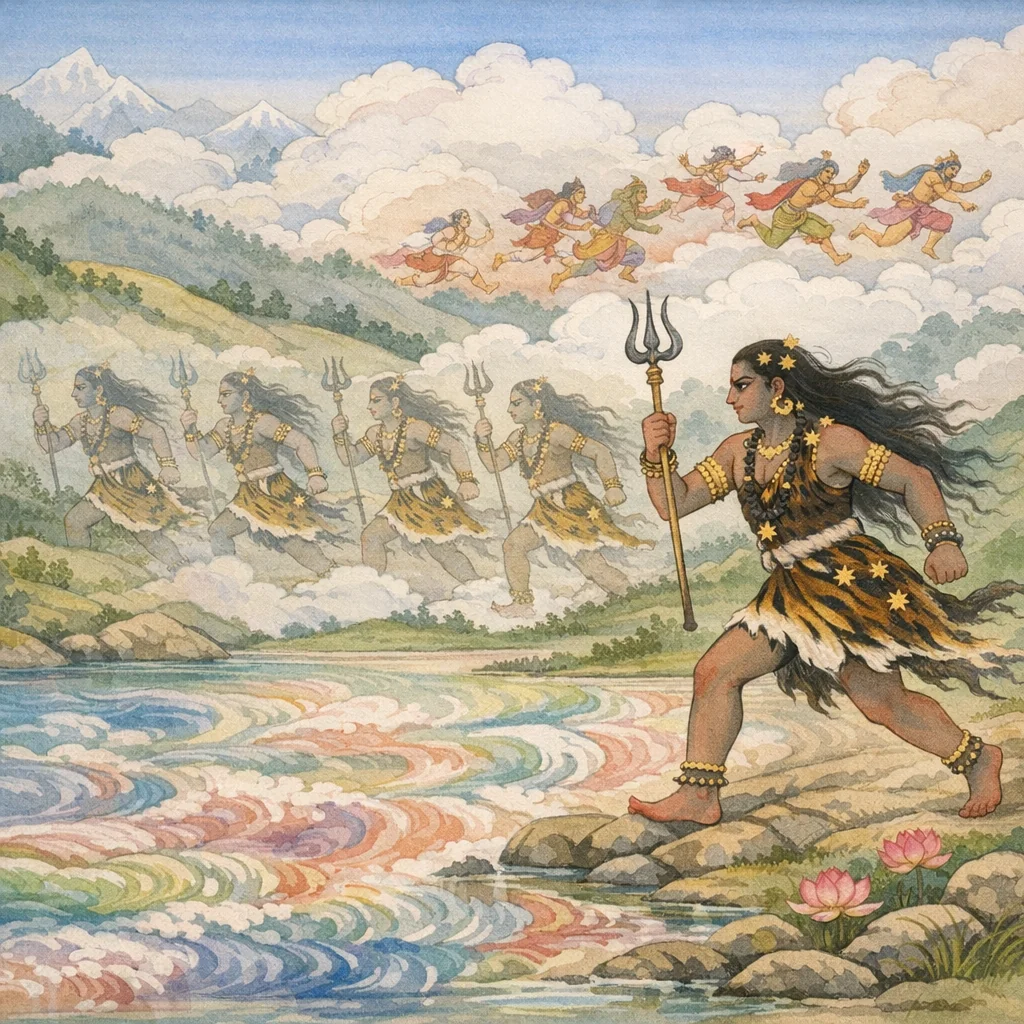
Adhyāya 21, narrated by Vāyu, recounts a battle in which the foremost devas—led by Viṣṇu and Indra—are seized by fear and scatter. Seeing the devas afflicted through his own (formerly unstained) limbs and agency, and judging that those deserving punishment had remained unpunished, the gaṇa-leader Bhadr(a), born of Rudra’s wrath, flares up in rage. He grasps a triśūla said to restrain even Śarva’s power, advances with upraised gaze and a flame-filled mouth, and charges the deva hosts like a lion among elephants. His rush is likened to a maddened elephant, and his violence to churning a great lake into many colors—images of chaos and terror in the celestial ranks. Clad in tiger-skin and adorned with brilliant golden star-like ornaments, he roams through the devas like a beneficent forest-fire, so that they perceive the single warrior as a thousand. Bhadrakālī too is described as furious and intoxicated with the swelling battle-frenzy. With a flame-emitting trident he pierces the devas in combat, and Bhadra shines as a direct eruption of Rudra’s anger, affirming the motif that Rudra’s attendants act as extensions of his punitive and corrective will.
Shlokas
Verse 1
वायुरुवाच । ततस्त्रिदशमुख्यास्ते विष्णुशक्रपुरोगमाः । सर्वे भयपरित्रस्तादुद्रुवुर्भयविह्वलाः
Vāyu said: Then those foremost among the gods—led by Viṣṇu and Śakra (Indra)—all, terrified by fear, fled away, shaken and overwhelmed by dread.
Verse 2
निजैरदूषितैरंगैर्दृष्ट्वा देवानुपद्रुतान् । दंड्यानदंडितान्मत्वा चुकोप गणपुंगवः
Seeing the gods harassed, while his own limbs remained untainted and unimpaired, the foremost of Śiva’s gaṇas grew wrathful, judging that those who deserved punishment had gone unpunished.
Verse 3
ततस्त्रिशूलमादाय शर्वशक्तिनिबर्हणम् । ऊर्ध्वदृष्टिर्महाबाहुर्मुखाज्ज्वालाः समुत्सृजन्
Then, taking up the trident—the destroyer of all hostile powers—mighty-armed Śiva fixed His gaze upward and, from His mouth, sent forth blazing flames.
Verse 4
अमरानपि दुद्राव द्विरदानिव केसरी । तानभिद्रवतस्तस्य गमनं सुमनोहरम्
Like a lion charging upon elephants, he drove even the gods into flight; and as he rushed after them, his onward movement appeared exceedingly captivating to behold.
Verse 5
वाराणस्येव मत्तस्य जगाम प्रेक्षणीयताम् । ततस्तत्क्षोभयामास महत्सुरबलं बली
He became a spectacle to behold—like a maddened elephant—and then that mighty one stirred into agitation the great army of the gods.
Verse 6
महासरोवरं यद्वन्मत्तो वारणयूथपः । विकुर्वन्बहुधावर्णान्नीलपांडुरलोहितान्
Just as an intoxicated leader of a herd of elephants, sporting in a vast lake, stirs up many hues—blue, pale-white, and red—so that power, though one in essence, manifests diverse appearances.
Verse 7
विभ्रद्व्याघ्राजिनं वासो हेमप्रवरतारकम् । छिन्दन्भिन्दन्नुद १ लिन्दन्दारयन्प्रमथन्नपि
Wearing a tiger-skin as his garment and bearing splendid golden ornaments, he moved with irresistible force—cutting, shattering, driving back, tearing apart, and overpowering all obstacles as well.
Verse 8
व्यचरद्देवसंघेषु भद्रो ऽग्निरिव कक्षगः । तत्र तत्र महावेगाच्चरंतं शूलधारिणम्
He moved among the hosts of the gods like a blazing forest-fire. With tremendous speed he ranged here and there—he, the trident-bearer.
Verse 9
तमेकं त्रिदशाः सर्वे सहस्रमिव मेनिरे । भद्रकाली च संक्रुद्धा युद्धवृद्धमदोद्धता
All the gods regarded that single one as though he were a thousand. And Bhadrakālī too—enraged, and made fiercely arrogant by the intoxication that grows in battle—stood ready to strike.
Verse 10
मुक्तज्वालेन शूलेन निर्बिभेद रणे सुरान् । स तया रुरुचे भद्रो रुद्रकोपसमुद्भवः
With a flaming trident hurled forth, he pierced the gods in the midst of battle. Born of Rudra’s wrath, that auspicious one blazed all the more with that very weapon.
Verse 11
प्रभयेव युगांताग्निश्चलया धूमधूम्रया । भद्रकाली तदायुद्धे विद्रुतत्रिदशाबभौ
In that battle, Bhadrakālī appeared like the fire at the end of an age—flickering, smoke-laden, and dark with fumes—so that the hosts of the gods were thrown into flight.
Verse 12
कल्पे शेषानलज्वालादग्धाविश्वजगद्यथा । तदा सवाजिनं सूर्यं रुद्रान्रुद्रगणाग्रणीः
At the end of the aeon, when the entire universe is burned by the blazing fire that issues from Śeṣa, then Śiva, the Leader of the hosts of Rudras, brings even the Sun—together with his steeds—under the power of the Rudras.
Verse 13
भद्रो मूर्ध्नि जघानाशु वामपादेन लीलया । असिभिः पावकं भद्रः पट्टिशैस्तु यमं यमी
Bhadra swiftly struck (the foe) upon the head with his left foot, as if in play. With swords Bhadra assailed Agni, the Fire-god, and with sharp axes he attacked Yama; and Yamī too confronted them.
Verse 14
रुद्रान्दृढेन शूलेन मुद्गरैर्वरुणं दृढैः । परिघैर्निरृतिं वायुं टंकैष्टंकधरः स्वयम्
Then the Lord Himself—bearing the mighty battle-axe—struck down the Rudras with a firm trident; with solid maces He subdued Varuṇa; with iron clubs He checked Nirṛti; and with sharp axes He restrained Vāyu.
Verse 15
निर्बिभेद रणे वीरो लीलयैव गणेश्वरः । सर्वान्देवगणान्सद्यो मुनीञ्छंभोर्विरोधिनः
In the battle, the heroic Gaṇeśvara struck them down with effortless ease—at once subduing all the hosts of gods and the sages who had set themselves in opposition to Śambhu (Lord Śiva).
Verse 16
ततो देवः सरस्वत्या नासिकाग्रं सुशोभनम् । चिच्छेद करजाग्रेण देवमातुस्तथैव च
Then the Lord cut off the beautifully shaped tip of Sarasvatī’s nose with the sharp edge of his fingernail; and in the same manner he also (did so) to the Devamātā (the divine Mother).
Verse 17
चिच्छेद च कुठारेण बाहुदंडं विभावसोः । अग्रतो द्व्यंगुलां जिह्वां मातुर्देव्या लुलाव च
With an axe he severed the forearm of Vibhāvasu (Agni). Then, in the very presence of all, he also cut off two finger-lengths from the tongue of the Goddess, his mother.
Verse 18
स्वाहादेव्यास्तथा देवो दक्षिणं नासिकापुटम् । चकर्त करजाग्रेण वामं च स्तनचूचुकम्
Then the Lord, in the same manner, cut off Svāhādevī’s right nostril with the tip of his fingernail, and also her left nipple.
Verse 19
भगस्य विपुले नेत्रे शतपत्रसमप्रभे । प्रसह्योत्पाटयामास भद्रः परमवेगवान्
Then the mighty and exceedingly swift Bhadra, by force, tore out Bhaga’s two broad eyes, which shone like a lotus of a hundred petals.
Verse 20
पूष्णो दशनरेखां च दीप्तां मुक्तावलीमिव । जघान धनुषः कोट्या स तेनास्पष्टवागभूत्
With the tip of His bow the Lord struck Pūṣan’s shining row of teeth, bright like a string of pearls; and from that blow Pūṣan’s speech became indistinct and unclear.
Verse 21
ततश्चंद्रमसं देवः पादांगुष्ठेन लीलया । क्षणं कृमिवदाक्रम्य घर्षयामास भूतले
Then the Lord, playfully pressing the Moon with the great toe of His foot, trampled it for a moment as one would a worm, and rubbed it upon the surface of the earth.
Verse 22
शिरश्चिच्छेद दक्षस्य भद्रः परमकोपतः । क्रोशंत्यामेव वैरिण्यां भद्रकाल्यै ददौ च तत्
Blazing with supreme wrath, Bhadra severed Daksha’s head; and, as the hostile one screamed, he handed that head to Bhadrakālī.
Verse 23
तत्प्रहृष्टा समादाय शिरस्तालफलोपमम् । सा देवी कंडुकक्रीडां चकार समरांगणे
Delighted, the Goddess lifted it up—head-sized, like a palmyra fruit—and there upon the battlefield she began to play as in a ball-game.
Verse 24
ततो दक्षस्य यज्ञस्त्री कुशीला भर्तृभिर्यथा । पादाभ्यां चैव हस्ताभ्यां हन्यते स्म गणेश्वरैः
Then Dakṣa’s sacrificial altar (the yajña-vedī) was struck by the Gaṇeśvaras—kicked with their feet and beaten with their hands—like a wayward woman chastised by her husbands.
Verse 25
अरिष्टनेमिने सोमं धर्मं चैव प्रजापतिम् । बहुपुत्रं चांगिरसं कृशाश्वं कश्यपं तथा
To Ariṣṭanemi were entrusted Soma, Dharma, and also Prajāpati; likewise Bahuputra, descendant of Aṅgiras, as well as Kṛśāśva and Kaśyapa.
Verse 26
गले प्रगृह्य बलिनो गणपाः सिंहविक्रमाः । भर्त्सयंतो भृशं वाग्भिर्निर्जघ्नुर्मूर्ध्नि मुष्टिभिः
Seizing him by the throat, the mighty Gaṇas—lion-like in valor—furiously reviled him with harsh words and then struck his head with their fists.
Verse 27
धर्षिता भूतवेतालैर्दारास्सुतपरिग्रहाः । यथा कलियुगे जारैर्बलेन कुलयोषितः
Wives, children, and all that one claims as one’s household are harassed by bhūtas and vetālas—just as, in the Kali age, women of respectable families are forcibly violated by lustful adulterers.
Verse 28
तच्च विध्वस्तकलशं भग्नयूपं गतोत्सवम् । प्रदीपितमहाशालं प्रभिन्नद्वारतोरणम्
And that place appeared with its ritual jars shattered, its sacrificial post (yūpa) broken, its celebration extinguished—its great hall left blazing, and its doorways and archways (toraṇa) torn apart.
Verse 29
उत्पाटितसुरानीकं हन्यमानं तपोधनम् । प्रशान्तब्रह्मनिर्घोषं प्रक्षीणजनसंचयम्
The hosts of the gods were thrown into disarray; the treasure of ascetic power was being struck down. The sacred utterance of Brahman fell silent, and the gathering of people was greatly diminished.
Verse 30
क्रन्दमानातुरस्त्रीकं हताशेषपरिच्छदम् । शून्यारण्यनिभं जज्ञे यज्ञवाटं तदार्दितम्
Then the sacrificial enclosure appeared ravaged—filled with distressed women crying aloud, stripped of all its remaining furnishings, and resembling an empty wilderness-forest.
Verse 31
शूलवेगप्ररुग्णाश्च भिन्नबाहूरुवक्षसः । विनिकृत्तोत्तमांगाश्च पेतुरुर्व्यां सुरोत्तमाः
Struck by the rushing force of the trident (śūla), the foremost of the gods fell upon the earth—some with arms, thighs, and chests shattered, and others with their heads cleanly severed.
Verse 32
हतेषु तेषु देवेषु पतितेषुः सहस्रशः । प्रविवेश गणेशानः क्षणादाहवनीयकम्
When those gods had been struck down and had fallen by the thousands, Gaṇeśāna entered—in a single instant—into the āhavanīya, the consecrated sacrificial fire.
Verse 33
प्रविष्टमथ तं दृष्ट्वा भद्रं कालाग्निसंनिभम् । दुद्राव मरणाद्भीतो यज्ञो मृगवपुर्धरः
Then, seeing Bhadra enter—blazing like the fire of Time at the world’s dissolution—Yajña, who had taken the body of a deer, fled in terror, fearing death.
Verse 34
स विस्फार्य महच्चापं दृढज्याघोषणभीषणम् । भद्रस्तमभिदुद्राव विक्षिपन्नेव सायकान्
He drew back and fully bent the great bow, terrifying with the thunderous twang of its tight bowstring; and Bhadra charged at him, as though scattering a shower of arrows.
Verse 35
आकर्णपूर्णमाकृष्टं धनुरम्बुदसंनिभम् । नादयामास च ज्यां द्यां खं च भूमिं च सर्वशः
He drew the cloud-dark bow back to the full length of his ear, and then twanged its bowstring so that the sound reverberated everywhere—through heaven, the sky, and the earth in all directions.
Verse 36
तमुपश्रित्य सन्नादं हतो ऽस्मीत्येव विह्वलम् । शरणार्धेन वक्रेण स वीरो ऽध्वरपूरुषम्
Taking refuge in that tumultuous roar, the hero—bewildered and thinking, “I am slain indeed”—approached the Adhvara-Puruṣa, the personified Sacrifice, with his half-shield held at an angle.
Verse 37
महाभयस्खलत्पादं वेपन्तं विगतत्विषम् । मृगरूपेण धावन्तं विशिरस्कं तदाकरोत्
Overwhelmed by great fear—his feet slipping, his body trembling, and his radiance faded—he fled in the form of a deer; then, in that very moment, Śiva’s power made him headless.
Verse 38
तमीदृशमवज्ञातं दृष्ट्वा वै सूर्यसंभवम् । विष्णुः परमसंक्रुद्धो युद्धायाभवदुद्यतः
Seeing the son of the Sun thus insulted, Viṣṇu became exceedingly enraged and prepared himself for battle.
Verse 39
तमुवाह महावेगात्स्कन्धेन नतसंधिना । सर्वेषां वयसां राजा गरुडः पन्नगाशनः
Then Garuḍa—the king of all birds, the devourer of serpents—swiftly carried him away with tremendous speed, bearing him upon his shoulder with his joints bent in submission.
Verse 40
देवाश्च हतशिष्टा ये देवराजपुरोगमाः । प्रचक्रुस्तस्य साहाय्यं प्राणांस्त्यक्तुमिवोद्यताः
The surviving devas, led by the king of the gods, hastened to render him aid—rising as though ready to lay down their very lives.
Verse 41
विष्णुना सहितान्देवान्मृगेन्द्रः क्रोष्टुकानिव । दृष्ट्वा जहास भूतेन्द्रो मृगेन्द्र इव विव्यथः
Seeing the gods accompanied by Viṣṇu—like a lion beholding a pack of jackals—the Lord of Beings (Śiva) laughed; and the ‘lord of beasts’ adversary trembled, as a lion might quake before a greater lion.
Frequently Asked Questions
A combat sequence where Bhadra—arising from Rudra’s anger—charges and wounds the deva hosts with a flame-emitting triśūla, causing Viṣṇu, Indra, and other devas to flee in fear; Bhadrakālī is also depicted as battle-enraged.
It signals the disproportionate potency of Rudra-śakti: a single gaṇa-embodiment of Śiva’s wrath functions as overwhelming, many-fold power, underscoring Śiva’s supremacy over collective deva authority.
Bhadra as Rudra’s wrath-incarnation, Bhadrakālī as a fierce battle-power, and the triśūla as the principal weapon-symbol of punitive cosmic governance.
Read Shiva Purana in the Vedapath app
Scan the QR code to open this directly in the app, with audio, word-by-word meanings, and more.