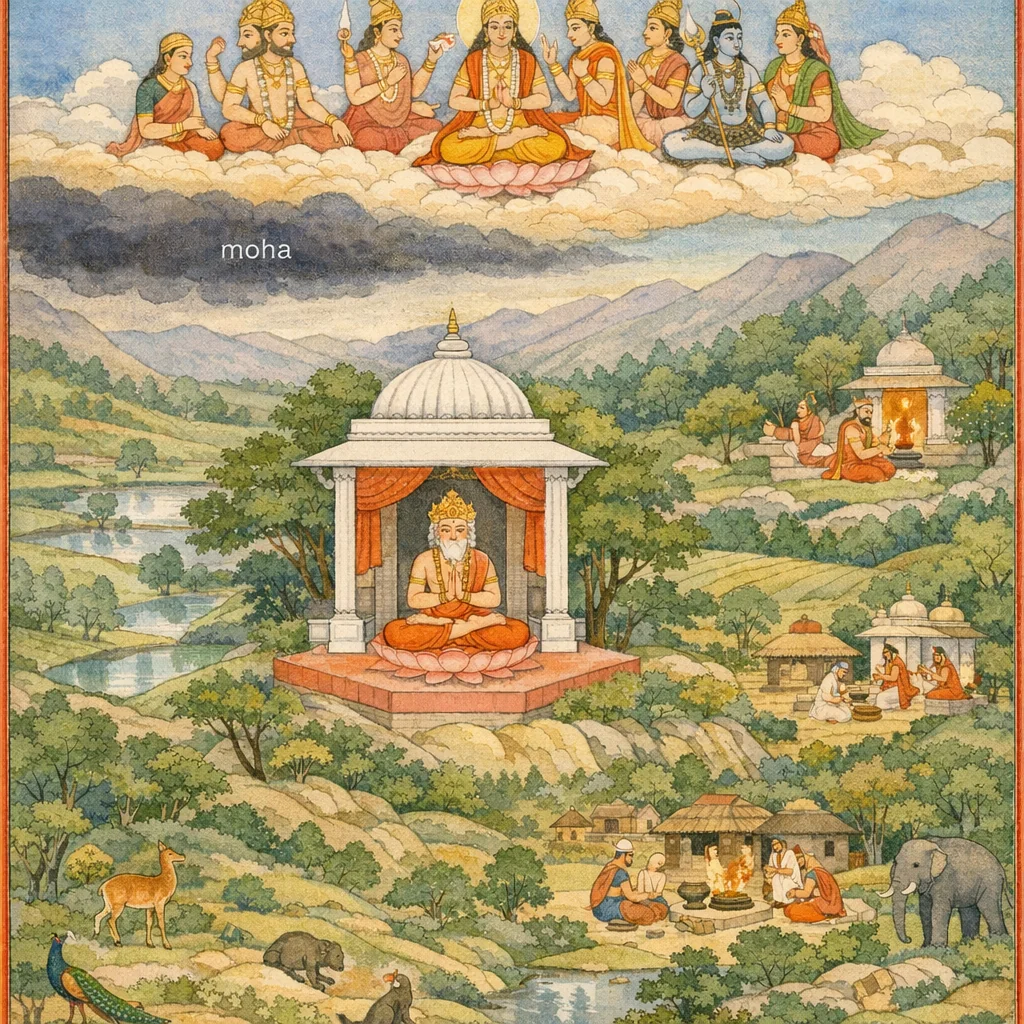
सर्गविभागवर्णनम् (Classification of Creation: the Nine Sargas and the Streams of Beings)
Adhyāya 12, spoken by Vāyu, gives a technical classification of cosmic manifestation (sarga). It opens with Brahmā’s resolve to create and the graded rise of tamas-born delusion (moha)—tamo-moha, mahā-moha, tāmisra, andha—identified with fivefold avidyā. Creation is then described in strata and “streams” of beings (srotas): first the obstructed, insentient mūkhya/sthāvara (immobile) formation; next the tiryaksrotas (animals), inwardly lit yet outwardly veiled and prone to error; then the ūrdhvasrotas (devas), clear, joyful, and sāttvika-dominant; and the arvāksrotas (humans), capable of sādhana yet tightly bound to duḥkha. The chapter also lists an anugraha-type creation in four modes (viparyaya, śakti, tuṣṭi, siddhi), and concludes with the canonical nine creations: three prākṛta (mahat; tanmātras/bhūtas; vaikārika/aindriyaka) and five vaikṛta beginning with mūkhya/sthāvara and ending with the kaumāra as the ninth. Overall, it maps cosmology as a graded spectrum of guṇa-dominance and cognitive-ethical capacity.
Shlokas
Verse 1
पद्भ्यां चाश्वान्समातंगान् शरभान् गवयान्मृगान् । उष्ट्रानश्वतरांश्चैव न्यंकूनन्याश्च जातयः
From their feet were brought forth horses and mighty elephants, śarabhas, wild oxen, deer, camels, mules, and also the species of the nyaṅku and other kinds of creatures.
Verse 3
पञ्चधा ऽवस्थितः सर्गो ध्यायतस्त्वभिमानिनः । सर्वतस्तमसातीव बीजकुम्भवदावृतः । बहिरन्तश्चाप्रकाशः स्तब्धो निःसंज्ञ एव च । तस्मात्तेषां वृता बुद्धिर्मुखानि करणानि च
Creation stood arranged in fivefold states as that self-conceited one merely contemplated. Dense darkness enveloped all around—like a seed shut within its husk—so there was no illumination either outwardly or inwardly; all was rigid, as if unconscious. Therefore their intellect, their mouths, and their organs of action and perception remained veiled and obstructed.
Verse 5
तस्मात्ते संवृतात्मानो नगा मुख्याः प्रकीर्तिताः । तं दृष्ट्वाऽसाधकं ब्रह्मा प्रथमं सर्गमीदृशम् । अप्रसन्नमना भूत्वा द्वितीयं सो ऽभ्यमन्यत । तस्याभिधायतः सर्गं तिर्यक्स्रोतो ऽभ्यवर्तत
Therefore they are proclaimed as the foremost “Nāgas,” beings of a closed and self-contained nature. Seeing that this first creation was unfit for the intended purpose, Brahmā grew displeased in mind and conceived a second creation. As he began to declare that creation, the stream called “tiryak-srotas”—those whose life-current moves horizontally (animals and lower creatures)—came forth.
Verse 7
अन्तःप्रकाशास्तिर्यंच आवृताश्च बहिः पुनः । पश्वात्मानस्ततो जाता उत्पथग्राहिणश्च ते । तमप्यसाधकं ज्ञात्वा सर्गमन्यममन्यत । तदोर्ध्वस्रोतसो वृत्तो देवसर्गस्तु सात्त्विकः
Then were born beings whose awareness turns sideways—inner light present, yet outwardly covered; they became souls in the “paśu” condition, inclined to seize upon wrong paths. Knowing that this creation too was not conducive to spiritual accomplishment, he conceived another creation. Thereupon arose the upward-flowing order: the divine creation of the devas, predominated by sattva.
Verse 9
ते सुखप्रीतिबहुला बहिरन्तश्च नावृताः । प्रकाशा बहिरन्तश्चस्वभावादेव संज्ञिताः । ततो ऽभिध्यायतोव्यक्तादर्वाक्स्रोतस्तु साधकः । मनुष्यनामा सञ्जातः सर्गो दुःखसमुत्कटः
They abound in happiness and delight and are not veiled either outwardly or inwardly. By their very nature they are called “luminous,” both within and without. Then, as the Unmanifest (Avyakta) was contemplated, there arose the downward-flowing stream—the striving one; the creation known as “human” came into being, intensely mixed with suffering.
Verse 11
प्रकाशाबहिरन्तस्ते तमोद्रिक्ता रजो ऽधिकाः । पञ्चमोनुग्रहः सर्गश्चतुर्धा संव्यवस्थितः । विपर्ययेण शक्त्या च तुष्ट्यासिद्ध्या तथैव च । ते ऽपरिग्राहिणः सर्वे संविभागरताः पुनः
These beings are luminous outwardly and inwardly; yet they are marked by an excess of tamas and a predominance of rajas. The fifth creation—called “Grace” (anugraha)—is arranged in four modes: by inversion (viparyaya), by power (śakti), by contentment (tuṣṭi), and likewise by accomplishment (siddhi). All of them are non-appropriating (aparigrāhiṇaḥ) and again devoted to proper apportionment and distribution (saṃvibhāga).
Verse 13
खादनाश्चाप्यशीलाश्च भूताद्याः परिकीर्तिताः । प्रथमो महतः सर्गो ब्रह्मणः परमेष्ठिनः । तन्मात्राणां द्वितीयस्तु भूतसर्गः स उच्यते । वैकारिकस्तृतीयस्तु सर्ग ऐन्द्रियकः स्मृतः
The classes beginning with “khādana” and “aśīla” are said to belong to the order of elemental beings (bhūta-ādi). The first creation is the unfolding of Mahat, brought forth by Brahmā, the Supreme Lord within the created order. The second is the creation of the subtle elements (tanmātras), and therefore it is called bhūta-sarga, the elemental creation. The third, called vaikārika, is remembered as the creation of the powers of the senses (aindriyaka).
Verse 15
इत्येष प्रकृतेः सर्गः सम्भृतो ऽबुद्धिपूर्वकः । मुख्यसर्गश्चतुर्थस्तु मुख्या वै स्थावराः स्मृताः । तिर्यक्स्रोतस्तु यः प्रोक्तस्तिर्यग्योनिः स पञ्चमः । तदूर्ध्वस्रोतसः षष्ठो देवसर्गस्तु स स्मृतः
Thus is described the creation arising from Prakṛti, first brought forth without discriminative intellect preceding it. The fourth is called the primary creation (mukhya-sarga), wherein the immovable beings—plants and the like—are held to be foremost. The fifth, declared as tiryak-srotas, the sideways-flowing current, is the birth of animals. Above that, the sixth—called ūrdhva-srotas, the upward-flowing current—is remembered as deva-sarga, the creation of the gods.
Verse 17
ततो ऽर्वाक्स्रोतसां सर्गः सप्तमः स तु मानुषः । अष्टमो ऽनुग्रहः सर्गः कौमारो नवमः स्मृतः । प्राकृताश्च त्रयः पूर्वे सर्गास्ते ऽबुद्धिपूर्वकाः । बुद्धिपूर्वं प्रवर्तन्ते मुख्याद्याः पञ्च वैकृताः
Then comes the seventh creation, that of the downward-flowing beings (arvāk-srotas)—the human creation. The eighth is known as the creation born of divine grace (anugraha). The ninth is remembered as the Kaumāra creation. The three earlier creations are Prākṛta, of primordial Nature, and proceed without discriminative intellect going before; but the five Vaikṛta creations, beginning with the primary (mukhya), proceed with intellect as their antecedent.
Verse 19
अग्रे ससर्ज वै ब्रह्मा मानसानात्मनः समान् । सनन्दं सनकञ्चैव विद्वांसञ्च सनातनम् । ऋभुं सनत्कुमारञ्च पूर्वमेव प्रजापतिः । सर्वे ते योगिनो ज्ञेया वीतरागा विमत्सराः
In the beginning, Brahmā—Prajāpati—first created from his own mind beings like unto himself: Sananda, Sanaka, the wise Sanātana, Ṛbhu, and Sanatkumāra. All of them are to be known as yogins—free from attachment and devoid of envy.
Verse 21
ईश्वरासक्तमनसो न चक्रुः सृष्टये मतिम् । तेषु सृष्ट्यनपेक्षेषु गतेषु सनकादिषु । स्रष्टुकामः पुनर्ब्रह्मा तताप परमं तपः । तस्यैवं तप्यमानस्य न किंचित्समवर्तत
With their minds absorbed in the Lord (Īśvara), they did not turn their intention toward creation. When Sanaka and the others had departed, indifferent to the work of creation, Brahmā—still desiring to create—again undertook supreme austerity (tapas). Yet even as he thus performed tapas, nothing whatsoever came to be manifested.
Verse 23
ततो दीर्घेण कालेन दुःखात्क्रोधो व्यजायत । क्रोधाविष्टस्य नेत्राभ्यां प्रापतन्नश्रुबिन्दवः । ततस्तेभ्यो ऽश्रुबिन्दुभ्यो भूताः प्रेतास्तदाभवन् । सर्वांस्तानश्रुजान्दृष्ट्वा ब्रह्मात्मानमनिंदत
Then, after a long time, from sorrow anger arose. Seized by wrath, drops of tears fell from his eyes. From those tear-drops, at that very moment, beings came to be as Bhūtas and Pretas. Seeing all those born of tears, Brahmā reproached himself.
Verse 25
तस्य तीव्रा ऽभवन्मूर्छा क्रोधामर्षसमुद्भवा । मूर्छितस्तु जहौ प्राणान्क्रोधाविष्टः प्रजापतिः । ततः प्राणेश्वरो रुद्रो भगवान्नीललोहितः । प्रसादमतुलं कर्तुं प्रादुरासीत्प्रभोर्मुखात्
Overcome by anger and wounded pride, a fierce swoon seized him. The Prajāpati, possessed by wrath, fell unconscious and even gave up his vital breath. Then Rudra—the Lord of the life-breaths, Bhagavān Nīlalohita—manifested from the Lord’s face, to bestow incomparable grace.
Verse 27
दशधा चैकधा चक्रे स्वात्मानं प्रभुरीश्वरः । ते तेनोक्ता महात्मानो दशधा चैकधा कृताः । यूयं सृष्टा मया वत्सा लोकानुग्रहकारणात् । तस्मात्सर्वस्य लोकस्य स्थापनाय हिताय च
The Lord, the supreme Īśvara, manifested His own Self both as the One and as the tenfold. Those great souls, instructed by Him, likewise became tenfold and also one. “You have been created by Me, dear ones, for compassion toward the worlds; therefore act for the stability and welfare of all the worlds.”
Verse 29
प्रजासन्तानहेतोश्च प्रयतध्वमतन्द्रिताः । एवमुक्ताश्च रुरुदुर्दुद्रुवुश्च समन्ततः । रोदनाद्द्रावणाच्चैव ते रुद्रा नामतः स्मृताः । ये रुद्रास्ते खलु प्राणा ये प्राणास्ते महात्मकाः
“For the sake of bringing forth progeny, strive diligently and without negligence.” Thus addressed, they wept and also ran about in all directions. Because of their weeping (rodana) and their causing things to flee (drāvaṇa), they are remembered by the name “Rudras”. Indeed, those Rudras are the vital breaths (prāṇas); and those vital breaths are the great-souled powers that sustain embodied life.
Verse 31
ततो मृतस्य देवस्य ब्रह्मणः परमेष्ठिनः । घृणी ददौ पुनः प्राणान्ब्रह्मपुत्रो महेश्वरः । प्रहृष्टवदनो रुद्रः प्राणप्रत्यागमाद्विभोः । अभ्यभाषत विश्वेशो ब्रह्माणं परमं वचः
Then, to the god Brahmā—the Parameṣṭhin who had fallen lifeless—Mahādeva, the great Lord also called the “Son of Brahmā” (Rudra), compassionately restored the vital breaths once again. Rejoicing at the return of life to that mighty one, Rudra—the Lord of the universe—addressed Brahmā with a sublime utterance.
Verse 33
माभैर्माभैर्महाभाग विरिंच जगतां गुरो । मया ते प्राणिताः प्राणाः सुखमुत्तिष्ठ सुव्रत । स्वप्नानुभूतमिव तच्छ्रुत्वा वाक्यं मनोहरम् । हरं निरीक्ष्य शनकैर्नेत्रैः फुल्लाम्बुजप्रभैः
“Fear not, fear not, O great-souled Viriñca (Brahmā), preceptor of the worlds. By Me your life-breaths have been restored—rise up happily, O you of excellent vow.” Hearing these charming words, as though experienced in a dream, he slowly looked upon Hara with eyes radiant like blossoming lotuses.
Verse 35
तथा प्रत्यागतप्राणः स्निग्धगम्भीरया गिरा । उवाच वचनं ब्रह्मा तमुद्दिश्य कृताञ्जलिः । त्वं हि दर्शनमात्रेण चानन्दयसि मे मनः । को भवान् विश्वमूर्त्या वा स्थित एकादशात्मकः
Then Brahmā, as though his very life-breath had returned, addressed Him with a voice both tender and profound, with palms joined in reverence: “By the mere sight of You, my mind is filled with bliss. Who are You—abiding as the very form of the universe, established in the nature of the Eleven?”
Verse 37
तस्य तद्वचनं श्रुत्वा व्याजहार महेश्वरः । स्पृशन् काराभ्यां ब्रह्माणं सुसुखाभ्यां सुरेश्वरः । मां विद्धि परमात्मानं तव पुत्रत्वमागतम् । एते चैकादश रुद्रास्त्वां सुरक्षितुमागताः
Hearing those words, Maheśvara replied. The Lord of the gods gently touched Brahmā with His two gracious hands and said: “Know Me as the Supreme Self, who has come to you in the relation of a son. And these eleven Rudras have also come to protect you.”
Verse 39
तस्मात्तीव्रामिमाम्मूर्छां विधूय मदनुग्रहात् । प्रबुद्धस्व यथापूर्वं प्रजा वै स्रष्टुमर्हसि । एवं भगवता प्रोक्तो ब्रह्मा प्रीतमना ह्यभूत् । नानाष्टकेन विश्वात्मा तुष्टाव परमेश्वरम्
“Therefore, by My grace, shake off this intense swoon. Awaken as before—you are indeed fit to create the beings.” Thus addressed by the Blessed Lord, Brahmā became glad at heart, and the World-Self praised Parameśvara with various hymns of eightfold verses.
Verse 41
ब्रह्मोवाच । नमस्ते भगवन् रुद्र भास्करामिततेजसे । नमो भवाय देवाय रसायाम्बुमयात्मने । शर्वाय क्षितिरूपाय नन्दीसुरभये नमः
Brahmā said: Salutations to You, O Blessed Rudra, whose immeasurable splendor is like the sun. Salutations to Bhava, the divine Lord whose very Self pervades the essence and the waters. Salutations to Śarva, whose form is the earth; and salutations to Nandī, the fearless among the gods.
Verse 42
ईशाय वसवे तुभ्यं नमस्स्पर्शमयात्मने । पशूनां पतये चैव पावकायातितेजसे । भीमाय व्योमरूपाय शब्दमात्राय ते नमः । उग्रायोग्रस्वरूपाय यजमानात्मने नमः । महादेवाय सोमाय नमोस्त्वमृतमूर्तये
Salutations to You, Lord Īśa—Vasu, the indwelling Power, whose very Self is manifest as touch. Salutations to You, Paśupati, Lord of beings—the Fire of transcendent splendor. Salutations to You, Bhīma, the Terrible, whose form is the vast sky, who is the very essence of sound. Salutations to You, Ugra, the Fierce, who abides as the inner Self of the sacrificer. Salutations to Mahādeva, to Soma—the embodiment of the deathless nectar, amṛta.
Verse 44
एवं स्तुत्वा महादेवं ब्रह्मा लोकपितामहः । प्रार्थयामास विश्वेशं गिरा प्रणतिपूर्वया । भगवन् भूतभव्येश मम पुत्र महेश्वर । सृष्टिहेतोस्त्वमुत्पन्नो ममांगे ऽनंगनाशनः
Thus, having praised Mahādeva, Brahmā—the grandsire of the worlds—humbly petitioned Viśveśa with words of reverent bowing: “O Blessed Lord, Master of past and future; O Maheśvara, my son; O Ananga-nāśana, destroyer of Kāma—for the sake of creation You have manifested from my very body.”
Verse 46
तस्मान्महति कार्येस्मिन् व्यापृतस्य जगत्प्रभो । सहायं कुरु सर्वत्र स्रष्टुमर्हसि स प्रजाः । तेनैषां पावितो देवो रुद्रस्त्रिपुरमर्दनः । बाढमित्येव तां वाणीं प्रतिजग्राह शंकरः
“Therefore, O Lord of the universe, since You are engaged in this great undertaking, please be a helper everywhere; You are indeed fit to bring forth these beings (prajās).” By that request, the God Rudra—the crusher of Tripura—was pleased and sanctified their intent; and Śaṅkara accepted those words, saying, “So be it.”
Verse 48
ततस्स भगवान् ब्रह्मा हृष्टं तमभिनंद्य च । स्रष्टुं तेनाभ्यनुज्ञातस्तथान्याश्चासृजत्प्रजाः । मरीचिभृग्वंगिरसः पुलस्त्यं पुलहं क्रतुम् । दक्षमत्रिं वसिष्ठं च सो ऽसृजन्मनसैव च
Thereupon the blessed Brahmā, delighted, praised Him. Having been granted permission by Him to carry out creation, Brahmā then brought forth other beings as well. By mind alone he created Marīci, Bhṛgu, Aṅgiras, Pulastya, Pulaha, Kratu, Dakṣa, Atri, and Vasiṣṭha.
Verse 49
पुरस्तादसृजद्ब्रह्मा धर्मं संकल्पमेव च । इत्येते ब्रह्मणः पुत्रा द्वादशादौ प्रकीर्तिताः । सह रुद्रेण संभूताः पुराणा गृहमेधिनः
In the beginning, Brahmā created Dharma and also Saṅkalpa—the power of sacred intention. These are proclaimed among the twelve foremost sons of Brahmā. They came into manifestation together with Rudra—ancient progenitors who uphold the householder order (gṛhamedhin).
Verse 51
तेषां द्वादश वंशाः स्युर्दिव्या देवगणान्विताः । प्रजावन्तः क्रियावन्तो महर्षिभिरलंकृताः । अथ देवासुरपित्ःन्मनुष्यांश्च चतुष्टयम् । सह रुद्रेण सिसृक्षुरंभस्येतानि वै विधिः
From them arose twelve lineages—divine, attended by hosts of the Devas—fruitful in progeny, active in sacred duties, and adorned by great Ṛṣis. Thereafter, together with Rudra, the Ordainer (Vidhī/Brahmā) willed to bring forth from the primal waters the fourfold classes—gods, Asuras, Pitṛs (ancestors), and human beings.
Verse 53
स सृष्ट्यर्थं समाधाय ब्रह्मात्मानमयूयुजत् । मुखादजनयद्देवान् पित्ःंश्चैवोपपक्षतः । जघनादसुरान् सर्वान् प्रजनादपि मानुषान् । अवस्करे क्षुधाविष्टा राक्षसास्तस्य जज्ञिरे
For the sake of creation, he entered deep samādhi and yoked his own being to the state of Brahmā, the creative principle. From his mouth he brought forth the Devas; from his side he produced the Pitṛs, the ancestral fathers. From his hips he generated all the Asuras, and from his generative organ, human beings. From the refuse were born of him the Rākṣasas, stricken with hunger.
Verse 55
पुत्रास्तमोरजःप्राया बलिनस्ते निशाचराः । सर्पा यक्षास्तथा भूता गंधर्वाः संप्रजज्ञिरे । वयांसि पक्षतः सृष्टाः पक्षिणो वक्षसो ऽसृजत् । मुखतोजांस्तथा पार्श्वादुरगांश्च विनिर्ममे
“Your sons are chiefly of tamas and rajas—powerful beings who move by night. Serpents, Yakṣas, Bhūtas, and Gandharvas likewise came fully into being. Birds were produced from the wings; winged creatures he created from the chest. From the mouth he fashioned men, and from the sides he also formed serpentine beings.”
Verse 57
औषध्यः फलमूलानि रोमभ्यस्तस्य जज्ञिरे । गायत्रीं च ऋचं चैव त्रिवृत्साम रथंतरम्
From the hairs of that Supreme Lord were born the medicinal herbs and all fruits and roots; and also the sacred Gāyatrī, the Ṛk-verses, the Trivṛt Sāman, and the Rathantara chant.
Verse 59
अग्निष्टोमं च यज्ञानां निर्ममे प्रथमान्मुखात् । यजूंषि त्रैष्टुभं छंदःस्तोमं पञ्चदशं तथा । बृहत्साम तथोक्थं च दक्षिणादसृजन्मुखात् । सामानि जगतीछंदः स्तोमं सप्तदशं तथा
From his foremost mouth he fashioned the Agniṣṭoma, the first among sacrifices; and he also brought forth the Yajus formulas together with the Triṣṭubh metre and the fifteenfold stoma. From his right mouth he produced the Bṛhat Sāman and the Uktha; and likewise the Sāman chants, the Jagatī metre, and the seventeenfold stoma.
Verse 61
वैरूप्यमतिरात्रं च पश्चिमादसृजन्मुखात् । एकविंशमथर्वाणमाप्तोर्यामाणमेव च । अनुष्टुभं स वैराजमुत्तरादसृजन्मुखात् । उच्चावचानि भूतानि गात्रेभ्यस्तस्य जज्ञिरे
From his western mouth he brought forth the Vairūpya and Atirātra rites, and likewise the Ekaviṃśa and Āptoryāma sacrifices together with the Atharvan tradition. From his northern mouth he produced the Vairāja Anuṣṭubh metre. And from his limbs were born beings of many kinds—higher and lower according to their condition.
Verse 63
यक्षाः पिशाचा गंधर्वास्तथैवाप्सरसां गणाः । नरकिन्नररक्षांसि वयःपशुमृगोरगाः । अव्ययं चैव यदिदं स्थाणुस्थावरजंगमम् । तेषां वै यानि कर्माणि प्राक्सृष्टानि प्रपेदिरे
Yakṣas, Piśācas, Gandharvas, and the hosts of Apsarases; humans, Kinnaras, and Rākṣasas; birds, cattle, wild beasts, and serpents—indeed, all this imperishable creation, whether immovable, stationary, or moving—each entered upon the actions and functions assigned to it at the very beginning of creation.
Verse 65
तान्येव ते प्रपद्यंते सृज्यमानाः पुनः पुनः । हिंस्राहिंस्रे मृदुक्रूरे धर्माधर्मावृतानृते । तद्भाविताः प्रपद्यंते तस्मात्तत्तस्य रोचते । महाभूतेषु नानात्वमिंद्रियार्थेषु मुक्तिषु
Created again and again, they resort only to those very states—violent and non-violent, gentle and cruel, clothed in dharma and adharma, in truth and untruth. Shaped by such dispositions, they fall into corresponding courses; therefore each finds pleasing what accords with its own conditioning. Thus diversity arises among the great elements, among the objects of the senses, and even in the paths of liberation.
Verse 67
विनियोगं च भूतानां धातैव व्यदधत्स्वयम् । नाम रूपं च भूतानां प्राकृतानां प्रपञ्चनम् । वेदशब्देभ्य एवादौ निर्ममे ऽसौ पितामहः । आर्षाणि चैव नामानि याश्च वेदेषु वृत्तयः
The Creator (Brahmā) himself assigned the respective functions of all beings, and unfolded the manifest diversity of the natural elements by determining their names and forms. In the beginning, that Grandfather of the worlds fashioned these designations from the very words of the Veda—both the seers’ (ārṣa) names and the usages and modes of expression found in the Vedas.
Verse 69
शर्वर्यंते प्रसूतानां तान्येवैभ्यो ददावजः । यथर्तावृतुलिंगानि नानारूपाणि पर्यये । दृश्यंते तानि तान्येव तथा भावा युगादिषु । इत्येष करणोद्भूतो लोकसर्गस्स्वयंभुवः
At the close of the night of dissolution, the Unborn Lord (Aja) bestowed upon these beings the very same instruments and capacities that had belonged to them before. Just as the marks of the seasons recur—appearing in varied forms in due succession—so too the same states of existence are seen to re-emerge at the beginnings of the yugas. Thus is described the self-born creation of the worlds by Svayambhū, arising from the operative causes, the instruments of manifestation.
Verse 71
महदाद्योविशेषांतो विकारः प्रकृतेः स्वयम् । चंद्रसूर्यप्रभाजुष्टो ग्रहनक्षत्रमंडितः । नदीभिश्च समुद्रैश्च पर्वतैश्च स मंडितः । परैश्च विविधैरम्यैस्स्फीतैर्जनपदैस्तथा
From Mahat onward up to the gross viśeṣas, this entire cosmos is itself a transformation of Prakṛti. Adorned with the radiance of the Moon and Sun, and ornamented with planets and constellations, it is embellished with rivers, oceans, and mountains, and likewise with many other diverse, beautiful, and flourishing realms and countries.
Verse 73
तस्मिन् ब्रह्मवने ऽव्यक्तो ब्रह्मा चरति सर्ववित् । अव्यक्तबीजप्रभव ईश्वरानुग्रहे स्थितः । बुद्धिस्कंधमहाशाख इन्द्रियांतरकोटरः । महाभूतप्रमाणश्च विशेषामलपल्लवः
In that forest of Brahman, Brahmā—the all-knowing—moves about as the Unmanifest. Born from the seed of the Unmanifest, he abides only through the grace of the Lord. His trunk is the principle of intellect (buddhi), his great branches are the evolutes; the hollows within are the inner workings of the senses. His measure is the great elements, and his leaves are the pure differentiations (viśeṣas).
Verse 75
धर्माधर्मसुपुष्पाढ्यः सुखदुःखफलोदयः । आजीव्यः सर्वभूतानां ब्रह्मवृक्षः सनातनः । द्यां मूर्धानं तस्य विप्रा वदंति खं वै नाभिं चंद्रसूर्यौ च नेत्रे । दिशः श्रोत्रे चरणौ च क्षितिं च सो ऽचिन्त्यात्मा सर्वभूतप्रणेता
Abounding in the blossoms of dharma and adharma, and bringing forth the fruits of pleasure and pain, that eternal Brahma-tree becomes the very livelihood of all beings. The sages declare that its head is the heaven; its navel is the sky; the moon and the sun are its eyes; the directions are its ears; and the earth is its feet. He—of inconceivable nature—is the impelling guide and ordainer of all beings.
Verse 77
वक्त्रात्तस्य ब्रह्मणास्संप्रसूतास्तद्वक्षसः क्षत्रियाः पूर्वभागात् । वैश्या उरुभ्यां तस्य पद्भ्यां च शूद्राः सर्वे वर्णा गात्रतः संप्रसूताः
From his mouth the Brāhmaṇas were brought forth; from his chest, from the fore-part, the Kṣatriyas. From his thighs the Vaiśyas arose, and from his feet the Śūdras. Thus all the social orders were manifested from his very body.
Frequently Asked Questions
Brahmā’s attempt to create and the sequential emergence of distinct creations (sargas), including immobile beings, animals, devas, and humans, framed as graded outcomes of guṇa-dominance and cognitive covering/uncovering.
It functions as a psychological-metaphysical account of how tamas veils consciousness during creation, producing graded delusion states that condition the capacity of beings to perceive, act, and orient toward liberation.
The chapter emphasizes the srotas-based classes—mukhya/sthāvara (immobile), tiryaksrotas (animals), ūrdhvasrotas (devas), and arvāksrotas (humans)—and then systematizes them within the broader nine-sarga schema.
Read Shiva Purana in the Vedapath app
Scan the QR code to open this directly in the app, with audio, word-by-word meanings, and more.