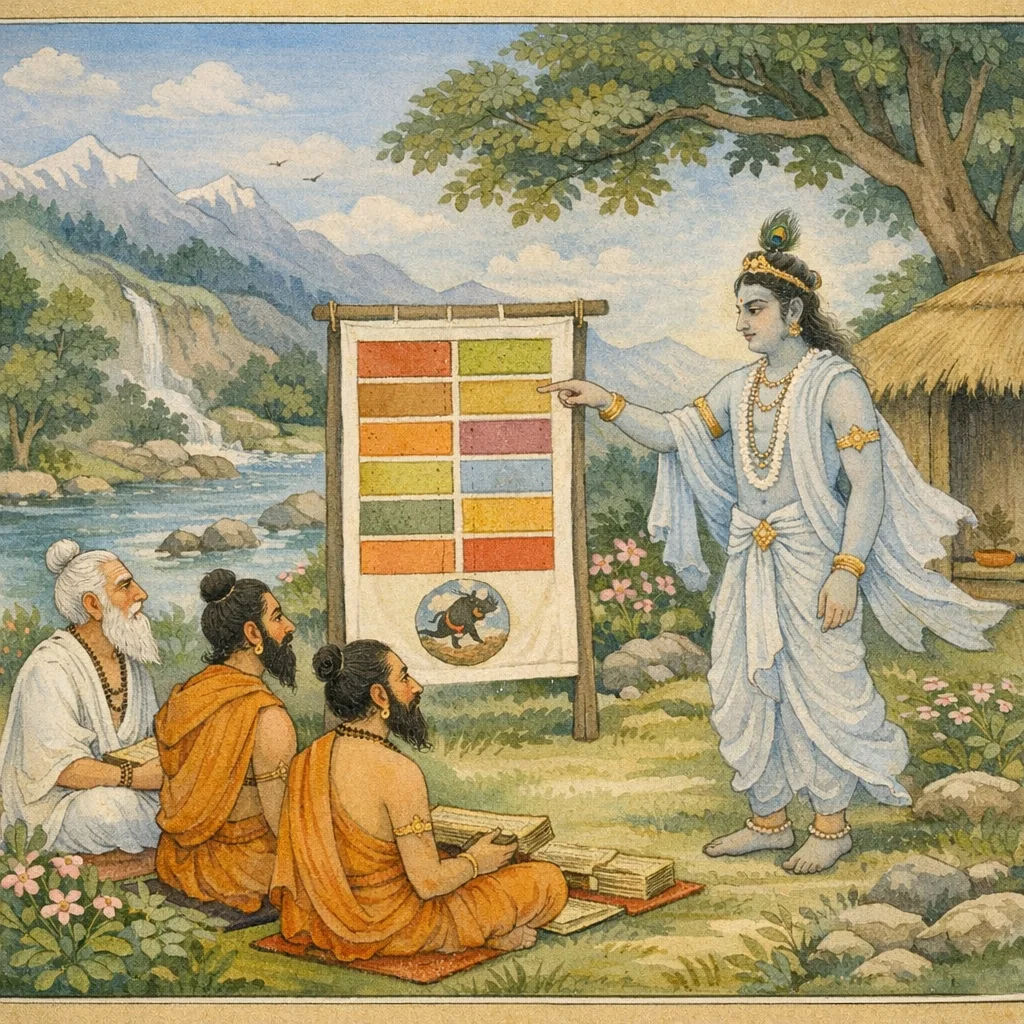
मन्वन्तर-कल्प-प्रश्नोत्तरम् / Discourse on Manvantaras, Kalpas, and Re-creation
Adhyāya 11 begins with the sages asking for a systematic account of all manvantaras and the kinds of kalpas, especially the inner creation (āntara-sarga) and the re-creation (pratisarga). Vāyu replies by placing the teaching within cosmic time: parārdha is recalled as a major unit in Brahmā’s lifespan, and re-creation occurs at the end of the relevant cycle. He states that each day of Brahmā has fourteen great divisions, corresponding to the revolutions of the Manus. Yet Vāyu cautions that kalpas and manvantaras are beginningless and endless and cannot be fully known, so they cannot be exhaustively enumerated in speech; even if all were told, the practical benefit to listeners would be limited. Therefore he adopts a pragmatic approach: he will describe the kalpa presently in operation, presenting creation and re-creation in abridged form. This current kalpa is identified as the Varāha Kalpa, containing fourteen Manus; the succession is summarized as seven beginning with Svāyambhuva and seven beginning with Sāvarṇika, with Vaivasvata as the seventh Manu now prevailing. The chapter thus suggests that patterns of creation and dissolution recur similarly across manvantaras, and then turns to imagery of the prior kalpa’s cessation and the rise of a new cycle under the forces of time and wind, preparing for the detailed cosmological narration that follows.
Shlokas
Verse 1
मुनय ऊचुः । मन्वंतराणि सर्वाणि कल्पभेदांश्च सर्वशः । तेष्वेवांतरसर्गं च प्रतिसर्गं च नो वद
The sages said: “Tell us fully about all the Manvantaras and every variety of Kalpa. And within those, explain to us the intermediate creation and the re-creation as well.”
Verse 2
वायुरुवाच । कालसंख्याविवृत्तस्य परार्धो ब्रह्मणस्स्मृतः । तावांश्चैवास्य कालोन्यस्तस्यांते प्रतिसृज्यते
Vāyu said: “In the reckoning of time, the ‘parārdha’ is known as Brahmā’s measure. And another span of time equal to that is also spoken of; at its end, creation is projected forth again.”
Verse 3
दिवसे दिवसे तस्य ब्रह्मणः पूर्वजन्मनः । चतुर्दशमहाभागा मनूनां परिवृत्तयः
Day after day, in that Brahmā’s former cycle of manifestation, the great successions of the Manus—fourteen in number—revolved in due order.
Verse 4
अनादित्वादनंतत्वादज्ञेयत्वाच्च कृत्स्नशः । मन्वंतराणि कल्पाश्च न शक्या वचनात्पृथक्
Because it is without beginning, without end, and wholly beyond complete knowing, the Manvantaras and the Kalpas cannot be distinctly enumerated or set apart by speech.
Verse 5
उक्तेष्वपि च सर्वेषु शृण्वतां वो वचो मम । किमिहास्ति फलं तस्मान्न पृथक्वक्तुमुत्सहे
Even after all this has been spoken, listen to my words, O you who are hearing: what distinct fruit is there here? Therefore I do not venture to state a separate result, for this teaching itself is the means to Shiva’s grace and liberation.
Verse 6
य एव खलु कल्पेषु कल्पः संप्रति वर्तते । तत्र संक्षिप्य वर्तंते सृष्टयः प्रतिसृष्टयः
Indeed, among the cycles of creation, the very Kalpa that is now in progress is the one under discussion. In this Kalpa, the processes of creation and re-creation proceed in a condensed, summarized manner.
Verse 7
यस्त्वयं वर्तते कल्पो वाराहो नाम नामतः । अस्मिन्नपि द्विजश्रेष्ठा मनवस्तु चतुर्दश
This very aeon (kalpa) that is now in progress is called—by name—the Vārāha Kalpa. And within it as well, O best of the twice-born, there are indeed fourteen Manus.
Verse 8
स्वायंभुवादयस्सप्त सप्त सावर्णिकादयः । तेषु वैवस्वतो नाम सप्तमो वर्तते मनुः
There are seven Manus beginning with Svāyambhuva, and (again) seven beginning with Sāvarṇi. Among them, the Manu known as Vaivasvata is the seventh who presently presides.
Verse 9
मन्वंतरेषु सर्वेषु सर्गसंहारवृत्तयः । प्रायः समाभवंतीति तर्कः कार्यो विजानता
In all the Manvantaras, the processes of creation and dissolution generally recur in a similar way—thus should the discerning knower employ sound reasoning to understand them.
Verse 10
पूर्वकल्पे परावृत्ते प्रवृत्ते कालमारुते । समुन्मूलितमूलेषु वृक्षेषु च वनेषु च
When the former aeon had turned away and the Time-wind began to blow forth, trees and forests were torn up—roots wrenched out and scattered.
Verse 11
जगंति तृणवक्त्रीणि देवे दहति पावके । वृष्ट्या भुवि निषिक्तायां विवेलेष्वर्णवेषु च
When the divine Fire blazes, creatures become as though their mouths were filled with dry grass—consumed and distressed; and when rain is poured down upon the earth, and when there are great openings and even in the oceans, (all beings are driven by the force of those conditions).
Verse 12
दिक्षु सर्वासु मग्नासु वारिपूरे महीयसि । तदद्भिश्चटुलाक्षेपैस्तरंगभुजमण्डलैः
When all the directions were submerged and the great Earth was filled everywhere with water, those waters, with their restless tossings and with circles of waves like encircling arms, surged and spread on all sides.
Verse 13
प्रारब्धचण्डनृत्येषु ततः प्रलयवारिषु । ब्रह्मा नारायणो भूत्वा सुष्वाप सलिले सुखम्
When the fierce cosmic dance had begun, and thereafter the waters of dissolution spread everywhere, Brahmā—becoming Nārāyaṇa—slept peacefully upon those waters.
Verse 14
इमं चोदाहरन्मंत्रं श्लोकं नारायणं प्रति । तं शृणुध्वं मुनिश्रेष्ठास्तदर्थं चाक्षराश्रयम्
Having thus uttered this mantra-verse addressed to Nārāyaṇa, listen to it, O best of sages—together with its meaning, grounded in the imperishable syllables of the mantra.
Verse 15
आपो नारा इति प्रोक्ता आपो वै नरसूनवः । अयनं तस्य ता यस्मात्तेन नारायणः स्मृतः
“The waters are called ‘nārā’; indeed, the waters are said to be the offspring of Nara. Because those waters are his ‘ayana’—his resting-place and abode—he is therefore remembered by the name Nārāyaṇa.”
Verse 16
शिवयोगमयीं निद्रां कुर्वन्तं त्रिदशेश्वरम् । बद्धांजलि पुटास्सिद्धा जनलोकनिवासिनः
The Siddhas who dwell in Jana-loka, with palms joined in reverent salutation, beheld the Lord of the gods abiding in a sleep made of Śiva-yoga—an inward yogic absorption rather than ordinary slumber.
Verse 17
स्तोत्रैः प्रबोधयामासुः प्रभातसमये सुराः । यथा सृष्ट्यादिसमये ईश्वरं श्रुतयः पुरा
At dawn the gods awakened the Lord with hymns—just as, in ancient times at the very beginning of creation, the Vedas (the Śrutis) roused Īśvara with their praises.
Verse 18
ततः प्रबुद्ध उत्थाय शयनात्तोयमध्यगात् । उदैक्षत दिशः सर्वा योगनिद्रालसेक्षणः
Then, having awakened, he rose from his resting place and moved into the midst of the waters. With eyes still languid from yogic sleep, he looked out toward all the directions.
Verse 19
नापश्यत्स तदा किंचित्स्वात्मनो व्यतिरेकि यत् । सविस्मय इवासीनः परां चिंतामुपागमत्
At that time he perceived nothing whatsoever that was separate from his own Self. Sitting as though struck with wonder, he then entered into a profound contemplation.
Verse 20
क्व सा भगवती या तु मनोज्ञा महती मही । नानाविधमहाशैलनदीनगरकानना
Where indeed is that blessed, enchanting, vast Earth—adorned with many kinds of great mountains, rivers, cities, and forests?
Verse 21
एवं संचिंतयन्ब्रह्मा बुबुधे नैव भूस्थितिम् । तदा सस्मार पितरं भगवंतं त्रिलोचनम्
Thus reflecting again and again, Brahmā could not comprehend the true state and ground of existence. Then he remembered his Father—the Blessed Lord, the Three‑eyed One (Śiva).
Verse 22
स्मरणाद्देवदेवस्य भवस्यामिततेजसः । ज्ञातवान्सलिले मग्नां धरणीं धरणीपतिः
By remembering Bhava—the God of gods, of immeasurable radiance—the Lord of the earth came to know that the Earth had sunk beneath the waters.
Verse 23
ततो भूमेस्समुद्धारं कर्तुकामः प्रजापतिः । जलक्रीडोचितं दिव्यं वाराहं रूपमस्मरत्
Then Prajāpati, wishing to raise up the Earth, called to mind the divine form of Varāha, the sacred Boar, perfectly suited for sport amid the waters.
Verse 24
महापर्वतवर्ष्माणं महाजलदनिःस्वनम् । नीलमेघप्रतीकाशं दीप्तशब्दं भयानकम्
His body was vast like a great mountain, roaring like a mighty thundercloud—dark as a blue rain-cloud, with a blazing, dreadful sound that inspired fear.
Verse 25
पीनवृत्तघनस्कंधपीनोन्नतकटीतटम् । ह्रस्ववृत्तोरुजंघाग्रं सुतीक्ष्णपुरमण्डलम्
His shoulders were full, rounded, and powerfully compact; his waist and hips were broad, firm, and well-raised. His thighs and shanks were short and well-rounded, and his forepart bore a keen, sharply defined, sphere-like contour—thus was that majestic form described.
Verse 26
पद्मरागमणिप्रख्यं वृत्तभीषणलोचनम् । वृत्तदीर्घमहागात्रं स्तब्धकर्णस्थलोज्ज्वलम्
He shone like a ruby gemstone; his eyes were round and awe-inspiring. His great body was rounded and long, and the region of his ears gleamed, held firm and erect.
Verse 27
उदीर्णोच्छ्वासनिश्वासघूर्णितप्रलयार्णवम् । विस्फुरत्सुसटाच्छन्नकपोलस्कंधबंधुरम्
With His mighty exhalations and inhalations, the ocean of cosmic dissolution was set swirling; and His beautifully formed cheeks and shoulders were covered by His quivering, splendid matted locks (jata).
Verse 28
मणिभिर्भूषणैश्चित्रैर्महारत्नैःपरिष्कृतम् । विराजमानं विद्युद्भिर्मेघसंघमिवोन्नतम्
Adorned with many gems and wondrous ornaments, exquisitely embellished with great jewels, it stood lofty—shining with flashes like lightning in a mass of clouds.
Verse 29
आस्थाय विपुलं रूपं वाराहममितं विधिः । पृथिव्युद्धरणार्थाय प्रविवेश रसातलम्
Assuming a vast and immeasurable boar-form as Varāha, the Creator (Brahmā) entered Rasātala to raise up the Earth.
Verse 30
स तदा शुशुभे ऽतीव सूकरो गिरिसंनिभः । लिंगाकृतेर्महेशस्य पादमूलं गतो यथा
Then that boar, mountain-like in form, shone exceedingly as he descended to the very foot-root of Mahādeva, who stood in the form of the Liṅga.
Verse 31
ततस्स सलिले मग्नां पृथिवीं पृथिवींधरः । उद्धृत्यालिंग्य दंष्ट्राभ्यामुन्ममज्ज रसातलात्
Then the Bearer of the Earth lifted up the Earth that had sunk in the waters, embraced her with His tusks, and rose up from Rasātala, the nether depths.
Verse 32
तं दृष्ट्वा मुनयस्सिद्धा जनलोकनिवासिनः । मुमुदुर्ननृतुर्मूर्ध्नि तस्य पुष्पैरवाकिरन्
Seeing him, the accomplished sages (Siddhas) dwelling in Jana-loka were filled with joy; they danced and, in reverent celebration, showered flowers upon his head.
Verse 33
वपुर्महावराहस्य शुशुभे पुष्पसंवृतम् । पतद्भिरिव खद्योतैः प्राशुरंजनपर्वतः
The Great Varāha’s body shone, covered with flowers—like Mount Prāśurañjana glittering with fireflies in flight.
Verse 34
ततः संस्थानमानीय वराहो महतीं महीम् । स्वमेव रूपमास्थाय स्थापयामास वै विभुः
Thereafter the mighty Varāha brought the great Earth back to her proper place; abiding in his own divine form, the all-pervading Lord firmly re-established her.
Verse 35
पृथिवीं च समीकृत्य पृथिव्यां स्थापयन्गिरीन् । भूराद्यांश्चतुरो लोकान् कल्पयामास पूर्ववत्
Then he levelled the earth and set the mountains upon it, and—just as before—fashioned the four worlds beginning with Bhūḥ.
Verse 36
इति सह महतीं महीं महीध्रैः प्रलयमहाजलधेरधःस्थमध्यात् । उपरि च विनिवेश्य विश्वकर्मा चरमचरं च जगत्ससर्ज भूयः
Thus, having lifted up the vast earth together with the mountains from the lower middle region of the great deluge-ocean, Viśvakarmā set it again above and once more fashioned the entire world—both the moving and the unmoving.
Frequently Asked Questions
The structure of kalpas and manvantaras, including āntara-sarga and pratisarga, with a focused identification of the currently operative Varāha Kalpa and the present Vaivasvata Manu.
It asserts the Purāṇic stance that cosmic cycles are effectively inexhaustible and not fully capturable by discourse; therefore knowledge is transmitted through a selective, present-kalpa-centered model that remains meaningful for practice and understanding.
Fourteen manvantara divisions within a day of Brahmā; the naming of the Varāha Kalpa; and the positioning of Vaivasvata as the seventh Manu in the current sequence.
Read Shiva Purana in the Vedapath app
Scan the QR code to open this directly in the app, with audio, word-by-word meanings, and more.