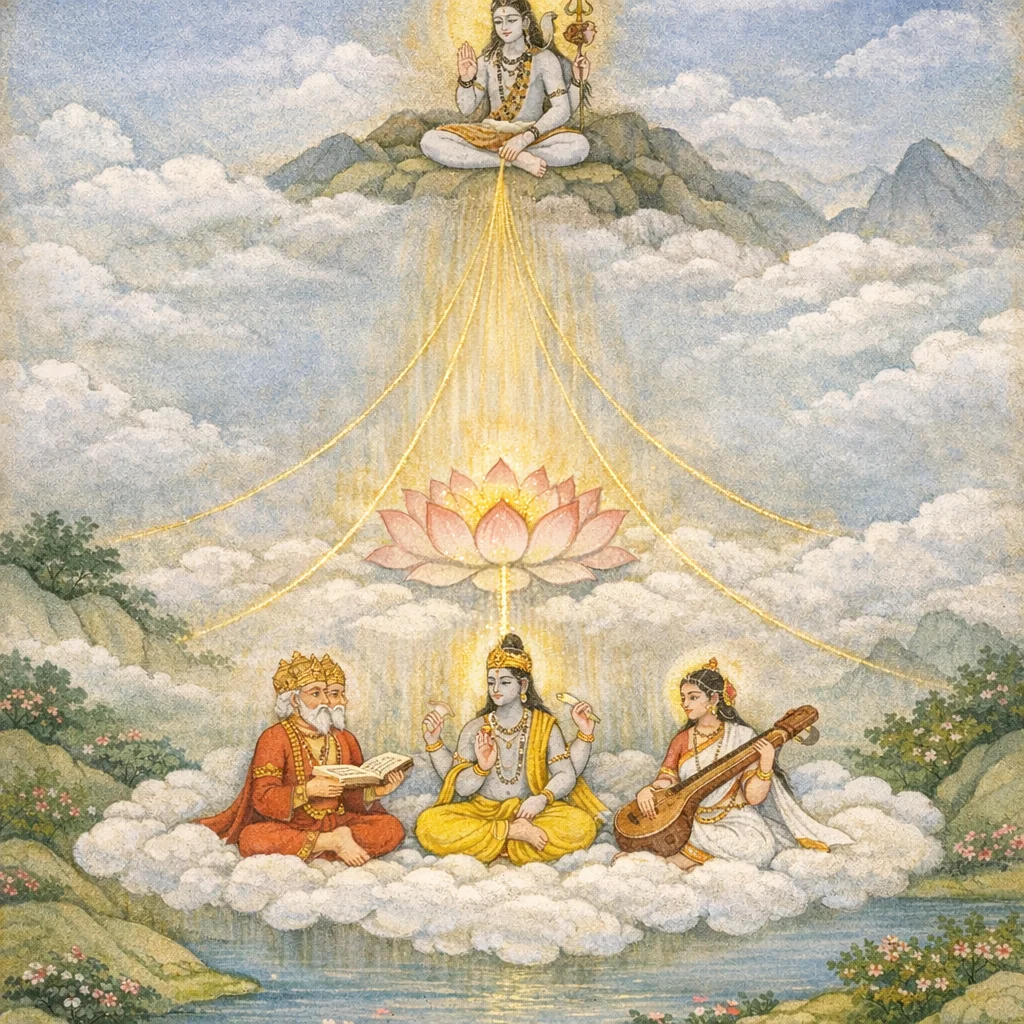
त्रिमूर्तिसाम्यं तथा महेश्वरस्य परमार्थकारणत्वम् | Equality of the Trimūrti and Maheśvara as the Supreme Cause
Spoken by Vāyu, this chapter presents a Shaiva cosmogony and theology. From the prior unmanifest (avyakta), by the Lord’s command, successive evolutes such as buddhi arise; from these transformations appear Rudra, Viṣṇu, and Pitāmaha (Brahmā) as causal administrators. The text praises the divine principle’s vast powers—world-pervasion, unobstructed potency, incomparable knowledge, and siddhis—and explicitly establishes Maheśvara as the sovereign supreme cause active in creation, maintenance, and dissolution. In a later cycle he assigns distinct governance—sarga (creation), rakṣā (protection), and laya (reabsorption)—to the three, while affirming that they mutually originate, sustain one another, and grow through reciprocal alignment. Sectarian hierarchies are rejected: praising one deity does not diminish the lordship of the others, and those who denigrate these deities become asuric/inauspicious beings. Finally, Maheśvara is described as beyond the three guṇas, manifest as a fourfold form (caturvyūha), the ground of all supports, and the playful (līlā) author of the cosmos, abiding as the inner Self of prakṛti, puruṣa, and the Trimūrti itself.
Shlokas
Verse 1
वायुरुवाच । पुरुषाधिष्ठितात्पूर्वमव्यक्तादीश्वराज्ञया । बुद्ध्यादयो विशेषांता विकाराश्चाभवन् क्रमात्
Vāyu said: By the command of the Supreme Lord, prior to the presiding entry of Puruṣa, from the Unmanifest (Avyakta) the evolutes arose in due order—beginning with intellect (buddhi) and continuing up to the specific gross elements; thus the transformations unfolded sequentially.
Verse 2
ततस्तेभ्यो विकारेभ्यो रुद्रो विष्णुः पितामहः । कारणत्वेन सर्वेषां त्रयो देवाः प्रजज्ञिरे
Then, from those evolutes, Rudra, Viṣṇu, and Pitāmaha (Brahmā) came into manifestation. As the causal principles for all beings and worlds, these three deities were born forth.
Verse 3
सर्वतो भुवनव्याप्तिशक्तिमव्याहतां क्वचित् । ज्ञानमप्रतिमं शश्वदैश्वर्यं चाणिमादिकम्
He possesses the unobstructed power to pervade all worlds on every side; He has incomparable knowledge; and He eternally holds divine lordship, together with the yogic perfections beginning with aṇimā.
Verse 4
सृष्टिस्थितिलयाख्येषु कर्मसु त्रिषु हेतुताम् । प्रभुत्वेन सहैतेषां प्रसीदति महेश्वरः
In the three acts known as creation, preservation, and dissolution, Mahādeva becomes the inner cause; and with sovereign lordship over these powers, Maheśvara graciously presides, granting order and fulfillment to the cosmic process.
Verse 5
कल्पान्तरे पुनस्तेषामस्पर्धा बुद्धिमोहिनाम् । सर्गरक्षालयाचारं प्रत्येकं प्रददौ च सः
Then, at the close of an aeon, to those beings whose minds were deluded and prone to rivalry, he again allotted to each individually their proper functions—creation, protection, dissolution, and the prescribed modes of conduct—so that cosmic order might be maintained.
Verse 6
एते परस्परोत्पन्ना धारयन्ति परस्परम् । परस्परेण वर्धंते परस्परमनुव्रताः
These arise in mutual dependence and sustain one another. By one another they increase, faithfully following one another’s course—bound together in interrelationship.
Verse 7
क्वचिद्ब्रह्मा क्वचिद्विष्णुः क्वचिद्रुद्रः प्रशस्यते । नानेन तेषामाधिक्यमैश्वर्यं चातिरिच्यते
In some places Brahmā is praised, in some places Viṣṇu, and in some places Rudra. Yet by this, no superiority or greater lordship is truly established for any of them.
Verse 8
मूर्खा निंदंति तान्वाग्भिः संरंभाभिनिवेशिनः । यातुधाना भवंत्येव पिशाचाश्च न संशयः
Foolish people, driven by rage and stubborn fixation, revile such devotees with harsh words; indeed they become like yātudhānas and piśācas—there is no doubt.
Verse 9
देवो गुणत्रयातीतश्चतुर्व्यूहो महेश्वरः । सकलस्सकलाधारशक्तेरुत्पत्तिकारणम्
Mahādeva, the Supreme Lord, transcends the three guṇas. As Maheśvara, He manifests in the fourfold divine emanations, yet remains the complete and perfect One—supporting all manifested principles and being the very cause from which Śakti arises and unfolds creation.
Verse 10
सोयमात्मा त्रयस्यास्य प्रकृतेः पुरुषस्य च । लीलाकृतजगत्सृष्टिरीश्वरत्वे व्यवस्थितः
He—this very Supreme Self—stands established as the Lord (Īśvara) of this triad, of Prakṛti and of Puruṣa as well; and the creation of the universe is brought forth by Him as a divine play (līlā).
Verse 11
यस्सर्वस्मात्परो नित्यो निष्कलः परमेश्वरः । स एव च तदाधारस्तदात्मा तदधिष्ठितः
He who is higher than all, eternal, partless, and the Supreme Lord—He alone is also its support, its very Self, and that in which it stands established.
Verse 12
तस्मान्महेश्वरश्चैव प्रकृतिः पुरुषस्तथा । सदाशिवभवो विष्णुर्ब्रह्मा सर्वशिवात्मकम्
Therefore Maheśvara is indeed both Prakṛti, the primordial matrix, and Puruṣa, the conscious principle. From Sadāśiva arise Viṣṇu and Brahmā—indeed, all this is of the very nature of Śiva.
Verse 13
प्रधानात्प्रथमं जज्ञे वृद्धिः ख्यातिर्मतिर्महान् । महत्तत्त्वस्य संक्षोभादहंकारस्त्रिधा ऽभवत्
From Pradhāna, first arose the Great Principle (Mahat), also called Vṛddhi, Khyāti, and Mati. From the agitation of that Mahat-tattva, Ahaṃkāra—the ego-principle—came into being in threefold form.
Verse 14
अहंकारश्च भूतानि तन्मात्रानींद्रियाणि च । वैकारिकादहंकारात्सत्त्वोद्रिक्तात्तु सात्त्विकः
From Ahaṃkāra arise the elements, the tanmātras (subtle essences), and the sense-faculties. And from the vaikarika form of ahaṃkāra—where sattva predominates—arises what is called the sāttvika principle, the luminous and ordering mode of manifestation.
Verse 15
वैकारिकः स सर्गस्तु युगपत्संप्रवर्तते । बुद्धीन्द्रियाणि पञ्चैव पञ्चकर्मेंद्रियाणि च
From that sāttvika (vaikārika) principle, the emanative process begins all at once: the five organs of knowledge and the five organs of action arise together.
Verse 16
एकादशं मनस्तत्र स्वगुणेनोभयात्मकम् । तमोयुक्तादहंकाराद्भूततन्मात्रसंभवः
There, as the eleventh principle, Mind (manas) arises—by its own nature sharing in both: the power of knowing and the power of acting. From egoity (ahaṅkāra) conjoined with tamas, the subtle essences (tanmātras) and the gross elements (bhūtas) come into manifestation.
Verse 17
भूतानामादिभूतत्वाद्भूतादिः कथ्यते तु सः । भूतादेश्शब्दमात्रं स्यात्तत्र चाकाशसंभवः
Because it is the primal element among all beings, it is indeed called “Bhūtādi” (the origin of the elements). The term “Bhūtādi” is, in essence, only a designation; and from that subtle principle arises ākāśa (ether/space).
Verse 18
आकाशात्स्पर्श उत्पन्नः स्पर्शाद्वायुसमुद्भवः । वायो रूपं ततस्तेजस्तेजसो रससंभवः
From ākāśa (ether) the subtle principle of touch arises; from touch is born vāyu (air). From air comes the principle of form, and from that arises tejas (fire); from fire, the principle of taste is produced.
Verse 19
रसादापस्समुत्पन्नास्तेभ्यो गन्धसमुद्भवः । गन्धाच्च पृथिवी जाता भूतेभ्योन्यच्चराचरम्
From taste (rasa) the waters (āpas) arose; from those waters, fragrance came forth. From fragrance the earth (pṛthivī) was produced; and from the elements, all other moving and unmoving beings came into manifestation.
Verse 20
पुरुषाधिष्ठितत्वाच्च अव्यक्तानुग्रहेण च । महदादिविशेषान्ता ह्यण्डमुत्पादयन्ति ते
Because they are presided over by Puruṣa (the Supreme Lord) and because the Unmanifest (Avyakta) grants its enabling support, those principles—from Mahat onward up to the particularized elements—bring forth the cosmic egg (aṇḍa).
Verse 21
तत्र कार्यं च करणं संसिद्धं ब्रह्मणो यदा । तदंडे सुप्रवृद्धो ऽभूत्क्षेत्रज्ञो ब्रह्मसंज्ञितः
When, within that cosmic order, Brahmā’s effect (the world to be manifested) and the means (the instruments of creation) became fully accomplished, then within that cosmic egg there arose—fully developed—the Knower of the Field (Kṣetrajña), who was known by the name “Brahmā.”
Verse 22
स वै शरीरी प्रथमः स वै पुरुष उच्यते । आदिकर्ता स भूतानां ब्रह्माग्रे समवर्तत
He indeed is the first embodied One; therefore He is called the Puruṣa. He is the primordial maker of all beings, existing even before Brahmā and standing at the very forefront of creation.
Verse 23
तस्येश्वरस्य प्रतिमा ज्ञानवैराग्यलक्षणा । धर्मैश्वर्यकरी बुद्धिर्ब्राह्मी यज्ञे ऽभिमानिनः
The manifest emblem (pratimā) of that Lord is characterized by true knowledge and dispassion (vairāgya). The Brahmī power of intellect—presiding over the yajña (sacrifice)—bestows dharma and aiśvarya, divine prosperity.
Verse 24
अव्यक्ताज्जायते तस्य मनसा यद्यदीप्सितम् । वशी विकृत्वात्त्रैगुण्यात्सापेक्षत्वात्स्वभावतः
From the Unmanifest (avyakta) there arises, for that embodied being, whatever the mind desires. Yet the individual self is not truly sovereign: by its very nature it is changeable, constituted of the three guṇas, and dependent on conditions, and therefore comes under control.
Verse 25
त्रिधा विभज्य चात्मानं त्रैलोक्ये संप्रवर्तते । सृजते ग्रसते चैव वीक्षते च त्रिभिस्स्वयम्
Dividing His own being threefold, He becomes operative throughout the three worlds; by these three powers He Himself creates, withdraws (devours), and also oversees and governs all.
Verse 26
चतुर्मुखस्तु ब्रह्मत्वे कालत्वे चांतकस्स्मृतः । सहस्रमूर्धा पुरुषस्तिस्रोवस्थास्स्वयंभुवः
In the state of Brahmā-hood He is remembered as the Four-faced One; and in the state of Time He is known as Antaka, the Ender. As the Cosmic Person He is the Thousand-headed Puruṣa; and as the Self-born He abides of Himself in the three states.
Verse 27
सत्त्वं रजश्च ब्रह्मा च कालत्वे च तमो रजः । विष्णुत्वे केवलं सत्त्वं गुणवृद्धिस्त्रिधा विभौ
In the state of Brahmāhood there are sattva and rajas; and in the state of Time (Kāla) there are tamas and rajas. But in the state of Viṣṇuhood there is only sattva. Thus, in the all-pervading Lord, the manifest predominance of the guṇas is threefold.
Verse 28
ब्रह्मत्वे सृजते लोकान् कालत्वे संक्षिपत्यपि । पुरुषत्वे ऽत्युदासीनः कर्म च त्रिविधं विभोः
When He assumes the state of Brahmāhood, He brings forth the worlds; when He assumes the state of Time (Kāla), He withdraws them as well. And when He abides as the Supreme Puruṣa, He remains utterly unattached. Thus, the Lord’s activity is threefold.
Verse 29
एवं त्रिधा विभिन्नत्वाद्ब्रह्मा त्रिगुण उच्यते । चतुर्धा प्रविभक्तत्वाच्चातुर्व्यूहः प्रकीर्तितः
Thus, because Brahmā is differentiated in a threefold manner, he is said to be constituted of the three guṇas; and because he is divided in a fourfold way, he is renowned as the ‘fourfold emanation’ (cāturvyūha).
Verse 30
आदित्वादादिदेवो ऽसावजातत्वादजः स्मृतः । पाति यस्मात्प्रजाः सर्वाः प्रजापतिरिति स्मृतः
Because He is the First, He is remembered as the Primal Deity; because He is unborn, He is remembered as “Aja” (the Unborn). And because He protects all creatures, He is remembered as “Prajāpati” (Lord of beings).
Verse 31
हिरण्मयस्तु यो मेरुस्तस्योल्बं सुमहात्मनः । गर्भोदकं समुद्राश्च जरायुश्चाऽपि पर्वताः
That golden Mount Meru is the “afterbirth,” the outer mass, of that supremely great Cosmic Being; the Garbhodaka waters became the oceans, and the mountains too became as it were the “membranes” (jarāyu) surrounding it.
Verse 32
तस्मिन्नंडे त्विमे लोका अंतर्विश्वमिदं जगत् । चंद्रादित्यौ सनक्षत्रौ सग्रहौ सह वायुना
Within that cosmic Egg are contained these worlds—indeed this entire inner universe: the Moon and the Sun, along with the constellations and the planets, and also the all-moving Wind (Vāyu).
Verse 33
अद्भिर्दशगुणाभिस्तु बाह्यतोण्डं समावृतम् । आपो दशगुणेनैव तेजसा बहिरावृताः
The outer shell is enclosed by waters, tenfold in measure; and those waters, in turn, are enclosed on the outside by fire, likewise tenfold.
Verse 34
तेजो दशगुणेनैव वायुना बहिरावृतम् । आकाशेनावृतो वायुः खं च भूतादिनावृतम्
Fire is externally enveloped by air, which is tenfold (greater). Air is enveloped by ether (space), and ether too is enveloped by the principle beginning with the elements (bhūtādi).
Verse 35
भूतादिर्महता तद्वदव्यक्तेनावृतो महान् । एतैरावरणैरण्डं सप्तभिर्बहिरावृतम्
The gross elements are enclosed by Mahat (cosmic intelligence), and Mahat in turn is veiled by the Unmanifest (Avyakta). Thus the cosmic egg (brahmāṇḍa) is outwardly encompassed by these seven coverings.
Verse 36
एतदावृत्त्य चान्योन्यमष्टौ प्रकृतयः स्थिताः । सृष्टिपालनविध्वंसकर्मकर्त्र्यो द्विजोत्तमाः
Thus, mutually enveloping one another, the eight primordial natures (prakṛti) remain established—O best of the twice-born—serving as the operative agencies whose functions are creation, preservation, and dissolution.
Verse 37
एवं परस्परोत्पन्ना धारयंति परस्परम् । आधाराधेयभावेन विकारास्तु विकारिषु
Thus, arising in mutual dependence, they sustain one another. Through the relation of support and supported (ādhāra–ādheya, the substratum and what rests upon it), the various modifications abide within their respective modifying causes.
Verse 38
कूर्मोंगानि यथा पूर्वं प्रसार्य विनियच्छति । विकारांश्च तथा ऽव्यक्तं सृष्ट्वा भूयो नियच्छति
Just as a tortoise first extends its limbs and then withdraws them again, so too the Unmanifest (Avyakta) projects the evolutes (vikāras) in creation and then, once more, reabsorbs them back into itself.
Verse 39
अव्यक्तप्रभवं सर्वमानुलोम्येन जायते । प्राप्ते प्रलयकाले तु प्रतिलोम्येनुलीयते
All this universe arises in due order from the Unmanifest (Avyakta); but when the time of dissolution arrives, it is reabsorbed in reverse order back into that Unmanifest.
Verse 40
गुणाः कालवशादेव भवंति विषमाः समाः । गुणसाम्ये लयो ज्ञेयो वैषम्ये सृष्टिरुच्यते
Under the governance of Time (kāla), the guṇas become either balanced or imbalanced. When the guṇas are in equilibrium, dissolution (laya) is to be understood; when they are in disequilibrium, creation (sṛṣṭi) is declared to arise.
Verse 41
तदिदं ब्रह्मणो योनिरेतदंडं घनं महत् । ब्रह्मणः क्षेत्रमुद्दिष्टं ब्रह्मा क्षेत्रज्ञ उच्यते
This very great and compact cosmic Egg is the womb (source) of Brahmā. It is declared to be Brahmā’s field (kṣetra), while Brahmā is called the knower of the field (kṣetrajña).
Verse 42
इतीदृशानामण्डानां कोट्यो ज्ञेयाः सहस्रशः । सर्वगत्वात्प्रधानस्य तिर्यगूर्ध्वमधः स्थिताः
Know that there are thousands upon thousands of crores of such cosmic eggs (universes). Because Pradhāna, primordial Nature, is all-pervading, these universes are situated everywhere—horizontally, above, and below.
Verse 43
तत्र तत्र चतुर्वक्त्रा ब्रह्माणो हरयो भवाः । सृष्टा प्रधानेन तथा लब्ध्वा शंभोस्तु सन्निधिम्
Here and there, four-faced Brahmās, Vishṇus, and Rudras (Bhavas) were manifested by Pradhāna. Having thus come forth, they attained the holy proximity of Śambhu, Lord Śiva.
Verse 44
महेश्वरः परोव्यक्तादंडमव्यक्तसंभवम् । अण्डाज्जज्ञे विभुर्ब्रह्मा लोकास्तेन कृतास्त्विमे
Maheshvara, higher than the Unmanifest (Avyakta), brought forth the cosmic Egg arising from the Unmanifest. From that Egg was born Brahmā, the all-pervading, and by him these worlds were fashioned.
Verse 45
अबुद्धिपूर्वः कथितो मयैष प्रधानसर्गः प्रथमः प्रवृतः । आत्यंतिकश्च प्रलयोन्तकाले लीलाकृतः केवलमीश्वरस्य
Thus have I explained this primal emanation—the first unfolding from Pradhāna—which proceeds without deliberate calculation. And the absolute dissolution at the end of the cosmic cycle is, in truth, only the līlā, the sacred sport, of Īśvara alone.
Verse 46
यत्तत्स्मृतं कारणमप्रमेयं ब्रह्मा प्रधानं प्रकृतेः प्रसूतिः । अनादिमध्यान्तमनन्तवीर्यं शुक्लं सुरक्तं पुरुषेण युक्तम्
That which is remembered as the immeasurable causal principle—called Brahman, the Pradhāna, the primordial matrix from which Prakṛti arises—has neither beginning, middle, nor end, and bears infinite potency. It is spoken of as pure (white) and also as intensely dynamic (red), and is united with Puruṣa, the conscious principle.
Verse 47
उत्पादकत्वाद्रजसोतिरेकाल्लोकस्य संतानविवृद्धिहेतून् । अष्टौ विकारानपि चादिकाले सृष्ट्वा समश्नाति तथांतकाले
Because rajas predominates and bears the power of generation, it becomes the cause of the world’s continuity and the increase of progeny. In the beginning it creates even the eight transformations (vikāras), and at the end of time it likewise consumes and reabsorbs them.
Verse 48
प्रकृत्यवस्थापितकारणानां या च स्थितिर्या च पुनः प्रवृत्तिः । तत्सर्वमप्राकृतवैभवस्य संकल्पमात्रेण महेश्वरस्य
The continuance and the renewed activation of all causes established within Prakṛti—this entire process occurs solely by the mere saṅkalpa, the will of Maheśvara, whose sovereign power transcends the material realm (aprakṛta).
Frequently Asked Questions
A doctrinal cosmogonic account: from avyakta and subsequent evolutes (e.g., buddhi), the three deities—Rudra, Viṣṇu, and Brahmā—arise as causal administrators, and Maheśvara assigns them the distinct cosmic functions of creation, protection, and dissolution across cycles.
The chapter aligns Sāṃkhya-like categories (avyakta, buddhi, vikāra, guṇas) with a Shaiva theism in which Maheśvara is both beyond the guṇas and the inner self of prakṛti–puruṣa, making cosmology a revelation of non-competitive, unitary divine causality.
Maheśvara is presented as guṇatrayātīta, as caturvyūha, as the source of universal pervasion and unobstructed śakti, and as the līlā-kartṛ (playful author) behind the world-process, while the Trimūrti are highlighted as mutually sustaining functional manifestations.
Read Shiva Purana in the Vedapath app
Scan the QR code to open this directly in the app, with audio, word-by-word meanings, and more.