Sarga 70
कबन्धवधः — The Severing of Kabandha’s Arms and the Opening of Dialogue
अरण्यकाण्ड
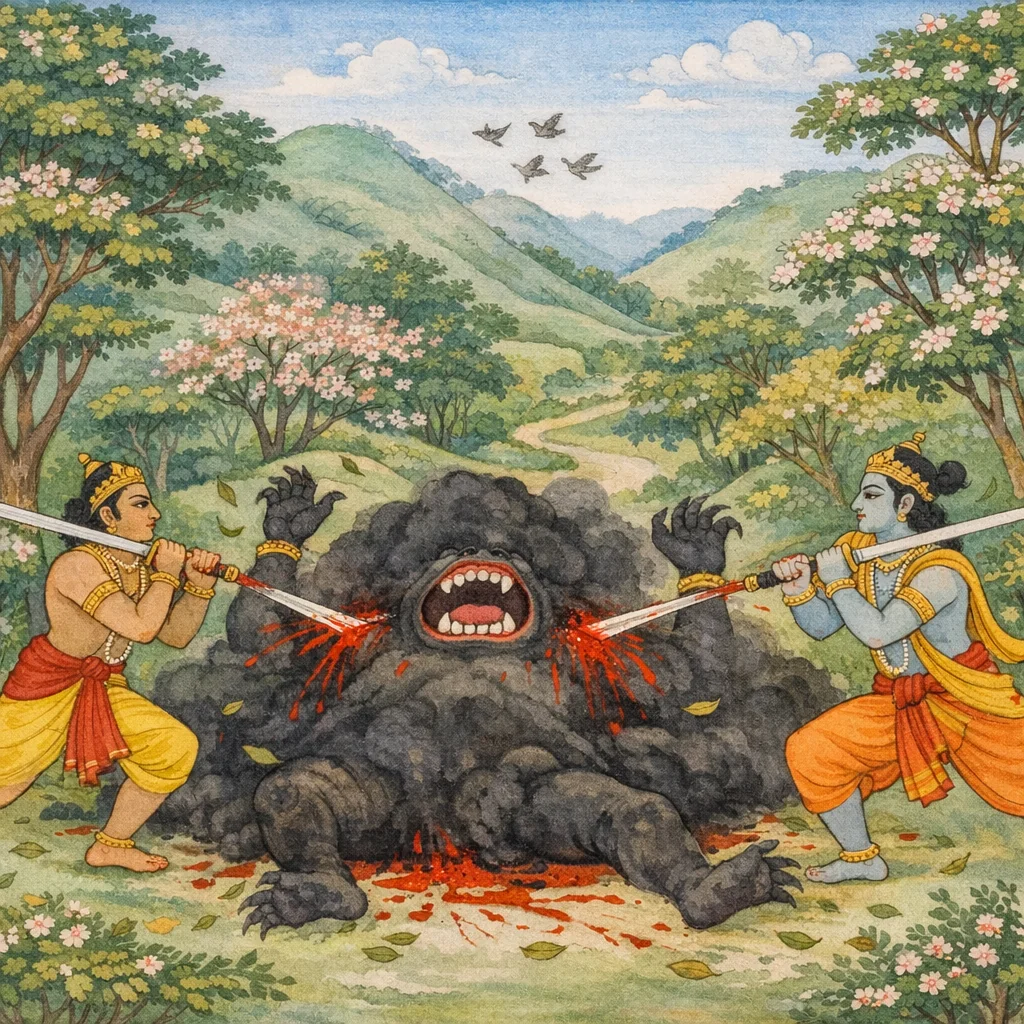
In Sarga 70, Kabandha seizes Rama and Lakshmana with arms like shackles and, driven by ravenous hunger, declares that destiny has delivered them to him as food. Lakshmana answers with timely counsel—act decisively before they are devoured—and adds an ethical note on blameworthy killing, contrasting helpless victims with sacrificial animals to show the impropriety of slaughter without just contest. Enraged, the demon opens his mouth to swallow them; but the brothers, skilled in judging place and time, draw their swords and sever both arms at the shoulders—Rama striking the right, Lakshmana the left. Kabandha crashes down like a storm-cloud and, blood-soaked and pitiable, asks who they are. Lakshmana identifies Rama as the famed heir of Ikshvaku and himself as the younger brother, explaining their forest search for Sita abducted by a demon, and then questions Kabandha’s monstrous form. Remembering Indra’s words, Kabandha welcomes them, rejoices that his binding arms have been cut away, and prepares to tell how his deformity arose as the consequence of pride.
Shlokas
Verse 1
तौ तु तत्र स्थितौ दृष्ट्वा भ्रातरौ रामलक्ष्मणौ।बाहुपाशपरिक्षिप्तौ कबन्धो वाक्यमब्रवीत्।।।।
Seeing the two brothers, Rāma and Lakṣmaṇa, standing there caught in the noose of his arms, Kabandha spoke these words.
Verse 2
तिष्ठतः किं नु मां दृष्ट्वा क्षुधार्तं क्षत्रियर्षभौ।आहारार्थं तु सन्दिष्टौ दैवेन गतचेतसौ।।।।
O bulls among kṣatriyas—seeing me tormented by hunger, why do you stand still as if senseless? Destiny itself has sent you here as my food.
Verse 3
तच्छ्रुत्वा लक्ष्मणो वाक्यं प्राप्तकालं हितं तदा।उवाचाऽर्तिं समापन्नो विक्रमे कृतलक्षणः।।।।
Hearing those words, Lakṣmaṇa—though distressed—summoned his valor, and at that fitting moment spoke what was timely and beneficial.
Verse 4
त्वां च मां च पुरा तूर्णमादत्ते राक्षसाधमः।तस्मादसिभ्यामस्याशु बाहू छिन्दावहै गुरू।।।।
Before that vile rākṣasa swiftly seizes and devours you and me, let us at once cut off his long arms with our swords.
Verse 5
भीषणोऽयं महाकायो राक्षसो भुजविक्रमः।लोकं ह्यतिजितं कृत्वा ह्यावां हन्तुमिहेच्छति।।।।
This rākṣasa is dreadful and vast of body, mighty in the strength of his arms. Having overpowered the world, he now seeks to slay us here.
Verse 6
निश्चेष्टानां वधो राजन्कुत्सितो जगतीपतेः।क्रतुमध्योपनीतानां पशूनामिव राघव।।।।
O king, O Rāghava—slaying the helpless is disgraceful for a lord of the world, like killing sacrificial beasts brought into the midst of a rite.
Verse 7
एतत्सञ्जल्पितं श्रुत्वा तयोः क्रुद्धस्तु राक्षसः।विदार्याऽस्यं तदा रौद्रस्तौ भक्षयितुमारभत्।।।।
Hearing their exchange, the rākṣasa grew enraged; ferocious, he gaped his mouth wide and set about devouring them both.
Verse 8
ततस्तौ देशकालज्ञौ खड्गाभ्यामेव राघवौ।अच्छिन्दतां सुसंविग्नौ बाहू तस्यांसदेशतः।।।।
Then the two Rāghavas—keenly aware of place and moment—agitated yet resolute, cut off his arms with their swords at the shoulders.
Verse 9
दक्षिणो दक्षिणं बाहुमसक्तमसिना ततः।चिच्छेद रामो वेगेन सव्यं वीरस्तु लक्ष्मणः।।।।
Then Rāma, positioned on the right, swiftly cut off the rākṣasa’s right arm with his sword; the heroic Lakṣmaṇa severed the left.
Verse 10
स पपात महाबाहुश्छिन्नबाहुर्महास्वनः।खं च गां च दिशश्चैव नादयञ्जलदो यथा।।।।
Then he fell—mighty-armed, yet with his arms severed—roaring aloud, making the sky, the earth, and all the quarters resound like a thunderous raincloud.
Verse 11
स निकृत्तौ भुजौ दृष्ट्वा शोणितौघपरिप्लुतः।दीनः पप्रच्छ तौ वीरौ कौ युवामिति दानवः।।।।
Seeing his arms cut off and drenched in a flood of blood, the demon, now pitiable, asked the two heroes, “Who are you both?”
Verse 12
इति तस्य ब्रुवाणस्य लक्ष्मणश्शुभलक्षणः।शशंस राघवं तस्य कबन्धस्य महात्मनः।।।।
As he spoke thus, Lakṣmaṇa, marked by auspicious qualities, disclosed to that great-souled Kabandha the identity of Rāghava (Rāma).
Verse 13
अयमिक्ष्वाकुदायादो रामो नाम जनैश्श्रुतः।अस्यैवावरजं विद्दि भ्रातरं मां च लक्ष्मणम्।।।।
This is Rāma, heir of the Ikṣvāku line, famed among the people. And know me as his younger brother—Lakṣmaṇa.
Verse 14
अस्य देवप्रभावस्य वसतो विजने वने।रक्षसाऽपहृता पत्नी यामिच्छन्ताविहागतौ।।।।
While he—whose prowess is like that of a deva—was dwelling in this lonely forest, a rākṣasa carried off his wife. We have come here seeking her.
Verse 15
त्वं तु को वा किमर्थं वा कबन्धसदृशो वने।आस्येनोरसि दीप्तेन भग्नजङ्घो विचेष्टसे।।।।
But who are you, and for what reason do you roam the forest in this trunk-like form—your shining mouth set upon your chest, your legs broken as you drag yourself along?
Verse 16
एवमुक्तः कबन्धस्तु लक्ष्मणेनोत्तरं वचः।उवाच परमप्रीत स्तदिन्द्रवचनं स्मरन्।।।।
Thus addressed by Lakṣmaṇa, Kabandha—remembering Indra’s words—replied with great delight.
Verse 17
स्वागतं वां नरव्याघ्रौ दिष्ट्या पश्यामि चाप्यहम्।दिष्ट्या चेमौ निकृत्तौ मे युवाभ्यां बाहुबन्धनौ।।।।
Welcome to you both, O tigers among men. By good fortune I behold you—and by that same fortune, these arm-bonds of mine, by which I had bound you, have been cut away by you two.
Verse 18
विरूपं यच्च मे रूपं प्राप्तं ह्यविनयाद्यथा।तन्मे शृणु नरव्याघ्र तत्त्वतश्शंसतस्तव।।।।
O tiger among men, listen from me as I tell you truthfully how this hideous form came upon me—brought about by my own arrogance.
Frequently Asked Questions
The pivotal action is justified self-defense under imminent predation: bound by Kabandha’s arms, Rama and Lakshmana act decisively to amputate the threat, while Lakshmana’s speech frames violence as accountable and context-sensitive rather than arbitrary.
The dialogue links bodily deformity and downfall to avinaya (haughtiness), preparing an etiological lesson: ethical failure has consequences, and liberation can begin when destructive power is curtailed and truthful narration (tattvataḥ) is sought.
The setting is the vijana vana (desolate forest) as a cultural-literary space of testing; the passage also invokes sacrificial imagery (kratu context) to articulate norms around permissible harm, and references Indra as a mythic authority shaping Kabandha’s remembrance.