Sarga 5
शरभङ्गाश्रमगमनम् तथा इन्द्रदर्शनम् (Approach to Sarabhanga’s Hermitage and the Vision of Indra)
अरण्यकाण्ड
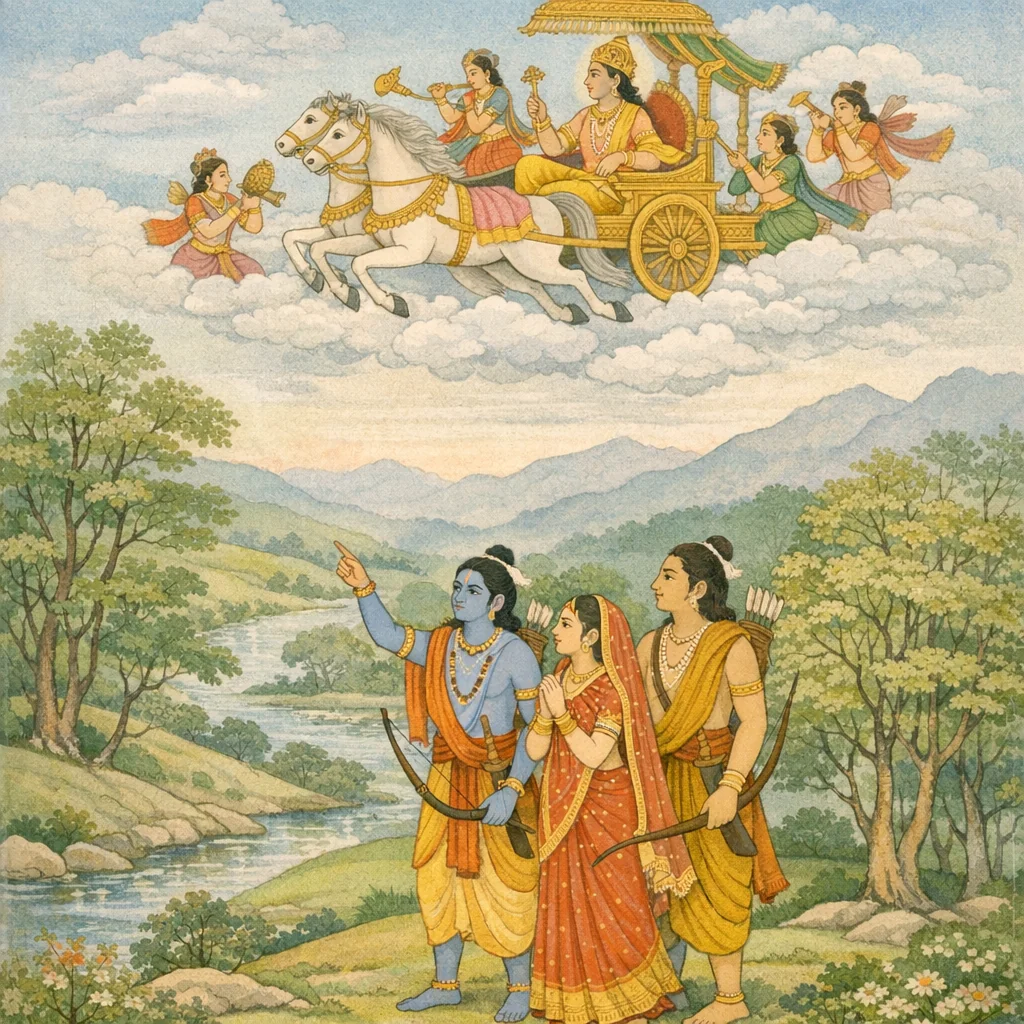
After slaying Virādha, Rāma reassures Sītā and speaks to Lakṣmaṇa of the hardship of the unfamiliar forest and the need to reach the ascetic Śarabhanga without delay. Near the hermitage, Rāma beholds an adbhuta in the sky: Indra’s radiant chariot with tawny horses, a spotless umbrella, costly yak-tail fans, and celestial attendants praised by gandharvas, devas, siddhas, and great ṛṣis. He tells Lakṣmaṇa to remain with Sītā while he discerns the dazzling being, and then proceeds toward the āśrama. Foreseeing Rāma’s greater destiny, Indra privately asks Śarabhanga to remove him from Rāma’s sight, saying that Rāma must first accomplish an exceptionally difficult task before their meeting is fitting. Indra departs for svarga. Rāma, with Sītā and Lakṣmaṇa, approaches Śarabhanga with reverence, inquires about Indra’s visit, and learns that Indra had offered to take the sage to Brahmaloka. Śarabhanga delays his ascent to honor Rāma as a beloved guest, offers him the merit of conquered worlds, and directs him instead to the righteous ascetic Sūtīkṣṇa by way of the Mandākinī. At last Śarabhanga performs a sacrificial act, enters the fire, emerges youthful, transcends the worlds of gods and sages, and ascends to Brahmaloka where Brahmā welcomes him—closing the sarga by linking tapas, cosmic hierarchy, and Rāma’s unfolding mission.
Shlokas
Verse 1
हत्वा तु तं भीमबलं विराधं राक्षसं वने।ततस्सीतां परिष्वज्य समाश्वास्य च वीर्यवान्।।3.5.1।।अब्रवील्लक्ष्मणं रामो भ्रातरं दीप्ततेजसम्।
Having slain Virādha, the fearsome, mighty rākṣasa in the forest, the valiant Rāma embraced Sītā and soothed her; then he spoke to his brother Lakṣmaṇa, radiant in splendor.
Verse 2
कष्टं वनमिदं दुर्गं न च स्म वनगोचराः।।3.5.2।।अभिगच्छामहे शीघ्रं शरभङ्गं तपोधनम्।
This forest is harsh and hard to traverse, and we are not accustomed to moving through such wild woodland. Let us quickly go to Śarabhaṅga, the sage rich in the treasure of austerity.
Verse 3
आश्रमं शरभङ्गस्य राघवोऽभिजगाम ह।।3.5.3।।तस्य देवप्रभावस्य तपसा भावितात्मनः।समीपे शरभङ्गस्य ददर्श महदद्भुतम्।।3.5.4।।
Rāma reached the hermitage of Śarabhaṅga. Near that sage—radiant with divine power and inwardly matured by austerity—he beheld a great and wondrous sight.
Verse 4
आश्रमं शरभङ्गस्य राघवोऽभिजगाम ह।।3.5.3।।तस्य देवप्रभावस्य तपसा भावितात्मनः।समीपे शरभङ्गस्य ददर्श महदद्भुतम्।।3.5.4।।
Rāma reached the hermitage of Śarabhaṅga. Near that sage—radiant with divine power and inwardly matured by austerity—he beheld a great and wondrous sight.
Verse 5
विभ्राजमानं वपुषा सूर्यवैश्वानरोपमम्।अवरुह्यरथोत्सङ्गादाकाशे विबुधानुगम।।3.5.5।।असंस्पृशन्तं वसुधां ददर्श विबुधेश्वरम्।सुप्रभाभरणं देवं विरजोऽम्बरधारिणम्।।3.5.6।।तद्विधैरेव बहुभिः पूज्यमानं महात्मभिः।
Rāma beheld in the sky the lord of the gods, radiant in form like the sun or blazing fire, descending from the seat of his chariot and attended by the celestials.
Verse 6
विभ्राजमानं वपुषा सूर्यवैश्वानरोपमम्।अवरुह्यरथोत्सङ्गादाकाशे विबुधानुगम।।3.5.5।।असंस्पृशन्तं वसुधां ददर्श विबुधेश्वरम्।सुप्रभाभरणं देवं विरजोऽम्बरधारिणम्।।3.5.6।।तद्विधैरेव बहुभिः पूज्यमानं महात्मभिः।
He saw the lord of the gods, not touching the earth—adorned with radiant ornaments, clad in spotless garments, and worshipped by many great beings of similar celestial stature.
Verse 7
हरिभिर्वाजिभिर्युक्तमन्तरिक्षगतं रथम्।।3.5.7।।ददर्शादूरतस्तस्य तरुणादित्यसन्निभम्।पाण्डुराभ्रघनप्रख्यं चन्द्रमण्डलसन्निभम्।।3.5.8।।
He beheld a chariot moving through mid-heaven, yoked to tawny-coloured horses.
Verse 8
हरिभिर्वाजिभिर्युक्तमन्तरिक्षगतं रथम्।।3.5.7।।ददर्शादूरतस्तस्य तरुणादित्यसन्निभम्।पाण्डुराभ्रघनप्रख्यं चन्द्रमण्डलसन्निभम्।।3.5.8।।
Not far away he saw it gleaming like the young rising sun—pale, cloud-like in hue, and radiant as the circle of the moon.
Verse 9
अपश्यद्विमलं छत्रं चित्रमाल्योपशोभितम्।चामरव्यजने चाग्र्ये रुक्मदण्डे महाधने।।3.5.9।।गृहीते वरनारीभ्यां धूयमाने च मूर्धनि।
He saw a spotless white royal umbrella, adorned with variegated garlands, and foremost cāmara fly-whisks with golden, most costly handles—held by two excellent women and waved near (Indra’s) head.
Verse 10
गन्धर्वामरसिद्धाश्च बहवः परमर्षयः।।3.5.10।।अन्तरिक्षगतं देवं वाग्भिरग्य्राभिरीडिरे।
Many Gandharvas, gods, Siddhas, and great sages praised the deity stationed in the sky with their finest words.
Verse 11
सह सम्भाषमाणे तु शरभङ्गेन वासवे।।3.5.11।।दृष्ट्वा शतक्रतुं तत्र रामो लक्ष्मणमब्रवीत्।
While Vāsava (Indra) was conversing there with Śarabhaṅga, Rāma, seeing Śatakratu (Indra), spoke to Lakṣmaṇa.
Verse 12
रामोऽथ रथमुद्दिश्य लक्ष्मणायप्रदर्शयन्।।3.5.12।।अर्चिष्मन्तं श्रिया जुष्टमद्भुतं पश्य लक्ष्मण।प्रतपन्तमिवादित्यमन्तरिक्षगतं रथम्।।3.5.13।।
Then Rāma, pointing out the chariot to Lakṣmaṇa, said: “Look, Lakṣmaṇa—this wondrous chariot, radiant and graced with splendor, shines in the sky like the Sun.”
Verse 13
रामोऽथ रथमुद्दिश्य लक्ष्मणायप्रदर्शयन्।।3.5.12।।अर्चिष्मन्तं श्रिया जुष्टमद्भुतं पश्य लक्ष्मण।प्रतपन्तमिवादित्यमन्तरिक्षगतं रथम्।।3.5.13।।
Then Rāma, pointing out the chariot to Lakṣmaṇa, said: “Look, Lakṣmaṇa—this wondrous chariot, radiant and graced with splendor, shines in the sky like the Sun.”
Verse 14
ये हयाः पुरुहूतस्य पुरा शक्रस्य नश्श्रुताः।अन्तरिक्षगता दिव्यास्त इमे हरयो ध्रुवम्।।3.5.14।।
These surely are the divine horses of Śakra (Indra), often invoked as Puruhūta—those very steeds we have heard of before—now moving in the sky.
Verse 15
इमे च पुरुषव्याघ्रा ये तिष्ठ्न्त्यभितो रथम्।शतं शतं कुण्डलिनो युवानः खङ्गपाणयः।।3.5.15।।विस्तीर्णविपुलोरस्काः परिघायतबाहवः।शोणांशुवसनास्सर्वे व्याध्रा इव दुरासदाः।।3.5.16।।उरोदेशेषु सर्वेषां हारा ज्वलनसन्निभाः।रूपं बिभ्रति सौमित्रे पञ्चविंशतिवार्षिकम्।।3.5.17।।
And, O Saumitrī (Lakṣmaṇa), around the chariot stand hundreds upon hundreds of tiger-like men—young, wearing earrings, swords in hand. Broad-chested, with arms like iron beams, all clad in red, they are hard to approach like tigers. On their chests hang necklaces blazing like fire; they bear the appearance of men about twenty-five years of age.
Verse 16
इमे च पुरुषव्याघ्रा ये तिष्ठ्न्त्यभितो रथम्।शतं शतं कुण्डलिनो युवानः खङ्गपाणयः।।3.5.15।।विस्तीर्णविपुलोरस्काः परिघायतबाहवः।शोणांशुवसनास्सर्वे व्याध्रा इव दुरासदाः।।3.5.16।।उरोदेशेषु सर्वेषां हारा ज्वलनसन्निभाः।रूपं बिभ्रति सौमित्रे पञ्चविंशतिवार्षिकम्।।3.5.17।।
And, O Saumitrī (Lakṣmaṇa), around the chariot stand hundreds upon hundreds of tiger-like men—young, wearing earrings, swords in hand. Broad-chested, with arms like iron beams, all clad in red, they are hard to approach like tigers. On their chests hang necklaces blazing like fire; they bear the appearance of men about twenty-five years of age.
Verse 17
इमे च पुरुषव्याघ्रा ये तिष्ठ्न्त्यभितो रथम्।शतं शतं कुण्डलिनो युवानः खङ्गपाणयः।।3.5.15।।विस्तीर्णविपुलोरस्काः परिघायतबाहवः।शोणांशुवसनास्सर्वे व्याध्रा इव दुरासदाः।।3.5.16।।उरोदेशेषु सर्वेषां हारा ज्वलनसन्निभाः।रूपं बिभ्रति सौमित्रे पञ्चविंशतिवार्षिकम्।।3.5.17।।
And, O Saumitrī (Lakṣmaṇa), around the chariot stand hundreds upon hundreds of tiger-like men—young, wearing earrings, swords in hand. Broad-chested, with arms like iron beams, all clad in red, they are hard to approach like tigers. On their chests hang necklaces blazing like fire; they bear the appearance of men about twenty-five years of age.
Verse 18
एतद्दि किल देवानां वयो भवति नित्यदा।यथेमे पुरुषव्याघ्रा दृश्यन्ते प्रियदर्शनाः।।3.5.18।।
Indeed, it is said that such is the unchanging age of the gods—for these tiger-like men appear ever youthful and pleasing to behold.
Verse 19
इहैव सह वैदेह्या मुहूर्तं तिष्ठ लक्ष्मण।यावज्जानाम्यहं व्यक्तं क एष द्युतिमान्रथे।।3.5.19।।
“Lakshmana, remain here for a moment with Vaidehī, until I clearly ascertain who this radiant being upon the chariot is.”
Verse 20
तमेवमुक्त्वा सौमित्रिमिहैव स्थीयतामिति।अभिचक्राम काकुत्स्थ श्शरभङ्गाश्रमं प्रति।।3.5.20।।
Having thus spoken to Saumitri—“Stay here”—Rāma of the Kakutstha line proceeded toward Śarabhaṅga’s hermitage.
Verse 21
ततस्समभिगच्छन्तं प्रेक्ष्य रामं शचीपतिः।शरभङ्गमनुप्राप्य विविक्त इदमब्रवीत्।।3.5.21।।
Then Śacī’s lord (Indra), seeing Rāma approaching, went to Śarabhaṅga and spoke these words to him in private.
Verse 22
इहोपयात्यसौ रामो यावन्मां नाभिभाषते।निष्ठां नयतु तावत्तु ततो मा द्रष्टुमर्हति।।3.5.22।।जितवन्तं कृतार्थं हि तदाहमचिरादिमम्।कर्म ह्यनेन कर्तव्यं महदन्यैस्सुदुष्करम्।।3.5.23।।
“Rāma is coming here. Before he addresses me, take me away to a place from which he should not see me. Later, when he has soon accomplished his purpose and stands victorious, I shall see him—for a great deed yet remains for him to do, exceedingly hard for others.”
Verse 23
इहोपयात्यसौ रामो यावन्मां नाभिभाषते।निष्ठां नयतु तावत्तु ततो मा द्रष्टुमर्हति।।3.5.22।।जितवन्तं कृतार्थं हि तदाहमचिरादिमम्।कर्म ह्यनेन कर्तव्यं महदन्यैस्सुदुष्करम्।।3.5.23।।
“Rāma is coming here. Before he addresses me, take me away to a place from which he should not see me. Later, when he has soon accomplished his purpose and stands victorious, I shall see him—for a great deed yet remains for him to do, exceedingly hard for others.”
Verse 24
इति वज्री तमामन्त्र्य मानयित्वा च तापसम्।रथेन हययुक्तेन ययौ दिवमरिन्दमः।।3.5.24।।
So saying, Vajrī (Indra)—the subduer of foes—took leave of the ascetic with due honor, and departed for heaven in his horse-yoked chariot.
Verse 25
प्रयाते तु सहस्राक्षे राघवस्सपरिच्छदः।अग्निहोत्रमुपासीनं शरभङ्गमुपागमत्।।3.5.25।।
After the thousand-eyed Indra had departed, Rāma—together with his companions—approached the sage Śarabhaṅga, who sat attending the sacred Agnihotra fire-rite.
Verse 26
तस्य पादौ च सङ्गृह्य रामस्सीता च लक्ष्मणः।निषेदुस्समनुज्ञाता लब्धवासा निमन्त्रिताः।।3.5.26।।
Clasping his feet in reverence, Rāma, Sītā, and Lakṣmaṇa—granted permission and offered seats—sat down, having been invited to stay.
Verse 27
ततश्शक्रोपयानं तु पर्यपृच्छत्स राघवः।शरभङ्गश्च तत्सर्यं राघवाय न्यवेदयत्।।3.5.27।।
Then Rāma enquired about Śakra’s (Indra’s) arrival, and Śarabhaṅga related the entire matter to him.
Verse 28
मामेष वरदो राम ब्रह्मलोकं निनीषति।जितमुग्रेण तपसा दुष्प्रापमकृतात्मभिः।।3.5.28।।
O Rāma, this boon-giving god wishes to take me to Brahmaloka—won by fierce austerity, and hard to attain for those who lack self-mastery.
Verse 29
अहं ज्ञात्वा नरव्याघ्र वर्तमानमदूरतः।ब्रह्मलोकं न गच्छामि त्वामदृष्ट्वा प्रियातिथिम्।।3.5.29।।
O tiger among men, knowing that you are nearby, I will not go to Brahmaloka without first seeing you—my dear and honored guest.
Verse 30
त्वयाऽहं पुरुषव्याघ्र धार्मिकेण महात्मना।समागम्य गमिष्यामि त्रिदिवं देवसेवितम्।।3.5.30।।
O best of men, only after meeting you—so virtuous and great-souled—shall I depart for heaven, the realm frequented by the gods.
Verse 31
अक्षया नरशार्दूल मया लोका जिताश्शुभा।ब्राह्म्याश्च नाकपृष्ठ्याश्च प्रतिगृह्णीष्व मामकान्।।3.5.31।।
O tiger among men, I have won auspicious worlds—imperishable realms of Brahmā and the heights of heaven. Accept these as mine to bestow.
Verse 32
एवमुक्तो नरव्याघ्रस्सर्वशास्त्र विशारदः।ऋषिणा शरभङ्गेण राघवो वाक्यमब्रवीत्।।3.5.32।।
Thus addressed by the sage Śarabhaṅga, Rāghava—tiger among men and well-versed in all śāstras—replied with these words.
Verse 33
अहमेवाहरिष्यामि सर्वांल्लोकान्महामुने।आवासं त्वहमिच्छामि प्रदिष्टमिह कानने।।3.5.33।।
“O great sage, by my own effort I shall win all such realms; yet here in this forest I seek a dwelling-place, if you will indicate one.”
Verse 34
राघवेणैवमुक्तस्तु शक्रतुल्यबलेन वै।शरभङ्गो महाप्राज्ञः पुनरेवाब्रवीद्वचः।।3.5.34।।
Thus addressed by Rāma—whose strength was equal to Indra’s—the highly sagacious Śarabhaṅga once again spoke these words.
Verse 35
इह राम महातेजास्सुतीक्ष्णो नाम धार्मिकः।वसत्यरण्ये धर्मात्मा स ते श्रेयो विधास्यति।।3.5.35।।
“Here in this forest, O Rāma of great radiance, lives the righteous ascetic named Sutīkṣṇa; that noble-hearted one will secure what is best for you.”
Verse 36
सुतीक्ष्णमभिगच्छ त्वं शुचौ देशे तपस्विनम्।रमणीये वनोद्देशे स ते वासं विधास्यति।।3.5.36।।
“Go to Sutīkṣṇa, the ascetic in a pure and sacred place; in a lovely region of the forest he will arrange lodging for you.”
Verse 37
इमां मन्दाकिनीं राम प्रतिस्रोतामनुव्रज।नदीं पुष्पोडुपवहां ततस्तत्र गमिष्यसि।।3.5.37।।
Follow this Mandākinī, O Rāma, going upstream against its current—this stream that bears flowers and floating blossoms; then you will reach that place.
Verse 38
एष पन्था नरव्याघ्र मुहूर्तं पश्य तात माम्।यावज्जहामि गात्राणि जीर्णां त्वचमिवोरगः।।3.5.38।।
This is the path, O tiger among men. Watch me for a brief moment, dear child, until I cast off these limbs—like a serpent shedding its worn-out skin.
Verse 39
ततोऽग्निं स समाधाय हुत्वा चाज्येन मन्त्रवित्।शरभङ्गो महातेजाः प्रविवेश हुताशनम्।।3.5.39।।
Then the radiant Śarabhaṅga—knower of mantras—kindled the fire, offered oblations of ghee, and entered the consuming flames.
Verse 40
तस्य रोमाणि केशांश्च तदा वह्निर्महात्मनः।जीर्णां त्वचं तथाऽस्थीनि यच्च मांसं सशोणितम्।।3.5.40।।
Then the fire consumed that great soul’s body-hair and head-hair, his worn-out skin, his bones, and whatever flesh remained with blood.
Verse 41
स च पावकसङ्काशः कुमारस्समपद्यत।उत्थायाग्निचयात्तस्माच्छरभङ्गो व्यरोचत।।3.5.41।।
And he became youthful, radiant like fire; rising from that heap of flames, Śarabhaṅga shone forth in splendor.
Verse 42
स लोकानाहिताग्नीनामृषीणां च महात्मनाम्।देवानां च व्यतिक्रम्य ब्रह्मलोकं व्यरोहत।।3.5.42।।
Passing beyond the worlds of the gods and even those of the great sages who maintain the sacred fires, he ascended to Brahmā’s world.
Verse 43
स पुण्यकर्मा भुवने द्विजर्षभः पितामहं सानुचरं ददर्श ह।पितामहश्चापि समीक्ष्य तं द्विजं ननन्द सुस्वागतमित्युवाच ह।।3.5.43।।
Śarabhanga—renowned for sacred merit and foremost among brahmins—beheld Brahmā (the Grandfather) arriving with his attendants. Brahmā too, seeing that brahmin, rejoiced and greeted him with the words, “Welcome.”
Frequently Asked Questions
The pivotal action is Indra’s deliberate withdrawal from Rama’s direct encounter: Indra requests Śarabhanga to move him away before Rama speaks to him, framing restraint as ethically appropriate until Rama completes his extraordinary, world-ordering duty.
The sarga teaches that tapas and dharma operate within a graded cosmic order: Śarabhanga honors atithi-dharma by receiving Rama first, yet directs Rama to earn merit through his own mission rather than accepting transferred spiritual gains, emphasizing self-acquired righteousness and purposeful action.
Key landmarks include Śarabhanga’s āśrama and the Mandākinī river (to be followed against the current), while cultural-religious markers include agnihotra practice, divine regalia (chariot, umbrella, chamara fans), and the ascension motif culminating in Brahmaloka.
Read Valmiki Ramayana in the Vedapath app
Scan the QR code to open this directly in the app, with audio, word-by-word meanings, and more.