Sarga 42
मायामृगप्रकरणम् (The Illusory Deer Episode: Ravana and Maricha at Rama’s Hermitage)
अरण्यकाण्ड
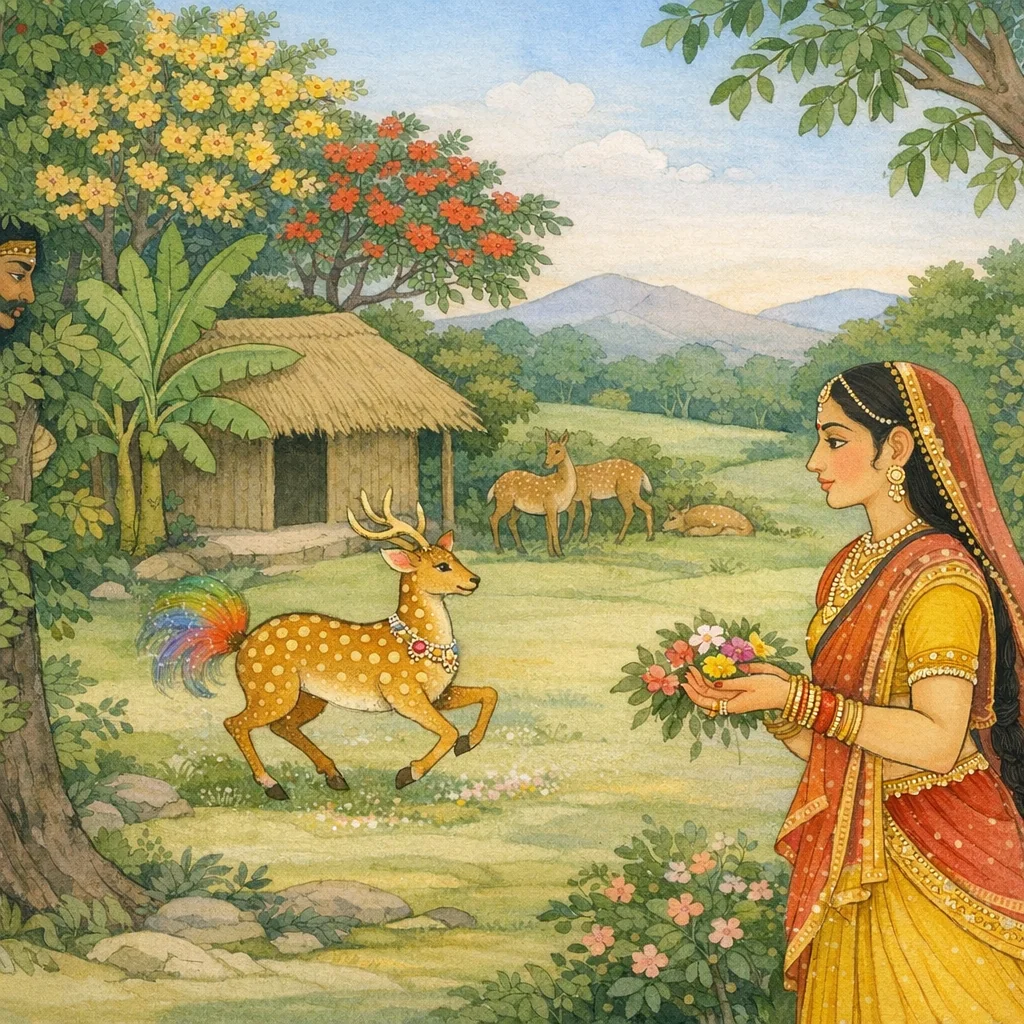
Sarga 42 records the practical execution of Rāvaṇa’s deception. Though earlier hesitant from fear, Mārīca—distressed at the thought of being seen by Rāma—nevertheless agrees to depart with Rāvaṇa. They ride a gem-adorned chariot yoked to grotesque, donkey-like beasts, crossing a vast landscape of towns, forests, mountains, rivers, kingdoms, and cities, until they reach Daṇḍakāraṇya and Rāma’s hermitage, said to be surrounded by banana plants. There Rāvaṇa dismounts, takes Mārīca by the hand, and commands immediate action. Mārīca transforms into an extraordinarily ornate deer, described through dense visual similes—lotus hues, a rainbow-like tail, gem-studded antlers, silver spots, and mineral colors. The illusory deer deliberately roams near the hermitage entrance, moving to and fro, mingling with herds, prancing in circles, and nibbling tender leaves, concealing predatory intent by harming no other animals. Sītā, gathering flowers from karnikara, aśoka, and mango trees, beholds the unprecedented jeweled deer and gazes with wonder and affection; the illusion seems to illumine the forest, accomplishing the lure central to Rāvaṇa’s plan.
Shlokas
Verse 1
एवमुक्त्वा तु वचनं मारीचो रावणं ततः।गच्छावेत्यब्रवीद्दीनो भयाद्रात्रिंचरप्रभोः।।3.42.1।।
Thus having spoken to Rāvaṇa, Mārīca—distressed and fearful of the lord of the night-rangers—said: “Let us go, the two of us.”
Verse 2
दृष्टश्चाहं पुनस्तेन शरचापासिधारिणा।मद्वधोद्यतशस्त्रेऽण विनष्टं जीवितं च मे।।3.42.2।।
If he sees me again—he who bears arrows, bow, and sword—and raises his weapon intent on my death, then my life will be finished.
Verse 3
न हि रामं पराक्रम्य जीवन्प्रतिनिवर्तते।वर्तते प्रतिरूपोऽसौ यमदण्डहतस्य ते।।3.42.3।।
No one who challenges Rāma and pits his valor against him returns alive. To you—already as though struck by Yama’s rod—Rāma stands as Yama himself in another form.
Verse 4
किं नु शक्यं मया कर्तुमेवं त्वयि दुरात्मनि।एष गच्छाम्यहं तात स्वस्ति तेऽस्तु निशाचर।।3.42.4।।
What can I do, when you persist in such evil resolve? I shall go then, dear one; may good befall you, O ranger of the night.
Verse 5
प्रहृष्टस्त्वभवत्तेन वचनेन स रावणः।परिष्वज्य सुसंश्लिष्टमिदं वचनमब्रवीत्।।3.42.5।।
At those words, Rāvaṇa was delighted; embracing him tightly, he spoke these words.
Verse 6
एतच्छौण्डीर्ययुक्तं ते मच्छन्दवशवर्तिनः।इदानीमसि मारीचः पूर्वमन्यो निशाचरः।।3.42.6।।
This course befits your bravado, for now you move under my will. Now you are truly ‘Mārīca’; before, you were some other night-roaming rākṣasa.
Verse 7
आरुह्यतामयं शीघ्रं रथो रत्नविभूषितः।मया सह तथा युक्तः पिशाचवदनैः खरैः।।3.42.7।।
“Mount at once this gem-adorned chariot; it is yoked to donkeys with ghastly, demon-like faces. Come quickly with me.”
Verse 8
प्रलोभयित्वा वैदेहीं यथेष्टं गन्तुमर्हसि।तां शून्ये प्रसभं सीतामानयिष्यामि मैथिलीम्।।3.42.8।।
“After luring Vaidehī (Sītā), you may go wherever you wish. When Sītā, Maithilī, is left unguarded and alone, I will seize her by force and carry her away.”
Verse 9
ततो रावणमारीचौ विमानमिव तं रथम्।आरुह्य ययतुश्शीघ्रं तस्मादाश्रममण्डलात्।।3.42.9।।
Then Rāvaṇa and Mārīca mounted that chariot—like a vimāna in appearance—and swiftly departed from the precinct of the hermitages.
Verse 10
तथैव तत्र पश्यन्तौ पत्तनानि वनानि च।गीरींश्च सरितस्सर्वा राष्ट्राणि नगराणि च।।3.42.10।।
So too, as they journeyed on, they beheld towns and forests, mountains and all the rivers, as well as provinces and cities.
Verse 11
समेत्य दण्डकारण्यं राघवस्याश्रमं ततः।ददर्श सह मारीचो रावणो राक्षसाधिपः।।3.42.11।।
Then Rāvaṇa, lord of the rākṣasas, arriving in the Daṇḍaka forest together with Mārīca, beheld the hermitage of Rāghava (Rāma).
Verse 12
अवतीर्य रथात्तस्मात्ततः काञ्चनभूषणात्।हस्ते गृहीत्वा मारीचं रावणो वाक्यमब्रवीत्।।3.42.12।।
Then, descending from that chariot adorned with golden ornaments, Rāvaṇa took Mārīca by the hand and spoke to him.
Verse 13
एतदाश्रमपदं दृश्यते कदलीवृतम्।क्रियतां तत्सखे शीघ्रं यदर्थं वयमागताः।।3.42.13।।
“Look—this is the hermitage-site, encircled by banana plants. O friend, quickly carry out that for the sake of which we have come.”
Verse 14
स रावणवचश्श्रुत्वा मारीचो राक्षसस्तदा।मृगो भूत्वाऽश्रमद्वारि रामस्य विचचार ह।।3.42.14।।
Hearing Rāvaṇa’s words, Mārīca the rākṣasa became a deer and began to roam at the doorway of Rāma’s hermitage.
Verse 15
स तु तद्रूपमास्थाय महदद्भुतदर्शनम्।मणिप्रवरशृङ्गाग्रस्सितासितमुखाकृतिः।।3.42.15।।
Assuming that form—vast and marvelous to behold—he had antler-tips set with the finest gems, and a face mottled with white and black.
Verse 16
रक्तपद्मोत्पलमुख इन्द्रनीलोत्पलश्रवाः।किंचिदभ्युन्नतग्रीव इंद्रनीलदलाधरः।।3.42.16।।
Its face was like a red lotus; its ears like blue lotuses; its neck slightly raised; its lips like petals of blue lotus.
Verse 17
कुन्देन्दुवज्रसङ्काशमुदरं चास्य भास्वरम्।मधूकनिभपार्श्वश्च पद्मकिञ्जल्कसन्निभः।।3.42.17।।वैडूर्यसङ्काशखुरस्तनुजङ्घस्सुसंहतः।
Its radiant belly shone like the kunda flower, the moon, and a diamond; its flanks were like madhūka blossoms, like lotus-filaments. Its hooves were like vaidūrya, its legs slender, and its body well-proportioned.
Verse 18
इन्द्रायुधसवर्णेन पुच्छेनोर्ध्वं विराजता।।3.42.18।।मनोहरस्स्निग्धवर्णो रत्नैर्नानाविधैर्वृतः।
With an upraised tail, variegated like a rainbow, it shone splendidly—charming, lustrous in hue, and covered with many kinds of jewels.
Verse 19
क्षणेन राक्षसो जातो मृगः परमशोभनः।।3.42.19।।वनं प्रज्वलयन्रम्यं रामाश्रमपदं च तत्।
In an instant the rākṣasa became a deer of supreme beauty, making the lovely forest—and that place of Rāma’s hermitage—seem to blaze with splendor.
Verse 20
मनोहरं दर्शनीयं रूपं कृत्वा स राक्षसः।।3.42.20।।प्रलोभनार्थं वैदेह्या नानाधातुविचित्रितम्।विचरन्गच्छते तस्माच्छाद्वलानि समन्ततः।।3.42.21।।
That rākṣasa, having assumed a delightful and beautiful form,
Verse 21
मनोहरं दर्शनीयं रूपं कृत्वा स राक्षसः।।3.42.20।।प्रलोभनार्थं वैदेह्या नानाधातुविचित्रितम्।विचरन्गच्छते तस्माच्छाद्वलानि समन्ततः।।3.42.21।।
—painted with varied mineral hues to entice Vaidehī—he moved about, grazing and roaming all around the grassy grounds there.
Verse 22
रूप्यैर्बिन्दुशतैश्चित्रो भूत्वा स प्रियदर्शनः।विटपीनां किसलयान्भङ्त्क्वाऽदन्विचचार ह।।3.42.22।।
Becoming wondrous with hundreds of silvery spots and pleasing to behold, he wandered about, nibbling and eating the tender shoots of trees.
Verse 23
कदलीगृहकं गत्वा कर्णिकारानितस्ततः।समाश्रयन्मन्दगतिस्सीतासन्दर्शनं तथा।।3.42.23।।
He entered the banana groves and then moved here and there toward the karṇikāra trees; keeping a slow pace, he sought as well to be noticed and seen by Sītā.
Verse 24
राजीवचित्रपृष्ठस्स विरराज महामृगः।रामाश्रमपदाभ्याशे विचचार यथासुखम्।।3.42.24।।
That great deer, its back patterned like a blue lotus, shone brilliantly and wandered at ease near the grounds of Rāma’s hermitage.
Verse 25
पुनर्गत्वा निवृत्तश्च विचचार मृगोत्तमः।गत्वा मुहूर्तं त्वरया पुनः प्रतिनिवर्तते।।3.42.25।।
The finest of deer would go forth and then return again; after moving off for a moment, it would swiftly turn back once more.
Verse 26
विक्रीडंश्च क्वचिद्भूमौ पुनरेव निषीदति।आश्रमद्वारमागम्य मृगयूथानि गच्छति।।3.42.26।।
At times it sported upon the ground and then sat down again; coming up to the very gate of the hermitage, it would then move along with herds of deer.
Verse 27
मृगयूथैरनुगतः पुनरेव निवर्तते।सीतादर्शनमाकांक्षन्राक्षसो मृगतां गतः।।3.42.27।।परिभ्रमति चित्राणि मण्डलानि विनिष्पतन्।
Followed by herds of deer, it returned again and again; the rākṣasa, having taken on deer-form, longed for Sītā to see him, and, leaping about, whirled in wondrous circles.
Verse 28
समुद्वीक्ष्य च ते सर्वे मृगा ह्यन्ये वनेचराः।।3.42.28।।उपागम्य समाघ्राय विद्रवन्ति दिशो दश।
Seeing him, all the other forest-roaming deer came near; but after approaching and sniffing him, they fled in all ten directions.
Verse 29
राक्षसस्सोऽपि तान्वन्यान्मृगान्मृगवधे रतः।।3.42.29।।प्रच्छादनार्थं भावस्य न भक्षयति संस्पृशन्।
That rākṣasa too—though fond of slaying wild deer—only touched them and did not devour them, so as to conceal his true intent.
Verse 30
तस्मिन्नेव ततः काले वैदेही शुभलोचना।।3.42.30।।कुसुमावचयव्यग्रा पादपानभ्यवर्तत।
Just then, Vaidehī, bright-eyed and auspicious, intent on gathering flowers, approached the trees.
Verse 31
कर्णिकारानशोकांश्च चूतांश्च मदिरेक्षणा।।3.42.31।।कुसुमान्यवचिन्वन्ती चचार रुचिरानना।
With enchanting eyes and a lovely face, she wandered about, plucking blossoms from karṇikāra, aśoka, and mango trees.
Verse 32
अनर्हाऽरण्यवासस्य सा तं रत्नमयं मृगम्।।3.42.32।।मुक्तामणि विचित्राङ्गं ददर्श परमाङ्गना।
That noble lady—unfit for life in the wilderness—caught sight of the deer, jewel-like, its body wondrously patterned with pearls and gems.
Verse 33
सा तं रुचिरदन्तोष्ठी रूप्यधातुतनूरुहम्।।3.42.33।।विस्मयोत्फुल्लनयना सस्नेहं समुदैक्षत।
Sītā—lovely in teeth and lips—looked upon that deer whose coat gleamed like silver and minerals; her eyes widened in wonder, and she gazed with affection.
Verse 34
स च तां रामदयितां पश्यन्मायामयो मृगः।।3.42.34।।विचचार पुनश्चित्रं दीपयन्निव तद्वनम्।
And that illusory deer, wrought of māyā, seeing Rāma’s beloved, moved about again in a wondrous way, as though it were lighting up the forest itself.
Verse 35
अदृष्टपूर्वं तं दृष्ट्वा नानारत्नमयं मृगम्।।3.42.35।।विस्मयं परमं सीता जगाम जनकात्मजा।
Seeing that deer—never seen before, studded with many kinds of gems—Sītā, Janaka’s daughter, was filled with the greatest astonishment.
Frequently Asked Questions
The pivotal action is the deliberate use of māyā: Mārīca assumes a dazzling deer-form to provoke attraction and distraction in Sītā, enabling Rāvaṇa’s coercive plan. The ethical dilemma centers on how sensory allure and curiosity can be weaponized against a virtuous household in exile, creating conditions for separation and harm.
The sarga underscores that adharma often advances through persuasion and spectacle rather than open force. It cautions that discernment (viveka) must accompany perception: beauty can be engineered, and intention can be concealed (as when the deer refrains from predation to mask its nature).
Daṇḍakāraṇya and Rāma’s hermitage precinct form the core setting, framed by banana groves and flowering trees (karnikara, aśoka, mango). The travel catalogue—towns, forests, mountains, rivers, states, and cities—functions as a cultural-geographic sweep situating the hermitage within a broader inhabited landscape.