Sarga 22
खरस्य सैन्योद्योगः — Khara Mobilizes the Janasthana Host
अरण्यकाण्ड
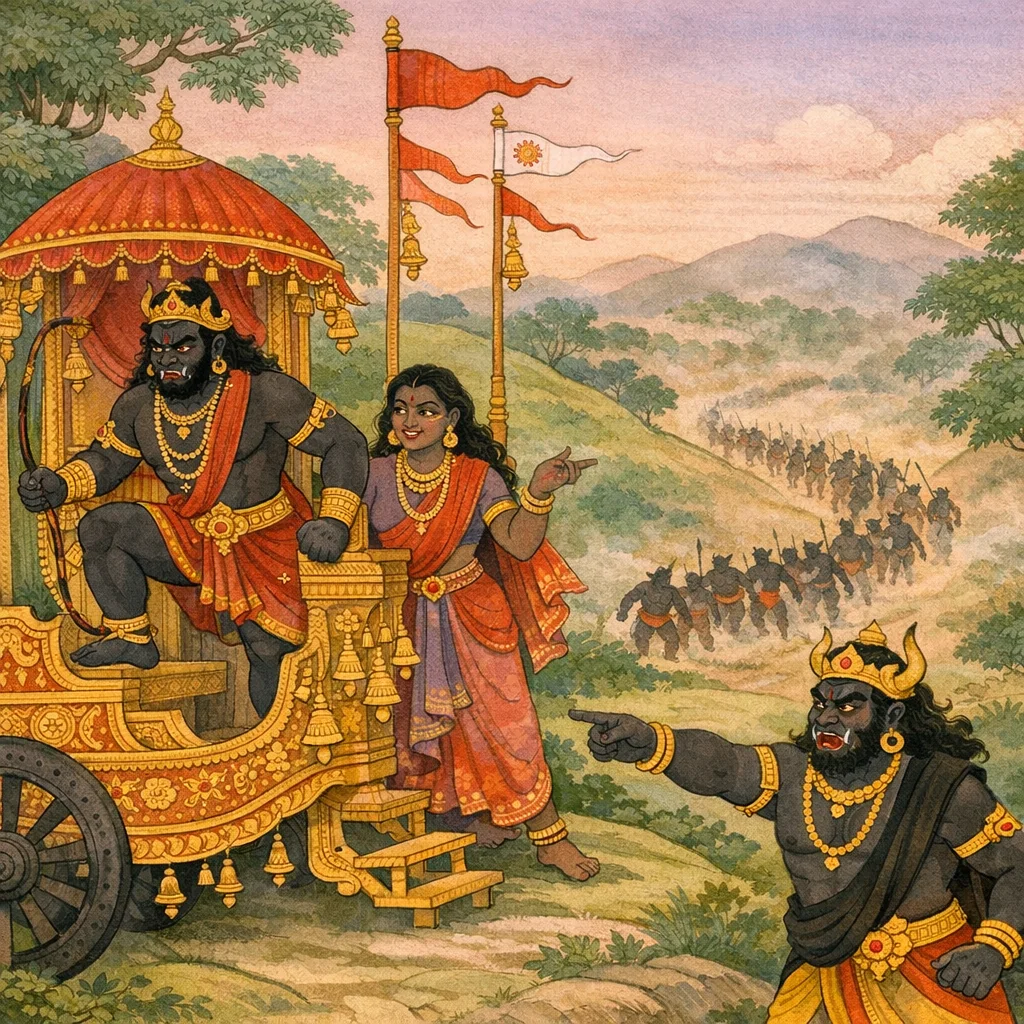
This sarga depicts the issuing of commands and the mobilization of forces in Janasthana. Shamed before the rākṣasas by Śūrpaṇakhā’s complaint, Khara speaks in wrath born of insult and declares that Rāma is a mortal who must be slain. Pleased, Śūrpaṇakhā praises him again, and Khara turns to Dūṣaṇa, his senāpati, to set the retaliation in motion. Khara orders the assembly of the proud, tiger-like, mighty rākṣasas and the preparation of his chariot and armory—bows, arrows, swords, and various missiles. Dūṣaṇa reports the sun-hued mahāratha ready, and the text lingers over the Meru-like chariot, adorned with gold, vaidūrya-studded fittings, bells, flags, and auspicious engravings of fish, flowers, trees, and celestial motifs. Khara mounts and commands the ranks to march; the narrative widens to the departure of fourteen thousand fierce rākṣasas bearing diverse weapons. The sarga closes with the army surging ahead, Khara’s chariot thundering through the directions, and Khara—likened to Yama and a hail-bearing cloud—driving forward to kill his enemy, marking a decisive escalation toward the Janasthana confrontation.
Shlokas
Verse 1
एवमाधर्षितश्शूरश्शूर्पणख्या खरस्ततः।उवाच रक्षसां मध्ये खरः खरतरं वचः।।3.22.1।।
Thus provoked and shamed by Shurpanakha, the valiant Khara spoke even harsher words in the midst of the Rakshasas.
Verse 2
तवावमानप्रभवः क्रोधोऽयमतुलो मम।न शक्यते धारयितुं लवणाम्भ इवोल्बणम्।।3.22.2।।
This incomparable anger of mine—born from your insult—cannot be held back, like the surging waters of the salty sea.
Verse 3
न रामं गणये वीर्यान्मानुषं क्षीणजीवितम्।आत्मदुश्चरितैः प्राणान्हतोयोऽद्य विमोक्ष्यते।।3.22.3।।
“I do not count Rama’s valor at all—he is a mere human, short-lived. Struck down, he will cast off his life today, because of his own misdeeds.”
Verse 4
बाष्पस्संह्रियतामेष सम्भ्रमश्च विमुच्यताम्।अहं रामं सह भ्रात्रा नयामि यमसादनम्।।3.22.4।।
“Hold back these tears; cast off your agitation. I will send Rama—together with his brother—to the dwelling of Yama.”
Verse 5
परश्वथहतस्याद्य मन्दप्राणस्य संयुगे।रामस्य रुधिरं रक्तमुष्णं पास्यसि राक्षसि।।3.22.5।।
“Today, on the battlefield, when Rama is felled by my axe and his life-breath grows faint, you will drink his hot, red blood—O rākṣasī.”
Verse 6
सा प्रहृष्टा वचश्श्रुत्वा खरस्य वदनाच्च्युतम्।प्रशशंस पुनर्मौर्ख्याद्भ्रातरं रक्षसां वरम्।।3.22.6।।
“Hold back these tears; cast off your agitation. I will send Rama—together with his brother—to the dwelling of Yama.”
Verse 7
तया परुषितः पूर्वं पुनरेव प्रशंसितः।अब्रवीद्दूषणं नाम खरस्सेनापतिं तदा।।3.22.7।।
“Today, on the battlefield, when Rama is felled by my axe and his life-breath grows faint, you will drink his hot, red blood—O rākṣasī.”
Verse 8
चतुर्दश सहस्राणि मम चित्तानुवर्तिनाम्।रक्षसां भीमवेगानां समरेष्वनिवर्तिनाम्।।3.22.8।।
“Fourteen thousand rākṣasas follow my will—of dreadful speed, and in battle they never turn back.”
Verse 9
नीलजीमूतवर्णानां घोराणां क्रूरकर्मणाम्।लोकहिंसाविहाराणां बलिनामुग्रतेजसाम्।।3.22.9।।
“Dark as blue rain-clouds, dreadful and cruel in deed—wandering about to harm the world—strong, and fierce in splendor.”
Verse 10
तेषां शार्दूलदर्पाणां महास्यानां महौजसाम्।सर्वोद्योग मुदीर्णानां रक्षसां सौम्य कारय।।3.22.10।।
O gentle one, mobilize fully those mighty Rakshasas, who possess the pride of tigers and huge faces, and who are already roused for action.
Verse 11
उपस्थापय मे क्षिप्रं रथं सौम्य धनूंषि च।शरांश्चित्रांश्च खङ्गांश्च शक्तीश्च विविधाश्शिताः।।3.22.11।।
O gentle one, quickly make ready my chariot and my bows; and arrows of fine make, and swords, and sharp spears of many kinds.
Verse 12
अग्रे निर्यातुमिच्छामि पौलस्त्यानां महात्मनाम्।वधार्थं दुर्विनीतस्य रामस्य रणकोविदः।।3.22.12।।
I wish to march at the head of the great-souled Paulastyas, skilled in war, in order to slay that ill-disciplined Rāma.
Verse 13
इति तस्य ब्रुवाणस्य सूर्यवर्णं महारथम्।सदश्वैश्शबलैर्युक्तमाचचक्षेऽथ दूषणः।।3.22.13।।
As Khara spoke thus, Dūṣaṇa then pointed out a massive chariot, sun-bright in color, standing ready, yoked to fine horses of variegated hues.
Verse 14
तं मेरुशिखराकारं तप्तकाञ्चनभूषणम्।हेमचक्रमसम्बाधं वैदूर्यमयकूबरम्।।3.22.14।।मत्स्यैः पुष्पैर्द्रुमैश्शैलैश्चन्द्रसूर्यैश्च काञ्चनैः।मङ्गलैः पक्षिसङ्घैश्च ताराभिरभिसंवृतम्।।3.22.15।।ध्वजनिस्त्रिंशसम्पन्नं किङ्किणीकविराजितम्।सदश्वयुक्तं सोऽमर्षादारुरोह खरो रथम्।।3.22.16।।
That chariot was like the peak of Mount Meru, adorned with refined gold, fitted with golden wheels, solidly built, and with a yoke-pole fashioned and inlaid with vaidūrya gems.
Verse 15
तं मेरुशिखराकारं तप्तकाञ्चनभूषणम्।हेमचक्रमसम्बाधं वैदूर्यमयकूबरम्।।3.22.14।।मत्स्यैः पुष्पैर्द्रुमैश्शैलैश्चन्द्रसूर्यैश्च काञ्चनैः।मङ्गलैः पक्षिसङ्घैश्च ताराभिरभिसंवृतम्।।3.22.15।।ध्वजनिस्त्रिंशसम्पन्नं किङ्किणीकविराजितम्।सदश्वयुक्तं सोऽमर्षादारुरोह खरो रथम्।।3.22.16।।
It was encircled and embellished with golden figures—fish, flowers, trees, mountains, the moon and the sun—along with auspicious motifs, flocks of birds, and star-like designs all around.
Verse 16
तं मेरुशिखराकारं तप्तकाञ्चनभूषणम्।हेमचक्रमसम्बाधं वैदूर्यमयकूबरम्।।3.22.14।।मत्स्यैः पुष्पैर्द्रुमैश्शैलैश्चन्द्रसूर्यैश्च काञ्चनैः।मङ्गलैः पक्षिसङ्घैश्च ताराभिरभिसंवृतम्।।3.22.15।।ध्वजनिस्त्रिंशसम्पन्नं किङ्किणीकविराजितम्।सदश्वयुक्तं सोऽमर्षादारुरोह खरो रथम्।।3.22.16।।
Furnished with flags and swords, gleaming with rows of tiny bells and yoked to fine horses, Khara—burning with impatience—mounted the chariot.
Verse 17
निशाम्य तु रथस्थं तं राक्षसा भीमविक्रमाः।तस्थुस्संपरिवार्यैनं दूषणं च महाबलम्।।3.22.17।।
Seeing him seated upon the chariot, the rākṣasas of dreadful prowess surrounded him and stood ready—along with the mighty Dūṣaṇa.
Verse 18
खरस्तु तान्महेष्वासान्घोरवर्मायुधध्वजान्।निर्यातेत्यब्रवीद्दृष्ट्वा रथस्थस्सर्वराक्षसान्।।3.22.18।।
Then Khara, from his chariot, looked upon all the rākṣasas—great bowmen bearing grim armor, weapons, and banners—and commanded, “March out!”
Verse 19
ततस्तद् राक्षसं सैन्यं घोरचर्मायुधध्वजम्।निर्जगाम जनस्थानान्महानादं महाजवम्।।3.22.19।।
Then that rākṣasa army—bearing grim shields, weapons, and banners—set out from Janasthāna with a tremendous roar and great speed.
Verse 20
मुद्गरैः पट्टिसैश्शूलैस्सुतीक्ष्णैश्च परश्वधैः।खङ्गैश्चक्रैश्च हस्तस्थैर्भ्राजमानैश्च तोमरैः।।3.22.20।।शक्तिभिः परिघैर्घोरैरतिमात्रैश्च कार्मुकैः।गदासिमुसलैर्वज्रैर्गृहीतैर्भीमदर्शनैः।।3.22.21।।राक्षसानां सुघोराणां सहस्राणि चतुर्दश।निर्यातानि जनस्थानात्खरचित्तानुवर्तिनाम्।।3.22.22।।
In their hands they bore maces, pikes and spears, razor-sharp battle-axes, swords, disc-like weapons, and shining javelins.
Verse 21
मुद्गरैः पट्टिसैश्शूलैस्सुतीक्ष्णैश्च परश्वधैः।खङ्गैश्चक्रैश्च हस्तस्थैर्भ्राजमानैश्च तोमरैः।।3.22.20।।शक्तिभिः परिघैर्घोरैरतिमात्रैश्च कार्मुकैः।गदासिमुसलैर्वज्रैर्गृहीतैर्भीमदर्शनैः।।3.22.21।।राक्षसानां सुघोराणां सहस्राणि चतुर्दश।निर्यातानि जनस्थानात्खरचित्तानुवर्तिनाम्।।3.22.22।।
They carried powerful lances and dreadful iron bars, oversized bows, and fearsome weapons—clubs, swords, pestles, and thunderbolt-like arms—terrifying to behold.
Verse 22
मुद्गरैः पट्टिसैश्शूलैस्सुतीक्ष्णैश्च परश्वधैः।खङ्गैश्चक्रैश्च हस्तस्थैर्भ्राजमानैश्च तोमरैः।।3.22.20।।शक्तिभिः परिघैर्घोरैरतिमात्रैश्च कार्मुकैः।गदासिमुसलैर्वज्रैर्गृहीतैर्भीमदर्शनैः।।3.22.21।।राक्षसानां सुघोराणां सहस्राणि चतुर्दश।निर्यातानि जनस्थानात्खरचित्तानुवर्तिनाम्।।3.22.22।।
Fourteen thousand exceedingly fierce rākṣasas—acting in obedience to Khara’s will—marched out from Janasthāna.
Verse 23
तांस्त्वभिद्रवतो दृष्ट्वा राक्षसान् भीमविक्रमान्।खरस्यापि रथः किञ्चिज्जगाम तदनन्तरम्।।3.22.23।।
Seeing those rākṣasas of fearsome prowess rushing forward to attack, Khara’s own chariot moved along a little behind them.
Verse 24
ततस्ताञ्छबलानश्वास्तप्तकाञ्चनभूषितान्।खरस्य मतिमाज्ञाय सारथिस्समचोदयत्।।3.22.24।।
Then, understanding Khara’s intent, the charioteer urged on those dappled horses adorned with burnished gold.
Verse 25
स चोदितो रथश्शीघ्रं खरस्य रिपुघातिनः।शब्देनापूरयामास दिशश्च प्रदिशस्तदा।।3.22.25।।
Spurred on, Khara’s swift chariot—of the ‘slayer of foes’—resounded so loudly that it filled the quarters and the intermediate directions.
Verse 26
प्रवृद्धमन्युस्तु खरः खरस्वनो रिपोर्वधार्थं त्वरितो यथान्तकः।अचूचुदत्सारथिमुन्नदन्घनं महाबलो मेघ इवाश्मवर्षवान्।।3.22.26।।
Khara, his anger swelling and his voice harsh, hastened to slay his foe like Antaka (Death). Roaring like a dense, mighty cloud that pours down hail, he pressed his charioteer to drive faster.
Frequently Asked Questions
The pivotal action is Khara’s choice to convert personal humiliation into state-level violence: he frames the insult as justification for killing Rama, demonstrating how krodha (anger) can override discernment and distort the rhetoric of duty into vengeance.
The sarga illustrates a classical moral psychology: anger arising from avamāna (insult) becomes ‘uncontainable’ and drives rash commitments. The implied upadesha is that leadership without self-restraint amplifies harm by mobilizing collective force for private grievance.
Janasthana functions as the operational base of the forest rākṣasas, while the ornate mahāratha—described with Meru and solar imagery—serves as a cultural marker of royal-military spectacle and auspicious iconography within epic warfare narration.