Adhyaya 58
Dharma of the Conduct of the Vānaprastha Āśrama (Forest-Dweller Discipline)
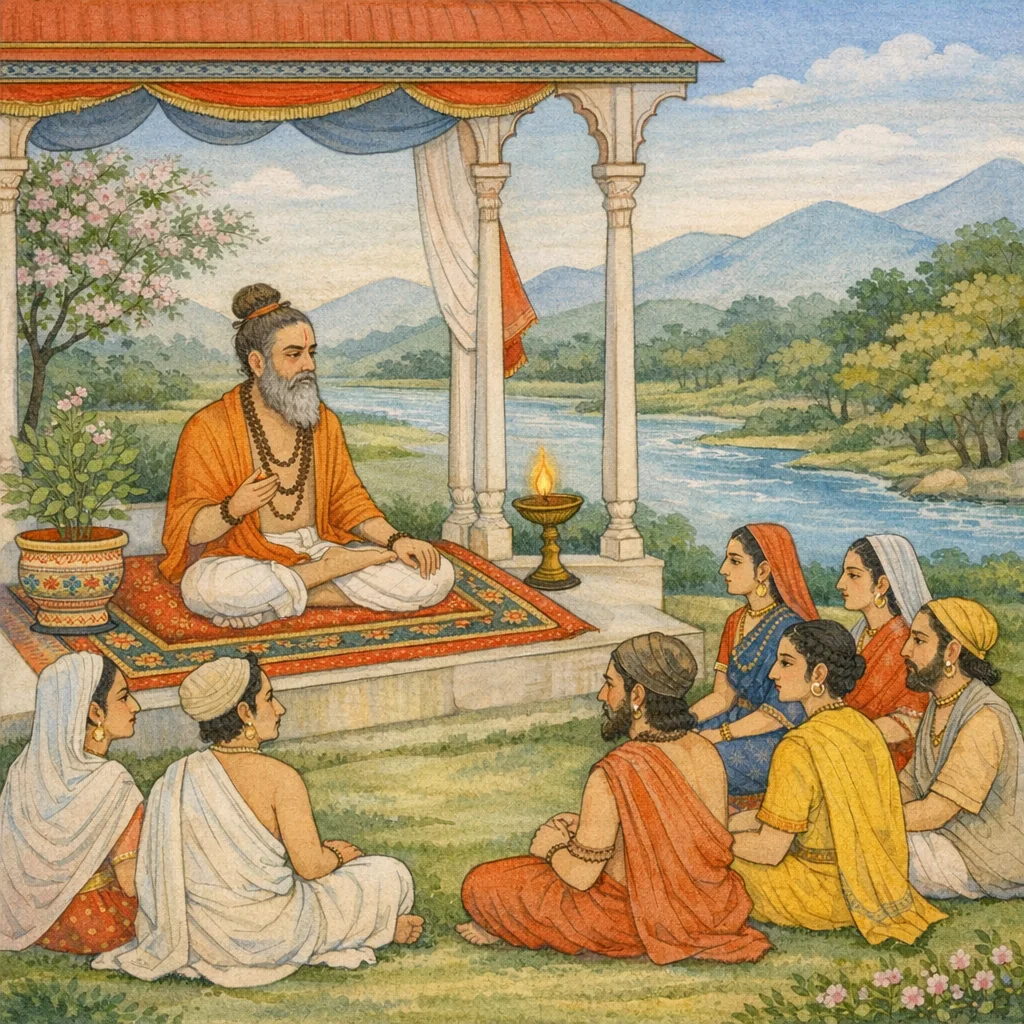
PP.3.58 defines vānaprastha as the third āśrama, to be entered after one has fulfilled the duties of the gṛhastha and seen one’s lineage established. It enjoins departure to the forest at auspicious times, the keeping of the sacred fire, worship of the gods and the Pitṛs, hospitality, and measured eating. It sets out rules of purity, limits on dress and grooming, Vedic study, and the performance of Agnihotra and the pañca-mahāyajñas, along with new- and full-moon and seasonal sacrifices. Dietary restraints, refusal of village produce and gifts, nonviolence (ahiṃsā), truthfulness, and night-discipline are repeatedly emphasized. Sexual conduct is strictly controlled: intercourse nullifies the observance and requires expiation (prāyaścitta). The chapter lists graded austerities and culminates in interiorized sacrifice—yoga and Upaniṣadic recitation—and optional final self-offering practices directed toward liberation (mokṣa).
Shlokas
Verse 1
व्यास उवाच । एवं गृहाश्रमे स्थित्वा द्वितीयं भागमायुषः । वानप्रस्थाश्रमं गच्छेत्सदारः साग्निरेव च
Vyāsa said: Having thus lived in the householder stage for the second portion of one’s life, one should proceed to the forest-dweller stage (vānaprastha), together with one’s wife and keeping the sacred fire.
Verse 2
निक्षिप्य भार्यां पुत्रेषु गच्छेद्वनमथापि वा । दृष्ट्वापत्यस्य वापत्यं जर्जरीकृतविग्रहः
Having entrusted his wife to his sons, he should depart—perhaps even to the forest. Seeing his child’s child (his grandchild), his body has become worn and broken with age.
Verse 3
शुक्लपक्षस्य पूर्वाह्णे प्रशस्ते चोत्तरायणे । गत्वारण्यं नियमवांस्तपः कुर्यात्समाहितः
In the forenoon of the bright fortnight, at an auspicious time and during uttarāyaṇa (the sun’s northward course), one should go to the forest and, disciplined in observances, perform tapas (austerities) with a collected mind.
Verse 4
फलमूलानि पूतानि नित्यमाहारमाहरेत् । यदाहारो भवेत्तेन पूजयेत्पितृदेवताः
One should regularly partake of pure fruits and roots as food. With whatever food is at hand, one should worship the Pitṛs, the ancestral divinities.
Verse 5
पूजयेदतिथिं नित्यं स्नात्वा चाभ्यर्चयेत्सुरान् । गृहादादाय चाश्नीयादष्टौ ग्रासान्समाहितः
One should always honor the guest; and after bathing, one should worship the gods. Then, taking food from the house, one should eat eight mouthfuls with a collected mind.
Verse 6
जटाश्च बिभृयान्नित्यं नखरोमाणि नोत्सृजेत् । स्वाध्यायं सर्वथा कुर्यान्नियच्छेद्वाचमन्यतः
He should always wear matted locks, and he should not cut off his nails and body-hair. He should in every way engage in svādhyāya, self-study of the Veda, and restrain his speech from all other idle talk.
Verse 7
अग्निहोत्रं च जुहुयात्पंचयज्ञान्समाचरेत् । उत्पन्नैर्विविधैर्मेध्यैः शाकमूलफलेन वा
One should also offer the Agnihotra and duly perform the five great sacrifices, using whatever pure items are available—various produce that has arisen, or even vegetables, roots, and fruits.
Verse 8
चीरवासा भवेन्नित्यं स्नायात्त्रिषवणं शुचिः । सर्वभूतानुकंपश्च प्रतिग्रहविवर्जितः
He should always wear simple bark-cloth, bathe three times a day, remain pure, show compassion toward all beings, and refrain from accepting gifts.
Verse 9
दर्शेन पौर्णमासेन यजेत नियतं द्विजः । ऋत्विष्ट्याग्रयणे चैव चातुर्मास्यानि कारयेत्
A disciplined twice-born man should regularly perform the new-moon and full-moon sacrifices; and he should also arrange the seasonal rites—such as the Agrayaṇa offering with officiating priests—and the Cāturmāsya sacrifices.
Verse 10
उत्तरायणं च क्रमशो दक्षिणायनमेव च । वासंतशारदैर्मेद्ध्यैरुत्पन्नैः स्वयमाहृतैः
In due sequence, he observes the Uttarāyaṇa and likewise the Dakṣiṇāyana, using pure offerings produced in the spring and autumn seasons and gathered by himself.
Verse 11
पुरोडाशांश्चरूंश्चैव विधिवन्निर्वपेत्पृथक् । देवताभ्यः पितृभ्यश्च दत्त्वा मेध्यतरं हविः
He should, in accordance with the proper rites, prepare separately the sacrificial cakes (puroḍāśa) and the cooked oblations (caru); and having offered the purer oblation to the deities and to the ancestors, the rite is duly fulfilled.
Verse 12
शेषं समुपभुंजीत लवणं च स्वयंकृतम् । वर्ज्जयेन्मद्यमांसानि भौमानि कवकानि च
One should then partake of what remains as prasāda, and also use salt prepared by oneself. One should avoid intoxicating liquor, meat, and earth-grown items such as mushrooms and other fungi.
Verse 13
भूस्तृणं शष्पकं चैव श्लेष्मातक फलानि च । न फालकृष्टमश्नीयादुत्सृष्टमपि केनचित्
One should not eat earth-grass, young shoots, or śleṣmātaka fruits; nor should one eat anything that has been ploughed up by a plough, even if it has been discarded by someone.
Verse 14
न ग्रामजातान्यार्तोपि पुष्पाणि च फलानि च । श्रावणेनैव विधिना वह्निं परिचरेत्सदा
Even in distress, one should not accept flowers or fruits that arise from a village; rather, one should always tend the sacred fire according to the prescribed rite of the month of Śrāvaṇa.
Verse 15
न द्रुह्येत्सर्वभूतानि निर्द्वंद्वो निर्भयो भवेत् । न नक्तं किंचिदश्नीयाद्रात्रौ ध्यानपरो भवेत्
One should bear no malice toward any being; one should become free from dualities and fearless. One should not eat anything at night; at night one should be devoted to meditation.
Verse 16
जितेंद्रियो जितक्रोधस्तत्त्वज्ञानविचिंतकः । ब्रह्मचारी भवेन्नित्यं न पत्नीमपि संश्रयेत्
Let him be one who has conquered the senses and mastered anger, who reflects on true knowledge. Let him always live as a brahmacārin and not seek refuge even in a wife.
Verse 17
यस्तु पत्न्या वनं गत्वा मैथुनं कामतश्चरेत् । तद्व्रतं तस्य लुप्येत प्रायश्चित्तीयते द्विजः
But if a man, having gone to the forest with his wife, engages in sexual intercourse out of desire, then his observance is annulled; the twice-born must then perform an expiation.
Verse 18
तत्र यो जायते गर्भो न स स्पृश्यो द्विजातिभिः । न हि वेदेधिकारोस्य तद्वंशेप्येवमेव हि
A child conceived there should not be touched by the twice-born, for he has no entitlement to the Veda; indeed, this holds true even for his lineage as well.
Verse 19
भूमौ शयीत सततं सावित्रीजप्यतत्परः । शरण्यः सर्वभूतानां सद्विभागपरः सदा
He should always lie upon the ground, be devoted to the recitation of the Sāvitrī (Gāyatrī), be a refuge for all beings, and ever remain intent on righteous and proper distribution.
Verse 20
परिवादं मृषावादं निद्रालस्ये च वर्जयेत् । एकाग्निरनिकेतः स्यात्प्रोक्षितां भूमिमाश्रयेत्
One should avoid slander, false speech, and also sleep and laziness. One should keep only a single sacred fire, live without a fixed home, and dwell upon ground that has been ritually purified by sprinkling.
Verse 21
मृगैः सह चरेद्दांतस्तैः सहैव च संवसेत् । शिलायां शर्करायां वा शयीत सुसमाहितः
Having become self-controlled, he should wander along with the deer and dwell in their company; and, fully composed, he should lie down to rest on bare rock or on gravel (sand).
Verse 22
सद्यः प्रक्षालको वा स्यान्माससंचयिकोपि वा । षण्मासनिचयो वापि समानिचय एव वा
Whether one is an immediate purifier, or one who accumulates (merit) for a month, or even one who accumulates it for six months—or likewise one with an equal accumulation (of merit).
Verse 23
नक्तं चान्नं समश्नीयाद्दिवा चाहृत्य शक्तितः । चतुर्थकालको वा स्यात्किं वाप्यष्टमकालिकः
Let him eat food at night, having procured it by day according to his ability. Or he may be one who eats at the fourth mealtime—or even one who eats at the eighth mealtime.
Verse 24
चांद्रायणविधानैर्वा शुक्लेकृष्णे च वर्जयेत् । पक्षेपक्षे समश्नीयाद्यवागूं क्वथितां सकृत्
Or else, observing the disciplines of the Cāndrāyaṇa vow, one should practise restraint in both the bright and the dark fortnights; and in each fortnight eat only once—taking a single portion of boiled barley gruel.
Verse 25
पुष्पमूलफलैर्वापि केवलैर्वर्तयेत्सदा । स्वाभाविकैः स्वयंशीर्णैर्वैखानसमते स्थितः
Abiding in the Vaikhānasa discipline, one should always sustain oneself only on flowers, roots, and fruits—those that are natural and have fallen of themselves.
Verse 26
भूमौ वा परिवर्तेत तिष्ठेद्वा प्रपदैर्दिनम् । स्थानासनाभ्यां विहरेन्न क्वचिद्धैर्य्यमुत्सृजेत्
Let him roll upon the ground, or stand all day on the tips of his toes; let him move only between standing and sitting—yet nowhere should he abandon steadfast fortitude.
Verse 27
ग्रीष्मे पंचतपाश्च स्याद्वर्षास्वभ्रावकाशिकः । आर्द्रवासाश्च हेमंते क्रमशो वर्द्धयेत्तपः
In summer one should practise the austerity of the five fires; in the rainy season one should remain in the open beneath the sky; and in winter one should wear damp garments—thus, step by step, one should intensify one’s tapas (penance).
Verse 28
उपस्पृशेत्त्रिषवणं पितृदेवांश्च तर्पयेत् । एकपादेन तिष्ठेत मरीचिं वा पिबेत्सदा
Let him perform ācāmana at the three daily junctions and offer tārpaṇa to the ancestors and the gods. Let him stand on one foot, or else continually drink the sun’s rays—living on sunlight alone.
Verse 29
पंचाग्निधूमगो वा स्यादूष्मगः सोमपोपि वा । पयः पिबेच्छुक्लपक्षे कृष्णपक्षे तु गोमयम्
One may dwell amid the smoke of the five sacred fires, or subsist on hot vapour, or even live on Soma-cakes. In the bright fortnight one should drink milk; but in the dark fortnight, one should take cow-dung.
Verse 30
शीर्णपर्णाशनो वा स्यात्कृच्छ्रैर्वा वर्तयेत्सदा । योगाभ्यासरतश्च स्याद्रुद्राध्यायी भवेत्सदा
He may live on withered leaves, or always subsist by severe austerities; he should be devoted to the practice of yoga and should constantly recite and study Rudra.
Verse 31
अथर्वशिरसोध्येता वेदांताभ्यासतत्परः । यमान्सेवेत सततं नियमांश्चाप्यतंद्रितः
Let him be a student of the Atharvaśiras and devoted to the practice of Vedānta; let him constantly observe the yamas and, without negligence, the niyamas as well.
Verse 32
अथ चाग्नीन्समारोप्य स्वात्मनि ध्यानतत्परः
Then, having kindled the sacred fires within his own self, he became wholly intent on meditation upon the Self (Ātman).
Verse 33
अनग्निरनिकेतो वा मुनिर्मोक्षपरो भवेत् । तापसेष्वेव विप्रेषु यात्रिकं भैक्षमाहरेत्
A sage may live without maintaining a sacred fire and without a fixed dwelling, intent solely on liberation (mokṣa). As a pilgrim, he should gather alms only among ascetic Brahmins.
Verse 34
गृहमेधिषु चान्येषु द्विजेषु वनचारिषु । ग्रामादाहृत्य चाश्नीयादष्टौ ग्रासान्वने वसन्
Dwelling in the forest, he should bring his food from the village and eat only eight mouthfuls; and he should do so among householders and other twice-born men, including those who live in the forest.
Verse 35
प्रतिगृह्य पुटेनैव पाणिना शकलेन वा । विविधाश्चोपनिषद आत्मसंसिद्धये जपेत्
Having received it with cupped hands, or with the hand, or even as a small portion, one should recite various Upaniṣadic teachings and mantras for the attainment of Self-realization.
Verse 36
विद्याविशेषान्सावित्रीं रुद्राध्यायं तथैव च । महाप्रस्थानिकं वासौ कुर्य्यादनशनं तथा । अग्निप्रवेशमन्यद्वा ब्रह्मार्पणविधौ स्थितः
Established in the rite of offering oneself to Brahman, he should recite the special sacred formulas—the Sāvitrī, the Rudra chapter, and the Mahāprasthānika; then he may undertake fasting unto death, enter fire, or adopt some other final mode of self-offering.
Verse 58
इति श्रीपाद्मे महापुराणे स्वर्गखंडे वानप्रस्थाश्रमाचारधर्मो । नामाष्टपंचाशत्तमोऽध्यायः
Thus ends the fifty-eighth chapter, called “The Dharma of the Conduct of the Vānaprastha Āśrama,” in the Svarga-khaṇḍa of the Śrī Padma Mahāpurāṇa.