Adhyaya 51
Teaching on Karma-yoga (Discipline of Action as Worship)
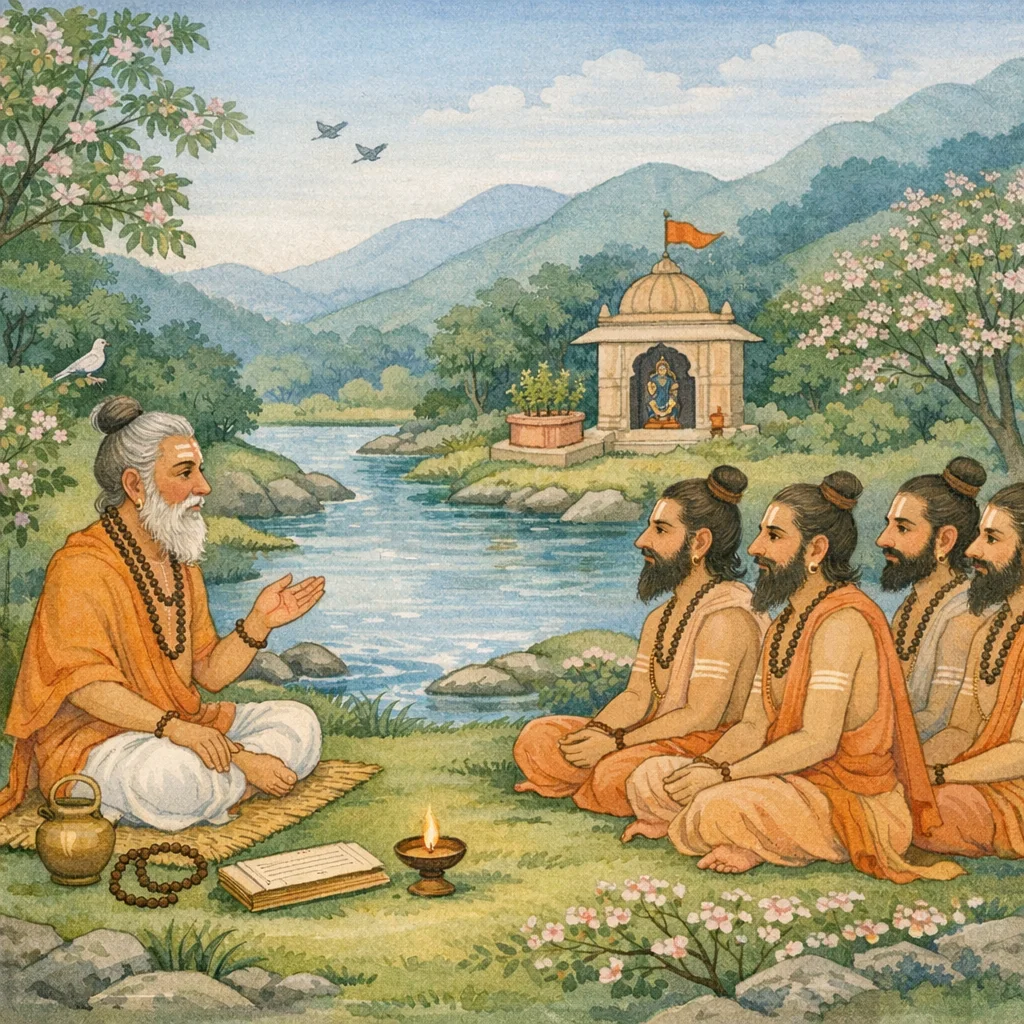
The chapter opens with sages asking Sūta to explain karma-yoga—the discipline of action offered as worship—by which Hari is pleased and liberation is sought. Sūta answers by recalling an earlier occasion when radiant ṛṣis questioned Vyāsa; Vyāsa then taught an eternal, brāhmaṇa-oriented karma-yoga grounded in Manu/Prajāpati’s traditional injunctions. Its core is an ācāra guide: the proper time for upanayana; the marks of a brahmacārin (staff, mekhalā, ajina); and the materials and modes of wearing the sacred thread—upavīta, nivīta, and prācīnāvīta. It also describes sandhyā and fire-rites, worship with simple offerings, and greeting etiquette according to varṇa. A long section defines who should be recognized and served as “gurus”: parents, teacher, elders, and for women, the husband. The chapter closes by affirming the brāhmaṇa’s blessing role and guru-status among the varṇas, presenting disciplined conduct as the preservation of dharma and as devotional action.
Shlokas
Verse 1
ऋषय ऊचु । कर्मयोगः कथं सूत येन चाराधितो हरिः । प्रसीदति महाभाग वद नो वदतां वर
The sages said: “O Sūta, how is Karma-yoga to be practiced—by which Hari, when worshipped, becomes pleased? O fortunate one, tell us; you are the best among speakers.”
Verse 2
येनासौ भगवानीशः समाराध्यो मुमुक्षुभिः । तद्वदाखिललोकानां रक्षणं धर्मसंग्रहम्
By that way the Blessed Lord is to be duly worshipped by those who seek liberation; likewise, the protection of all worlds is upheld as the preservation and consolidation of dharma.
Verse 3
तं कर्मयोगं वद नः सूत मूर्तिमयस्तु यः । इति शुश्रूषवो विप्रा भवदग्रे व्यवस्थिताः
“O Sūta, tell us of that Karma-yoga—how it is embodied in practice.” Thus, the brāhmaṇas, eager to listen, stood assembled before you.
Verse 4
सूत उवाच । एवमेव पुरा पृष्टो व्यासः सत्यवतीसुतः । ऋषिभिरग्निसंकाशैर्व्यासस्तानाह तच्छृणु
Sūta said: Long ago, Vyāsa, the son of Satyavatī, was asked in the same manner by sages radiant like fire. Vyāsa then spoke to them—listen to that.
Verse 5
व्यास उवाच । शृणुध्वंमृषयः सर्वे वक्ष्यमाणं सनातनम् । कर्मयोगं ब्राह्मणानामात्यंतिकफलप्रदम्
Vyāsa said: “Hear, all you sages, the eternal teaching I am about to declare—the karma-yoga of the brāhmaṇas, which bestows the ultimate fruit.”
Verse 6
आम्नायसिद्धमखिलं ब्राह्मणार्थं प्रदर्शितम् । ऋषीणां शृण्वतां पूर्वं मनुराह प्रजापतिः
All that is established by sacred tradition and fully set forth for the sake of the brāhmaṇas—formerly, while the sages were listening, Prajāpati Manu spoke.
Verse 7
सर्वव्याधिहरं पुण्यमृषिसंघैर्निषेवितम् । समाहितधियो यूयं शृणुध्वं गदतो मम
This is holy and removes all ailments; it is practiced by assemblies of sages. You all, with minds collected and attentive, listen to what I am about to tell.
Verse 8
कृतोपनयनो वेदानधीयीत द्विजोत्तमः । गर्भाष्टमेऽष्टमेवाब्दे स्वसूत्रोक्तविधानतः
After receiving the upanayana (sacred-thread initiation), the best of the twice-born should study the Vedas according to the rules laid down in his own Gṛhya-sūtra, in the eighth year from conception—indeed, in the eighth year.
Verse 9
दंडी च मेखली सूत्री कृष्णाजिनधरो मुनिः । भिक्षाहारो गुरुहितो वीक्ष्यमाणो गुरोर्मुखम्
Holding a staff, wearing a girdle and the sacred thread, clad in a black antelope-skin, the sage lived on alms, intent on his teacher’s welfare, ever watching his teacher’s face (for instruction).
Verse 10
कार्पासमुपवीतार्थं निर्मितं ब्रह्मणा पुरा । ब्राह्मणानां त्रिवृत्सूत्रं कौशं वा वस्त्रमेव वा
Long ago, Brahmā fashioned cotton for the sake of the sacred thread. For brāhmaṇas, the upavīta should be a three-stranded cord—made of kuśa-grass, or else simply of cloth.
Verse 11
सदोपवीती चैव स्यात्सदाबद्ध शिखो द्विजः । अन्यथा यत्कृतं कर्म्म तद्भवत्ययथाकृतम्
A twice-born man should always wear the sacred thread and keep his śikhā (topknot) always tied; otherwise, whatever rite he performs becomes as though it were not properly done.
Verse 12
वसेदविकृतं वासः कार्पासं वा कषायकम् । तदेव परिधानीयं शुक्लं तांतवमुत्तमम्
One should wear unadorned clothing—either cotton, or a simple garment dyed the kaṣāya hue. Indeed, one should dress only in excellent white cloth woven of thread.
Verse 13
उत्तरं तु समाम्नातं वासः कृष्णाजिनं शुभम् । अभावे गावयमपि रौरवं वा विधीयते
As for the upper garment, the auspicious clothing prescribed is a black antelope-skin; if that is unavailable, a gavaya-hide or even a raurava-hide is also enjoined.
Verse 14
उद्धृत्य दक्षिणं बाहुं सव्यबाहौ समर्पितम् । उपवीतं भवेन्नित्यं निवीतं कंठसज्जने
When the right arm is lifted and the sacred thread is placed over the left shoulder, it is always called the upavīta position; when it is worn around the neck, it is called nivīta.
Verse 15
सव्यबाहुं समुद्धृत्य दक्षिणे तु धृतं द्विजाः । प्राचीनावीतमित्युक्तं पित्र्येकर्मणि योजयेत्
Having lifted the sacred thread from the left arm and placed it upon the right, O twice-born—this is called the prācīnāvīta; it should be adopted in rites performed for the ancestors.
Verse 16
अग्न्यागारे गवां गोष्ठे होमे तप्ये तथैव च । स्वाध्याये भोजने नित्यं ब्राह्मणानां च सन्निधौ
In the fire-house, in the cows’ shed, during homa offerings and likewise during austerities; during Vedic study and at meals—always, and also in the presence of Brahmins, one should maintain proper conduct and restraint.
Verse 17
उपासने गुरूणां च संध्ययोः साधुसंगमे । उपवीती भवेन्नित्यं विधिरेष सनातनः
During service to one’s gurus, at the times of sandhyā, and in the company of the virtuous, one should always wear the sacred thread in the prescribed manner; this is the eternal rule.
Verse 18
मौंजी त्रिवृत्समां श्लिष्टां कुर्याद्विप्रस्य मेखलाम् । मुंजाभावे कुशेनाहुर्ग्रंथिनैकेन वा त्रिभिः
For a brāhmaṇa, one should make a mekhala (girdle) of muñjā grass, evenly threefold-twisted and closely fitted. If muñjā is unavailable, it may be made from kuśa grass, with one knot—or with three knots.
Verse 19
धारयेद्वैणवपालाशौ दंडौ केशांतिकौ द्विजः । यज्ञार्हवृक्षजं वाथ सौम्यमव्रणमेव च
A twice-born man should carry two staffs made of bamboo or palāśa wood, reaching up to the end of his hair (topknot). Or else he may carry a staff made from a tree fit for sacrificial rites—gentle in nature and free from blemish.
Verse 20
सायंप्रातर्द्विजः संध्यामुपासीत समाहितः । कामाल्लोभाद्भयान्मोहात्त्यक्त्वैनां पतितो भवेत्
A twice-born should worship the Sandhyā at evening and at dawn with a collected mind. If, out of desire, greed, fear, or delusion, he abandons it, he becomes fallen.
Verse 21
अग्निकार्यं ततः कुर्यात्सायंप्रातः प्रसन्नधीः । स्नात्वा संतर्पयेद्देवानृषीन्पितृगणांस्तथा
Then, with a calm and cheerful mind, one should perform the fire-rite in the evening and in the morning; and after bathing, one should offer satisfaction (oblations) to the gods, the sages, and likewise to the hosts of ancestors.
Verse 22
देवताभ्यर्चनं कुर्यात्पुष्पैः पत्रैर्यवांबुभिः । अभिवादनशीलः स्यान्नित्यं वृद्धेषु धर्मतः
One should worship the deities with flowers, leaves, barley, and water; and, in accordance with dharma, one should always be habitually respectful in greeting elders.
Verse 23
असावहं भो नामेति सम्यक्प्रणतिपूर्वकम् । आयुरारोग्यसिद्ध्यर्थं तंद्रादिपरिवर्जितः
Saying, “This is I—O sir—(calling out) by name,” and first offering proper obeisance, he should—free from sloth and the like—act for the attainment of long life and good health.
Verse 24
आयुष्मान्भव सौम्येति वचो विप्रोऽभिवादने । आकारश्चास्य नाम्नोंऽते वाच्यः पूर्वाक्षरप्लुतः
When a brāhmaṇa returns a salutation, he should say, “May you be long-lived, O gentle one,” and he should also pronounce an “ā” at the end of the other person’s name, with the preceding syllable lengthened.
Verse 25
यो न वेत्त्यभिवादस्य विप्रः प्रत्यभिवादनम् । नाभिवाद्यः स विदुषा यथा शूद्रस्तथैव सः
A brāhmaṇa who does not know the proper return-greeting to a salutation should not be greeted by the learned; he is to be regarded as no different from a śūdra.
Verse 26
व्यत्यस्तपाणिना कार्यं पादसंग्रहणं गुरोः । सव्येन सव्यः स्प्रष्टव्यो दक्षिणेन तु दक्षिणः
One should clasp the Guru’s feet with hands crossed: the left hand touching the left foot, and the right hand the right foot.
Verse 27
लौकिकं वैदिकं वापि तथाध्यात्मिकमेव वा । अवाप्य प्रयतो ज्ञानं तं पूर्वमभिवादयेत्
Having earnestly obtained knowledge—worldly, Vedic, or spiritual—one should first offer respectful salutations to the teacher from whom it was received.
Verse 28
नोदकं धारयेद्भैक्ष्यं पुष्पाणि समिधस्तथा । एवंविधानि चान्यानि न देवार्थेषु कर्म्मसु
One should not keep for later use water, alms-food, flowers, or sacrificial kindling (samidh); likewise, other such items should not be stored when performing rites intended for the gods.
Verse 29
ब्राह्मणं कुशलं पृच्छेत्क्षत्रबंधुमनामयम् । वैश्यं क्षेमं समागम्य शूद्रमारोग्यमेव च
One should ask a brāhmaṇa about his well-being; a kṣatriya about his freedom from illness; upon meeting a vaiśya, about his security and prosperity; and a śūdra, indeed, about his health.
Verse 30
उपाध्यायः पिता ज्येष्ठो भ्राता त्राता च भीतितः । मातुलः श्वशुरश्चैव मातामह पितामहौ
The preceptor, the father, the elder brother, the protective brother, and one who rescues from fear; likewise the maternal uncle and the father-in-law, as well as the maternal grandfather and the paternal grandfather—all these are to be honored with special reverence.
Verse 31
वर्णश्रेष्ठः पितृव्यश्च पुंसोऽत्र गुरवः स्मृताः । माता मातामही गुर्वी पितुर्मातुश्च सोदराः
Here, the most eminent within one’s own social order and one’s paternal uncle are remembered as a man’s elders (gurus). Likewise, the mother and maternal grandmother are revered as venerable elders, as are the sisters of one’s father and mother.
Verse 32
श्वश्रूः पितामही ज्येष्ठा धात्री च गुरवः स्त्रियः । ज्ञेयस्तु गुरुवर्गोऽयं मातृतः पितृतो द्विजाः
A mother-in-law, a grandmother, an elder sister, and a nurse or caretaker—these women are to be regarded as venerable elders (gurus). O twice-born ones, this group of elders should be understood as belonging to both the maternal and paternal lines.
Verse 33
अनुवर्तनमेतेषां मनोवाक्कायकर्मभिः । गुरून्दृष्ट्वा समुत्तिष्ठेदभिवाद्य कृताञ्जलि
One should follow and serve these teachers with mind, speech, and bodily action. On seeing the gurus, one should rise, offer salutations, and greet them with folded hands.
Verse 34
नैतैरुपविशेत्सार्द्धं विवदेन्नात्मकारणात् । जीवितार्थमपि द्वेषाद्गुरुभिर्नैव भाषणम्
One should not sit in their company, nor argue with them for one’s own sake. Even for the sake of livelihood, one should not speak out of hatred—even if they are elders or superiors.
Verse 35
उद्रिक्तोऽपि गुणैरन्यैर्गुरुद्वेषी पतत्यधः । गुरूणामपि सर्वेषां पंच पूज्या विशेषतः
Even if one is rich in other virtues, whoever hates or despises the guru falls downward. Among all gurus, five are especially to be revered.
Verse 36
तेषामाद्यास्त्रयः श्रेष्ठास्तेषां माता सुपूजिता । यो भावयति या सूते येन विद्योपदिश्यते
Among them, the first three are the most excellent; and their mother too is greatly revered—he who begets, she who gives birth, and he by whom knowledge is imparted.
Verse 37
ज्येष्ठो भ्राता च भर्ता च पंचैते गुरवः स्मृताः । आत्मनः सर्वयत्नेन प्राणत्यागेन वा पुनः
The elder of the family, one’s brother, and one’s husband—together with two others—are remembered as the five ‘gurus’. One should honor them with every effort, even at the cost of one’s own life.
Verse 38
पूजनीया विशेषेण पंचैते भूतिमिच्छता । यावत्पिता च माता च द्वावेतौ निर्विकारिणौ
One who desires prosperity should especially revere these five, so long as one’s father and mother—those two—remain steadfast and unimpaired.
Verse 39
तावत्सर्वं परित्यज्य पुत्रः स्यात्तत्परायणः । पिता माता च सुप्रीतौ स्यातां पुत्रगुणैर्यदि
Setting aside all else, a son should be wholly devoted to that duty. If he possesses the virtues of a good son, his father and mother will indeed be greatly pleased.
Verse 40
स पुत्रः सकलं धर्मं प्राप्नुयात्तेन कर्मणा । नास्ति मातृसमं दैवं नास्ति पितृसमो गुरुः
By that very deed, such a son attains the fullness of dharma. There is no divinity equal to one’s mother, and no teacher equal to one’s father.
Verse 41
तयोः प्रत्युपकारोऽपि न कथंचन विद्यते । तयोर्नित्यं प्रियं कुर्यात्कर्मणा मनसा गिरा
There is no way at all to repay those two. Therefore, one should always do what is pleasing to them—through one’s actions, one’s mind, and one’s speech.
Verse 42
न ताभ्यामननुज्ञातो धर्ममन्यं समाचरेत् । वर्जयित्वा मुक्तिफलं नित्यं नैमित्तिकं तथा
Without being permitted by those two, one should not undertake any other religious duty—except for the daily and occasional rites, setting aside even acts whose fruit is liberation.
Verse 43
धर्मसारः समुद्दिष्टः प्रेत्यानंतफलप्रदः । सम्यगाराध्य वक्तारं विसृष्टस्तदनुज्ञया
The essence of dharma has been expounded—bestowing endless results after death. Having duly honored the speaker, he departed with that speaker’s permission.
Verse 44
शिष्यो विद्याफलं भुंक्ते प्रेत्य चापद्यते दिवि । यो भ्रातरं पितृसमं ज्येष्ठं मूढोऽवमन्यते
A disciple enjoys the fruit of learning and, after death, attains heaven; but the fool who disrespects his elder brother—who is like a father—falls into misfortune.
Verse 45
तेन दोषेण संप्रेत्य निरयं घोरमृच्छति । पुंसां वर्त्मनि सृष्टेन पूज्यो भर्ता तु सर्वदा
By that fault, after death one goes to a dreadful hell. Therefore, since the husband has been established as the ordained path for men, the husband should always be revered.
Verse 46
अपि मातरि लोकेऽस्मिन्नुपकाराद्धि गौरवम् । मातुलांश्च पितृव्यांश्च श्वशुरानृत्विजो गुरून्
Even in this world, reverence arises from beneficence; therefore one should honor the maternal uncles, paternal uncles, fathers-in-law, officiating priests, and teachers.
Verse 47
असावहमिति ब्रूयात्प्रत्युत्थायाभिवादयेत् । अवाच्यो दीक्षितो नाम्ना यवीयानपि यो भवेत्
One should say, “It is I,” and, rising up, offer respectful salutation. Even if he is younger, one who has been initiated (dīkṣā) should not be addressed by name.
Verse 48
भो भवत्पूर्वकं त्वेनमभिभाषेत धर्मवित् । अभिवाद्यश्च पूज्यश्च शिरसानम्य एव च
A knower of dharma should address him beginning with the respectful “bhavat”; and having saluted and honored him, one should bow one’s head as well.
Verse 49
ब्राह्मणक्षत्रियाद्यैश्च श्रीकामैः सादरं सदा । नाभिवाद्याश्च विप्रेण क्षत्रियाद्याः कथंचन
Brahmins, Kshatriyas, and others who desire śrī—prosperity and auspicious fortune—should always act with reverence. Yet Kshatriyas and the rest should never, under any circumstance, be the ones to initiate salutations to a Brahmin.
Verse 50
ज्ञानकर्मगुणोपेता यद्यप्येते बहुश्रुताः । ब्राह्मणः सर्ववर्णानां स्वस्ति कुर्यादिति श्रुतिः
Even if these people are learned and endowed with knowledge, ritual action, and virtues, the śruti teaches that it is the Brāhmaṇa who should pronounce blessings for all the varṇas.
Verse 51
इति श्रीपाद्मे महापुराणे स्वर्गखंडे कर्मयोगकथनं । नाम एकपंचाशत्तमोऽध्यायः
Thus ends the fifty-first chapter, called “The Teaching on Karma-yoga,” in the Svarga-khaṇḍa of the glorious Padma Mahāpurāṇa.
Verse 52
पतिरेको गुरुः स्त्रीणां सर्वत्राभ्यागतो गुरुः । विद्याकर्मवयोबंधुर्वित्तं भवति पंचमम्
For women, the husband alone is the primary teacher; in every situation he is regarded as the guide. Learning, work, age, relatives, and wealth are also counted—wealth being the fifth.
Verse 53
मान्यस्थानानि पंचाहुः पूर्वं पूर्वं गुरूत्तरात् । पंचानां त्रिषु वर्णेषु भूयांसि बलवंति च
They speak of five ranks worthy of honor, each earlier one being weightier than the one that follows. And among these five, within the three higher varṇas, the greater claims are regarded as stronger.
Verse 54
यत्र स्युः सोऽत्र मानार्हः शूद्रोऽपि दशमीं गतः । पंथा देयो ब्राह्मणाय स्त्रियै राज्ञे विचक्षुषे
Wherever they may be, that person there is worthy of honor—even a Śūdra who has reached the tenth stage. A path should be given way to a Brāhmaṇa, to a woman, to a king, and to one who is discerning.
Verse 55
वृद्धाय भारभग्नाय रोगिणे दुर्बलाय च । भिक्षामाहृत्य शिष्टानां गृहेभ्यः प्रयतोऽन्वहम्
With reverent care, each day he brought alms from the homes of the respectable, for an old man—crushed by burdens, sick and frail.
Verse 56
निवेद्य गुरुवेऽश्नीयाद्वाग्यतस्तदनुज्ञया । भवत्पूर्वं चरेद्भैक्ष्यमुपवीती द्विजोत्तमः
Having first offered it to the teacher, he should eat only with the teacher’s permission, keeping his speech restrained. The excellent twice-born should go to gather alms only after the teacher has eaten, wearing the sacred thread properly.
Verse 57
भवन्मध्यं तु राजन्यो वैश्यस्तु भवदुत्तरम् । मातरं वा स्वसारं वा मातुर्वा भगिनीं निजाम्
“O king, the Kṣatriya stands in the middle rank, and the Vaiśya is placed below you. (One must not approach improperly) one’s mother, one’s sister, or one’s own maternal aunt.”
Verse 58
भिक्षेत भिक्षांप्रथमं याचैनं न विमानयेत् । सजातीयगृहेष्वेव सार्ववर्णिकमेव वा
One should first go forth to seek alms; and if a petitioner asks of him, he should not insult or disregard the supplicant. Alms should be sought only in the houses of one’s own community—or else in households open to all varṇas.
Verse 59
भैक्ष्यस्याचरणं प्रोक्तं पतिता दिवि वर्जितम् । वेदयज्ञैरहीनानां प्रशस्तानां स्वकर्म्मसु
The practice of living on alms is declared (proper for some), yet it is forbidden to those who have fallen from righteous conduct. For those not deprived of Vedic rites and sacrifices—approved in their own duties—only then is it commended within their rightful work.
Verse 60
ब्रह्मचार्य्याहरेद्भैक्ष्यं गृहेभ्यः प्रयतोऽन्वहम् । गुरोः कुले न भिक्षेत न ज्ञातिकुलबंधुषु
A brahmacārin, disciplined and restrained, should daily gather alms from households; yet he should not beg in his teacher’s family, nor among his own relatives and kinsmen.
Verse 61
अलाभेत्वन्यगेहानां पूर्वं पूर्वं विवर्जयेत् । सर्वं वा विचरेद्ग्रामं पूर्वोक्तानामसंभवे
If he does not obtain (alms-food) from other households, he should withdraw—step by step—from those previously approached; or, if the earlier-mentioned means are not possible, he may go about the entire village.
Verse 62
नियम्य प्रयतो वाचं दिशस्त्वनवलोकयन् । समाहृत्य तु भैक्ष्यान्नं यावदर्थममायया
Restraining his speech with disciplined care and not looking about in the directions, he gathered alms-food only to the extent needed, without deceit.
Verse 63
भुंजीत प्रयतो नित्यं वाग्यतोऽनन्यमानसः । भैक्ष्येण वर्तयेन्नित्यं नैवेकान्नो भवेद्व्रती
Let the vow-observer eat daily with purity and discipline—restraining speech and keeping the mind undistracted. Let him live always on alms, and let him never become one who eats from a single source (dependent on one household alone).
Verse 64
भैक्ष्यैण वर्त्तिनो वृत्तिरुपवाससमा स्मृता । पूजयेदशनं नित्यमद्याच्चैनमकुत्सयन्
For one who lives by alms, that way of livelihood is regarded as equal to fasting. One should always honor the food received and eat it without disparaging it.
Verse 65
दृष्ट्वा हृष्येत्प्रसीदेच्च प्रतिनंदेच्च सर्वशः । अनारोग्यमनायुष्यमस्वर्ग्यं चातिभोजनम्
On seeing food, one should rejoice, be content, and offer approval in every way; for overeating brings ill-health, shortens life, and is not conducive to heaven.
Verse 66
अपुण्यं लोकविद्विष्टं तस्मात्तत्परिवर्जयेत् । प्राङ्मुखोऽन्नानि भुंजीत सूर्याभिमुखमेव वा
What is impure and condemned by society is without merit; therefore one should avoid it. One should eat food facing east—or else facing the Sun.
Verse 67
नाद्यादुदङ्मुखो नित्यं विधिरेष सनातनः । प्रक्षाल्य पाणिपादौ च भुंजानो द्विरुपस्पृशेत्
One should never eat while facing north; this is an eternal rule. Having washed the hands and feet, and while eating, one should perform the purifying touch (ācamana) twice.
Verse 68
शुद्धे देशे समासीनो भुक्त्वा च द्विरुपस्पृशेत्
Seated in a clean place, after eating he should perform ācamana (ritual sipping of water) twice.