Adhyaya 44
The Greatness of Prayāga (Merits of Māgha Rites and Northern River Fords)
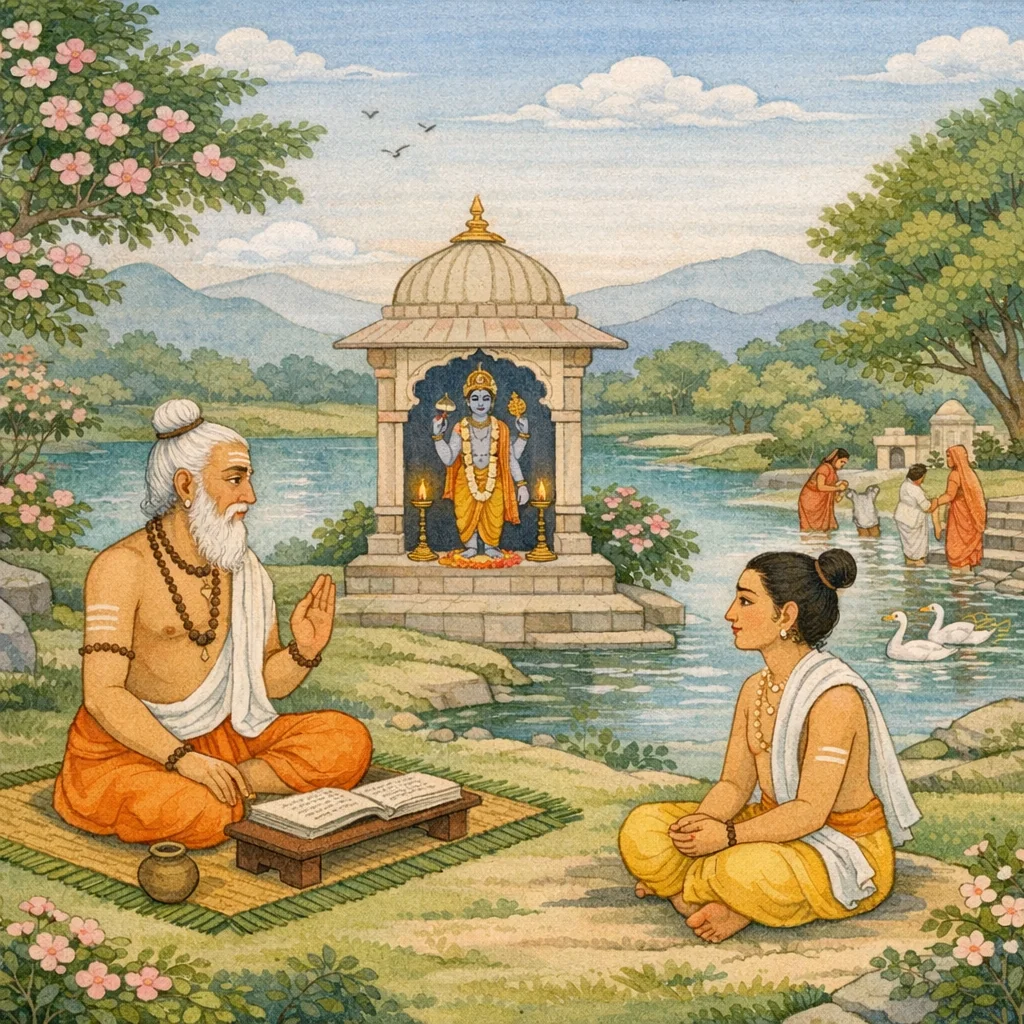
This chapter continues the Prayāga-māhātmya by naming particular tīrthas and time-bound observances at the Gaṅgā–Yamunā confluence. It introduces the Mānasā ford on the northern bank of the Gaṅgā, praising a three-night fast there, and declaring that even mere remembrance of the ford can be salvific. It then sets forth the promised afterlife for those who die in the Gaṅgā: celestial enjoyments, travel in aerial cars (vimānas), and a fixed sojourn in svarga; when merit is spent, they are reborn in prosperous lineages or attain rulership. The Māgha pilgrimage to the confluence is proclaimed equal to vast gifts of cows, and Māgha austerities such as the pañcāgni are compared to the merit of many days of sacred bathing. The chapter also mentions Ṛṇapramocana tīrtha, south of Prayāga on the northern bank of the Yamunā, where a single night is said to remove debts and lead to Sūrya’s realm.
Shlokas
Verse 1
मार्कंडेय उवाच । शृणु राजन्प्रयागस्य माहात्म्यं पुनरेव तु । यच्छ्रुत्वा सर्वपापेभ्यो मुच्यते नात्र संशयः
Mārkaṇḍeya said: O King, listen once again to the sacred greatness of Prayāga; by hearing it, one is freed from all sins—of this there is no doubt.
Verse 2
मानसं नाम तत्तीर्थं गंगायामुत्तरे तटे । त्रिरात्रोपोषितो भूत्वा सर्वान्कामानवाप्नुयात्
There is a sacred ford called Mānasā on the northern bank of the Gaṅgā. Having observed a fast there for three nights, one attains all desired aims.
Verse 3
गोभूहिरण्यदानेन यत्फलं प्राप्नुयान्नरः । एतत्फलमवाप्नोति तत्तीर्थं स्मरते पुनः
Whatever merit a person would obtain by gifting cows, land, and gold—he attains that very merit again simply by remembering that sacred tīrtha.
Verse 4
अकामो वा सकामो वा गंगायां यो विपद्यते । मृतस्तु भवति स्वर्गे नरकं न च पश्यति
Whether free of desires or full of desires, whoever meets death in the Gaṅgā—once dead—dwells in heaven and does not behold hell.
Verse 5
अप्सरोगणसंगीतैः सुप्तोऽसौ प्रतिबुध्यते । हंससारसयुक्तेन विमानेन स गच्छति
Awakened from sleep by the music of hosts of apsarās, he rises; and he proceeds in a celestial aerial car (vimāna) yoked with swans and sārasas (cranes).
Verse 6
बहुवर्षाणि राजेन्द्र षट्सहस्राणि भुंजते । ततः स्वर्गात्परिभ्रष्टः क्षीणकर्मा दिवश्च्युतः
O king of kings, they enjoy heavenly delights for many years—six thousand. Then, fallen from Svarga, their merit exhausted, they are cast down from the celestial realm.
Verse 7
सुवर्णमणिमुक्ताढ्ये जायते स महाकुले । षष्टितीर्थसहस्राणि षष्टितीर्थशतानि च
He is born into a great lineage, abounding in gold, jewels, and pearls; and he attains the merit of sixty thousand tīrthas, and also of sixty hundreds of tīrthas.
Verse 8
माघेमासि गमिष्यंति गंगायमुनसंगमे । गवां शतसहस्रस्य सम्यग्दत्तस्य यत्फलम्
Those who go in the month of Māgha to the confluence of the Gaṅgā and Yamunā obtain the same merit as that gained by properly gifting one hundred thousand cows.
Verse 9
प्रयागे माघमासे तु त्र्यहंस्नानस्य तत्फलम् । गंगायमुनयोर्मध्ये पंचाग्निं यस्तु साधयेत्
In Prayāga, during the month of Māgha, one who performs the austerity of the ‘five fires’ between the Gaṅgā and Yamunā gains the same merit as bathing for three days.
Verse 10
अहीनांगो ह्यरोगश्च पंचेन्द्रियसमन्वितः । यावंति रोमकूपाणि तस्य गात्रस्य देहिनः
He becomes whole-limbed and free from disease, endowed with the five senses; and as many as are the pores of hair upon the limbs of that embodied being…
Verse 11
तावद्वर्षसहस्राणि स्वर्गलोके महीयते । ततः स्वर्गात्परिभ्रष्टो जंबूद्वीपपतिर्भवेत्
For so many thousands of years he is honored in the world of Svarga; then, when his merit is spent and he falls from heaven, he becomes a ruler of Jambūdvīpa.
Verse 12
स भुक्त्वा विपुलान्भोगांस्तत्तीर्थं भजते नरः । जलप्रवेशं यः कुर्यात्संगमे लोकविश्रुते
That man, having enjoyed abundant pleasures, attains that sacred tīrtha; whoever enters the waters at the renowned confluence (saṅgama) gains its merit.
Verse 13
राहुग्रस्तो यथा सोमो विमुक्तः सर्वपातकैः । सोमलोकमवाप्नोति सोमेन सह मोदते
Just as the Moon, once seized by Rāhu, is released and freed from all sins, so the devotee attains the realm of Soma (Somaloka) and rejoices there together with Soma.
Verse 14
षष्टिवर्षसहस्राणि षष्टिवर्षशतानि च । स्वर्गलोकमवाप्नोति ऋषिगंधर्वसेवितः
For sixty thousand years, and for a further six hundred years, he attains the world of Svarga, honored and attended by sages (ṛṣis) and Gandharvas.
Verse 15
परिभ्रष्टस्तु राजेंद्र समृद्धे जायते कुले । अधःशिरास्तु यो ज्वालामूर्ध्वपादः पिबेन्नरः
O king, one who has fallen from his proper state is born into a prosperous family; but the man who drinks with his head downward and feet upward, as though flames were his head, falls into a dreadful condition.
Verse 16
शतं वर्षसहस्राणि स्वर्गलोके महीयते । परिभ्रष्टस्तु राजेंद्र अग्निहोत्री भवेन्नरः
For a hundred thousand years he is honored in the heavenly world. But if he falls away from right conduct, O king, that man becomes an Agnihotrī, bound to the sacred Agnihotra rite.
Verse 17
भुक्त्वा तु विपुलान्भोगांस्तत्तीर्थं भजते नरः । यस्तु देहं विकर्तित्वा शकुनिभ्यः प्रयच्छति
But after enjoying abundant pleasures, a man resorts to that sacred ford (tīrtha). And he who, having cut up his own body, offers it to the birds—vultures and the like—…
Verse 18
विहंगैरुपभुक्तस्य शृणु तस्यापि यत्फलम् । शतं वर्षसहस्राणां सोमलोके महीयते
Hear also the fruit of that which has been enjoyed by birds: one is honored in Soma’s world for a hundred thousand years.
Verse 19
ततः स्वर्गात्परिभ्रष्टो राजा भवति धार्मिकः । गुणवान्रूपसंपन्नो विद्वान्सुप्रियदेहवान्
Then, having fallen from heaven, he becomes a righteous king—virtuous, handsome, accomplished in form, learned, and possessed of a pleasing body.
Verse 20
भुक्त्वा तु विपुलान्भोगांस्तत्तीर्थं भजते पुनः । यामुने चोत्तरे कूले प्रयागस्य तु दक्षिणे
After enjoying abundant pleasures, he again resorts to that sacred ford (tīrtha)—on the northern bank of the Yamunā, and to the south of Prayāga.
Verse 21
ऋणप्रमोचनं नाम तीर्थं तत्परमं स्मृतम् । एकरात्रोषितो भूत्वा ऋणैः सर्वैः प्रमुच्यते
There is a sacred ford called Ṛṇapramocana, remembered as supremely excellent. By staying there for a single night, one is released from all debts and obligations.
Verse 22
सूर्यलोकमवाप्नोति अनृणी च सदा भवेत्
He attains the realm of the Sun, Sūryaloka, and always remains free from debt, unburdened by obligations.
Verse 44
इति श्रीपाद्मे महापुराणे स्वर्गखंडे प्रयागमाहात्म्ये चतुश्चत्वारिंशोऽध्यायः
Thus ends the forty-fourth chapter, “The Greatness of Prayāga,” in the Svarga-khaṇḍa of the Śrī Padma Mahāpurāṇa.