Adhyaya 38
The Glory of Gayā and the Pilgrimage Circuit of Allied Tīrthas
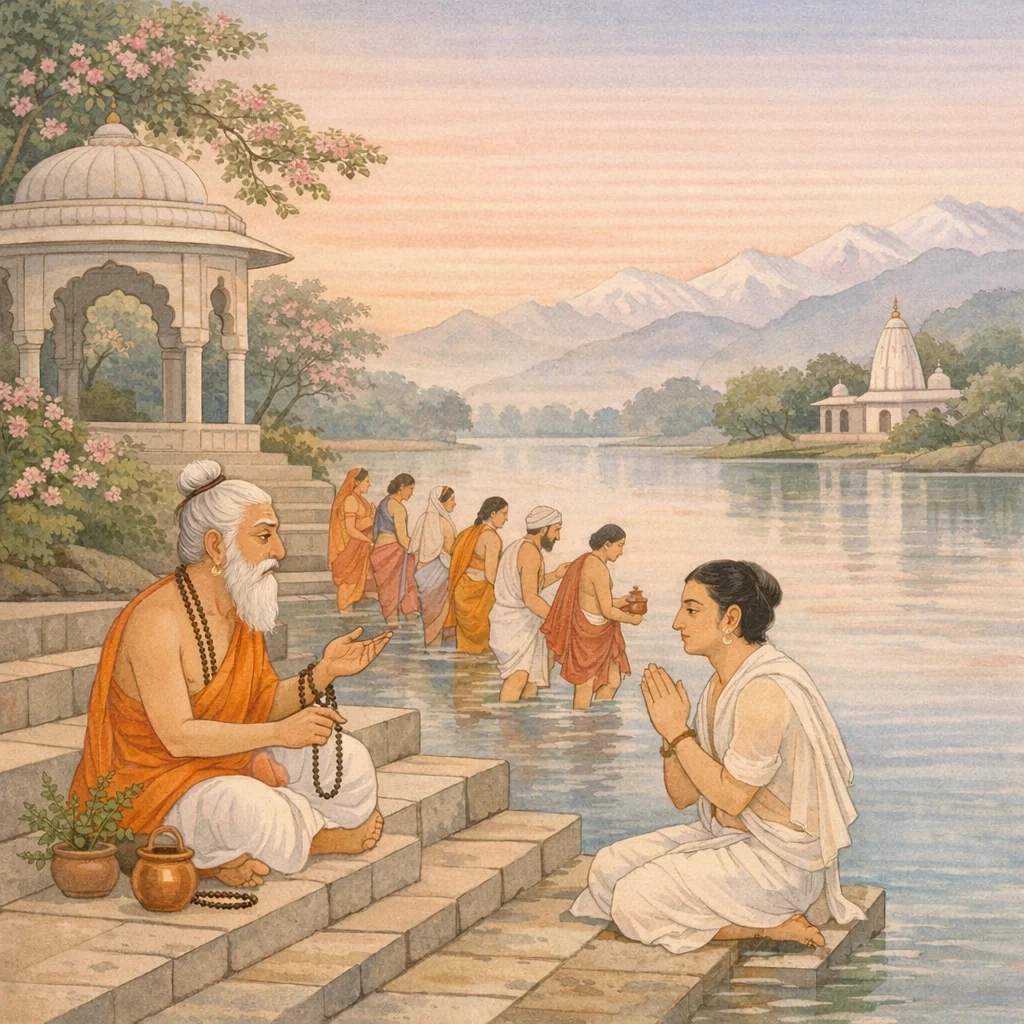
PP.3.38 carries the tīrtha itinerary beyond Vārāṇasī into Gayā and a broad circuit of rivers, lakes, wells, groves, and deity-stations. Gayā is praised as granting at once the merit of an Aśvamedha, especially through ancestral rites at the Akṣaya-vaṭa and the offering of tarpaṇa after bathing. The chapter links many sacred sites—Brahmā’s lake and yūpa, Dhenuka, Gṛdhravaṭa, the Sāvitrī station, Yonidvāra, the Phalgu, Dharmapṛṣṭha, Brahmā’s ford, Rājagṛha, Maṇināga, Ahalyā’s lake, Janaka’s well, Gaṇḍakī/Śālagrāma, Māheśvara-pada, Tīrthakoṭi, and others—repeatedly declaring their fruits equal to Vājapeya, Rājasūya, or Agniṣṭoma, or promising the heavenly worlds of Soma, Sūrya, Indra, Viṣṇu, and Maheśa. Ritual acts are presented as the means of merit and lineage uplift: snāna, abhiṣeka, an ash-bearing bath, fasting, the gift of a sesame-cow, and dāna. Through such observances the pilgrim is purified, the ancestors are satisfied, and higher realms are attained.
Shlokas
Verse 1
नारद उवाच । वाराणस्याश्च माहात्म्यं तस्यां तीर्थानि च प्रभो । कथितानि समासेन तीर्थान्यन्यानि संशृणु
Nārada said: “O Lord, the greatness of Vārāṇasī and the sacred tīrthas within it have been told in brief. Now hear also of the other holy tīrthas.”
Verse 2
ततो गयां समासाद्य ब्रह्मचारी समाहितः । अश्वमेधमवाप्नोति गमनादेव भारत
Then, having reached Gayā, the disciplined brahmacārin, steady and self-collected, attains the merit of the Aśvamedha sacrifice merely by going there, O Bhārata.
Verse 3
यत्राक्षय्यवटो नाम त्रिषु लोकेषु विश्रुतः । पितॄणां तत्र वै दत्तमक्षयं भवति प्रभो
Where the sacred banyan known as Akṣayya-vaṭa is famed throughout the three worlds—O Lord—whatever is offered there for the ancestors truly becomes inexhaustible.
Verse 4
महानद्यामुपस्पृश्य तर्पयेत्पितृदेवताः । अक्षयान्प्राप्नुयाल्लोकान्कुलं चैव समुद्धरेत्
After bathing in a great sacred river, one should offer tarpaṇa—libations—to the ancestral deities; thereby one attains imperishable worlds and also uplifts one’s family lineage.
Verse 5
ततो ब्रह्मसरो गच्छेद्ब्रह्मारण्योपसेवितम् । पुंडरीकमवाप्नोति प्रभातमिव शर्वरी
Then one should go to the Brahma-lake, revered by the Brahma-forest; there one attains the merit called Puṇḍarīka—just as night yields to dawn.
Verse 6
सरसि ब्रह्मणा तत्र यूपश्रेष्ठः समुच्छ्रितः । यूपं प्रदक्षिणं कृत्वा वाजपेयफलं लभेत्
There, in that lake, Brahmā raised aloft the finest sacrificial post (yūpa). Having reverently circumambulated that yūpa, one attains the merit—the fruit—of the Vājapeya sacrifice.
Verse 7
ततो गच्छेत राजेंद्र धेनुकं लोकविश्रुतम् । एकारात्रोषितो राजन्प्रयच्छेत्तिलधेनुकाम्
Then, O best of kings, he should go to the world-renowned sacred place called Dhenuka. After staying there for one night, O king, he should offer a tiladhenu—a ritual ‘sesame-cow’ gift.
Verse 8
सर्वपापविशुद्धात्मा सोमलोकं व्रजेद्ध्रुवम् । तत्र चिह्नं महाराज अद्यापि हि न संशयः
One whose self has been purified of all sins surely goes to Soma’s world. And there, O great king, the sign remains even today—of this there is no doubt.
Verse 9
कपिला सहवत्सा वै पर्वते विचरत्युतः । सवत्सायाः पदान्यस्या दृश्यंतेऽद्यापि भारत
O Bhārata, the tawny cow Kapilā, together with her calf, indeed roams upon the mountain; and even today the hoofprints of that cow with her calf are seen there.
Verse 10
तेषूपस्पृश्य राजेंद्र पदेषु नृपसत्तम । यत्किंचिदशुभं पापं तत्प्रणश्यति भारत
O king of kings, O best of rulers—by touching those footprints, whatever inauspicious sin there may be is destroyed, O Bhārata.
Verse 11
ततो गृध्रवटं गच्छेत्स्थानं देवस्य शूलिनः । स्नायात्तु भस्मना तत्र संगम्य वृषभध्वजम्
Then one should go to Gṛdhravaṭa, the sacred abode of the trident-bearing Lord (Śiva). There, having met the bull-bannered Lord, one should bathe, anointing oneself with holy ash.
Verse 12
ब्राह्मणेन भवेच्चीर्णं व्रतं द्वादशवार्षिकम् । इतरेषां तु वर्णानां सर्वपापं प्रणश्यति
For a Brāhmaṇa, this vow is to be observed for twelve years; but for the other varṇas, by it all sin is destroyed.
Verse 13
गच्छेत तत उद्यंतं पर्वतं गीतनादितम् । सावित्रं तु पदं तत्र दृश्यते भरतर्षभ
Then one should proceed to the eastern, rising mountain, resonant with songs; there, O bull among the Bhāratas, the sacred station of Sāvitrī is seen.
Verse 14
तत्र संध्यामुपासीत ब्राह्मणः संशितव्रतः । उपास्ताहि भवेत्संध्या तेन द्वादशवार्षिकी
There, a Brāhmaṇa steadfast in vows should perform the Sandhyā worship; for when Sandhyā is duly observed, that practice yields merit equal to a twelve-year observance.
Verse 15
योनिद्वारं च तत्रैव विश्रुतं भरतर्षभ । तत्राभिगम्य मुच्येत पुरुषो योनिसंकटात्
And there itself, O best of the Bhāratas, is a renowned place called “Yonidvāra,” the Womb-Gate. By going there, a person is freed from the affliction and peril connected with birth (the womb).
Verse 16
शुक्लकृष्णावुभौ पक्षौ गयायां यो वसेन्नरः । पुनात्यासप्तमं राजन्कुलं नास्त्यत्र संशयः
O King, the man who dwells in Gayā through both fortnights—the bright and the dark—purifies his lineage up to the seventh generation; of this there is no doubt.
Verse 17
एष्टव्या बहवः पुत्रा यद्यप्येको गयां व्रजेत् । यजेत वाश्वमेधेन नीलं वा वृषमुत्सृजेत्
Many sons should be desired, even if only one of them might go to Gayā; or one may perform the Aśvamedha sacrifice, or release a blue bull.
Verse 18
ततः फल्गुं व्रजेद्राजंस्तीर्थसेवी नराधिप । अश्वमेधमवाप्नोति सिद्धिं च परमां व्रजेत्
Then, O king—O lord of men—the pilgrim who serves the sacred tīrthas should go to Phalgu; he attains the merit of an Aśvamedha sacrifice and proceeds to the highest spiritual perfection.
Verse 19
ततो गच्छेत राजेंद्र धर्मपृष्ठं समाहितः । यत्र धर्मो महाराज नित्यमास्ते युधिष्ठिर
Then, O lord of kings, he should proceed with a focused mind to Dharmapṛṣṭha—where Dharma, O great king Yudhiṣṭhira, ever abides.
Verse 20
धर्म्मं तत्राभिसंगम्य वाजिमेधफलं लभेत् । ततो गच्छेत राजेंद्र ब्रह्मणस्तीर्थमुत्तमम्
Having approached Dharma there, one attains the fruit of the Aśvamedha sacrifice. Then, O best of kings, one should proceed to the supreme sacred tīrtha of Brahmā.
Verse 21
तत्राभिगम्य ब्रह्माणमर्चयेन्नियतव्रतः । राजसूयाश्वमेधाभ्यां फलं प्राप्नोति भारत
Having gone there, one of disciplined vows should worship Brahmā; O Bhārata, he attains the same fruit as the Rājasūya and Aśvamedha sacrifices.
Verse 22
ततो राजगृहं गच्छेत्तीर्थसेवी नराधिप । उपस्पृश्य ततस्तत्र कक्षीवानिव मोदते
Then, O king, the pilgrim devoted to visiting sacred fords should go to Rājagṛha. Having purified himself there by touching the holy water, he rejoices in that place like Kakṣīvān.
Verse 23
यक्षिण्या नैत्यकं तत्र प्रागग्निपुरुषः शुचिः । यक्षिण्यास्तु प्रसादेन मुच्यते ब्रह्महत्यया
There, by the yakṣiṇī, the naityaka (funeral rite) was performed; and beforehand the radiant Agni-puruṣa, pure, appeared. By the yakṣiṇī’s gracious favor, he is released from the sin of brahma-hatyā (the killing of a brāhmaṇa).
Verse 24
मणिनागं ततो गच्छेद्गोसहस्रफलं लभेत् । नैत्यकं भुंजते यस्तु मणिनागस्य मानवः
Then one should go to Maṇināga; one obtains merit equivalent to the gift of a thousand cows. But the person who partakes of the naityaka belonging to Maṇināga does not gain that merit.
Verse 25
दष्टस्याशीविषेणास्य न विषं क्रमते नृप । तत्रोष्य रजनीमेकां सर्वपापैः प्रमुच्यते
O king, for one who has been bitten by a venomous serpent, the poison does not spread. By staying there for a single night, one is released from all sins.
Verse 26
ततो गच्छेत ब्रह्मर्षेर्गौतमस्य वनं नृप । अहल्याया ह्रदे स्नात्वा व्रजेत परमां गतिम्
Then, O King, one should go to the forest of the Brahmarṣi Gautama; bathing in Ahalyā’s lake, one attains the supreme state.
Verse 27
अभिगम्य श्रियं राजन्विंदते श्रियमुत्तमाम् । तत्रोदपानो धर्म्मज्ञ त्रिषु लोकेषु विश्रुतः
O King, by approaching that sacred prosperity, one attains the highest fortune. There, O knower of dharma, a well is found—renowned throughout the three worlds.
Verse 28
तत्राभिषेकं कुर्वीत वाजिमेधमवाप्नुयात् । जनकस्य तु राजर्षेः कूपस्त्रिदशपूजितः
One should perform the consecratory rite (abhiṣeka) there and thereby attain the merit of the Aśvamedha sacrifice. Indeed, the well of King Janaka, the royal sage, is revered even by the gods.
Verse 29
तत्राभिषेकं कृत्वा च विष्णुलोकमवाप्नुयात् । ततोऽविनाशनं गच्छेत्सर्वपापप्रमोचनम्
Having performed the ritual bathing (abhiṣeka) there, one attains Viṣṇu’s world. Thereafter one reaches the Imperishable, the remover of all sins.
Verse 30
वाजिमेधमवाप्नोति सोमलोकं च गच्छति । गंडकीं च समासाद्य सर्वतीर्थजलोद्भवाम्
He attains the fruit of the Aśvamedha sacrifice and also goes to Soma’s world; and having reached the Gaṇḍakī—whose waters are said to arise from all sacred pilgrimage-waters—he gains great merit.
Verse 31
वाजपेयमवाप्नोति सूर्यलोकं च गच्छति । ततो ध्रुवस्य धर्मज्ञ समाविश्य तपोवनम्
He attains the merit of the Vājapeya sacrifice and also goes to the world of Sūrya. Then, O knower of dharma, entering Dhruva’s sacred Tapovana, the grove of austerities, he abides there.
Verse 32
गुह्यकेषु महाभाग मोदते नात्र संशयः । कर्मदां तु समासाद्य नदीं सिद्धनिषेविताम्
O greatly fortunate one, he rejoices among the Guhyakas—of this there is no doubt—having reached the river Karmadā, which is frequented by the Siddhas.
Verse 33
पुंडरीकमवाप्नोति सोमलोकं च गच्छति । ततो विशालामासाद्य नदीं त्रैलोक्यविश्रुताम्
He attains Puṇḍarīka and also goes to the world of Soma; then, reaching the river Viśālā—renowned throughout the three worlds—he proceeds onward.
Verse 34
अग्निष्टोममवाप्नोति स्वर्गलोकं च गच्छति । अथ माहेश्वरीं धारां समासाद्य नराधिप
He attains the merit of the Agniṣṭoma sacrifice and goes to the heavenly world. Then, O king, having reached the Maheśvarī stream,
Verse 35
अश्वमेधमवाप्नोति कुलं चैव समुद्धरेत् । दिवौकसां पुष्करिणीं समासाद्य नरः शुचिः
A pure man, having reached the sacred lake of the gods, attains the merit of the Aśvamedha sacrifice and indeed uplifts his lineage.
Verse 36
न दुर्गतिमवाप्नोति वाजपेयं च विंदति । अथ माहेशपदं गच्छेद्ब्रह्मचारी समाहितः
He does not fall into an evil destiny; he attains the merit of the Vājapeya sacrifice. Thereafter, the disciplined and composed brahmacārin reaches the supreme abode of Maheśa (Śiva).
Verse 37
माहेश्वरपदे स्नात्वा वाजिमेधफलं लभेत् । तत्र कोटिस्तु तीर्थानां विश्रुता भरतर्षभ
O best of the Bharatas, by bathing at Māheśvara-pada one obtains the fruit of the Aśvamedha sacrifice; for there, a ‘crore’ of sacred tīrthas is renowned to be present.
Verse 38
कूर्मरूपेण राजेंद्र असुरेण दुरात्मना । ह्रियमाणा हृता राजन्विष्णुना प्रभविष्णुना
O best of kings, she was being carried off by a wicked Asura in the form of a tortoise; but, O king, she was rescued by Viṣṇu, the all-powerful Lord.
Verse 39
तत्राभिषेकं कुर्वीत तीर्थकोट्यां नराधिप । पुंडरीकमवाप्नोति विष्णुलोकं च गच्छति
O king, one should perform the ritual bathing (abhiṣeka) there at Tīrthakoṭi; by doing so, one attains the merit called Puṇḍarīka and also goes to Viṣṇu’s world.
Verse 40
ततो गच्छेन्नरश्रेष्ठ स्थानं नारायणस्य च । सदा सन्निहितो यत्र हरिर्वसति भारत
Then, O best of men, one should go to the abode of Nārāyaṇa—where Hari ever remains present and dwells, O Bhārata.
Verse 41
यत्र ब्रह्मादयो देवा ऋषयश्च तपोधनाः । आदित्यावसवोरुद्रा जनार्दनमुपासते
There Brahmā and the other gods, and the sages rich in austerity, and the Ādityas, Vasus, and Rudras worship Janārdana (Viṣṇu).
Verse 42
शालग्राम इति ख्यातो विष्णोरद्भुतकर्मणः । अभिगम्य त्रिलोकेशं वरदं विष्णुमच्युतम्
He became renowned as “Śālagrāma,” a manifestation of Viṣṇu of wondrous deeds; and, approaching Viṣṇu—the Lord of the three worlds, the boon-giver, the infallible one—
Verse 43
अश्वमेधमवाप्नोति विष्णुलोकं च गच्छति । तत्रोदपानो धर्मज्ञ सर्वपापप्रमोचनः
He attains the merit of the Aśvamedha sacrifice and also goes to Viṣṇu’s world. There, the well (udapāna) is known to the righteous and removes all sins.
Verse 44
समुद्रास्तत्रचत्वारः कूपे सन्निहिताः सदा । तत्रोपस्पृश्य राजेंद्र न दुर्गतिमवाप्नुयात्
There, four oceans are ever present within a well. O best of kings, by performing ritual ablution there, one would not attain an evil destiny.
Verse 45
अभिगम्य महादेवं वरदं विष्णुमव्ययम् । विराजते यथा सोम ऋणैर्मुक्तो युधिष्ठिर
Having approached Mahādeva—Viṣṇu, the imperishable bestower of boons—one shines like the moon, O Yudhiṣṭhira, freed from debts.
Verse 46
जातिस्मरं उपस्पृश्य शुचिः प्रयतमानसः । जातिस्मरत्वं प्राप्नोति स्नात्वा तत्र न संशयः
Having touched the sacred Jātismara and, being pure and of disciplined mind, one who bathes there attains the power to remember past births—of this there is no doubt.
Verse 47
वटेश्वरपुरं गत्वा अर्चयित्वा च केशवम् । ईप्सितांल्लभते लोकानुपवासान्न संशयः
Having gone to Vaṭeśvarapura and worshipped Keśava, one surely attains the desired worlds through fasting—of this there is no doubt.
Verse 48
ततस्तु वामनं गत्वा सर्वपापप्रणाशनम् । अभिवाद्य हरिं देवं न दुर्गतिमवाप्नुयात्
Then, going to Vāmana—the destroyer of all sins—and respectfully bowing to Hari, the Divine Lord, one would not fall into an evil destiny.
Verse 49
भरतस्याश्रमं गत्वा सर्वपापप्रमोचनम् । कौशिकीं तत्र सेवेत महापातकनाशिनीम्
Having gone to Bharata’s hermitage—a place that releases one from all sins—one should there worship the river Kauśikī, the destroyer of even the gravest sins.
Verse 50
राजसूयस्य यज्ञस्य फलं प्राप्नोतिमानवः । ततो गच्छेत धर्मज्ञ चंपकारण्यमुत्तमम्
A person obtains the merit, the fruit of performing the Rājasūya sacrifice. Thereafter, O knower of dharma, one should go to the excellent forest of Campaka (Caṃpakāraṇya).
Verse 51
तत्रोष्य रजनीमेकां गोसहस्रफलं लभेत् । अथ गोविंदमासाद्य तीर्थं परमसम्मतम्
By staying there for a single night, one gains merit equal to the gift of a thousand cows. Then, having reached Govinda—Govinda-tīrtha—a pilgrimage place held to be supremely revered—.
Verse 52
उपोष्य रजनीमेकामग्निष्टोमफलं लभेत् । तत्र विश्वेश्वरं दृष्ट्वा देव्या सह महाद्युतिम्
By fasting for a single night, one obtains the fruit of the Agniṣṭoma sacrifice. There, upon beholding Viśveśvara—of great radiance—together with the Goddess, one is blessed.
Verse 53
मित्रावरुणयोर्लोकान्प्राप्नुयाद्भरतर्षभ । त्रिरात्रोपोषितस्तत्र अग्निष्टोमफलं लभेत्
O best of the Bhāratas, one attains the worlds of Mitra and Varuṇa. Having observed a fast there for three nights, one obtains the fruit of the Agniṣṭoma sacrifice.
Verse 54
कन्यावसथमासाद्य नियतो नियताशनः । मनोः प्रजापतेर्लोकानाप्नोति भरतर्षभ
Having reached the abode of maidens, disciplined and restrained in diet, one attains the worlds of the Prajāpati Manu, O best of the Bhāratas.
Verse 55
कन्यायां ये प्रयच्छंति दानमण्वपि भारत । तदक्षयमिति प्राहुरृषयः संशितव्रताः
O Bhārata, even the smallest gift offered in connection with a maiden is declared by sages of well-disciplined vows to be imperishable, yielding inexhaustible merit.
Verse 56
निष्ठावासं समासाद्य त्रिषु लोकेषु विश्रुतम् । अश्वमेधमवाप्नोति विष्णुलोकं च गच्छति
Having reached Niṣṭhāvāsa—renowned throughout the three worlds—one attains the merit of an Aśvamedha sacrifice and also goes to Viṣṇu’s realm.
Verse 57
ये तु दानं प्रयच्छंति निष्ठायाः संगमे नराः । ते यांति नरशार्दूल ब्रह्मलोकमनामयम्
But those men who give charity at the meeting-point of Niṣṭhā—O tiger among men—go to the flawless, disease-free world of Brahmā (Brahmaloka).
Verse 58
तत्राश्रमो वसिष्ठस्य त्रिषु लोकेषु विश्रुतः । तत्राभिषेकं कुर्वाणो वाजपेयमवाप्नुयात्
There is the hermitage of Vasiṣṭha, renowned throughout the three worlds. One who performs the sacred ablution (abhiṣeka) there attains the merit of the Vājapeya sacrifice.
Verse 59
देवकूटं समासाद्य देवर्षिगणसेवितम् । अश्वमेधमवाप्नोति कुलं चैव समुद्धरेत्
Having reached Devakūṭa—attended by hosts of divine seers—one attains the merit of an Aśvamedha sacrifice and also uplifts one’s entire lineage.
Verse 60
ततो गच्छेत राजेंद्र कौशिकस्य मुनेर्ह्रदम् । तत्र सिद्धिं परां प्राप विश्वामित्रोऽथ कौशिकः
Then, O king of kings, one should go to the lake of the sage Kauśika. There Kauśika—Viśvāmitra—attained the highest spiritual accomplishment.
Verse 61
यत्र मासं वसेद्धीरः कौशिक्यां भरतर्षभ । अश्वमेधस्य यत्पुण्यं तन्मासेनाधिगच्छति
O best of the Bharatas, a steadfast person who dwells for a month on the Kauśikī river attains, in that single month, the merit gained by performing the Aśvamedha sacrifice.
Verse 62
सर्वतीर्थवरं चैव यो वसेत महाह्रदम् । न दुर्गतिमवाप्नोति विंद्याद्बहुसुवर्णकम्
Whoever dwells at that great sacred lake—esteemed as the best among all tīrthas—does not fall into misfortune and obtains abundant gold, great prosperity.
Verse 63
कुमारमभिगम्याथ वीराश्रमनिवासिनम् । अश्वमेधमवाप्नोति शक्रलोकं स गच्छति
Then, having approached Kumāra who resides in Vīrāśrama, one gains the merit of an Aśvamedha sacrifice and goes to the world of Śakra (Indra).
Verse 64
नंदिन्यां च समासाद्य कूपं त्रिदशसेवितम् । नरमेधस्य यत्पुण्यं तत्प्राप्नोति कुरूद्वह
O best of the Kurus, by reaching the well on the Nandinī river, frequented by the gods, one attains the same merit as that obtained from the nara-medha sacrifice.
Verse 65
कालिकासंगमे स्नात्वा कौशिक्यारुणयोर्यतः । त्रिरात्रोपोषितो विद्वान्सर्वपापैः प्रमुच्यते
A learned person who bathes at the confluence of the Kālikā river and, with self-restraint, observes a three-night fast at the meeting-place of the Kauśikī and Aruṇā, is freed from all sins.
Verse 66
उर्वशीतीर्थमासाद्य तथा सोमाश्रमं बुधः । कुंभकर्णाश्रमे स्नात्वा पूज्यते भुवि मानवः
A wise person, having reached the Urvaśī Tīrtha and likewise the Soma Āśrama, and having bathed at the hermitage of Kumbhakarṇa, becomes honored among people on earth.
Verse 67
तथा कोकामुखे स्नात्वा ब्रह्मचारी समाहितः । जातिस्मरत्वं प्राप्नोति दृष्टमेतत्पुरातनैः
Likewise, a disciplined brahmacārī, bathing at Kokāmukha with a collected mind, attains the power of remembering past births—this has been observed by the ancients.
Verse 68
सकृन्नदीं समासाद्य कृतार्थो भवति द्विजः । सर्वपापविशुद्धात्मा स्वर्गलोकं च गच्छति
Having approached the river even once, a twice-born becomes fulfilled; purified from all sins, he also goes to the world of heaven.
Verse 69
ऋषभद्वीपमासाद्य सेव्य क्रौंचनिषूदनम् । सरस्वत्यामुपस्पृश्य विमानस्थो विराजते
Having reached Ṛṣabha-dvīpa and worshipped Krauñca-niṣūdana (the slayer of Krauñca), and having performed ritual ablution in the Sarasvatī, he shines resplendent, seated in a celestial vimāna.
Verse 70
औद्यानकं महाराज तीर्थं मुनिनिषेवितम् । तत्राभिषेकं कुर्वीत सर्वपापैः प्रमुच्यते
O great king, Audyānaka is a sacred tīrtha frequented by sages. One who performs abhiṣeka there is freed from all sins.
Verse 71
ब्रह्मतीर्थं समासाद्य पुण्यं ब्रह्मर्षिसेवितम् । वाजपेयमवाप्नोति नरो नास्त्यत्र संशयः
Having reached Brahma-tīrtha—holy and attended by the Brahmarṣis—a man attains the fruit of the Vājapeya sacrifice; of this there is no doubt.
Verse 72
ततश्चंपां समासाद्य भागीरथ्यां कृतोदकः । दंडार्पणं समासाद्य गोसहस्रफलं लभेत्
Then, having reached Campā and performed the water-rite in the Bhāgīrathī (Gaṅgā), one who comes to Daṇḍārpaṇa obtains the merit equal to the gift of a thousand cows.
Verse 73
लाविढिकां ततो गच्छेत्पुण्यां पुण्यनिषेविताम् । वाजपेयमवाप्नोति विमानस्थश्च पूज्यते
Then one should go to Lāviḍhikā, a holy place frequented by the virtuous. One attains the merit of the Vājapeya sacrifice, and, seated in a celestial chariot, is honored in heaven.