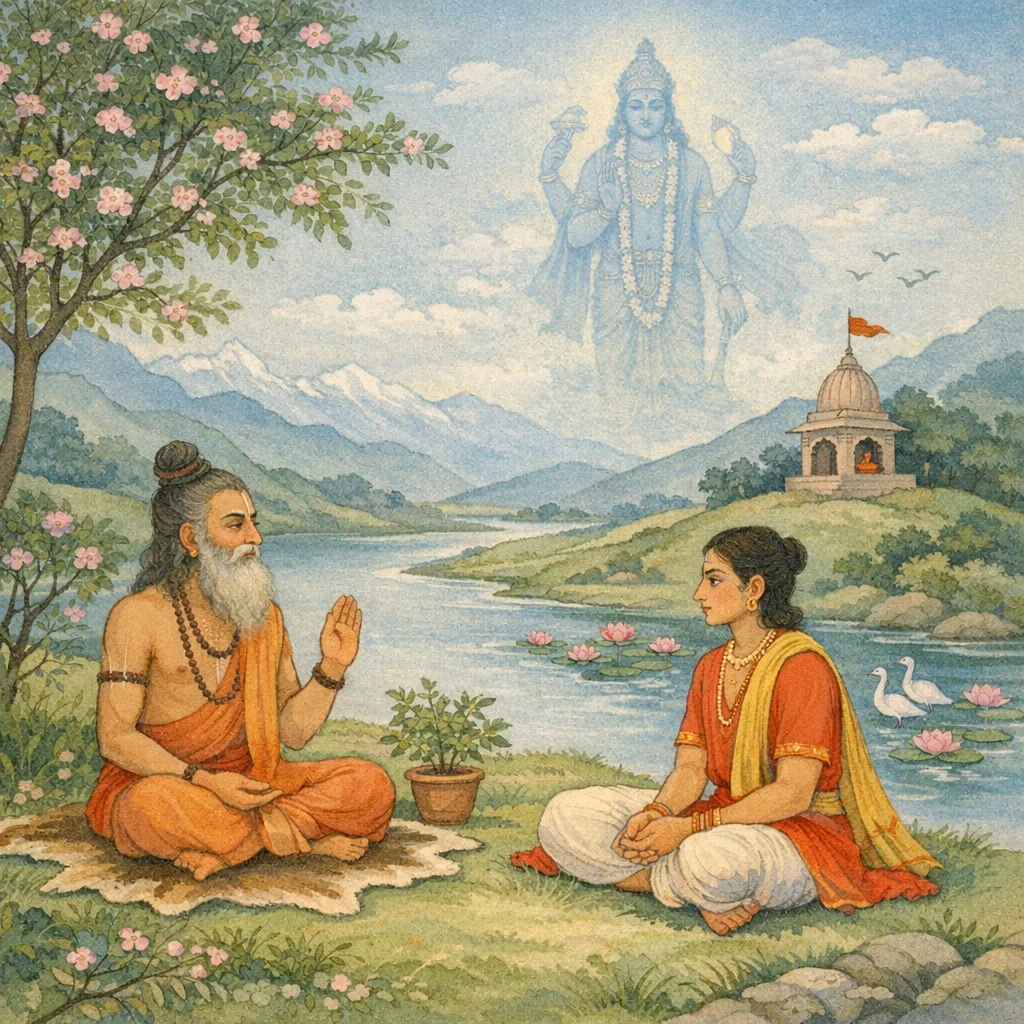
Adhyaya 3
Qualities of the Five Great Elements; Description of Sudarśana-dvīpa and Mount Meru
The chapter begins with the sages requesting a complete account of the rivers, mountains, regions, and the earth’s extent. The teaching first sets an ontological frame: the five great elements (pañca-mahābhūtas) pervade the world, and their qualities (guṇas) are listed in order—earth, foremost, bears five (sound, touch, form, taste, smell); water lacks smell; and the qualities diminish further through fire, air, and ether (ākāśa). When beings do not overstep their appointed courses, order and balance prevail; when they transgress, embodied conflict arises, and birth and death proceed in sequence. The narrator cautions that what is inconceivable should not be fixed by reasoning alone. The discourse then turns to sacred cosmography: the circular form of Sudarśana-dvīpa, its surrounding oceans and mountain boundaries, the pippala tree and the hare motif. Finally, a fuller Meru-centered map is given—varṣas, mountain ranges, divine communities, and the Gaṅgā manifesting in multiple streams.
Shlokas
Verse 1
ऋषय ऊचुः । नदीनां पर्वतानां च नामधेयानि सर्वशः । तथा जनपदानां च ये चान्ये भूमिमाश्रिताः
The sages said: “Tell us in full the names of the rivers and mountains, and likewise of the provinces (janapadas), and of whatever other places are situated upon the earth.”
Verse 2
प्रमाणं च प्रमाणज्ञ पृथिव्याः किल सर्वतः । निखिलेन समाचक्ष्व काननानि च सत्तम
O knower of measures, tell me fully and in detail the extent of the earth on every side, and also describe its forests, O best among the virtuous.
Verse 3
सूत उवाच । पंचेमानि महाप्राज्ञ महाभूतानि संग्रहात् । जगतीस्थानि सर्वाणि समान्याहुर्मनीषिणः
Sūta said: O great sage, these five great elements, taken together, pervade the whole world; the wise declare them to be the common foundation of all that exists in the earthly realm.
Verse 4
भूमिरापस्तथा वायुरग्निराकाशमेव च । गुणोत्तराणि सर्वाणि तेषां भूमिः प्रधानतः
Earth, water, wind, fire, and also ether—each of these elements is progressively endowed with additional qualities; yet among them, Earth is regarded as foremost.
Verse 5
शब्दस्पर्शश्च रूपं च रसो गंधश्च पंचमः । भूमेरेतेगुणाः प्रोक्ता ऋषिभिस्तत्त्ववेदिभिः
Sound and touch, form, taste, and—fifth—smell: these are declared to be the qualities of earth, as taught by the seers who know the principles of reality.
Verse 6
चत्वारोप्सुगुणा विप्रा गंधस्तत्र न विद्यते । शब्दः स्पर्शश्च रूपं च तेजसोथ गुणास्त्रयः
O brāhmaṇas, water possesses four qualities; scent is not found there. Sound, touch, and form—these are the three qualities of fire.
Verse 7
शब्दः स्पर्शश्च वायोस्तु आकाशे शब्द एव च । एते पंच गुणा विप्रा महाभूतेषु पंचसु
Sound and touch belong to air; and in ether there is sound alone. O brāhmaṇas, these are the five qualities within the five great elements.
Verse 8
वर्तंते सर्वलोकेषु येषु भूताः प्रतिष्ठिताः । अन्योन्यं नातिवर्तंते साम्यं भवति वै तदा
In all the worlds, the beings established there proceed along their appointed course. When they do not overstep one another, then indeed equilibrium arises.
Verse 9
यदा तु विषमीभावमाविशंति परस्परम् । तदा देहैर्देहवंतो व्यतिरोहंति नान्यथा
But when they enter into mutual disharmony, then embodied beings clash with one another through their bodies—there is no other outcome.
Verse 10
आनुपूर्व्या विनश्यंति जायंते चानुपूर्वशः । सर्वाण्यपरिमेयाणि तदेषां रूपमैश्वरम्
In due sequence they perish, and in due sequence they are born. All of them are immeasurable; that is their divine, sovereign form.
Verse 11
यत्रयत्र हि दृश्यंते धावंति पांचभौतिकाः । तेषां मनुष्यास्तर्केण प्रमाणानि प्रचक्षते
Wherever the five-elemental things are seen in motion, people, by means of reasoning, declare the relevant pramāṇas—means of valid knowledge—as proofs for them.
Verse 12
अचिंत्याः खलु ये भावास्तान्न तर्केण साधयेत् । सुदर्शनं प्रवक्ष्यामि द्वीपं तु मुनिपुंगवाः
Indeed, matters that are inconceivable should not be established by mere reasoning. O best of sages, I shall now describe the island called Sudarśana.
Verse 13
परिमंडलो महाभागा द्वीपोऽसौ चक्रसंस्थितः । नदीजलपरिच्छिन्नः पर्वतैश्चाब्धिसन्निभैः
O most fortunate one, that island-continent is circular in form, set like a wheel; it is bordered by river-waters and by mountains resembling the ocean in vastness.
Verse 14
पुरैश्च विविधाकारै रम्यैर्जनपदैस्तथा । वृक्षैः पुष्पफलोपेतैः संपन्नो धनधान्यवान्
It was endowed with cities of many designs and with delightful countryside settlements, and with trees laden with flowers and fruits—prosperous, rich in wealth and abundant in grain.
Verse 15
लवणेन समुद्रेण समंतात्परिवारितः । यथा हि पुरुषः पश्येदादर्शे मुखमात्मनः
Encircled on all sides by the salt ocean—just as a man sees his own face in a mirror.
Verse 16
एवं सुदर्शनो द्वीपो दृश्यते चक्रमंडलः । द्विरंशे पिप्पलस्तस्य द्विरंशे च शशो महान्
Thus the island called Sudarśana is seen as a circular disk, like a wheel; in one of its two divisions stands a pippala, the sacred fig, and in the other division there is a great hare.
Verse 17
सर्वौषधिं समादाय सर्वतः परिवारितः । आपस्ततोन्या विज्ञेयाः शेषः संक्षेप उच्यते
Having gathered all medicinal herbs and being surrounded on every side, the remaining matters should be understood from what has already been stated; the rest is now spoken in brief.
Verse 18
ऋषय ऊचुः । उक्तो यस्य च संक्षेपो बुद्धिमन्विधिवत्त्वया । तत्त्वज्ञश्चासि सर्वस्य विस्तरं सूत नो वद
The sages said: “You have intelligently and methodically stated its summary. And since you are a knower of the truth of all matters, O Sūta, tell us its detailed account.”
Verse 19
यावान्भूम्यवकाशोयं दृश्यते शशलक्षणे । तस्य प्रमाणं प्रब्रूहि ततो वक्ष्यसि पिप्पलम्
O you marked by the hare (on the moon), tell me the measure of this expanse of land that is seen; then you may speak about the pippala, the sacred fig tree.
Verse 20
एवं तैः किल पृष्टः स सूतो वाक्यमथाब्रवीत् । सूत उवाच । प्रागायता महाप्राज्ञाः षडेते रत्नपर्वताः
Thus questioned by them, the Sūta then spoke these words: “To the east extend these six jewel-like mountains, O wise ones.”
Verse 21
अवगाढा ह्युभयतः समुद्रौ पूर्वपश्चिमौ । हिमवान्हिमकूटश्च निषधश्च नगोत्तमः
On both sides lie the seas—the eastern and the western. (There are) Himavān, Himakūṭa, and Niṣadha, the excellent mountain.
Verse 22
नीलश्च वैडूर्यमयः श्वेतश्च शशिसन्निभः । सर्वधातुपिनद्धश्च शृंगवान्नामपर्वतः
There is a mountain named Śṛṅgavān—blue, formed of vaidūrya (the cat’s-eye gem), white and radiant like the moon, and clad in every kind of mineral.
Verse 23
एते वै पर्वता विप्राः सिद्धचारणसेविताः । तेषामंतरविष्कुंभौ योजनानि सहस्रशः
O brāhmaṇas, these indeed are the mountains, resorted to by Siddhas and Cāraṇas; and the spaces between them extend for many thousands of yojanas.
Verse 24
तत्र पुण्या जनपदास्तानि वर्षाणि सत्तमाः । वसंति तेषां सत्त्वानि नानाजातीनि सर्वशः
There, the regions and lands are holy—realms truly excellent. In them dwell living beings of many kinds, everywhere.
Verse 25
इदं तु भारतं वर्षं ततो हैमवतं परम् । हेमकूटात्परं चैव हरिवर्षं प्रचक्षते
This indeed is Bhārata-varṣa; beyond it lies Haimavata. And beyond Hemakūṭa, they declare, is Hari-varṣa.
Verse 26
दक्षिणेन तु नीलस्य निषधस्योत्तरेण च । प्रागायतो महाभागा माल्यवान्नाम पर्वतः
To the south of Nīla and to the north of Niṣadha, stretching eastward, lies the fortunate mountain named Mālyavān.
Verse 27
ततः परं माल्यवतः पर्वतो गंधमादनः । परिमंडलस्तयोर्मध्ये मेरुः कनकपर्वतः
Beyond that lies the Mālyavat mountain, and then the Gandhamādana mountain. Between those two stands Meru, the golden mountain, circular in form.
Verse 28
आदित्यतरुणाभासो विधूम इव पावकः । योजनानां सहस्राणि चतुरशीतिरुच्छ्रितः
He shines with the youthful radiance of the Sun, like a smokeless fire, and rises to a height of eighty-four thousand yojanas.
Verse 29
अधस्ताच्चतुरशीतिर्योजनानां द्विजोत्तमाः । ऊर्ध्वमधश्च तिर्यक्च लोकानावृत्य तिष्ठति
O best of the twice-born, it extends eighty-four yojanas downward, and, spreading upward, downward, and across, it stands enclosing the worlds.
Verse 30
तस्य पार्श्वेष्वमी द्वीपाश्चत्वारः संस्थिता द्विजाः । भद्राश्वः केतुमालश्च जंबूद्वीपश्च सत्तमाः
O brāhmaṇas, on its sides are situated these four continents: Bhadrāśva, Ketumāla, and Jambūdvīpa—O best of the virtuous.
Verse 31
उत्तराश्चैव कुरुवः कृतपुण्य प्रतिश्रयाः । विहंगसुमुखो यस्तु सुपार्श्वस्यात्मजः किल
And the Northern Kurus too are a refuge for accumulated merit. There, it is said, is (one named) Vihaṅgasumukha, who indeed is the son of Supārśva.
Verse 32
स वै विचिंतयामास सौवर्णान्प्रेक्ष्य वायसान् । मेरुरुत्तममध्यानामधमानां च पक्षिणाम्
Seeing the golden-hued crows, he reflected: “Among birds there are the highest, the middling, and the low—just as Meru stands pre-eminent.”
Verse 33
अविशेषकरो यस्मात्तस्मादेनं त्यजाम्यहम् । तमादित्योनुपर्येति सततं ज्योतिषां वरः
“Since he makes no proper distinctions, therefore I renounce him. The Sun—best among the luminaries—constantly follows him.”
Verse 34
चंद्रमाश्च सनक्षत्रो वायुश्चैव प्रदक्षिणः । स पर्वतो महाप्राज्ञा दिव्यपुष्पसमन्वितः
The Moon, together with the constellation-bearing sky, and the wind as well, move in auspicious circumambulation. That mountain, O greatly wise one, is endowed with divine flowers.
Verse 35
भवनैरावृतैः सर्वैः र्जांबूनदमयैः शुभैः । तत्र देवगणा विप्रा गंधर्वासुरराक्षसाः
All around were auspicious mansions made of Jāmbūnada (refined gold). There were present the hosts of gods, O brāhmaṇas, along with Gandharvas, Asuras, and Rākṣasas.
Verse 36
अप्सरोगणसंयुक्ताः शैले क्रीडंति सर्वदा । तत्र ब्रह्मा च रुद्रश्च शक्रश्चापि सुरेश्वरः
Accompanied by hosts of Apsarās, they always sport upon the mountain. There too are Brahmā, Rudra, and Śakra (Indra) as well—the lord of the gods.
Verse 37
समेत्य विविधैर्यज्ञैर्यजंतेऽनेक दक्षिणैः । तुंबुरुर्नारदश्चैव विश्वावसुर्हाहा हूहूः
Assembled together, they perform various yajñas, accompanied by many kinds of dakṣiṇās (sacrificial gifts): Tumburu, Nārada, and also Viśvāvasu, Hāhā, and Hūhū.
Verse 38
अभिगम्यामरश्रेष्ठं स्तुवंति विविधैः स्तवैः । सप्तर्षयो महात्मानः कश्यपश्च प्रजापतिः
Approaching the foremost among the devas, the great-minded Seven Ṛṣis—along with Kaśyapa, the Prajāpati—praised him with many kinds of hymns.
Verse 39
तत्र गच्छंति भद्रं वः सदा पर्वणि पर्वणि । तस्यैव मूर्द्धन्युशना काव्यो दैत्यैर्महीयते
May auspiciousness be yours—there they go, at every sacred observance, time and again. There, on that very summit, Uśanā Kāvya (Śukra) is honored by the Daityas.
Verse 40
तस्य हैमानि रत्नानि तस्यैते रत्नपर्वताः । तस्मात्कुबेरो भगवांश्चतुर्थं भागमश्नुते
His are the golden jewels; his are these mountains of gems. Therefore the venerable Kubera partakes of a fourth share of that wealth.
Verse 41
ततः कलांशं वित्तस्य मनुष्येभ्यः प्रयच्छति । पर्वतस्यांतरे दिव्यं सर्वर्तुकुसुमैश्चितम्
Then he bestows upon human beings a portion of his wealth. Within a mountain-cleft there is a divine place, adorned with flowers of every season.
Verse 42
कर्णिकारवनं रम्यं शिलाजालसमुच्छ्रितम् । तत्र साक्षात्पशुपतिर्दिव्यभूतैः समावृतः
There was a delightful forest of karṇikāra trees, rising amid a network of rocky heights. There, Paśupati (Śiva) himself was present, surrounded by divine beings.
Verse 43
उमासहायोभगवान्रमते भूतभावनः । कर्णिकारमयीं मालां बिभ्रदापादलंबिनीम्
The Blessed Lord, accompanied by Umā, delights—he who is the sanctifier and source of beings—wearing a garland made of karṇikāra blossoms, hanging down to his very feet.
Verse 44
त्रिभिर्नेत्रैः कृतोद्द्योतस्त्रिभिः सूर्यैरिवोदितैः । तमुग्रतपसः सिद्धाः सुव्रताः सत्यवादिनः
Illuminated by three eyes, as though by three risen suns, he was beheld and approached by siddhas—sages of fierce austerity, of good vows, and devoted to truthfulness.
Verse 45
पश्यंति नहि दुर्वृत्तैः शक्यो द्रष्टुं महेश्वरः । तस्य शैलस्य शिखरात्क्षीरधारा द्विजोत्तमाः
Those of ill conduct do not behold him; Maheśvara cannot be seen by the wicked. From the summit of that mountain, O best of brāhmaṇas, a stream of milk flows.
Verse 46
विश्वरूपात्परमिता भीमनिर्घातनिस्वना । पुण्यापुण्यतमैर्जुष्टा गंगा भागीरथी शुभा
The auspicious Gaṅgā—Bhāgīrathī—surpassing all in manifold forms, resounds like a terrifying thunderclap, and is frequented by both the most meritorious and the most sinful.
Verse 47
प्लवंती च प्रवेगेन ह्रदे चंद्रमसः शुभे । तया ह्युत्पादितः पुण्यः स ह्रदः सागरोपमः
Then, moving with swift force, she surged into the auspicious Lake of the Moon; by her was brought forth that sacred lake—vast and magnificent, like an ocean.
Verse 48
तां धारयामास तदा दुर्द्धरां पर्वतैरपि । शतं वर्षसहस्राणि शिरसैव पिनाकधृक्
Then Pinākadhṛk (Śiva), bearing her upon his head alone, held that burden—hard to sustain even for mountains—for a hundred thousand years.
Verse 49
मेरोस्तु पश्चिमे पार्श्वे केतुमालो द्विजोत्तमाः । जंबूखंडे तु तत्रैव महाजनपदो द्विजाः
O best of the twice-born, on the western flank of Mount Meru lies Ketumāla; and there itself, within Jambū-khaṇḍa, is the great realm (mahājanapada), O brāhmaṇas.
Verse 50
आयुर्दशसहस्राणि वर्षाणां तत्र सत्तमाः । सुवर्णवर्णाश्च नरा स्त्रियश्चाप्सरसां समाः
O best of the virtuous, there the lifespan is ten thousand years; the men are golden-hued, and the women are comparable to the Apsarases.
Verse 51
अनामया वीतशोका नित्यं मुदितमानसाः । जायंते मानवास्तत्र निस्तप्तकनकप्रभाः
There, human beings are born free from disease, free from sorrow, with minds ever joyful, radiant like well-refined gold.
Verse 52
गंधमादनशृंगेषु कुबेरः सह राक्षसैः । संवृतोप्सरसां संघैर्मोदते गुह्यकाधिपः
On the peaks of Gandhamādana, Kubera—the lord of the Guhyakas—rejoices, accompanied by rākṣasas and surrounded by hosts of apsarās.
Verse 53
गंधमादनपार्श्वे तु परे विगतपातकाः । एकादशसहस्राणि वर्षाणां परमायुषः
But on the far side, near Gandhamādana, dwell those freed from sin; their utmost lifespan is eleven thousand years.
Verse 54
तत्र कृष्णा नरा विप्रास्तेजोयुक्ता महाबलाः । स्त्रियश्चोत्पलपत्राभाः सर्वाः सुप्रियदर्शनाः
There, the men—dark-complexioned brāhmaṇas—were endowed with radiance and great strength; and the women, lotus-petal-like in appearance, were all exceedingly pleasing to behold.
Verse 55
नीलोत्पलधरं श्वेतं श्वेताद्धैरण्यकं वरम् । वर्षमैरावतं विप्रा नानाजनपदावृतम्
O brāhmaṇas, the region called Airāvata-varṣa is said to bear blue lotuses, to shine in whiteness, and—more excellent still—to possess a golden splendor beyond that whiteness; it is encircled by many lands and districts.
Verse 56
धनुखंडेः महाभागा द्वे वर्षे दक्षिणोत्तरे । इलावृत्तं मध्यगं तु पंचवर्षाणि चैव हि
O noble ones, in Dhanukhaṇḍa there are two varṣas, the southern and the northern; but Ilāvṛtta, situated in the middle, indeed consists of five varṣas.
Verse 57
उत्तरोत्तरमेतेभ्यो वर्षमुद्रिच्यते गुणैः । आयुः प्रमाणमारोग्यं धर्मतः कामतोऽर्थतः
In each successive region beyond these, the land becomes ever more excellent in its qualities—granting greater longevity, the proper measure of stature and vitality, and freedom from disease, together with the fulfillment of dharma, kāma, and artha.
Verse 58
समन्वितानि भूतानि तेषु सर्वेषु सत्तमाः । एवमेषा महाभागाः पर्वतैः पृथिवी चिता
All beings were gathered within them; and among them all, the noblest were present. Thus, O greatly fortunate ones, this Earth came to be as though heaped up, filled with mountains.
Verse 59
हेमकूटस्तु सुमहान्कैलासो नाम पर्वतः । तत्र वैश्रवणो देवो गुह्यकैः सह मोदते
There is a very great mountain called Kailāsa, also known as Hemakūṭa. There the god Vaiśravaṇa delights together with the Guhyakas.
Verse 60
अस्त्युत्तरेण कैलासं मैनाकं पर्वतं प्रति । हिरण्यशृंगः सुमहान्दिव्यो मणिमयो गिरिः
To the north of Kailāsa, in the direction of Mount Maināka, there is a very great mountain—Hiraṇyaśṛṅga—divine, as though made of jewels.
Verse 61
तस्य पार्श्वे महद्दिव्यं शुभ्रं कांचनवालुकम् । रम्यं विष्णुसरो नाम यत्र राजा भगीरथः
Beside it lies a vast, divine, and beautiful place with white, golden sands—a delightful lake named Viṣṇu-saras, where King Bhagīratha once stayed and performed austerities.
Verse 62
दृष्ट्वा भागीरथीं गंगामुवास बहुलाः समाः । यूपा मणिमयास्तत्र क्षेत्राश्चापि हिरण्मयाः
Having beheld the Bhāgīrathī Gaṅgā, he dwelt there for many years; and in that place the sacrificial posts of the yajña were made of gems, and the sacred fields were also of gold.
Verse 63
तत्रेष्ट्वा तु गतः सिद्धिं सहस्राक्षो महायशाः । स्रष्टा भूतिपतिर्यत्र सर्वलोकैः सनातनः
Having worshipped there, the thousand-eyed one, greatly renowned, attained perfection (siddhi). There indeed the eternal Creator—Lord of prosperity and ruler of all worlds—is manifest and worshipped.
Verse 64
उपास्यते तिग्मतेजा यत्र भूतः समंततः । नरनारायणौ ब्रह्मा मनुः स्थाणुश्च पंचमः
In that place the radiant Lord of keen splendour is worshipped, with beings gathered all around; there are Nara and Nārāyaṇa, Brahmā, Manu, and Sthāṇu as the fifth.
Verse 65
तत्र दिव्या त्रिपथगा प्रथमं तु प्रतिष्ठिता । ब्रह्मलोकादपाक्रांता सप्तधा प्रतिपद्यते
There, first of all, the divine Tripathagā—Gaṅgā who moves in three realms—became established. Having descended from Brahmaloka, she then manifests in seven streams.
Verse 66
वटोदका सा नलिनी पार्वती च सरस्वती । जंबूनदी च सीता च गंगा सिंधुश्च सप्तमी
These streams are Vaṭodakā, Nalinī, Pārvatī, Sarasvatī, Jambūnadī, Sītā, Gaṅgā, and Sindhu—the seventh in the series.
Verse 67
अचिंत्या दिव्यसंज्ञा सा प्रभावैश्च समन्विता । उपास्यते यत्र सत्रं सहस्रयुगपर्यये
She is inconceivable, known by a divine appellation, and endowed with wondrous powers; in that place the satra, the sacrificial session, is reverently maintained until the completion of a thousand yugas.
Verse 68
दृश्यादृश्या च भवति तत्रतत्र सरस्वती । एता दिव्याः सप्तगंगास्त्रिषुलोकेषु विश्रुताः
There, Sarasvatī becomes visible and invisible in different places. These are the divine “seven Gaṅgās,” renowned throughout the three worlds.
Verse 69
रक्षांसि वै हिमवती हेमकूटे च गुह्यकाः । सर्पा नागाश्च निषधे गोकर्णं च तपोवनम्
Indeed, on Himavat dwell the Rākṣasas, and on Hemakūṭa the Guhyakas; on Niṣadha are serpents and Nāgas; and Gokarṇa is a tapovana, a sacred forest of austerities.
Verse 70
देवासुराणां सर्वेषां श्वेतः पर्वतमुच्यते । गंधर्वा निषधे नित्यं नीले ब्रह्मर्षयस्तथा
Among all the gods and asuras, the White Mountain is spoken of as their seat. The Gandharvas dwell eternally on Niṣadha, and likewise the Brahmarṣis on the Blue Mountain.
Verse 71
शृंगवांस्तु महाभागा देवानां प्रतिसंचरः । इत्येतानि महाभागाः सप्तवर्षाणि भागशः
And Śṛṅgavān—O noble ones—is the region traversed by the gods. Thus, O illustrious ones, these are the seven varṣas, each distinguished in its own portion.
Verse 72
भूतान्युपनिविष्टानि गतिमंति ध्रुवाणि च । तेषामृद्धिर्बहुविधा दृश्यते देवमानुषा
Beings become established in their own conditions; some move, and some remain fixed. Their prosperity is seen in many forms—among both the devas and humankind.
Verse 73
अशक्यं परिसंख्यातुं श्रद्धे या तु विभूषिता । यां तु पृच्छथ मां विप्रा दिव्यमेनां शशाकृतिम्
O Śraddhā, adorned with splendor, she cannot be counted or fully enumerated. O brāhmaṇas, you ask me about this divine one, whose form is like the moon.
Verse 74
पार्श्वे शशस्य द्वे वर्षे उक्ते ये दक्षिणोत्तरे । कर्णे तु नागद्वीपश्च काश्यपद्वीप एव च
On the flanks of the Hare (Śaśa) are said to be two regions (varṣas), the southern and the northern; and at its ear are Nāgadvīpa and likewise Kāśyapadvīpa.
Verse 75
कर्णद्वीपशिलो विप्राः श्रीमान्मलयपर्वतः । एतद्द्वितीयं द्वीपस्य दृश्यते शशिसंस्थितम्
O brāhmaṇas, the illustrious Malayaparvata is the rocky height of Karṇadvīpa. This is seen as the second feature of the island, set in place like the moon.