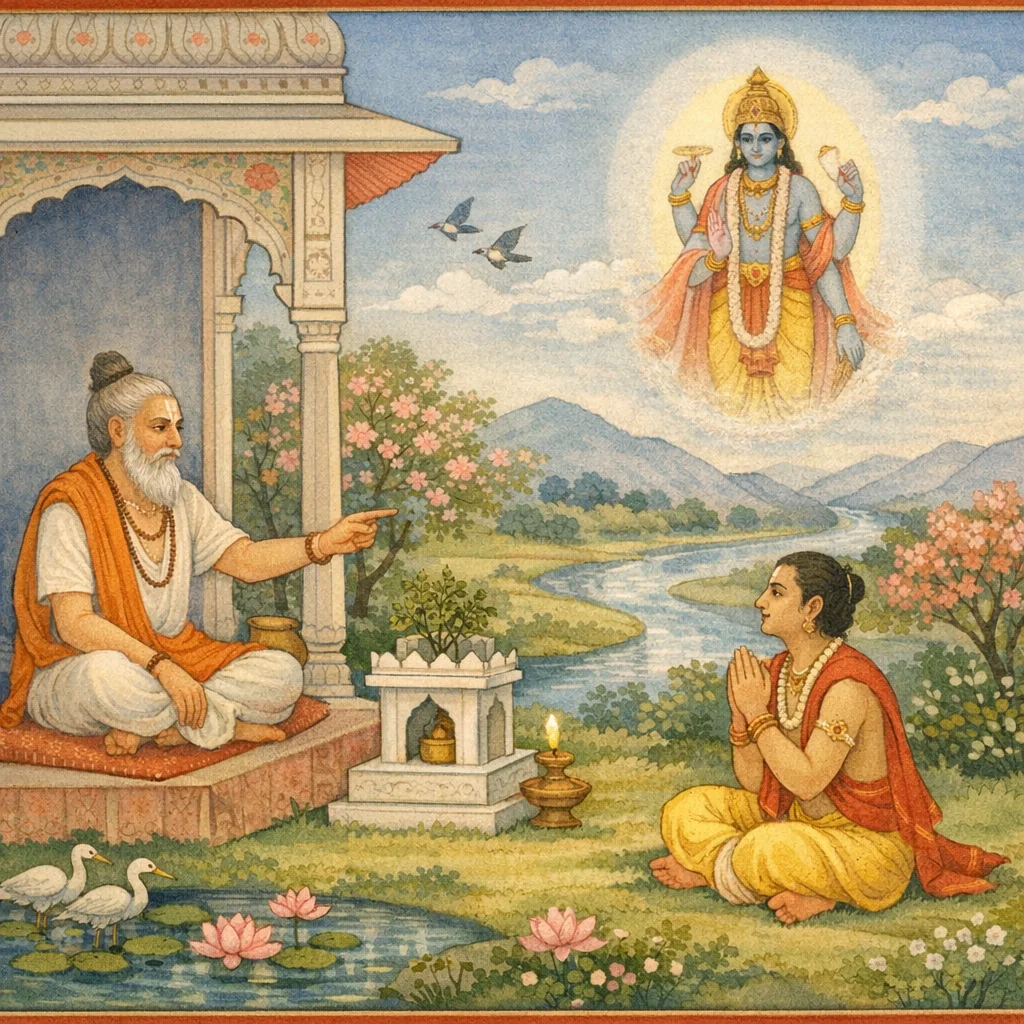
Adhyaya 29
The Greatness of the Kāliṇdī (Yamunā): Merit of Bathing, Charity, and Faith
Chapter PP.3.29 is a tīrtha-māhātmya praising the Kāliṇdī (Yamunā). It opens with Nārada urging pilgrimage and bathing at the sacred ford, declaring that one who bathes there with faith (śraddhā) is protected from evil destiny and harmful influences. The discourse exalts Yamunā-bathing as equal to or surpassing famed tīrthas such as Puṣkara, Kurukṣetra, and Avimukta. It bestows longevity, health, and prosperity, and yields the full fruit of religious acts, whereas rites performed without faith give only half. Through layered metaphors—moon’s phases, oceanic jewels, kāmadhenu and cintāmaṇi—the river is portrayed as wish-fulfilling, sin-destroying, and devotion-awakening; joined with Mathurā, it becomes liberation-giving (mokṣa). A moral appendix warns that dharma, tapas, learning, gifts (dāna), mantra, and vows are ruined by hypocrisy, anger, negligence, impurity of speech, and lack of faith, reaffirming śraddhā as the hinge of ritual efficacy.
Shlokas
Verse 1
नारदौवाच । ततो गच्छेत राजेंद्र कालिंदीतीर्थमुत्तमम् । तत्र स्नात्वा नरो राजन्न दुर्गतिमवाप्नुयात्
Nārada said: “Then, O best of kings, one should go to the excellent tīrtha of Kāliṃdī. Having bathed there, O king, a person does not fall into misfortune or an evil destiny.”
Verse 2
पुष्करे तु कुरुक्षेत्रे ब्रह्मावर्त्ते पृथूदके । अविमुक्ते सुवर्णाख्ये यत्फलं लभते नरः
Whatever fruit of spiritual merit a person obtains at Puṣkara, at Kurukṣetra, in Brahmāvarta, at Pṛthūdaka, in Avimukta, and at the sacred place called Suvarṇākhya—that very same fruit is attained (here).
Verse 3
तत्फलं समवाप्नोति यमुनायां नरोत्तम । स्वर्गभोगेतिरागो वै येषां मनसि वर्तते
O best of men, at the Yamunā one attains that very fruit; indeed, for those in whose minds there dwells an intense attachment to the enjoyments of heaven.
Verse 4
यमुनायां विशेषेण स्नानदानेन सत्तम । आयुरारोग्यसंपत्तौ रूपयौवनता गुणे
O best of the virtuous, by bathing and giving charity—especially in the Yamunā—one gains long life, health, prosperity, beauty, youthfulness, and excellence of character.
Verse 5
येषां मनोरथस्तैस्तु न त्याज्यं यमुनाजलम् । ये बिभ्यति नरकादेर्दारिद्र्योऽत्र संति च
For those whose cherished aims depend upon it, the water of the Yamunā should not be given up. And those who fear hell and the like—and those afflicted by poverty here—should also resort to it.
Verse 6
सर्वथा तैः प्रयत्नेन तत्र कार्यं निमज्जनम् । दारिद्र्य पाप दौर्भाग्य पंक प्रक्षालनाय वै
Therefore, by all means and with earnest effort, they should immerse themselves there, for it is indeed meant to wash away the mire of poverty, sin, and misfortune.
Verse 7
ऋते वै यामुनं तोयं न चान्योस्ति युधिष्ठिर । श्रद्धाहीनानि कर्माणि मतान्यर्धफलानि वै । फलं ददाति संपूर्णं यामुनं स्नानमात्रतः
O Yudhiṣṭhira, apart from the waters of the Yamunā there is no other tīrtha like it. Ritual acts performed without faith (śraddhā) are regarded as yielding only half their fruit; but bathing in the Yamunā alone bestows the full result.
Verse 8
अकामो वा सकामो वा यामुने सलिले नृप । इहामुत्र च दुःखानि मज्जनान्नैव पश्यति
O king, whether one is free of desires or full of desires, by immersing in the waters of the Yamunā one beholds no suffering—neither in this world nor in the next.
Verse 9
पक्षद्वये यथा चंद्र क्षीःयते वर्द्धते तथा । पातकं नश्यते तत्र स्नानात्पुण्यं विवर्द्धते
Just as the moon wanes and waxes in the two fortnights, so there: by bathing, sin is destroyed and merit steadily increases.
Verse 10
यथाब्धौ सुखमायांति रत्नानि विविधानि च । आयुर्वित्तं कलत्राणि संपदः संभवंति च
Just as varied jewels readily arise from the ocean, so too do longevity, wealth, spouses, and other prosperities come into being.
Verse 11
कामधेनुर्यथा कामं चिंतामणिर्विचिंतितम् । ददाति यमुनास्नानं तद्वत्सर्वं मनोरथम्
Just as the wish-fulfilling cow Kāmadhenū grants desires, and the wish-gem Cintāmaṇi bestows what is contemplated, so bathing in the Yamunā likewise fulfills every cherished aspiration.
Verse 12
कृते तपः परं ज्ञानं त्रेतायां यजनं तथा । द्वापरे च कलौ दानं कालिंदी सर्वदा शुभा
In the Kṛta age, austerity (tapas) and the highest knowledge are foremost; in Tretā, sacrifice (yajña) likewise; in Dvāpara and in Kali, giving (dāna, charity) is paramount. The Kāliṇdī (Yamunā) is always auspicious.
Verse 13
सर्वेषां सर्ववर्णानामाश्रमाणां च भूपते । यामुने मज्जनं धर्मं धाराभिः खलु वर्षति
O king, for people of all varṇas and all āśramas, bathing in the Yamunā truly pours forth dharma in streaming currents.
Verse 14
अस्मिन्वै भारते वर्षे कर्मभूमौ विशेषतः । कालिंद्यस्नायिनां नॄणां निष्फलं जन्मकीर्त्तितम्
Indeed, in this Bhārata-varṣa—preeminently the land of sacred action—the birth of those men who merely bathe in the Kāliṇdī (Yamunā) is declared fruitless.
Verse 15
नैश्वर्यं गगने यद्वच्चांद्रे ऽमायां तु मंडले । तद्वन्न भाति सत्कर्म यमुनामज्जनं विना
Just as the moon’s orb does not shine in the sky on the night of amāvasyā, so the merit of righteous deeds does not shine forth without bathing in the Yamunā.
Verse 16
व्रतैर्दानैस्तपोभिश्च न तथा प्रीयते हरिः । तत्र मज्जनमात्रेण यथा प्रीणाति केशवः
Hari is not pleased so greatly by vows, gifts, or austerities as Keśava is pleased there by mere bathing alone.
Verse 17
न समं विद्यते किंचित्तेजः सौरेण तेजसा । तद्वन्न यमुनास्नानं समानाः क्रतुजाः क्रियाः
Nothing whatsoever equals the splendor of the Sun’s radiance; likewise, no ritual acts born of sacrifices are equal to bathing in the Yamunā.
Verse 18
प्रीतये वासुदेवस्य सर्वपापापनुत्तये । कालिंद्या मज्जनं कुर्य्यात्स्वर्गलाभाय मानवः
To please Vāsudeva and to dispel all sins, a person should bathe in the Kāliṅdī (Yamunā) to attain heaven.
Verse 19
किं रक्षितेन देहेन सुपुष्टेन बलीयसा । अध्रुवेण सुदेहेन यमुना मज्जनं विना
What use is a body carefully preserved—well nourished and strong—when that fair body is impermanent and has not been sanctified by bathing in the Yamunā?
Verse 20
अस्थिस्तंभं स्नायुबंधं मांसक्षतज लेपनम् । चर्मावनद्ध दुर्गंधं पूर्णं मूत्रपुरीषयोः
It is a framework of bones, bound by sinews, smeared with flesh and blood; wrapped in skin, foul-smelling, and filled with urine and feces.
Verse 21
जराशोक विपद्व्याप्तं रोगमंदिरमातुरम् । रागमूलमनित्यं च सर्वदोषसमाश्रयम्
Pervaded by old age, sorrow, and calamity, this body is a dwelling of disease—afflicted, rooted in attachment, impermanent, and a refuge of every fault.
Verse 22
परोपकारपापार्ति परद्रोहपरेर्षिकम् । लोलुपं पिशुनं क्रूरं कृतघ्नं क्षणिकं तथा
One who is pained by others’ good deeds, intent on harming others and ever envious; greedy, slanderous, cruel, ungrateful, and fickle as well—
Verse 23
निष्ठुरं दुर्धरं दुष्टं दोषत्रयविदूषितम् । अशुचितापि दुर्गंधि तापत्रयविमोहितम्
It is cruel, hard to restrain, and wicked—tainted by the three doṣas (faults). Though impure, it reeks, and it is deluded by the threefold afflictions (tāpa-traya).
Verse 24
निसर्गतो ऽधर्मरतं तृष्णाशतसमाकुलम् । कामक्रोधमहालोभ नरकद्वारसंस्थितम्
By its very nature it delights in adharma, is agitated by hundreds of cravings, and—filled with kāma, krodha, and great lobha—stands stationed at the very gate of naraka (hell).
Verse 25
कृमिवर्चस्तु भस्मादि परिणामगुणावहम् । ईदृक्शरीरं व्यर्थं हि यमुनामज्जनं विना
This body is but worm-filth and foulness, and by the law of transformation it tends toward ash and the like. Such a body is truly useless without bathing in the sacred Yamunā.
Verse 26
बुद्बुदा इव तोयेषु प्रत्यंडा इव पक्षिषु । जायंते मरणायैव यमुनास्नान वर्जिताः
Those who forgo bathing in the Yamunā are born only to die—like bubbles upon water, like eggs among birds, destined to perish.
Verse 27
अवैष्णवो हतो विप्रो हतं श्राद्धमपिंडकम् । अब्रह्मण्यं हतं क्षत्रमनाचार हतं कुलम्
A brāhmaṇa is as good as ruined if he is not a Vaiṣṇava (devoted to Viṣṇu); a śrāddha becomes fruitless if performed without offering the piṇḍa. A kṣatriya is ruined if he is hostile to brāhmaṇas, and a family is ruined when right ācāra (conduct) is lost.
Verse 28
सदंभश्च हतो धर्म्मः क्रोधेनैव हतं तपः । अदृढं च हतं ज्ञानं प्रमादेन हतं श्रुतम्
Righteousness is ruined by hypocrisy; austerity (tapas) is destroyed by anger. Knowledge, when lacking firmness, is lost; and sacred learning (śruti) is destroyed by negligence.
Verse 29
परभक्त्या हता नारी ब्रह्मचारी स्त्रिया हतः । अदीप्तेऽग्नौ हतो होमो हता भक्तिः समायिका
A woman is ruined by devotion directed elsewhere; a brahmacārī is ruined by a woman. An offering is ruined when the fire is not kindled; and devotion is ruined when it is only periodic, not steady.
Verse 30
उपजीव्या हता कन्या स्वार्थे पाकक्रिया हता । शूद्र भक्षो हतो योगः कृपणस्य हतं धनम्
A maiden is ruined when treated as a means of livelihood; cooking is ruined when done only for self-interest. Yoga is ruined when one lives by eating what is given by a Śūdra; and wealth is ruined in the hands of a miser.
Verse 31
अनभ्यासहता विद्या हतो बोधो विरोधकृत् । जीवितार्थं हतं तीर्थं जीवनार्थं हतं व्रतम्
Knowledge is destroyed when it is not practiced; understanding is ruined by contentious opposition. A pilgrimage to a tīrtha is wasted when undertaken merely for livelihood, and a vow (vrata) is ruined when observed only for material survival.
Verse 32
असत्या च हता वाणी तथा पैशुन्यवादिनी । षट्कर्णगो हतो मंत्रो व्यग्रचित्तो हतो जपः
Speech is ruined when it is untruthful, and likewise when it is given to slander. A mantra is ruined when it becomes ‘six-eared’ (heard by those not intended), and japa is ruined when the mind is distracted.
Verse 33
हतमश्रोत्रिये दानं हतो लोकश्च नास्तिकः । अश्रद्धया हतं सर्वं यत्कृतं पारलौकिकम्
A gift given to one unfit as a Vedic recipient is wasted; and a community is ruined by an atheist. And whatever other-worldly act is done without faith—of it all, everything becomes futile.
Verse 34
इह लोको हतो नॄणां दरिद्राणां यथा नृप । मनुष्याणां हतं जन्म कालिदीमज्जनं विना
O king, just as life in this world is ruined for the poor, so too is human birth wasted if one does not bathe in the Kālidī.
Verse 35
उपपातक सर्वाणि पातकानि महांति च । भस्मी भवंति सर्वाणि यमुनामज्जनान्नृप
O king, by immersing oneself in the Yamunā, all minor sins and even the great sins are reduced to ashes.
Verse 36
वेपंते सर्वपापानि यमुनायां गते नरे । नाशके सर्वपापानां यदि स्नास्यति वारिणि
All sins tremble when a person goes to the Yamunā; for she destroys every sin—if one bathes in her waters.
Verse 37
पावका इव दीप्यंते यमुनायां नरोत्तमाः । विमुक्ताः सर्वपापेभ्यो मेघेभ्य इव चंद्रमाः
In the Yamunā, the best of men shine like fires—freed from all sins, like the moon released from clouds.
Verse 38
आर्द्र शुष्कलघुस्थूलं वाङ्मनः कर्मभिः कृतम् । तत्र स्नानं दहेत्पापं पावकः समिधो यथा
Whether sin be “wet” or “dry,” subtle or gross—wrought by speech, mind, or deed—bathing there burns it away, as fire consumes the fuel-sticks.
Verse 39
प्रामादिकं च यत्पापं ज्ञानाज्ञानकृतं च यत् । स्नानमात्रेण नश्येत यमुनायां नृपोत्तम
O best of kings, whatever sin is committed through negligence, and whatever is done knowingly or unknowingly—by merely bathing in the Yamunā, it is destroyed.
Verse 40
निष्पापास्त्रिदिवं यांति पापिष्ठा यांति शुद्धताम् । संदेहो नात्र कर्तव्यः स्नाने वै यमुनाजले
The sinless go to heaven, and even the most sinful attain purity. No doubt should be entertained about this—such is the power of bathing in the waters of the Yamunā.
Verse 41
सर्वेऽधिकारिणो ह्यत्र विष्णुभक्तौ तथा नृप । सर्वेषां सर्वदा देवी यमुना पापनाशिका
O King, here all are indeed qualified for devotion to Viṣṇu; and for everyone, at all times, the Goddess Yamunā is the destroyer of sins.
Verse 42
एष एव परो मंत्र एतच्च परमं तपः । प्रायश्चित्तं परं चैव यमुनास्नानमुत्तमम्
This alone is the supreme mantra; this indeed is the highest austerity. It is also the highest expiation—namely, the most excellent bath in the Yamunā.
Verse 43
नृणां जन्मांतराभ्यासात्कालिंदी मज्जने मतिः । अध्यात्मज्ञानकौशल्यं जन्माभ्यासाद्यथा नृप
O King, through practice carried over from former births, people develop an inclination to bathe in the Kāliṇdī (Yamunā); just so, skill in spiritual knowledge arises from repeated cultivation across many lives.
Verse 44
संसारकर्दमालेप प्रक्षालन विशारदम् । पावनं पावनानां च यमुनास्नानमुत्तमम्
Bathing in the Yamunā is supremely excellent—most adept at washing away the mud-like stains of worldly existence, and itself a purifier among purifiers.
Verse 45
स्नातास्तत्र च ये राजन्सर्वकामफलप्रदे । शुभांश्च भुंजते भोगांश्चंद्र सूर्यग्रहोपमान्
O King, those who bathe there—at that place which bestows the fruits of all desired aims—enjoy auspicious pleasures comparable to the splendour of the moon, the sun, and the planets.
Verse 46
यमुना मोक्षदा प्रोक्ता मथुरासंगता यदि । मथुरायां च कालिंदी पुण्याधिकविवर्द्धिनी
The Yamunā is declared to grant mokṣa when she is joined with Mathurā; and there, in Mathurā, the Kāliṇdī increases sacred merit all the more.
Verse 47
अन्यत्र यमुना पुण्या महापातकहारिणी । विष्णुभक्तिप्रदा देवी मथुरा संगता भवेत्
Elsewhere, the holy Yamunā—destroyer of the gravest sins—when associated with Mathurā, becomes a goddess who bestows bhakti (devotion) to Viṣṇu.
Verse 48
भक्तिभावेन संयुक्ता कालिंद्यां यदि मज्जयेत् । कल्पकोटिसहस्राणि वसते सन्निधौ हरेः
If one immerses in the Kāliṇdī (Yamunā) with a heart united to devotion (bhakti), one dwells in the presence of Hari for thousands of crores of kalpas.
Verse 49
मुक्तिं प्रयांति मनुजाः नूनं सांख्येन वर्जिताः । पितरस्तस्य तृप्यंति तृप्ताः कल्पशतैर्दिवि
Surely, men who are bereft of Sāṅkhya—true discriminative wisdom—do not attain liberation; yet that person’s Pitṛs are satisfied, remaining content in heaven for hundreds of kalpas.
Verse 50
ये पिबंति नरा राजन्यमुनासलिलं शुभम् । पंचगव्यसहस्रैस्तु सेवितैः किं प्रयोजनम्
O King, for those who drink the auspicious waters of the Yamunā, what purpose is served by consuming even thousands of portions of pañcagavya?
Verse 51
कोटितीर्थसहस्रैस्तु सेवितैः किं प्रयोजनम् । तत्र दानं च होमश्च सर्वं कोटिगुणं भवेत्
What is the use of having visited thousands of tīrthas? There, charity (dāna) and fire-offering (homa)—indeed everything—becomes multiplied a crore-fold.