Adhyaya 25
Merits of Vitastā, Devikā, Rudrakoṭī and Sarasvatī Sacred Fords
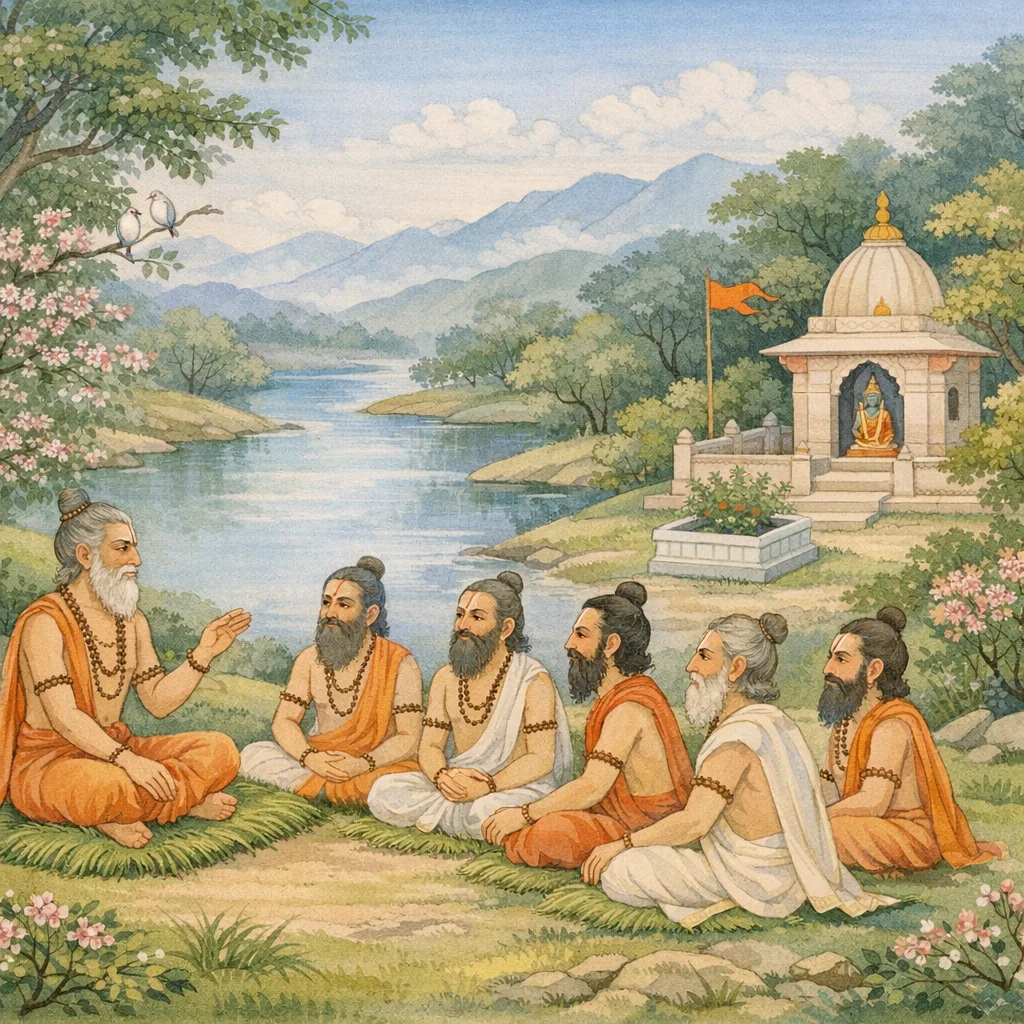
Chapter 25 sets forth a pilgrimage sequence through Kashmir-linked tīrthas, making the prestige of śrauta sacrifice attainable through sacred-ford practice. Bathing in the Vitastā and satisfying the Pitṛs is declared equal to Vājapeya merit. The route proceeds to Malada for twilight ablutions, and to the offering of caru into seven-flamed Agni, proclaimed superior to vast cow-gifts and even major sacrifices. It then speaks of entering Rudra’s abode to gain the fruit of an Aśvamedha. Devikā is praised as a world-renowned Śiva site connected with the origin of brāhmaṇas; Kāmākhya and other named places grant siddhi and fearlessness toward death. Dīrghasatra is introduced as a divine sacrificial session whose merit accrues even by merely setting out. Sarasvatī’s hidden and reappearing flow is linked with Camasodbheda, Śivodbheda, Nāgodbheda, and Śaśayāna/Puṣkarā (hare-form), along with Kārttika bathing and the sages’ episode at Rudrakoṭī. The chapter concludes at a confluence where Janārdana is worshiped on an auspicious date in Caitra.
Shlokas
Verse 1
नारदौवाच । वितस्तां च समासाद्य संतर्प्य पितृदेवताः । नरः फलमवाप्नोति वाजपेयस्य भारत
Nārada said: O Bhārata, a man who reaches the Vitastā and duly satisfies the Pitṛ-deities attains the same fruit as that of the Vājapeya sacrifice.
Verse 2
काश्मीरेष्वेव नागस्य भवनं तक्षक स्यच । वितस्ताख्यमिति ख्यातं सर्वपापप्रमोचनम्
In Kashmir itself is the dwelling of the Nāga Takṣaka; it is renowned by the name “Vitastā” and is said to remove all sins.
Verse 3
तत्र स्नात्वा नरो नूनं वाजपेयमवाप्नुयात् । सर्वपापविशुद्धात्मा गच्छेत परमां गतिम्
Having bathed there, a man surely attains the (merit of) the Vājapeya sacrifice; purified in soul from all sins, he goes to the highest state.
Verse 4
ततो गच्छेत मलदं त्रिषु लोकेषु विश्रुतम् । पश्चिमायां तु संध्यायामुपस्पृश्य यथाविधि
Then one should proceed to Malada, renowned in the three worlds; and at the evening twilight, facing west, one should perform the prescribed ablutions in the proper manner.
Verse 5
चरुं सप्तार्चिषे राजन्यथाशक्ति निवेदयेत् । पितॄणामक्षयं दानं प्रवदंति मनीषिणः
O king, according to one’s ability one should offer cooked rice (caru) to the Seven-Flamed Fire (Agni). The wise declare that such a gift to the ancestors becomes imperishable.
Verse 6
गवांशतसहस्रेण राजसूयशतेन च । अश्वमेधसहस्रेण श्रेयान्सप्तार्चिषश्चरुः
More meritorious than a hundred thousand gifts of cows, than a hundred Rājasūya sacrifices, and than a thousand Aśvamedha sacrifices is the caru oblation offered into the seven-flamed sacred fire.
Verse 7
ततो निवृत्तो राजेंद्र रुद्रास्पदमथाविशेत् । अभिगम्य महादेवमश्वमेधफलं लभेत्
Then, having turned back, O king of kings, one should enter Rudra’s sacred abode; on approaching Mahādeva there, one attains the fruit of the Aśvamedha sacrifice.
Verse 8
मणिमंतं समासाद्य ब्रह्मचारी समाहितः । एकरात्रोषितो राजन्नग्निष्टोमफलं लभेत्
O king, a disciplined brahmacārin who, with focused mind, reaches Maṇimanta and stays there for a single night attains the fruit of the Agniṣṭoma sacrifice.
Verse 9
अथ गच्छेत राजेंद्र देविकां लोकविश्रुताम् । प्रसूतिर्यत्र विप्राणां श्रूयते भरतर्षभ
Then, O lord of kings, he should go to the Devikā, renowned throughout the world, where, O bull among the Bharatas, it is heard that the origin of the Brahmins took place.
Verse 10
त्रिशूलपाणेः स्थानं यत्त्रिषुलोकेषु विश्रुतम् । देविकायां नरः स्नात्वा अभ्यर्च्य च महेश्वरम्
That sacred abode of the Trident-bearer, renowned throughout the three worlds—having bathed at Devikā, a man should worship Mahēśvara (Śiva).
Verse 11
यथाशक्ति नरस्तत्र निवेद्य भरतर्षभ । सर्वकामसमृद्धस्य यज्ञस्य लभते फलम्
O best of the Bharatas, a man who offers there according to his capacity attains the fruit of a sacrifice complete in all desired rewards.
Verse 12
कामाख्यं तत्र रुद्रस्य तीर्थं देवर्षिसंमतम् । तत्र स्नात्वा नरः क्षिप्रं सिद्धिमाप्नोति भारत
There is the sacred ford of Rudra known as Kāmākhya, approved by the divine sages. By bathing there, a man quickly attains spiritual accomplishment, O Bhārata.
Verse 13
यजनं याजनं गत्वा तथैव ब्रह्मवालकम् । पुष्पन्यास उपस्पृश्य न शोचेन्मरणं ततः
Having gone to the sacrificial rite and to the act of officiating at sacrifice, and likewise to Brahmavālaka, and having touched Puṣpanyāsa, one should no longer grieve over death thereafter.
Verse 14
अर्द्धयोजनविस्तारां पंचयोजनमायताम् । एतावद्देविकामाहुः पुण्यां देवर्षिसंमताम्
They declare Devikā to be of this measure—half a yojana in breadth and five yojanas in length—holy and approved by the divine seers.
Verse 15
ततो गच्छेत धर्मज्ञ दीर्घसत्रं यथाक्रमम् । यत्र ब्रह्मादयो देवाः सिद्धाश्च परमर्षयः
Then, O knower of dharma, one should proceed in due order to Dīrghasatra, where Brahmā and the other devas, the Siddhas, and the supreme ṛṣis abide.
Verse 16
दीर्घसत्रमुपासंते दीक्षिता नियतव्रताः । गमनादेव राजेंद्र दीर्घसत्रमरिंदम
At Dīrghasatra the consecrated (dīkṣita), steadfast in disciplined vows, observe the long sacrificial session. O king of kings, O subduer of foes, even by merely setting out toward it one gains the fruit of Dīrghasatra.
Verse 17
राजसूयाश्वमेधाभ्यां फलं प्राप्नोति मानवः । ततो विनाशनं गच्छेन्नियतो नियताशनः
A person gains merit equal to that of the Rājasūya and Aśvamedha sacrifices; thereafter, disciplined and regulated in diet, he proceeds toward the destruction of sin and impurity.
Verse 18
गच्छंत्यंतर्हिता यत्र मेरुपृष्ठे सरस्वती । चमसे च शिवोद्भेदे नागोद्भेदे च दृश्यते
There—upon the slopes of Mount Meru—Sarasvatī flows on and then disappears from sight. She is seen again at Camasa, at Śivodbheda, and at Nāgodbheda.
Verse 19
स्नात्वा तु चमसोद्भेदे अग्निष्टोमफलं लभेत् । शिवोद्भेदे नरः स्नात्वा गोसहस्रफलं लभेत्
By bathing at Camasodbheda, one obtains the merit equal to that of the Agniṣṭoma sacrifice. By bathing at Śivodbheda, a person obtains the merit equal to donating a thousand cows.
Verse 20
नागोद्भेदे नरः स्नात्वा नागलोकमवाप्नुयात् । शशयानं च राजेंद्र तीर्थमासाद्य दुर्लभम्
By bathing at Nāgodbheda, a man attains the realm of the Nāgas. And, O king of kings, by reaching the rare sacred ford called Śaśayāna, he likewise gains its exceptional fruit.
Verse 21
शशरूपप्रतिच्छन्ना पुष्करा यत्र भारत । सरस्वत्यां महाभाग अनुसंवत्सरंहिते
O Bhārata, there lies Puṣkarā, concealed in the form of a hare; it is on the Sarasvatī, O greatly fortunate one, in a place beyond the cycle of years.
Verse 22
स्नायंते भरतश्रेष्ठ वृत्ता वै कार्त्तिकीं सदा । तत्र स्नात्वा नरव्याघ्र द्योतते शिववत्सदा
O best of the Bhāratas, those devoted to the observances of the month of Kārttika always bathe there. O tiger among men, having bathed there, one ever shines forth like Śiva.
Verse 23
गोसहस्रफलं चैव प्राप्नुयाद्भरतर्षभ । कुमारकोटिमासाद्य नियतः कुरुनंदन
O bull of the Bhāratas, he would indeed obtain merit equal to the gift of a thousand cows; having reached the merit of ten million youthful beings, O joy of the Kurus, he remains disciplined.
Verse 24
तत्राभिषेकं कुर्वीत पितृदेवार्चने रतः । गवामयुतमाप्नोति कुलं चैव समुद्धरेत्
There one should perform the ritual ablution (abhiṣeka), devoted to the worship of the ancestors and the gods. He obtains merit equal to ten thousand cows and indeed uplifts his entire lineage.
Verse 25
इति श्रीपाद्मे महापुराणे स्वर्गखंडे पंचविंशोऽध्यायः
Thus ends the twenty-fifth chapter in the Svarga-khaṇḍa of the glorious Padma Mahāpurāṇa.
Verse 26
वर्षेण च समाविष्टा देवदर्शनकांक्षया । अहंपूर्वमहंपूर्वं द्रक्ष्यामि वृषभध्वजम्
And, filled with longing to behold the Lord, she kept count by the passing of a year—thinking, “I shall be the first, yes the very first, to see the Bull-bannered One (Śiva).”
Verse 27
एवं संप्रस्थिता राजनृषयः किलभारत । ततो योगीश्वरेणापि योगमास्थाय भूपते
Thus, O Bhārata, the royal sages indeed set out. Then, O king, the lord of yogins too, having resorted to Yoga, acted accordingly.
Verse 28
तेषां मन्युप्रशांत्यर्थमृषीणां भावितात्मनाम् । सृष्टा तु कोटिरुद्राणामृषीणामग्रतः स्थिता
To pacify the anger of those sages of disciplined, contemplative selves, a koṭi (crore) of Rudras was created and stood before the sages.
Verse 29
मया पूर्वं हरो दृष्टो इति ते मेनिरे पृथक् । तेषां तुष्टो महादेव ऋषीणामुग्रतेजसाम्
“I have seen Hara before”—thinking thus, they each formed their own conclusion. Pleased with those sages of fierce spiritual radiance, Mahādeva became satisfied.
Verse 30
भक्त्या परमया राजन्वरं तेषां प्रदत्तवान् । अद्यप्रभृति युष्माकं धर्मवृद्धिर्भविष्यति
O king, through supreme devotion he granted them a boon. From this day onward, the increase of dharma among you will surely grow.
Verse 31
तत्र स्नात्वा नरव्याघ्र रुद्रकोट्यां नरः शुचिः । अश्वमेधमवाप्नोति कुलं चैव समुद्धरेत्
O tiger among men, having bathed there at Rudrakoṭī, a man becomes purified; he attains the merit of the Aśvamedha sacrifice and also uplifts his lineage.
Verse 32
ततो गच्छेत राजेंद्र संगमं लोकविश्रुतम् । सरस्वत्यां महापुण्यमुपासीत जनार्दनम्
Then, O king of kings, one should go to the world-renowned confluence; and at the most holy Sarasvatī, one should worship Janārdana (Vishnu).
Verse 33
यत्र ब्रह्मादयो देवा ऋषयः सिद्धचारणाः । अभिगच्छंति राजेंद्र चैत्रशुक्लचतुर्दशीम्
O king of kings, it is there that Brahmā and the other gods—along with sages, Siddhas, and Cāraṇas—come on the fourteenth lunar day of the bright fortnight of the month of Caitra.
Verse 34
तत्र स्नात्वा नरव्याघ्र विंदेद्बहुसुवर्णकम् । सर्वपापविशुद्धात्मा शिवलोकं च गच्छति
Having bathed there, O tiger among men, one obtains abundant gold; purified in spirit from all sins, one also goes to Śiva’s world.
Verse 35
ऋषीणां यत्र सत्राणि समाप्तानि नराधिप । तत्रावसानमासाद्य गोसहस्रफलं लभेत्
O king, at the place where the sages’ satra-yajñas have been concluded, one who reaches that sacred point of completion gains merit equal to the gift of a thousand cows.