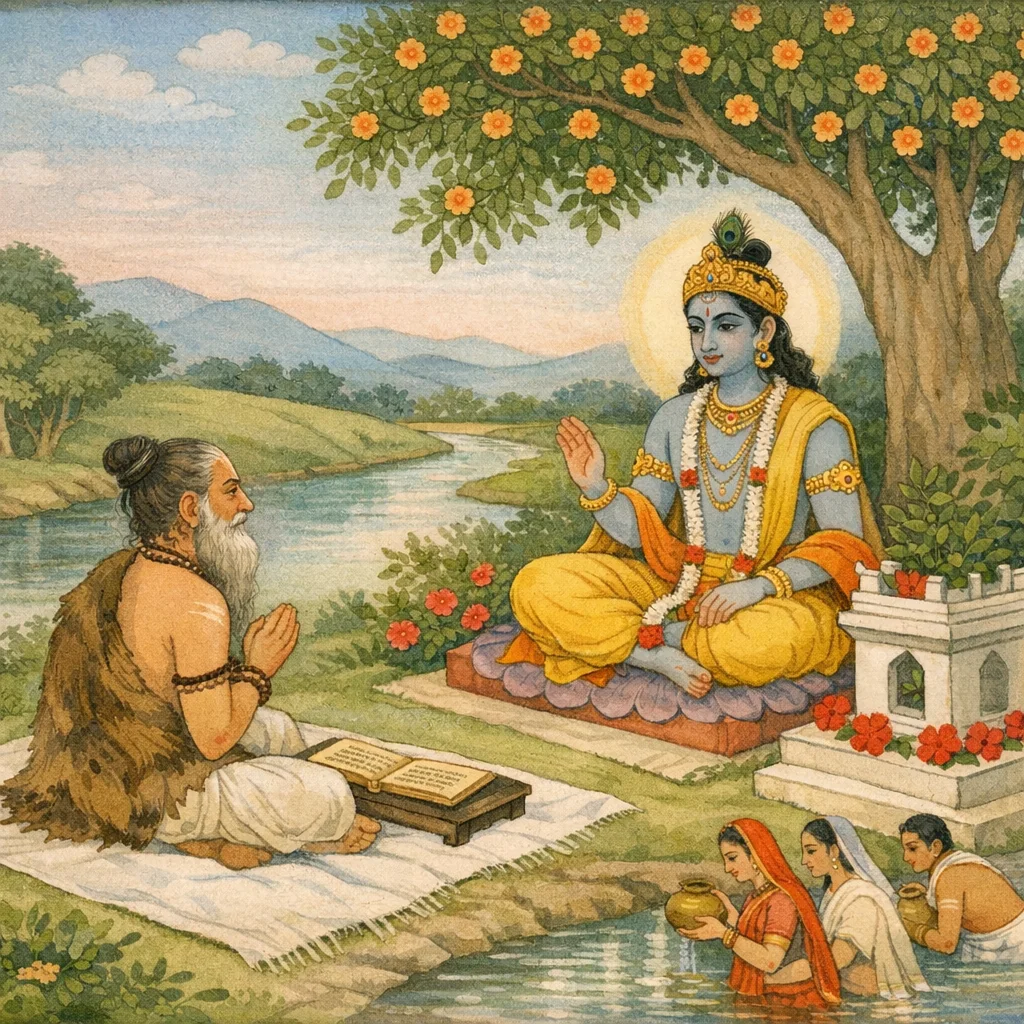
Adhyaya 78
Appeasement Rite of the Sun (Sunday Vrata, Mantra, and Healing Praise)
PP.1.78 teaches a Sūrya-śānti and a Sunday observance (vrata): offering arghya with red flowers, keeping a regulated diet (night-only meal; haviṣyānna), and noting heightened efficacy when Sunday coincides with Saptamī or Saṅkrānti. It lays out the ritual order—purification, maṇḍala placement, visualization of the two-armed Sun seated on a red lotus, offerings of unguents, incense, lamp, naivedya, and water, along with prescribed mudrās. The chapter then turns to doctrinal praise: the Sun as supreme, the twelve Ādityas by month, and a stotra declaring Sūrya as the Brahmā/Viṣṇu/Rudra principle. A root-mantra (oṃ hrāṃ hrīṃ saḥ …) and a Sūryāvarta-water healing rite are taught with rules of secrecy and eligibility, ending with a phalaśruti promising health, removal of sin, prosperity, heaven, and liberation.
Shlokas
Verse 1
वैशम्पायन उवाच । भगवंस्त्वत्प्रसादाच्च श्रुतं मे पावनं व्रतं । अपरं श्रोतुमिच्छामि ब्रध्नस्य च प्रियं च यत्
Vaiśampāyana said: “O Blessed one, by your grace I have heard the purifying vow. Now I wish to hear something further—namely, what is dear to Bradhna as well.”
Verse 2
व्यास उवाच । कैलासशिखरे रम्ये सुखासीनं महेश्वरं । प्रणम्य शिरसा भूमौ स्कंदो वचनमब्रवीत्
Vyāsa said: On the delightful summit of Kailāsa, Skanda, having bowed with his head to the ground before Mahēśvara who was seated at ease, spoke these words.
Verse 3
अर्काङ्गाख्यविधिस्त्वत्तो मयैवं विस्तराच्छ्रुतः । वारादेर्यत्फलं नाथ श्रोतुमिच्छामि तत्त्वतः
Thus have I heard from you in full the procedure called Arkāṅga. Now, O Lord, I wish to hear in truth the real fruit of the observance that begins with Vāra—the weekday rites—according to reality.
Verse 4
ईश्वर उवाच । रक्तपुष्पै रवेर्वारे त्वर्घ्यं दद्याद्व्रती नरः । नक्ताहारं हविष्यान्नं कृत्वा स्वर्गान्न हीयते
Īśvara said: On Sunday, the man under vow should offer arghya to the Sun with red flowers. Taking food only at night and eating havishyānna, he does not fall away from heaven.
Verse 5
सप्तम्याश्च सदाचारं सर्वमेवार्कवासरे । कुर्वतः प्रीतिमाप्नोति सगणः परमेश्वरः
When one observes all proper conduct on the seventh tithi—especially when it falls on Sunday—Parameśvara, together with his attendants, becomes pleased.
Verse 6
शूरस्य सदृशं याति तिथिवारस्य पालनात् । एकेन गाणपत्यस्य यावत्सूरो नभस्तले
By duly observing the tithi and the weekday, one attains a state comparable to that of a hero. By a single observance of the Gaṇapati rite, the merit endures for as long as the sun remains in the sky.
Verse 7
सर्वकामप्रदं पुण्यमैश्वर्यं रोगनाशनम् । स्वर्गदं मोक्षदं पुण्यं रवेर्वारे व्रतं हितम्
The vow observed on Sunday is auspicious and beneficial: it grants all desired aims, bestows prosperity, destroys disease, gives heaven, and even leads to mokṣa, liberation.
Verse 8
रविवारेण संक्रांत्या सप्तम्या तद्दिने शिवे । व्रतपूजादिकं चाप्यं सर्वं चाक्षयतां व्रजेत्
When Saṅkrānti (the Sun’s ingress) falls on a Sunday, and likewise when Saptamī (the seventh lunar day) occurs on that day sacred to Śiva, all observances—vows, worship, and the like—become inexhaustibly fruitful.
Verse 9
आदित्यवासरे शुभ्रे ग्रहाधिपप्रपूजनम् । प्राणादहतवक्त्रेण निःसार्य मंडले न्यसेत्
On the auspicious Sunday, one should duly worship the lord of the planets, the Sun. With the mouth purified by regulated breath, one should exhale and place (the mantra/energy) within the maṇḍala.
Verse 10
द्विभुजं रक्तपद्मस्थं सुगलं रक्तवाससं । सर्वरक्ताभरणं ध्यात्वा हस्ताभ्यां पुष्पं विधृतसंघ्रायैशान्यां क्षिपेत्
Meditating on the two-armed deity seated upon a red lotus—beautiful-limbed, clad in red garments, and adorned with wholly red ornaments—one should hold a flower in both hands, smell it as an offering, and then cast it toward the north-east (Īśāna) direction.
Verse 11
आदित्याय विद्महे भास्कराय धीमहि । तन्नो भानुः प्रचोदयात्
We seek to know Āditya; we meditate upon Bhāskara. May that Bhānu inspire and impel our understanding.
Verse 12
ततो गुरूपदिष्टेन विधिना च विलेपनम् । विलेपनांते सद्धूपं धूपांते च प्रदीपकम्
Then, following the method taught by the guru, one should apply the prescribed unguent. When the anointing is completed, one should offer fine incense; and when the incense offering is finished, one should present a lamp.
Verse 13
प्रदीपांते च नैवेद्यं ततो वारि निवेदयेत् । ततो जप्यं स्तुतिं मुद्रां नमस्कारं तु कारयेत्
At the close of the lamp-offering, one should present the naivedya (food-offering); then one should offer water. Thereafter, one should perform japa (recitation), a hymn of praise, the ritual mudrā, and then make obeisance.
Verse 14
अंजलि प्रथमा मुद्रा द्वितीया धेनुका स्मृता । एवं यः पूजयेदर्कं रविसायुज्यमाव्रजेत्
The first hand-gesture is known as Añjali, and the second is remembered as Dhenukā. One who worships Arka, the Sun, in this manner attains union with Ravi, the Sun.
Verse 15
मम ब्रह्मवधं घोरं कपालं करलग्नकम् । रवेस्तस्यप्रसादात्तु मुक्तं वाराणसीतटे
This dreadful skull—my mark of brahmin-slaying—was stuck fast to my hand; but by the grace of Ravi, the Sun, it was released on the bank of Vārāṇasī.
Verse 16
रवेः परतरं दैवं त्रैलोक्ये तु न विद्यते । यस्य प्रसादतो घोरान्मुक्तोहं गुरुकिल्बिषात्
In the three worlds there is no deity higher than Ravi, the Sun. By his grace I have been freed from the dreadful sin incurred against my guru.
Verse 17
स्कंद उवाच । श्रुत्वा त्वत्तो गिरं नाथ विस्मयो मेऽभवत्प्रभो । त्वदन्योस्ति न को देवः कथं ब्रह्मवधं त्वयि
Skanda said: “O Lord, having heard these words from you, O Master, I am filled with wonder, O Sovereign. There is no other god besides you—how, then, could the sin of brahmin-slaying be in you?”
Verse 18
त्वं च ज्ञानीश्वरो योगी लोके भोक्ताऽक्षरोऽव्ययः । देवानां गुरुरेकस्त्वं व्याप्तरूपी महेश्वरः
You are the Lord of wisdom and the yogin; in the world You are the experiencer—imperishable and undecaying. You alone are the teacher of the gods, O Maheśvara, whose form pervades all.
Verse 19
सर्वज्ञो वरदो नित्यं सर्वेषां प्राणिनां प्रभुः । दुष्कृतं ते कुतो नाथ तथा क्रोधो विशेषतः
You are all-knowing, ever the giver of boons, and the lord of all living beings. O Master, how could wrongdoing exist in You—especially anger?
Verse 20
शिव उवाच । लोकानां च हितार्थाय पृथग्भूता युगे युगे । सर्वं कुर्मो वयं पुत्र ब्रह्मविष्णुमहेश्वराः
Śiva said: For the welfare of the worlds, we become differentiated in every age. We—Brahmā, Viṣṇu, and Maheśvara—accomplish everything, my son.
Verse 21
नास्माकं बंधमोक्षौ च नाकार्यं कार्यमेव वा । तथा लोकस्य रक्षार्थं चरामो विधिपूर्वकम्
For us there is neither bondage nor liberation, neither what must not be done nor what must be done. Yet, for the protection of the world, we act in accordance with the ordained rule.
Verse 22
सर्वं च परमं चैव सर्वविघ्नविनाशनम् । सर्वरोगप्रशमनं सर्वार्थप्रतिसाधकम्
It is everything, and it is supreme as well; it destroys all obstacles, pacifies all diseases, and accomplishes every aim in full.
Verse 23
एकोसौ बहुधा भूत्वा कालभेदादनिंदितः । मासे मासे तु तपति एको द्वादशतां व्रजेत्
Though He is One, He becomes many through the divisions of time, O blameless one. Month after month that One burns and shines, and thus the One attains the state of twelve.
Verse 24
मित्रो मार्गशिरे मासि पौषे विष्णुः सनातनः । वरुणो माघमासे तु सूर्यो वै फाल्गुने तथा
In the month of Mārgaśīrṣa (Agrahāyaṇa) He is Mitra; in Pauṣa He is the eternal Viṣṇu; in Māgha He is Varuṇa; and likewise in Phālguna He is indeed Sūrya.
Verse 25
चैत्रे मासि तपेद्भानुर्वैशाखे तापनः स्मृतः । ज्येष्ठमासे तपेदिंद्र आषाढे तपते रविः
In the month of Caitra, Bhānu (the Sun) scorches; in Vaiśākha He is remembered as “Tāpana,” the Scorcher. In Jyeṣṭha, Indra burns with heat; and in Āṣāḍha, Ravi (the Sun) blazes.
Verse 26
गभस्तिः श्रावणे मासि यमो भाद्रपदे तथा । हिरण्यरेताश्वयुजि कार्तिके तु दिवाकरः
In the month of Śrāvaṇa, (the Sun is called) Gabhasti; in Bhādrapada, Yama; in Āśvayuja, Hiraṇyaretas; and in Kārtika, Divākara.
Verse 27
इत्येते द्वादशादित्या मासि मासि प्रकीर्तिताः । उरुरूपा महातेजा युगांतानलवर्चसः
Thus these twelve Ādityas are proclaimed month after month—vast in form, exceedingly radiant, blazing like the fire at the end of an age (yuga).
Verse 28
य इदं पठते नित्यं तस्य पापं न विद्यते । न रोगो न च दारिद्र्यं नावमानो भवेत्क्वचित्
Whoever recites this daily, no sin remains for him. Neither illness nor poverty arises, and at no time is he subject to dishonor.
Verse 29
अक्षयं लभते स्वर्गं सुखं राज्यं यशः क्रमात् । महामंत्रं प्रवक्ष्यामि सर्वप्रीतिकरं परम्
In due course one attains imperishable heaven, happiness, sovereignty, and fame. Now I shall proclaim the great mantra—supreme, and the source of delight for all.
Verse 30
ऊं नमः सहस्रबाहवे आदित्याय नमोनमः । नमस्ते पद्महस्ताय वरुणाय नमोनमः
Om—salutations to the thousand-armed One; salutations again and again to Āditya, the Sun. Salutations to You, the lotus-handed One; salutations again and again to Varuṇa.
Verse 31
नमस्तिमिरनाशाय श्रीसूर्याय नमोनमः । नमः सहस्रजिह्वाय भानवे च नमोनमः
Salutations again and again to the glorious Sun, the destroyer of darkness. Salutations again and again to Bhānu, the thousand-tongued Sun.
Verse 32
त्वं च ब्रह्मा त्वं च विष्णू रुद्रस्त्वं च नमोनमः । त्वमग्निः सर्वभूतेषु वायुस्त्वं च नमोनमः
You are Brahmā, and You are Viṣṇu; You are Rudra—salutations to You again and again. You are the fire within all beings, and You are the wind—salutations to You again and again.
Verse 33
सर्वगः सर्वभूतेषु नहि किंचित्त्वया विना । चराचरे जगत्यस्मिन्सर्वदेहे व्यवस्थितः
You are all-pervading, present in all beings; nothing exists without You. In this moving and unmoving universe, You abide established within every body.
Verse 34
इति जप्त्वा लभेत्कामं स्वर्गभोग्यादिकं क्रमात् । आदित्यो भास्करः सूर्यो अर्को भानुर्दिवाकरः
Thus, by reciting this, one gradually attains the desired aims—such as the enjoyments of heaven. He is called Āditya, Bhāskara, Sūrya, Arka, Bhānu, and Divākara.
Verse 35
सुवर्णरेता मित्रश्च पूषा त्वष्टा च ते दश । स्वयंभूस्तिमिराशश्च द्वादशः परिकीर्तितः
Suvarṇaretā, Mitra, Pūṣā, and Tvaṣṭṛ—these complete the ten; and Svayaṃbhū and Timirāśa are also mentioned—thus the twelve are declared.
Verse 36
नामान्येतानि सूर्यस्य शुचिर्यस्तु पठेन्नरः । सर्वपापाच्च रोगाच्च मुक्तो याति परां गतिम्
Whoever, being pure, recites these names of Sūrya is freed from all sins and diseases, and attains the supreme state.
Verse 37
पुनरन्यत्प्रवक्ष्यामि भास्करस्य महात्मनः । रक्ताख्याये रक्तनिभास्सिंदूरारुणविग्रहाः
Again I shall explain another account concerning the great-souled Bhāskara. In the episode called ‘Rakta’, they appear blood-red, embodied in a vermilion, ruddy form.
Verse 38
यानि नामानि मुख्यानि तच्छृणुष्व षडानन । तपनस्तापनश्चैव कर्त्ता हर्त्ता ग्रहेश्वरः
Hear, O Six-faced One, the foremost names: Tapana, Tāpana, and also Kartā (the Doer), Hartā (the Remover), and Graheśvara (Lord of the planets).
Verse 39
लोकसाक्षी त्रिलोकेषु व्योमाधिपो दिवाकरः । अग्निगर्भो महाविप्रः स्वर्गः सप्ताश्ववाहनः
He is the witness of the worlds in the three realms; the lord of the sky—the Sun. He is the womb of fire, the great sage-priest; he is heaven itself, and he rides a chariot drawn by seven horses.
Verse 40
पद्महस्तस्तमोभेदी ऋग्वेदो यजुस्सामगः । कालप्रियं पुंडरीकं मूलस्थानं च भावितम्
With lotus in hand, dispelling darkness—embodying the Ṛg, Yajus, and Sāma Vedas—he is dear to Time; the white lotus and the primordial seat as well are contemplated as his abiding source.
Verse 41
यः स्मरेच्च सदा भक्त्या तस्य रोगभयं कुतः । शृणु कार्तिक यत्नेन सर्वपापहरं शुभम्
For one who constantly remembers the Lord with devotion, how could there be any fear of disease? O Kārtika, listen carefully to this auspicious teaching that removes all sins.
Verse 42
न संदेहो मनाक्कार्य आदित्यस्य महामते । ऊं इंद्राय नमः ऊं विष्णवे नमः
O wise one, there is no doubt at all about what should be done regarding Āditya, the Sun. (Recite:) “Oṁ, obeisance to Indra; Oṁ, obeisance to Viṣṇu.”
Verse 43
एष जप्यश्च होमश्च संध्योपासनमेव च । सर्वशांतिकरश्चैव सर्वविघ्नविनाशनः
This is indeed fit for japa and for homa, and also for the worship of Sandhyā; it brings perfect peace and destroys all obstacles.
Verse 44
नाशयेत्सर्वरोगांश्च लूताविस्फोटकादिकान् । कामलादिकरोगांश्च ये रोगाश्चैव दारुणाः
It destroys all diseases—such as skin ailments like ringworm and eruptive boils—and also maladies like jaundice, as well as whatever other terrible diseases there may be.
Verse 45
एकाहिकं त्र्यहिकं च ज्वरं चातुर्थिकं तथा । कुष्ठं रोगं क्षयं रोगं कुक्षिरोगं ज्वरं तथा
Also it wards off one-day fever, three-day fever, and quartan fever; as well as leprosy, consumption (wasting disease), abdominal ailments, and fevers.
Verse 46
अश्मरीमूत्रंकृच्छ्रांश्च नानारोगामयांस्तथा । ये वातप्रभवा रोगा ये रोगा गर्भसंभवाः
It removes urinary stones and painful disorders of urination, and likewise many varieties of diseases and ailments—those that arise from disordered vāta, and those that originate from the womb (congenital conditions).
Verse 47
मर्दयन्तो महारोगा मर्दिता वेदनात्मकाः । विलयं यांति ते सर्व आदित्योच्चारणेन तु
Even the great diseases that crush beings—painful by their very nature—are themselves crushed; all of them perish through the utterance of Āditya’s name.
Verse 48
रक्ष मां देवदेवेश ग्रहरोगभयेषु च । प्रशमं यांति ते सर्वे कीर्तिते तु दिवाकरे
Protect me, O Lord of the gods, amid fears born of planets and diseases as well; for when Divākara, the Sun, is praised, all such fears and afflictions subside into peace.
Verse 49
मूलमंत्रं प्रवक्ष्यामि सर्वकामार्थसाधकम् । भुक्तिमुक्तिप्रदं नित्यं भास्करस्य महात्मनः
I shall declare the root-mantra of the great-souled Bhāskara, the Sun, which accomplishes all desired aims—ever bestowing both worldly enjoyment and liberation.
Verse 50
मंत्रश्चायं ॐ ह्रां ह्रीं सः सूर्याय नमः । अनेन मंत्रेण सदा सर्वसिद्धिर्भवेद्ध्रुवं
And this is the mantra: “Oṃ hrāṃ hrīṃ saḥ—obeisance to Sūrya.” By this mantra, indeed, constant attainment of all perfections surely arises.
Verse 51
व्याधयो वै न बाधंते न चानिष्टं भयं भवेत् । सूर्यावर्तोदकं यस्तु गृहीत्वा तु क्रमेण तु
Diseases do not afflict him, nor does any inauspicious fear arise, for the one who takes the water known as Sūryāvarta, duly and in the prescribed sequence.
Verse 52
तस्य प्राशनमात्रेण नरो रोगात्प्रमुच्यते । न दातव्यं न ख्यातव्यं जप्तव्यं च प्रयत्नतः
By merely consuming it, a person is freed from disease. It should not be given to others, not publicized, and its japa should be performed with careful effort and restraint.
Verse 53
अभक्तेष्वनपत्येषु पाषण्डलौकिकेषु च । कटुतैलसमायुक्तं नस्ये पाने च दापयेत्
To those devoid of devotion, to the childless, and to heretics and worldly-minded people, one should administer pungent oil—both as a nasal treatment (nasya) and as a drink.
Verse 54
सूर्यावर्तजलं पुत्र सर्वरोगाद्विमुच्यते । मूलमंत्रस्तु जप्तव्यः संध्यायां होमकर्मसु
O son, water sanctified by the Sun’s circling rite frees one from all diseases. And the root mantra should indeed be recited at the twilight prayers (sandhyā) and during acts of fire-offering (homa).
Verse 55
जप्यमाने तु नश्यंति रोगाः क्रूरग्रहास्तथा । किमन्यैर्बहुभिः शास्त्रैर्मंत्रैर्वा बहुविस्तरैः
When it is recited as japa, diseases—and even the cruel afflictions of the grahas—are destroyed. What need is there for many other scriptures, or for mantras elaborated at great length?
Verse 56
सर्वशांतिरियं वत्स सर्वार्थप्रतिसाधिका । नास्तिकाय न दातव्या देवब्राह्मणनिंदके
“This, dear child, is the source of all peace and the accomplisher of every aim. It should not be given to an atheist—nor to one who reviles the devas and the brāhmaṇas.”
Verse 57
गुरुभक्ताय दातव्या नान्येभ्योपि कदाचन । प्रातरुत्थाय यो नित्यं कीर्तयिष्यति मानवः
It should be given to one devoted to the Guru—never to others. The person who rises early and recites it daily, O mortal…
Verse 58
गोघ्नः कृतघ्नकश्चैव मुच्यते सर्वपातकैः । शरीरारोग्यकृच्चैव धनवृद्धियशस्करः
Even a slayer of a cow, and even an ungrateful person, is freed from all sins; it also grants bodily health, increases wealth, and bestows fame and honor.
Verse 59
जायते नात्र संदेहो यस्य तुष्येद्दिवाकरः । एककालं द्विकालं वा त्रिकालं नित्यमेव च
There is no doubt: for the one with whom the Sun is pleased—whether once a day, twice, thrice, or continually—spiritual merit and auspicious results surely arise.
Verse 60
यः पठेद्रविसान्निध्ये सोऽभीष्टं फलमाप्नुयात् । पुत्रार्थी लभते पुत्रं कन्यार्थी कन्यकां लभेत्
Whoever recites this in the presence of the Sun attains the desired fruit. One who seeks a son obtains a son; one who seeks a daughter obtains a daughter.
Verse 61
विद्यार्थी लभते विद्यां धनार्थी लभते धनं । शृणुयात्संयुतो भक्त्या शुद्धाचारसमन्वितः
The seeker of learning attains learning; the seeker of wealth attains wealth. One should listen with devotion, self-discipline, and pure conduct.
Verse 62
सर्वपापविनिर्मुक्तस्सूर्यलोकं व्रजत्यपि । भास्करस्य व्रते यच्च व्रताचारमखेषु च
Freed from all sins, one indeed attains the world of the Sun. This is the fruit of observing Bhāskara’s vow, and likewise of disciplined vow-practice in all sacred rites.
Verse 63
पुण्यस्थानेषु तीर्थेषु पठेत्कोटिगुणं भवेत् । ग्रहे भोज्येषु पूजायां ब्रह्मभोज्ये द्विजाग्रतः
If one recites this in holy places and at sacred tīrthas of pilgrimage, the merit becomes a millionfold. Likewise, at home—during offerings of food, during worship, and especially at the rite of feeding brāhmaṇas—in the presence of foremost twice-born, it yields great fruit.
Verse 64
य इदं पठते विप्रस्तस्यानंतफलं भवेत् । तपस्विनां च विप्राणां देवानामग्रतः सुधीः
O brāhmaṇa, the brāhmaṇa who recites this attains endless merit. The wise recite it in the presence of ascetic brāhmaṇas and before the gods.
Verse 65
यः पठेत्पाठयेद्वापि सुरलोके महीयते
Whoever recites it—or even causes it to be recited—is honored in the world of the gods, in Svarga.
Verse 78
इति श्रीपाद्मपुराणे प्रथमे सृष्टिखंडे सूर्यशांतिर्नामाष्टसप्ततितमोऽध्यायः
Thus, in the revered Padma Purāṇa, in the First Book, the Sṛṣṭikhaṇḍa, concludes the seventy-eighth chapter named “Sūrya-śānti,” the rite of appeasing the Sun.